Tag: ambulances

  • Revealed: England’s June 2026 heatwave sparked record demand for ambulances

    Spread the love

    Article by Josh Gabbatiss republished from Carbon Brief under a CC license.
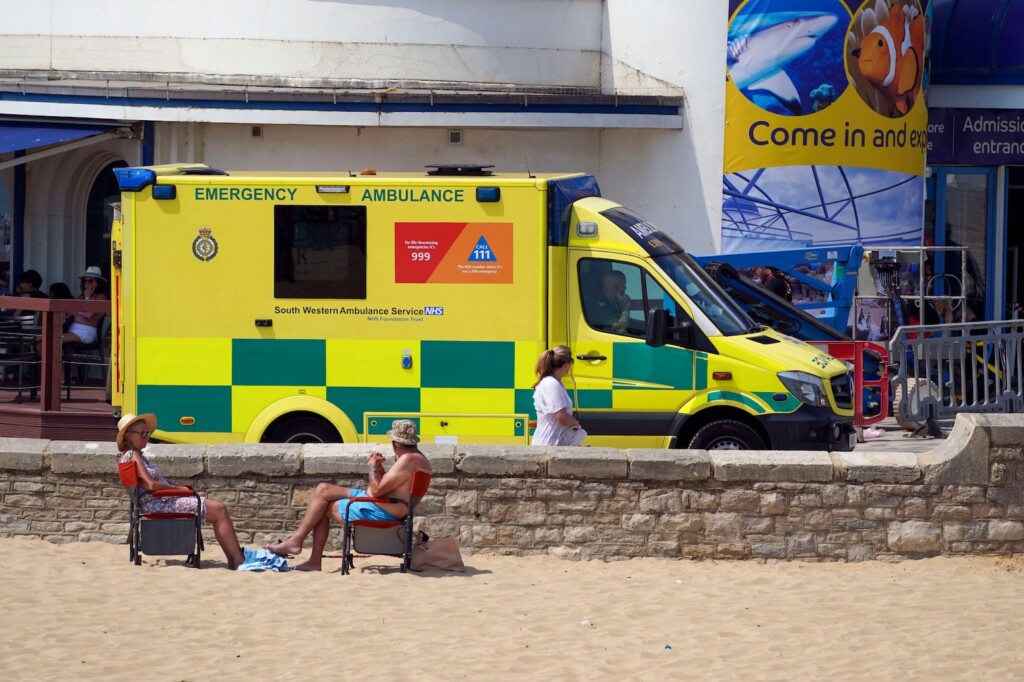
    Ambulance in the promenade in Bournemouth, UK. Credit: PA Images / Alamy Stock Photo

    All the ambulance services in England experienced some of their busiest-ever days during this summer’s record-breaking June heatwave, according to data obtained by Carbon Brief.

    In June, temperatures climbed past 37C in parts of the country as authorities declared only the second ever “red” extreme heat warning.

    Four out of 10 NHS ambulance services, including London’s, responded to unprecedented numbers of life-threatening emergencies on at least one day from 23-27 June.

    Another two services – in the south-west and east of the country – received their highest volume of 999 calls on record.

    Ambulance services provided data on their busiest days since records began, in response to freedom-of-information (FOI) requests from Carbon Brief.

    The results show how demand during the June heatwave exceeded levels seen during the traditionally busy winter season in other years – and even the height of the Covid-19 pandemic – for many services.

    Heat demand

    Extreme heat ramps up the risk of numerous life-threatening conditions, including heart disease and respiratory problems. 

    England experienced record-breaking temperatures at the end of June, with the whole country covered by amber or red “heat health alerts” from the government.

    A red alert, which was issued for the entire Midlands and south of England, indicates “significant risk to life for even the healthy population”. This was only the second time such an alert has been triggered.

    Researchers calculated that there were nearly 3,000 heat-related deaths in the UK this summer. There has also been unprecedented demand for A&E departments and some ambulance services.

    To investigate the strain facing ambulances, Carbon Brief sent FOI requests to the 10 NHS ambulance trusts in England, asking for lists of their busiest days. 

    This covered both the total volume of 999 calls and “category 1” responses – referring to incidents involving “life-threatening injuries and illnesses”, such as heart attacks.

    The chart below shows the busiest days on record for England’s ambulances, including both total calls and category 1 responses. Most services were able to provide records back to the 2010s. (See: Methodology.)

    The five-day period from 23-27 June is overrepresented in these results, with at least two heatwave days ranking in the top 20 for every service in the country.
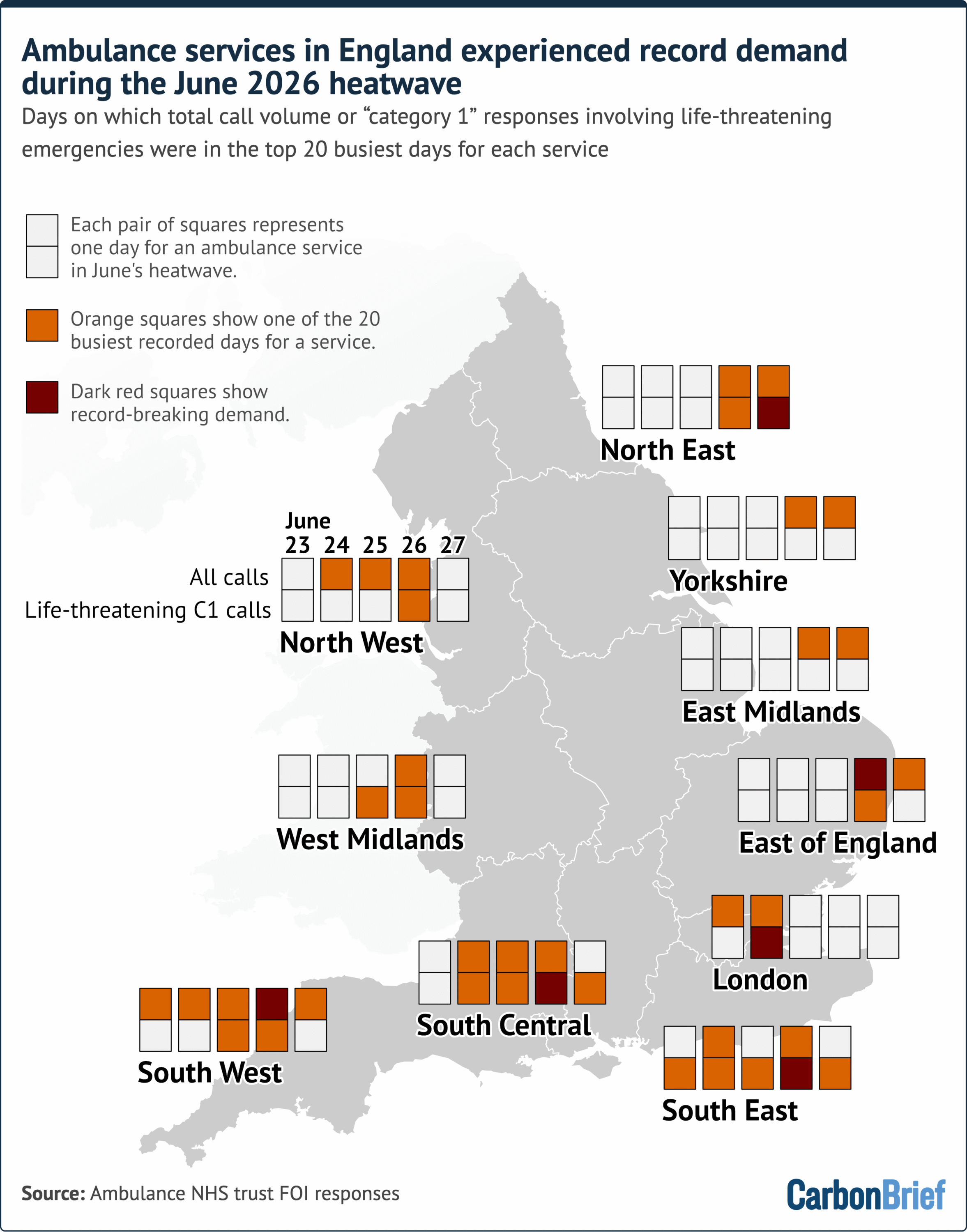
    Ambulance services in England experienced record demand during the June heatwave. Days on which total call volume or “category 1” responses involving life-threatening emergencies were in the top 20 busiest days for each service. A map shows high demand across regions from June 23-27. Source: Ambulance NHS trust FOI responses. (Alt text generated by Google Gemini)
    The top 20 rankings for services across England cover different periods of time. See Methodology for more details.

    This trend is especially pronounced in the south and east of England, where June temperatures exceeded 36C and even approached 38C in some regions.

    London, South East Coast, South Central and North East ambulance services all reported daily records for responding to life-threatening emergencies during the heatwave.

    For the South East Coast and South Central services – which cover a region stretching from Oxfordshire to Kent – 25, 26 and 27 June all saw unprecedented numbers of category 1 callouts. 

    South Western and East of England services both saw record numbers of 999 calls on 26 June, the same day the highest-ever June UK temperature was reported in Norfolk.

    It is worth noting that demand for ambulance services – including category 1 calls – has been growing for many years, driven by factors such as an ageing population, more complex health conditions and growing mental-health pressures.

    This helps to explain why dates from before the 2020s are rare in the top rankings provided to Carbon Brief.

    Beyond the heatwave, 2026 as a whole is on track to be a record year for ambulance demand.

    ‘Stifling heat’

    On 26 June, the busiest day of the heatwave, ambulances across England responded to 4,084 life-threatening emergencies.

    The average daily volume of such incidents is normally around 2,500 during the summer months.

    Stu Holliday, head of emergency preparedness, resilience and response at North East Ambulance Service, tells Carbon Brief: 

    “During periods of hot weather, we typically see an increase in calls from people affected by dehydration, heat exhaustion and heatstroke, as well as those whose existing health conditions, particularly heart and respiratory illnesses, can be made worse by prolonged high temperatures.

    “Older people, young children and pregnant people can be especially vulnerable.”

    Ambulance teams are generally busier in the winter because cold weather and seasonal illnesses drive up the number of severe medical emergencies.

    However, the data from June shows that extremely hot days are starting to match or even edge out cold ones as the busiest days. This is a trend seen across the healthcare system.

    While not every service provided records back to 2019, the data broadly shows that ambulances were busier during the heatwave than at the height of the Covid-19 pandemic.

    As well as patients, heatwaves put pressure on ambulance workers. The UNISON union has warned of crews facing “stifling heat with faulty or no air conditioning” and “back-to-back callouts” due to increased demand.

    Methodology

    Carbon Brief requested data on the top 50 busiest days for England’s 10 main ambulance services.

    These are: London; South East Coast; South Central; South Western; West Midlands; East Midlands; East of England; North East; Yorkshire; and North West.

    Data was requested for as far back as service records go. Most were able to provide records going back to some point in the 2010s, with the exception of North East and South Central, which only had records from 2021 and 2022 onwards, respectively. 

    Rising annual demand for ambulance services means that most of the busiest days for ambulances have been in the 2020s. For example, all but four of the busiest days for category 1 emergencies reported to Carbon Brief were in the 2020s. 

    Carbon Brief requested data on ambulance demand for all the UK nations. In Scotland and Northern Ireland – where temperatures are cooler – services did not see call volumes reach the top 50 rankings during the June heatwave. The Welsh Ambulance Service did not respond to Carbon Brief’s request.

    Article by Josh Gabbatiss republished from Carbon Brief under a CC license.

    Nigel Farage urges you to ignore facts and reality and be a climate science denier like him and his Deputy Richard Tice. He says that Reform UK has received £Millions and £Millions from the fossil fuel industry to promote climate denial and destroy the planet.
    Nigel Farage urges you to ignore facts and reality and be a climate science denier like him and his Deputy Richard Tice. He says that Reform UK has received £Millions and £Millions from the fossil fuel industry to promote climate denial and destroy the planet.
    Power-mad orange gasbag Donald Trump says Burn, Baby, Burn.
    Power-mad orange gasbag Donald Trump says Burn, Baby, Burn.
    Elon Musk urges you to be a Fascist like him, says that you can ignore facts and reality then.
    Elon Musk urges you to be a Fascist like him, says that you can ignore facts and reality then.
  • England’s NHS crews ‘watching patients die in back of ambulances’ due to A&E delays

    Spread the love

    https://www.theguardian.com/society/2025/apr/06/englands-nhs-crews-watching-patients-die-in-back-of-ambulances-due-to-ae-delays

    The gridlock of patients in some of England’s hospitals has led to queues of up to 20 ambulances outside A&Es. Photograph: Andy Hall/The Observer

    Paramedics across England are watching patients die in the back of ambulances because of delays outside emergency departments, according to a survey by Unison.

    The gridlock of patients in some of the country’s hospitals has led to queues of up to 20 ambulances outside casualty departments in certain areas. In a number of cases, crews have been forced to wait more than 12 hours before handing over patients.

    The survey of nearly 600 ambulance workers reveals the toll of the waits on patients and the crews looking after them. Unison warns that “car park care” is increasingly becoming the norm, with hospital medical staff tending to patients in the back of ambulances.

    More than three-quarters (77%) of paramedics and emergency medical technicians said they have had to look after people in the back of ambulances in the past year while stuck outside emergency departments. Two-thirds (68%) have waited in hospital corridors, or in other locations, with one paramedic often caring for several patients to allow colleagues to respond to other calls.

    More than two-thirds also reported patients’ health deteriorating during long waits, and one in 20 (5%) said people have died in their care because of long delays in being admitted.

    …

    Article continues at https://www.theguardian.com/society/2025/apr/06/englands-nhs-crews-watching-patients-die-in-back-of-ambulances-due-to-ae-delays

  • Israel turns Gaza’s Eid into tragedy with new massacres

    Spread the love

    Original article by Aseel Saleh republished from peoples dispatch under a Creative Commons Attribution-ShareAlike 4.0 (CC BY-SA) license.

    PRCS workers bidding farewell to the 8 PRCS workers who were targeted and killed by Israel. Photo: PRCS

    The mass killings tainted the supposedly joyful occasion in Gaza with blood, and replaced celebrations with funerals.

    Over 60 Palestinians were killed in multiple Israeli airstrikes that rocked different parts of the Gaza strip, on Sunday, March 30, which also marked the first day of Eid Al-Fitr holiday.

    The Israeli Occupation Forces (IOF) intensified their aerial attacks on the besieged enclave in the early hours of Sunday and throughout the day. However, hundreds of thousands of people in Gaza gathered to perform Eid prayers atop the rubble of demolished mosques, in a clear message to the world that their will to survive is greater than Israel’s destruction.

    Israel deliberately targeted rescue teams in Rafah

    The first day of Eid saw another incident of tragedy for the people of Gaza, after the Palestinian Red Crescent Society (PRCS) announced that it retrieved the bodies of 14 aid workers in Rafah, southern Gaza. The 14 included eight PRCS medics, five staff members of the Palestinian Civil Defense agency, and an employee working with a UN agency.

    The recovery of the bodies was announced six days after the PRCS had lost contact with the rescue teams. The release of satellite images exclusively obtained by Al Jazeera demonstrated that the IOF destroyed at least five rescue vehicles belonging to the PRCS and the Civil Defense, who were on a humanitarian mission in Tel al-Sultan neighborhood in Rafah. The IOF did so after they targeted the teams of both organizations, which included 15 volunteers.

    Mourning its executed staff, the PRCS said in a statement that “they were targeted by the Israeli occupation forces while performing their humanitarian duties as they were heading to the Hashashin area of ​​Rafah to provide first aid to a number of people injured by Israeli shelling in the area.” The organization added that a ninth medic remains missing.

    The PRCS called the massacre a “tragedy” not only for the organization “but also for humanitarian work and humanity.” Emphasizing that the incident was a deliberate execution the PRCS said that the rescue teams were targeted by the IOF “despite the protected status of their mission and the Red Crescent emblem.”

    It also pointed out that the incident “can only be considered a war crime punishable under international humanitarian law, which the occupation continues to violate before the eyes of the entire world.”

    Meanwhile, the International Federation of Red Cross and Red Crescent Societies (IFRC) expressed its outrage at the deaths of eight medics from the PRCS.

    The IFRC stressed that when the medics were killed, their ambulance vehicle was “clearly marked” and they were wearing emblems that “should have protected them.”

    “I am heartbroken. These dedicated ambulance workers were responding to wounded people. They were humanitarians. They wore emblems that should have protected them; their ambulances were clearly marked. They should have returned to their families; they did not.” IFRC Secretary General Jagan Chapagain stated.

    “Even in the most complex conflict zones, there are rules. These rules of International Humanitarian Law could not be clearer – civilians must be protected; humanitarians must be protected. Health services must be protected.” He added.

    Original article by Aseel Saleh republished from peoples dispatch under a Creative Commons Attribution-ShareAlike 4.0 (CC BY-SA) license.

    Experiencing issues with this image not appearing. I suspect because it's so critical of Zionist Keir Starmer's support of and complicity in Israel's genocides.
    Genocide denier and Current UK Prime Minister Keir Starmer is quoted that he supports Zionism without qualification. He also confirms that UK air force support has been essential in Israel’s mass-murdering genocide. Includes URLs https://www.declassifieduk.org/keir-starmers-100-spy-flights-over-gaza-in-support-of-israel/ and https://youtu.be/O74hZCKKdpA
    UK Labour Party Shadow Foreign Secretary repeatedly heckled at a speech to the Fabian Society over his and the Labour Party's support for and complicity in Israel's genocide of Gaza.
    UK Labour Party Shadow Foreign Secretary repeatedly heckled at a speech to the Fabian Society over his and the Labour Party’s support for and complicity in Israel’s genocide of Gaza.
  • ‘Crime Against Humanity’: UN Inquiry Details Israeli ‘Extermination’ of Gaza Healthcare

    Spread the love

    Original article by Brett Wilkins republished from Common Dreams under Creative Commons (CC BY-NC-ND 3.0). 

    Palestinian paramedic Maha Wafi, 43, walks past destroyed ambulances destroyed by Israeli attacks in Khan Yunis in the southern Gaza Strip on September 15, 2024. (Photo: Bashar Taleb/AFP via Getty Images)

    “Israel must immediately stop its unprecedented wanton destruction of healthcare facilities in Gaza,” the head of the inquiry stressed.

    For the second time this year, a United Nations commission tasked with investigating Israel’s conduct during its yearlong invasion and blockade of Gaza has found that the U.S.-armed Israeli military is committing crimes against humanity against Palestinians.

    The Independent International Commission of Inquiry on the Occupied Palestinian Territory released a report Thursday detailing how “Israel has perpetrated a concerted policy to destroy Gaza’s healthcare system as part of a broader assault on Gaza, committing war crimes and the crime against humanity of extermination with relentless and deliberate attacks on medical personnel and facilities.”

    “The commission also investigated the treatment of Palestinian detainees in Israel and of Israeli and foreign hostages in Gaza since October 7, 2023 and concluded that Israel and Palestinian armed groups are responsible for torture and sexual and gender-based violence,” the Office of the U.N. High Commissioner for Human Rights (OHCHR) said in a summary of the report.

    The report cites the U.N. World Health Organization’s findings that Israel carried out 498 attacks on healthcare facilities in the Gaza Strip between October 7, 2023—when Hamas launched the deadliest-ever attack on Israel—and July 30, 2024.

    “A total of 747 persons were killed directly in those attacks, and 969 others were injured, and 110 facilities were affected,” the publication states. The report calls the attacks “widespread and systematic.”

    The commission continued:

    Israeli security forces carried out air strikes against hospitals, causing considerable damage to buildings and surroundings, as well as multiple casualties; surrounded and besieged hospital premises; prevented the entry of goods and medical equipment and exit/entry of civilians; issued evacuation orders but prevented safe evacuations; and raided hospitals, arresting hospital staff and patients. Israeli security forces also obstructed access by humanitarian agencies.

    “Israel must immediately stop its unprecedented wanton destruction of healthcare facilities in Gaza,” said commission chair Navi Pillay. “By targeting healthcare facilities, Israel is targeting the right to health itself with significant long-term detrimental effects on the civilian population. Children in particular have borne the brunt of these attacks, suffering both directly and indirectly from the collapse of the health system.”

    OHCHR said that “attacks on medical facilities in Gaza, particularly those devoted to pediatric and neonatal care, have led to incalculable suffering of child patients, including newborns.”

    “In continuing these attacks, Israel has violated children’s right to life, denied children access to basic healthcare, and deliberately inflicted conditions of life resulting in the destruction of generations of Palestinian children and, potentially, the Palestinian people as a group,” the agency added.

    The commission’s inquiry found that as of July 15, “113 ambulances had been attacked and at least 61 had been damaged,” including vehicles used by the U.N., International Committee of the Red Cross (ICRC), the Palestine Red Crescent Society (PRCS), and other organizations.

    “Access was also reduced owing to closure of areas by Israeli security forces, [and] delays in coordination of safe routes, checkpoints, searches, or destruction of roads,” the report notes.

    The commission investigated the January 29 attack that killed 6-year-old Hind Rajab and six of her relatives, as well as two paramedics who had Israeli permission to attempt to rescue them.

    “They were attacked while trying to evacuate in their car,” the report said of the family. “The ambulance, carrying two paramedics, Yousef Zeino and Ahmed al-Madhoun, was dispatched after its route had been coordinated with Israeli security forces. It was hit by a tank shell at a distance of some 50 meters from the family’s car.”

    “Hind was still alive at the time that the ambulance was dispatched,” the publication noted. “The presence of Israeli security forces in the area prevented access. As a result, the family members’ bodies could not be retrieved from their bullet-ridden car until 12 days after the incident.”

    Israel Defense Forces officials have repeatedly claimed that no IDF troops were in the area at the time of the attack. Multiple journalistic investigations, including one published Tuesday by Sky News, showed that Israeli tank and machine gun fire killed the family and paramedics.

    The new report’s authors also noted that “hundreds of medical personnel, including three hospital directors and the head of an orthopedic department, as well as patients and journalists were arrested by Israeli security forces” during raids on Gaza medical facilities.

    “Reportedly, 128 health workers remain detained by Israeli authorities as of July 15, including four PRCS staff members,” the publication states.

    “The institutionalized mistreatment of Palestinian detainees, a longstanding characteristic of the occupation, took place under direct orders from the Israeli minister in charge of the prison system, Itamar Ben-Gvir, and was fueled by Israeli government statements inciting violence and retribution,” said OHCHR.

    The commission report also detailed crimes committed by Hamas and other Palestinian armed groups against Israelis on and after October 7, 2023, when more than 1,100 Israelis and others were killed—at least some by so-called “friendly fire” and under the fratricidal Hannibal Directive—and over 240 people abducted.

    Hostages “were mistreated to inflict physical pain and severe mental suffering, including physical violence, abuse, sexual violence, forced isolation, limited access to hygiene facilities, water and food, threats and humiliation,” OHCHR said. “Hamas and other Palestinian armed groups committed the war crimes of torture, inhuman or cruel treatment, and the crimes against humanity of enforced disappearance and other inhumane acts causing great suffering or serious injury.”

    In June, the same U.N. commission found Israel’s far-right government responsible for a range of war crimes and crimes against humanity in the Gaza Strip, including “extermination, torture, forcible transfer, and the use of starvation as a weapon of warfare.”

    Over the course of its 370-day assault on Gaza, Israeli forces have killed at least 42,010 Palestinians in the coastal enclave—most of them women and children—and wounded more than 97,700 others, according to the Gaza Ministry of Health and international agencies.

    At least 10,000 Palestinians are missing and believed to be dead and buried beneath the rubble of hundreds of thousands of bombed buildings. Israel’s “complete siege” of Gaza has forcibly displaced more than 90% of Gaza’s 2.3 million people, and has contributed to the starvation and sickening of hundreds of thousands of Gazans.

    Israel is on trial for genocide at the U.N. International Court of Justice. Meanwhile, International Criminal Court Prosecutor Karim Khan is seeking arrest warrants for Israeli Prime Minister Benjamin Netanyahu, Israeli Defense Minister Yoav Gallant, and three Hamas leaders—at least one of whom, political chief Ismail Haniyeh, has been assassinated—for alleged war crimes and crimes against humanity, including extermination.

    Original article by Brett Wilkins republished from Common Dreams under Creative Commons (CC BY-NC-ND 3.0). 

  • Israel Killed 28 Lebanese Medical Workers in 24 Hours, 73 Since War’s Start: WHO

    Spread the love

    Original article by Brett Wilkins republished from Common Dreams under Creative Commons (CC BY-NC-ND 3.0). 

    A broken stethoscope and surgical glove are seen after Israeli warplanes bombed a building in the Bachoura area of Beirut, Lebanon on October 3, 2024. (Photo: Murat Sengul/Anadolu via Getty Images)

    “I’m afraid first about my safety and about my family’s safety because there’s no safe place in Lebanon now,” said one physician.

    The head of the United Nations World Health Organization said Thursday that Israeli forces killed 28 healthcare workers in Lebanon over the previous 24 hours, and that 73 medical personnel are among the nearly 2,000 Lebanese killed during Israel’s bombing and invasion of its northern neighbor.

    “In southern Lebanon, 37 health facilities have been closed, while in Beirut, three hospitals have been forced to fully evacuate staff and patients, and another two were partially evacuated,” WHO Director-General Tedros Adhanom Ghebreyesus said during a press conference in Geneva. “And yet healthcare continues to come under attack. In Lebanon alone, 28 health workers have been killed in the last 24 hours.”

    Tedros said the WHO “calls on urgent facilitation of flights to deliver health supplies to Lebanon,” adding, “Lives depend on it!”

    Lebanese Health Minister Firas Al-Abiad said separately Thursday that more than 40 paramedics and firefighters have been killed by Israeli forces over the previous three days.

    Dr. Abdinasir Abubakar, the acting WHO representative in Lebanon, said that “most of those healthcare workers killed in the last 24 hours, most of them—actually, all of them—were on duty.”

    “Some of them were in the ambulances, some of them were in the health facilities,” Abubakar added. “They were on duty trying to help civilians who have been wounded in the conflict.”

    Dr. Fathalla Fattouh, the head cardiovascular and thoracic surgeon at Rafik Hariri University Hospital (RHUH) in Jnah, just outside Beirut, described the chaos he witnessed firsthand, including “a surge of nearly identical injuries—amputations, eye trauma, and shattered hip and femur bones—straining the hospital’s capacity to a near-breaking point.”

    “We were forced to make difficult decisions,” he added. “I believe that we did our best relying on available capacities, but with the escalation of events we need to plan for the worst.”

    Sara, a surgeon at the hospital, said that “there are only two hospitals in Lebanon prepared to treat burn patients, and once they were at capacity, we were left with nowhere to send the patients we received.”

    “It was a feeling of helplessness that we had never experienced before,” she added.

    Some doctors admitted fearing for their lives.

    “It’s hard to work in fear,” Dr. Mohammad Taoube, who heads the emergency room at an undisclosed hospital in southern Lebanon, told Sky News on Wednesday. “I’m afraid first about my safety and about my family’s safety because there’s no safe place in Lebanon now.”

    According to figures provided by the WHO Regional Office for the Eastern Mediterranean, Israeli forces have killed 1,974 people in Lebanon—including at least 127 children—while wounding 9,384 others in recent weeks.

    At least one American has been killed by Israeli bombing of Lebanon this week. Hajj Kamel Ahmad Jawad, 56, of Dearborn, Michigan was killed Tuesday while in Nabatieth in southern Lebanon caring for his sick mother and volunteering to help elderly, disabled, and injured patients at a local hospital.

    The Nabatieth area has come under heavy Israeli bombardment. Local journalists said the city’s main hospital “came under direct Israeli fire” on Friday and that two nurses were killed.

    Lebanese officials said Friday that more than 1.2 million people have been forcibly displaced amid Israel’s recent bombing and invasion of their country. The Israeli campaign comes amid attacks by the political and paramilitary group Hezbollah, whose rockets and other projectiles have killed or wounded scores of Israelis and forced tens of thousands from their homes.

    Residents of southern Lebanon described the terror of coming under Israeli bombardment and having to flee for their lives. One woman, Fatima, and her 14-year-old daughter Zeinab said they were in their home preparing for a school exam when the shelling started.

    “My mother told us to pack our things quickly, and we left in a rush,” Zeinab told the U.N. Children’s Fund on Thursday. “My siblings were crying. The journey was terrifying.”

    “The shelling was all around us, and the sound of explosions echoed everywhere,” she said while crying. “We miss home dearly and yearn to return.”

    Tedros noted that since last October, when Hezbollah began launching rockets at Israel in solidarity with Gaza after Hamas-led militants attacked Israel, over 1 million Lebanese have been displaced, with many seeking refuge in neighboring Syria.

    He also said that “since the 7th of October last year, more than 1,500 people have been killed in Israel, almost 42,000 in Gaza, and more than 700 in the West Bank.”

    “In addition,” Tedros added, “more than 10,000 people are missing in Gaza, and 1.9 million people are displaced, while 101 hostages taken from Israel remain in Gaza.”

    Hundreds of Palestinians working in the health sector have been killed in Gaza by Israeli forces, who have deliberately targeted medical workers. Israeli troops have also allegedly tortured doctors and other medical workers after kidnapping them from the coastal enclave.

    Tedros on Thursday stressed the need for “deescalation of the conflict; for healthcare to be protected and not attacked; for access routes to be secured and supplies delivered; and for a cease-fire, a political solution, and peace.”

    “The best medicine,” he said, “is peace.”

    Original article by Brett Wilkins republished from Common Dreams under Creative Commons (CC BY-NC-ND 3.0).