Remember the Palestinian doctors killed by Israel

Spread the love

Original article by Vijay Prashad republished from peoples dispatch under a Creative Commons Attribution-ShareAlike 4.0 (CC BY-SA) license.

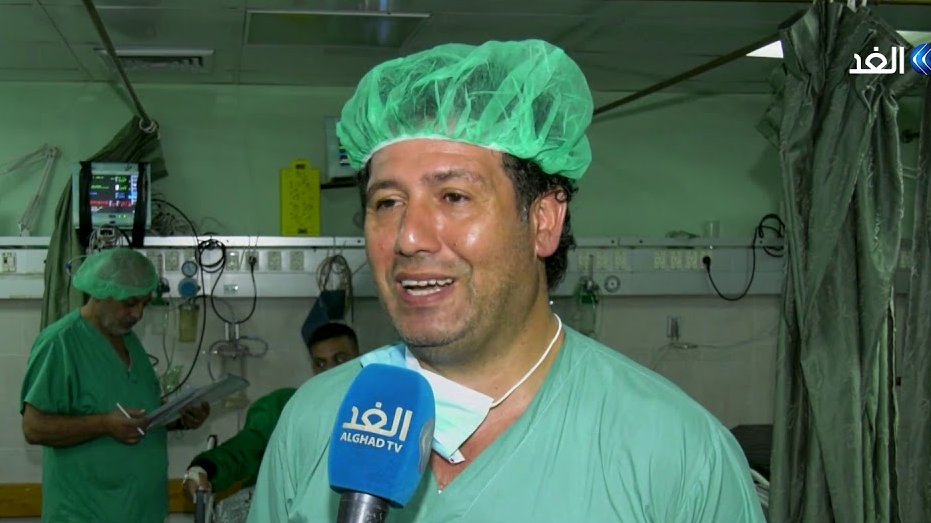
Dr. Adnan Al-Barsh giving an interview.

Israel has systematically attacked Gaza’s health system and killed over 700 health workers, a flagrant violation of international law

In the first week of June 2024, the Palestine office of the World Health Organization (WHO) released figures about the atrocious attacks on health care facilities and workers in Gaza since October 7, 2023. Thus far, according to the WHO, the Israelis have attacked 464 health care facilities, killed 727 health care workers, injured 933 health care workers, and damaged or destroyed 113 ambulances. “Health care,” the WHO’s Palestine office argues, “is not a target.” And yet, during the past seven months, health care workers have faced relentless attacks by the Israeli military. Each of the stories about the deaths is heartbreaking, the names of the dead are too long to list in any article (although a group called Healthcare Workers for Palestine did read the names of their dead colleagues as a protest against this war). But some of the stories are worth reflecting on because they tell us about the commitment of the workers and the great loss to humanity from their murder.

Dr. Iyad Rantisi, who was 53 years old, ran the Kamal Adwan Hospital in Beit Lahiya, which lies in the northern part of Gaza. There are many Rantisis in Gaza, but they are not native to that part of Palestine. Like many Palestinians who live in Gaza, they have roots in other parts of Palestine from which they had been expelled in the Nakba of 1948; the Rantisis come from the village of Rantis, northwest of Ramallah.

On November 11, 2023, during the Israeli military assault inside northern Gaza, Dr. Rantisi was taken into custody at an Israeli military checkpoint when he tried to leave northern Gaza for the south, following the orders of the Israeli military. Since then, his family had not heard anything about his whereabouts. Now, months later, the Israeli newspaper Haaretz reports that he was taken to the Shikma Investigation Center of the Shin Bet (Israel Security Agency), which is inside the Ashkelon Prison. Dr. Rantisi was tortured and then killed six days into his detention. His family was not informed of this until the Haaretz report. Then, Dr. Rantisi’s daughter Dima wrote of the death of her father, a social media post that she paired with photographs of him in medical scrubs performing surgery on a patient.

Dr. Adnan Al-Barsh, also 53, trained in Romania before he returned home to Gaza to head the orthopedic department at Al-Shifa Hospital. He has a reputation of being a very loved doctor, whose office was crowded with his diplomas (from Jordan, from Palestine, from the United Kingdom). When the Israeli military attacked al-Shifa, Dr. Al-Barsh was forced to leave his post, but he did not leave his work. He first went to Kamal Adwan Hospital, where Dr. Rantisi worked, and then to Al-Awda Hospital in the area east of the Jabaliya refugee camp in northern Gaza, which was also attacked several times by the Israelis. On December 18, 2023, the Israeli military raided Al-Awda and took Dr. Al-Barsh and other hospital personnel into custody. Included among those arrested was the manager of the hospital and another very popular doctor, Dr. Ahmed Muhanna. On October 15, 2023, Dr. Muhanna made a video—which went viral—in which he pleaded to the world for help and for an immediate ceasefire. It is now reported that on April 19, 2024, Dr. Al-Barsh was killed by the Israelis in Ofer Prison. Tlaleng Mofokeng, the UN Special Rapporteur on the right to health, said, “Dr. Adnan’s case raises serious concerns that he died following torture at the hands of Israeli authorities.”

Dr. Hammam Alloh, age 36, was killed when an Israeli missile struck his home near his ward in Al-Shifa Hospital on November 12, 2023. Trained in Yemen and Jordan, Dr. Alloh was Gaza’s only nephrologist, a kidney specialist. Concerned about his patients who were on dialysis, particularly with the lack of electricity and the constant attacks, Dr. Alloh—who was known as “The Legend” during his residency in Jordan—refused to leave the hospital. On October 31, Dr. Alloh was asked why he did not abandon his post and go to southern Gaza. “If I go,” he replied calmly, “who would treat my patients? We are not animals. We have the right to receive proper health care. You think I went to medical school and for my postgraduate degrees for a total of 14 years so I think only about my life and not my patients?” This was the caliber of Dr. Alloh. Less than two weeks later, when he left his post to have a rest at home with his parents, his wife (pregnant with a child), and his two children, the Israelis struck his home. He died alongside his father.

At the International Court of Justice in January 2024, the Irish lawyer Blinne Ní Ghrálaigh made the closing arguments for South Africa’s claim of genocide against Israel. In the course of her statement, Ní Ghrálaigh showed an image of a whiteboard with the following written on it: “Whoever stays until the end will tell the story. We did what we could. Remember us.” These lines had been written by 38-year-old Dr. Mahmoud Abu Najaila, who worked as a physician for Médecins Sans Frontières (MSF) at Al-Awda Hospital in northern Gaza. On November 21, 2023, the Israeli military bombed the third and fourth floors of the hospital, where Dr. Najaila worked with Dr. Ahmad Al-Sahar and Dr. Ziad Al-Tatari. All three of them were killed.

On her LinkedIn page, Reem Abu Lebdeh, a physiotherapist who was an associate trustee on the board of MSF’s UK branch, wrote, “Such a devastating loss for the medical community and humanity.” These doctors, whom she knew, she said, “were true embodiments of selfless service and humanitarian dedication, tirelessly saving lives in the most urgent conditions.” Then a few weeks later, sometime in December, the Israelis attacked a residential area in Khan Younis and killed Reem Abu Lebdeh, whose own messages of solidarity now sit on the web like Dr. Najaila’s whiteboard note: Remember us.

Vijay Prashad is an Indian historian, editor, and journalist. He is a writing fellow and chief correspondent at Globetrotter. He is an editor of LeftWord Books and the director of Tricontinental: Institute for Social Research. He has written more than 20 books, including The Darker Nations and The Poorer Nations. His latest books are Struggle Makes Us Human: Learning from Movements for Socialism and (with Noam Chomsky) The Withdrawal: Iraq, Libya, Afghanistan, and the Fragility of US Power.

This article was produced by Globetrotter.

Original article by Vijay Prashad republished from peoples dispatch under a Creative Commons Attribution-ShareAlike 4.0 (CC BY-SA) license.

Continue ReadingRemember the Palestinian doctors killed by Israel

‘As a Human Being, I Beg’: Doctors Say Cease-Fire in Gaza Only Way to Save Countless Lives

Spread the love

Original article by BRETT WILKINS republished from Common Dreams under Creative Commons (CC BY-NC-ND 3.0). 

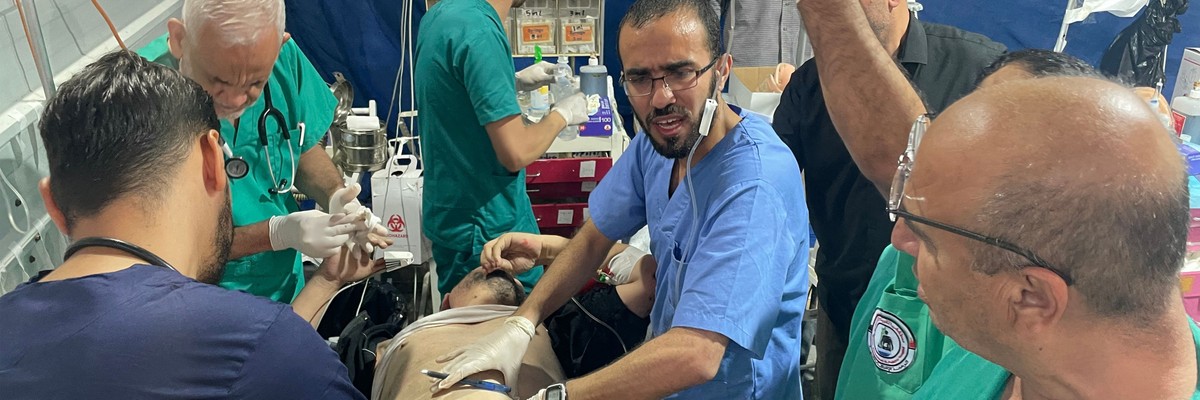
Trauma surgeons treat an injured man after Israeli bombardment, at the Kuwaiti hospital in Rafah in the southern Gaza Strip on October 21, 2023  (Photo: Said Khatib/AFP via Getty Images)

Fresh demands for a major increase in humanitarian aid and an end to the bombing came as Gaza’s only cancer hospital shut down due to a lack of fuel.

As the World Health Organization warns of an “imminent public health catastrophe” in Gaza amid Israeli attacks on medical workers and infrastructure, doctors and other frontline medics said Wednesday that only an immediate cease-fire would give them a fighting chance to save countless lives.

Responding Wednesday to the shutdown of the Turkish-Palestinian Friendship Hospital—Gaza’s only cancer treatment center—due to lack of fuel and damage from Israeli airstrikes, WHO Director-General Tedros Adhanom Ghebreyesus said that “no words can describe our concern for the patients who have just lost the only possibility to receive lifesaving cancer treatment or palliative care.”

Tedros added: “I urge and I plead—for full medical and fuel aid access NOW! The more we wait, the more we put these fragile lives at risk.”

The WHO chief’s plea came a day after Christian Lindmeier, a spokesperson for the Geneva-based United Nations agency, warned that “an imminent public health catastrophe… looms with the mass displacement, the overcrowding, the damage to water and sanitation infrastructure.”

Meanwhile, James Elder, a spokesperson for the United Nations Children’s Fund (UNICEF), said Tuesday that “child deaths due to dehydration, particularly infant deaths due to dehydration, are a growing threat.”

The U.N. Office for the Coordination of Humanitarian Affairs (OCHA) called Gaza a “graveyard” for children, more than 3,600 of whom have been killed by Israeli bombardment, with another 1,000 minors reported missing, according to Palestinian and other officials.

Israeli forces have attacked numerous hospitals, clinics, ambulances, and medical workers, including the Turkish-Palestinian Friendship Hospital and al-Hilu Hospital. The Gaza Health Ministry said Wednesday that the bombardment that damaged al-Hilu “endangers the lives of women in the maternity wards and medical staff.”

According to an “urgent call for protecting healthcare workers in Gaza” published Tuesday in the British medical journal The Lancet, Israeli forces have attacked 57 medical facilities since launching the war on Gaza on October 7, killing 73 workers—including doctors, nurses, paramedics, and others—as of October 24. Sixteen of the medical personnel were killed while on duty.

As Israel’s bombardment of Gaza exacts a heavy toll on overwhelmed medical workers and infrastructure in the besieged strip, frontline medics like Dr. Noureddein al-Khateeb—a 38-year-old resident doctor in the emergency department at the Nasser Medical Center in the southern Gaza city of Khan Younis—say they are living “in a constant state of threat and fear.”

“It’s constant fear on top of the exhaustion we’re experiencing,” al-Khateeb toldThe New Humanitarian on Wednesday. “But one shouldn’t think of that too much. I can’t. If I do, I won’t get any work done.”

Al-Khateeb added that “we’re also afraid for our families’ safety, but what can we do?”

Dr. Mohamed Abu Mousa, a radiologist at Nasser, said one of the few trips he’s made outside the hospital since Israeli bombardment began was to bury his 7-year-old son after he was killed in an October 15 Israeli airstrike on their family home.

“We don’t have the luxury of pausing to grieve,” he told The New Humanitarian. “The heartache is immense, but the wounded are endless. We have to keep going.”

Conditions are dire inside Gaza’s hospitals, which are running out of or low on fuel, medicines, equipment, and other essential services and supplies.

“We’re operating on children without anesthetics,” Léo Cans, who heads the Doctors Without Borders (MSF) mission in Palestine, toldCNN Tuesday. “We don’t have morphine for them.”

On Wednesday, MSF international president Dr. Christos Christou said in a video published on social media that “we’ve seen and heard the stories of the hell being unleashed on Gaza” as “helpless people are being subjected to horrific bombing” and “families have nowhere to run or hide.”

Christou continued:

So many people need help. What medical staff can do is just a drop in the ocean compared to the immense needs. Our teams working in Gaza are exhausted and terrified. Our staff tell us that pregnant women can’t get to hospitals to deliver. People are stuck under the rubble of shelled-out buildings. Children are having limbs amputated while lying on the floor.

“An immediate cease-fire is the only way the people of Gaza can find safety and the essential aid they urgently need,” Christou asserted. “The bombing, the all-out assault, needs to stop now… As a human being, I beg—stop the bombing and allow people in Gaza to live.”

The Gaza Health Ministry said Wednesday afternoon that at least 8,796 Palestinians—including nearly 2,300 women and over 3,600 children—have been killed in Israeli attacks, while around 23,000 other people have been injured.

Original article by BRETT WILKINS republished from Common

Dreams under Creative Commons (CC BY-NC-ND 3.0). 

Continue Reading‘As a Human Being, I Beg’: Doctors Say Cease-Fire in Gaza Only Way to Save Countless Lives

Morning Star: Our NHS at 75: we have still faith, now we need to fight

Spread the love
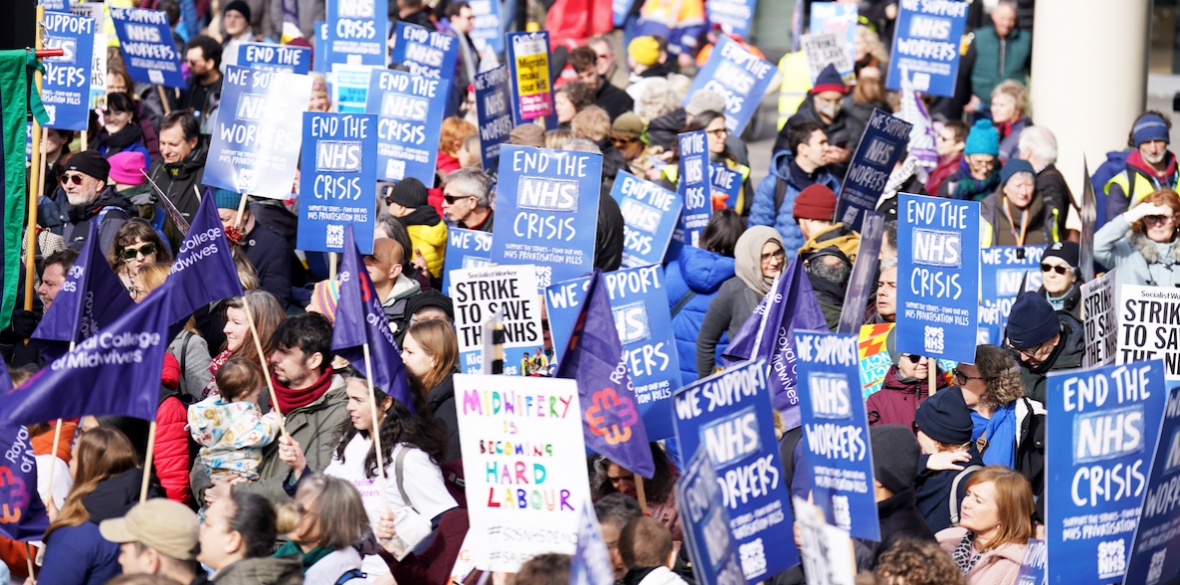
People on Warren Street in London, ahead of a Support the Strikes march in solidarity with nurse 11 March 2023

https://morningstaronline.co.uk/article/e/our-nhs-at-75-we-have-still-faith-now-we-need-to-fight

Image reads Accident & Emergency, A & E

Today the NHS is in a deep crisis. Its millions-long waiting list condemns patients to seriously delayed treatments, often painfully, sometimes dangerously. Its hospitals are so overloaded ambulances line up outside, waiting hours to discharge patients.

Those who can afford it are going private: the number paying for private hospital treatment has risen by nearly a third since 2019.

This raises demand for trained medical workers in the private sector, with reports earlier this year that doctors were being offered £5,000 to recruit NHS colleagues to undertake private work, accelerating a vicious cycle in resource competition when the NHS already carries over 100,000 vacancies.

The logic is towards a two-tier healthcare system in which those who can pay get faster treatment while the “universal” health service is reduced through under-resourcing to basic cover for the poor.

Preventing this means challenging the two main drivers of NHS decline: underinvestment and privatisation.

NHS sign

Since Tony Blair first introduced private provision within the NHS, the service itself has become a lucrative source of private profit. Extortionate PFI contracts, state collusion with big pharma over drug prices and reliance on private providers all waste NHS money.

The last risks turning our health service into a commissioner rather than a provider of services, a brand name that masks a for-profit health system.

That betrayal of Bevan’s vision is the current prospectus from both Tories and Labour. Saving the NHS means building a mass campaign for real solutions to its twin crises: a serious increase in investment, and an end to all private-sector involvement.

https://morningstaronline.co.uk/article/e/our-nhs-at-75-we-have-still-faith-now-we-need-to-fight

Continue ReadingMorning Star: Our NHS at 75: we have still faith, now we need to fight