Climate activists from Greenpeace and Uplift during a demonstration outside the Scottish Court of Session, Edinburgh, on the first day of the Rosebank and Jackdaw judicial review hearing, November 12, 2024
STICK to the spirit of Labour’s manifesto commitments, climate campaigners told the Prime Minister as the public consultation on Rosebank closes on Monday.
Stop Climate Chaos Scotland (SCCS) demanded Andy Burnham block proposed new North Sea oil fields, claiming their lifetime carbon emissions could result in up to 65,495 excess heat deaths by the end of this century.
Made up of more than 70 organisations with a total of about one million supporters, SCCS wrote an open letter to Mr Burnham and his Energy Secretary Miatta Fahnbulleh ahead of the consultation closure for Rosebank, the largest untapped oil field in the North Sea which lies some 80 miles north-west of Shetland.
A similar exercise for the planned Jackdaw gas field, which lies in waters about 150 miles east of Aberdeen, finished on August 10.
Production for both fields had been approved by the previous Conservative government, but a legal challenge from Greenpeace has now left the current government to decide whether or not drilling should go ahead.
SCCS reminded the new PM, who recently issued a temporary ban on the sale of disposable barbecues and brought in the military to help deal with wildfires, that 2,700 excess deaths were linked to heatwaves in May and June alone.
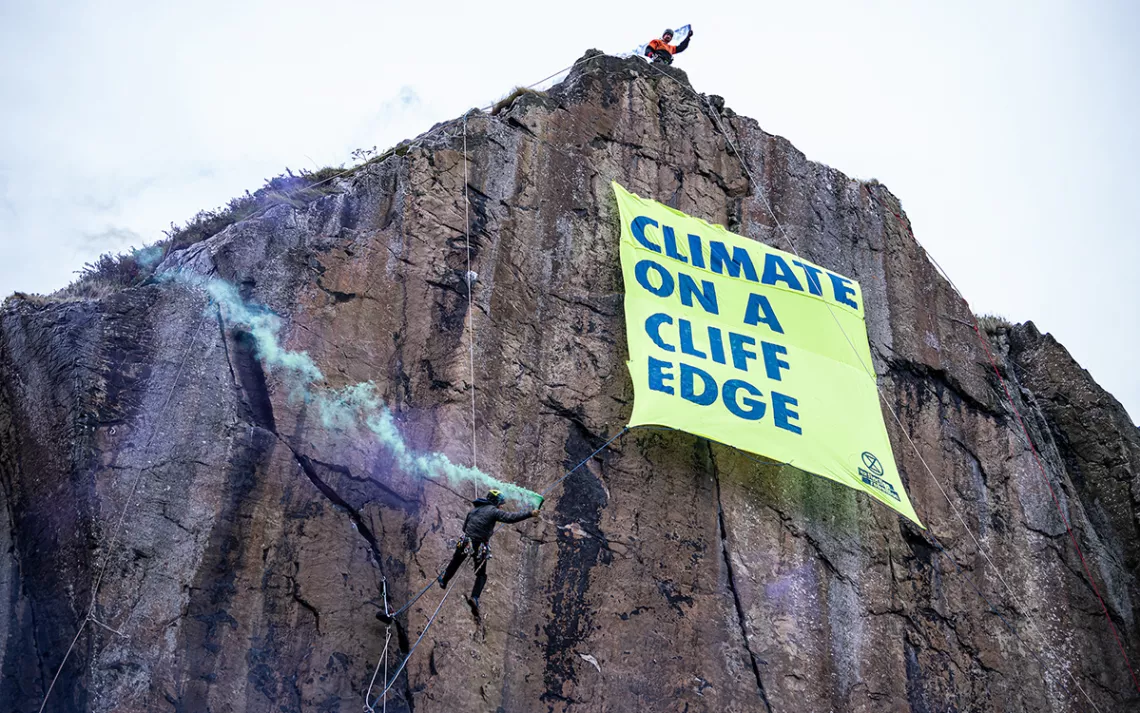
Experienced climbers scale a rock face near the historic Dumbarton castle in Glasgow, releasing a banner that reads “Climate on a Cliff Edge.” One activist, dressed as a globe, symbolically looms near the edge, while another plays the bagpipes on the shores below. | Photo courtesy of Extinction Rebellion and Mark RichardsDonald Trump urges you to be a Climate Science denier like him. He says that he makes millions and millions for destroying the planet, Burn, Baby, Burn and Flood, Baby, Flood.Nigel Farage urges you to ignore facts and reality and be a climate science denier like him and his Deputy Richard Tice. He says that Reform UK has received £Millions and £Millions from the fossil fuel industry to promote climate denial and destroy the planet.
This work by Middle East Monitor is licensed under a Creative Commons Attribution-NonCommercial-ShareAlike 4.0 International License.
US President Donald Trump at the White House in Washington, D.C., United States, on July 14, 2026. [Mehmet Eser – Anadolu Agency]
US President Donald Trump on Monday threatened military action against Oman if it interferes with US-Iran negotiations, while saying Washington is in direct contact with officials from Iran’s Islamic Revolutionary Guard Corps (IRGC).
“If Oman gets in the way, we’ll bomb the shit out of them,” Trump told Fox News when asked about Oman’s role in negotiations involving Iran and the Strait of Hormuz.
Iran said Saturday that it had reached an agreement with Oman on a shipping route map for the Strait of Hormuz following weeks of technical negotiations.
Turning to Iran, Trump said Tehran should raise a “white flag of surrender,” adding: “They’re good poker players, but they’re dying.”
He also confirmed that Washington has a backchannel with the IRGC.
“We have a backchannel with the IRGC. We are speaking directly with the IRGC officials in Iran,” Trump said.
On Gaza, he said: “Israelis should not be striking in Gaza. Hamas agreed to lay down their weapons.”
Trump also said the US maintains a separate channel of communication with Hamas.
“We have a different channel with Hamas, and ultimately they are giving up their guns,” he said.
The remarks come as Washington pushes ahead with efforts to implement Trump’s Gaza peace plan, which includes the disarmament of Hamas and an Israeli military withdrawal from the enclave.
Asked about Israeli politics, Trump said he believed it was “most appropriate” for him to stay out of the country’s elections, while leaving open the possibility of endorsing a candidate.
“I think it’s most appropriate for me to stay out of Israeli elections, but I may endorse somebody,” he said.
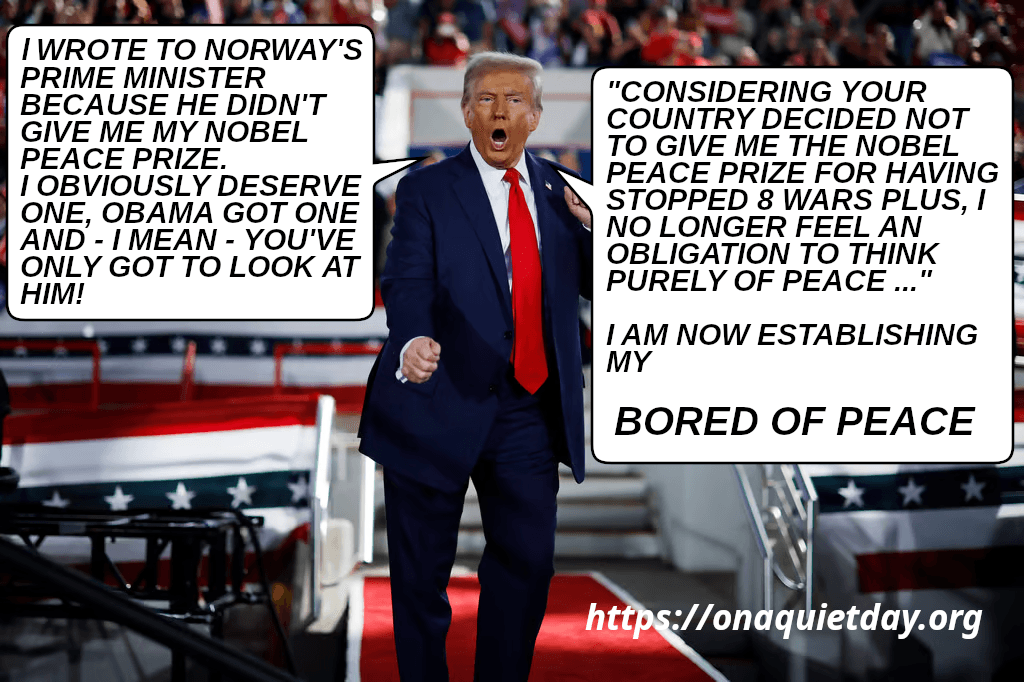
Donald Trump explains why he established his Bored of PeaceOrcas discuss how Trump was re-elected and him being an obviously insane, xenophobic Fascist.
This work by Middle East Monitor is licensed under a Creative Commons Attribution-NonCommercial-ShareAlike 4.0 International License.
Israeli Prime Minister Benjamin Netanyahu (R) shakes hands with US President Donald Trump’s senior White House adviser and his son-in-law Jared Kushner (L) prior to their meeting at the Prime Minister’s Office in Western Jerusalem on 31 July 2019. [Kobi Gideon / GPO / Handout – Anadolu Agency]
US President Donald Trump’s adviser and son-in-law Jared Kushner began a planned meeting with Israeli Prime Minister Benjamin Netanyahu in Israel on Monday to discuss the Gaza ceasefire, Israeli media reported.
Kushner was joined by the Board of Peace’s lead envoy for Gaza, Nickolay Mladenov, and board member and former British Prime Minister Tony Blair during the meeting, The Times of Israel said, citing an unnamed source.
The source said Monday’s talks focus on “moving forward on all the elements (US President Donald Trump’s 15-point plan)” rather than seeking Tel Aviv’s “signature” on the plan.
The discussions come after Kushner, accompanied by Mladenov and Blair, visited the Egyptian capital Cairo on Sunday and met with Hamas officials to hold similar discussions.
In October 2023, the Israeli army launched a deadly offensive in the Gaza Strip that has killed over 73,000 and wounded more than 174,000 others.
Despite a ceasefire that has remained in place since October 2025 as part of the first phase of Trump’s Gaza plan, the army has continued its attacks in the Palestinian enclave, killing at least 1,260 and injuring over 4,100 others, according to Gaza’s Health Ministry.
The second phase of Trump’s plan envisages the transfer of administration in Gaza to a Palestinian technocratic committee, deploying an international stabilization force and placing weapons under the responsibility of the National Committee for Gaza Administration under international supervision, alongside a phased Israeli withdrawal and reconstruction efforts.
Donald Trump explains why he established his Bored of PeaceOrcas discuss how Trump was re-elected and him being an obviously insane, xenophobic Fascist.
This work by Middle East Monitor is licensed under a Creative Commons Attribution-NonCommercial-ShareAlike 4.0 International License.
Iranian Foreign Ministry Spokesman Esmaeil Baqaei holds a press conference at the ministry building in Tehran, Iran on August 18, 2025. [Ahmet Dursun – Anadolu Agency]
Iran’s Foreign Ministry spokesman Esmaeil Baqaei said on Monday that the 60-day deadline for talks with the US following the June 17 memorandum of understanding “lost its relevance” after what he called “flagrant” violations by Washington, Anadolu reports.
“There is no provision in the memorandum of understanding referring to a ‘60-day deadline’, and the Islamic Republic of Iran never formulates its policies under pressure, ultimatums or time limits,” Baqaei told reporters at a weekly news conference, as cited by the semi-official Tasnim news agency.
The memorandum instead envisaged a 60-day period for negotiations on two issues — “the lifting of sanctions” and “the nuclear issue” — which could have been extended if no agreement was reached, he added.
“Due to the flagrant and widespread violation of the memorandum of understanding by the United States, no dialogue was started just a few weeks after its signing,” Baqaei said.
“As a result, the discussion of the 60-day deadline completely lost its relevance,” he added.
The spokesman claimed that the US sanctions have “no impact” on Iran, saying the main obstacle to resolving disputes between Tehran and Washington “is not a lack of mediators.”
“Countries such as Pakistan and Qatar are already playing a role in Iran-US relations,” Baqaei noted.
“It is also entirely natural for some European countries to express their views and indicate their readiness in bilateral contacts to offer their ‘good offices’,” he said. “But this does not mean that a new mediator has emerged or been accepted in the course of Iran-US relations.”
The Iranian spokesman said negotiations with Oman on a maritime transit in the Strait of Hormuz are continuing.
”Compilation of the maritime traffic route map with Oman has taken time due to the security complications caused by the actions of the US and the Israeli regime, the multiplicity of actors and the disruption of malicious currents,” he added.
Baqaei said a possible understanding following talks with Muscat would take the form of a package comprising a roadmap and a joint statement.
The spokesman said the fate of missing Iranian pilots remains on Tehran’s agenda.
“Diplomatic relations with Qatar do not conflict with the serious pursuit of the fate of the army pilots,” he said.
On March 2, Qatar’s Defense Ministry announced that it had shot down two Su-24 aircraft from Iran. Tehran said at the time that four pilots were killed when their aircraft were hit during attacks on a US base in Qatar. Iran also said the remains of one pilot had since been recovered, while the fate of the other three pilots remained unknown.
On Saturday, Qatar rejected Iranian accusations that the three pilots had been detained by Doha.
The US and Israel launched attacks on Iran on Feb. 28, with Tehran launching retaliatory strikes targeting countries hosting US military assets across the region.
Tehran and Washington agreed to a ceasefire in April and subsequently signed a memorandum of understanding in June aimed at ending their military conflict and reaching a lasting peace agreement.
The deal, however, collapsed last month, with Iran and the US exchanging attacks for nearly two weeks before US President Donald Trump abruptly halted the bombardment amid efforts to revive the agreement.
Donald Trump explains why he established his Bored of PeaceOrcas discuss how Trump was re-elected and him being an obviously insane, xenophobic Fascist.
This work by Middle East Monitor is licensed under a Creative Commons Attribution-NonCommercial-ShareAlike 4.0 International License.
A screen grab taken from a video shows commercial vessels waiting in the Gulf of Oman after applying for transit permits to pass through the Strait of Hormuz, on June 4, 2026. [Stringer – Anadolu Agency]
Shipping traffic through the Strait of Hormuz slowed sharply at the start of the week following attacks on oil tankers, as US-Iran talks aimed at resolving the conflict in the Middle East stalled, according to Reuters.
Ship-tracking data from Kpler showed that only five commodity vessels passed through the strait on Saturday, while none were recorded on Sunday, compared with 31 vessels over the previous weekend, Reuters added.
An Iranian official earlier said the United States had suffered major strategic losses during the latest military confrontations, stressing that the Strait of Hormuz would remain under Iranian control.
Kazem Gharibabadi, Iran’s deputy foreign minister, stated that the United States has sustained significant strategic losses, urging Washington to accept this reality and abandon its illusions. He warned that failure to do so would result in Iran continuing to enforce the naval blockade.
Donald Trump explains why he established his Bored of PeaceOrcas discuss how Trump was re-elected and him being an obviously insane, xenophobic Fascist.

 Climate activists from Greenpeace and Uplift during a demonstration outside the Scottish Court of Session, Edinburgh, on the first day of the Rosebank and Jackdaw judicial review hearing, November 12, 2024