Original article republished from MEMO under a Creative Commons Attribution-NonCommercial-ShareAlike 4.0 International License.
Palestinians wait in line to receive aids at the school where UNRWA distributes food parcels in Deir al-Balah, Gaza on November 07, 2024. [Ashraf Amra – Anadolu Agency]
President Joe Biden’s administration has concluded that Israel is not currently impeding assistance to Gaza and, therefore, is not violating US law, the State Department said on Tuesday, although Washington acknowledged the humanitarian situation remained dire in the Palestinian enclave, Reuters reports.
US Secretary of State, Antony Blinken, and Defence Secretary, Lloyd Austin, in a 13 October letter gave their Israeli counterparts a list of specific steps that Israel needs to take within the next 30 days to address the worsening situation in Gaza. Failure to do so may have possible consequences on US military aid to Israel, they said in the letter.
But, on Tuesday, the deadline mentioned in the letter, State Department deputy spokesperson, Vedant Patel, repeatedly declined to say if the specific criteria were fulfilled. Instead, he told reporters that Israel has taken steps to address the demands and that Washington would continue to assess the situation.
“We’ve seen some progress being made. We would like to see some more changes happen. We believe that had it not been for US intervention, these changes may not have ever taken place,” Patel said, adding that Washington will continue to assess Israel’s compliance with US law.
International aid groups said Israel had failed to meet the series of US demands intended to improve the humanitarian crisis in Gaza by the Tuesday deadline.
Patel, fielding repeated questions from reporters in the briefing, declined to explain why Washington chose to make the assessment based on Israel’s measures to address the problems instead of actual results on the ground, which US officials have repeatedly said would be their measuring stick.
Earlier this month, the State Department said the results on the ground as of 4 November were not good enough.
On Tuesday, Patel said Israel had taken some steps, including reopening the Erez Crossing, waiving certain customs requirements and opening additional delivery routes within Gaza.
For more than a month, Israeli forces have been pushing deeper into north Gaza, surrounding hospitals and shelters and displacing new waves of people in an operation they say is designed to prevent Hamas fighters regrouping.
Biden, whose term ends soon, has offered strong backing to Israel since Hamas-led gunmen attacked Israel last October, killing 1,200 people and taking more than 250 hostages.
However, since then, it has been revealed by Haaretz that helicopters and tanks of the Israeli army had, in fact, killed many of the 1,139 soldiers and civilians claimed by Israel to have been killed by the Palestinian Resistance.
More than 43,500 Palestinians have been killed in Gaza over the past year and Gaza has been reduced to a wasteland of wrecked buildings and piles of rubble where more than 2 million Gazans seek shelter as best they can.
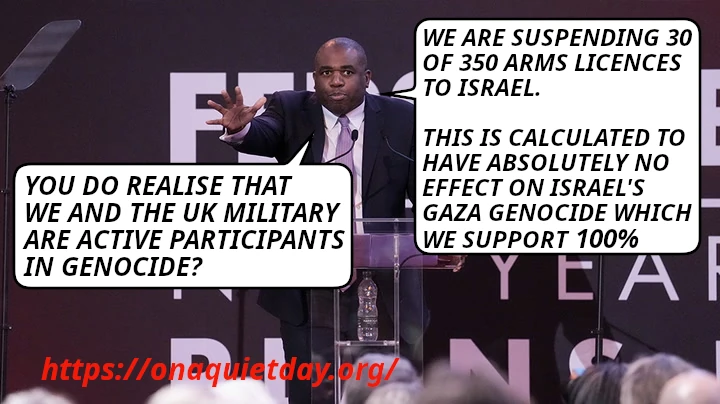
Current UK Prime Minister Keir Starmer is quoted that he supports Zionism without qualification. He also confirms that his active support and that of UK’s air force has been essential in Israel’s mass-murdering genocide. Includes URLs https://www.declassifieduk.org/keir-starmers-100-spy-flights-over-gaza-in-support-of-israel/ and https://youtu.be/O74hZCKKdpAUK Foreign Secretary David Lammy says that UK is suspending 30 of 350 arms licences to Israel. He also confirms the UK government’s support for Israel’s Gaza genocide and the UK government and military’s active participation in genocide.
The Wall Street Journal (10/1/24) describes an Iranian missile barrage as a response to “Israel’s restraint”—rather than as a response to an Israeli terrorist bombing in Tehran, which went unmentioned in the editorial.
The media hawks are flying high, pushing out bellicose rhetoric on the op-ed pages that seems calculated to whip the public into a war-ready frenzy.
Just as they have done with Hezbollah (FAIR.org, 10/10/24), prominent conservative media opinionators misrepresent Iran as the aggressor against an Israel that practices admirable restraint.
Under the headline, “Iran Opens the Door to Retaliation,” the Wall Street Journal editorial board (10/1/24) wrote that Iran’s October 1 operation against Israel “warrants a response targeting Iran’s military and nuclear assets. This is Iran’s second missile barrage since April, and no country can let this become a new normal.”
The editors wrote:
After April’s attack, the Biden administration pressured Israel for a token response, and President Biden said Israel should “take the win” since there was no great harm to Israel. Israel’s restraint has now yielded this escalation, and it is under no obligation to restrain its retaliation this time.
‘We need to escalate’
“Bully regimes respond to the stick,” Bret Stephens (New York Times, 10/1/24) declared—citing the fact that Iran was reluctant to make a nuclear deal with the United States after the United States unilaterally abrogated the last deal.
The New York Times‘ self-described “warmongering neocon” columnist Bret Stephens (10/1/24), in a piece headlined “We Absolutely Need to Escalate in Iran,” similarly filed Iran’s April and October strikes on Israel under “aggression” that requires a US/Israeli military “response.” And a Boston Globe editorial (10/3/24) wrote that Iran “launched a brazen attack,” arguing that the incident illustrated why US students are wrong to oppose American firms making or investing in Israeli weapons.
All of these pieces conveniently neglected to mention that Iran announced that its October 1 missile barrage was “a response to Israel’s recent assassinations of leaders of [Iran’s Islamic Revolutionary Guard Corps], Hezbollah and Hamas” (Responsible Statecraft, 10/1/24). One of these assassinations was carried out by a bombing in Tehran, the Iranian capital. But we can only guess as to whether the Globe thinks those killings are “brazen,” Stephens thinks they qualify as “aggression,” or if the Journal believes any country can let such assassinations “become a new normal.”
Likewise, Iran’s April strikes came after Israel’s attack on an Iranian consulate in Damascus that killed seven Islamic Revolutionary Guard Corps officers (CBS, 4/14/24). At the time, Iran reportedly said that it would refrain from striking back against Israel if the latter agreed to end its mass murder campaign in Gaza (Responsible Statecraft, 4/8/24).
‘Axis of Aggression’
Bret Stephens (New York Times, 10/8/24) thinks we’d be safer if “cunning and aggressive dictatorships…finally learned the taste of defeat.”
A second Stephens piece (New York Times, 10/8/24) claimed that “the American people had better hope Israel wins” in its war against “the Axis of Aggression led from Tehran.” The latter is his term for the coalition of forces resisting the US and Israel from Palestine, Yemen, Lebanon and Iran, which refers to itself as the “axis of resistance.” Stephens’ reasoning is that, since Iran’s 1979 revolution, the country
has meant suffering for thousands of Americans: the hostages at the US embassy in Tehran; the diplomats and Marines in Beirut; the troops around Baghdad and Basra, killed by munitions built in Iran and supplied to proxies in Iraq; the American citizens routinely taken as prisoners in Iran; the Navy SEALs who perished in January trying to stop Iran from supplying Houthis with weapons used against commercial shipping.
The war Israelis are fighting now—the one the news media often mislabels the “Gaza war,” but is really between Israel and Iran—is fundamentally America’s war, too: a war against a shared enemy; an enemy that makes common cause with our totalitarian adversaries in Moscow and Beijing; an enemy that has been attacking us for 45 years. Americans should consider ourselves fortunate that Israel is bearing the brunt of the fighting; the least we can do is root for it.
This depiction of Iran as an aggressor that has victimized the United States for 45 years, causing “suffering for thousands of Americans,” is a parody of history. The fact is that the US has imposed suffering on millions of Iranians for 71 years, starting with the overthrow of the country’s democratically elected Prime Minister Mohammad Mosaddegh in 1953. It propped up the brutal Pahlavi dictatorship until 1979, then backed Iraq’s invasion of Iran, helping Saddam Hussein use chemical weapons against Iranians (Foreign Policy, 8/26/13). It imposes murderous sanctions on Iran to this day (Canadian Dimension, 4/3/23).
Given this background, suggesting—as the Journal, the Globe and Stephens do—that Iran is the aggressor against the US is not only untenable but laughable. Furthermore, as I’ve previously shown (FAIR.org, 1/21/20), it’s hardly a settled fact that Iran is responsible for Iraqi attacks on US occupation forces in the country. Stephens’ description of the Navy SEALs who died in the Red Sea is vague enough that one might be left with the impression that Iran or Ansar Allah killed them, but the SEALs died when one of them fell overboard and the other jumped into the water to try to save him (BBC, 1/22/24).
Stephens went on:
Those who care about the future of freedom had better hope Israel wins.
We are living in a world that increasingly resembles the 1930s, when cunning and aggressive dictatorships united against debilitated, inward-looking, risk-averse democracies. Today’s dictatorships also know how to smell weakness. We would all be safer if, in the Middle East, they finally learned the taste of defeat.
What Stephens is deploying here is the tired and baseless propaganda strategy of hinting that World War II redux is impending if America doesn’t crush the Third World bad guy of the moment. More realistically, the “future of freedom” is jeopardized by the US/Israeli alliance’s invading the lands of Palestinian and Lebanese people and massacring them. These crimes suggest that, in the Journal’s parlance, it’s the US/Israeli partnership that is the “regional and global menace.” Or, to borrow another phrase from the Journal’s editorial, it’s Israel and the US who are the “dangerous regime[s]” from which “the civilized world” must be defended.
‘A global menace’
“Iran launched a brazen attack,” the Boston Globe (10/3/24) editorialized—brazenly ignoring Israeli violence toward Iran.
Corporate media commentators didn’t stop at Iran’s direct strikes on Israel, casting Iran as, in the Journal‘s words (10/1/24), “a regional and global menace”:
It started this war via Hamas, which it funds, arms and trains to carry out massacres like the one on October 7, and it escalated via Hezbollah, spreading war to Lebanon. Other proxies destabilize Iraq and Yemen, fire on Israeli and US troops and block global shipping. It sends drones and missiles to Russia and rains ballistic missiles on Israel. All while seeking nukes.
Stephens’ column (10/1/24) similarly argued that “Iran presents an utterly intolerable threat not only to Israel but also to the United States and whatever remains of the liberal international order we’re supposed to lead.” The Globe editorial (10/3/24) wrote that “the threat posed by Iran extends beyond Israel’s borders.” Both cited the Houthis in Yemen, among other alleged Iranian “proxies.”
Painting Iran as the mastermind behind unprovoked worldwide aggression helps prop up the hawks’ demands for escalation. But the US State Department said there was “no direct evidence” that Iran was involved in the October 7, 2023, Hamas-led attack on Israel, “either in planning it or carrying it out” (NBC, 10/12/23).
As FAIR has shown repeatedly (e.g., FAIR.org, 4/21/21, 8/26/20), it isn’t true that Hezbollah is an Iranian puppet. The Houthis, formally known as Ansar Allah, likewise aren’t mere proxies (Democracy Now!, 2/1/24)—and don’t expect the media hawks to tell you that the Houthis began attacking ships they understand to be Israel-linked in response to the US/Israeli assault on Gaza, and say that they will stop if the US/Israeli war crimes in Gaza end.
Moreover, it’s clear that the Journal has no problem with US arms exports, including when they are used to carry out atrocities against civilians, so its posturing about the harm done by Iranian arms sales to Russia cannot be taken seriously (FAIR.org, 1/27/23).
Propaganda goes nuclear
Uriel Hellman (LA Times, 10/17/24) writes that “the responsible nations of the world have tried myriad methods to thwart this doomsday scenario” of Iran making a nuclear weapon, including “negotiated agreements.” The US has tried making deals with Iran, it’s tried violating those deals—nothing seems to work!
As usual, those who are itching for a war on Iran invoke the specter of an Iranian nuclear weapon. Stephens (New York Times, 10/1/24) wrote:
This year, Secretary of State Antony Blinken warned that Iran was within a week or two of being able to produce enough weapons-grade uranium for a nuclear bomb. Even with the requisite fissile material, it takes time and expertise to fashion a nuclear weapon, particularly one small enough to be delivered by a missile. But a prime goal for Iran’s nuclear ambitions is plainly in sight, especially if it receives technical help from its new best friends in Russia, China and North Korea.
Now’s the time for someone to do something about it.
That someone will probably be Israel.
By “something,” Stephens said he also meant that “Biden should order” military strikes to destroy the “Isfahan missile complex.” “There is a uranium enrichment site near Isfahan, too,” Stephens wrote suggestively.
The LA Times published two guest op-eds in less than two weeks urging attacks on Iran based on its alleged nuclear threat. Yossi Klein Halevi (10/7/24) wrote:
Today, Iran sits at the nuclear threshold…. The culminating moment of this war to restore Israeli deterrence against existential threat will be preventing Iran’s nuclear breakout.
Ten days later, Uriel Heilman (LA Times, 10/17/24) argued: “With Iran’s belligerence in overdrive, the US and its allies should seriously consider a military option to take out Iran’s nuclear sites.”
The first question posed by CBS‘s Margaret Brennan in the vice presidential debate (10/1/24)—”would you support or oppose a preemptive strike by Israel on Iran?”—was premised on the claim that Iran “has drastically reduced the time it would take to develop a nuclear weapon. It is down now to one or two weeks time.”
‘Threshold’ is a ways away
If this New York Times piece (10/2/24) seems to have a different, less alarmist tone than other corporate media reports, perhaps that’s because its author, William Broad, is a science reporter and not someone whose beat is foreign policy.
Readers who aren’t versed in the technical terms used to discuss nuclear proliferation can be forgiven for thinking that a country at “the nuclear threshold” is mere days away from being able to use nuclear weapons against their enemies, as these media warnings seem to suggest. But in reality, as the blog War on the Rocks (5/3/24) explained:
Three distinct elements distinguish a state that has achieved a threshold status. First, the conscious pursuit of this combined technical, military and organizational capability to rapidly (probably within three to six months) obtain a rudimentary nuclear explosive capability after a decision to proceed. Second, implementation of a strategy for achieving and utilizing this status. And third, the application of this status for gain vis-à-vis adversaries, allies and/or domestic audiences. Nevertheless, a threshold state remains sufficiently short of weapons possession and even from the capacity to assemble disparate components into a nuclear weapon within days.
According to a Congressional Research Service document (3/20/24) published in March, International Atomic Energy Agency (IAEA) reports “suggest that Iran does not yet have a viable nuclear weapon design or a suitable explosive detonation system.”
Estimates of how long it would take for Iran to develop nuclear weapons vary. US intelligence said that Iran could enrich enough uranium for three nuclear devices within weeks if it chose to do so (Congressional Research Service, 9/6/24). Yet as noted by Houston G. Wood, an emeritus professor of mechanical and aerospace engineering who specializes in atomic centrifuges and other nuclear issues, it “would take Iran up to a year to devise a weapon once it had enough nuclear fuel” (New York Times, 10/2/24).
Siegfried S. Hecker, former director of the Los Alamos weapons laboratory, likewise told the New York Times that “it would likely take many months” for Iran to develop nukes, “not weeks.” As the Times noted, CBS‘s question in the vice presidential debate “conflated the time it would most likely take Iran to manufacture a bomb’s worth of highly enriched uranium with the overall process of turning it into a weapon. ”
What’s more, US intelligence continues to say that Iran “is not currently undertaking nuclear weapons-related activities” (Congressional Research Service, 9/6/24). In 2003, Ayatollah Ali Khamenei issued a fatwa against building nuclear weapons that has not yet been rescinded (FAIR.org, 10/17/17).
‘Iran won’t stop itself’
“Iran is implementing its nuclear-related commitments,” the IAEA (3/5/18) said in March 2018. Two months later, the same could not be said to the United States.
Even if Iran were pursuing nuclear weapons, nothing under international law supports the idea that Israel and the US therefore have the right to attack Iran. India would not have been within its rights to attack Pakistan to prevent its rival from building a nuclear weapon.
But media assume different rules apply to Iran. The editors of the Wall Street Journal (10/1/24) contended:
If there were ever cause to target Iran’s nuclear facilities, [Iran’s October attack on Israel] is it…. Iran is closer than ever to a nuclear weapon and won’t stop itself. The question for American and Israeli leaders is: If not now, when?
Recent history shows that Iran has been willing to “stop itself” from acquiring nuclear weapons. Iran abided by the 2015 Joint Comprehensive Plan of Action (JCPOA), popularly known as the Iran nuclear deal, under which Iran limited its nuclear development in exchange for a partial easing of US sanctions. It stuck to the deal for some time even after the United States unilaterally abandoned it.
Just before President Donald Trump ripped up the agreement in 2018, the IAEA reported that Iran was “implementing its nuclear-related commitments” under the accord. The year after the US abrogated the agreement, Iran was still keeping up its end of the bargain.
‘Provocative actions’ from US/Israel
Responsible Statecraft (5/7/24): “Relations between the United States and Iran have been so damaged by Trump’s withdrawal that it does not appear as though the deal can be resurrected.”
Iran subsequently stopped adhering to the by then nonexistent deal—often advancing its nuclear program, as Responsible Statecraft (5/7/24) noted, “in response to provocative actions from the US and Israel”:
In early 2020, the Trump administration killed Iranian Major General Qassem Soleimani, leader of the Islamic Revolutionary Guard Corps, and soon after Tehran announced that it would no longer abide by its enrichment commitments under the deal. But, even so, Tehran said it would return to compliance if the other parties did so and met their commitments on sanctions relief.
In late 2020, Iranian nuclear scientist Mohsen Fakhrizadeh was assassinated near Tehran, reportedly by Israel. Soon after, Iran’s Guardian Council approved a law to speed up the nuclear program by enriching uranium to 20%, increasing the rate of production, installing new centrifuges, suspending implementation of expanded safeguards agreements, and reducing monitoring and verification cooperation with the IAEA. The Agency has been unable to adequately monitor Iran’s nuclear activities under the deal since early 2021.
However, situating Iranian policies in relation to US/Israeli actions like these would get in the way of the Journal’s campaign, which it articulated in another editorial (10/2/24), to convince the public that “If Mr. Biden won’t take this opportunity to destroy Iran’s nuclear program, the least he can do is not stop Israel from doing the job for its own self-preservation.”
Of course, the crucial, unstated assumption in the articles by Stephens, Halevi, Heilman and the Journal’s editors is that Iran’s hypothetical nuclear weapons are emergencies that need to be immediately addressed by bombing the country—while Washington and Tel Aviv’s vast, actually existing nuclear arsenals warrant no concern.
FAIR’s work is sustained by our generous contributors, who allow us to remain independent. Donate today to be a part of this important mission.
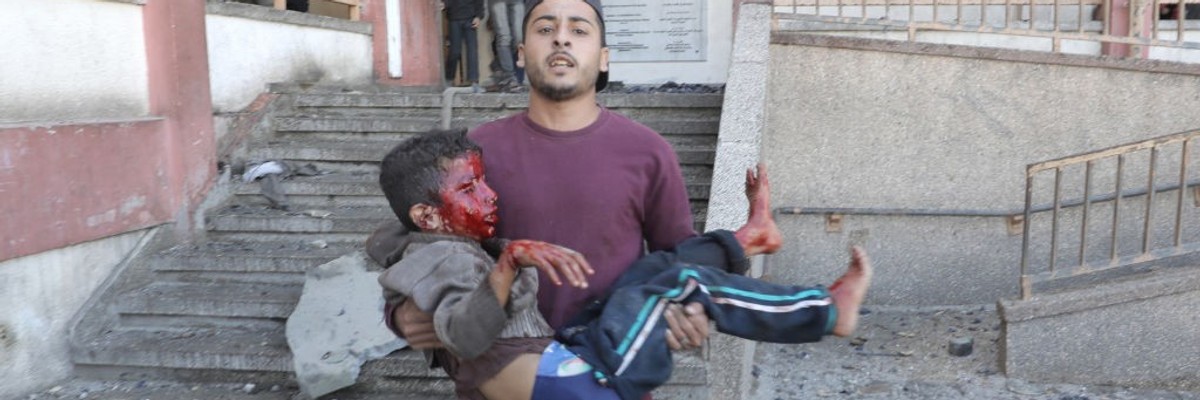
A man carries a child wounded in an Israeli strike on a school housing forcibly displaced Palestinians in the Nuseirat refugee camp, on October 24, 2024 in Deir al-Balah, Gaza, Palestine. (Photo: Moiz Salhi/Anadolu via Getty Images)
“Our ambulances can’t transfer wounded people,” said one overwhelmed hospital director. “Those who can arrive by themselves to the hospital receive care, but those who don’t just die in the streets.”
A devastating wave of Israeli airstrikes across the Gaza Strip on Wednesday and Thursday have killed or wounded hundreds of Palestinians, including many children, according to local and international media reports.
Citing Gaza Civil Defense officials, Palestine’s Quds News Network reported Thursday that at least 150 Palestinian civilians were killed or wounded by Israel Defense Forces (IDF) bombardment of around a dozen apartment towers on Al-Houja Street in the Jabalia refugee camp in northern Gaza.
Local and international media outlets earlier reported at least 17 Palestinians were killed and dozens more wounded by an IDF strike on the al-Shuhada school in the Nuseirat refugee camp in central Gaza.
At least 17 Palestinians, including children, were killed and a number of others were injured in an Israeli bombardment that targeted a school housing displaced people in the Nuseirat camp in the central Gaza Strip. pic.twitter.com/GY1cGLd45I
Medical staff at the al-Awda Hospital in Nuseirat—where many people killed and wounded in the strike were taken—told Al Jazeera that 13 children under age 18 and three women were among the dead.
The IDF said the strike targeted a Hamas command-and-control center. However, survivors and eyewitnesses said that all of the dead were women and children.
Gaza Notifications published the names of 16 people killed in the attack, including at least five children—the youngest of whom was a baby, just 11 months old.
The outlet said a total of 203 Palestinian civilians have been killed so far on Thursday, and that “all medical and rescue operations have been completely halted by the military administration.”
“The Israeli army has warned that ambulances and rescue teams will be directly targeted if they attempt to continue their operations, effectively blocking any humanitarian efforts,” the site added.
Gaza’s Government Media Office reported 34 Palestinians including 11 children were burned alive in an IDF strike on a youth club-turned shelter in the al-Maghazi refugee camp in central Gaza.
Israeli forces have also reportedly attacked hospitals and healthcare workers throughout Gaza. The Palestine Chronicle reported that IDF troops opened fire on Kamal Adwan Hospital in Beit Lahia, “with sick children inside.”
Hussam Abu Safia, the hospital’s director, told Al Jazeera that IDF tanks surrounded the facility and “directly targeted” it, severely damaging the intensive care unit. On Wednesday, Abu Safia said there were more than 150 wounded people in the hospital, including 14 children in the ICU or neonatal ward.
“There is a very large number of wounded people, and we lose at least one person every hour because of the lack of medical supplies and medical staff,” he said. “Our ambulances can’t transfer wounded people. Those who can arrive by themselves to the hospital receive care, but those who don’t just die in the streets.”
The Palestinian Ministry of Health also said several of its employees were wounded by Israeli artillery strikes on Thursday.
Earlier this month, the United Nations Independent International Commission of Inquiry on the Occupied Palestinian Territory released a report detailing how “Israel has perpetrated a concerted policy to destroy Gaza’s healthcare system as part of a broader assault on Gaza, committing war crimes and the crime against humanity of extermination with relentless and deliberate attacks on medical personnel and facilities.”
Israel’s ongoing offensive in northern and central Gaza has killed or wounded more than 2,000 Palestinians this month alone, according to Gaza officials. Since last October, Israel’s war on Gaza—which is the subject of a South Africa-led genocide case at the International Court of Justice—has left more than 153,000 Palestinians dead, maimed, or missing; millions more forcibly displaced, starved, or sickened; and most of the coastal enclave in ruins.
GAZA HEALTH MINISTRY: 42,847 Palestinians have been killed, and 100,544 wounded in Israel’s ongoing genocide in Gaza starting on October 7, 2023. pic.twitter.com/IUGklWnyYT
Thursday’s strikes came as U.S. Secretary of State Antony Blinken traveled to the Middle East, where he is set to take part in cease-fire negotiations with officials from Israel, Egypt, and Qatar in the Qatari capital Doha.
“Going back to the negotiations on ceasefire and the hostages, one of the things we’re doing is looking at whether there are different options that we can pursue to get us to a conclusion, to get us to a result,” Blinken said Thursday.
The United States is Israel’s primary international backer, providing billions of dollars in military aid and diplomatic cover including multiple vetoes of United Nations Security Council cease-fire resolutions.
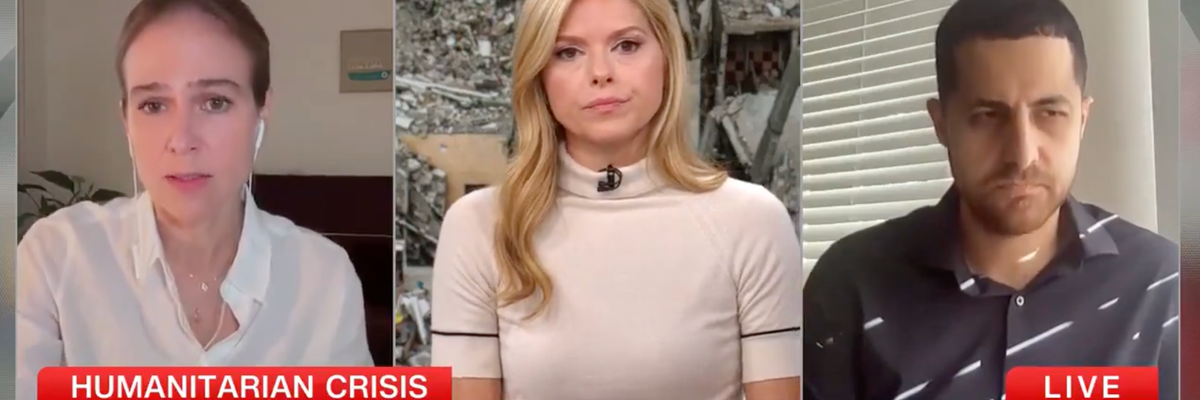
Dr. Tanya Haj-Hassan (left) pushes back on CNN anchor Kate Bolduan’s (center) description of the Gaza genocide as a “humanitarian crisis” during an October 7, 2024 interview. (Photo: CNN screen grab)
“History books will be written on this and countries will have to reckon—media agencies will have to reckon—with their major role in the genocide,” said Dr. Tanya Haj-Hassan.
Human rights advocates on Friday highlighted a rare instance in which a U.S. corporate media outlet allowed a pro-Palestinian voice to set the record straight about Israel’s crimes against humanity in Gaza.
Earlier this week, CNN “News Central” aired a panel segment on the anniversary of the October 7, 2023 Hamas-led attack on Israel and Israel’s retaliatory war. Anchor Kate Bolduan noted that around 1,200 people were killed during the Hamas attack—although she did not say that at least some of them were slain by Israeli forces in “friendly fire” incidents and under the Hannibal Directive—and that 250 others were kidnapped.
Bolduan also acknowledged that nearly 42,000 Palestinians have been killed and another 2 million displaced by Israeli forces, calling the situation in Gaza a “desperate humanitarian crisis.”
“A humanitarian crisis is what you deal with when you have a hurricane, what you deal with when you have an earthquake.”
The anchor asked panel participant Dr. Tanya Haj-Hassan—an American pediatric intensive care physician who volunteered for two weeks at Al-Aqsa Martyrs Hospital in Deir al-Balah in the central Gaza Strip—for her thoughts on the matter.
“In all honesty, a humanitarian crisis is what you deal with when you have a hurricane, what you deal with when you have an earthquake,” Haj-Hassan replied. “This is not a humanitarian crisis.”
“Kate, and I’m going to say it very clearly for your viewers to hear, this is genocide,” the doctor stressed.
"This is not a humanitarian crisis, Kate, and I'm going to say it very clearly for your viewers to hear: This is genocide […] Media agencies will have reckon with their major role in the genocide." — Dr. Tanya Haj-Hassan to CNN pic.twitter.com/PTVSe0lOFY
When 70% of the population that are killed are women and children, when the population is starved of food, of water, of medicine, when you have attacks, repeated attacks on all the hospitals, the clinics, the aid distribution sites, the humanitarian aid agencies that tried to help, more [United Nations] workers have been killed in Gaza than in U.N.’s history. When you have over 900 families that have been exterminated, that have been taken off of the civil registry, killed, when you have over 17,000 children that have lost one or both parents, when you have bakeries, aid distribution sites, churches, mosques, schools, and in the last three days—in the last 24 hours in fact—a hospital today that was bombed, as you just reported, the hospital where I personally was working, and I can tell you, they are working every second of every day to try and sustain life.
“And so it’s really hard to hear it over and over and over again, framed in the way that it’s being framed in the media, which, frankly, Kate, is very misleading,” Haj-Hassan said. “It is very misleading. Three hundred and sixty-five days of this. Death tolls that are so far outdated we have… no idea how many people are killed.”
“But I am… genuinely afraid about what we’re going to find out when the dust settles. History books will be written on this,” she added. “And countries will have to reckon—media agencies will have to reckon—with their major role in the genocide of an entire population and in the destruction of humanitarian law and rule of order.”
Some observers noted the absence of voices like Haj-Hassan’s in U.S. mainstream media coverage of Gaza, which is overwhelmingly pro-Israel and almost never airs the word “genocide”—even as Israel is on trial for the crime at the International Court of Justice (ICJ).
The New York Times, for example, ordered journalists covering the war in Gaza to eschew terms including “genocide,” “ethnic cleansing,” and even “occupied territory,” even though Israel has indisputably occupied Palestine for over half a century and the ICJ recently ruled that the Israeli occupation is a crime of apartheid that must end immediately.
“The media may be forgiven for missing a carefully hidden story. For missing some details,” Quincy Institute for Responsible Statecraft executive vice president Trita Parsi said Friday on social media. “But when a genocide is there for everyone to see and you help conceal it, forgiveness is not in the cards.”
Another social media user offered mild praise for Bolduan—who has been criticized by Israel supporters for previous interviews in which Palestine defenders accused Israel of genocide—writing that the anchor “didn’t seem happy” to hear what Haj-Hassan was saying.
“Hard to say whether it was because the truth is so horrible or because CNN doesn’t want to report that truth—but she did let her say it,” the user said of Bolduan.
Allegations of Israeli genocide remain highly contentious—even taboo—in the United States, which provides the key Mideast ally with tens of billions of dollars in military aid and diplomatic cover including multiple vetoes of United Nations Security Council cease-fire resolutions that were overwhelmingly supported by other countries.
In the United States, Palestinians, Palestinian Americans, and human rights groups are asking the 9th U.S. Circuit Court of Appeals to revisit a lawsuit they filed accusing President Joe Biden, Secretary of State Antony Blinken, and Defense Secretary Lloyd Austin of complicity in the Gaza genocide.
In July, a three-judge panel of the federal court dismissed the lawsuit, in which the U.S. District Court for the Northern District of California previously found that “the current treatment of the Palestinians in the Gaza Strip by the Israeli military may plausibly constitute a genocide in violation of international law,” but dismissed the case on jurisdictional grounds.
U.S. Secretary of State Antony Blinken speaks to reporters on a tarmac in Doha, Qatar on August 20, 2024. (Photo: Kevin Mohatt/Pool/AFP via Getty Images)
“You are currently arming, funding, and defending a genocide in Gaza. That is how history will remember you.”
U.S. Secretary of State Antony Blinken was accused of stark hypocrisy on Saturday after he condemned the Myanmar military’s genocide against the Rohingya people while simultaneously aiding Israel’s genocidal assault on the Gaza Strip.
Marking the seventh anniversary of Myanmar’s vicious ethnic cleansing of the stateless Rohingya, Blinken wrote on social media that “the United States continues to honor the victims and stand with the survivors as they seek justice and accountability for these atrocities.”
Blinken also issued a statement highlighting the U.S. State Department’s “extensive documentation of the atrocities and abuses committed against Rohingya and all civilians”—a sharp contrast with the Biden administration’s reluctance to assess Israeli atrocities against Palestinians in the Gaza Strip.
“You are currently arming, funding, and defending a genocide in Gaza,” Middle East researcher and analyst Assal Rad wrote in response to Blinken’s statement. “That is how history will remember you, not your empty words.”
U.S. Rep. Rashida Tlaib (D-Mich.) also weighed in, telling Blinken to “just stop trying to act like you care about genocide or human rights.”
Under Blinken’s leadership, the U.S. State Department has approved massive arms transfers to Israel—including a recent $20 billion sale—and provided diplomatic cover for the country’s far-right government on the world stage, dismissing as “meritless” the South Africa-led genocide case against Israel at the International Court of Justice.
Israel has killed more than 40,400 people in Gaza since the October 7 Hamas-led attack. Most of those killed in Israel’s assault have been women and children—including thousands of infants and toddlers.
“According to documents and sources who spoke with Haaretz,” the Israeli newspaper reported last September, “the government-owned Israel Aerospace Industries and the Israeli arms maker Elbit Systems maintained their trade with Myanmar despite an international arms embargo on the country, and despite a 2017 ruling by Israel’s High Court of Justice and the Israeli government’s own 2018 statement saying it stopped such sales.”
“Israel’s longstanding relations with the different regimes controlling Myanmar have involved arms trade since the mid-20th century,” Haaretz continued. “Even in the years in which the country was openly ruled by its military junta, Israel refused to stop the trade. The trade was maintained through the Rohingya genocide of 2016-17.”