‘Unsettling New Milestone’: Top 12 US Billionaires Now Control $2 Trillion in Wealth

Spread the love

Original article by Eloise Goldsmith republished from Common Dreams under Creative Commons (CC BY-NC-ND 3.0).

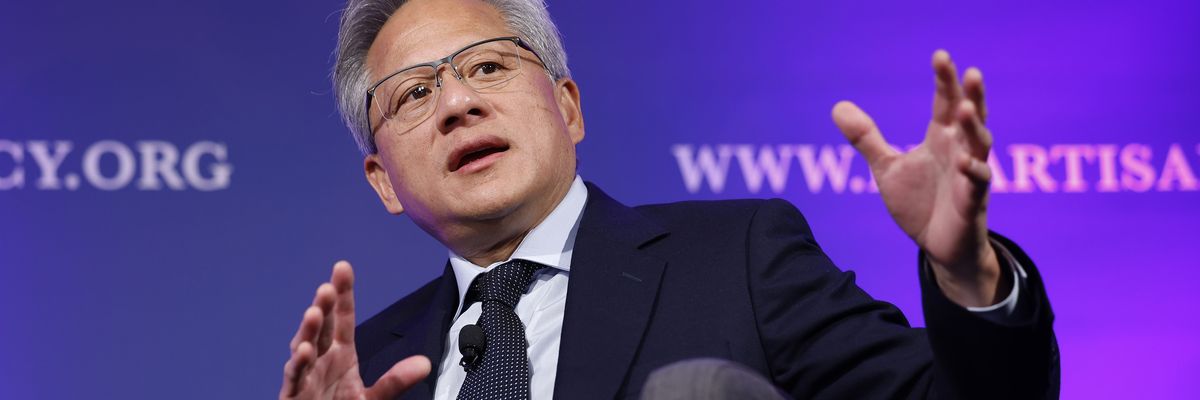
Jensen Huang of Nvidia speaks about the future of artificial intelligence and its effect on energy consumption and production at the Bipartisan Policy Center on September 27, 2024 in Washington, DC. (Photo by Chip Somodevilla/Getty Images)

“The oligarchic dozen is richer than ever, and they are endowed with extreme material power that can be used to pursue narrow political interests at the expense of democratic majorities,” according to the author of a new analysis.

Just 12 U.S. billionaires now have a collective net worth of over $2 trillion—a figure that amounts to a little less than a third of total federal spending in 2023—according to an analysis out Tuesday from Inequality.org, a project of the Institute for Policy Studies (IPS).

The $2 trillion number is also twice the amount of wealth that the top 12 US billionaires held in 2020, according to researchers at IPS, a progressive organization.

The full list of 12 billionaires includes Jeff Bezos, Bill Gates, Mark Zuckerberg, Warren Buffett, Elon Musk, Steve Ballmer, Larry Ellison, Larry Page, Sergey Brin, Jim Walton, Rob Walton, and Jensen Huang.

“This is an unsettling new milestone for wealth concentration in the United States. The oligarchic dozen is richer than ever, and they are endowed with extreme material power that can be used to pursue narrow political interests at the expense of democratic majorities,” wrote the author of the analysis, Omar Ocampo, a researcher at IPS.

New to the “oligarchic dozen” is Jensen Huang, the co-founder and CEO of the tech company Nvidia. Nvidia, which became the most valuable publicly traded company this year, has seen its profits jump thanks to the world’s ravenous appetite for the artificial intelligence chips that the firm produces. According to the analysis, Huang’s personal wealth “has skyrocketed from $4.7 billion in 2020 to $122.4 billion—a mind-boggling 2,504 percent increase—over the last four years.”

Each of the billionaires on the list “owns or is a controlling shareholder of a business that is investing billions of dollars in artificial intelligence,” according to Ocampo, which raises concerns about their respective carbon footprints.

Fueling AI is energy intensive, and AI data centers in the U.S. are largely powered by fossil fuels, meaning their proliferation poses a threat to the environment and a transition to a green economy.

Ocampo also discusses the political reach of the billionaires on the list. Elon Musk and Jeff Bezos, who respectively own X and The Washington Post, “have both purchased large media platforms, which has granted them the ability to set the terms of public debate with the hopes of influencing public opinion in their favor.”

Musk specifically has established himself as a major power broker within the GOP. The billionaire spent hundreds of millions helping to re-elect Donald Trump and is now poised to play a major role in the president-elect’s administration, helping oversee a new advisory committee tasked with slashing government spending.

As of early December, Trump had tapped an “unprecedented” total of seven reported billionaires for key positions in his administration, according to a separate piece of analysis by Inequality.org.

“We see the effects of this growing concentration of wealth and economic inequality everywhere—plutocratic influence on our politics, wealth transfers from the bottom to the top, and the acceleration of climate breakdown,” Ocampo wrote on Tuesday.

Original article by Eloise Goldsmith republished from Common Dreams under Creative Commons (CC BY-NC-ND 3.0).

Continue Reading‘Unsettling New Milestone’: Top 12 US Billionaires Now Control $2 Trillion in Wealth

Global Cooperation Key to Preventing ‘Runaway’ Climate and AI Chaos: UN Chief

Spread the love

Original article by JULIA CONLEY republished from Common Dreams under Creative Commons (CC BY-NC-ND 3.0). 

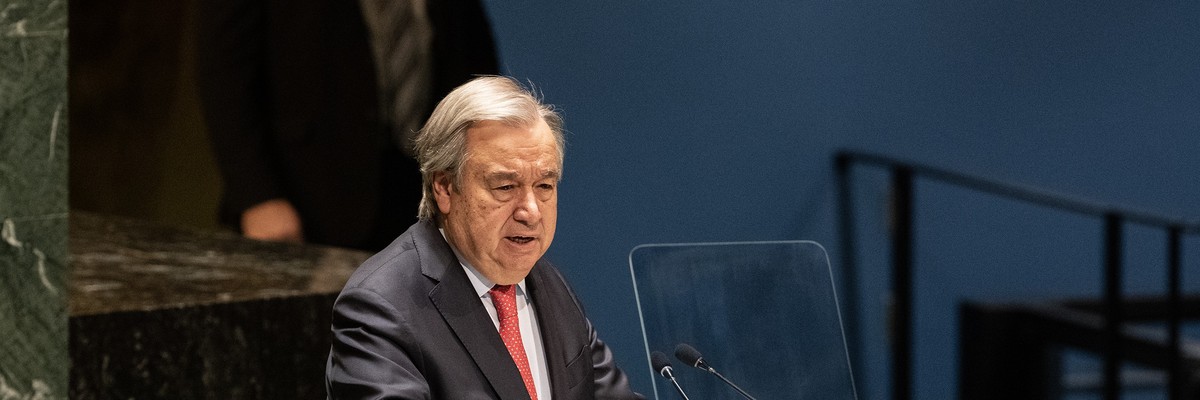
United Nations Secretary-General António Guterres speaks at the U.N. headquarters on February 22, 2023.  (Photo: Lev Radin/Pacific Press/LightRocket via Getty Images)

“Geopolitical divides are preventing us from coming together around global solutions for global challenges,” said United Nations Secretary-General António Guterres.

At the World Economic Forum in Davos, Switzerland on Wednesday, United Nations Secretary-General António Guterres warned that multilateralism that includes often overlooked governments in the Global South is the only solution to the rapidly developing crises posed by the climate emergency and artificial intelligence—both of which are worsening “the global crisis in trust.”

“In the face of the serious, even existential threats posed by runaway climate chaos,” said Guterres, “and the runaway development of artificial intelligence without guardrails, we seem powerless to act together.”

While “droughtsstormsfires, and floods are pummeling countries and communities,” particularly in nations that have contributed the least planet-heating fossil fuel pollution, Guterres told the political and business elite assembled in Davos, “countries remain hellbent on raising emissions.”

He reserved particular scorn for the United States fossil fuel industry, which—amid the Biden administration’s approval of pollution-causing infrastructure including the Willow oil project and the Mountain Valley Pipelinedeceives the public with false climate solutions, misinformation, and greenwashing campaigns “to kneecap progress and keep the oil and gas flowing indefinitely.”

As suffering intensifies in communities that are most vulnerable to drought, damage from extreme weather, and other climate catastrophes, Guterres said, fossil fuel giants and powerful governments are risking lives to only delay an “inevitable” shift to renewable energy.

“The phaseout of fossil fuels is essential,” said the secretary-general. “No amount of spin or scare tactics will change that. Let’s hope it doesn’t come too late.”

As trust between the Global South and wealthy governments is frayed by fossil fuel-producing countries’ refusal to leave oil, gas, and coal behind, Guterres warned that the separate threat of “unintended consequences” of artificial intelligence evolution also looms—for people in rich economies as well as developing countries.

“This technology has enormous potential for sustainable development,” said the U.N. chief, while noting that “some powerful tech companies are already pursuing profits with a clear disregard for human rights, personal privacy, and social impact.”

Guterres’ comments came days after the International Monetary Fund (IMF) released a new analysis of AI’s expected impact on the global economy and workers, with nearly 40% of the labor market expected to be “exposed” to AI.

In wealthy countries, about 60% of jobs are projected to be impacted by AI, and about half of those workers are likely to see at least some of their primary tasks being completed by AI tools like ChatGPT or similar technology, “which could lower labor demand, leading to lower wages, and reduced hiring,” according to the IMF. “In the most extreme cases, some of these jobs may disappear.”

The analysis released Sunday noted that the rapidly changing field could worsen inequality within countries, as some higher earners may be able to “harness AI” and leverage its use for increases in their productivity and pay while those who can’t fall behind.

“In most scenarios, AI will likely worsen overall inequality, a troubling trend that policymakers must proactively address to prevent the technology from further stoking social tensions,” said the IMF. “It is crucial for countries to establish comprehensive social safety nets and offer retraining programs for vulnerable workers.”

Guterres called on policymakers to work closely with the private sector—currently “in the lead on AI expertise and resources”—to “develop a governance model” for AI that is focused on “monitoring and mitigating future harms.”

A systematic effort is also needed, said the secretary-general, “to increase access to AI so that developing economies can benefit from its enormous potential.”

Along with the IMF and Guterres, global human rights group Amnesty International this week raised alarm about AI and the “urgent but difficult task” of regulating the technology, noting that in addition to changing how people and companies work, AI has the potential to be “used as a means of societal control, mass surveillance, and discrimination.”

Police agencies in several countries have begun using AI for so-called “predictive policing,” attempting to prevent crimes before they’re committed, while officials have also deployed automated systems to detect fraud, determine who can and can’t access healthcare and social assistance, as well as to monitor migrants’ and refugees’ movement.

Amnesty credited the European Union with making headway in regulating AI in 2023, closing out the year by reaching a landmark agreement on the AI Act, which would take steps to protect Europeans from the automation of jobs, the spread of misinformation, and national security threats.

The AI Act, however, has been criticized by rights groups over its failure to ban mass surveillance via live facial recognition tools.

“Others must learn from the E.U. process and ensure there are not loopholes for public and private sector players to circumvent regulatory obligations, and removing any exemptions for AI used within national security or law enforcement is critical to achieving this,” said Amnesty.

In Davos on Wednesday, Guterres expressed hope that policymakers will agree on climate, AI, and other solutions that center human rights in the coming year, including at the U.N.’s Summit of the Future, planned for September.

“These two issues—climate and AI—are exhaustively discussed by governments, by the media, and by leaders here in Davos,” said Guterres. “And yet, we have not yet an effective global strategy to deal with either. And the reason is simple. Geopolitical divides are preventing us from coming together around global solutions for global challenges.”

“The only way to manage this complexity and avoid a slide into chaos,” he said, “is through a reformed, inclusive, networked multilateralism.”

Original article by JULIA CONLEY republished from Common Dreams under Creative Commons (CC BY-NC-ND 3.0). 

Continue ReadingGlobal Cooperation Key to Preventing ‘Runaway’ Climate and AI Chaos: UN Chief