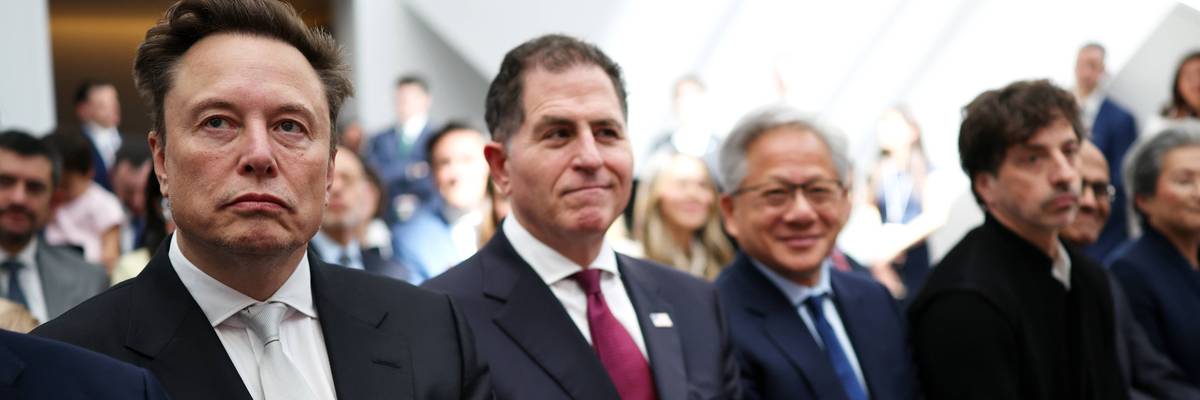
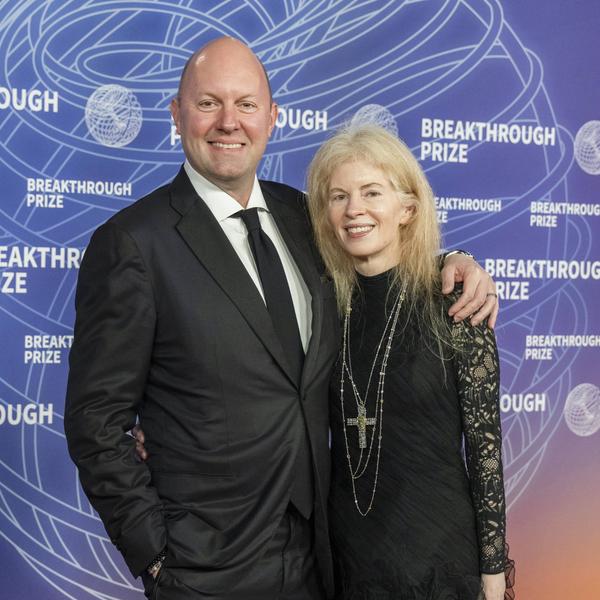
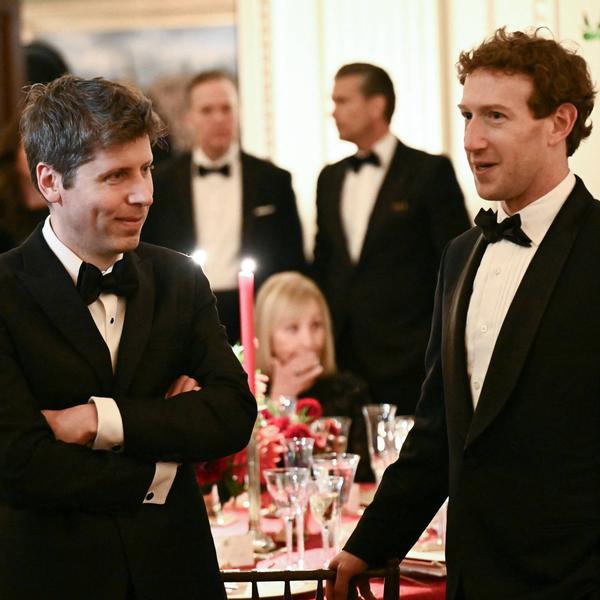
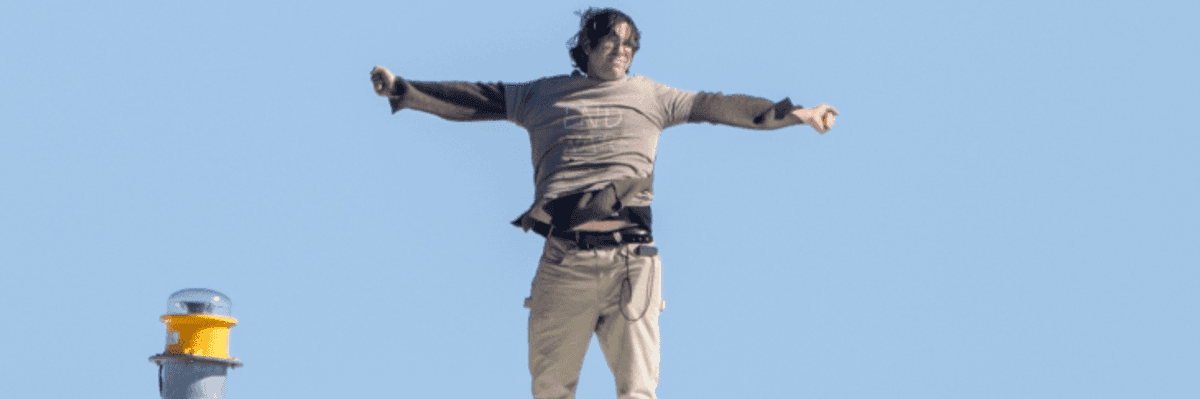
SpaceX CEO Elon Musk, CEO of Dell Technologies Michael Dell, Nvidia CEO Jensen Huang, and co-founder of Google Sergey Brin attend the Golden Age of American Innovation Summit on October 8, 2026 in Washington, DC.(Photo by Win McNamee/Getty Images)
“Trump and his anti-AI regulation posture is dragging the party to a politically suicidal place,” said one Democratic strategist.
American voters’ antipathy toward Big Tech companies has become a central theme of campaigns in the 2026 midterm elections, according to an analysis published by The Guardian on Thursday.
The Guardian noted that hundreds of midterm campaign ads attacking data centers have aired over the past two months, with both Republicans and Democrats accusing one another of being pawns of the artificial intelligence industry.
“And it’s not only data centers,” The Guardian added. “The public anxiety over AI and distaste for the billionaires developing it, as well as backlash over encroaching tech like surveillance cameras, has turned the tech industry into a ubiquitous villain this election cycle.”
Silicon Valley has become a punching bag for politicians even as Big Tech moguls have been throwing record sums of money to elect politicians sympathetic to their needs.
Super political action committees (PACs) “funded by tech billionaires are among the top spenders in this election cycle,” The Guardian explained. “Leading the Future, formed by OpenAI president Greg Brockman and venture capitalist Marc Andreessen, has raised more than $75 million to back tech-friendly candidates. [SpaceX CEO] Elon Musk has sunk $366 million into Republican causes, more than he spent on the 2024 presidential election.”
Much of the Big Tech money has been going toward Republican candidates this cycle, even though the industry has traditionally had close ties with elected Democrats.
Texas Democratic US Senate candidate James Talarico in recent days has been trying to turn Big Tech money being spent against him into an advantage, highlighting in particular the outsize role that Musk is playing funding the campaign of his Republican rival, Texas Attorney General Ken Paxton.
After Musk on Wednesday used his platform X to declare that “there is something deeply wrong with Talarico,” the Texas Democrat quickly returned fire.
“There is something deeply wrong with a political system,” Talarico wrote, “that allows one trillionaire to buy his own personal US senator.”
A report published by The Atlantic on Monday examined how the tech industry’s embrace of President Donald Trump during his second term has given Democrats an incentive to pummel the industry, particularly when polls show a bipartisan hostility to AI data centers.
In fact, Democratic strategists told The Atlantic that data centers have proven to be a top wedge issue capable of getting normally loyal GOP voters to think twice before voting for a Republican candidate.
“Trump and his anti-AI regulation posture is dragging the party to a politically suicidal place,” Democratic strategist Rob Flaherty told The Atlantic. “They are grabbing the wrong side of an 80–20 issue at exactly the wrong time.”
Democratic strategists started pushing the party to take a more populist approach toward the tech industry when polling data “showed surprising concern about AI” even in traditionally conservative rural districts, The Atlantic reported.
Rishi Bharwani, US director of tech regulation advocacy group Reset Tech, said much has changed since Democrats under former President Barack Obama embraced the industry as a positive force for society.
“What we all experienced was a ton of growth in the tech sector, the creation of numerous new billionaires, and even the world’s first trillionaire,” said Bharwani, “and a bunch of working families basically recognizing that they’re not sharing. These tech companies are actually undermining their economic security and their safety.”
Orcas discuss rotting brain, front Orca says Sundown Syndrome is a dead givaway and he wishes someone would Lock Him UpClimate science denier Donald Trump confirms that he knows nothing about democracy and that more liquid gold is being secured according to his policy of global privateering.Orcas discuss Donald Trump and the killer apes’ concept of democracy. Front Orca warns that Trump is crashing his country’s economy and that everything he does he does for the fantastically wealthy.
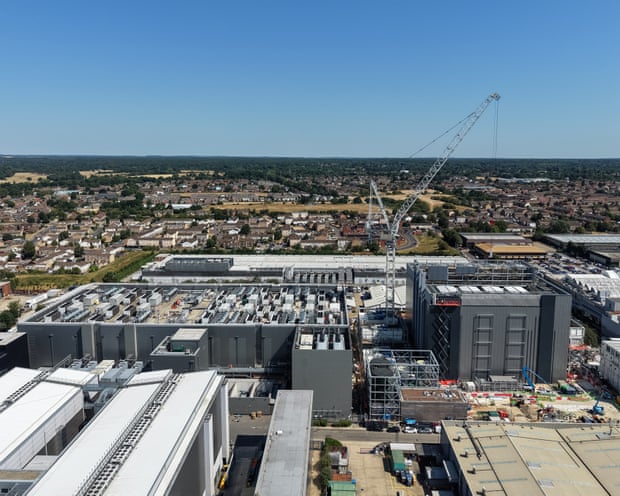
Equinix datacentre under construction (right) and an operational datacentre (left) in Slough. Photograph: Bloomberg/Getty Images
Government says Green leader’s proposed moratorium on ‘energy-guzzling’ AI projects would be disaster for economy
Labour has rejected calls to pause construction of major AI infrastructure in Britain after the Green party leader, Zack Polanski, said it was time to “slam the brakes on these energy-guzzling, water-guzzling datacentres”.
The government hit back at the opposition party’s proposal of a “moratorium other than [for] local-scale datacentres for the local community”, saying it “would be a disaster for jobs and national security”.
The Greens’ call for a pause comes amid one of the UK’s worst droughts in years and predictions that datacentres’ electricity use, now standing at about 2.5% of the UK’s supply, will rise fourfold by 2030.
Datacentres contain the processing chips that power billions of AI prompts every day and Labour has designated them as critical national infrastructure, a decision Polanski called “outrageous”. “To most people critical infrastructure means hospitals, water, electricity,” he said. “It doesn’t mean artificial intelligence.”
He added: “Right now the government is putting our communities, our water security and our climate ambitions second to the demands of tech giants.”
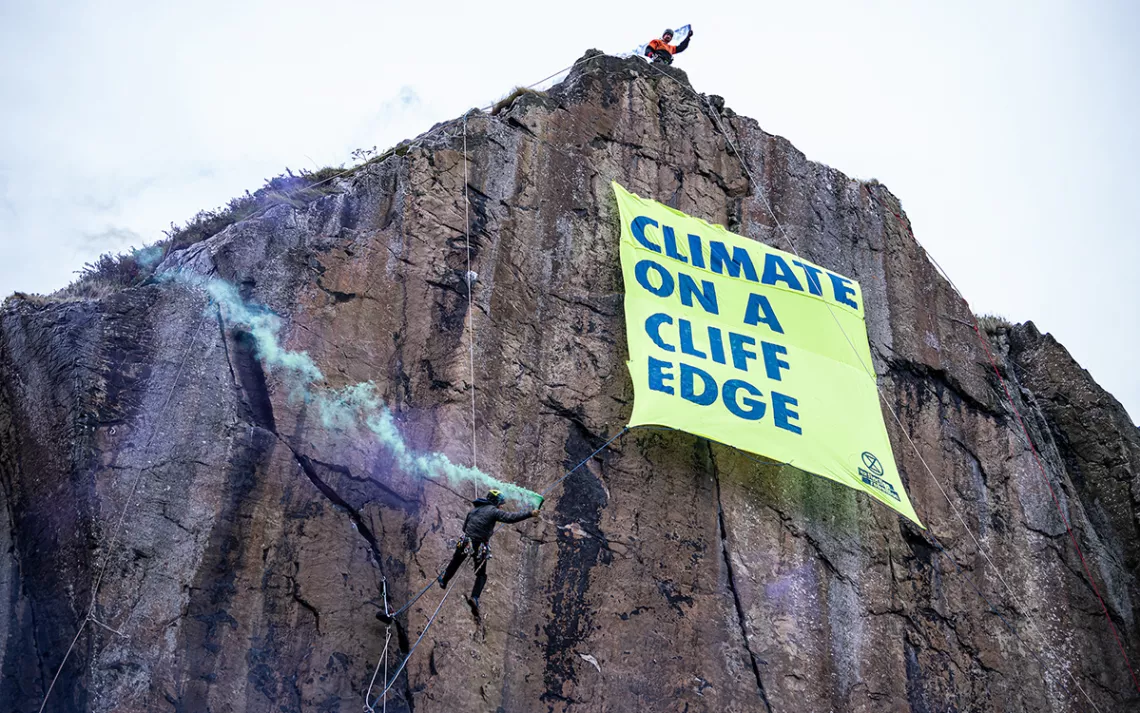
Experienced climbers scale a rock face near the historic Dumbarton castle in Glasgow, releasing a banner that reads “Climate on a Cliff Edge.” One activist, dressed as a globe, symbolically looms near the edge, while another plays the bagpipes on the shores below. | Photo courtesy of Extinction Rebellion and Mark RichardsGreenpeace activists display a billboard during a protest outside Shell headquarters on July 27, 2023 in London. (Photo: Handout/Chris J. Ratcliffe for Greenpeace via Getty Images)Donald Trump urges you to be a Climate Science denier like him. He says that he makes millions and millions for destroying the planet, Burn, Baby, Burn and Flood, Baby, Flood.
Meta CEO Mark Zuckerberg shows a prototype of computer glasses in Menlo Park, California on September 25, 2024. (Photo: Andrej Sokolow/picture alliance via Getty Images)
Anthropic CEO Dario Amodei said on Sunday that Americans distrust Big Tech because they “always suspect that we are cooking up some new way to screw them over.”
Opposition to artificial intelligence data centers has exploded across the US in 2026, as a recent Annenberg Public Policy Center poll showed that more than 60% of Americans say they are against building AI facilities in their areas.
However, a new survey highlighted by Futurism on Sunday shows that the AI industry has bigger problems than just the unpopularity of data centers.
As Futurism noted, the poll by CNBC found widespread distrust of artificial intelligence CEOs among Americans between the ages of 18 and 34.
In fact, more than two-thirds of respondents said they did not trust Palantir CEO Alex Karp, Alphabet CEO Sundar Pichai, Anthropic CEO Dario Amodei, OpenAI CEO Sam Altman, Meta CEO Mark Zuckerberg, Nvidia CEO Jensen Huang, or SpaceX CEO Elon Musk to responsibly expand the use of AI.
“Those are some appalling approval ratings,” commented Futurism, “reflecting the massive swing in popularity the tech industry has experienced over the last decade, driven by concerns around data privacy, the purposeful decay of once-useful platforms, and the erosion of democracy.”
The survey comes amid signs that the AI industry knows it faces a significant deficit in public opinion.
Anthropic boss Amodei wrote a social media post on Sunday acknowledging that “the public has a negative view of AI,” which he said was “fundamentally a crisis of trust.”
“I think that ordinary people don’t trust companies, governments, or the tech industry and always suspect that we are cooking up some new way to screw them over,” wrote Amodei. “The causes of this go back decades and AI is just the latest iteration of it.”
The Anthropic CEO added that he didn’t think any positive public relations campaign could turn around people’s perception of the industry, and he said that one of the few ways it could gain trust was “actually curing cancer.”
The rapid expansion of AI data centers, pushed by President Donald Trump, has provoked grassroots campaigns in communities across the country, with people loudly opposing the facilities that have been linked to high household electricity bills, massive water consumption, and few, if any, long-term job opportunities.
Amodei’s musings about AI’s unpopularity came days after Zuckerberg published a 6,500-word manifesto, in which he pushed back on AI developers who believe the technology will “eliminate most jobs and much of humanity’s relevance,” while insisting that Meta would develop “personal superintelligence for everyone” that would put “power in people’s hands” rather than taking it away.
However, Zuckerberg’s promises of a benevolent AI future drew skepticism from TechCrunch AI editor Russell Brandom, who argued in an essay published last week that the Meta chief’s manifesto would fall on deaf ears given his own toxic reputation. Meta was recently ordered to pay nearly $1 billion in fines due to its products’ harms to children and teens.
“Suffice it to say, Facebook as a product and Zuckerberg as a person are both unpopular with the US public,” wrote Brandom. “A recent survey found that 64% of Americans believe social media has been harmful to democracy and a similar percentage believe it should be more heavily regulated, numbers that cut evenly across partisan lines.”
People’s own past experience with social media, Brandom continued, is a big reason why they are revolting against Big Tech’s ambitions to use AI to remake society.
“The public does not trust tech executives to make sure new technologies like this have a positive impact on society,” Brandom explained. “Instead of acknowledging that and trying to win back their trust, this essay demonstrates over and over again how the trust was lost in the first place.”
Brandom cited Zuckerberg’s discussion of human lawyers eventually being replaced by AI as particularly problematic, given that enabling chatbots to engage in litigation could result in a wave of nuisance lawsuits that would clog up the legal system.
“It’s hard to feel calm about any of this stuff,” commented Brandom, “and the fact that Zuckerberg isn’t worried makes me more worried.”
Climate science denier Donald Trump confirms that he knows nothing about democracy and that more liquid gold is being secured according to his policy of global privateering.Donald Trump sings and dances, says that it’s fun to kill everyone … unless he gets distracted or falls asleep.
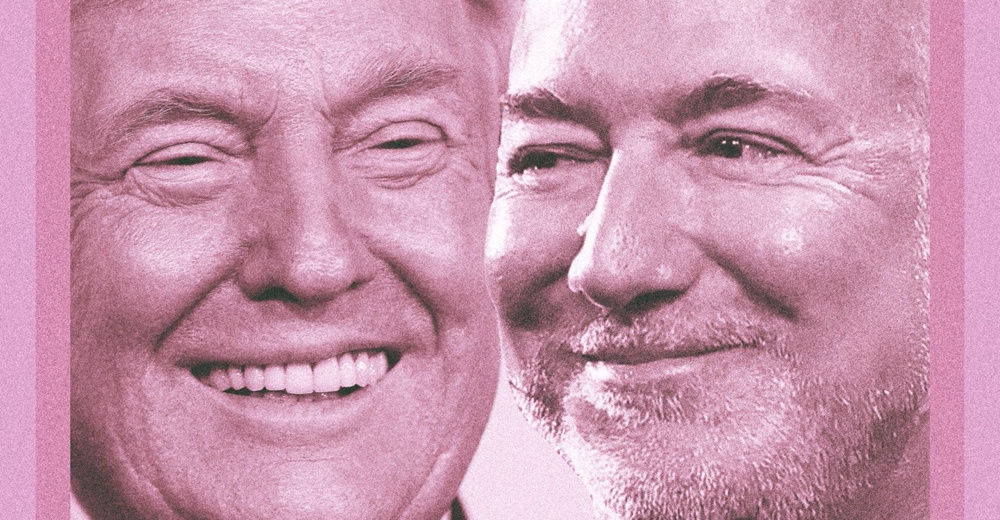
It’s been an eventful year since Washington Post owner Jeff Bezos tapped Adam O’Neal for the prestigious job of Post Opinions editor. O’Neal was an unusual hire, a 33-year-old with little by way of managerial experience. But O’Neal had a redeeming quality: He was ready to shill for Bezos, and the man Bezos has been desperately wooing, President Donald Trump.
It’s remarkable how far Bezos has come since 2013, when he said he purchased the Post from the Graham family out of a sense of civic duty.
Bezos was still singing a similar tune nearly midway through Trump’s first term, telling Axel Springer CEO Mathias Döpfner (4/28/18), “I would be humiliated to interfere” with the Post’s coverage. “I would be so embarrassed. I would turn bright red…. It would feel icky; it would feel gross.”
But days before the 2024 election, with Trump looking like he might return to the White House, Bezos apparently got over his queasiness and personally spiked the Post’s endorsement of Kamala Harris (FAIR.org, 10/30/24). “Trump was thrilled, advisers said, and later thanked Bezos,” the Wall Street Journal (7/2/26) reported.
Bezos followed up by declaring that Post Opinions would now promote “personal liberties and free markets,” while “viewpoints opposing those pillars will be left to be published by others.” Coming a month into Trump’s second term, this came across as another gift to the president (FAIR.org, 2/28/25).
‘Unapologetically patriotic’
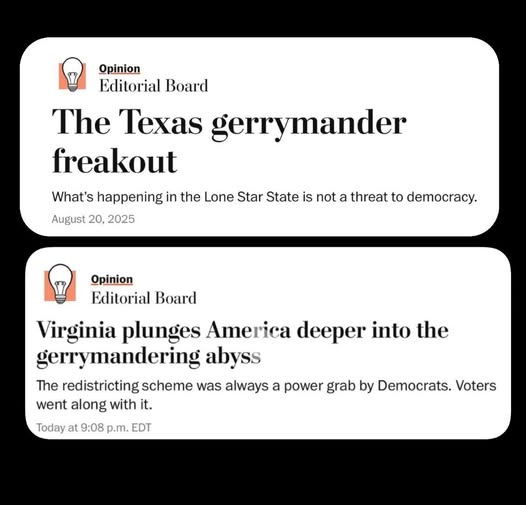
When Texas did a mid-census gerrymander in 2025, the Washington Post (8/20/25) urged Democrats to “hold the apocalyptic warnings about the end of democracy.” When Virginia followed suit in 2026, the Post‘s message (4/21/26) to Democrats was ” spare us the false sanctimony about democratic norms.”
To lead the newly oriented Opinions page, Bezos tapped O’Neal, who had been a correspondent for the Economist, editorial writer for the Wall Street Journal and executive editor at the conservative Dispatch for just one year.
In that last role—apparently O’Neal’s only newsroom managerial experience—he quickly alienated the Dispatch staff. “He was a competent editor who had no idea how to talk to another human being,” a former associate of O’Neal’s told Status (7/18/25):
He was tough on reporters, sure, but that’s common in newsrooms. He just couldn’t express even the most minor thing without being abrasive, hostile or raising his voice.
After being named to his post in June 2025, O’Neal declared that Post Opinions would be “unapologetically patriotic” and “communicate with optimism about this country.” This echoed Bezos, who declared a month into Trump’s second term, “I am of America and for America, and proud to be so.” Bezos was, of course, echoing Trump’s “America first” rhetoric.
O’Neal has demonstrated his patriotism by overseeing an editorial page that has backed Trump in destroying the East Wing of the White House (10/25/25), kidnapping the Venezuelan president (“one of the boldest moves a president has made in years”—1/3/26), militarily taking over DC (8/11/25; FAIR.org, 8/14/25), and unprecedented gerrymandering (8/20/25). (When Democrats responded in kind, the Post decried the “power grab”—4/21/26).
The Post’s pro-Trump boosterism under O’Neal has been so over the top, wrote Chris Lehmann (TheNation, 2/4/26), it’d “be a stretch for Pravda to pull off.”
“I try to avoid reading what the opinions section publishes,” a current Post staffer told Status (5/10/26). “I can’t tell if some of these arguments are being made in good faith or not. Sometimes it just seems like rage bait.”
‘Being reconciled is not enough’
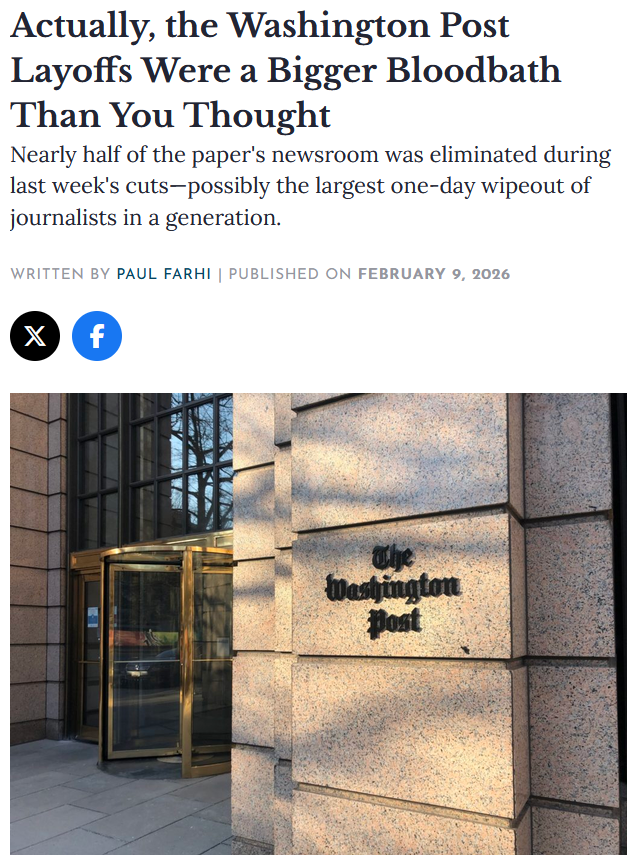
Former Washington Post media writer Paul Farhi (Washingtonian, 2/9/26) described Bezos’ layoffs as “disfiguring…with whole sections and departments—sports, books, staff photography—wiped away, and devastating cuts inflicted on its Metro section and foreign bureaus.”
While O’Neal’s predecessor, David Shipley, did everything Bezos could have asked for—spiking the Post’s Harris endorsement and a cartoon depicting Bezos and other tech moguls as Trump supplicants (FAIR.org, 1/7/25)—he did it without zeal, which Bezos found intolerable. “I suggested to him that if the answer wasn’t ‘hell yes,’ then it had to be ‘no,’” Bezos wrote, in explaining Shipley’s February 2025 resignation.
Shipley had voiced concern over the direction Bezos was taking the Post, warning the billionaire that spiking the Harris endorsement days before the election and yanking Opinions rightward could turn off subscribers. “I don’t care,” Bezos replied (New York Times, 3/14/26). (Shipley proved correct; Bezos’ interventions led to over 375,000 Post readers canceling their subscriptions—NPR, 1/30/26.)
Replacing Shipley, O’Neal wasted little time in transforming Opinions’ editorial outlook, and its personnel. In his first email to the Opinions desk, O’Neal encouraged his colleagues to get with the program or quit, mimicking Bezos’ message to Shipley. “Simply being reconciled to these changes is not enough,” O’Neal wrote. “We want those who stick with us to be genuinely enthusiastic about the new direction and focus.”
The paper’s last full-time Black Opinions columnist, Karen Attiah, was fired in September 2025 (Golden Hour, 9/15/25; FAIR.org, 9/23/25). (Theodore R. Johnson of New America writes roughly once a week as a contributing columnist, but is not on staff.)
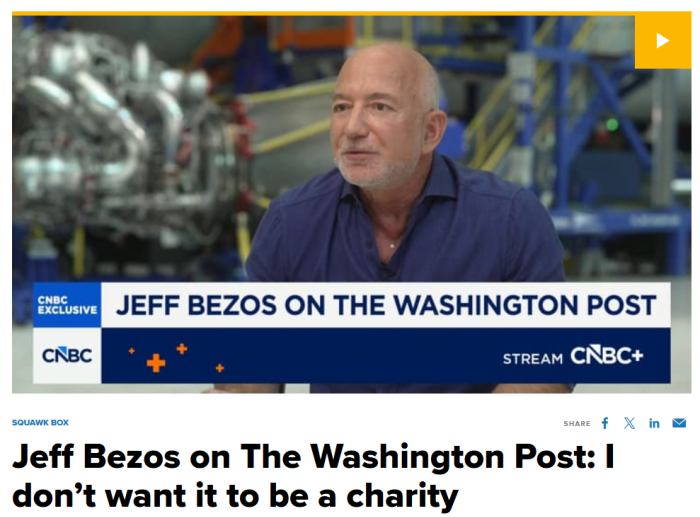
Jeff Bezos (CNBC, 5/20/26): “The [Washington] Post needs to be a profitable enterprise that stands on its own two feet.” Bezos could cover the Post‘s annual losses by spending 0.04% of his wealth—the equivalent of a typical US household spending $77 a year to maintain a fishtank. Bezos hollowed the Post out further in February when he laid off nearly half of the newsroom, in what “may have been the biggest one-day wipeout of journalists in a generation” (Washingtonian, 2/9/26).
Publicly, Bezos claimed he was doing this for the long-term viability of the paper. To be relevant, the Post has to be a “profitable enterprise that stands on its own two feet,” Bezos told Andrew Ross Sorkin (CNBC, 5/20/26). Otherwise, “it would be like poetry without rhyming.”
Privately, however, Bezos told Trump that Post employees “are terrible…. They don’t listen. My other companies, they listen,” according to New York Times reporters Maggie Haberman and Jonathan Swan’s new book Regime Change.
To make the Post more like his other companies, Bezos needed “hell yes” management, like Adam O’Neal (and former publisher Will Lewis).
O’Neal, in turn, needed fellow travelers, and seems to have hired exclusively MAGA-friendly columnists. According to media critic Adam Johnson (Real News Network, 5/22/26), the Post
purged its opinion page of its actually popular writers and replaced them with charmless Economist and Wall Street Journal also-rans so they can spew libertarian cliches [and] tedious anti-woke screeds.
‘A whole bunch of incredible miracles’
Jeff Bezos (Financial Times, 6/11/26): “Six thousand years ago, somebody invented the plow, and we all got wealthier.” Actually, the invention of agriculture impoverished most people, resulting in humans losing 5–6 inches of height due to malnutrition (Discover, 5/87).
O’Neal’s fealty to Bezos is most blatant in Opinions’ approach to artificial intelligence.
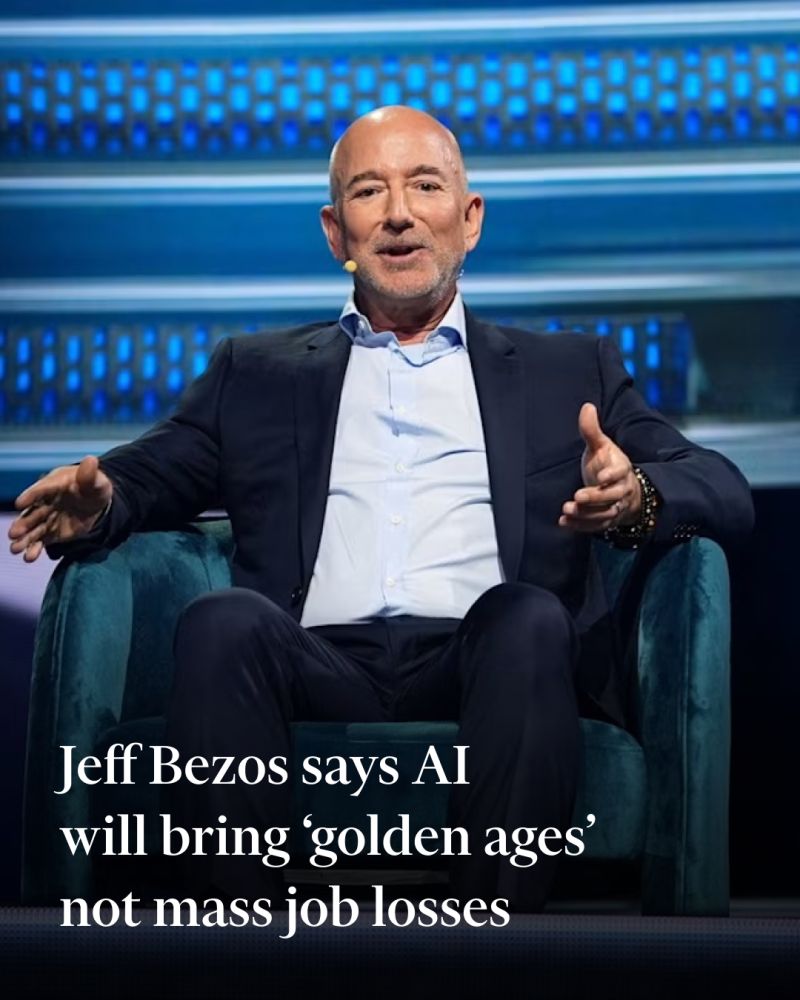
“All of the things that I work on today have something to do with AI,” Bezos told the Financial Times (6/11/26). “We’re in the middle of multiple golden ages right now, certainly with AI,” he continued, sounding every bit the snake oil salesman. “I think you’re going to see a whole bunch of incredible miracles unfold here in the next decade.”
And Bezos is banking on these miracles to expand his empire on earth and in space. Despite being worth a quarter-trillion dollars, Bezos is presently scouring the globe to raise $100 billion for a new fund that plans to buy companies in industrial sectors and improve them using AI (Forbes, 3/19/26). Bezos’ latest effort aligns neatly with his new role as co-CEO of Project Prometheus, a low-profile AI company that’s raised $18 billion in funding (Morning Brew, 6/12/26).
Meanwhile, Amazon—the company Bezos founded, where he remains the largest shareholder and executive chair—“recently placed a series of staggeringly expensive bets on artificial intelligence, audacious even by the standards of Silicon Valley’s ongoing trillion-dollar AI bacchanalia,” Bloomberg reported (5/14/26).
With so much on the line, Bezos has little patience for doomsayers who fear AI will cause mass job loss—the very thing Wall Street is salivating over. Sure, AI will be “shrinking the number of people needed by 10x,” Bezos told the Wall Street Journal (6/11/26). But the technology will in fact create “more than 10x” as many jobs, he said. The suggestion seems to be that more than 90% of us will soon be in hitherto unimagined job categories made possible by artificial intelligence. (Bezos’ fellow tech titans recently started following his lead and saying similar things about AI job losses.)
Despite Bezos’ rosy outlook, “the public isn’t so reassured,” the Journal reported (6/13/26) two days later, citing a Pew Research Center survey from March. “Only 17% of Americans say AI will have an overall positive effect on the US over the next 20 years.”
And the data centers needed to power AI fare little better. “Americans have changed their minds about data centers. Decisively,” reported the outlet Heatmap (6/2/26), which conducted a recent poll. “At least seven in 10 Americans would now oppose a data center being built near their home…a record low.”
Opposition to data centers—and their insatiable demand for power and water—has become “The Most Bipartisan Issue Since Beer,” according to a New York Times headline (5/1/26).
‘Data centers don’t deserve so much hate’
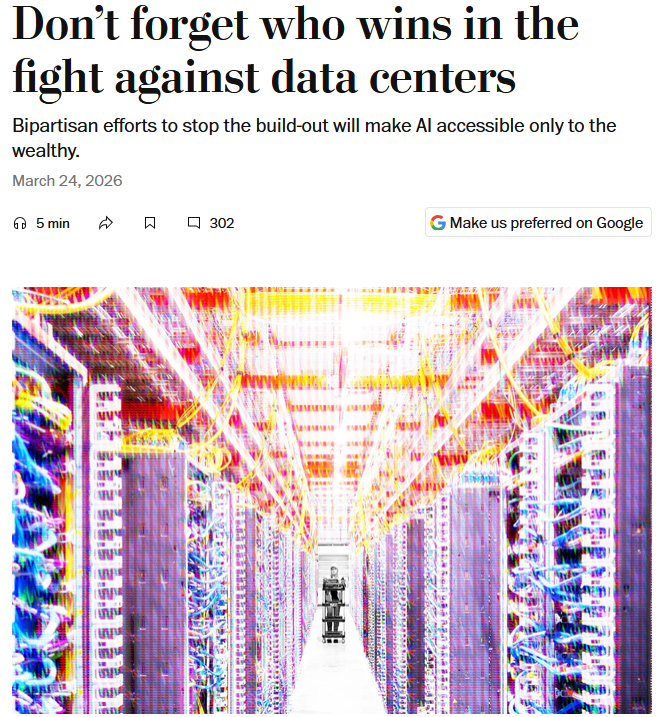
Billionaire-owned paper warns that blocking data centers will only benefit billionaires. (Original headline: “Halting Data Center Construction Will Entrench Inequality”—Washington Post, 3/24/26.)
With the American people on one side of the AI divide, and Bezos and his fellow tech oligarchs on the other, O’Neal has rushed to his boss’s rescue (FAIR.org, 11/20/25). Here are some recent Opinions headlines (a couple have been subsequently altered):
“Halting Data Center Construction Will Entrench Inequality” (3/24/26)
“High Energy Bills? Blame the Trial Lawyers” (4/24/26)
“Blocking the Construction of Data Centers Is a National Security Risk” (5/28/26)
“AI Backlash Threatens to Hold Kids Back” (6/21/22)
“AI Is Sparking a Boom in Blue-Collar Jobs…” (6/22/26)
Beyond the dutiful headlines themselves, the editorials also fail to disclose Bezos’ AI ties—which is not unusual. “What the Post’s data-center cheerleading only intermittently mentions is its owner’s vested interest in the topic,” noted Paul Farhi (Washingtonian, 6/23/26), the Post’s former media reporter. “I was unable to find a single editorial or opinion column opposing [AI data centers’] construction over the past six months.”
One of O’Neal’s top deputies, James Hohmann, took things a step further (while also failing to note Bezos’ ties to AI). Hosting an episode (5/26/26) of Opinions’ new flagship podcast, Make It Make Sense—headlined “Why Data Centers Don’t Deserve So Much Hate”—Hohmann “described climate activists as a ‘cult’ and argued that the media is ‘guilty’ of fueling ‘hysteria’ over climate change,” Status (6/7/26) summarized. It’s a jarring listen; like the keys to a once-storied newspaper have been turned over to the manosphere.
Even as Bezos hollows out the rest of the Post, money is flowing to Make It Make Sense, which has a well-appointed new studio. So far, however, “the investment has produced an astonishingly small audience,” Status reported (5/11/26). “It does feel like this is just for an audience of one,” a former Post staffer told the outlet.
Bernie Sanders, ‘leading Luddite’
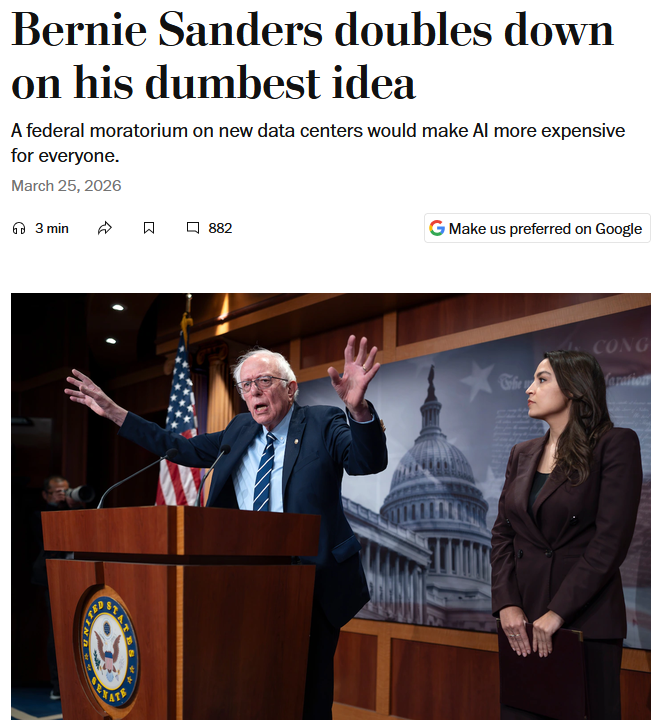
The Washington Post (3/25/26) calls Sen. Bernie Sanders “part of the lunatic fringe” because he wants “safeguards” on a technology whose developers routinely warn “could end humanity” (Nature, 4/21/26).
As grassroots fights against AI data centers spring up from coast to coast, opposition in the Senate is led by Sen. Bernie Sanders, who introduced a bill to place a two-year moratorium on the construction of new data centers.
Already a bête noire of the Post (FAIR.org, 3/8/16), Sanders’s critique of data centers has led to a renewed thrashing. In a March editorial (3/25/26) headlined “Bernie Sanders Doubles Down on His Dumbest Idea,” the Post placed Sanders at “the lunatic fringe” of society for “throwing sand into the gears of progress.” The editorial also called Sanders “the leading Luddite of the 2020s.”
Two weeks later, the Post (4/8/26) returned to the “L” word, this time in an editorial that didn’t mention Sanders, but did associate opposition to data centers with domestic terrorism:
The mob-like movement against data centers that’s been gaining traction across the country took a dark turn this week. Indianapolis Councilor Ron Gibson (D), who supports a project to build such a facility in his district, woke up early Monday to the sound of 13 gunshots fired at his home. The gunman left a note on the lawmaker’s doorstep: “NO DATA CENTERS.”
No one was injured, but the incident illustrates how opposition to artificial intelligence can metastasize into an irrational frenzy. It wouldn’t be the first time in history that deranged Luddites turn to violence to fight the advancement of frontier technology.
Later that month, the Post’s editorial page was back to attacking Sanders. Under a scowling picture of the senator, a Post editorial (4/30/26) charged that Sanders
is as naive now as he was during the Cold War. Rarely, if ever, has the socialist met an enemy of the United States who he doesn’t think he can partner with to advance his agenda. The same impulse that led Sanders to cozy up to the Soviets, the Sandinistas and Fidel Castro in the 1980s was on display again Wednesday night at the Capitol as he invited two Chinese academics to urge Americans to slow-roll our pursuit of artificial intelligence.
“Of course that’s what Beijing wants Washington to do,” the Post continued, in a brazen attempt to paint skepticism of AI data centers—a view held by most Americans—as anti-American.
The Post’s inflammatory editorial mentioned neither Bezos or Amazon, per usual.
The billionaire project
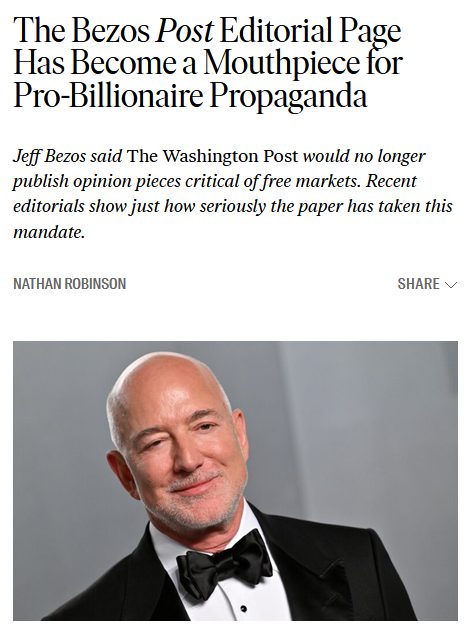
“It’s remarkable how brazen the paper is about shilling for the financial interests of its owner,” writes Nathan Robinson (The Nation, 4/21/26) . “Some of these headlines might as well read ‘Don’t Tax Jeff Bezos More,’ ‘Don’t Let Unions Threaten Jeff Bezos’ Control Over His Workers,’ ‘Don’t Stop Jeff Bezos From Building Data Centers in Your Town.’”
It’s not just Bezos’ financial interests that are advanced by O’Neal’s Opinions page, but also Bezos’ and his fellow billionaires’ broader ideological project (Real News Network, 5/22/26).
Under O’Neal’s watch, no tax on the wealthy seems to go uncensured. “The Post has weighed in on tax policy everywhere from Switzerland to Seattle, lambasting every attempt to reduce the grotesque inequality of our times,” Nathan Robinson wrote in a detailed review of the Post Opinions page for The Nation (4/21/26):
Almost no tax on the rich around the world escapes the paper’s notice—one might wonder why capital gains taxes in the Netherlands are a priority for a DC paper.
And no social program appears too small to earn O’Neal’s ire, not even diapers. In providing 400 free diapers to new parents, “California’s nanny state is taking infantilization to a new level,” decried a Post editorial (5/12/26).
But when government largesse flows to the rich, the Post is more open minded. The Trump administration’s request for another $200 billion for the Iran War, as well as a $1.5 trillion Pentagon budget for next year, both received the Post’s blessing (3/21/26, 5/12/26). “Peace doesn’t come cheap,” the Post wrote.
Left unmentioned in the editorials is that Bezos’ empire—via his space company Blue Origin and Amazon’s cloud computing arm, AWS—holds billions of dollars worth of Pentagon contracts.
FAIR’s work is sustained by our generous contributors, who allow us to remain independent. Donate today to be a part of this important mission.
Guido Reichstadter scaled the Frederick Douglass Memorial Bridge in Washington, DC on Friday, May 1, 2026 in order to protest the Iran War started by the President Donald Trump just over two months ago. (Photo: bystander video/screenshot/via Al-Jazeera)
“I’m at the top of this bridge,” says Guido Reichstadter, “because the government of the United States is engaged in acts of mass murder in my name.”
Forty-five-year-old social justice activist named Guido Reichstadter, on Saturday morning, was still perched atop the Frederick Douglass Memorial Bridge in Washington, DC, after first scaling the structure Friday afternoon in protest against President Donald Trump’s disastrous war against Iran, now in its third month, and the rapid and unregulated spread of artificial intelligencetechnology.
As Reichstadter, who described himself as the father of two children with master’s degrees in both math and physics, said in a video posted to social media on Friday: “Hi, my name is Guido Reichstadter, and I’m currently occupying the top of the Frederick Douglass memorial bridge in Washington, DC.”
“I’m calling on the people of the United States,” he continued, “to bring an immediate end to the Trump regime’s illegal war on Iran and the removal of the regime’s power through mass nonviolent direct action and non-cooperation.”
“I woke up on February 28th, and I found that hundreds of school children had been blown apart. I think there are many millions of Americans who reject the war in principle, but whose actions have not yet been sufficient to bring it to an end.”
In a separate video, he explained he was at the top of the bridge, which rises approximately 168 feet above the Anacostia River at its highest point, “because the government of the United States is engaged in acts of mass murder in my name. And I refuse to be complicit in that.”
While bridge traffic in both directions was closed at times on Friday and overnight, the bridge is reportedly open to traffic Saturday morning, though with some lane restrictions, as law enforcement said a “barricade situation” with the protester continued.
Reichstadter, who has staged high-profile protests in the past, spoke to Al-Jazeera via video stream on Friday to explain his actions and call for an end to the war that he says—and tens of millions of other Americans agree, according to polling—is a colossal failure by the Trump administration.
A 45-year old man is occupying the top of Washington’s Frederick Douglass Memorial Bridge to protest the war on Iran.
Guido Reichstadter spoke to Al Jazeera from atop the structure – here's what he had to say. pic.twitter.com/YzHghEoS8m
“I mean, it’s an atrocity, right?” he said when asked what motivated him. “I woke up on February 28th, and I found that hundreds of school children had been blown apart. I think there are many millions of Americans who reject the war in principle, but whose actions have not yet been sufficient to bring it to an end.”
Democratic members of Congress, both in the US House and Senate, have now brought several War Powers Resolutions to the floor in an effort to end the US attack on Iran, which now includes a naval blockade of the country, but Republican majorities in both chambers, backing Trump, have thwarted those efforts.
End the wars Bring down the Trump regime Stop AI Revolutionary nonviolent non-cooperation with evil is our right, power & responsibility pic.twitter.com/Fwbwl5STy0
— Guido Reichstadter (@wolflovesmelon) May 1, 2026
Poll after poll, meanwhile, shows that Reichstadter is completely correct in stating that millions of people “reject the war,” but still the war continues even after a 60-day deadline, according to the War Powers Act of 1973, which says the president must either end military operations or get the explicit approval of Congress, which came and went on Friday.
On Friday, a video showed Reichstadter wearing a t-shirt that read “NO WAR” and unfurling a large black banner along the side of the bridge’s central arch as part of the protest.
Before scaling the bridge, Reichstadter also spoke with journalist Ford Fisher to explain his motivations and what he hoped to accomplish with his one-person direct action:
Reichstatder stayed on the bridge overnight, even as fireworks exploded overhead from a nearby Major League Baseball game.
NOW: Even as anti-war protester Guido Reichstadter remains on top of the adjacent bridge, fireworks are fired from a barge in the river as the nearby Washington Nationals Baseball game concludes. https://t.co/DFkhA6zABGpic.twitter.com/8HWUl7fjWL
In his statement concerning AI, Reichstadter said he wanted to “urgently warn the people of the US and the world of the imminent danger we are in of crossing a point of no return towards the development of artificial intelligence, which poses the risk of catastrophic harm to humanity, including human extinction.”
“I call on the governments of the world to take immediate action to end this danger by permanently banning the development of artificial general intelligence and machine super intelligence,” he said. “I also call on the people of the world to exert all possible influence through nonviolent action to compel their governments to end this danger with all possible speed.”
Donald Trump sings and dances, says that it’s fun to kill everyone …Donald Trump explains why he established his Bored of PeaceOrcas discuss Donald Trump and the killer apes’ concept of democracy. Front Orca warns that Trump is crashing his country’s economy and that everything he does he does for the fantastically wealthy.