This work by Middle East Monitor is licensed under a Creative Commons Attribution-NonCommercial-ShareAlike 4.0 International License.
UN special rapporteur on the Palestinian territories, Francesca Albanese speaks during a press conference at the European Parliament in Brussels, Belgium on November 19, 2025. [Dursun Aydemir – Anadolu Agency]
A member of the European Parliament (MEP), Matjaz Nemec, publicly presented on Tuesday the nomination of UN Special Rapporteur on the occupied Palestinian territories, Francesca Albanese, and Gaza-based doctors for the 2026 Nobel Peace Prize, following its official submission to the Norwegian Nobel Committee, Anadolu reports.
The nomination was signed by nearly 300 eligible proposers from 33 countries, including Brazil, South Africa, Canada, Australia, New Zealand, and the United Kingdom, according to a statement shared by Nemec on US social media company X.
Nemec said the nomination “is an expression of respect for the courage, efforts, and perseverance of individuals who defend fundamental human values in the most difficult circumstances” and “represents a contribution to peace that transcends political divisions.”
He highlighted Albanese’s work in upholding international law and human rights, noting that she continues her mission despite facing “strong political pressure” and sanctions from Israel and the United States.
“Francesca Albanese holds up a mirror to us all and is firmly committed to international law and the foundations we built in response to the greatest massacre in human history – World War II,” he said.
The nomination also includes Gaza-based doctors, such as Dr. Hussam Abu Safiya and Dr. Sara Al-Saqqa, who risk their lives amid armed conflict to carry out medical duties.
Nemec said: “With the health infrastructure completely destroyed and the acute shortage of basic necessities, they realize the values of humanity, solidarity and peace every day by saving lives and adhering to medical ethics, and they more than deserve this kind of award.”
The lawmaker emphasized that the global campaign for the nomination calls on the international community and political leaders worldwide to respect international law, human rights, and human dignity under all circumstances.
Since Oct. 10, the Israeli army has committed hundreds of ceasefire violations, killing at least 391 Palestinians and injuring 1,063 others, according to the latest figures by the Gaza Health Ministry.
Israel has killed more than 70,600 people, mostly women and children, and injured over 171,100 others in attacks in Gaza since October 2023.
Genocide denier and Current UK Prime Minister Keir Starmer is quoted that he supports Zionism without qualification. He also confirms that UK air force support has been essential in Israel’s mass-murdering genocide. Includes URLs https://www.declassifieduk.org/keir-starmers-100-spy-flights-over-gaza-in-support-of-israel/ and https://youtu.be/O74hZCKKdpAOrcas discuss Genocide-supporting and complicit Zionists. Donald Trump, Keith Starmer, David Lammy, Rachel Reeves, Angela Rayner and Wes Streeting are acknowledged as evil genocide-complicit and supporting cnuts.Keir Starmer objects to criticism of the IDF. He asks how could anyone object to them starving people to death, forced marches like the Nazis did, bombing Gaza’s hospitals and universities, mass-murdering journalists, healthworkers and starving people queuing for food, killing and raping prisoners and murdering children. He calls for people to stop obstructing his genocide for Israel.
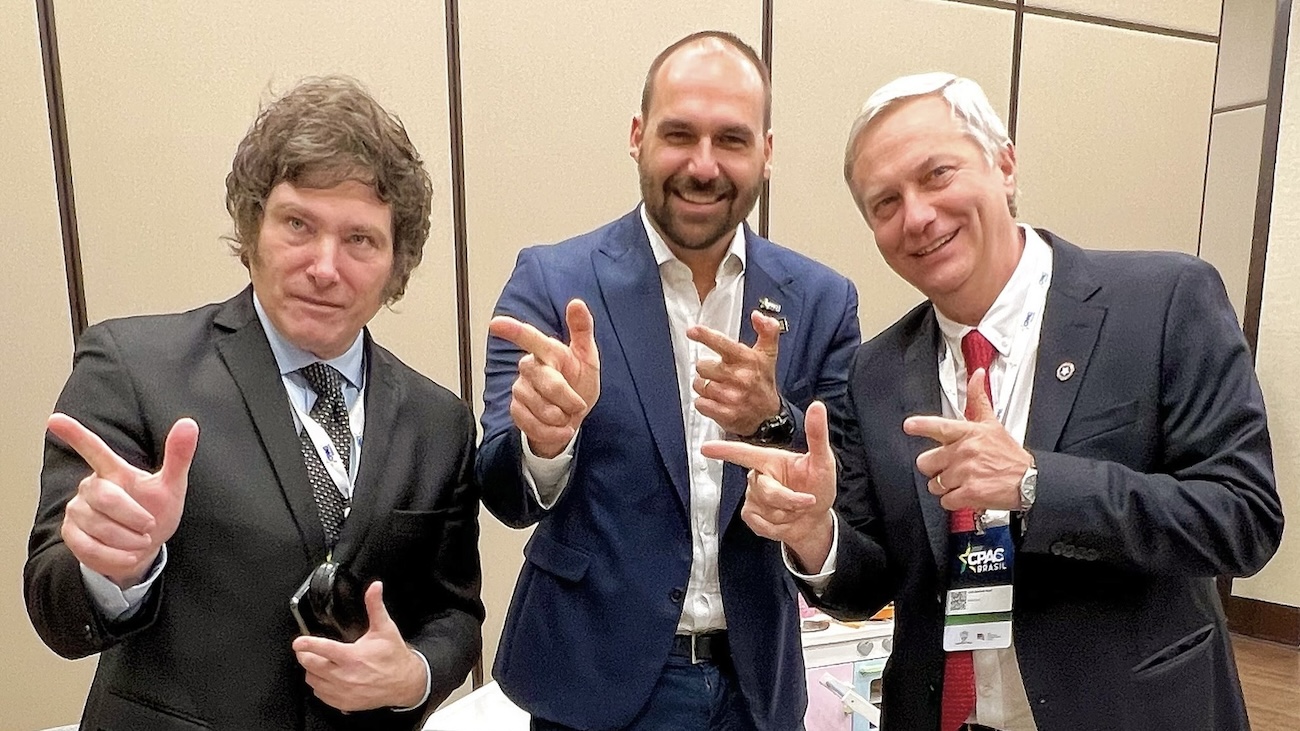
Argentine President Javier Milei, Brazilian legislator Eduardo Bolsonaro, and Chilean far-right presidential candidate José Antonio Kast at CPAC Conference in 2022. Photo: Eduardo Bolsonaro / X
The far right in Latin America is angry. Brazil’s Jair Bolsonaro and Argentina’s Javier Milei always look furious, and they always speak loudly and aggressively. Testosterone leaks from their pores, a toxic sweat that has spread across the region. It would be easy to say that this is the impact of Donald Trump’s own brand of neo-fascism, but this is not true. The far right has much deeper pedigrees, linked to the defense of the oligarchical families that have roots in the colonial era across the virreinatos (viceroyalties) from New Spain to Rio de la Plata. Certainly, these far right men and women are inspired by Trump’s aggressiveness and by the entry of Marco Rubio, a furious defender of the far right in Latin America, to the position of US Secretary of State. This inspiration and support are important but not the reason for the return of the far right, an angry tide that has been growing across Latin America.
On the surface, it looks as if the far right has suffered some defeats. Jair Bolsonaro is in prison for a very long time because of his role in the failed coup d’état on January 8, 2023 (inspired by Trump’s own failed coup attempt on January 6, 2021). In the first round of the presidential election in Chile, the candidate of the Communist Party, Jeannette Jara won the most votes and will lead the center-left bloc into the second round (December 14). Despite every attempt to overthrow the government of Venezuela, President Nicolás Maduro remains in charge and has mobilized large sections of the population to defend the Bolivarian Revolution against any threats. And, in late October 2025, most of the world’s countries voted for a UN General Assembly resolution that demands an end to the blockade on Cuba. These indicators – from Bolsonaro’s imprisonment to the vote on Cuba – suggest that the far right has not been able to move its agenda in every place and through every channel.
However, beneath the surface, there are indications that Latin America is not seeing the resurgence of what had been called the Pink Tide (after the election of Hugo Chávez in Venezuela in 1998) but is experiencing the emergence of an angry tide that slowly has begun to sweep the region from Central America down to the Southern Cone.
Elections in South America
The first round of the Chilean presidential election produced a worrying result. While Jara of the Communist Party won 26.85% of an 85.26% turnout, the far right’s José Antonio Kast came in second with 23.92%. Evelyn Matthei of the traditional Right won 12.5%, while the extreme right candidate who was once with Kast and now to his right, Johannes Kaiser, won 14%. It is likely that Jara will pick up some of the votes of the center, but not enough to overcome the advantage of the far right which looks to have at least more than 50% of the voters on its side. The so-called social liberal, Franco Parisi, who came in third, endorsed Kast in 2021 and will likely endorse him again. That means that in Chile, the presidency will be in the hands of a man of the far right whose ancestry is rooted in German Nazism (Kast’s father was a member of the Nazi Party who escaped justice through the intercession of the Vatican) and who believes that the dictatorship in Chile from 1973 to 1990 was on balance a good idea.
North of Chile, in Bolivia, the new president Rodrigo Paz Pereria, son of a former president, beat the far right’s Jorge Tuto Quiroga (a former president) in the second round of the election. This round had no candidate of the left, after the Movement for Socialism governed Bolivia continuously from 2006 to 2025. Paz’s own party has a minority position in the legislature and he will therefore have to align himself with the Quiroga’s Libre coalition and he will likely adopt a pro-US foreign policy and a libertarian economic policy. Peru will have its own election in April, where the former mayor of Lima – Rafael López Aliaga – is expected to win. He rejects the label far right but adopts all the generic policies of the far right (ultra-conservative Catholic, advocate for harsh security measures, and favors a libertarian economic agenda). Iván Cepeda of Colombia is the left’s likely candidate in their presidential election in May 2026, since Colombia does not permit second terms (so President Gustavo Petro cannot run again). Cepeda will face strong opposition from Colombia’s oligarchy which will want to return the country to their rule. It is too early to say who Cepeda will face, but it might be journalist Vicky Dávila, whose far right opposition to Petro is finding traction in unexpected parts of Colombian society. It is likely that by the middle of 2026, most of the states along the western edge of South America (from Chile to Colombia) will be governed by the far right.
Even as Bolsonaro is in prison, his party, the PL (or Liberal Party), is the largest bloc in Brazil’s National Congress. It is likely that Lula will be re-elected to the presidency next year due to his immense personal connection with the electorate. The far right’s candidate – who could be possibly Tarcísio de Freitas, the governor of São Paulo state, or one of the Bolsonaro’s (wife Michelle or son Flavio) – will struggle against him. But the PL will make inroads into the Senate. Their control over the legislature has already tightened the reins on the government (at COP30, Lula’s representative made no proposals to confront the climate catastrophe), and a Senate win will further their control over the country.
Common agenda of the angry tide
The Angry Tide politicians who are making waves have many things in common. Most of them are now in their fifties – Kast (born 1966), Paz (born 1967), Venezuelan politician María Corina Machado (born 1967), and Milei (born 1970). They came of age in the post-dictatorship period in Latin America (the last dictatorship to end was in Chile in 1990). The decade of the 1990s continued the economic stagnation that characterized the 1980s: the Lost Decade (La Década Perdida) that convulsed these countries with low growth rates and with poorly developed comparative advantages forced into globalization. It was in this context that these politicians of the Angry Tide developed their common agenda:
Anti-Communism. The far right in Latin America is shaped by an anti-left agenda that it inherits from the Cold War, which means that its political formations typically endorse the era of US-backed military dictatorships. The ideas of the left, whether from the Cuban Revolution (1959) or from the era of the Pink Tide (after 1998), are anathema to these political forces; these ideas include agrarian reform, state-led finance for industrialization, state sovereignty, and the importance of trade unions for all workers and peasants. The anti-communism of this Angry Tide is rudimentary, mother’s milk to the politicians and used cleverly to turn sections of society against others.
Libertarian Economic policies. The economic ideas of the Angry Tide are shaped by the Chilean “Chicago Boys” (including Kast’s brother Miguel who was the head of General Augusto Pinochet’s Planning Commission, his Minister of Labor, and his head of the Central Bank). They directly take their tradition from the libertarian Austrian School (Friedrich Hayek, Ludwig von Mises, and Murray Rothbard as well as Milton Friedman). The ideas were cultivated in well-funded think tanks, such as the Centro de Estudios Macroeconómicos de Argentina (founded in 1978) and the Chilean Centro de Estudios Públicos (founded in 1980). They believe the State should be a force to discipline the workers and citizens, and that the economy must be in the hands of private interests. Milei’s famous antics with a chainsaw illuminate this politics not only of cutting social welfare (the work of neoliberalism) but of destroying the capacity of the State itself.
Culture Wars. Drawing on the wave of anti-gender ideology and anti-migration rhetoric, the Angry Tide has been able to appeal to conservative evangelical Christians and to large sections of the working class that has been disoriented by changes seen to come from above. The far right argues that the violence in working class neighborhoods created by the drug industry is fostered by “liberalism” and that only tough violence (as demonstrated by El Salvador’s president Nayib Bukele) can be the solution; for this reason, they want to strengthen the military and police and set aside constitutional limitations on use of force (on October 28, the government of Bolsonaro ally Cláudio Castro in Rio de Janeiro sent in the police who killed at least 121 people in Operation Containment). It helps the far right that it adopted various conspiracy theories about how the “elites” have spread “globalized” ideas to damage and destroy the “culture” of their nations. This is a ludicrous idea coming from far right and traditional right political forces that champion full-scale entry of US corporations into their society and culture, and that have no respect for the histories of struggle of the working class and peasantry to build their own national and regional cultural worlds. But the Angry Tide has been able to construct the idea that they are cultural warriors out to defend their heritage against the malignancies of “globalization”. Part of this culture war is the promotion of the individual entrepreneur as the subject of history and the denigration of the necessity of social reproduction.
It is these three elements (anti-communism, libertarian economic policies, and the culture wars) that brings together the far right across Latin America. It provides them with a robust ideological framework to galvanize sections of the population to believe that they are the saviours of the hemisphere. This Latin American far right is backed by Trump and the international network of the Spanish far right (the Foro Madrid, created in 2020 by Fundación Disenso, the think tank of the far right Vox party). It is heavily funded by the old elite social classes, who have slowly abandoned the traditional Right for these new, aggressive far right parties.
Crisis of the Left
The Left is yet to develop a proper assessment of the emergence of these parties and has not been able to drive an agenda that sparkles with vitality. A deep ideological crisis grips the Left, which cannot properly decide whether to build a united front with the traditional right and with liberals to contest elections or to build a popular front across the working class and peasantry to build social power as a prelude to a proper electoral push. The example of the former strategy (the electoral alliance) comes from Chile, where first the Concertación de Partidos por la Democracia (Concertación) formed in 1988 to keep out the parties of the dictatorship from power and second the Apruebo Dignidad formed in 2021 that brought Gabriel Boric of the centrist Broad Front to the presidency. But outside Chile, there is little evidence that this strategy works. The latter has become harder as unionization rates have collapsed, and as uberization individualizes the working class to erode working class culture.
It is telling that Bolivia’s former socialist Vice President Álvaro García Linera looked northwards to New York City for inspiration. When Zohran Mamdani won the mayor’s race, García Linera said, “Mamdani’s victory shows that the left must commit to boldness and a new future.” It is hard to disagree with this statement; although, Mamdani’s own proposed agenda is mostly to salvage a worn-out New York infrastructure rather than to advance the city to socialism. García Linera did not mention his own time in Bolivia, when he tried with former president Evo Morales to build a socialist alternative. The left will have to be bold, and it will have to articulate a new future, but it will have to be one that emerges from its own histories of building struggles and building socialism.
Donald Fuhrump says that Amerikkka doesn’t bother with crimes or charges anymore, not being 100% Amerikkkan and opposing his real estate intentions is enough.
Indigenous activists participate in a climate protest during the COP30 U.N. Climate Summit, November 17, 2025, in Belem, Brazil
CLIMATE activists slammed the lack of a meaningful deal as the United Nations Cop30 climate talks in Belem, Brazil, came to a close on Saturday.
The negotiators pledged more funding for countries to adapt to extreme weather. But the catch-all agreement doesn’t include explicit details to phase out fossil fuels or strengthen countries’ inadequate emissions-cutting plans, which dozens of nations demanded.
After the deal was approved, Cop30 president Andre Correa do Lago said that the tough discussions will continue under Brazil’s leadership until the next annual conference “even if they are not reflected in this text we just approved.”
UN secretary-general Antonio Guterres said the deal shows “that nations can still come together to confront the defining challenges no country can solve alone.”
He said: “I cannot pretend that Cop30 has delivered everything that is needed. The gap between where we are and what science demands remains dangerously wide.”
Amnesty International slammed the deal, accusing the leaders of placing “profit over people” and saying it lacked “accountability and transparency.”
Amnesty said that “the final document avoided any mention of fossil fuels, the primary driver of climate change, failing to build on or even to reaffirm the commitment to ‘transition away’ from fossil fuels agreed upon in Cop28.
“A record number of fossil fuel lobbyists at Cop30 showed who had the real access, leaving humanity, especially those already the most marginalised, to suffer the deadly consequences of their plans to continue fossil fuel expansion and to be the ones to pump the last barrel of oil,” said Amnesty climate justice adviser Ann Harrison.
The Elders group of former world leaders said: “Cop30 didn’t deliver the results needed. Major emitters have blocked a roadmap to phase out fossil fuels.”
Orcas discuss Donald Trump and the killer apes’ concept of democracy. Front Orca warns that Trump is crashing his country’s economy and that everything he does he does for the fantastically wealthy.Donald Trump urges you to be a Climate Science denier like him. He says that he makes millions and millions for destroying the planet, Burn, Baby, Burn and Flood, Baby, Flood.Nigel Farage urges you to ignore facts and reality and be a climate science denier like him and his Deputy Richard Tice. He says that Reform UK has received £Millions and £Millions from the fossil fuel industry to promote climate denial and destroy the planet.
Fossil fuel lobbyists in the Canadian delegation include representatives of the Canadian Association of Petroleum Producers (CAPP), a lobby group that represents Canada’s oil and natural gas producers. Credit: C2C Journal
Delegation’s composition consistent with new KBPO report revealing this year’s U.N. climate talks have the largest number of fossil fuel lobbyists to date.
Lobbyists and representatives of Canada’s oil and gas industry are part of Canada’s official delegation to this year’s U.N. climate talks in Brazil, in keeping with the high number of fossil fuel representatives in attendance at the summit.
About a dozen individuals representing fossil fuel interests were part of the 240-person Canadian delegation, according to documents reviewed by DeSmog as well as a Nov. 12 Canadian Press article.
“Fossil fuel lobbyists have no place at the U.N. climate negotiations,” Emilia Belliveau, program manager of energy transition with Environmental Defence, said in a statement to DeSmog.
“Their presence here with official badges from Canada undermines the work of Canadians attending COP30 who are genuinely working to advance climate action,” she said.
This year’s U.N. climate talks have the single largest share of fossil fuel lobbyists in attendance to date. Some 1,600 people — or one out of every 25 attendees — are fossil industry or related lobbyists, according to an analysis by Kick Big Polluters Out (KBPO), an alliance of climate and justice organizations that push to remove fossil fuel companies and their lobbyists from influencing climate negotiations and policymaking.
The presence of so many Canadian fossil fuel sector representatives exemplifies the report’s findings.
“It demonstrates the extent by which the current government is aligned with oil industry interests,” Patrick Bonin, the Bloc Québécois’ environment and climate change critic, said in a statement to DeSmog.
“The oil and gas industry is the biggest lobby in Canada,” Bonin continued, “so it’s like inviting the fox into the henhouse … Giving them access to the delegation gives them far greater influence than regular participants.”
Fossil fuel lobbyists in the Canadian delegation include representatives of the Canadian Association of Petroleum Producers (CAPP), a lobby group that represents Canada’s oil and natural gas producers; Tourmaline Oil, Canada’s largest natural gas producer; CarbonAi; the International Emissions Trading Association (IETA), the Global CCS Institute; and the gas industry advocacy group Energy for a Secure Future.
Huge Industry Presence
KBPO’s analysis reveals that fossil fuel lobbyists at COP30 outnumber every national delegation except for Brazil, the host country. The number of lobbyists also represents a 12 percent increase over last year’s COP conference held in Baku, Azerbaijan.
Fossil fuel lobbyists received two-thirds more passes to COP30 than the total number of delegates from the 10 most climate-affected nations on Earth, the KBPO report said. This highlights “how industry presence continues to dwarf that of those on the frontlines of the climate crisis,” KBPO said in a statement that accompanied the report’s release.
The influence of major trade associations at COP30 is palpable, with the IETA bringing 60 representatives, including delegates from oil and gas giants ExxonMobil, BP, and TotalEnergies. These associations are “a primary vehicle for fossil fuel influence, according to a KBPO statement.
Kathleen Sullivan, global managing director with IETA, is in the COP30 Canadian delegation. It also includes Jay Averill, assistant vice president of communications with CAPP; Scott Volk and Tim Shaw of Tourmaline Oil; and Todd Smith, Ontario’s former energy minister who advocated for an expansion of nuclear power. Smith left office in August 2024 to become vice president of marketing and business development with CANDU Energy Inc., a manufacturer of nuclear reactors.
The Canadian delegation also includes several representatives from Energy for a Secure Future, a lobby group that advocates for continued fossil fuel use to ensure “energy affordability.” The group states on their website that “our gas energy can respond to the needs of our friends around the world who are facing punishing energy costs and are left with options that drive up global emissions.”
Canadian “Carbon Bombs”
However, Canada’s natural gas industry is a major contributor of rising global emissions. The nation’s natural gas resources have been described as “carbon bombs” for their potential to release billions of tonnes of CO2 into the atmosphere, according to a 2024 DeSmog article.
“The spectacle of Canada’s COP delegation [serving as] a Trojan horse for fossil fuel interests like Tourmaline and the CAPP is shocking,” said James Browning, executive director of F Minus, a climate accountability group. F Minus recently issued a report detailing numerous conflicts of interest that have resulted from Canadian environmental organization sharing lobbyists who also serve major polluters.
“Lobbying decisionmakers in secret is really just another day at the office for these climate denialists, given the failure of Canada’s lobbyist disclosure system to fully capture the extent of their dealings with Canadian officials,” Browning said in a statement to DeSmog.
“COP may be 5,000 kilometres away, but the deeper scandal here is that Tourmaline’s and CAPP’s lobbyists enjoy a similar, extraordinary level of secrecy in their meetings with government officials every day in Ottawa,” he said.
CAPP has misled the public about emissions from Canada’s oil and gas sector, and has campaigned against anti-greenwashing laws. Heather Feldbusch, one of Pierre Poilievre’s campaign’s inner circle, was formerly a lobbyist with Alberta Counsel Inc., which represents Tourmaline.
“At the COP negotiations two years ago, governments took a historic step by committing to transition away from fossil fuels in energy systems in a just, orderly, and equitable manner,” Keith Stewart, senior energy strategist with Greenpeace Canada, said in a statement to DeSmog. “By including fossil fuel lobbyists in our official delegation, Canada is undermining that global effort and risks being seen as negotiating in bad faith.”
“CAPP has been fighting against effective climate action for decades and should be shown the door, not the red carpet,” he added.
Another organization with a stake in fossil fuels included in the Canadian delegation is the Global CCS Institute, a carbon capture advocacy group based in Australia. Critics have long argued that carbon capture is an expensive false solution designed to give fossil fuel production an air of social acceptability. Canadian Prime Minister Mark Carney has used the term “low carbon oil” in reference to carbon capture, despite experts arguing that the term is nonsense.
“Inviting fossil fuel lobbyists into global climate negotiations is as misguided as letting the tobacco industry write health policy, and Canada is compounding the problem by weakening its own greenwashing rules” Sabaa Khan, director general, Quebec and Atlantic Canada, with the David Suzuki Foundation, said in a statement to DeSmog.
DeSmog reached out to Keean Nembhard, press secretary for Canadian environment minister Julie Dabrusin, but did not receive a statement by press time.
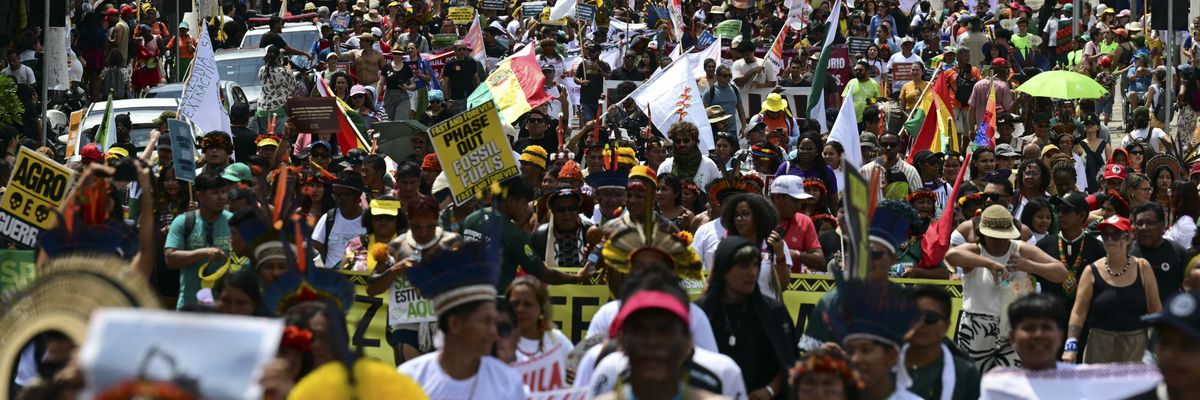
Thousands of people take part in the so-called “Great People’s March” in the sidelines of the COP30 UN Climate Change Conference in Belem, Para State, Brazil on November 15, 2025. Tens of thousands of people attended the march to demand “real solutions” to human-caused global warming , and which comes at the halfway point of contentious COP30 negotiations following two Indigenous-led protests that disrupted proceedings earlier in the week. (Photo by Pablo Porciuncula / AFP via Getty Images)
“It is time to put these old fuels where they belong—in the ground of history.”
An estimated 50,000 people took to the streets of Belém do Pará, Brazil, on Saturday to demonstrate outside the halls of the United Nations annual climate summit, holding a “Great People’s March” and makeshift “Funeral for Fossil Fuels” as they demanded a just transition toward a more renewable energy system and egalitarian economy.
Organized by civil society organizations and Indigenous Peoples groups from Brazil and beyond, the tens of thousands who marched outside the thirtieth Conference of the Parties (COP30) summit called for an end to the rapacious greed of the oil, gas, and coal companies as they advocated for big polluters to pay for the large-scale damage their businesses have caused worldwide over the last century.
“We are tens of thousands here today, on the streets of Belém, to show negotiators at COP30 that this is what people power looks like,” said Carolina Pasquali, executive director of Greenpeace Brazil, said as the march took hold. “Yesterday we found out that one in every 25 COP30 participants is a fossil fuel lobbyist, proportionally a 12% increase from last year’s COP. How can the climate crisis be solved while those creating it are influencing the talks and delaying decisions? The people are getting fed up–enough talking, we need action and we need it now.”
The report by the Kick Big Polluters Out coalition last week showed that at least 1,600 lobbyists from the fossil fuel industry are present at the conference, making it the second-largest delegation overall, second only to Brazil’s, the host nation.
“It’s common sense that you cannot solve a problem by giving power to those who caused it,” said Jax Bongon from the Philippines-based IBON International, a member of the coalition, in a Friday statement. “Yet three decades and 30 COPs later, more than 1,500 fossil fuel lobbyists are roaming the climate talks as if they belong here. It is infuriating to watch their influence deepen year after year, making a mockery of the process and of the communities suffering its consequences.”
While the overwhelming presence of fossil fuel lobbyists has once again diminished hopes that anything worthwhile will emerge from the conference, the tens of thousands in the streets on Saturday represented the ongoing determination of the global climate movement.
João Talocchi, co-founder of Alianza Potência Energética Latin America, one of the key groups behind the “Funeral for Fossil Fuels” portion of the day’s action—which included mock caskets for the oil, gas, and coal companies alongside parades of jungle animals, wind turbines, and solar panels representing what’s at stake and the better path forward—noted the key leadership of Indigenous groups from across the Global South.
“From the Global South to the world, we are showing what a fair and courageous energy transition must look like,” said Talochhi.
Ilan Zugman, director of 350.org in Latin America and the Caribbean, noted the significance of the demonstration, including the symbolism of the funeral procession.
“We march symbolically burying fossil fuels because they are the root of the crisis threatening our lives,” explained Zugman. “Humanity already knows the way forward: clean energy, climate justice, and respect for the peoples who protect life. What is missing is political courage to break once and for all with oil, gas, and coal. It is time to put these old fuels where they belong—in the ground of history.”
With the COP30 at its midway point, climate activists warn that not nearly enough progress is being made, with the outsized influence of the fossil fuel industry one of the key reasons that governments, year after year and decade after decade, continue to drag their feet when it comes to taking the kind of aggressive actions to stem the climate crisis that scientists and experts say is necessary.
“We are taking to the streets because, while governments are not acting fast enough to make polluters pay for their climate damages at COP30, extreme weather events continue to wreak havoc across the globe,” said Abdoulaye Diallo, co-head of Greenpeace International’s “Make Polluters Pay” campaign. “That is why we are here, carrying the climate polluters bill, showing the projected economic damages of more than $5 trillion from the emissions of just five oil and gas companies over the last decade.”
“Fossil fuel companies are destroying our planet, and people are paying the price,” said Diallo. “Negotiators must wake up to the growing public and political pressure to make polluters pay, and agree to new polluter taxes in the final COP30 outcome.”




 Indigenous activists participate in a climate protest during the COP30 U.N. Climate Summit, November 17, 2025, in Belem, Brazil