COP 30’s Agrizone showcases the very companies responsible for the environmental crisis

Spread the love

Original article by Landless Rural Workers’ Movement republished form peoples dispatch under a Creative Commons Attribution-ShareAlike 4.0 (CC BY-SA) license.
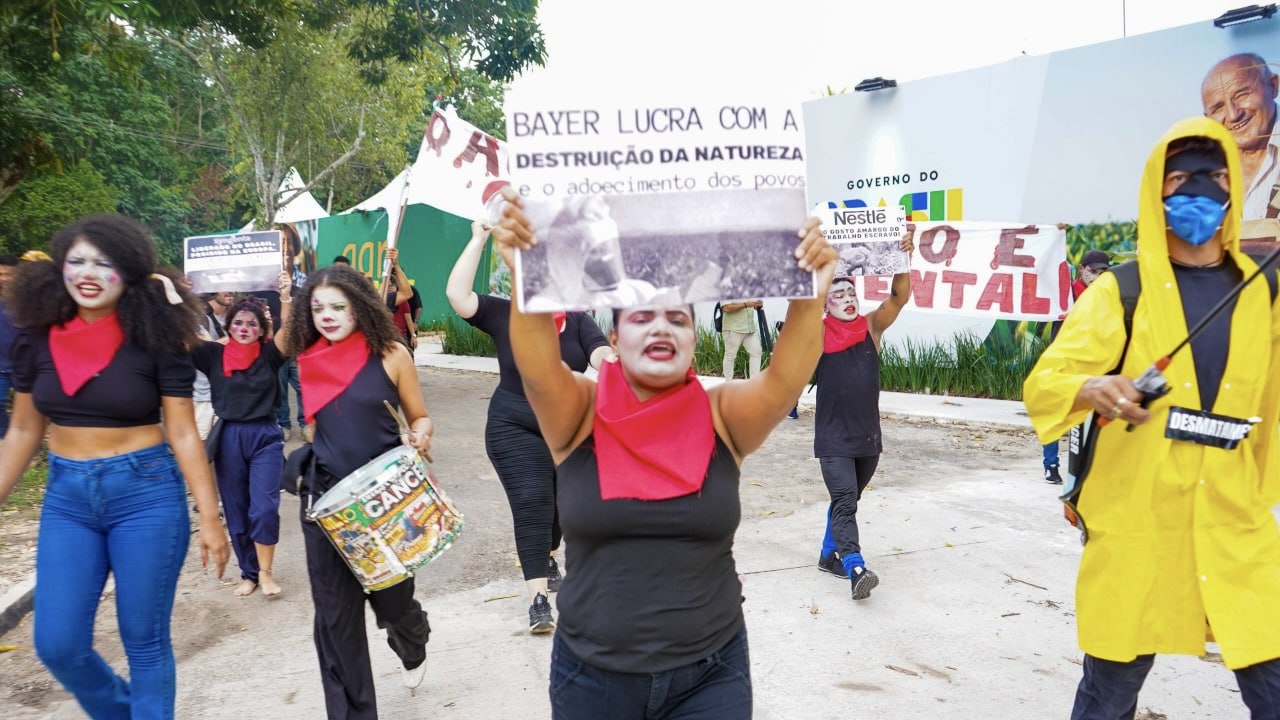
MST activists held a protest on November 11 in the Agrizone at COP 30, an area dedicated to discussions related to agribusiness. The action aimed to denounce agribusiness as the main driver of the environmental crisis in Brazil. Photo: @alain.grao / COP30 Collaborative Coverage

Embrapa’s event at the Climate Conference is sponsored by giants such as Bayer, Nestlé, and Syngenta, accused of practices that exacerbate socio-environmental damage

The United Nations Climate Conference COP30, is currently underway in Belém, Brazil and will conclude on November 21. It has become increasingly clear that, just as the Landless Rural Workers’ Movement (MST) and several other organizations, movements, collectives, and groups warned, agribusiness is at the forefront of the supposed search for solutions to the environmental crisis. This, in itself, sheds light on the fact that the Conference has become a large business expo, in which the assets will be our territories, communities, and nature.

According to Embrapa itself (the Brazilian Agricultural Research Corporation, a state entity), Agrizone is “a large showcase of technologies, science, and international cooperation focused on sustainable agriculture and the fight against hunger in a context of climate change.” However, in practice, the space will serve as a stage for agribusiness to do business, promote its image, and increase its profits – at the expense of the destruction of nature, the concentration of land, and the expulsion of peasant communities and traditional peoples. Under the discourse of “sustainability,” what we will see is the old logic of exploitation disguised as green.

Starting with its sponsors. It is unthinkable that a space that claims to combat hunger and the environmental crisis would have Bayer, Nestlé, and OCP among its financiers. These are three companies that directly contribute to the deepening of the environmental crisis. In 2024, Bayer had to pay more than USD 2 billion in compensation to a man in the US who was proven to have contracted cancer because of one of its main products: the pesticide Roundup. The product is no longer sold in that country, but in Brazil it circulates freely. It is estimated that the company faces 170,000 similar lawsuits.

One of the panels that Nestlé will lead at Agrizone is called “Remodeling food in Brazil.” This is a very suggestive title, given that the company is already engaged in this “remodeling” – at the expense of the health of the Brazilian people. According to the company’s own criteria, 54% of its sales are products with very low health ratings. In this context, it has already been proven that the Swiss company adds more sugar to its products destined for Africa and Latin America.

Office Chérifien des Phosphates (OCP) is a Moroccan state-owned company focused on the extraction of phosphate, which is mainly used in the production of pesticides. The company holds 70% of global phosphorus reserves. However, most of its production comes from the Bou Craa mine in Western Sahara, a country under colonial occupation by the Moroccan kingdom. In other words, OCP literally maintains its production at the expense of looting and stealing minerals that belong to the people of the Sahara.

Agrizone panels will be dominated by giants that plunder nature

The giants of agribusiness, the ultra-processed food industry, and mining, in addition to sponsoring Agrizone, will also dominate the debate panels at the event.

Syngenta, together with Itaú Bank, will coordinate the panel “Cooperation for long-term financing in the restoration of degraded areas.”

The question to be asked is whether the transnational corporation is willing to restore areas that it itself degrades? After all, the company is responsible for a quarter of the market for profenofos, an insecticide used mainly on corn, soybean, cotton, and other crops. It turns out that this pesticide “is extremely harmful to aquatic organisms, birds, and bees. It is a powerful neurotoxin (similar to sarin gas) that can affect brain development in humans, especially in children,“ said Laurent Gaberell, head of agriculture and biodiversity at the NGO Public Eye, which published a report on the subject. In Brazil, Syngenta’s largest market, ”profenofos residues are found in the drinking water of millions of people,” the report points out.

It is also worth remembering that Syngenta was responsible for the murder of Keno, an MST activist, in 2015, in Paraná. The murder took place in a field of illegal Syngenta transgenic experiments in the city of Santa Tereza do Oeste, western Paraná, near the Iguaçu National Park. The area was occupied by about 150 members of Via Campesina. The activists were shot at by about 40 agents from NF Segurança, a private company hired by Syngenta. In addition to Keno’s murder, Isabel Nascimento was also shot and lost sight in her right eye.

In addition to Syngenta, Natura will also be at Agrizone. The cosmetics company will lead the panel “from circular carbon to sustainable cooperation.” Natura was fined by Ibama in 2010 for biopiracy. The fine, in the amount of 21 million reais, was imposed “for allegedly irregular access to biodiversity.” In addition, the company was the subject of a complaint to the Parliamentary Inquiry Commission in the Federal Senate in 2023 for exploiting traditional communities in Pará. According to testimony from Indigenous leaders at the time, cooperatives linked to Natura paid three reais per day for harvesting andiroba and copaiba seeds, which are typical of the Amazon. However, the cooperatives sold a liter of seeds for 1,000 reais, and the company further increased this profit margin.

Ultra-processed food giant PepsiCo will be the protagonist in the panel “Every drop counts: growing potatoes in a changing climate.” Residues of the pesticide glyphosate have been identified in several of the company’s products, including Doritos chips. Potential health damage can begin at very low levels, from 0.1 parts per billion (ppb) of glyphosate. But in the company’s products, levels between 289.47 ppb and 1,125.3 ppb were found. The consequences of glyphosate on the body include gastrointestinal disorders, obesity, diabetes, heart disease, depression, autism, infertility, cancer, Alzheimer’s disease, Parkinson’s disease, and gluten intolerance.

Agribusiness controls Agrizone

Although Agrizone was officially conceived by Embrapa, control of the space is, in fact, in the hands of agribusiness. It is no surprise that important players in the sector here in Brazil, such as the Brazilian Agribusiness Association (ABAG), the Brazilian Rural Society (SRB), and Amaggi will be in the spotlight.

There is no way to build concrete solutions to the environmental crisis when the main causes of this scenario are sitting at the table, coordinating the “board room.” In Brazil, agribusiness (and the entire industrial complex surrounding it) is the main cause of this crisis. It is responsible for 74% of greenhouse gas emissions in the country.

All the supposed sustainable discourse maintained by those entities and companies in this sector – which will dominate the Agrizone panels – will actually serve two functions. First, to camouflage the real way agribusiness operates, which is based on the appropriation and destruction of nature’s common goods, in addition to the exploitation of traditional peoples. Second, in the face of the environmental crisis that they themselves have caused, to implement false solutions based on the financialization of nature – as is the case with the carbon market.

For an Embrapa that serves the people, not corporations

Embrapa is a strategic public company for the country. It suffered a profound attack during the Bolsonaro administration. However, it was not agribusiness, which was hand in hand with Bolsonaro, that defended it, but the Brazilian people and their public servants.

Therefore, it is essential that it be effectively focused on the interests of the Brazilian people and not under the control of transnational giants linked to agribusiness. The challenges related to food sovereignty and combating the environmental crisis will not come from those who profit from hunger and diseases caused by ultra-processed foods and pesticides. They will come from those who have been resisting the advance of capital for centuries and cultivating emancipated forms of relationship with nature.

This article was first published on the MST website.

Original article by Landless Rural Workers’ Movement republished form peoples dispatch under a Creative Commons Attribution-ShareAlike 4.0 (CC BY-SA) license.

Donald Trump urges you to be a Climate Science denier like him. He says that he makes millions and millions for destroying the planet, Burn, Baby, Burn and Flood, Baby, Flood.
Nigel Farage urges you to ignore facts and reality and be a climate science denier like him and his Deputy Richard Tice. He says that Reform UK has received £Millions and £Millions from the fossil fuel industry to promote climate denial and destroy the planet.

Continue ReadingCOP 30’s Agrizone showcases the very companies responsible for the environmental crisis

COP30: Ode to the Amazon

Spread the love

https://www.vaticannews.va/en/world/news/2025-11/ode-to-the-amazon-cop-30-brazil-belem-indigenoous-climate-change.html

The Rio Guajará (Guajará River), part of the vast Amazon River delta 

As COP30 kicks off in Belém, Brazil, we look at the significance of hosting this year’s UN climate conference in the heart of the Amazon rainforest.

The world’s largest rainforest – home to more species of plants and animals than anywhere else on Earth – is opening its doors, giving humanity a chance to do right by the planet that hosts it. As we walk through the rainforest, we are humbled, as it reminds us that it is the heartbeat and the lungs of our planet.

Here in Belém, “the gateway to the Amazon”, life moves in time with nature. The air is thick with humidity, sudden tropical showers fall, followed by the hum of insects and the call of birds. Vultures circle above, herons perch on the riverbanks, and capybaras wander through the green patches that break the city’s skyline. Coconut water stalls line the streets, purple açaí leaves a natural liner around the lips of the men, women and children who eat it – with their fish or in their milkshakes. Even amongst the hustle and bustle, as the streets fill up, Belém is very clearly inseparable from the forest that cradles it.

Representing the Holy See just prior to the opening of COP30, at the leaders’ summit on 7 November, Vatican Secretary of State, Cardinal Pietro Parolin, reminded delegates of Pope Leo XIV’s message: “If you want to cultivate peace, care for creation.” Cardinal Parolin reminded world leaders that the climate crisis is not only a question of technology or finance, but of justice and solidarity – pointing out that ‘those in the most vulnerable situations are the first to suffer,’ and he called for COP30 to become ‘a sign of hope’ in a world already ‘in flames’ from both environmental and human conflict. 

His words echoed those of Pope Francis in Laudato si’, who wrote that “we have no such right” to destroy creation, reminding us that humanity’s vocation is not to dominate the earth but to till and keep it – to care for the world and for every creature that shares it with us. 

The message is clear: caring for the planet is inseparable from caring for one another.

As delegates gather in Belém over the next two weeks, the world will watch for commitments that can bring together words and action, pray for funding that reaches the communities protecting the world’s organs, and hope for agreements that honour both people and planet.

https://www.vaticannews.va/en/world/news/2025-11/ode-to-the-amazon-cop-30-brazil-belem-indigenoous-climate-change.html

Orcas comment on killer apes destroying the planet by continuing to burn fossil fuels.
Donald Trump urges you to be a Climate Science denier like him. He says that he makes millions and millions for destroying the planet, Burn, Baby, Burn and Flood, Baby, Flood.
Nigel Farage urges you to ignore facts and reality and be a climate science denier like him. He says that Reform UK has received millions and millions from the fossil fuel industry to promote climate denial and destroy the planet.
Continue ReadingCOP30: Ode to the Amazon

Cop30 talks begin in Brazil with calls for faster action

Spread the love

https://morningstaronline.co.uk/article/cop30-talks-begin-brazil-calls-faster-action

 A pumpjack operates in the foreground while a wind turbine at the Buckeye Wind Energy wind farm rises in the distance, September 30, 2024, near Hays, Kansas, US

THE United Nations climate negotiations got under way today in the Brazilian city of Belem, known as the gateway to the Amazon River.

The negotiations follow the leaders’ summit which was held last Friday where leaders pushed for greater urgency and co-operation in the fight to curb global warming by drastically reducing the carbon pollution that causes it.

Andre Correa do Lago, president of this year’s Cop30, emphasised that negotiators engage in “mutirao,” a Brazilian word derived from an indigenous word that refers to a group uniting to work on a shared task.

“Either we decide to change by choice, together, or we will be imposed change by tragedy,” do Lago wrote in his letter to negotiators Sunday. “We can change. But we must do it together.”

Complicating the calls for togetherness is the United States. The Trump administration did not send high-level negotiators to the talks and is withdrawing for the second time from the 10-year-old Paris Agreement.

Article continues at https://morningstaronline.co.uk/article/cop30-talks-begin-brazil-calls-faster-action

Donald Trump urges you to be a Climate Science denier like him. He says that he makes millions and millions for destroying the planet, Burn, Baby, Burn and Flood, Baby, Flood.
Elon Musk urges you to be a Fascist like him, says that you can ignore facts and reality then.
Nigel Farage urges you to ignore facts and reality and be a climate science denier like him and his Deputy Richard Tice. He says that Reform UK has received £Millions and £Millions from the fossil fuel industry to promote climate denial and destroy the planet.
Continue ReadingCop30 talks begin in Brazil with calls for faster action

Twenty years after “No to the FTAA”, Latin American movements reaffirm their anti-imperialist commitment

Spread the love

Original article by Pablo Meriguet republished from peoples dispatch under a Creative Commons Attribution-ShareAlike 4.0 (CC BY-SA) license.

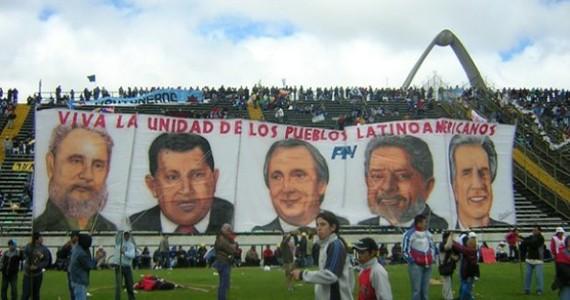
In 2005, in the city of Mar del Plata, the presidents of the brother countries of the Americas, Lula da Silva, Hugo Chávez, Evo Morales, and Néstor Kirchner stood firm against the United States. Photo: X

The meeting in Mar del Plata paid tribute to the moment when several Latin American presidents defeated the US attempt to establish a regional free trade agreement.

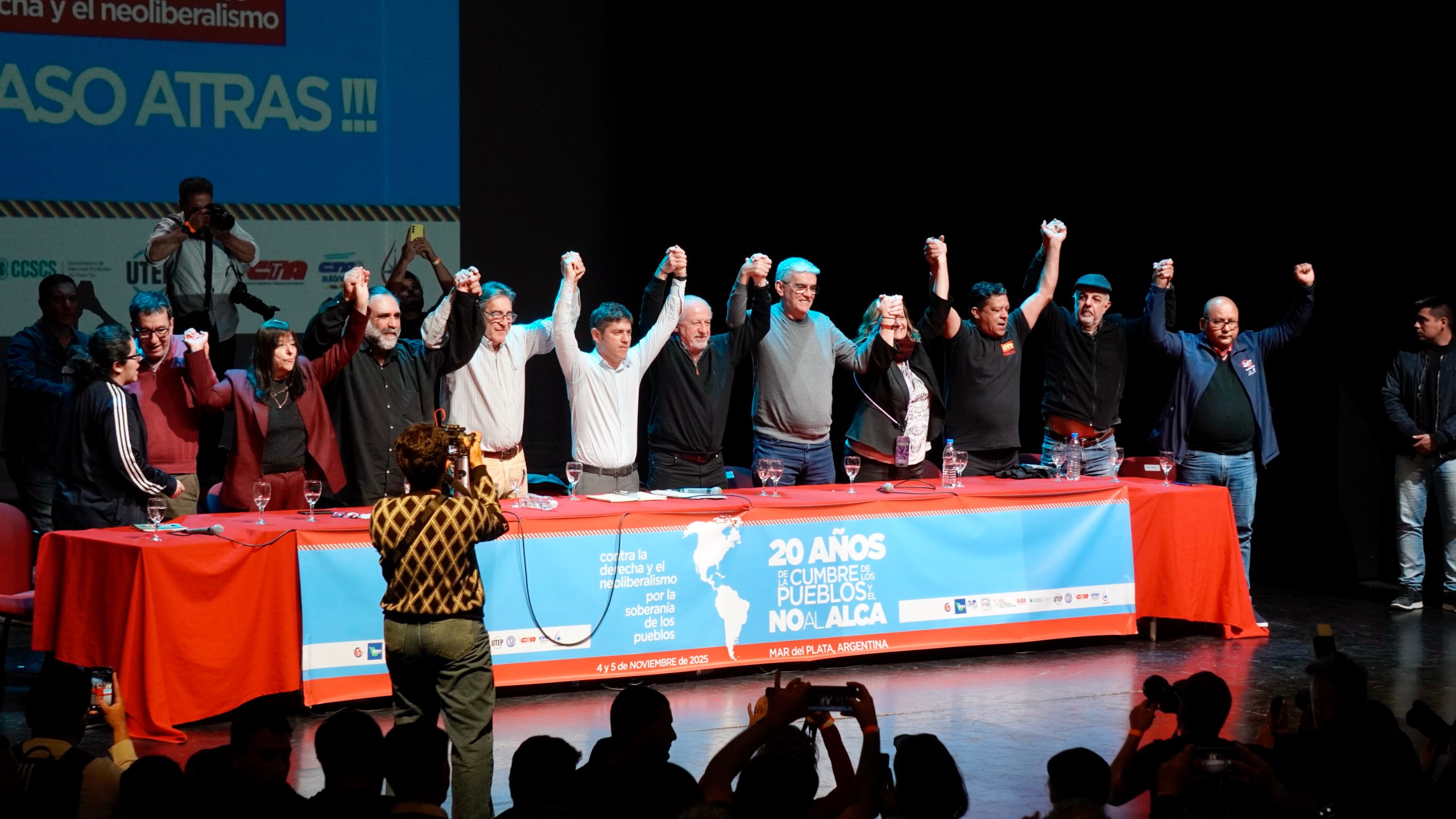
In the same place where the regional free trade project was “buried” two decades ago, 150 delegates from various social movements in Brazil, Uruguay, Bolivia, Cuba, Mexico, Portugal, Haiti, Palestine, Chile, Nicaragua, Peru, and Paraguay gathered to reaffirm the anti-imperialist spirit that led to the regional rejection of the FTAA project, they say.

“The world faces greater levels of inequality, injustice, and authoritarianism, with a growing concentration of financial and technological power that deepens poverty and limits the autonomy of countries in the Global South,” the delegates said in the event’s final declaration.

The meeting was also attended by the governor of Buenos Aires, Axel Kicillof, who stated that the rejection of the FTAA in 2005 was a “new declaration of independence” for Latin American countries. “The rejection of the FTAA was a victory for Latin American sovereignty, voiced by a group of presidents with enormous courage, represented in our country by Néstor Kirchner. Twenty years after that historic milestone, we have a responsibility to continue building unity, because there is no possibility of development for our countries outside the framework of regional integration. We cannot afford not to have a project on behalf of our people, because Argentina and the countries of Latin America are not anyone’s backyard,” Kicillof wrote in X.

Peoples Summit No al ALCA
Delegates from dozens of Latin American countries reaffirm the anti-imperialist spirit of the “No to the FTAA” summit in 2005.

For his part, the Secretary of Foreign Affairs of the Argentine Workers’ Central Union (CTA), Adolfo Aguirre, stated: “In this very place, in front of the President of the United States, George W. Bush, and before the eyes of the whole world, our peoples, workers, together with leaders such as Néstor Kirchner, Hugo Chávez, and Luiz Inácio Lula da Silva, marked a turning point. We said no to surrender, no to dependence, no to the model that wanted to turn our America into the backyard of economic power.”

Twenty years ago, the anti-imperialist slogan was born

Twenty years ago in Argentina, several political leaders from the Latin American left gathered at a People’s Summit, whose fundamental slogan was the rejection of the Free Trade Area of the Americas (FTAA), an initiative promoted, among others, by the George W. Bush administration. The FTAA sought to significantly reduce customs barriers between American countries.

According to popular and left-wing forces in Latin America and the Caribbean, the agreement would have promoted a regional market in which the United States would have had an enormous advantage over other countries and which, in the long run, would have led to the destruction of the still immature regional industry to benefit the interests of large US companies.

However, the economic and geopolitical project did not prosper due to fierce and coordinated opposition from several Latin American presidents, including Néstor Kirchner (Argentina), Hugo Chávez (Venezuela), and Luiz Inácio Lula da Silva (Brazil), among others. The political maneuver took place in Mar del Plata, during the Summit of the Americas, where Bush and his entourage suffered a severe setback. Thus, the proposal that had been in the works and planned since 1994 in Miami and was definitively defeated.

The Summit of the Americas is considered by several experts to be a turning point in the geopolitical relations of the American continent. New progressive and pro-sovereignty processes joined those of Argentina, Brazil, and Venezuela, giving rise to an attempt at regional integration that to this day is pushed by progressivism and boycotted by Washington’s neoliberal allies.

While the summit was taking place, thousands of people from left-wing and progressive movements and political parties gathered at a parallel conference with the slogan “No to the FTAA,” which was eventually attended by several political leaders. Among them, Hugo Chávez made a statement in his speech that would go down in history: “ALCA (FTAA in Spanish), al carajo! (FTAA, go to hell!)”.

A historic event

The region has undoubtedly changed its political composition. The seemingly unstoppable rise of progressive governments is now fragmented due to the emergence of new right-wing and neoliberal projects, such as those of Javier Milei in Argentina and Daniel Noboa in Ecuador, and the recent victory of the Bolivian right after more than 20 years of left-wing governments, among others.

However, in several countries, progressivism managed to regain government, as in the case of Lula da Silva himself, or managed to remain in power, as in the case of the United Socialist Party of Venezuela. Also, in other countries such as Colombia with Gustavo Petro and Mexico with Andrés Manuel López Obrador and Claudia Sheinbaum, progressive governments took office for the first time in their recent history.

In this sense, the dispute over governments in Latin America remains open, and much of the structure of that dispute can be found in what happened in Mar del Plata 20 years ago, where one regional project was buried and another was established, for almost a decade, as the model for regional integration around a position that, although it had its clear limits, always declared itself sovereign and independent.

Original article by Pablo Meriguet republished from peoples dispatch under a Creative Commons Attribution-ShareAlike 4.0 (CC BY-SA) license.

Continue ReadingTwenty years after “No to the FTAA”, Latin American movements reaffirm their anti-imperialist commitment

Less arguing, more action: will Brazil’s unorthodox approach to Cop30 work?

Spread the love

https://www.theguardian.com/environment/2025/nov/08/brazil-unorthodox-cop30-approach-no-agenda

People meeting during the Cop30 local leaders’ forum at the Museum of Modern Art in Rio de Janeiro . Photograph: Tita Barros/Reuters

Host uses Indigenous concepts and changes agenda to help delegates agree on ways to meet existing climate goals

From the very beginning, Brazil poured wide-ranging diplomatic effort into using the event to forge connections and foster climate networks, drawing on the Brazilian concept of the mutirão. Adapted from Indigenous practice, a mutirao “refers to a community coming together to work on a shared task, whether harvesting, building, or supporting one another”, said André Corrêa do Lago, the Cop30 president.

“By sharing this invaluable ancestral wisdom and social technology, the incoming Cop30 presidency invites the international community to join Brazil in a global mutirão against climate change, a global effort of cooperation among peoples for the progress of humanity.” (Writing to participants, he could not resist mentioning another of Brazil’s passions: “As the nation of football, Brazil believes we can win by virada. This means fighting back to turn the game around when defeat seems almost certain.”)

Dozens of senior diplomats, community leaders and statespeople from around the world were recruited to be Cop30 envoys and ambassadors; as were a “circle” of previous Cop presidents, including the UK’s Alok Sharma; a circle of finance ministers; a people’s circle for Indigenous communities; and special envoys for energy, agriculture and business.

“Brazil have put a lot of preparation into this Cop over two years,” says Nicholas Stern, an economics professor at the London School of Economics. “Whatever comes out will be more considered than a rush job would have been. They have taken very important steps [in bringing experts together].”

Some of the circles have already borne fruit; the finance ministers’ meeting facilitated introductions not only among countries, but in some cases between finance and environment ministers within the same government. “Some of them appeared not to have known each other before,” one participant observed.

President Luiz Inácio Lula da Silva wanted social issues high on the agenda, so his environment minister, Marina Silva, set up an initiative called the global ethical stocktake (GES), which will pursue climate justice. Bringing together Indigenous people – who have been promised a much bigger role in this summit than previous ones – and representatives for poor communities, vulnerable people, workers and marginalised groups, the GES aims to ensure fairness and equity are key considerations in any climate policy.

https://www.theguardian.com/environment/2025/nov/08/brazil-unorthodox-cop30-approach-no-agenda

Orcas comment on killer apes destroying the planet by continuing to burn fossil fuels.
Donald Trump urges you to be a Climate Science denier like him. He says that he makes millions and millions for destroying the planet, Burn, Baby, Burn and Flood, Baby, Flood.
Nigel Farage urges you to ignore facts and reality and be a climate science denier like him and his Deputy Richard Tice. He says that Reform UK has received £Millions and £Millions from the fossil fuel industry to promote climate denial and destroy the planet.
Continue ReadingLess arguing, more action: will Brazil’s unorthodox approach to Cop30 work?