“We’re just bringing the super-rich into the same tax bracket as the middle class,” said Barreirinhas
Brazilian Finance Minister Fernando Haddad’s policy of taxing the “super rich” yielded unprecedented returns of R$ 20.6 billion (US$ 3.32 billion) to the South American country’s coffers in 2024, Federal Revenue Secretary Robinson Barreirinhas confirmed Tuesday. The strategy focuses on exclusive investment funds and offshore assets, it was explained.
Under the new scheme, previously untaxed exclusive funds now contributed R$ 13 billion (US$ 2.10 billion), while offshore investments added R$ 7.67 billion (US$ 1.24 billion), thus closing legal loopholes allowing the wealthy to dodge substantial contributions. “This is about justice,” Barreirinhas argued. According to Brazilian Government figures, the economy grew by around 3.5% last year.
People gather for a funeral ceremony of Palestinian journalist Saed Sabri Abu Nabhan after he is fatally shot by an Israeli sniper while on duty in the Nuseirat Refugee Camp in the central Gaza Strip on January 11, 2025 [Ashraf Amra – Anadolu Agency]
A dramatic escape was cited by Israeli media as the reason that Yuval Vagdani, a soldier in the Israeli army, managed to escape justice in Brazil.
Vagdani was accused by a Palestinian advocacy legal group, the Hind Rajab Foundation, of carrying out well-documented crimes in Gaza. He is not the only Israeli soldier being pursued for similar crimes.
According to the Israeli Broadcasting Corporation (KAN), more than 50 Israeli soldiers are being pursued in countries ranging from South Africa to Sri Lanka to Sweden.
In one case, the Hind Rajab Foundation filed a complaint in a Swedish court against Boaz Ben David, an Israeli sniper from the 932 Battalion of the Israeli Nahal Brigade. He is also accused of committing war crimes in Gaza.
The Nahal Brigade has been at the heart of numerous war crimes in Gaza. Established in 1982, the brigade is notorious for its unhinged violence against Occupied Palestinians. Their role in the latest genocidal atrocities in the Strip has far exceeded their own dark legacy.
Even if these 50 individuals are apprehended and sentenced, the price exacted from the Israeli army pales in comparison to the crimes carried out.
Numbers, though helpful, are rarely enough to convey collective pain. The medical journal Lancet’s latest report is still worthy of reflection. Using a new data-collecting method called ‘capture–recapture analysis’, the report indicates that, by the first nine months of the war, between October 2023 and June 2024, 64,260 Palestinians have been killed.
Still, capturing and trying Israeli war criminals is not just about the fate of these individuals. It is about accountability—an absent term in the history of Israeli human rights violations, war crimes and recurring genocides against Palestinians.
The Israeli government understands that the issue now goes beyond individuals. It is about the loss of Israel’s historic status as a country that stands above the law.
As a result, the Israeli army announced that it decided not to publicly reveal the names of soldiers involved in the Gaza war and genocide, fearing prosecution in international courts.
However, this step is unlikely to make much difference for two reasons. First, numerous pieces of evidence against individual soldiers, whose identities are publicly known, have already been gathered or are available for future investigation. Second, much of the documentation of war crimes has been unwittingly produced by Israeli soldiers themselves.
Reassured about the lack of accountability, Israeli soldiers have taken countless pieces of footage showing the abuse and torture of Palestinians in Gaza. This self-indictment will likely serve as a major body of evidence in future trials.
All of this cannot be viewed separately from the ongoing investigation into the Israeli genocide in Gaza by the International Court of Justice (ICJ). Additionally, arrest warrants have been issued by the International Criminal Court (ICC) against top Israeli leaders, including Prime Minister Benjamin Netanyahu.
Though these cases have moved slowly, they have set a precedent that even Israel is not immune to some measure of international accountability and justice.
Moreover, these cases have granted countries that are signatories to the ICC and ICJ the authority to investigate individual war crimes cases filed by human rights and legal advocacy groups.
Though the Hind Rajab Foundation is not the only group pursuing Israeli war criminals globally, the group’s name derives from a five-year-old Palestinian girl from Gaza who was murdered by the Israeli army in January 2024, along with her family. This tragedy and that particular name are a reminder that the innocent blood of Palestinians will not go in vain.
Though justice may be delayed, as long as there are pursuers, it will someday be attained.
Pursuing alleged Israeli war criminals in international and national courts is just the start of a process of accountability that will last many years. With every case, Israel will learn that the decades-long US vetoes and blind Western protection and support will no longer suffice.
It was the West’s shameless shielding of Israel throughout the years that allowed Israeli leaders to behave as they saw fit for Israel’s so-called national security—even if it meant the very extermination of the Palestinian people, as is the case today in Gaza.
Still, Western governments, including the US and Britain, continue to treat wanted Israelis as sanctified heroes—not war criminals. This goes beyond accusations of double standards. It is the highest immorality and disregard for international law.
Things need to change; in fact, they are already changing.
Since the start of the Israeli war on Gaza, Tel Aviv has already learned many difficult lessons. For example, its army is no longer “invincible”, its economy is relatively small and highly dependent, and its political system is fragile. In times of crisis, it is barely operable.
It is time for Israel to learn yet another lesson: that the age of accountability has begun. Dancing around the corpses of dead Palestinians in Gaza is no longer an amusing social media post, as Israeli soldiers once thought.
Former Brazilian President Jair Bolsonaro speaks during a rally on September 7, 2024 in São Paulo, Brazil. (Photo: Allison Sales/picture alliance via Getty Images)
“Well, look at this thing called ‘accountability,’” said one MSNBC host.
The Brazilian Federal Police on Thursday indicted former President Jair Bolsonaro and 36 others for allegedly plotting the “violent overthrow of the democratic state” after the country’s current leftist president, Luiz Inácio Lula da Silva, defeated the right-wing leader in 2022.
“The final report has been sent to the Supreme Court with the request that 37 individuals be indicted for the crimes of the violent overthrow of the democratic state, coup d’ etat, and criminal organization,” police said in a statement about the conclusion of the two-year investigation.
As The New York Times explained: “Although the police in Brazil can make recommendations about criminal prosecutions, they do not have the power to formally charge Mr. Bolsonaro. The country’s top federal prosecutor, Paulo Gonet, must now… decide whether to pursue charges against Mr. Bolsonaro and compel him to stand trial before the nation’s Supreme Court.”
The recommendations for charges came after the arrest of four members of the military and a federal police officer earlier this week over an alleged plot to kill Lula and Vice President Geraldo Alckmin before they were sworn in, as well as Supreme Court Justice Alexandre de Moraes. Police said that “a detailed operational plan called ‘Green and Yellow Dagger’ was identified, which would be executed on December 15, 2022, aimed at the murder of the elected candidates for president and vice president.”
According to CNN, “Police reportedly allege that Bolsonaro had ‘full knowledge’ of a plan to prevent Lula and his government from taking office after his election victory.”
Bolsonaro has repeatedly denied any wrongdoing, including with two other pending cases: In March he was indicted for allegedly falsifying his Covid-19 vaccination data and in July he was indicted for crimes including embezzlement related to alleged misappropriation of diamond jewelry and other state property. Those indictments came after Brazil’s highest election authority last year barred him from running for any public office for eight years over his lies about the 2022 contest.
In addition to Bolsonaro, the other three dozen people indicted on Thursday include “some of the most important members of his far-right administration,” The Guardian reported. As the newspaper detailed:
They included Bolsonaro’s former spy chief, the far-right Congressman Alexandre Ramagem; the former defense ministers, Gen. Walter Braga Netto and Gen. Paulo Sérgio Nogueira de Oliveira; the former minister of justice and public security, Anderson Torres; the former minister of institutional security, Gen. Augusto Heleno; the former navy commander Adm. Almir Garnier Santos; the president of Bolsonaro’s political party, Valdemar Costa Neto; and Filipe Martins, one of Bolsonaro’s top foreign policy advisers.
Also named is the right-wing blogger grandson of Gen. João Baptista Figueiredo, one of the military rulers who governed Brazil during its 1964-85 dictatorship.
The list contains one non-Brazilian name: that of Fernando Cerimedo, an Argentinian digital marketing guru who was in charge of communications for Argentina’s president, Javier Milei, during that country’s 2023 presidential campaign. Buenos Aires-based Cerimedo is close to Bolsonaro and his politician sons.
Given that Bolsonaro previously traveled to the United States when faced with legal trouble shortly after his loss two years ago, in this case, “precautionary measures have been issued, including a ban on international travel, which led to the confiscation of Bolsonaro’s passport months ago,” EL País noted Thursday.
vBolsonaro was among the right-wing leaders around the world who celebrated U.S. President-elect Donald Trump’s victory earlier this month. The Brazilian—who is sometimes called the “Trump of the Tropics” and like the American incited an insurrection after his last electoral loss—said that the impact of Trump’s win “will resonate across the globe… empowering the rise of the right and conservative movements in countless other nations.”
Trump’s return to office is expected to at least stall if not end his various legal issues, including for trying to overturn his 2020 loss.
In Brazil’s Amazon region, more than 1,700 schools and 760 health centers have been shuttered or become inaccessible due to drought. A scene from Tabatinga, Amazonan State, Brazil in October 2024. UNICEF / UNI671256 / Diogenes
A drought in much of South America impacts more than 420,000 children living in the Amazon basin, according to new estimates from UNICEF.
The record-breaking drought — ongoing since last year — has left rivers in the region at an all-time low, a press release from UNICEF said.
The lack of rain has affected river transportation and water supplies for Indigenous children and their communities in Colombia, Brazil and Peru. Families use the rivers to access and transport water, food, fuel and medical supplies. The children also use them to travel to school.
“For centuries the Amazon has been home to precious natural resources. We are witnessing the devastation of an essential ecosystem that families rely on, leaving many children without access to adequate food, water, health care and schools,” said Executive Director of UNICEF Catherine Russell in the press release.
Food insecurity caused by the drought has increased malnutrition risk in the region’s children, while restricted access to drinking water could lead to an increase in infectious diseases, UNICEF said, as AFP reported.
“Food insecurity caused by drought increases the risk of malnutrition, stunting and wasting, and death in children,” the press release said. “Research has also found that pregnant women who experience droughts are likely to have children with lower birth weights.”
In the Brazilian Amazon, more than 760 medical clinics and over 1,700 schools have become inaccessible or were forced to close due to low river levels.
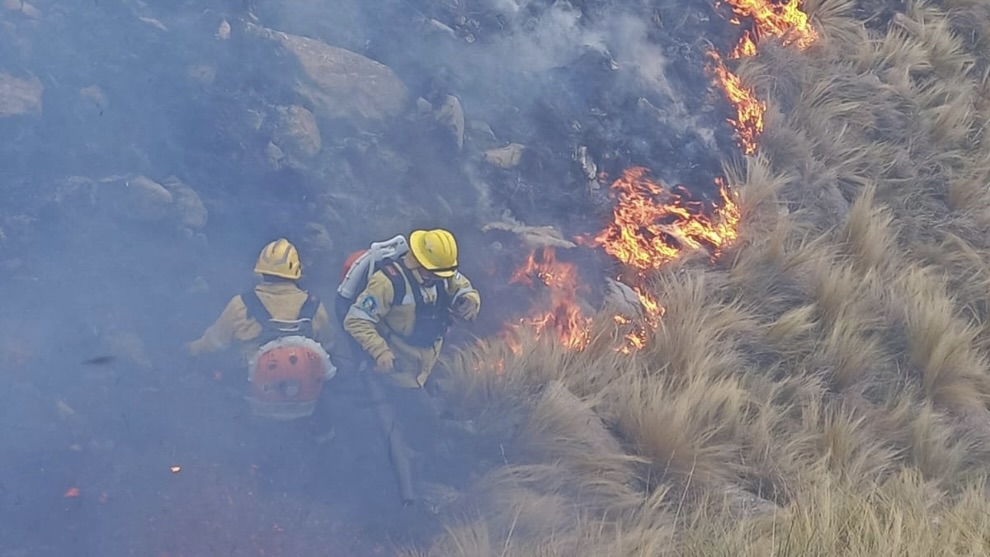
Fires in Córdoba, Argentina have been raging for the past month. Photo: Córdoba Government
More than 300,000 fires have been reported so far in 2024 across South America. The blazes have displaced hundreds and killed several. The causes of this tragedy must be sought in deep geopolitical injustices.
South America is facing one of the most serious environmental crises in recent decades. In the last two months, there has been a dramatic increase in the outbreak of forest fires that have devastated thousands of square kilometers across Colombia, Ecuador, Brazil, Perú, Paraguay, Bolivia, and Argentina. The impacts of the blazes are exponential, not only seen in the direct destruction to the forests and wildlife and surrounding communities, but in many countries the dangerous smoke has traveled far beyond the site of the fire.
The tragedy of fires in South American countries
So far in 2024, more than 300,000 fires have been registered across South America.
In Brazil, the number of fires in southern Brazil (Pantanal and the Amazon) have increased by 92% compared to last year. In the whole country, more than 170,000 have been registered so far and more than 11 million hectares have been lost in this year so far. The fires have required massive state investments in order to alleviate the destruction. In the State of São Paulo alone, more than 15,000 people from the civil guard, firefighters and others have been mobilized to try to put out the fires.
🚨VEJA: Onda de incêndios atinge cidades do interior de São Paulo e mata dois funcionários de usina; nuvem de fumaça chega à capital. pic.twitter.com/QXTBDKA6AH
In the El Chaco area, encompassing Bolivia and Paraguay, fires continue to consume thousands of hectares. More than 60,000 fires have been reported in Bolivia this year, with the regions of Rio Blanco and Palestina, in the east of the country, being the most affected and hundreds of people were evacuated. President Luis Arce has declared a national state of emergency to better address the environmental catastrophe. For now, Chile and Venezuela have offered assistance to Bolivia, which has not been able to quell the flames on its own.
In Córdoba, Argentina, fire continues to destroy millions of plants and animals despite the efforts of almost 1,000 firefighters who are trying to extinguish the flames. The strong winds in the central region of the country have made it even more difficult for hundreds of firefighters to extinguish the two large fires. In several cities in Córdoba, hundreds of people were urgently evacuated due to the threat of the flames.
🔴 Los incendios en Córdoba, están descontrolados y sus escenas son desesperantes. En la noche del viernes, las llamas avanzaron con rapidez hacia la localidad de Los Cocos, donde alcanzaron la atracción de las aerosillas | Más información en https://t.co/wLQDCFnHvspic.twitter.com/4Ia2qXLXlE
In Colombia, more than 31 forest fires devastated 10,000 hectares of forest. The most affected region is the southwest encompassing the departments of Tolima, Valle del Cauca, and Huila. In these places, Petro’s government ordered the deployment of military troops to help in the rescue tasks and to alleviate the fires. Over a dozen fires are still raging in the country that threaten the lives of hundreds of people.
In Peru, the serious fires have already claimed the lives of over 20 people and experts estimate that it will take about 500 years for Peru’s ecosystems to recover from the latest fires. More than 49 active fires have reported by the National Emergency Operations Center, and are mainly located in Tumbes, Ayacucho, Amazonas, Cuzco, San Martin, and Cajamarca. The army has also been deployed in these areas, which are suffering from the ongoing forest fires.
Some underlying causes of fires
The eruption of fires across the region and the widespread devastation to the continent’s flora and fauna has once again brought many to ask why these fires are breaking out. In some cases, the fires are literally sparked by “human intervention”, yet even in these cases, they could not have reached large proportions if it were not for the generalized state of drought in the region, as well as the high temperatures.
According to experts, the leading cause behind the fires is the climate change-induced drought in the region. The lack of rainfall is devastating in an ecosystem that especially requires water during certain periods of the year to subsist. Most of the environmental changes that have occurred worldwide due to global warming are due in particular to large companies that devastate ecosystems, and developed countries, which consume most of the world’s goods and generate most of the world’s CO2 emissions and waste.
In this case, the South American region, rich in flora and fauna (and therefore one of the most fragile areas), is one of the most affected by the economic inequality and production imbalance between developed and developing countries, with many countries on the continent producing overwhelmingly raw materials for export.
The production of monoculture crops for agro-export business in many regions of the continent often requires the destruction of native plants to clear land. The vast forests of the continent are also often taken advantage of by large timber companies whose felling of trees also desertifies vast areas of land. The extraction of minerals by multinational mining companies also requires large amounts of water for processing and has severe impacts on the surrounding region also because of the chemicals used in the process.
In addition, it must be taken into account that the fires, already a product of global warming, release thousands of tons of additional CO2 into the environment, which worsens global warming. It is a vicious circle that endangers not only the affected regions but also the existence of all species on Earth.
For now, South American states are quite simply not prepared to face these challenges, especially because many of them have decided to reduce the size of the state, further liberalize the economy by allowing large companies to do whatever they want in rural areas and with their countries’ natural resources, and defund various emergency and rescue groups such as firefighters and forest rangers. The drought is also preventing hydroelectric plants from producing the energy needed to supply its citizens. In addition, wildfire emergencies are not being adequately addressed by firefighting groups that often do not have adequate funding to hire more recruits and acquire better equipment. This is without taking into account the millions of animals (many of them endangered) that are dying every day in the flames, or that have to flee their natural habitat without the certainty that they will be able to survive in a new environment.
Climate change has long ceased to be a theoretical hypothesis. Old speculations about the consequences of a radically unjust world now take the form of flares that can be seen for hundreds of kilometers (only a blind man does not see them); developed countries pollute poor countries and in doing so are destroying the natural wealth of the people, which, in many ways, is all they have. Climate change in South America (this environmental projection of colonialism) is killing people and devastating life and is today a hell that seems to have no end.