A protester is seen in Los Angeles during a climate change demonstration holding a placard that says, “There is no Planet B.” (Photo by Ronen Tivony/SOPA Images/LightRocket via Getty Images)
“Seven of nine planetary boundaries are transgressed, and pressure on all seven is at its highest recorded level,” said one scientist.
Like other recent warnings from climate scientists, the message sent by the latest Planetary Health Check report on Monday was clear: “We need to move fast,” as the director of the Potsdam Institute for Climate Impact Research, the group behind the report, said.
“Seven of nine planetary boundaries are transgressed, and pressure on all seven is at its highest recorded level,” said Johan Rockström, director of the Potsdam Institute (PIK).
The report finds that seven measures of the Earth’s health are no longer within the “safe operating space”: ocean acidification, freshwater change, land system change, climate change, modification of biogeochemical flows, introduction of novel entities, and change in biosphere integrity.
Just two markers, stratospheric ozone depletion and the increase in atmospheric aerosol loading, have shown improvement over the last decade, said the Planetary Boundaries Science Lab at PIK.
Today, we launched the Planetary Health Check 2026. Seven of nine Planetary Boundaries are transgressed, and pressure on all seven is at its highest recorded level. Yet, we still have a window to change course. But we need to move fast.https://t.co/QQM6PKOQSf
“The diagnosis is unambiguous,” said Boris Sakschewski, the lead author of the report. “Pressure is rising across every planetary boundary already outside the safe operating space. It means that the risk of large-scale, persistent, and potentially irreversible change is increasing, while our margin for error in tackling these problems is shrinking.”
The scientists behind the report emphasized that with recent news regarding the state of the planet’s crucial coral reefs, forests, and extreme weather events like heatwaves and flooding, it should come as no surprise that the Earth’s boundaries have been transgressed, as continued fossil fuel emissions have caused runaway planetary heating.
Earlier this month, United Nations scientists said the planet can no longer avoid at least a temporary temperature rise above 1.5°C over preindustrial levels.
Oceans have also become so warm that stressed coral reefs have less and less time to recover from climate damage, as Common Dreams reported last month, and a UN report last year found that the world’s governments are not moving fast enough to end the destruction of forests.
Last month and the summer of 2026 both set heat records, with extreme heatkilling more than 1,000 people across Europe, and wildfiresspreading across the continent and Canada. Record-breaking heat was also recorded in parts of Asia and the Middle East.
In June, the UN Children’s Fund found that nearly every child on Earth is now exposed to at least one climate hazard driven by fossil fuel emissions, including flooding, heatwaves, and drought.
“Pakistan’s 2025 monsoon floods affected more than 6.9 million people,” said PIK. “Global ocean heat content reached a new record in 2025, with Hurricane Melissa rapidly ramping up to a Category 5 hurricane and striking Jamaica after passing over exceptionally warm seas. From January 2023 to September 2025, bleaching-level heat stress impacted about 84.4% of the world’s coral reef area, making it the largest global coral-bleaching event observed to date.”
Hindou Oumarou Ibrahim, chair of Planetary Guardians, implored readers of the Planetary Health Check report to “read that list again: Pakistan, the Caribbean, Europe, the reefs beneath our oceans. These are not separate emergencies; the planet is telling us, in every region at once, that it is out of balance.”
“As chair of Planetary Guardians, I hear this same story wherever I go, whether from a pastoralist watching the rains fail season after season or a coastal community watching the sea rise,” said Ibrahim. “The 2026 Planetary Health Check puts data behind what communities on the frontlines already know from living it. We do not have the luxury of treating these as separate crises any longer.”
Rockström emphasized that while “we do not have the luxury of time… we do have the knowledge, capacity, and solutions to change course.”
“Accelerating action to return to the safe operating space across all planetary boundaries is essential to protect lives and livelihoods,” said Rockström, “and to deliver on the promise of shared future prosperity.”
Donald Trump urges you to ignore facts and reality and be a Climate Science denier like him. He says that he makes millions and millions for destroying the planet, Burn, Baby, Burn and Flood, Baby, Flood.Orcas comment on killer apes destroying the planet by continuing to burn fossil fuels.Climate science denier Donald Trump confirms that he knows nothing about democracy and that more liquid gold is being secured according to his policy of global privateering.
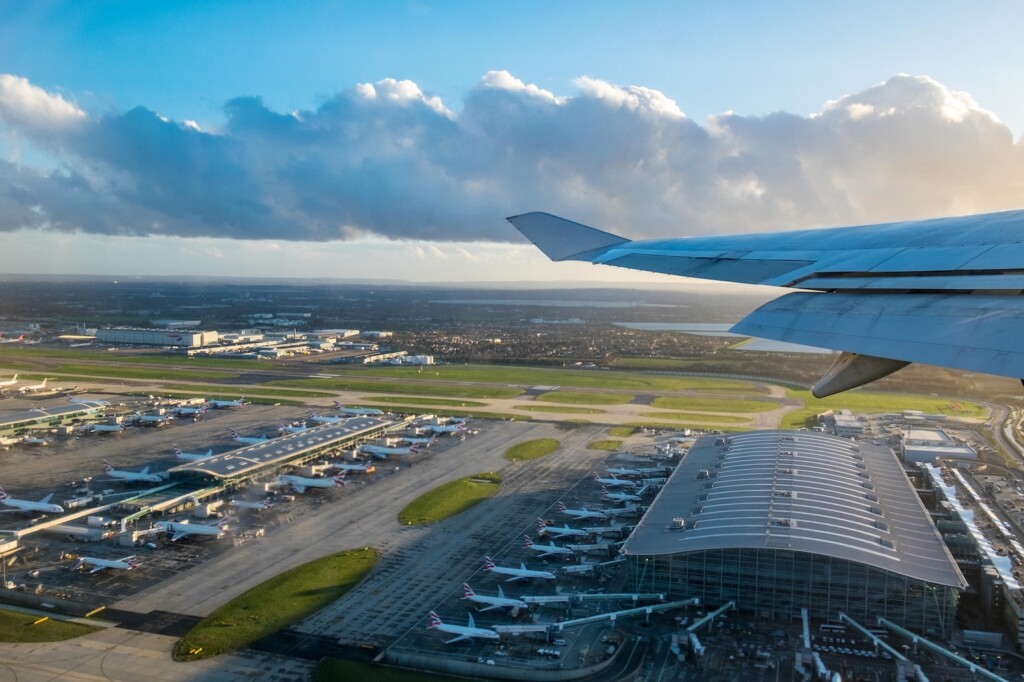
The UK government has slashed its hopes for electric planes and “sustainable aviation fuels” (SAFs), ahead of giving the green light to a third runway at Heathrow.
An “ambitious” rollout of new technologies and efficiency upgrades will only cut flight emissions by a quarter over the next two decades, according to forecasts quietly released in June.
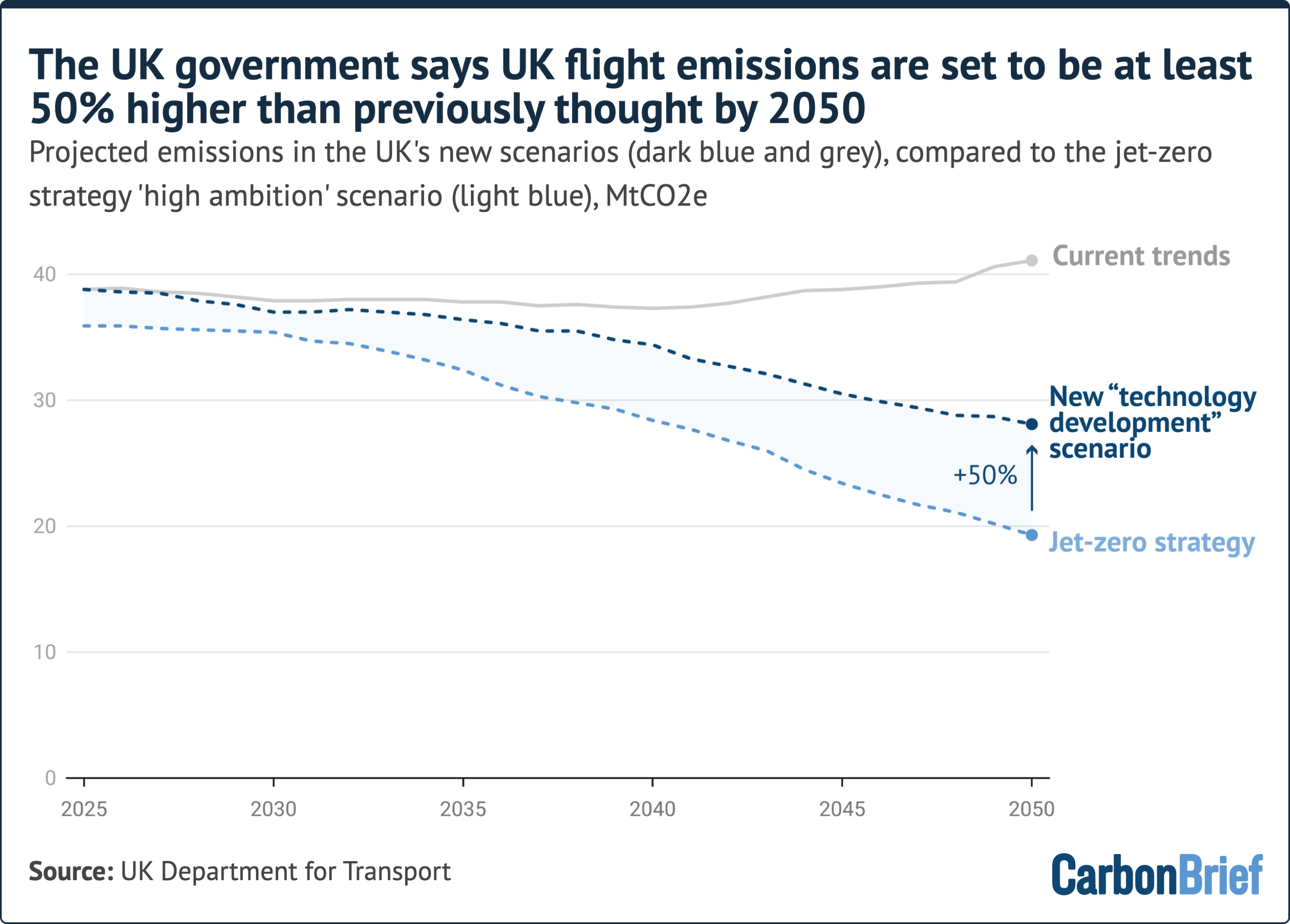
This would leave aviation emissions in 2050 nearly 50% higher than expected under the “jet-zero” strategy, launched by the previous Conservative government in 2022.
The Labour government has signalled its support for a contentious third runway at Heathrow airport, with a final planning decision expected by 2029.
Ministers have justified this expansion by citing the rollout of clean-aviation technologies.
Yet, the updated forecasts suggest that rising flight numbers and a reduced role for “techno-fixes” will leave aviation emissions stubbornly high in 2050 – the UK’s legal target for net-zero.
If this is to be compatible with UK climate goals, then these higher emissions from flights in 2050 would need to be taken out of the atmosphere using costly and largely unproven “carbon dioxide removal” technologies – or by planting gigantic new forests.
Emissions up
The previous government’s “jet-zero” strategy committed the UK to a “high ambition” pathway that would have seen aviation emissions peak at 38.2m tonnes of carbon dioxide equivalent (MtCO2e) in 2019 and drop to 19.3MtCO2e in 2050.
At the time, the Conservative government said this “clear goal” was achievable, alongside airport expansion and rising flight numbers.
Its strategy relied heavily on the extensive use of early-stage technologies, such as SAFs and battery-powered planes, as well as wider fuel-efficiency improvements.
In public statements, Labour has broadly continued this approach, backing new airport runways while supporting SAFs as a way to curb aviation emissions.
However, the government’s latest forecast, quietly published ahead of the formal approval of a new runway at Heathrow, sets far lower expectations for these technologies.
Its “technology development” pathway, with “ambitious carbon abatement measures”, only sees emissions drop to 28.1MtCO2e in 2050. As the chart below shows, this is around 9MtCO2e higher than the jet-zero strategy’s stated goal – a roughly 50% increase.
The shift is down to much lower expectations for SAF uptake, fuel-efficiency improvements and the roll-out of battery-powered planes, as well as lower international carbon prices.
The government now expects SAFs to make up 30% of aviation fuel by 2050, rather than 50%. It also concedes that SAFs will save less carbon over their lifecycle than previously thought.
SAFs have faced considerable criticism, due to limited supplies and uncertainty around the extent to which they cut emissions. Even meeting the UK’s relatively modest goal of 22% SAF uptake by 2040 would require enormous – potentially unattainable – volumes of waste products, which are currently the main source of the fuel.
For its new forecasts, the government commissioned a separate analysis of likely aircraft fuel-efficiency improvements over the next few decades. This analysis, from the Aviation Impact Accelerator, yielded “less optimistic” projections than earlier work.
Fuel-efficiency improvements have therefore been revised downward from 2% per year in the “jet-zero” strategy to 1.3% in the new “technology development” scenario.
There is also a reduced role for battery-powered planes, with only some of the smallest zero-emissions aircraft expected to be in use by 2035.
Crucially, even making the more limited emissions cuts in the new “technology development” pathway would require greater efforts to decarbonise the aviation sector.
If the UK fails to implement new policies or innovations, while flight numbers continue to rise, then aviation emissions would be even higher in 2050 than they are today.
This is illustrated by the pink “current trends” pathway in the chart above, in which emissions increase to 41.1MtCO2e by 2050.
This is roughly double the amount targeted by the jet-zero strategy and recommended by government climate advisors, the Climate Change Committee (CCC).
Budget ‘busting’
The new forecasts all account for the growth of several UK airports, including “planned Heathrow expansion”. Overall, passenger numbers would be at least 50% higher by 2050.
In contrast, the CCC and other experts have advised that the rise in passenger numbers may need to be limited, in order to keep emissions down.
In order to meet the UK’s net-zero target, any aviation emissions that remain in 2050 would need to be offset by planting many thousands of hectares of new forest, or by relying on costly and largely unproven CO2 removal technologies.
Tim Johnson, director at the Aviation Environment Federation (AEF), says the new forecasts present “a more honest and realistic vision of what’s possible in the next 24 years”. However, he tells Carbon Brief:
“Less reliance on cleaner technology and fuels reopens the debate about the role and scale of greenhouse gas removals and ways to tackle the projected 50% growth in demand for air travel.”
AEF calculations, based on government data and shared with Carbon Brief, suggest that emissions from the third runway at Heathrow would initially be relatively modest, reaching 3.5MtCO2e per year in 2050. Its emissions would then be expected to rise significantly beyond the legal 2050 net-zero deadline.
Previously, the Labour government has explicitly cited SAFs and other new technologies as part of its justification for expanding Heathrow airport.
Dr Lois Pennington, a research associate at the University of Manchester who has analysed Heathrow’s emissions impact, says the government’s new forecast shows “we are projected to be well over aviation’s share of the carbon budget even before a third runway is considered”.
She tells Carbon Brief:
“For Heathrow, it means expansion can no longer be waved through on the promise of technology, and any approvals will be in the full knowledge that it will bust our legally binding carbon budgets.”
Nigel Farage urges you to ignore facts and reality and be a climate science denier like him and his Deputy Richard Tice. He says that Reform UK has received £Millions and £Millions from the fossil fuel industry to promote climate denial and destroy the planet.Donald Trump urges you to ignore facts and reality and be a Climate Science denier like him. He says that he makes millions and millions for destroying the planet, Burn, Baby, Burn and Flood, Baby, Flood.Orcas comment on killer apes destroying the planet by continuing to burn fossil fuels.
Operation theatre illustration by Kerry Cleaver for Carbon Brief.
More than 1,000 operations at NHS hospitals were cancelled due to heat during the UK’s record May and June heatwaves, Carbon Brief can reveal.
This includes 167 orthopaedic surgeries, such as knee and hip replacements, as well as heart, eye and skin cancer operations.
At least 10 emergency surgeries – those for “life-threatening” conditions – had to be cancelled because of the record-breaking heat, according to the investigation.
Carbon Brief sent freedom-of-information (FOI) requests to 140 NHS trusts to investigate the impact of heatwaves on operations being cancelled in England and Wales.
Areas with the most operations cancelled due to heat include Surrey and Sussex, south Essex and parts of London – all regions experiencing among the highest temperatures.
High temperatures can threaten patient safety by stopping the ventilation systems used in theatres from working, increasing the risk of infection, experts tell Carbon Brief.
Less than half of the NHS trusts provided details of heat-related surgery cancellations – and Carbon Brief understands that many hospitals do not routinely record this information.
Carbon Brief’s figure is therefore likely to be a significant underestimate, but still provides an unprecedented insight into a surgical system “poorly prepared” for heatwaves and the impact on patients.
Overheating operations
The record-breaking heatwaves that have repeatedly struck the UK in 2026 – amplified by climate change – have already been linked to thousands of deaths.
Extreme heat also threatens healthcare systems. News outlets have reported on the NHS “struggling”, as it faces record A&E demand, hospital wards reaching “unsafe” temperatures and equipment failing due to heat.
Among these reports was coverage of hospitals being forced to cancel operations, or even abandon them midway through, as surgical theatres became intolerably hot.
To investigate this problem, Carbon Brief sent FOI requests to the 140NHS trusts and health boards in England and Wales responsible for hospitals with surgical theatres.
They were asked about all the operations that were cancelled due to extreme heat during the May and June heatwaves, when “amber” and “red” heat warnings were in place.
In total, 59trusts and health boards responded with details of 1,110 heat-related cancellations across the 17-day period covering 22-28 May and 18-27 June.
(Of the 63 trusts that responded but did not provide details of heat-related disruption, many said that they simply did not record this data, rather than stating that heat was not a problem. See Methodology for more details.)
The map below shows the location of these cancelled surgeries, which cover everything from routine hernia operations to heart surgeries.
Surrey and Sussex Healthcare NHS Trust reported the most cancellations – 140 in total – all in the surgery unit at Crawley Hospital. This hospital was in one of the hottest parts of the country in June, with temperatures approaching 36C.
Other hotspots for cancellations include south Essex, Dudley in the West Midlands, south Wales and parts of London. Many of the hardest-hit hospitals were in southern England, where temperatures were highest.
Of the trusts that provided full datasets of all surgery cancellations in the period, around 7% were heat-related. This data illustrates how heat is placing more strain on an already stretched NHS, adding to existing issues such as staff shortages and lack of beds.
Nearly all of the cancelled surgeries were “elective”, meaning they were scheduled in advance and not immediately life-saving. Nevertheless, the list of cancellations includes at least eight heart operations and seven skin-cancer removals.
There were also 10 “emergency” operations cancelled due to heat in surgical theatres. Another 18 surgeries had to be abandoned mid-way through.
Dr Dmitri Nepogodiev, a public health researcher focusing on surgery at the University of Birmingham, says hospitals will always prioritise “time-sensitive, life-threatening” surgeries.
Nevertheless, he tells Carbon Brief that every cancellation can cause significant “distress” and harm to patients’ quality of life, adding:
“Behind all of these statistics…are real people who have probably already been waiting a long time.”
Each dot in the graphic below indicates a cancelled surgery. Of the 596 for which trusts provided details, 167are orthopaedic surgeries, such as knee and hip replacements.
Eye surgeries, gynaecological and urological surgeries are also among the most frequently cancelled, broadly reflecting how common such procedures are.
Richard Egan, an endocrine surgeon and a national clinical director within NHS Wales,notes the knock-on effects of cancelling surgeries for several days during heatwaves. He tells Carbon Brief:
“That’s a significant impact on waiting lists…For every week that patients are waiting on a waiting list, their condition could get worse and deteriorate.”
‘Increased risks’
When providing specific reasons for cancellations, most NHS trusts simply indicated that surgical theatres were “too hot and humid”.
Sometimes, this was accompanied by comments about “risk of infection” or “overheating for both patients and staff”.
There are several reasons why it can get “too hot” for operations to take place, but the main one is that the complex ventilation systems installed in theatres can stop working above a certain temperature, explains Dr Ed Robinson, an NHS anaesthetist. He tells Carbon Brief:
“An operating theatre is a very tightly engineered clinical environment. There are quite complicated ventilation systems, which dilute airborne contaminants, remove fumes from different [medications] and anaesthetic gases.
“We have generalised airflow systems that make the air in theatre flow outwards to adjacent areas, so pathogens and fumes get carried away from the patient into non-clinical areas. When it gets to a certain heat, those systems can fail.”
These systems are also responsible for controlling heat and humidity levels inside theatres, says Robinson.
When the systems fail, it is not possible to guarantee patient safety, he continues, meaning surgeries may need to be cancelled.
Although most hospitals simply stated that it was “too hot” for operations to take place during the heatwaves, there were 48 cases where staff specified that this was due to air conditioning or ventilation units that were either broken or unable to sustain appropriate temperatures.
“Extreme heat can increase risks and make it harder to deliver care under the conditions clinicians would consider ideal.”
If air in operating theatres is too humid, excess moisture can condense on surgical implements and transmit infections, he says.
Extreme heat and humidity inside theatres can also pose a risk to staff having to wear heavy protective clothing. Robinson explains:
“Staff are usually wearing PPE [personal protective equipment]. If it’s orthopaedics, they will be wearing ‘leads’ a lot of the time. This is because they will be doing lots of X-rays, and there’s no time to descrub and rescrub every time.
“So if the ventilation system is not working, you’re going to overheat [and] that’s going to affect your ability to concentrate and perform a safe operation. You just wouldn’t start under those conditions.”
There are also “certain pieces of equipment and medications” that are not “validated to be used outside of certain ranges of temperature”, he says.
This includes specialised “cement” used to secure hip and knee replacements, which can set too quickly at higher temperatures, according to Lane.
‘Poorly prepared’
Following the record-breaking heat of 2022, one study found that surgical services in the UK were “poorly prepared for heatwaves”.
Based on staff surveys, the study concluded that ambient temperatures “could not be controlled” in two-fifths of NHS operating theatres.
With hospitals once again under significant pressure this summer, health secretary Yvette Cooper told the Guardian that the NHS “has to make sure we are preparing for summer pressures now in the same way we prepare for winter”.
Nepogodiev notes that the problem of extreme heat extends from increased patient numbers to staff shortages, which can be the result of a range of wider factors such as heat-related train cancellations. He tells Carbon Brief.
“There isn’t a single magic solution because it’s a kind of complex, multifactorial challenge – so it also underlines the importance of broader preparedness.”
Egan, who is investigating ways to prepare surgical theatres for extreme heat, says the response so far has been “ad hoc”. He suggests it may be possible to continue with less risky operations, even at higher humidity levels.
As it stands, many NHS hospitals are old and not designed for increasingly extreme temperatures.
Government advisers at the Climate Change Committee (CCC) have recommended that all healthcare buildings should work to “maintain safe and appropriate temperatures” by 2035.
The UK’s national adaptation programme already says NHS England will work to “adapt NHS infrastructure to extreme weather events and overheating risks”, by incorporating adaptation measures into plans for new buildings.
However, years of underinvestment have left many sites with what the King’s Fund thinktank calls “deteriorating buildings” and “outdated technology”.
Following the extreme heat this summer, the government has announced £32m from a £1.5bn spending programme for projects that strengthen hospitals’ “resilience to extreme heat, including improved “cooling and ventilation systems”.
RCS England president Lane tells Carbon Brief that heat-related surgical cancellations underline the need for investment in hospitals, ventilation systems and modern equipment:
“NHS staff work incredibly hard to adapt, often reorganising services and finding practical solutions to keep care running, but resilience alone cannot compensate indefinitely for outdated infrastructure or sustainability.”
Methodology
Carbon Brief contacted 140 NHS trusts and health boards in England and Wales, only including those that perform surgical procedures. Mental health trusts, community trusts and other specialist trusts were therefore excluded.
These requests covered the periods 22-28 May 2026 and 18-27 June 2026, when heatwaves affected much of England and Wales.
At the time of filing the FOIs, these were the two periods when the UK Health Security Agency (UKHSA) had issued “amber” or “red” heat-health alerts across much or all of England. There were also comparable weather warnings in place across Wales for some of this time.
(Scotland and Northern Ireland were excluded from the analysis, on the basis that they did not experience such extreme heat.)
The FOI requests asked for details of all surgical procedures – both elective and emergency – that were cancelled during this period. Specifically, the requests also asked trusts to state which cancellations were related to extreme heat. Of these, 59provided details of surgeries that were cancelled due to heat.
Of the remaining 63 that responded to the FOI requests, only a fewstated explicitly that there were no surgeries cancelled due to heat. Most either said that they did not record this information, or provided lists with standard cancellation reasons that may – or may not – indicate heat as a factor, such as “failure of equipment”. The remaining 19did not respond to the request by the time of publication.
NHS trusts and health boards responded to Carbon Brief’s FOI requests in a large variety of ways, reflecting the inconsistent way in which heat-related cancellations are recorded.
Among those that disclosed data, some provided all the information requested while others only provided parts. Some would not provide exact numbers when the number of cancellations was five or less. In those cases, Carbon Brief assumed that two surgeries had been cancelled. (This assumption accounts for fewer than 50 of the 1,110 cancellations.)
The full dataset is available here, with details of all the surgeries cancelled and the reasons given for their cancellations.
Donald Trump urges you to ignore facts and reality and be a Climate Science denier like him. He says that he makes millions and millions for destroying the planet, Burn, Baby, Burn and Flood, Baby, Flood.Nigel Farage urges you to ignore facts and reality and be a climate science denier like him and his Deputy Richard Tice. He says that Reform UK has received £Millions and £Millions from the fossil fuel industry to promote climate denial and destroy the planet.Orcas discuss Donald Trump and the killer apes’ concept of democracy. Front Orca warns that Trump is crashing his country’s economy and that everything he does he does for the fantastically wealthy.
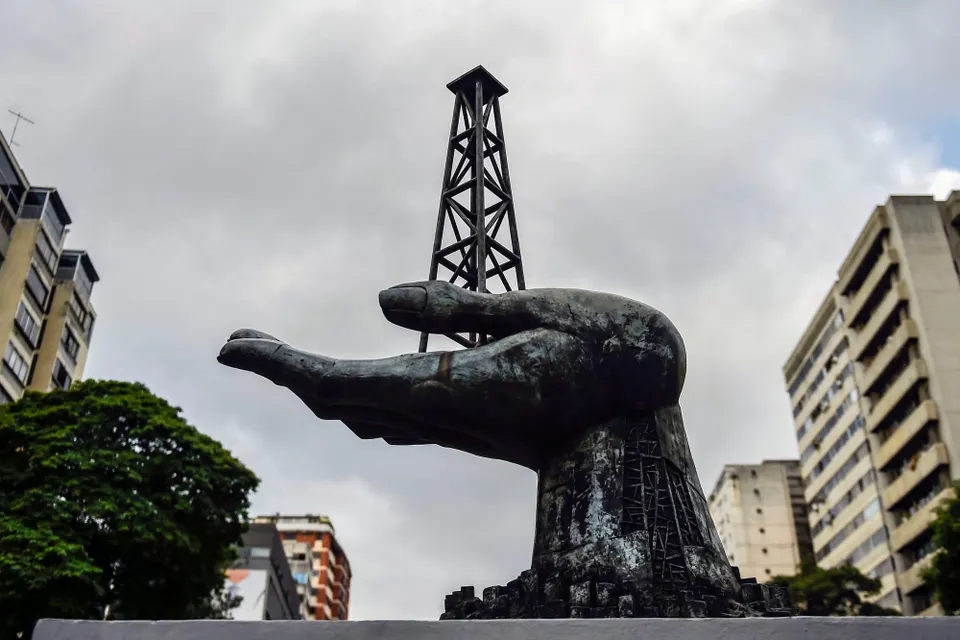
A monument in homage to the struggles of the Venezuelan people for the conquest of their oil | by LUIS ROBAYO/AFP/Getty Images
The Trump administration’s forcible appropriation of a fifth of Venezuela’s oil reserves is worse than the theft of national assets in post-Soviet Russia.
Nine months after United States special forces abducted Venezuelan President Nicolás Maduro and his wife in an early morning raid, the US claims to have struck a highly unusual deal to take control of about a fifth of Venezuela’s oil reserves, or about 65 billion barrels, over the course of a 100-year lease period.
The deal, which is structured through the US Department of Defense (which the Trump administration calls the Department of War), has no recent precedent. While the United States has often engineered military and covert regime change in countries around the world to appropriate resources, the Trump administration’s actions in Venezuela recalls the sorts of 20th century US interventions that lead to a series of revolutions in Latin America and also Iran in the 1950s.
To make sense of this moment, I caught up with Francisco Rodríguez, a Venezuelan economist, a senior research fellow at the Center for Economic and Policy Research, and professor of public and international affairs at the University of Denver. Rodriguez is also the author of four books, including his latest, The Collapse of Venezuela: Scorched-Earth Politics and Economic Decline.
The following is an edited excerpt of our interview. You can listen to the whole interview on our In Solidaritypodcast.
Aman Sethi: I’d like us to start with just getting your reactions to this, this oil deal. Specifically, if you could just talk through what you know so far, what this means, and whether this is how oil deals are normally done in Venezuela.
Francisco Rodriguez: Okay, a bit of the background. Venezuela had been under oil sanctions from the US between 2019 and this year. And the US after it carried out a military operation to capture Nicolás Maduro, it decided that it was going to try to forge, let’s call it a “cooperative relationship,” with the government of Delcy Rodriguez, who was Maduro’s vice president.
And what the US has been trying to do is sell the idea of ‘Now we’re gonna help the Venezuelan oil sector recover’. Venezuela is sitting on the world’s largest oil reserves , but it produces just 1% of world oil output.
January of this year just a few days after the military operation to take out Maduro, President Trump actually calls a lot of oil industry executives to the White House, says, “I want you to invest in Venezuela.” Many of these executives say, “We’re not so sure.” One of them actually says this country is really uninvestable under current conditions. So he gets a lukewarm reaction.
So now we have the announcement of this plan, and this plan — it promises that Venezuela is going to get $100 billion in oil investment. And that’s really important here, because that’s what most experts have said is needed to get Venezuela to produce what it was producing before the sanctions back in 2016 which was around two and a half million barrels.
Now it’s producing roughly one [million barrels per day]. It’s increased a bit to 1.2 million. So you want to get that up by 1.5 million barrels. You need 100 billion to do that. That sounds fine. Actually, that sounds great. If I’m Venezuela, and I’m told, “Hey, here’s the $100 billion you can put into your oil industry, and you’ll get more tax revenue. We’ll benefit.” I say, “Where do I sign?” So that part looks good.
But then let’s look at it in more detail because President Trump actually says two things almost in the same breath. He says Venezuela’s gonna get $100 billion of investment in the oil sector, but this is not going to cost a dime to US taxpayers.
Okay, wait.
So the US is not gonna pay for it. Venezuela is broke, so Venezuela is not gonna pay for it. Who is going to pay for it? Well you would think oil companies, large oil companies, right? Chevron, Exxon, Conoco. But they’re not here. They’re nowhere in the deal. No, they don’t wanna be part of this.
So where are these 100 billion going to come out of ?
Here’s where it gets really interesting and really murky. These $100 billion are going to be put out by a Barbados-based company that was created just a few years ago. It’s a company owned by a businessman with not the best reputation in the world. His name is Alejandro Betancourt. He’s best known for getting billions of dollars in no-bid contracts from the Chavez administration to build electrical plants, at least one of which was never completed. And he’s offering to the US a thirty-five percent stake in his company.
So the US Department of War is going to now own thirty-five percent of that company. And it’s also going to have the right to purchase at cost twenty percent of the company’s output. So that’s the deal.
The White House yesterday put out a statement saying that Venezuelan barrels of oil are going to start flowing into US reserves as of November. And basically, President Trump had already said that they were going to replenish the US Strategic Petroleum Reserve with oil that was a gift from Venezuela.
That’s the word that President Trump used.
So that means that probably as of today you will have Venezuela sending 40,000 barrels of oil to the US at cost. That’s a loss of about $500 million a year for Venezuela.
What is Venezuela getting in return? A promise that somebody, someday, is going to come up with $100 billion is going to be willing to lend them to Mr. Betancourt so that he can invest in the oil sector.
This deal is all wrong. This is the most impoverished country in Latin America.
How legal is this? Like, is this from a Venezuelan perspective, from an international contracts perspective?
There’s a set of legal objections to it. Now of course the problem is that in developing countries Venezuela ranks 146 out of 146 countries in terms of the rule of law.
Asking what is legal or not in a country that has no rule of law, this is almost like a theological question, really.
Because when we think about the law, laws are interpreted by courts, but the courts are controlled by the government. Article 150 of the Venezuelan Constitution says that the National Assembly has to approve the deal.
The National Assembly is 90% controlled by the government, so they could have taken the deal before the National Assembly. They didn’t. Why didn’t they do it? Because then they’d have to publish the contract, but they don’t want to publish the contract. Nobody wants to publish the contract.
There’s a set of other problems I could go down out of all of the different laws that have been violated. But one important one is Article 39 of the country’s hydrocarbons law states that you have to assign contracts in the oil sector through public competitive bidding. There was no public competitive bidding here.
In fact, a government vice-minister recently said, “The thing is that we’re under an economic emergency decree that we declared after the earthquake.” Really? You’re gonna use the earthquake as an excuse to give away 20% of the country’s reserves?
What does it smell like to you?
It smells like Trump essentially said, “I wanna do something about gas prices before the midterm and I wanna claim that I’m getting some of this oil from Venezuela. So I want some of that oil from Venezuela to come in and for me to say that I’m putting it into a strategic reserve, and this is bringing down oil prices. I wanna do that before the midterms. Sign me a deal.”
I think that’s essentially all there is. But from the standpoint of Venezuela, Venezuela has just given away 20% of its reserves to a company owned by a very shady figure.
After the invasion of Iraq when you had the occupation there was a public bidding round for the rights to exploit Iraqi oil. This was a competitive bidding process, it was transmitted through public television, so Iraqis could actually see the bidding taking place in real time.
This process was transparent. This is the complete opposite. This firm is going to get, over the life of the concession, the equivalent of $303 billion.
That’s the, that, that is what the private firm gets in profits.
That is what it’s going to get. That is the equivalent of three years of Venezuelan GDP. 65 billion barrels. Venezuela has a huge level of reserves. The Russian privatization program of 1996 was for 20 billion barrels of oil.
This is more than three times the size. And in Russia, which was a steal, which was horrible, there was a free-for-all. That’s what led to the rise of the Russian oligarchs. They at least had the decency to rig an auction. Here, there was no auction. They didn’t even pretend.
So this is not going to end up well. If you’re handing over these massive resources to connected political insiders this is not helping create a democracy. This is consolidating a crony capitalist oligarchy.
In your book you’ve likened studying the Venezuelan economy to the equivalent of being a rare disease specialist. For all of us outside who honestly don’t know very much about Venezuela, what is your analysis of the regime in power right now?
What is the point at which the people just say, “We’re done with this regime,” and they just get swept out?
We can understand the American motivations. We can understand Delcy Rodriguez is some kind of captive, but what about the entire country that sits below her? How are people taking this?
That’s a great question. And it forces one to think about how we got here. So Venezuela got here after about a quarter of a century of very deep polarization. Hugo Chávez, who came into power in 1999 was a populist and popular politician.
And, like many populist politicians, his message was, “Throw the bums out, people are tired of the old politics. You need change. You need to refound the republic.” And that convinced a lot of people. He was able to get a clear electoral mandate. He reformed the constitution.
He did what many leaders who have at least an authoritarian bent will do in those circumstances, which is say “We really need to change this, give more power to me.” So he really made the Venezuelan presidency all-powerful in that constitutional reform. And that really shaped Venezuelan politics over the next quarter century because you created a winner-take-all political system in which the opposition was completely out of anything.
So you ended up in this, this politics which was very polarized between the government and the opposition. Now, Chávez did some things that a lot of Venezuelans liked at the time. He was definitely somebody who sought out ways to let very large disadvantaged majorities which had been excluded from Venezuelan social, economic, and political life have a stake.
He also did a lot of things very badly.
He got a huge oil boom. He spent a lot of that money. He ran the country into debt. He hired people like Alejandro Betancourt to build electrical plants, some of which were never built. So the country lived through this deep polarization. And then Chávez died, and then he leaves Maduro. Then the economy starts doing poorly. Then he [Maduro] becomes more repressive because the opposition is really going after him. And then the opposition goes to the US, and the US says “Let’s get tough on this, let’s impose sanctions.”
They hurt the country’s oil industry. It leads to a huge decline in the country’s oil production. So they, they effectively create an economic catastrophe. So you end up in this trap, which is what in my book I call the trap of economically destructive political conflict.
And the whole– the puzzle that I try to explain in my book is, how is it that you get an economy to collapse, to lose seventy-one percent of per capita income? This is the equivalent of three consecutive great depressions without a war. And my answer is that this happens because there’s a moment in which this politics becomes so destructive that both sides are essentially playing scorched earth.
So you end up having this battle for the country that turns the economy into a political battlefield, and that’s where it collapses.
Then all of a sudden Trump decides to send in US forces, captures Maduro, and decides that he’s going to run the country with the people who are there. What we know and what he has said literally is that he’s put a gun to Delcy Rodriguez’s head. We also know that Delcy Rodriguez is complying with everything that Trump is asking for.
Is she doing it because she has a gun to her head, or is she doing it because this actually works in her favor and she can stay in power? Probably both.
I have, well, several questions from this, but, but let’s start with the question of sanctions. It’s possible for many governments to make many bad decisions and to do bad things to the economy.
But there is a very specific kind of bad thing that happens once sanctions are imposed, right? When you’re cut out of the US financial system, for example, that is a very, very particular form of economic punishment.
What is your assessment of the role that, that sanctions have actually played here? Because one thing that I’m struggling with is this narrative of “Venezuela let its oil industry completely collapse, and now we’re gonna fix it, and now everything will be fine”. I’m struggling with the dissonance, but maybe I don’t know enough.
That’s a very interesting question. It’s a very important question. It’s not an easy question to answer because well, you have many factors going on, and definitely there was a lot of mismanagement.
There were poor economic policies, so you have to disentangle the effects of those poor policies from the effect of sanctions.
My estimate is that approximately half of Venezuela’s economic contraction during its collapse period between 2012 and 2020 can be attributed to sanctions.
So in other words, this is a country that in the absence of sanctions would have gone through a major crisis. It would have seen, by my estimates, GDP decline by thirty-six percent, but not by seventy-one percent. And in fact, that thirty-six percent decline that would have occurred in the absence of sanctions actually puts it in line with other collapses generated by similar episodes of protracted exercise of bad policies particularly in Latin America.
And all of them have a very similar pattern. You have a commodity-dependent economy. You have a period in which deep imbalances accumulate. You start getting high levels of debt.
The country starts going into a current account deficit. You start seeing high levels of capital flight, and then you get a decline in the price of the commodity like what you got between 2014 and 2016. And there you get this deep economic crisis.
That is what happened in Venezuela between 2012 and 2016, which were the first three years of Maduro in power. In 2017 something different starts happening. And you start seeing that markets are expecting that the Venezuelan economy will begin to recover.
Because oil prices had fallen from $100 to $30, and then they had recovered to around $50, $60. What history teaches us is that the economy stabilizes and then begins to recover in that situation. That’s not what happened in Venezuela. In Venezuela, the economy continued shrinking at an accelerating rate. And the difference was that was the year in which sanctions began to be imposed.
So yes, sanctions did deep damage to this economy. These sanctions didn’t come out of the blue. These sanctions were part of a political strategy by the country’s opposition that was reacting to things that Maduro was doing which were very bad and were very evil and very authoritarian, and said, “We need to up the ante here by doing what we can do. We have allies in the US, that can help us start taking Maduro’s control from the country’s purse strings away.”
So in 2019, the Trump administration decided to recognize Juan Guaido, an opposition legislator, as Venezuela’s legitimate President. This is something that the US had never done before. The US had never recognized somebody with no de facto control over the territory as the President. And what happened as a result of that was that all of the country’s offshore assets, including all of the assets of PDVSA, the state-owned oil company, were transferred to the management of Guaido or his appointees. What that meant is that the country no longer had access to its funds. These funds were essentially handed over to the opposition. It made it impossible for the government even to carry out the most basic economic policy.
There’s nothing in politics that is for free, right? So you acquire a commitment when you have an external power like that, that is helping you. And that means that you can’t question what that external power is doing in your country because you essentially live off of them, right? And this, by the way, was literally true. The Venezuelan opposition — the Venezuelan National Assembly elected in 2015, whose term ended in 2020 — had around 80 opposition legislators who were getting paid monthly salaries out of an account in the Federal Reserve. So the US could literally cut the salaries of the opposition politicians if the opposition decided to go against it.
This is the typical Faustian bargain, right? You say, “I’m willing to do anything if you will help me regain power,” for good reasons.
But the reality is that these Faustian bargains don’t end well.
I’m imagining an Indian opposition leader touring Europe and America and asking for support to become the Prime Minister of India, and they would be, you know, laughed out of the country.
I understand that the dynamics are different but it does strike me as an unusual theory of power. In your book, you also talk about the fact that while Venezuela is shown as an exception to kind of ordinary politics, it in many ways is almost like a weather vane that shows you where politics is going.
But what does this moment in Venezuela tell us if we say Venezuela is, in some ways, the country of the future? What is it telling us now, especially in light of this deal?
I would love to be wrong but I do think that Venezuela might be initiating a model that the US is probably going to try to imitate in other countries.
President Trump actually considers Venezuela a success story, and he’s been trying to produce similar outcomes in Cuba and Iran. And there have been negotiations between Trump administration officials and officials in those countries where they’re proposing this type of deal. The type of deal is you stay in power, the opposition doesn’t come to power but you change completely the way in which you’re doing things, and you follow our orders essentially.
And I want to emphasize that this isn’t a government that rules the country with US support. This is a government that is carrying out the orders of the US . This is a government that has carried out military operations with US troops and Venezuelan troops in Venezuelan territory. It recognized Israel. And three days after Marco Rubio announced that the US was launching a campaign to dismantle the International Criminal Court, Venezuela says, “We’re leaving the International Criminal Court.” The first Latin American country to do so.
So this has become the most dependable US ally in the region. And it’s led to this thesis in Washington of, why seek regime change if you can get regime compliance? That’s essentially what they’re trying to do.
You were saying this looks like a somewhat of an odd concept coming from India and thinking about it in terms of the dynamics in that region.
I would say it’s not that foreign in Latin America. But you have to dig a little bit into history to go there. What the US did in Venezuela was actually what the US did in a number of countries at the beginning of the [20th] century including Cuba, Dominican Republic, Haiti, Panama. It basically imposed protectorates in these countries.
The Cuban one is interesting because Cuba, the US kind of occupied and took control of after the Spanish-American War. And then what the US did is that it forced the Cubans as a condition for independence to accept into their constitution to grant the US a standing right of intervention.
So basically, if the US disagreed, if it took exception to any key decisions of the Cuban government, the US had the right to intervene militarily, and the US, in fact, exercised that right four times in the subsequent twenty years from the signing of that amendment, known as the Platt Amendment.
And one of the problems with that, it’s no coincidence that it was precisely Cuba that saw the political movement that has been most antagonistic to the US emerge.
If you study the early 20th century in Cuba what you find is that Cuban politicians were acting very much in the way in which Venezuelan politicians are acting now
They understood that whoever was in power needed the support of the US. So they became politicians who were adept at lobbying Washington and at building political coalitions between Washington stakeholders to support them. And this means that they were not politicians that built a domestic political base, that were trying to answer the demands of their constituencies. So the protectorate regime, what it does is that it stifles institutional development in a way that basically doesn’t let the institutions of a democracy emerge.
And of course, if you have an electorate that cannot express its grievances, cannot express its demands through the political system, a big part of that electorate is going to become very angry, and then you end up with something like the Cuban Revolution. I think that is a very distinct risk now.
It’s a risk that we will enter into a pattern as a result of Washington’s idea that it can run Latin American countries by remote control, that we’re going to enter into a very similar political dynamics, which, in the end, is going to be bad for the region, but it’s also going to be very bad for the US standing in the region.
Climate science denier Donald Trump confirms that he knows nothing about democracy and that more liquid gold is being secured according to his policy of global privateering.Orcas discuss Donald Trump and the killer apes’ concept of democracy. Front Orca warns that Trump is crashing his country’s economy and that everything he does he does for the fantastically wealthy.Donald Trump urges you to ignore facts and reality and be a Climate Science denier like him. He says that he makes millions and millions for destroying the planet, Burn, Baby, Burn and Flood, Baby, Flood.
Green party leader Zack Polanski speaks to media following the National Emergency Briefing on climate and nature at the Central Hall Westminster, 27 November 2025, London, UK. Vuk Valcic/ZUMA Press Wire
It predicts a UK national security crisis with war, pandemics and food shortages.
Zack Polanski is calling on the government to publish the full, unredacted version of a report outlining how ecosystem collapse will plunge Britain into a national security crisis.
The report from UK intelligence chiefs warns that global ecosystem degradation and collapse will have devastating security consequences for Britain, including price rises, geopolitical instability, food and water shortages, greater pandemic risk, increased migration and conflict.
The Joint Intelligence Committee’s report was published in a redacted version in January and despite pressure from MPs and journalists, the Labour government has so far refused to release it in full.
Green party leader Polanski called on prime minister Andy Burnham to “tell the truth”, arguing that the public has a right to know the full scale of the threat.
Speaking at the Wild Summit in Bristol, Polanski said: “We’ve already seen how fragile our food systems are this year, with farmers warning that we could see empty shelves as a result of drought and flooding, and the government whispering that we should start stocking up on tinned food and bottled water.
“And these buried reports lay bare how unprepared we are for what is coming.”
Donald Trump urges you to be a Climate Science denier like him. He says that he makes millions and millions for destroying the planet, Burn, Baby, Burn and Flood, Baby, Flood.Nigel Farage urges you to ignore facts and reality and be a climate science denier like him and his Deputy Richard Tice. He says that Reform UK has received £Millions and £Millions from the fossil fuel industry to promote climate denial and destroy the planet.