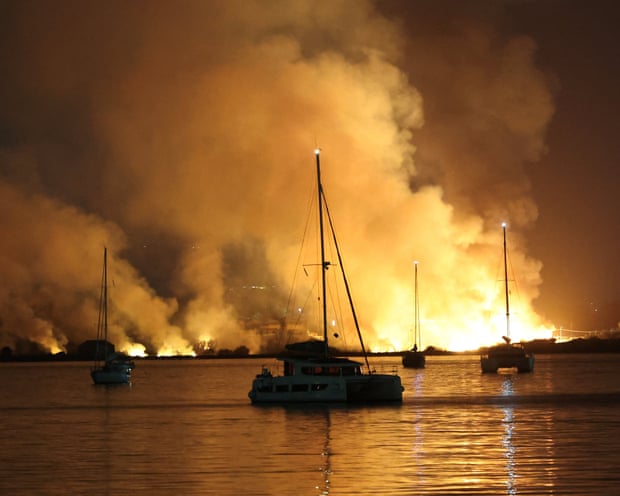
A wildfire burning near the coast of Syracuse in Sicily, Italy, toward the end of last month. Photograph: Stéphane Mahé/Reuters
WMO report details extreme weather events causing climatic feedback loop with serious health consequences
Big increases in wildfires and heatwaves supercharged by the climate crisis are hindering improvements to air quality around the world, UN experts have said.
Regions that had recorded a fall in pollution emitted by cars and industrial sites are facing new threats to air quality because of exposure to smoke from wildfires, according to a new report, while rising temperatures caused by intense heatwaves are causing a surge in ground-level ozone.
In turn, the pollution generated by these climate-linked events is itself contributing to climate breakdown, creating a feedback loop that risks dragging the world deeper into environmental catastrophe.
“Air quality and climate cannot be treated as separate subjects; they are deeply intertwined and have to be treated together,” said Lorenzo Labrador, a scientific officer of the World Meteorological Organization (WMO), which issued the report.
Elon Musk urges you to be a Fascist like him, says that you can ignore facts and reality then.Donald Trump urges you to be a Climate Science denier like him. He says that he makes millions and millions for destroying the planet, Burn, Baby, Burn and Flood, Baby, Flood.Nigel Farage urges you to ignore facts and reality and be a climate science denier like him and his Deputy Richard Tice. He says that Reform UK has received £Millions and £Millions from the fossil fuel industry to promote climate denial and destroy the planet.
As the latest UNEP reports we will blow past 1.5°C, we must prioritise solutions that work, rather than focusing on complex, unproven technologies
For anyone who’s been paying attention, it’s no surprise that the United Nations Environment Program (UNEP) reports that we will now inevitably blow past the global average temperature threshold of 1.5°C above pre-industrial levels.
Climate scientists like myself have been warning for years that we are about to cross this invisible red line, while quietly worrying that global average temperatures will end up being double that. Personally, I said goodbye to 1.5°C several years ago, but it still feels momentous to see it written in print, and that too by the UN.
The target to keep warming to 1.5°C above pre-industrial temperatures isn’t some hard red line in the sand, because all warming carries some risk, but it’s relevant because limiting warming to 1.5°C gives us a good chance of avoiding some of the worst impacts of climate heating. We’ve already had a glimpse of what this looks like in the myriad heatwaves, wildfires, floods, droughts and storms that have made headlines this year.
Every tenth of a degree of heating means real-terms impacts for peoples’ lives, livelihoods and property, and increases the risk of the extreme events that we’ve already seen tragically claim so many lives. It also increases the likelihood of exceeding critical tipping points such as the collapse of the West Antarctic Ice Sheet, beyond which there’s no return.
We’ve already had single years that have exceeded the 1.5°C limit, but the widely discussed Paris Agreement target is a multi-year average. That means we won’t know we’ve reached it until it’s in the rearview mirror, but it’s also possible to “overshoot” 1.5°C, temporarily peak at higher temperatures, and then bring them back down – and that’s now the best-case scenario outlined by UNEP.
This would mean we would have to take drastic action to bring temperatures back down again rather than continuing to drive them ever upwards. Which, in the current political climate, feels like a bit of a stretch.
Temperatures won’t stabilise until we reach net zero emissions, where we remove as much carbon from the atmosphere as we add to it. Until then, we will still be increasing greenhouse gas concentrations in the atmosphere and turning up the dial on the thermostat. Net zero isn’t a nice to have, despite what certain parts of the political spectrum would have you believe, it’s an essential if we want to have a liveable planet.
In fact, UNEP’s latest report points to the need to take action beyond net zero:
Once we have limited heating to 2°C or below — which currently feels optimistic — we will have to roll out carbon dioxide removal (CDR) to reduce temperatures on an enormous scale.
CDR often connotes high-tech solutions to suck carbon dioxide out of the atmosphere, but it can also mean one of the oldest technologies in the world: trees. That’s why restoring nature and preventing deforestation is so important for climate action.
But UNEP reports that CDR only works if we limit heating to 2C or below. As the stakes of climate heating continue to rise, another idea is moving from the sidelines to centre-stage: geoengineering, or deliberate technological interventions to alter the Earth’s climate.
Geoengineering is a spectrum, ranging from the comparatively reasonable and well-researched (injecting particles into the stratosphere to reflect incoming sunlight and cool the surface, much like major volcanic eruptions have done) to downright barmy (launching mirrors into space – you can imagine which silicon valley billionaires love that idea). And while there are sensible (if heated) scientific discussions about how to actually do it, there are also some very serious ethical and governance hurdles to overcome.
The tech bros will tell you that geoengineering will save us and allow us to keep doing what we’re doing while still ‘fixing’ climate change. But beware any arguments that downplay the importance of emissions cuts. We can’t simply geoengineer our way out of this crisis.
For example: who decides when to deploy? What happens if an intervention makes things better for some and worse for others? How do we safeguard against bad actors acting unilaterally? These questions are largely unanswered, and that’s before we get to the scientific questions around unintended consequences, like disrupting the Arctic food chain while trying to refreeze ice, or what happens if we stop the intervention, resulting in a so-called termination shock, where temperatures would shoot back up with devastating effect.
In some senses the climate crisis is relatively simple: we’re pumping planet-heating carbon dioxide into the atmosphere, and it’s heating the planet. To reverse it, we need first to stop adding planet-heating carbon dioxide to the atmosphere, and then to start removing it.
The good news is that we do know what we need to do to achieve that. Climate action is less a knowledge problem, and more an implementation one.
Proponents of geoengineering argue that it’s not an either/or between emissions cuts and major interventions. But in a world with finite resources, expensive and unproven geoengineering solutions should not be a priority, rather, we should prioritise the simple stuff we know works: decarbonising energy production, improving public transport, retrofitting and building greener housing, reducing meat and dairy consumption, restoring natural ecosystems.
That said, we are now committed to some level of change, and we need to behave as such. That means we need to prepare for the sea level rise that’s to come, and adapt societies, behaviours and infrastructure to a less predictable and more extreme climate.
If the summer of 2026 has taught us anything in the UK, it’s that our houses, schools, offices, railways, emergency services, power networks and public transport are simply not fit for purpose in the heat. Nor are they built to withstand the wet, stormy, flood-prone autumn and winter that is on its way. We’re not equipped to deal with the rapidly extremifying climate or the weather whiplash it brings. Simply put: our infrastructure was built for a climate that no longer exists.
If we are to survive the coming decades, we need to build preparedness and climate resilience into our society. Extreme events are already exposing our vulnerabilities, and if we thought 2026 was bad, count my words: we ain’t seen nothing yet.
In the wake of our hottest summer on record, it’s abundantly clear that we need to slash emissions to save lives, and at the same time prepare for the changes that are now committed.
The geoengineers are right about one thing: It’s not an either/or. We have to reduce emissions to net zero and remove carbon from the atmosphere and adapt to what’s in store. There’s no other safe option.
Dr. Ella Gilbert is a climate scientist and multi-award-winning presenter with a PhD in Antarctic climate change.
Donald Trump urges you to be a Climate Science denier like him. He says that he makes millions and millions for destroying the planet, Burn, Baby, Burn and Flood, Baby, Flood.Nigel Farage urges you to ignore facts and reality and be a climate science denier like him and his Deputy Richard Tice. He says that Reform UK has received £Millions and £Millions from the fossil fuel industry to promote climate denial and destroy the planet.Elon Musk urges you to be a Fascist like him, says that you can ignore facts and reality then.
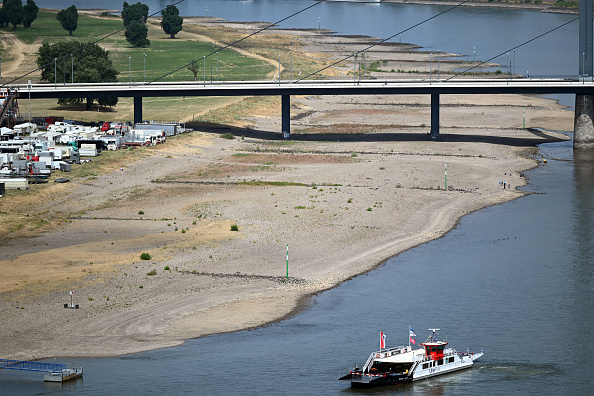
[Photo by Federico Gambarini/picture alliance via Getty Images]
World must slash emissions to limit irreversible climate damage
The world must rapidly change course as it drifts beyond the global warming limit of 1.5°C above pre-industrial temperatures, the United Nations Environment Programme (UNEP) has warned in a new report.
The UN and climate scientists have already conceded that the red line agreed in Paris over a decade ago will be crossed. The three-year average last year exceeded the limit agreed in Paris in 2015, many are betting on 2026 being among the hottest years ever, and 2027 looks set to be hotter still.
“We must make the overshoot as small and short as possible,” UN Secretary-General António Guterres said in a statement ahead of the report’s publication on Wednesday. This means “limiting how high temperatures rise and how long they remain above 1.5°C,” he said.
At a time of growing political resistance to climate action, Guterres called for an “overshoot of ambition” that would include a faster phase-out of fossil fuels and sharp cuts to methane emissions.
Nigel Farage urges you to ignore facts and reality and be a climate science denier like him and his Deputy Richard Tice. He says that Reform UK has received £Millions and £Millions from the fossil fuel industry to promote climate denial and destroy the planet.Donald Trump urges you to be a Climate Science denier like him. He says that he makes millions and millions for destroying the planet, Burn, Baby, Burn and Flood, Baby, Flood.Orcas discuss how Trump was re-elected and him being an obviously insane, xenophobic Fascist.
A person using an electric fan to cool down on the underground in London. Education, health services and transport all suffered in the heat. Photograph: Tolga Akmen/EPA
Meteorologists say mean average temperature of 16.5C was made 130 times more likely by climate crisis
This year’s summer was the UK’s hottest on record, according to provisional data, and the Met Office said the season’s mean temperature was made 130 times more likely by the climate crisis.
Record-breaking and back-to-back heatwaves have scorched much of Europe. In England, temperatures peaked at 38.1C (100.1F) at Kew Gardens in London on 13 August, and June had already been confirmed as the country’s hottest since records began in 1884. Scientists have said these heatwaves are only possible because of the climate crisis driven by burning fossil fuels.
The Met Office said an average mean UK temperature of 16.5C made this summer provisionally the warmest on record as well as the warmest season in a series going back to 1884. England, Wales and Northern Ireland broke their respective mean temperature records for summer while Scotland recorded its joint sixth hottest summer.
This is the second year in a row that temperature records have been broken, with 2025 and 2026 both the warmest UK summers since records began.
The infamous summer of 1976 is now the seventh warmest on record in terms of mean temperature.
Donald Trump urges you to be a Climate Science denier like him. He says that he makes millions and millions for destroying the planet, Burn, Baby, Burn and Flood, Baby, Flood.Nigel Farage urges you to ignore facts and reality and be a climate science denier like him and his Deputy Richard Tice. He says that Reform UK has received £Millions and £Millions from the fossil fuel industry to promote climate denial and destroy the planet.Orcas comment on killer apes destroying the planet by continuing to burn fossil fuels.
US President Donald Trump holds an image showing the size of Meta’s new data center in Washington, DC on August 26, 2025. (Photo by Mandel Ngan/AFP via Getty Images)
“Donald Trump is actively trying to help as many Democratic senators as possible get elected,” said one polling expert.
President Donald Trump on Monday warned Americans that they risk becoming “backwards and poor” unless they allow Big Tech companies to build artificial intelligence data centers in their communities.
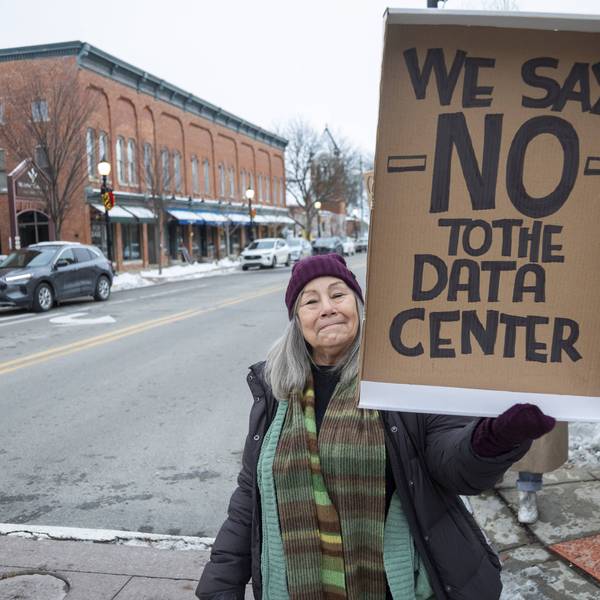
In a social mediapost, the president expressed indignation that any town or city wouldn’t welcome data centers, which have drawn nationwide opposition for generating pollution and jacking up utility bills.
“The only reason that communities throughout the USA should not want Data Centers is if they want to end up being backwards and poor,” Trump wrote. “If they want to be successful and rich, with far lower taxes and jobs all over the place, let Data Reign.”
In reality, AI data centers create very few jobs once they are completed, as most of their functions are fully automated.
Trump then said that Americans “will only have yourselves to blame” if they “kill the Golden Goose” that is AI data centers.
“China could not be happier with this anti Data Center movement,” Trump wrote. “Actually, they can’t believe it is happening!”
Building AI data centers has become massively unpopular throughout the US.
A poll conducted by Embold Research and published by Heatmap Pro earlier this month shows that 75% of Americans now oppose building AI data centers in their area, including 61% registering strong opposition.
While Republicans polled in the survey were more supportive of data centers than Democrats and independent voters, it nonetheless found that opposition among Republicans outweighed support by 43 points.
Polling analyst G. Elliott Morris marveled at how politically tone deaf the president sounds when it comes to data centers, commenting that “Donald Trump is actively trying to help as many Democratic senators as possible get elected.”
Longtime GOP operative Frank Luntz similarly noted data centers’ unpopularity, citing a recent Gallup poll showing 63% of Republican voters oppose having one of the facilities built in their communities.
“We’re about to see whether President Trump can sway those voters to support them, as he’s done on many issues before,” Luntz remarked.
Democratic US Senate hopeful Abdul El-Sayed wasted no time tying the president’s position on data centers to his opponent, Republican Mike Rogers.
“Make no mistake—this is Mike Rogers’ position on data centers,” wrote El-Sayed. “He’s got up to $2.6 million invested in companies cashing in on the data center boom, all while Michiganders watch their utility bills soar. You can’t trust a word out of Mike’s mouth because he’s only out for himself, for Donald Trump, and for Big Tech—not Michigan.”
Faiz Shakir, a longtime adviser to US Sen. Bernie Sanders (I-Vt.), observed that Trump is merely “sharing the perspective of Wall Street and Big Tech” and is showing “no interest… in grappling with the mass revolt across American communities, or to learn anything from them.”
Screenwriter David Simon, creator of the acclaimed television series The Wire, accused Trump of brazenly lying about data centers’ economic benefits.
“If data centers are a geographic benefit to communities, you can be sure they’d be siting and building them in affluent and politically connected environs,” wrote Simon. “Curiously, they’re dumped in poorer, less influential places. Go fucking figure.”
Republican Kentucky state Rep. Savannah Maddox took issue with the president disparaging communities opposed to data centers, which include many of the rural communities that voted for him in three presidential elections.
“Rural doesn’t mean ‘backwards and poor’ and development doesn’t always equate to being ‘successful and rich,’” wrote Maddox. “President Trump wouldn’t be president without the rural voters who inhabit America’s heartland. It is not wrong of us to question the sudden and wide-scale effort to convert arable land into data centers. We are not stupid for wanting to protect our rural way of life.”
Orcas discuss rotting brain, front Orca says he wishes someone would lock him up, small Orca speaks bluntly.Donald Trump urges you to be a Climate Science denier like him. He says that he makes millions and millions for destroying the planet, Burn, Baby, Burn and Flood, Baby, Flood.Donald Trump explains why he established his Bored of Peace