NHS news review

Spread the love

Pressure Group 38degrees commissioned legal advice on the Liberal-Democrat – CONservative government’s Destroy the NHS Bill.

The legal advice confirms that the Bill will remove the duty on the Health Secretary to be responsible for providing a health service and that the NHS will be subject to competition law which, in turn, will promote private interests.

The proposed cut in legal aid to patients will cost the NHS very dearly.

CONservative Prime Minister David Cameron claims that “the whole health profession is on board for what is now being done”. It’s a deliberately misleading statement since much of the medical profession actively oppose his plans to destroy the NHS.
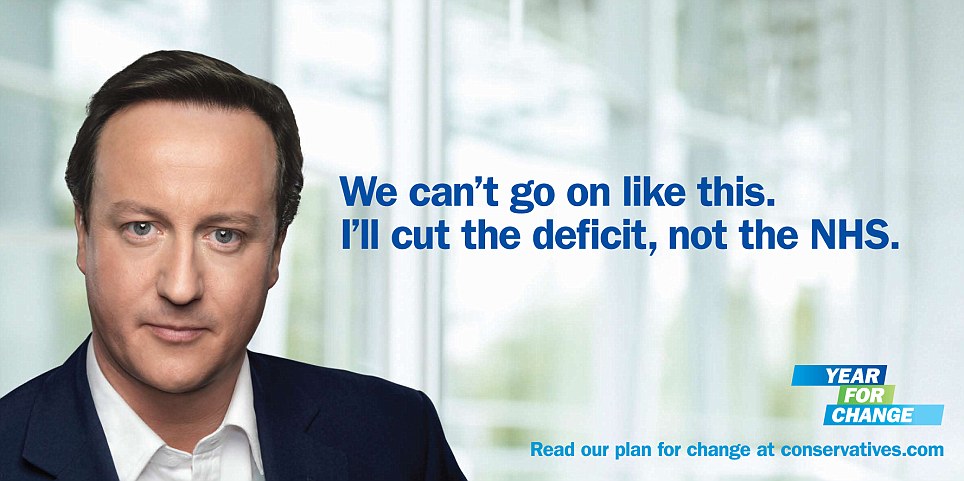
Conservative election poster 2010

A few recent news articles about the UK’s Conservative and Liberal-Democrat coalition government – the ConDem’s – brutal attack on the National Health Service.

NHS bill ‘will let Andrew Lansley wash his hands of health service’ | Society | The Guardian

Legal opinion funded by campaigners suggests ‘hands-off’ clause will remove the health secretary’s accountability

The health secretary will be able to “wash his hands” of the NHS after forthcoming legislation which will take away his duty to provide a national health service, according to legal advice funded by campaigners.

The legal opinion, commissioned and paid for by members of the 38 Degrees website, justifies the widespread public concern about the government’s health reforms, in spite of Andrew Lansley‘s assurances that he has listened and responded to criticisms, they say.

The independent legal team says the health and social reform bill removes the health secretary’s responsibility for NHS provision through a “hands-off” clause designed to give autonomy to commissioning groups.

Now lawyers move in to make a killing off Lansley’s NHS reforms – Health News, Health & Families – The Independent

The Health Secretary’s promise to prevent price competition in the NHS as part of the Government’s health reforms is meaningless and could be challenged in the courts, senior lawyers have warned.

Under the reformed Health and Social Care Bill, being put through Parliament by Andrew Lansley, regulators will no longer have a duty to promote price competition between public and private health providers.

But yesterday lawyers suggested that the concession would have no practical effect as EU competition and procurement law will force trusts to consider the price and value of services when commissioning or face challenges in the courts.

This could lead to significant fines or the cancelling of contracts – with a knock-on effect on patient care – if challenged by companies that lose out on contracts. It will also, the advice suggests, cost the new GP consortiums, set up to replace primary care trusts, millions of pounds in lawyers’ fees to ensure that their commissioning decisions are legally sustainable.

“The Government has simply failed to grapple with the frontline issues in procurement [and] has wholly underestimated the increasing rather than diminishing complexity in the area and has had no or perhaps little regard to the administrative and financial burdens arising from the regime,” the legal opinion concludes.

“The fact, however, that the Government has amended the Bill to remove… the duty to promote competition as an end in itself is arguably futile since the very fact that domestic and European competition law applies to the NHS arguably itself results in the promotion of competition since that is its aim.”

The opinion was commissioned by the campaign group 38 Degrees from lawyers at the Doughty Street and Monckton Chambers. It will be passed on to MPs debating the Bill, which is currently going through the House of Commons.

Its conclusions are likely to concern senior Liberal Democrats ahead of the party’s conference next month – as the removal of the competition clause was trumpeted by the party as a key concession won from the Conservatives.

Any suggestion that it is meaningless will anger activists and lead to calls for further reform to the legislation.

The report also concludes that if the Bill becomes law the duty of the Government to provide a “national” health service will have been diluted and it will reduce what is currently the “unfettered power” of the Health Secretary to impose his or her will on the NHS.

The legal advice adds that in the “clear intention of the Bill to give consortia autonomy from the Secretary of State, there is a real risk of an increase in the ‘postcode lottery’ nature of the delivery of some services, depending on the decisions made by consortia in relation to these subsections. And the intention of the Bill is that there will be very little that the Secretary of State can do about this in practice.”

Patients’ legal aid cuts will cost NHS tens of millions – Health News, Health & Families – The Independent

The Government’s plans to slash the soaring legal aid bill threaten to cost the NHS millions and exclude many victims of medical negligence from justice, the National Health Service’s own lawyers have warned.

The man in charge of managing an NHS negligence bill that last year topped £1bn for the first time, told the Justice Secretary, Kenneth Clarke, that his attempts to stop the state bankrolling medical cases would be counterproductive – and would “undoubtedly cause NHS legal costs to escalate massively”.

Steve Walker, chief executive of the NHS Litigation Authority (NHSLA), cautioned that the move would push alleged victims into the arms of lawyers offering “no win, no fee” deals, which would leave hospitals with hugely inflated bills every time they lost a case. The deals, also known as conditional fee agreements (CFAs), have been on the increase in recent years, with payments to claimant lawyers amounting to 76 per cent of the £257m outlay on legal costs for clinical negligence claims closed last year.

Mr Walker also suggested the move would lead to a conflict of interest between lawyers and clients seeking a fair settlement – amounting to “a danger that some very seriously injured and vulnerable claimants may be prejudiced by the desire of their lawyers to recover their costs”. Claimants in some of the most serious cases, including brain-damaged children and adults, could struggle to strike suitable CFAs – and face prohibitive charges including hefty “after the event” insurance premiums.

But the warnings, delivered in an official response to the Ministry of Justice, appear to have made little difference to the final Bill, which will be debated in Parliament when MPs return next month.

Pressure groups and the legal profession last night said the NHSLA’s comments revealed officials’ deep concerns over the dangers posed by Mr Clarke’s proposals, and they condemned his failure to amend the Bill to take account of the warnings.

Peter Walsh, of the charity Action against Medical Accidents, said: “All that will happen here is that Ken Clarke will be able to say he has saved a few millions on the legal aid budget, but elsewhere in Whitehall the NHS will be paying tens of millions more. At the same time, dozens of people will be excluded from justice and the NHS will not be learning from its mistakes.”

This is Devon | Cameron defends health reforms during Cornwall visit

David Cameron has defended controversial proposals for a radical shake-up of the NHS, defiantly stating “the whole health profession is on board for what is now being done”.

The Prime Minister yesterday issued a passionate broadside in response to St Ives Liberal Democrat MP and Health Select Committee member Andrew George, who this week called on opponents to dig their heels in and derail service changes over concerns the NHS would become a profit-making machine at the expense of patient care.


27/11/13 Having received a takedown notice from the Independent newspaper for a different posting, I have reviewed this article which links to an article at the Independent’s website in order to attempt to ensure conformance with copyright laws.

I consider this posting to comply with copyright laws since
a. Only a small portion of the original article has been quoted satisfying the fair use criteria, and / or
b. This posting satisfies the requirements of a derivative work.

Please be assured that this blog is a non-commercial blog (weblog) which does not feature advertising and has not ever produced any income.

dizzy
Continue ReadingNHS news review

NHS news review

Spread the love

The Lancet on the failed NHS records IT project.

Corporate Watch investigates the Co-operation and Competition Panel (CCP) quango that supports privatisation and the abolition of public sector NHS provision.

Waiting times for Accident and Emergency treatment increase.

Conservative election poster 2010

A few recent news articles about the UK’s Conservative and Liberal-Democrat coalition government – the ConDem’s – brutal attack on the National Health Service.

Winner of world’s most mismanaged health project » Hospital Dr

This is an editorial from The Lancet.

If there were an award for the world’s most mismanaged national health project, England’s National Programme for IT in the NHS would be a strong contender, if not outright winner. Started in 2002, Tony Blair’s brainchild has, like the computer in 2001: A Space Odyssey, gone badly wrong.

The main aim of the project was to create a fully integrated centralised electronic care records system to improve services and patient care by 2007. The budget for the undertaking was a substantial £11·4 billion. Nine years on, the Department of Health has spent £6·4 billion on the project so far, failed to meet its initial deadline, and has had to abandon the central goal of the project because it is unable to deliver a universal system.

Given the ineptitude that has characterised this project, disaster was almost certain. According to a new report by the Public Accounts Committee (PAC), the Department has failed to get value for the vast sums of money that it has paid contractors. Of the two companies that are still involved in the project, one has yet to deliver the bulk of the systems that it was contracted to supply despite being paid £1·8 billion since 2002, and the other is being paid £9 million to implement systems at each NHS site that have cost other organisations outside the programme £2 million.

The Department seems to have been foolishly duped by commercial companies that promised the sun, cost the earth, and delivered not much more than hot air. Damningly, PAC’s report states: “The Department could have avoided some of the pitfalls and waste if they had consulted at the start of the process with health professionals.”

Corporate Watch : LATEST NEWS : Co-operating and competing to privatise the NHS

“NHS delays operations ‘as it waits for patients to die or go private’” thundered the front page of the Daily Telegraph after the release of the Co-operation and Competition Panel (CCP)’s report on choice and competition in elective care late last month. Most of the major papers and news broadcasters jumped on board, the majority repeating that Primary Care Trusts (PCTs), in an attempt to cut costs, are setting minimum waiting times for patients, who then either “die or go private.” A Daily Mail leader declared: “it’s hard to conceive of a more barbaric tactic than making patients wait so long for surgery that they either go private or die.”

But reading the report, it turns out they were getting all worked up for nothing. For a start, the report is looking into elective care. Elective care includes things like hip replacements, knee replacements, foot surgery, tinnitus, varicose veins and so on: “pre-arranged, non-emergency care that includes scheduled operations,” in the words of the Department of Health. Serious, painful conditions of course, but not ones that will kill you if you have to wait a couple more weeks for an operation. As a weary David Stout, director of the Primary Care Trust Network, told the Today programme: “the suggestion people are dying waiting for routine elective care doesn’t make sense.”

So what’s this “waiting for patient to die” claim? It comes from paragraph 131 of the report, in which the writers explain they were told: “increasing waiting times for patients did have the potential to save money overall” and then they quote someone who says: “Experience suggests that if patients wait longer then some will remove themselves from the list or will no longer require treatment when it is finally offered.”

This is footnoted, but not to explain who is being quoted.* Instead, the note says:

“We understand that patients will ‘remove themselves from the waiting list’ either by dying or by paying for their own treatment at private sector providers.”

And that’s what the fuss is about. One unsubstantiated footnote. We asked the CCP if they had based this on any evidence but they didn’t reply. So the Co-operation and Competition Panel – which, if the government’s reforms go through, will become a decision-making body within the NHS – is saying that if someone’s knee replacement is delayed by an extra two weeks they may choose to die rather than wait. As the Daily Mail put it: that is sickening.


We are told early on that it is based on “around 80 submissions from NHS providers, GPs, Primary Care Trusts, Strategic Health Authorities, independent and third sector providers, representative organisations and others,” but that those submissions made by the independent sector providers – i.e. private companies – will not be disclosed due to: “concerns that publication of these submissions would be likely to prejudice the commercial interests of the organisation which had made the submission.” This makes things difficult, because the report is based on the companies’ allegations that PCTs are unfairly denying them work by encouraging patients to use public healthcare providers. Quotes of no more than a couple of sentences are pulled out of the companies’ submissions, but we are never told which company made them or what context they were made in.

Reading through the submissions made by the PCTs which we are allowed to read, it seems they were kept in the dark too. Many seem confused because the CCP has told them they have been accused of something but they haven’t been told what. NHS Somerset, among others, says it is “difficult to comment directly on the points raised without sight of the specific allegations raised.” NHS North Yorkshire and York note: “without further detail or specific examples it is difficult to respond to this allegation.”

Recommendations for the whole NHS are conjured up from a combination of accusations from a few un-named companies, explanations from a few PCTs and the panel’s “understanding” of the issue, which, as we have seen, isn’t exactly foolproof. To show PCTs are encouraging GPs to restrict patients’ ability to choose which provider they go to for their treatment, for example, we are given two, single sentence quotes from un-named PCTs and three unsubstantiated allegations made by unnamed providers. There is no thorough analysis of all the evidence taken together and no suggestion of exactly how widespread this so-called anti-competitive behaviour is. Early on they say they saw “many” examples of PCTs “excessively constraining patients’ ability to choose” and then, later on: “a significant number of PCTs are restricting patient choice and competition in routine elective care,” but that’s about it.

If the Health and Social Care bill goes through the CCP’s remit will only widen. The Department of Health has already announced that the “any qualified provider” policy will be extended into community and mental health services and it will not stop there. David Cameron and his health secretary Andrew Lansley are always keen to say how their reforms will bring an end to the reign of pen-pushing bureaucrats in the NHS but they are quietly loading an unelected body run by bureaucrats (albeit pro-market bureaucrats) with the power to censure and overrule any doctors, managers or staff that try to keep healthcare public.

Number of NHS patients waiting more than four hours in A&E doubles | Society | The Guardian

The number of patients waiting more than four hours for treatment in accident and emergency departments has almost doubled in the space of a year, the latest statistics reveal.

Figures show 161,422 patients were left waiting over four hours for “major A&E” treatment between April and June 2011 – 91% more than during the same period in 2010.

A broader measure including minor injuries units and walk-in centres was also up 90%, to 165,279.

The increases come despite a slight fall in the number of patients using A&E services, from 3.6 million to 3.58 million, scotching past Department of Health assertions that the longer waits were down to increased pressure on services.

Continue ReadingNHS news review

NHS news review

Spread the love

The Audit Commission reports that NHS organisations face “the worst financial situation they have ever experienced”.

Pulse reports that “Private companies are poised to bid to run huge chunks of NHS care across the country”.

Waiting times rise despite David Cameron’s pledges.

Conservative election poster 2010

A few recent news articles about the UK’s Conservative and Liberal-Democrat coalition government – the ConDem’s – brutal attack on the National Health Service.

Funding crisis looms over NHS / Britain / Home – Morning Star

NHS organisations face “the worst financial situation they have ever experienced” as a result of government funding cuts, the Audit Commission claimed today.

It found that most trusts were only able to balance their books with financial help in 2010-11.

Sixteen NHS trusts needed £90 million to help them keep on track while cash was also distributed from underspending primary care trusts to those that had overspent.

The public-service watchdog said that although only nine out of the 276 NHS organisations in England were in deficit, six in the south-east, trusts face a challenging 12 months trying to keep on top of a £20 billion efficiency savings target by 2015.

Related: NHS faces growing financial pressure, says auditor | Healthcare Network | Guardian Professional


PCTs clamour to put entire care pathways out for tender – newsarticle-content – Pulse

Exclusive Private companies are poised to bid to run huge chunks of NHS care across the country, as a host of PCTs follow NHS East of England’s controversial lead in placing entire care pathways out to tender.

NHS East of England plans to auction off £300m of services to GPs, private companies or a combination of the two, in pathways including respiratory and musculoskeletal medicine.

Eight PCTs are now planning to replicate the NHS East of England plans, which Pulse first revealed in March and are backed by an adviser to the Government’s QIPP programme.

Pulse has established that NHS Bassetlaw, NHS Hampshire, NHS Coventry, NHS Brighton and Hove and NHS Outer North East London, a cluster covering four PCTs, are all considering putting entire care pathways out to tender, with several having started discussions with GP commissioners about the move.

NHS Outer North East London said it would tender out entire care pathways and would ‘provide an outline programme of these once prioritised and agreed with GP consortia and existing service providers’. NHS Bassetlaw said it had already awarded tenders for musculoskeletal and dermatology pathways, worth £680,000 and £775,000 respectively, to NHS providers.

Leap in waiting times for key NHS health tests despite Cameron’s pledge – Health News, Health & Families – The Independent

The number of NHS patients waiting more than three months for tests has increased nine-fold in a year.

In June, 1,763 people had been waiting for at least 13 weeks for one of 15 diagnostic tests – including MRI and heart scans, ultrasound and colonoscopies – according to Government figures released yesterday. This compares with only 190 in June 2010.

The figures came a month after the Prime Minister personally pledged to keep waiting times low. Health ministers were quick to point to a small month-on-month improvement in June, but with nearly 600,000 people in total waiting for a test to diagnose or exclude a medical condition, June is the worst month of 2011 so far.

Related: Nine-fold increase in patients waiting for diagnostics » Hospital Dr  Number of NHS patients waiting more than six weeks for tests quadruples in one year | Mail Online

BMA calls on every GP to join pensions fight – newsarticle-content – Pulse

The BMA has issued a rallying cry for every GP in the country to join the fight to protect NHS pensions by responding individually to the Department of Health’s ongoing consultation.

BBC News – Bupa calls for ‘urgent’ action over care home crisis

Ray King, chief executive of medical group Bupa, has called for a “chronic underfunding” of the care homes system to be addressed “urgently”.


27/11/13 Having received a takedown notice from the Independent newspaper for a different posting, I have reviewed this article which links to an article at the Independent’s website in order to attempt to ensure conformance with copyright laws.

I consider this posting to comply with copyright laws since
a. Only a small portion of the original article has been quoted satisfying the fair use criteria, and / or
b. This posting satisfies the requirements of a derivative work.

Please be assured that this blog is a non-commercial blog (weblog) which does not feature advertising and has not ever produced any income.

dizzy
Continue ReadingNHS news review

NHS news review

Spread the love

A report confirms that the NHS is incredibly efficient and successful.

The decision to force the NHS to support Circle Health’s luxurious hospital in Bath provides a real insight into the Con-Dems’ NHS ‘reforms’. It is all about destroying the NHS and supporting expensive crap, getting those donations in and having grand lunches.

Conservative election poster 2010

A few recent news articles about the UK’s Conservative and Liberal-Democrat coalition government – the ConDem’s – brutal attack on the National Health Service.

NHS among developed world’s most efficient health systems, says study | Society | The Guardian

Report in the Journal of the Royal Society of Medicine finds health service second only to Ireland for cost-effectiveness

The NHS is one of the most cost-effective health systems in the developed world, according to a study (pdf) published in the Journal of the Royal Society of Medicine.

The “surprising” findings show the NHS saving more lives for each pound spent as a proportion of national wealth than any other country apart from Ireland over 25 years. Among the 17 countries considered, the United States healthcare system was among the least efficient and effective.

Researchers said that this contradicted assertions by the health secretary, Andrew Lansley, that the NHS needed competition and choice to become more efficient.

“The government proposals to change the NHS are largely based on the idea that the NHS is less efficient and effective than other countries, especially the US,” said Professor Colin Pritchard, of Bournemouth University, who analysed a quarter of a century’s data from 1980.

“The results question why we need a big set of health reform proposals … The system works well. Look at the US and you can see where choice and competition gets you. Pretty dismal results.”

The study will be a blow for Lansley, who argues that patients should choose between competing hospital services and GPs.

Pritchard’s last academic paper, which argued that surgeons were being distracted from frontline work by “unfunded” targets in the NHS, was used by Lansley to justify government reforms.

Using the latest data from the World Health Organisation, the paper shows that although Labour’s tax-and-spend strategy for the NHS saw health spending rise to a record 9.3% of GDP, this was less than Germany with 10.7% or the US with 15%.

Not only was the UK cheaper, says the paper, it saved more lives. The NHS reduced the number of adult deaths a million of the population by 3,951 a year – far better than the nearest comparable European countries. France managed 2,779 lives a year and Germany 2,395.

Bradford union chief fears staff won’t cope as NHS cuts (From Bradford Telegraph and Argus)

A union boss has hit out against job cuts at a Bradford health trust which she warned means “work simply won’t get done”.

A major national restructure of the NHS will see Primary Care Trusts disappear by April, 2013, when commissioning of services will be taken over by local clinical commissioning groups and national bodies such as Public Health England.

NHS Bradford and Airedale, which says it needs to save £2.9 million in management costs this year, has approved 34 applications for voluntary redundancy or early retirement but has warned that some staff are still at risk of losing their jobs.

Drawing a comparison with troubled care home company Southern Cross, Jackie Smith, Unison’s Bradford health branch secretary, said: “If you have a commissioning organisation that is so crippled by the Government’s cuts that we cannot be guaranteed that it is commissioning the right services and that it cannot police those services that they have commissioned because of lack of resources, you will end up with a Southern Cross scenario in health care.

“The restructure that we have been consulted on also looks very top heavy with lots of managers and fewer workers.”

NHS trust must save £12m by end of year – Health – Eastbourne Herald

cash-strapped East Sussex Healthcare NHS Trust is walking a financial tightrope which could have a major impact on frontline services.

It has been ordered to identify £30 million in savings by the end of the year – and so far only £18 million has been found. And the trust’s board was told at a recent meeting the organisation’s ‘run rate’ shows it spending out around £1million a month more than it is bringing in.

The situation has not been helped by a drop in income from patients being referred by GPs, which has piled more pressure on the trust’s already beleaguered purse. And in a further blow the trust is having to fork out £115,000 to pay for extra Microsoft licences for IT equipment across its sites – a cost which up until now has been met at a national level under an NHS deal.

Report critical of NHS rule on waiting times (From This Is Wiltshire)

NHS Wiltshire has been rapped for imposing a minimum waiting time of 15 weeks for people to receive hospital treatment.

The health trust imposed the 15-week limit to save money, to ensure patients are treated strictly in order and to prevent unfair competition on waiting times. But the move has been criticised by the Co-Operation and Competition Panel (CCP), an independent watchdog that advises the NHS.

In a report published last week, the CCP said: “The conduct of Wiltshire Primary Care Trust in setting uniform minimum waiting times, which in effect become minimum waiting times, restricts competition and distorts patient choice and this imposes material costs on patients and taxpayers.”

This is Bath | Bath circlebath hospital competition panel NHS wiltshire

The operator of a private hospital near Bath has won a ruling from a Government watchdog that the NHS is unfairly holding back potential patients.

Health Secretary Andrew Lansley will have to decide what sanctions should be taken against health chiefs in Wiltshire over their imposition of a minimum waiting time for patients in negotiations with Circle Health, over its hospital at Peasedown St John.

The row threatens to turn the Bath area into a test-bed for how far the Government is prepared to push the idea of increasing the private sector’s involvement in treating NHS patients.

Both the area’s biggest NHS hospital, the Royal United Hospital, and commissioning body NHS B&NES insist that no such minimum wait operates in the immediate Bath area.

But the ruling by the Cooperation and Competition Panel quango underlines the tension between patient choice and finite NHS budgets, and between private and specialist treatment centres performing routine surgery and acute hospitals such as the RUH which have to support emergency and intensive care.

Circle Health, which opened its hospital at the beginning of last year, had complained to the CCP that NHS Wiltshire – which commissions services for the county and in some cases for B&NES – was breaking health service rules on competition and co-operation.

This is Bath | Fear of favours to ‘Tory’ hospital as NHS ‘undermined’ by competition

A Government quango has ordered health chiefs across two counties to send more patients to a private hospital which is owned by two major donors to the Conservative Party.

Union bosses said the decree ‘stinks of cronyism’ and has demanded questions be asked about the relationship between the private hospital firm and the Government.

The Government’s new Co-operation and Competition Panel (CCP) was given the job of enforcing new competition rules within the NHS, which campaigners say is a ‘back door’ way of privatising the health service.

Earlier this year, CircleBath, a private hospital in Peasedown St John, near Bath, complained to the CCP that local health trusts weren’t sending enough patients to it for routine operations.

Circle said NHS Bath & North East Somerset and NHS Wiltshire, which commission services jointly at the Royal United Hospital in Bath, weren’t playing fair in setting a cap of £6 million on operations it would fund at the new private hospital, while it spent £160 million at the RUH.

The CCP has now ruled in Circle’s favour, saying the two NHS trusts had breached the new competition rules by favouring NHS hospitals like the RUH over private hospitals like Circle. It has now given health bosses in Bath and Devizes a fortnight to respond to the ruling and outline what they are going to do.

CCP director Andrew Taylor said setting a maximum spend on using private hospitals was unfair to CircleBath, and meant a worse deal for patients. “The panel considers that the majority of the aspects of conduct raised in this complaint impose costs on patients and taxpayers that are not outweighed by any of the benefits that may arise from such behaviour. We are now keen to consult on what would be an appropriate remedy to the conduct in question,” he said.

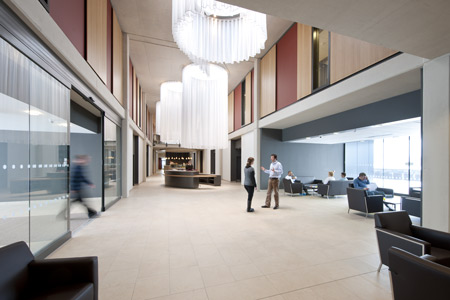
Cirle Bath by Foster & Partners
Cirle Bath 'hospital' by Foster & Partners


Foster + Partners

CircleBath is Foster + Partners’ first hospital and represents a radical departure from orthodox approaches to hospital planning. The three-storey building is set into the hills on the edge of protected green belt nine kilometres south east of Bath and its compact arrangement provides a ‘corridor-less’ environment, encouraging a sense of community and well-being.

The hospitable: Foster + Partners’ Circle Bath hospital | Magazine News | Building


“We wanted a building that looked more like a five-star hotel than a hospital,” says Ali Parsa, the managing partner of health provider Circle, the scheme’s client. “We’ve forgotten what the word ‘hospital’ means. It comes from ‘hospitality’ and visiting a hospital is a very important time in your life. To make it drab is really wrong.”

If you think this is the glossy prelude to a megabudget luxury spa-type experience for the super-rich, think again. Circle is hoping to capitalise on the government’s promise to allow NHS patients to choose where they go for non-emergency specialist treatment, as long as the provider meets NHS standards, and, crucially, costs (see box). [edit: I think that is incorrect & that it is not necessary to compete on cost.]

So does the building live up to its boutique hotel billing? With just 28 beds, it is certainly boutique in scale, and it cuts a strikingly cosmopolitan figure in the mundane surroundings.


Continue ReadingNHS news review

NHS news review

Spread the love

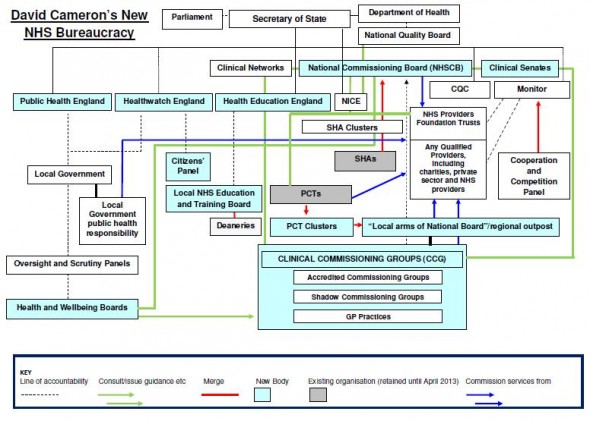
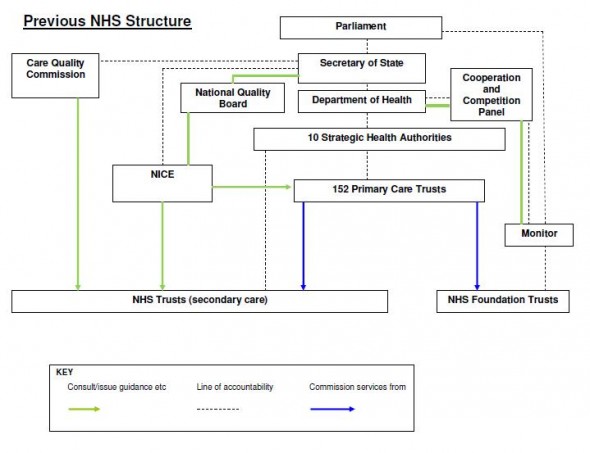
The Labour Party are ridiculing the Con-Dems’ coalition governments’ proposed changes to the NHS as excessively complex and incomprehensible. Previous to the 2010 general election Cameron promised no more top-down reorganisation of the NHS and said “The recent history of the NHS reads like a wretched bowl of Alphabetti Spagetti and it has got to stop”.

These organograms(?) – credited to Labour policy wonks – show the current and proposed excessive spagetti-like top-down re-organisation of the NHS that Cameron said would not happen and “has got to stop”.

NHS current spagetti-like organisation


Extreme spagetti-like organisation proposed by the Con-Dems' destroy the NHS bill

The Guardian reports  that

The Liberal Democrats will not debate a formal motion on the future of the NHS at their conference, but will hear from a balanced group of speakers including Baroness Williams on whether the reforms sought by the party at its spring conference have been achieved through the listening exercise.

Perhaps they should amend their name to the Liberals or Conservatives?


Conservative election poster 2010

A few recent news articles about the UK’s Conservative and Liberal-Democrat coalition government – the ConDem’s – brutal attack on the National Health Service.

Organograms show NHS becoming even more complex | Westminster blog | Jim Pickard and Kiran Stacey share their views on the UK’s political scene for the Financial Times – FT.com

David Cameron, pre-election, told National Health Service staff there would be no more “top-down reorganisations”. The recent history of the organisation had been “like a bowl of alphabetty spaghetti“, he pointed out.

The government is getting rid of primary care trusts. At the same time it is creating a National Commissioning Board, Clinical Senates, Public Health England, Healthwatch England, Health Education England, Citizens’ Panels, Local Education and Training Boards and Health and Wellbeing Boards and shadow Clinical Commissioning Groups.

Even now Cameron has insisted that he has been “taking out” bureaucracy out of the National Health Service. These two graphics would suggest a rather different situation.

Labour ridicules David Cameron’s NHS structure | Politics | The Guardian


Before the election, David Cameron promised NHS staff there would be no more top-down reorganisation of the NHS, describing its recent history as “like a bowl of alphabetti spaghetti”. His commitment was reiterated in the coalition agreement and was widely welcomed by health service staff. At the latest relaunch of his reorganisation plans, he claimed that he was “taking out a huge amount of bureaucracy” from the NHS.

Yet Cameron’s new NHS structure includes the creation of a National Commissioning Board, intended to be separate from ministers, at the apex of the reformed organisation. The chief executive designate of the board, Sir David Nicholson, has acknowledged that it “could become the greatest quango in the sky we have seen”.

Other new bodies to be created include clinical senates, Public Health England, Healthwatch England, Health Education England, citizens’ panels, local education and training boards, and health and wellbeing boards. Primary care trusts (PCTs) will be replaced by accredited and shadow clinical commissioning groups (CCGs). Labour said confusion remained about the transfer of responsibility from PCTs to CCGs, with senior officials at the Department of Health reportedly raising concerns about the danger of operating a two-tier commissioning system.

One senior commissioner was reported as saying “You can just about tolerate a two-tier provision system but we can’t operate two-tier commissioning” and another as saying “Either it doesn’t really work like this [as announced] or it will be a feverishly expensive bureaucracy”.

We all need to get behind anti-Health Bill campaign » Hospital Dr

The NHS Consultants’ Association backs the BMA campaign to withdraw the Health and Social Care Bill.

Following the Executive Committee meeting of the NHSCA on the 4 August 2011, there was a unanimous decision to congratulate and support the BMA over its decision to mount a public campaign to call for withdrawal of the Health and Social Care Bill.

The NHSCA continues to believe that the Health and Social Care Bill represents the greatest threat to the NHS in its history. Despite the government’s proposed changes to the Bill following the Future Forum report, the key policy levers to deliver a full blooded market based system with increasing NHS privatisation remain intact. Worse still, the bill is now even more complicated and will be more costly to implement.

The Royal College of GPs has worked out that the number of NHS statutory bodies is going to increase from 163 bodies to 521! No wonder why Dr Hamish Meldrum, chair of BMA council stated that the Bill was: “Hopelessly complex and it really would be better if it were withdrawn.”

We are now left with a policy mess, at a time when the NHS is facing the greatest funding crisis in its history, with the QIPP efficiency drive aiming to deliver £20bn of savings by 2014. This will actually act as a catalyst to drive increasing privatisation of the NHS, as PCT clusters are forced to ration NHS care due to financial constraints, and NHS trusts come under huge financial pressure to cut costs.

We are already seeing an increase in NHS waiting lists and many PCTs reducing their lists of ‘NHS core services’, both of which result in increasing uptake of private health insurance policies.

GP warning over ‘crazy’ rapid roll-out of NHS 111 | GPonline.com

Strategic health authorities have been given seven weeks to tell the DoH how and when they plan to roll-out NHS 111 hotlines across their area.

But one senior GP warned the deadline was ‘crazy’ given that the pilot NHS 111 schemes across the UK were either incomplete, or yet even to begin.

Tories’ circular logic / Features / Home – Morning Star

The government is demanding that the National Health Service doesn’t use NHS hospitals.

Instead, the NHS must pay David Cameron’s dinner guests for their operations.

It sounds quite mad but it is, sadly, quite true. At the end of July a little-known government quango called the NHS Co-operation and Competition Panel ruled that Wiltshire and Bath NHS were wrong not to give a company called Circle Health millions of pounds for operations.

The Tories love to talk about “social enterprises,” claiming they are a new type of firm that use market methods but are driven by ethical impulses.

Circle claims to be such a beast.

Last January future Tory Health Secretary Andrew Lansley spoke at the firm’s glamorous private hospital in Bath to praise its work.

Of course, the fact that behind all the waffle about “social enterprises” lurk some very profit-hungry Tory donors may well have encouraged Lansley to go to the shindig.

Circle is 49 per cent owned by its employees, which is why it calls itself a “social enterprise.”

But the firm is also 51 per cent owned by private investors, including around 40 per cent by hedge funds Odey Asset Management and Lansdowne Holdings.

Since 2003 Crispin Odey and Lansdowne’s Paul Ruddock and David Craigen have between them donated £561,000 to the Tories.

This money buys them membership of the Tories’ Leader’s Club and regular dinners with Cameron.

‘Miracle’ MS Pill Won’t Get NHS Funding | LBC

Fingolimod is the first pill to treat MS, but now NICE, the health watchdog, has ruled it should not be funded by the NHS because it is not cost effective.

Amanda Cook from Norfolk has taken the tablet for the past three years.

She told Sky News: “This tablet has changed my life completely. I think it’s a very disappointing decision.

“It takes away another option for MS therapies and I think it’s the wrong decision.”

Research found that Fingolimod reduces the number of relapses for sufferers by more than a half, and cuts disability progression by 30 percent in some cases.

Continue ReadingNHS news review