UCP members voted in favor of a resolution to “recognize the importance of CO2 to life and Alberta’s prosperity.” Credit: Danielle Paradis
Alberta’s United Conservative Party has passed a resolution to rebrand carbon dioxide — the chief gas whose overabundance in Earth’s atmosphere is causing the climate emergency — in a brazen display of climate science denial that harkens back to the 1990s fossil fuel industry playbook.
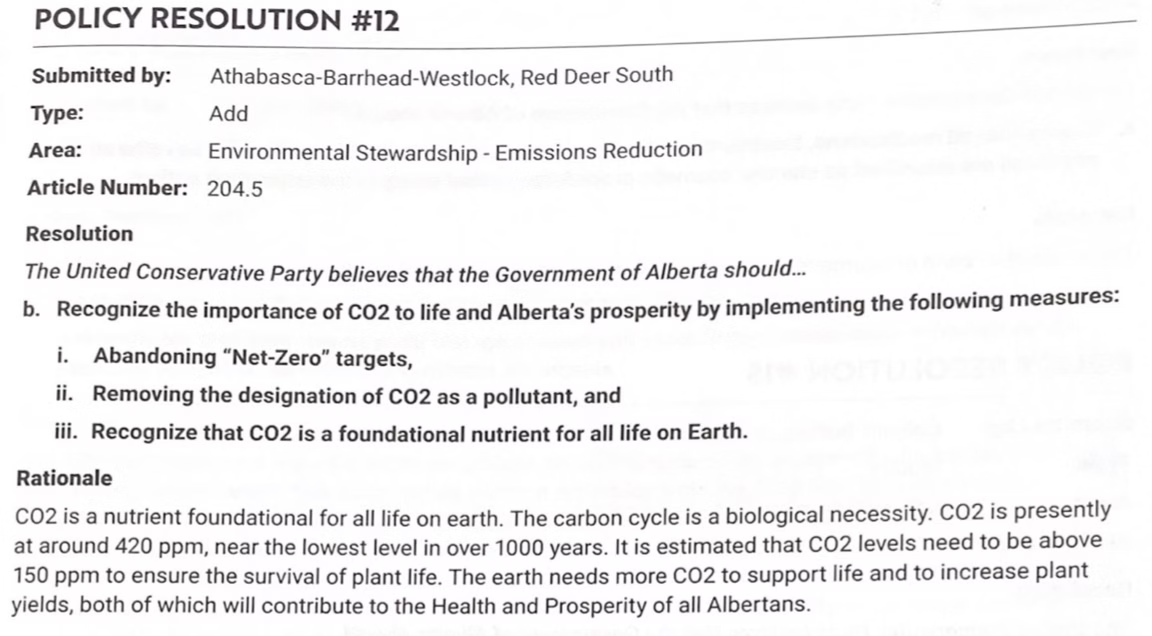
Resolution 12, which falls under the “environmental stewardship and emissions reduction” area of the policy discussion, will “recognize the importance of CO2 to life and Alberta’s prosperity.”
In approving the resolution, the UCP resolved to abandon the province’s net zero targets, remove the designation of CO2 as a pollutant, and further “recognize that CO2 is a foundational nutrient for all life on Earth.”
“We must prioritize policies that protect our economy and our way of life. CO2 is an essential nutrient for mass, driving growth and boosting plant production. According to the CO2 Coalition, higher CO2 levels have led to healthier crops and improved food security worldwide,” said a UCP member speaking in favour of the policy who cited the notorious CO2 Coalition.
The resolution passed by a wide majority.
UCP members vote in favor of Resolution 12. Credit: Danielle Paradis
A member who spoke against the bill, saying that just like like someone can drink too much water and experience water poisoning, too much CO2 can be bad. He was booed by the crowd.
The policy discussion took place in Red Deer, Alberta, where 6,085 UCP members and observers debated 33 policy resolutions at their annual general meeting. Earlier in the day, Alberta Premier Danielle Smith pledged to “triple down” on conservative priorities, including further expanding oil production and attacking Canadian climate policies.
As severaloutlets have reported previously, Resolution 12 flies in the face of the scientific consensus on climate change, and the party’s rationale for the resolution states a widely debunked claim that “the Earth needs more CO2 to support life and to increase plant yields.”
Carbon dioxide is the gas principally responsible for exacerbating the greenhouse effect, the consequence of which is global warming. Whereas carbon is a foundational building block of life on Earth, carbon dioxide is an asphyxiating gas whose atmospheric proportions are so high they’re disrupting the normal function of the carbon cycle.
The resolution was submitted by the members of the legislative assembly (MLA) representing the provincial ridings of Athabasca-Barrhead-Westlock (Glenn van Dijken), and Red Deer-South (Jason Stephan).
The argument that carbon dioxide is a “gas of life” has been a common yet easily refutable talking point popularized by climate change deniers and other right-wing extremists. One such group, the anti-wind energy group Wind Concerns, referred to carbon dioxide as a “gas of life” in an interview with DeSmog last year. Their leader, Mark Mallett, took credit for contributing to the anti-renewable energy moratorium instituted by Alberta UCP Premier Danielle Smith.
Climate scientists have long confirmed that increased CO2 in the atmosphere does not, as climate change deniers insist, create better growing conditions for plants.
The argument that carbon dioxide is beneficial for the environment appears to have first been made by the Greening Earth Society (GES) in the mid-late 1990s. GES was a creation of the Western Fuels Association, and it was later determined the two groups were one and the same. GES published the World Climate Report, a non-academic and non-peer-reviewed journal that served as a platform for climate change denial. They were transparent in acknowledging their funding from fossil fuel companies, and appear to have originated several talking points now common amongst climate change deniers, including those that advocate for increased atmospheric carbon dioxide, which would result in faster plant growth and greater agricultural yields.
In the “rationale” section of the resolution, the United Conservative Party document argues that “CO2 is a nutrient foundational to all life on Earth.”
While plants need both light and carbon dioxide to thrive, the over-supply of CO2 in recent decades is leading to plants being deprived of their nutrients. One biologist was quoted in a 2017 Politico article describing this as akin to “the greatest injection of carbohydrates into the biosphere in human history,” and that injection is diluting the nutrients in the food supply.
While the resolution notes that the “carbon cycle is a biological necessity,” it doesn’t appear the resolution’s sponsors are aware that increasing carbon dioxide in the atmosphere throws the carbon cycle off balance. This is precisely what’s causing the climate emergency: too much carbon dioxide in the atmosphere combined with the destruction of natural carbon storage is destroying the carbon cycle as we know it. The proposed resolution is as contradictory as it is scientifically illiterate.
The resolution also states that current CO2 levels are around 420 PPM, which is described as being “near the lowest level in over 1000 years.” Where this idea comes from is not clear, but it is not supported by verifiable scientific evidence. To the contrary, CO2 levels were 34 percent lower than today in the year 1024, at about 280 PPM. CO2 levels have climbed steadily since the beginning of the Industrial Revolution, though they have grown most aggressively since 1950. NASA estimates that, despite wide fluctuations over time, CO2 levels had not exceeded 300 PPM over the last 800,000 years, but have stayed above that level since 1950.
The argument that more CO2 will support life, increase yields, and “contribute to the health and prosperity of all Albertans” — as stated in the resolution — is not supported by scientific evidence. The opposite is a far likelier outcome. As the principal driver of the climate crisis and global warming, increasing CO2 levels will exacerbate droughts, wildfires, and floods, among other disasters, in turn resulting in loss of life and major disruptions to global supply chains. The consequent economic disturbances and their aftereffects will worsen the affordability crisis and result in increasingly negative economic outcomes for all, not just Albertans. Rather than stimulate Alberta’s agricultural sector, climate change will destroy it, and the evidence this is already happening is quite clear.
Another policy resolution is focused on the provincial government’s “scrap the cap” program. The policy builds on a previous resolution to repeal the carbon tax and instead: “Prohibit any consumer carbon tax or carbon pricing scheme or carbon cap and trade system from being implemented in Alberta.”
The resolution also proposes to support “any federal or interprovincial government’s efforts to “axe the tax” (the federal conservative campaign) by eliminating the federal carbon pricing backstop from being imposed on Albertans and Canadians.”
Other resolutions over the weekend have focused on print-based identification, and a requirement for in-person voting “to deal with all the voter fraud.”
One Saturday in April, Dutch engineers manoeuvred a giant drill into position in the reclaimed, industrial extension of the Port of Rotterdam, and began boring a hole under the seawall. Nearby, sections of metal pipe waited to be lowered into the breach.
The operation was a step forward for Europe’s most advanced scheme to capture carbon dioxide (CO2) from industry, then bury the planet-heating gas under the North Sea.
After years of delay, a joint venture known as Porthos, an acronym for Port of Rotterdam CO2 Transport Hub and Offshore Storage, is due to begin operating in 2026. It’s a 1.3-billion-euro joint venture between state-owned gas companies Energie Beheer Nederland (EBN) and Gasunie, and the Port of Rotterdam Authority. The CEOs of these organisations are due to join Sophie Hermans, the Netherlands’ minister of climate policy and green growth, and senior European Union officials, for a ceremony on Monday to toast the start of construction work at the site.
At full capacity, Porthos is expected to handle 2.5 million tonnes of CO2 captured annually from facilities operated by its four dedicated customers: Shell, ExxonMobil, and the hydrogen producers Air Liquide and Air Products. That total is equivalent to roughly 10 percent of the port’s emissions, and 1.5 percent of the Netherlands’ current CO2 output. Once captured, the gas will be pumped under the North Sea throughout a 15-year period, or until the storage space reaches a maximum estimated capacity of 37.5 million tonnes.
The cost to the Dutch taxpayer: up to 4 billion euros in subsidies.
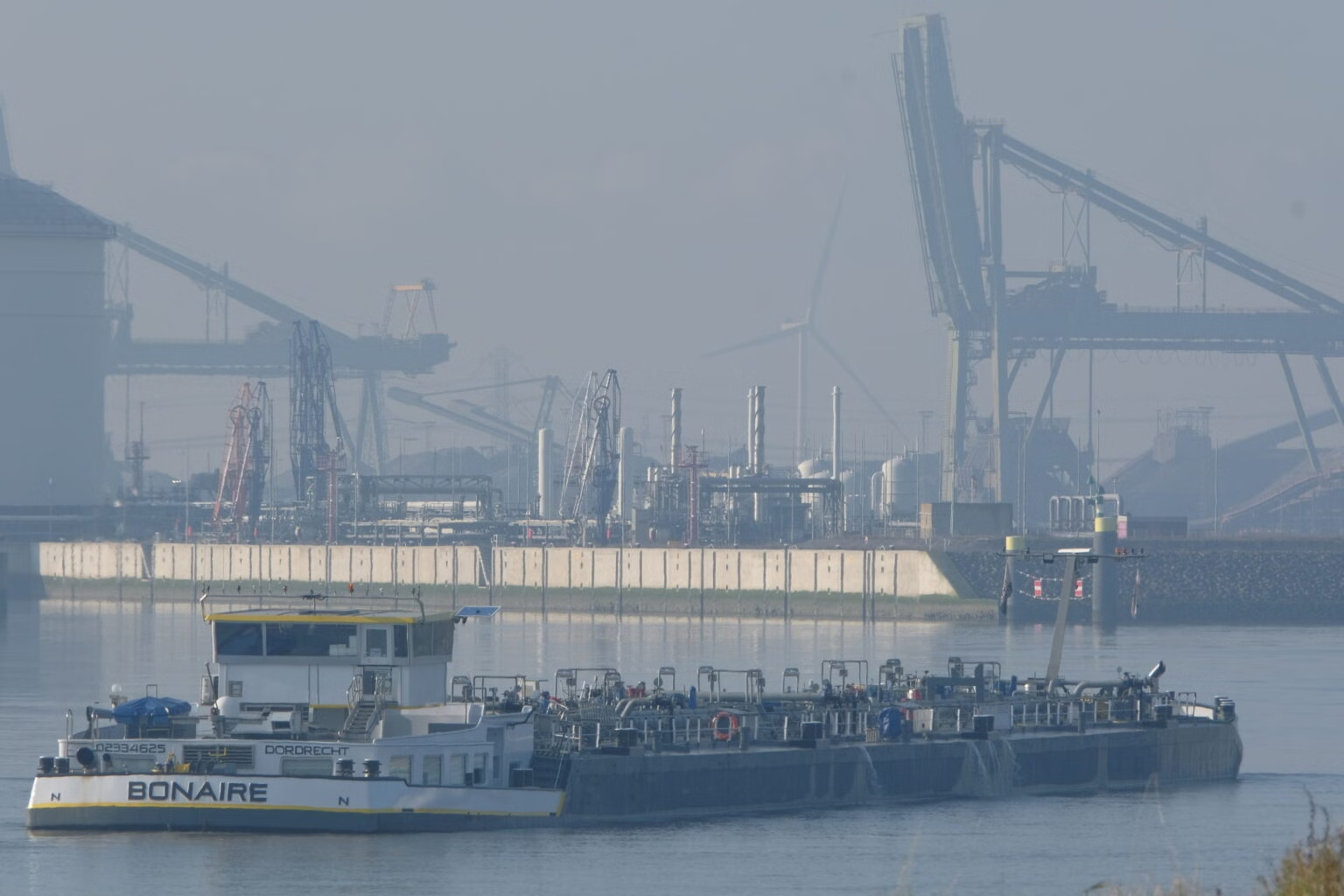
Credit: Leon de Korte/Follow the Money.
Porthos relies on a technology known as carbon capture and storage, or CCS, which uses a chemical process to capture some of the CO2 that spews from a customer’s industrial chimneys. This trapped gas is then condensed and pumped through pipelines to underground storage sites, such as certain kinds of geological formations, or disused oil and gas wells.
Nevertheless, the backers of Porthos, and its much larger sister project Aramis — also being developed by EBN and Gasunie, along with Shell and French oil giant TotalEnergies — see them as the first nodes in a planned network of pan-European CCS infrastructure. The aim is to eventually funnel CO2 captured in the industrial heartlands of Germany, as well as throughout the Netherlands, to hundreds of storage sites under the seabed.
To its critics, however, Porthos is emblematic of the way oil and gas companies are securing subsidies for CCS schemes that present an appearance of climate action — but are never likely to attain the massive scale needed to make a dent in global emissions.
As Europe’s flagship project, Porthos is emerging as a litmus test for a critical question in the fight against climate change: Will carbon capture actually help reduce the emissions fuelling the crisis? Or will government backing for these technologies instead serve to preserve the fossil fuel business models that caused it?
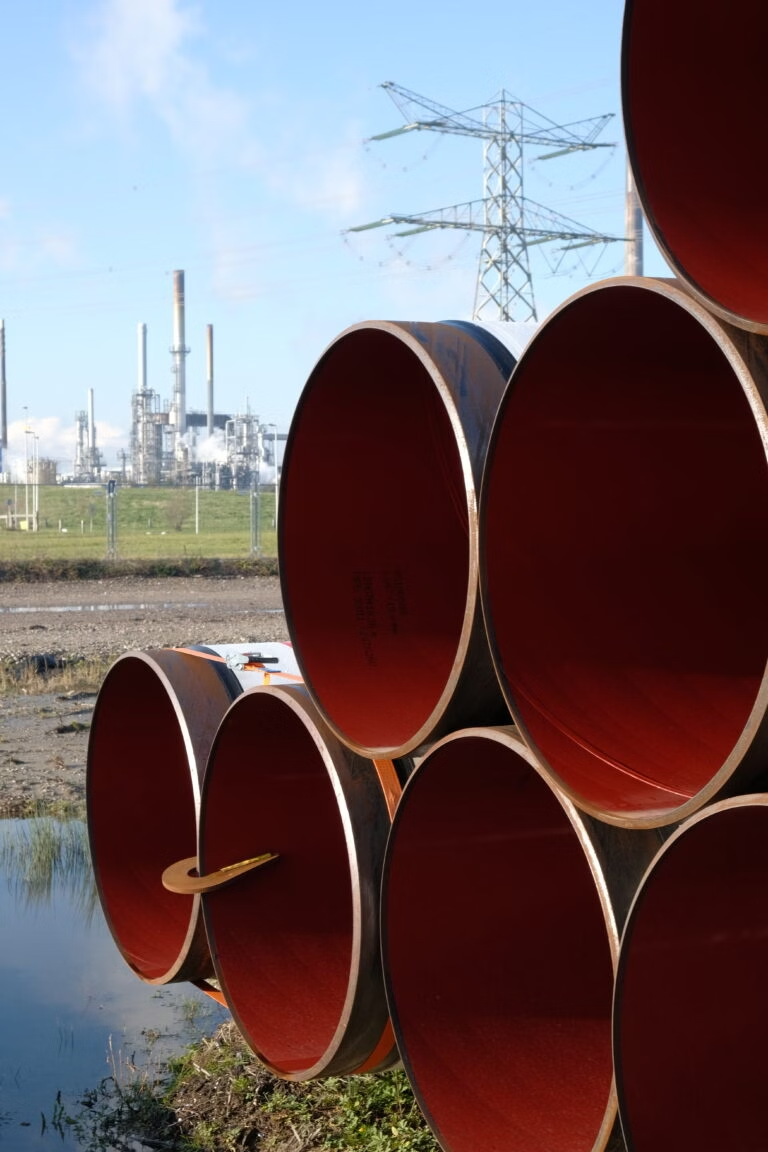
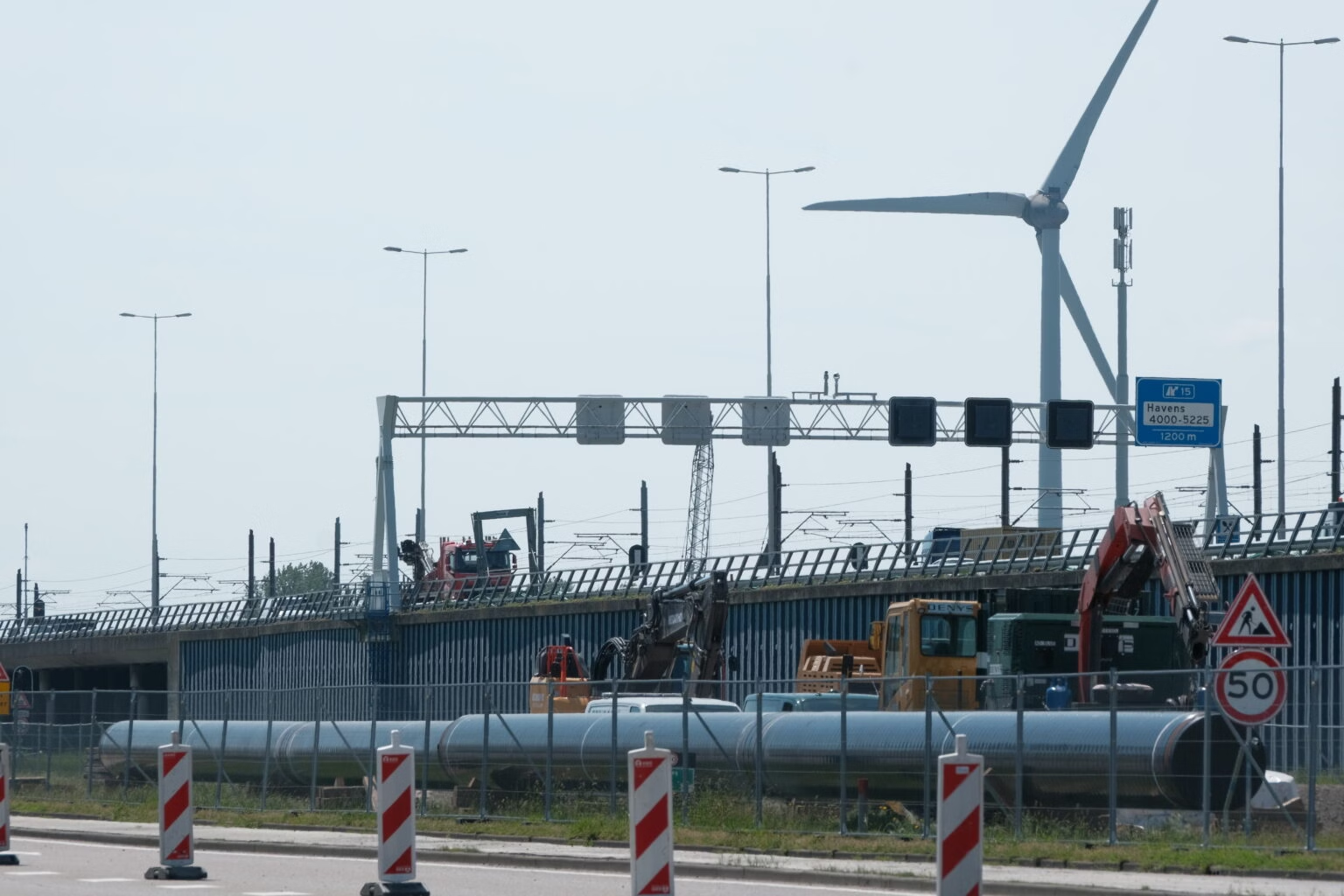
Sections of pipe for the Porthos CO2 pipeline, intended to take captured carbon emissions and inject them under the North Sea, await burial at the Port of Rotterdam. Credit: Michael Buchsbaum.
Ambitious Plans
With intensifying heatwaves, floods and fires underscoring the threat the climate crisis poses to Europe, the EU has agreed to slash its carbon emissions to net zero by 2050, with an interim target of a 90-percent reduction relative to 1990 levels by 2040. Given the scale of that challenge, and in line with lobbying by the fossil fuel industry, policy-makers have assumed a major role for carbon capture projects in cleaning up industry.
“Reducing emissions is not enough,” reads a European Commission website on CCS. “To achieve our climate ambitions, we will also need to capture, utilise and store carbon.”
Climate campaigners argue, however, that the technology has secured official backing in large part because it helps governments persuade voters they are taking climate action, while stopping short of the kind of rapid, fundamental transformation of economies needed to end the use of fossil fuels.
In May, the EU adopted the Net Zero Industry Act, obligating oil and gas producers to develop 50 million tonnes of annual CO2 storage capacity across the continent by 2030 — roughly equivalent to today’s global total. More ambitiously, the act targets approximately 280 million tonnes of annual CO2 storage capacity by 2040, increasing to a staggering 450 million tonnes by 2050.
Environmental groups such as E3G, the Institute for Energy Economics and Financial Analysis and European Environmental Bureau doubt such targets are feasible, given the thousands of kilometres of pipelines that would have to be built, and the dozens of projects that would have to be designed. A lack of technical and geological know-how combined with potential local opposition could also slow fossil fuel companies’ plans.
“The industry needs to commit to genuinely helping the world meet its energy needs and climate goals —which means letting go of the illusion that implausibly large amounts of carbon capture are the solution,” said Fatih Birol, executive director of the Paris-based International Energy Agency (IEA), in the introduction to a report on clean energy transitions for oil companies published in November.
Despite the oil industry often citing scenarios from the Intergovernmental Panel on Climate Change that include significant deployments of CCS, the U.N.-backed body also considers the technology the least efficient, and one of the most expensive, climate tools. In their Sixth Assessment report, the IPCC’s scientists wrote that “even if implemented at its full potential, CCS will account for only 2,4% of the world’s carbon mitigation by 2030 due to its low effectiveness and high cost.”
And Europe is nowhere near close to meeting its carbon capture targets. Today, only 2.7 million tonnes of CO2 is being captured annually across the continent, including in Norway and Iceland, according to the IEA. Porthos’ backers are therefore hailing the project as a crucial step towards fulfilling the continent’s decarbonisation plans — starting with its largest port.
“If we want to reach our climate target, we will need CCS,” Willemien Terpstra, CEO of Gasunie, told DeSmog.
Still, even backers of the technology acknowledge that deployment is lagging. To meet the EU’s target of capturing 280 million tonnes of CO2 annually by 2040 would require 651 projects, said Chris Davies, director of industry group CCS Europe. Each would have to capture more than 400,000 tonnes per year, he told DeSmog.
To date, 50 years after the first CCS projects were started in a Texas oilfield, only about 40 projects are operating globally, with the combined potential to capture just over 50 million tonnes of CO2 per year. However, almost 80 per cent of the CO2 being captured is injected underground to pump more oil — which when refined and burned, adds more CO2 into the atmosphere.
While there is no estimate as to how long it would take to construct hundreds of projects, it is clear that time is running out, Davies said.
Capturing this amount by 2040 requires that construction on all these projects begin no later than early 2038: “So we have less than 5,000 days,” said Davies.
Since Porthos’ backers took a final investment decision last year, no other CCS project “has been given the green light to put a shovel in the ground”, he added.
Cleaning up the Quayside
With docks and quays stretching from its old town centre to the ocean over 40 kilometres away, the Port of Rotterdam covers an area almost twice the size of Manhattan, and handles nearly 440 million tonnes of freight each year, roughly the equivalent of more than 1,200 Empire State Buildings stacked on top of each other.
Not only is Rotterdam a massive cargo port, it’s also one of the largest hubs for energy in Europe, including oil. Counting oil, coal, and liquefied natural gas, the port boasts that some 13 per cent of all the energy used throughout Europe passes through it.
Most of the oil is destined for one of the port’s four refineries, including the giant Shell Pernis facility, as well as sites run by BP and Exxon. (Reducing emissions from the refineries is one of Porthos’ key aims).
All this activity generates tremendous amounts of carbon pollution: The port emitted 20.3 million tonnes of CO2 in 2023.
The port intends to slash its emissions by 55 per cent by 2030, then achieve climate neutrality by 2050.
The port argues that it can reduce its emissions to its target of 9.3 million tonnes by 2030 by:
Storing up to 5.8 million tonnes of emissions annually by the end of the decade through its Porthos and Aramis projects
Reducing emissions by another 5.7 million tonnes by shutting down, as legally required, itsremaining coal-fired power plants by 2030, building on savings made by previous coal plant closures
Greening its operations with electrification, and “green” hydrogen made with wind and solar
“Porthos and Aramis by far contribute the most to the Netherlands’ CO2 reduction targets…the Dutch goals cannot be met without those projects,” Hans Coenen, Executive Board member of energy company Gasunie, told Follow the Money, the Dutch investigative journalism platform that co-published this story with DeSmog.
The Port of Rotterdam’s only real CO2 reductions so far stem from the shuttering of several coal-fired power plants . Credit: Michael Buchsbaum.
Taxpayers Foot the Bill
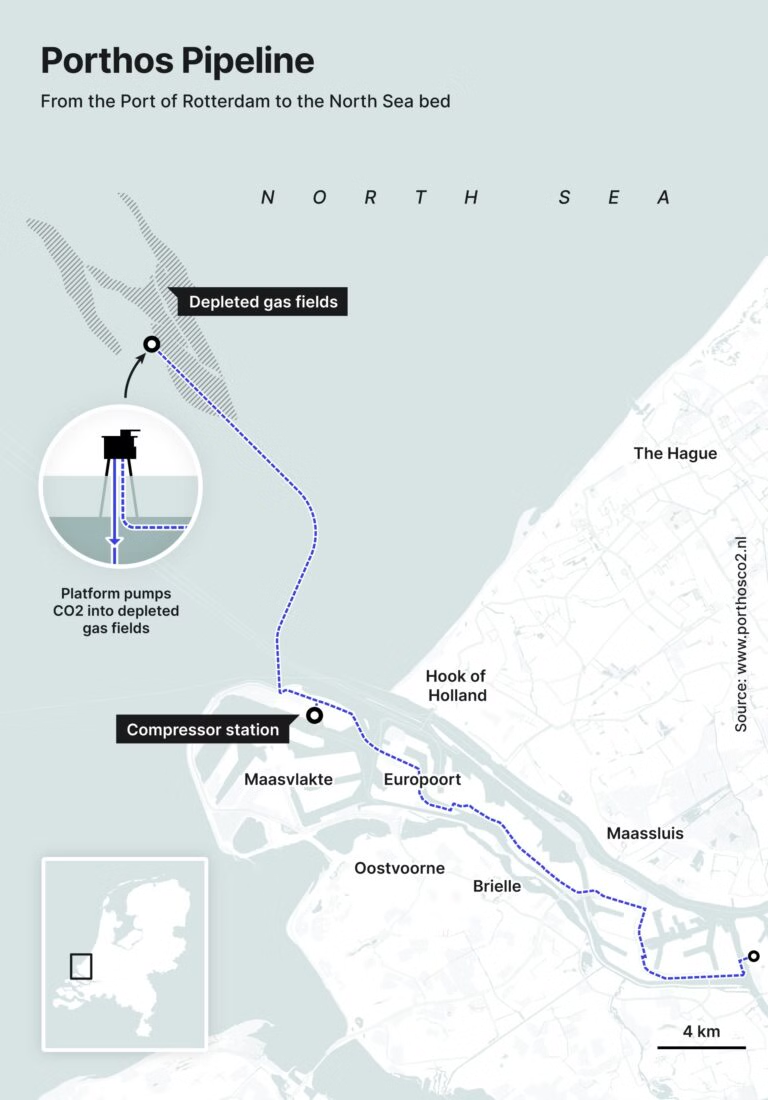
Crucially, Porthos will not be capturing any CO2 itself, instead handling and storing CO2 captured by Shell, Exxon, Air Liquide and Air Products. Porthos itself consists of a new 30-kilometre pipeline system leading to a compression station. From there, CO2 will be pumped to a repurposed gas drilling platform 20 kilometres offshore, and injected into a depleting gas field for final storage.
To ensure emissions are captured, in 2021, the Dutch government allocated Shell, Exxon, Air Liquide and Air Products a combined 2.1 billion euros via its SDE++ scheme to subsidise company decarbonisation projects.
As it stands, under a long-running scheme known as the European Emissions Trading System (ETS), these companies are already required to buy credits for each tonne of CO2 they emit.
Although the credits currently trade at just under 69 euros per tonne, the price could almost triple by 2035, according to BloombergNEF.
By disposing of some of their emissions via Porthos, its customers save money by having to purchase fewer credits.
But, if buying ETS “emission certificates” is cheaper for them than storing the gas via Porthos, then the Dutch government will make up the cost difference using up to 2.1 billion euros allocated under the SDE++ scheme.
This means that whatever happens, the companies face limited risk, and potentially large savings, if they capture emitted CO2 instead.
The port says this arrangement enables the companies “to cut back their carbon emissions without weakening their respective competitive positions.”
Alternatively, without state support, “Porthos would not have gotten off the ground and this project would not have been able to contribute to achieving the climate objectives,” Ellen Ehmen, Exxon’s community relations manager in the Netherlands, told DeSmog.
Combining various other EU and Dutch government subsidies associated with the project, with the 1.3 billion euro cost to state-owned companies to build it, and up to 2.1 billion in carbon capture subsidies, the overall cost to the state could approach or even exceed 4 billion euros.
In other words, Dutch and European taxpayers are picking up the bill for cleaning up these highly profitable companies’ carbon pollution.
In March, the Netherlands Court of Audit warned in a report that the way the project has been structured means that the state has assumed a disproportionate level of risk relative to industry.
Coenen, of Gasunie, says that he wasn’t surprised by these findings: “We decided deliberately to accept a low return on investment on Porthos, because we find it important to kickstart the project.”
Experimental Projects
Many climate advocacy groups, academics and policy experts have long warned of the dangers of relying on carbon capture projects, arguing that they provide fossil fuel companies with a justification for pumping ever more oil and gas.
Seeking to allay those fears, the European Commission advised in February that carbon capture should only be used in sectors where industry argues that emissions are particularly difficult or costly to cut, for example steel, cement, aluminium, chemicals and waste-to-energy.
But Porthos’ customers are using carbon capture for very different purposes: they’re either developing never-before attempted “low-carbon” projects that may be deployed at some point in future, or capturing a portion of the emissions now being generated by producing hydrogen used in the port’s oil refineries.
Shell, the first company to agree to partner with Porthos, is slated to become the project’s largest single customer, having committed to deliver 1.2 million tonnes of CO2 annually — captured mainly from its sprawling Pernis refinery complex, Rotterdam’s biggest. Shell also pledged to capture 820,000 tonnes a year from its to-be constructed biofuels facility, which is designed to produce so-called sustainable aviation fuel, as well as renewable diesel made from waste oil.
This so-called HEFA (hydroprocessed esters and fatty acids) plant is “essentially where the Porthos project starts,” said Nico van Dooren, director new business, hydrogen infrastructure, transport and storage with the Port of Rotterdam, during a media tour of the Porthos project in May.
Carbon capture “is the low hanging fruit,” Shell spokesperson Marc Potma said during the tour. “We have always said we believe in CCS for the future, but it’s never going to be the only answer. One must also invest in renewable sources, which is why we invested in the biofuels factory.”
Fellow oil and gas major Exxon’s CCS plans at Porthos are also highly experimental. Exxon says it plans to capture CO2 from a pilot project to test a new technology known as carbonate fuel cells — which the company says could help capture CO2 from industry more efficiently than existing methods, while also generating electricity, heat and hydrogen. This technology has never been proved at scale.
Also the recipient of EU funds, Exxon’s pilot plant is expected to be constructed in 2025, and start operations in 2026. Unlike Shell, Exxon has not announced any plans to use Porthos to capture emissions from its own oil refinery at the port.
Porthos’ two other customers are both large-scale hydrogen manufacturers who are producing the gas for use in oil refining — today one of hydrogen’s main uses.
As part of its participation in Porthos, U.S.-based Air Products announced in November it would build a carbon capture project at its existing hydrogen production facility in Rotterdam. Billed as the largest such facility in Europe, the project aims to help the company more than halve its CO2 emissions within the Port, while supplying most of the resulting hydrogen (known as “blue” hydrogen since some of the CO2 generated during the production process will be captured) for use in the nearby Exxon refinery.
Just weeks later, in December 2023, French rival Air Liquide announced it would also retrofit the company’s existing hydrogen facility in Rotterdam with carbon capture, using a proprietary technology that has only been tested at a smaller facility in Port-Jérôme-sur-Seine, France.
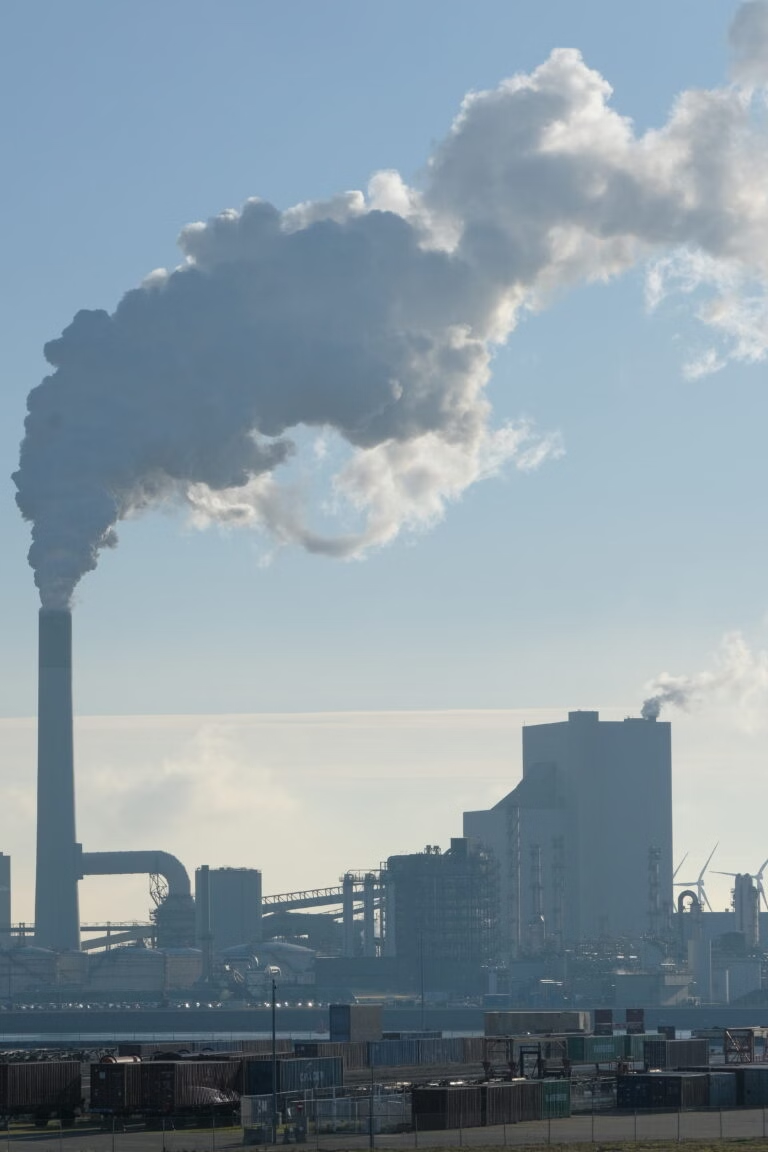
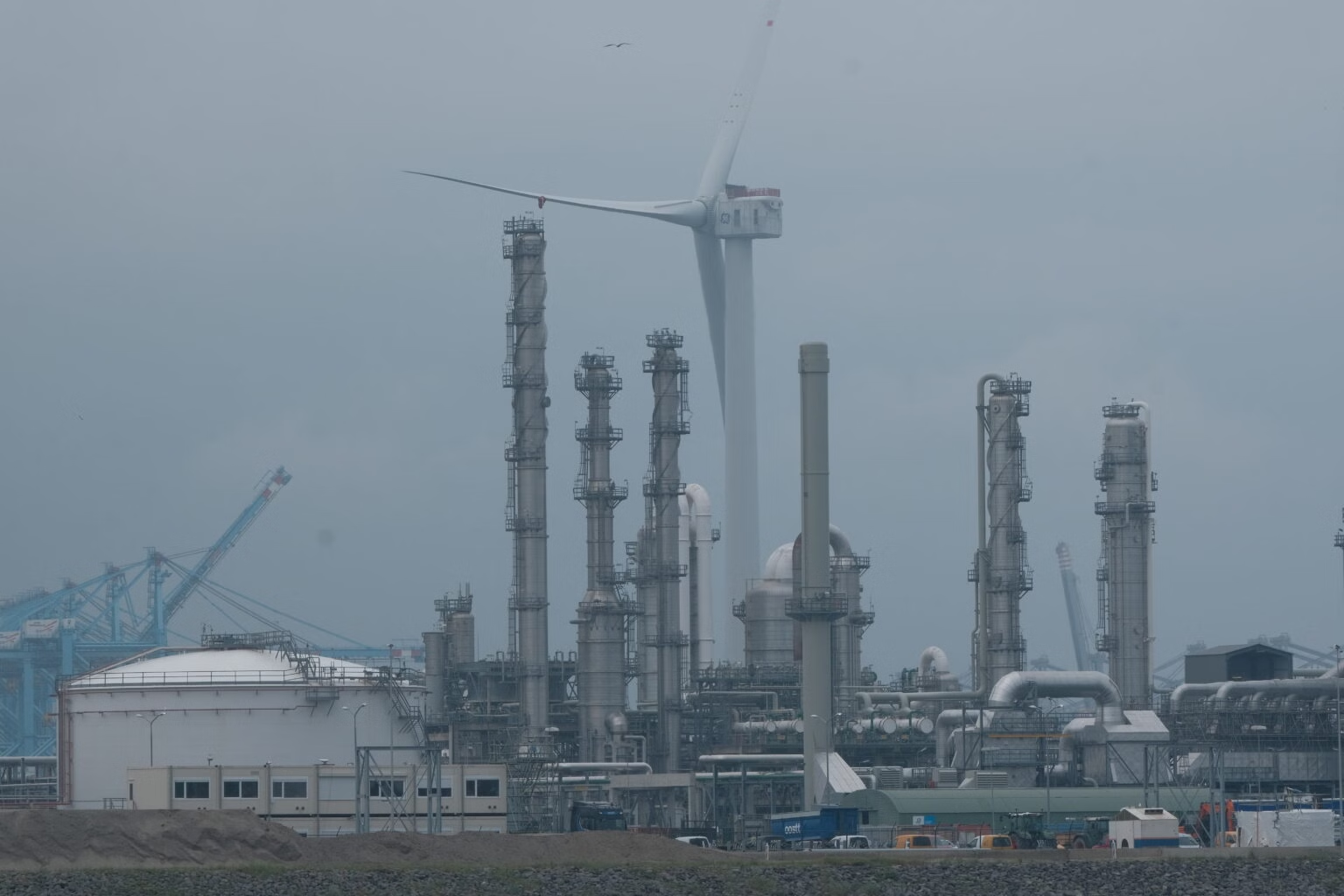
Giant new wind turbines tower over Rotterdam’s oil refineries, holding out the promise of an emissions-free future as they replace coal-fired power. Credit: Michael Buchsbaum.
Aramis Following Porthos
As workers dig trenches and bury Porthos’ pipelines around Rotterdam’s port, Shell and TotalEnergies — together with Gasunie and EBN — are working on the larger Aramis project. They want to funnel and bury CO2 emissions captured in Germany, Europe’s biggest emitter, and send them via a yet-to-be-built pipeline project known as the Delta Rhine Corridor.
By 2028, two years after Porthos is due to come online, the first phase of Aramis is scheduled to transport up to 7.5 million tonnes of CO2 for storage — also thanks in part to EU subsidies.
To connect Rotterdam to Belgium, Gasunie is also working on a so-called Delta Schelde Corridor. “It’s going to be one interconnected system in order to help our industry,” Gasunie’s Coenen told Follow the Money.
Signalling EU support, in mid-June, the European Climate, Infrastructure and Environment Executive Agency, or CINEA, awarded Aramis 124 million euros in subsidies under the CEF Energy fund. CINEA also granted 33 million euros in funds to another planned Rotterdam CCS hub, known as CO2next.
The bigger question, however, is whether these projects will be completed on time.
At the end of June, the then Dutch Minister of economic affairs and climate policy, Rob Jetten, told parliament that the Delta Rhine Corridor pipelines wouldn’t be completed before 2032 — dealing a blow to the pace of CCS development.
In early July, Shell “temporarily” paused construction of its crucial biofuels plant that is supposed to produce 820,000 tonnes a year. Shell now says production will only begin “towards the end of the decade,” said Shell spokesperson Wendel Broere.
Sections of the Porthos CO2 pipeline are now being buried around Rotterdam’s industrial port. Credit: Michael Buchsbaum.
A Temporary Solution?
Regardless of when they come online, Porthos and the other planned Dutch CCS projects are generally presented as temporary solutions giving industry time to wean itself off fossil fuels — but how long that transformation will take remains unclear.
With billions of euros being invested, “you just have to count on a few decades,” Gasunie’s Coenen said.
Even as Porthos, Aramis and similar projects inch forward, further questions loom: Who will pay the enormous cost of rolling out the network of carbon capture facilities and pipelines needed to ferry CO2 from Europe’s industry to disposal sites in the North Sea via Rotterdam? And can such a project be completed in anything like the timeline demanded by the EU’s carbon capture targets?
Another unknown is how investing in these and other CCS projects will lead to a reduction in overall emissions — particularly since so many planned CCS projects involve building new fossil fuel infrastructure, such as gas-fired power stations or blue hydrogen facilities, rather than retrofitting existing industries. It is also unclear how subsidising industries to adopt CCS will compel fossil fuel companies to accelerate the shift to renewables.
Berte Simons, business unit director of CO2 transport and storage systems at EBN, the Dutch state-owned gas company, said that companies not only have to start capturing emissions, but stop producing them.
“There needs to be an end date to using CCS from fossil sources,” she said. “The sooner [fossil fuel companies] are able to green their portfolio, the quicker they can start with that, the better.”
For many climate advocates, the danger is that carbon capture will simply prolong business as usual — while soaking up billions of euros in subsidies.
Relying on CCS “isn’t a sensible climate mitigation strategy or even a proper carbon management strategy,” Lili Fuhr, deputy director of the Washington D.C.-based Center for International Environmental Law’s Climate and Energy Program, told DeSmog. “It’s really an escape hatch for an industry with its back against the wall faced with an energy transition that is gaining support and is becoming a reality because renewable energies are so cheap.”
This story was corrected on August 29, 2024 to clarify that the cost to taxpayers could be “up to” 4 billion euros (rather than “at least”), and show the various forms of subsidy included in that figure.
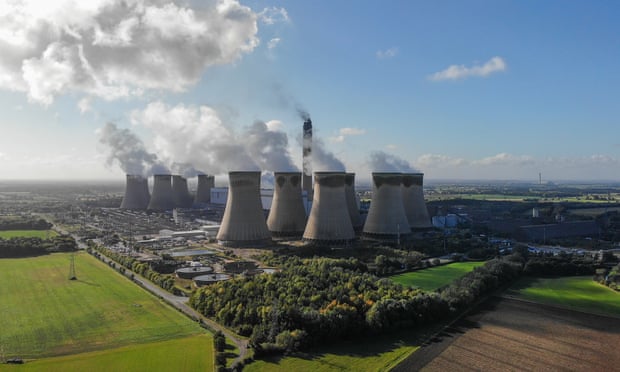
Drax was responsible for 11.5m tonnes of CO2 last year, or nearly 3% of the UK’s total carbon emissions. Photograph: SOPA Images/LightRocket/Getty Images
Drax received £22bn in subsidies despite being UK’s largest emitter in 2023, though company rejects ‘flawed’ research
The Drax power station was responsible for four times more carbon emissions than the UK’s last remaining coal-fired plant last year, despite taking more than £0.5bn in clean-energy subsidies in 2023, according to a report.
The North Yorkshire power plant, which burns wood pellets imported from North America to generate electricity, was revealed as Britain’s single largest carbon emitter in 2023 by a report from the climate thinktank Ember.
The figures show that Drax, which has received billions in subsidies since it began switching from coal to biomass in 2012, was responsible for 11.5m tonnes of CO2 last year, or nearly 3% of the UK’s total carbon emissions.
Drax produced four times more carbon dioxide than the UK’s last remaining coal-fired power station at Ratcliffe-on-Soar in Nottinghamshire, which is due to close in September. Drax also produced more emissions last year than the next four most polluting power plants in the UK combined, according to the report.
Reform UK leader Nigel Farage campaigning in Clacton, Essex. Credit: Nigel Farage / X
Scientific modelling indicates that areas of Clacton could be submerged annually by rising sea levels and flooding.
Reform UK leader Nigel Farage, who is a vocal critic of green policies and climate science, is standing in a constituency threatened by rising sea levels and flooding due to global warming.
Mapping from the science-based visualisation platform Climate Central suggests that substantial parts of Clacton, Essex, will be at risk of yearly flooding even by 2030. These include Seawick and Jaywick on the west of the seaside town, and the area between Holland-on-Sea and Frinton-on-Sea.
Farage yesterday announced that he would be taking over as Reform leader and standing in Clacton at the general election on 4 July.
Climate Central’s projection of which areas of Clacton will be below the annual flood level in 2030. The annual flood level is the water level at shoreline that local coastal floods exceed on average at least once per year.The constituency boundary of Clacton.
The international journal Oceans and Coastal Management also produced a study in 2022 suggesting that the Tendring area, which encompasses Clacton, is at risk of sea level rises – potentially affecting hundreds of homes.
The study’s lead author Paul Sayers, an engineering consultant who works with the University of East Anglia’s Tyndall Centre, said: “Significant sea level rise is now inevitable. We need a serious national debate about the scale of the threat.”
The Environment Agency last year upgraded Clacton’s flood defences as part of a £10 million project to protect more than 3,000 properties and businesses in the area from “climate change and sea level rise”.
However, Farage is actively campaigning to scrap the green policies that may help to limit local flooding. Farage, who is projected to win the seat, is a vocal critic of the UK’s goal of reaching net zero emissions by 2050. He has claimed that the policy is an “act of self harm” and has called for it to be dropped.
Clacton is already ranked ninth in the county in terms of properties at risk of surface water flooding. Scientists at the World Weather Attribution group found that the UK’s wet weather in the winter of 2023/24 was made 10 times more likely and 20 percent wetter due to climate change.
The UN’s Intergovernmental Panel on Climate Change (IPCC), the world’s foremost climate science body, has estimated that global mean sea levels will most likely rise between 0.95 feet (0.29 metres) and 3.61 feet (1.1 metres) by the end of the century.
Rising levels could directly affect more than 1 billion people worldwide by 2050, and require up to $14 trillion worth of coastal infrastructure by 2100. Rising sea levels could cost the British economy alone more than £100 billion by the end of the century, according to research published by the journal Scientific Reports.
Reform’s Fossil Fuel Donations
Despite the global warming risks posed in the area, Farage is hoping to win support for his anti-green views when he stands in Clacton on 4 July.
Speaking on GB News in August 2021, Farage said that he was “very much an environmentalist” and that he couldn’t “abide things like plastics in our seas, pollution in our rivers.” However, on the issue of climate change, he added: “What annoys me though, is this complete obsession with carbon dioxide almost to the exclusion of everything else, the alarmism that comes with it, based on dodgy predictions and science.”
The IPCC has stated that carbon dioxide “is responsible for most of global warming” since the late 19th century, which has increased the “severity and frequency of weather and climate extremes, like heat waves, heavy rains, and drought”.
Reform has also spread climate falsehoods while supporting the reversal of green measures.
The party’s manifesto claims that “scientists disagree as to how much” humans have had an impact on global warming.
A number of climate consensus studies conducted between 2004 and 2015 found that between 90 percent and 100 percent of experts agree that humans are responsible for climate change. A study published in 2021, which reviewed over 3,000 scientific papers, found that over 99 percent of climate science literature says that global warming is caused by human activity.
According to climate journalist Simon Evans, Reform’s 500 word plan on energy and the environment contains 30 false or misleading statements about the climate crisis and green policies.
Reform wants to develop new oil and gas fields in the North Sea, open onshore fracking sites across the country, end the windfall tax on fossil fuel companies, and “restart opencast coal mines using the latest cleanest techniques”.
The party has campaigned for a referendum on the UK’s 2050 net zero emissions target, and like Farage supports scrapping the policy entirely.
As revealed by DeSmog, Reform has received more than £2.3 million from oil and gas interests, highly polluting industries, and climate science deniers since December 2019, amounting to 92 percent of its donations since the last general election.
“Reform is in the business of toxic propaganda,” Green Party co-leader Carla Denyer told DeSmog. “Farage and his party have a track record of misleading voters and I hope the good people of Clacton make clear to him on 4 July that his distortions and lies on migration and climate won’t wash.”
Climate Central’s projections are based on peer-reviewed science in leading journals, though it warns that these are large datasets that always include some error and local variations.
In response to previous reporting on Climate Central’s sea level projections, the Environment Agency said that its data “does not take into account extensive efforts taken to prevent such severe incidents in the future, including the presence of sea defences, which protect communities from flooding”.
Reform did not respond to DeSmog’s request for comment, but has previously said that: “Climate change is real, Reform UK believes we must adapt, rather than foolishly think you can stop it. We are proud to be the only party to understand that economic growth depends on cheap domestic energy and we are proud that we are the only party that are climate science realists, realising you can not stop the power of the sun, volcanoes or sea level oscillation.
“The deniers are those who continually gaslight the public into thinking you can stop these powerful natural forces. We must use the energy under our feet, rather than send our money and jobs abroad.”
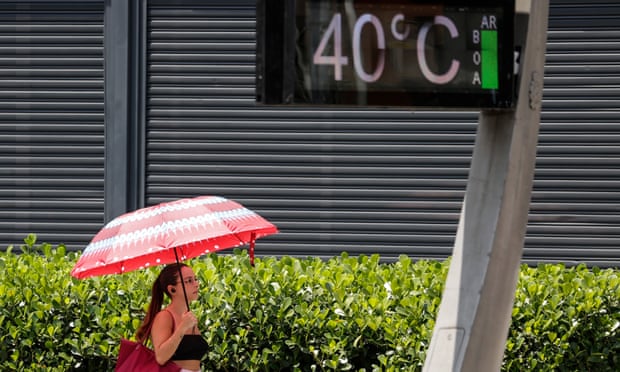
A young woman protects herself from the sun in São Paulo, Brazil, on 14 November 2023. Photograph: Sebastião Moreira/EPA
Global concentrations of carbon dioxide, methane and nitrous oxide climbed to unseen levels in 2023, underlining climate crisis
The levels of the three most important heat-trapping gases in the atmosphere reached new record highs again last year, US scientists have confirmed, underlining the escalating challenge posed by the climate crisis.
The global concentration of carbon dioxide, the most important and prevalent of the greenhouse gases emitted by human activity, rose to an average of 419 parts per million in the atmosphere in 2023 while methane, a powerful if shorter-lasting greenhouse gas, rose to an average of 1922 parts per billion. Levels of nitrous oxide, the third most significant human-caused warming emission, climbed slightly to 336 parts per billion.
Through the burning of fossil fuels, animal agriculture and deforestation, the world’s CO2 levels are now more than 50% higher than they were before the era of mass industrialization. Methane, which comes from sources including oil and gas drilling and livestock, has surged even more dramatically in recent years, Noaa said, and now has atmospheric concentrations 160% larger than in pre-industrial times.
Noaa said the onward march of greenhouse gas levels was due to the continued use of fossil fuels, as well as the impact of wildfires, which spew carbon-laden smoke into the air. Nitrous oxide, meanwhile, has risen due to the widespread use of nitrogen fertilizer and the intensification of agriculture.
…
Because of a lag between CO2 levels and their impact, as well as the hundreds of years that the emissions remain in the atmosphere, the timescale of the climate crisis is enormous. Scientists have warned that governments need to rapidly slash emissions to net zero, and then start removing carbon from the atmosphere to bring down future temperature increases.