New Shell Files Could Aid Climate Cases, Attorneys Say 

Spread the love

Original article by Matthew Green and Merel de Buck republished from DeSmog.

Credit: Sabrina Bedford.

Latest documents unearthed by Dutch climate activist seen as “valuable sources” for litigators.

Newly-discovered Shell documents dating back decades could help strengthen lawsuits aiming to hold the oil major to account for climate damages, climate attorneys say.

Among the files, reported for the first time today by DeSmog and Follow The Money, and published on Climate Files, there is a 1970 industry journal article where Shell appears to accept responsibility for harms caused by its products. A trove of Shell publications from the 1980s and 1990s foresee the “major adverse changes” the “greenhouse effect” is liable to cause to the climate. 

And a 1998 report spells out Shell’s reasons for leaving the Global Climate Coalition, a now defunct lobby group that worked to undermine climate science. The document shows that Shell had acknowledged the need to adopt  “prudent precautionary measures” to avoid the worst impacts of the climate crisis — even as it continued to push for more production of oil and gas.   

“It is feared that a further rise in carbon dioxide levels in the atmosphere could lead to a higher average surface temperature on Earth, which could have far-reaching environmental, social and economic consequences,” wrote the authors of a 1987 internal Shell publication entitled “Air Pollution: an Oil Industry Perspective.”

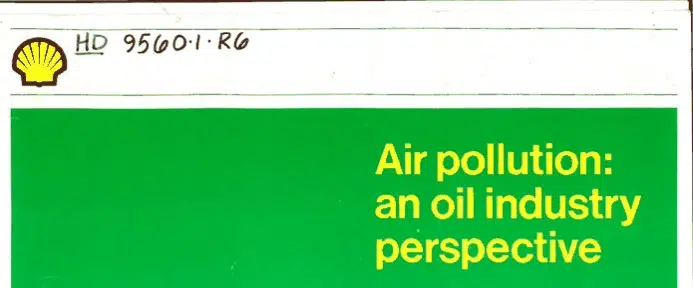
Cover of the 1987 internal Shell publication “Air Pollution: an Oil Industry Perspective.”

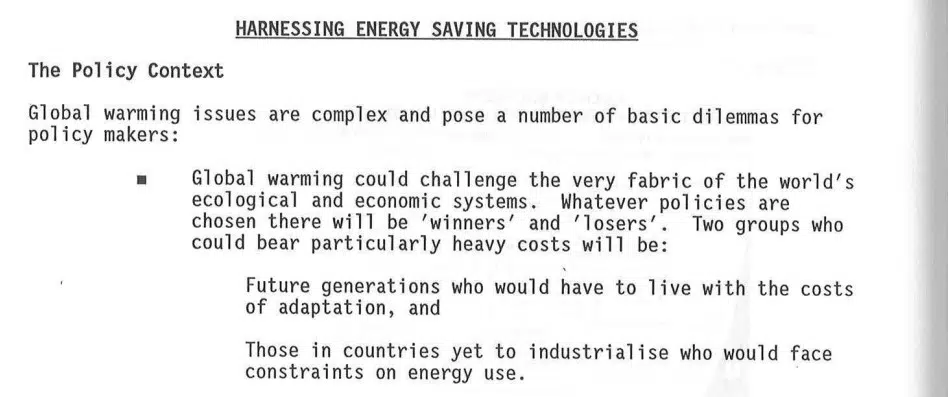
“Global warming could challenge the very fabric of the world’s ecological and economic systems,” Shell executive Ged Davis wrote in a contribution to a report by the Organisation for Economic Co-operation and Development (OECD) published two years later.

Vatan Hüzeir, a climate activist and doctoral candidate in sociology at Rotterdam’s Erasmus University, unearthed the documents over five years of research, gathering thousands of pages of Shell-related material from archives, former employees, and other sources.

The latest materials add to an initial tranche published in April last year which showed that even as Shell’s awareness of the potentially devastating consequences of climate change grew during the 1970s and 1980s, the company downplayed or omitted key risks in public communications; emphasised scientific uncertainties; and pushed for more fossil fuels.

Shell and other oil and gas companies have been named as defendants in dozens of U.S. climate lawsuits brought by the attorneys general of states such as New Jersey, Vermont, and California, as well as Washington, D.C. and other municipalities across the country. Some of these cases have been brought under consumer fraud or protection laws that penalise companies for misrepresenting their products to the public.

The Washington D.C.-based Center for Climate Integrity, which has filed briefs in support of many of the climate cases against Shell, said that the latest documents provide further evidence that the company has known for at least half a century that its products posed a threat to the climate, as well as the grave consequences of delaying action.

“These internal admissions are valuable sources for litigators around the world seeking to hold Shell accountable for its climate deception under a variety of legal theories,” Corey Riday-White, senior staff attorney at the Center for Climate Integrity, told DeSmog. “While Shell privately acknowledged the dangers of using its products as intended, the corporation publicly sowed doubt about the science and fought efforts to regulate its pollution.”

Hüzeir hopes the latest documents will support two additional and complementary legal strategies: showing that Shell has long accepted some liability for harms caused by its products — including, by implication, climate change — and demonstrating that even as Shell supported lobby groups that sought to block meaningful action to curb fossil fuel use, senior executives acknowledged the need for a “precautionary” approach to the growing climate crisis.    

In response to a request for comment, Shell referred DeSmog to a previous statement it has made regarding the lawsuits. 

“It is for government to determine the right trade-offs for society and put in place smart policy to enable fundamental change in the way society consumes energy,” a Shell spokesperson said.  

More than a dozen of the newly released documents, as well as the previous tranche published in April, can be viewed on Climate Files, under the title Dirty Pearls: Exposing Shell’s hidden legacy of climate change accountability, 1970-1990

Shell Knew

In July 2023, 20 Democratic members of Congress cited DeSmog’s initial coverage of the documents in a letter to U.S. Attorney General Merrick Garland, in which they requested a Department of Justice investigation into the evidence that Shell, ExxonMobil and other oil majors concealed their early knowledge of climate risks.

This spring, a Dutch court is due to hear Shell’s appeal of a 2021 order to slash the company’s carbon dioxide (CO2) emissions 45 percent by 2030, issued in response to a suit filed by environmental group Milieudefensie. Six other organisations also participated in the suit, including FossielvrijNL, a campaign group chaired by Hüzeir, as well as 17,000 Dutch citizens.  

“Shell must do its part to contribute to combating dangerous climate change,” Hague district court judge Larissa Alwin said, reading out the ruling.

Hüzeir believes the latest tranche of documents will strengthen cases brought by climate litigators in Europe and North America, in part by providing clues to the possible existence of additional Shell documents that could be obtained through discovery — a pre-trial procedure in the U.S. legal system that parties involved in a lawsuit use to obtain evidence from each other.

“You have to ‘crack the shell,’” Hüzeir told DeSmog. “With the existing documents in hand, and perhaps many more yet to be discovered, prosecutors, litigators and campaign groups can ground their demands for Shell to be held accountable in even more detailed fact and documentation.”

‘Annoying Consequences’

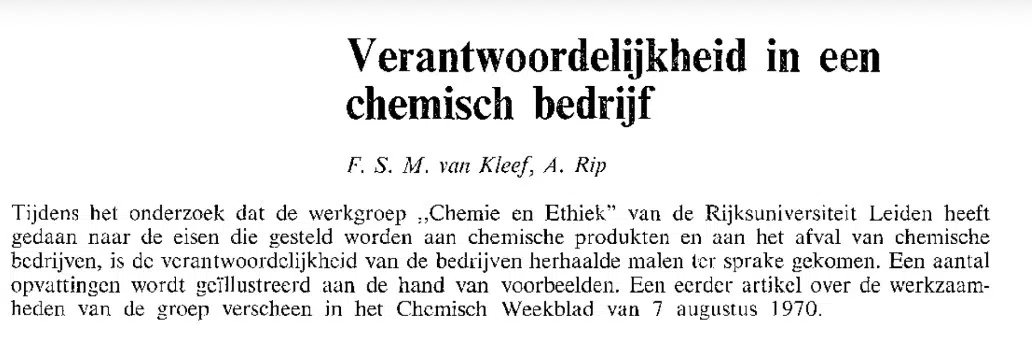
Among the new documents is an October, 1970 article in Dutch trade publication Chemisch Weekblad (Chemical Weekly), in which two authors from the University of Leiden reported on their research into “chemistry and ethics” — including the results of interviews with petrochemical executives. Representatives from Shell had appeared to acknowledge that the company bore some responsibility for the problems that its products would cause.

“If a product is used, as indicated by Shell, and annoying consequences nevertheless arise, Shell feels partly responsible,” they told the researchers.

Excerpt from an October, 1970 article in Dutch trade publication Chemisch Weekblad (Chemical Weekly).

Hüzeir said the document, and others like it, could support litigators to argue that Shell’s apparent early admission of some liability for the side-effects caused by its products should, by extension, also include climate impacts from burning its oil and gas, now known as “Scope 3” emissions. 

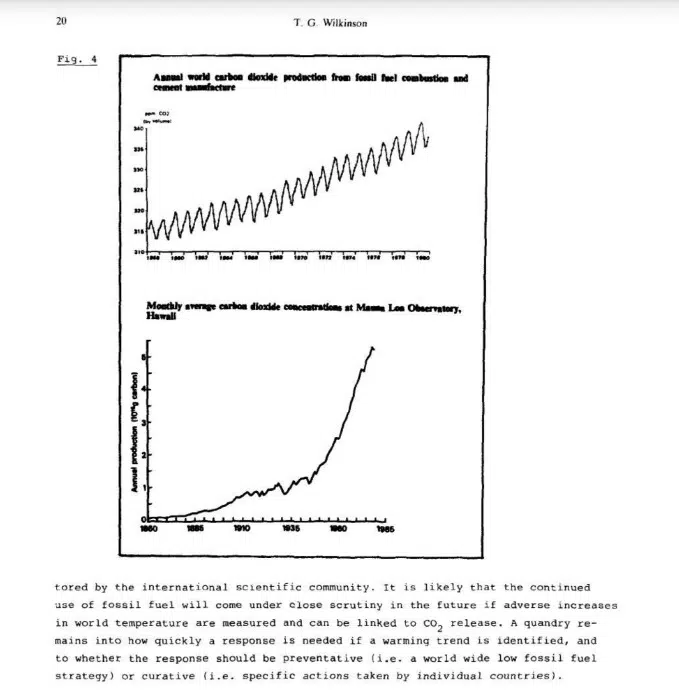
Later documents cast new light on Shell’s growing understanding of the risks posed by climate change. In a March 1985 article in the journal Conservation & RecyclingT.G. Wilkinson, who worked at the time in the Ecology Section of Shell UK’s Long Term Business Planning Unit, explored the risks posed by “energy-generated pollution.” 

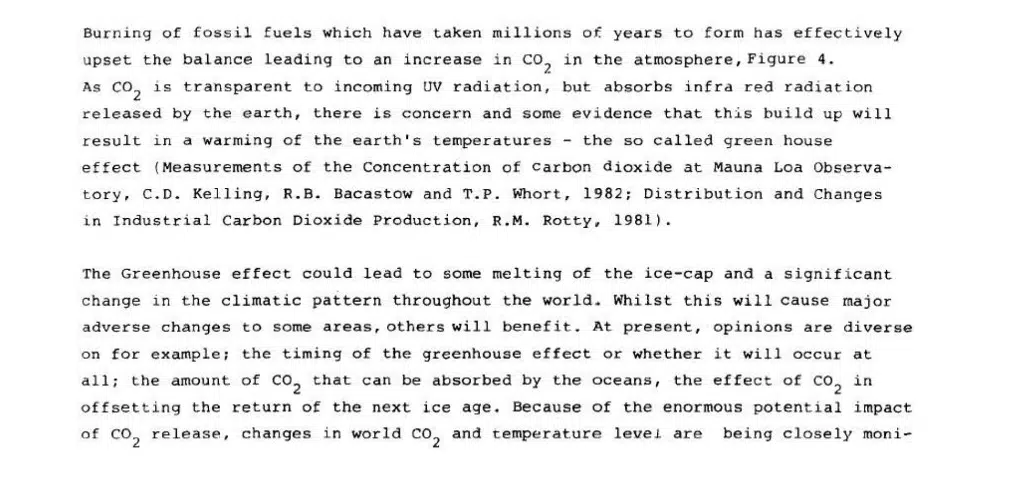
“Burning of fossil fuels which have taken millions of years to form has effectively upset the balance leading to an increase in CO2 in the atmosphere,” Wilkinson wrote. “The Greenhouse effect could lead to some melting of the ice-cap and a significant change in the climatic pattern throughout the world. Whilst this will cause major adverse changes to some areas, others will benefit.”

Excerpt from a March 1985 article in the journal Conservation & Recycling by T.G. Wilkinson, who worked at the time in Shell UK’s Long Term Business Planning Unit.

Wilkinson went on to explore whether a precautionary approach should be adopted to prevent the “potential enormous effects on the world’s climate.”

“It is likely that the continued use of fossil fuel will come under close scrutiny in the future if adverse increases in world temperature are measured and can be linked to CO2 release. A quandary remains into how quickly a response is needed if a warming trend is identified, and to whether the response should be preventative (i.e. a worldwide low fossil fuel strategy) or curative (i.e. specific actions taken by individual countries).

“The dilemma therefore remains as to whether to encourage the continued use of fossil fuels with the potential enormous effects on the world’s climate.”

Wilkinson returned to this dilemma in his conclusion, again noting the dangers posed by “emissions and discharges” caused by fossil fuels and nuclear power. 

“As well as the benefits of these energy developments however, there are also consequences to the environment arising from the emissions and discharges which are part of the process operations or are implicit in the subsequent use of the fuel,” Wilkinson wrote. “There is concern that energy-generated pollution could well affect the quality of life that has at least in part been made possible by energy developments.”

Graphs showing growing carbon dioxide emissions from fossil fuels, and rising CO2 concentrations in the atmosphere, in Shell staffer T.G. Wilkinson’s March 1985 article in Conservation & Recycling.

Winners and Losers

Further evidence of Shell’s growing understanding of the risks posed by burning its products appears in the 1987 internal Shell publication “Air Pollution: an Oil Industry Perspective.” 

“It is feared that a further rise in carbon dioxide levels in the atmosphere could lead to a higher average surface temperature on Earth, which could have far-reaching environmental, social and economic consequences,” the document said. “A lot of scientific research is being done to determine which climatic changes can occur and which measures should be taken.”

Shell’s understanding of the gravity of the dangers was also apparent in the 1989 OECD report, entitled “Energy Technologies for Reducing Emissions of Greenhouse Gases.” Davis, the Shell executive, who warned that “global warming could challenge the very fabric of the world’s ecological and economic systems,” also foresaw the possible cost to future generations of failing to curb emissions.

“Whatever policies are chosen there will be ‘winners’ and ‘losers,’” he wrote. “Two groups who could bear particularly heavy costs will be: Future generations who would have to live with the costs of adaptation, and…Those in countries yet to industrialise who would face constraints on energy use…How should we allocate resources between prevention and adaptation?”

An excerpt from Shell executive Ged Davis’ contribution to a 1989 report by the OECD.

Shell planners spelled out the risks even more starkly in an October 1989 confidential scenario exercise, previously reported by DeSmog. The authors warned that climate-fuelled migration could spark conflicts by swamping borders in the U.S., Soviet Union, Europe, and Australia, and that “civilisation could prove a fragile thing.”

‘Too Late’

In the 1990s, as the oil industry increasingly backed lobby groups and think tanks working to undermine climate science, the stark assessments of the risks of burning fossil fuels made by Shell staff in the previous decade gave way to a greater emphasis on scientific uncertainty.  

In an October 1990 internal Dutch-language publication entitled “Climate Change,” Shell acknowledged that many leading scientists were convinced of the existence of the “greenhouse effect” — the term then used for climate change. 

But the publication also echoed a message  seen in other Shell documents that Hüzeir has turned up: emphasizing uncertainty about the magnitude and timing of climate impacts, “if they do come.” 

“There is a considerable period of time (perhaps decades) between the increase in greenhouse gases and their ultimate effect on the climate,” the report stated. “As a result, by the time the enhanced greenhouse effect has been conclusively proven, it may be too late to do anything about it.” 

Nevertheless, the report went on to acknowledge the importance of reducing greenhouse gas emissions, and referenced the possibility of using carbon taxes to promote a shift away from fossil fuels. “It is widely recognized that emissions of the main greenhouse gases must be limited if there is to be any chance of reducing the further strengthening of the greenhouse effect,” the document said.

The report also noted technologies that could reduce emissions, ranging from switching to fuels that produce less CO2 per unit of energy, to boosting nuclear and renewables such as solar and wind energy. Hüzeir hopes this explicit acknowledgement of the existence of alternatives could strengthen the hand of litigators who want to prove that Shell chose to continue boosting production of fossil fuels, even while knowing that cleaner options were available.

The cover of the October 1990 internal Dutch-language publication entitled “Climate Change.”

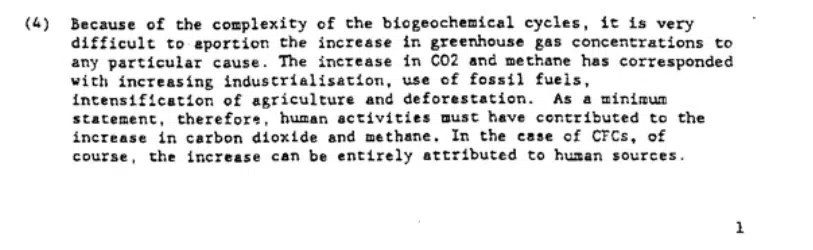
Shell’s emphasis on scientific uncertainty was evident again two years later, in September 1992, when the company’s Group Planning department published a “Business Environment Occasional Paper” on the “Potential Augmented Greenhouse Effect, & Depletion of the Ozone Layer.”

In contrast to Shell authors who had squarely recognised the primary role of fossil fuels in driving climate change in documents and graphs published during the 1980s, the authors emphasised that it was difficult to assess the extent to which fossil fuels were responsible. 

“Because of the complexity of the biogeochemical cycles, it is very difficult to aportion [sic] the increase in greenhouse gas concentrations to any particular cause,” the paper said. “The increase in CO2 and methane has corresponded with increasing industrialisation, use of fossil fuels, intensification of agriculture and deforestation. As a minimum statement, therefore, human activities must have contributed to the increase in carbon dioxide and methane.”

An excerpt from Shell’s September 1992 “Business Environment Occasional Paper” on the “Potential Augmented Greenhouse Effect, & Depletion of the Ozone Layer.”

Meanwhile, in other documents, Shell recognised the need to adopt a “precautionary” approach to climate change. In a 1993 report by the World Energy Council, a think tank backed by government and industry, where Shell’s managing director at the time, John Jennings, served on the board, the word “precautionary” appears more than 20 times. 

“Given the as yet unknown consequences of continued and increasing greenhouse gas emissions and impacts, the ability to ascertain the ‘economically optimal’ level of emissions and their mitigation, as required by a cost-benefit approach, is impossible,” the report said. “As a matter of simple prudence, therefore, action based on the precautionary principle is advocated.” 

An excerpt from a 1993 report by the World Energy Council, where Shell held a seat on the board.

Hüzeir argues that such explicit acknowledgements of the need for precautionary measures will further bolster lawsuits alleging that Shell had developed a thorough understanding of the dangers posed by fossil fuels, even as it issued other publications that emphasised scientific uncertainties, and backed lobby groups working to undermine climate action.  

‘Profits and Principles’

Shell was a founding member of the Global Climate Coalition (GCC), the outspoken oil industry lobby group, which was formed in 1989 to actively promote uncertainty and doubt about climate science in order to delay climate action.

Hüzeir believes Shell’s explanation of why it left the GCC in 1998 in an English-language sustainability report called “Profits and Principles – Does There Have to Be a Choice?” could provide a further hook for litigators.  

DeSmog has previously documented that the GCC had attempted to limit the strength of statements regarding the human causes of climate change made by the Intergovernmental Panel on Climate Change, the UN’s scientific advisory body, in the run-up to the 1997 climate conference where nations agreed to the Kyoto Protocol.

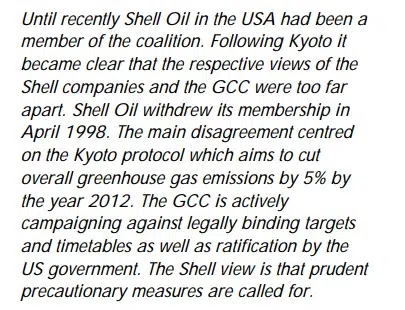
The “Profits and Principles” document said that the “main disagreement” between Shell and the GCC centred on the group’s opposition to the Kyoto agreement, which aimed to cut global greenhouse gas emissions by five percent by 2012.

“The GCC is actively campaigning against legally binding targets and timetables as well as ratification by the US government,” the report said. “The Shell view is that prudent precautionary measures are called for.”

An excerpt from Shell’s 1998 English-language sustainability report called “Profits and Principles – Does There Have to be a Choice?

Hüzeir said that Shell’s admission that it saw the need for these “precautionary measures” affirms that the company had long understood the risks posed by the climate crisis — knowledge apparent in many earlier files. 

This document also raised the question of why Shell had continued to fund the GCC, as late as 1998 — the year it left the organisation — despite that understanding, Hüzeir said.  

Shell’s acknowledgement that its position in GCC had become untenable could also help litigators demonstrate that oil and gas companies that remained in the group until it disbanded in 2002 had been acting in bad faith, Hüzeir added.

“We’ve heard many times from the fossil fuel industry that it was unsure whether or not to take early action on the climate crisis, because there were uncertainties in the science,” Hüzeir said. “But Shell’s deepening embrace of the precautionary principle, as revealed in this document, shows that Shell was well aware of the crisis ahead. What else did they know?”

Original article by Matthew Green and Merel de Buck republished from DeSmog.

Continue ReadingNew Shell Files Could Aid Climate Cases, Attorneys Say 

‘Call to Action’: CO2 Now at Levels Not Seen in 14 Million Years

Spread the love

Original article by OLIVIA ROSANE republished from Common Dreams under Creative Commons (CC BY-NC-ND 3.0). 

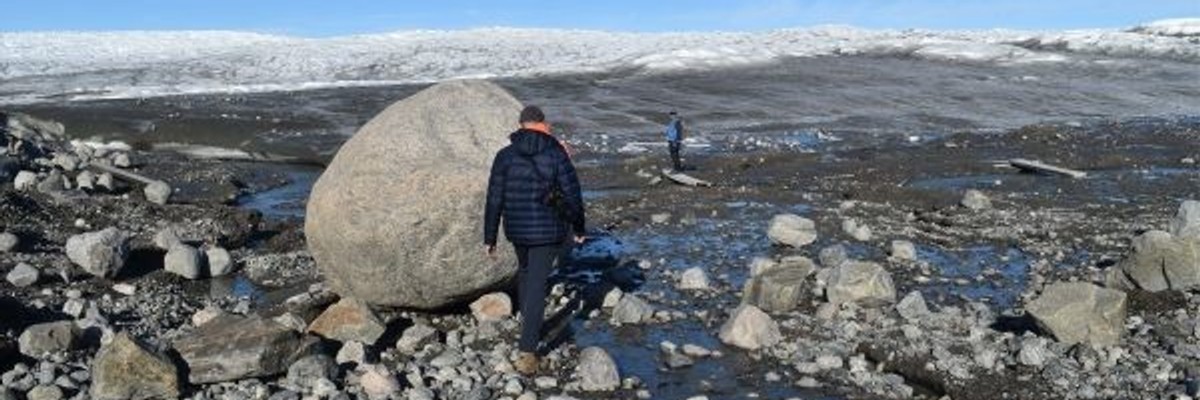
An image shows the edge of the Greenland ice sheet, where recent melting has left bare ground.  (Photo: Kevin Krajick/Columbia University)

“It really brings it home to us that what we are doing is very, very unusual in Earth’s history,” the lead author of a new study said.

The last time that levels of atmospheric carbon dioxide were as high as they are today, Greenland was free of ice and the savanna and grassland ecosystems where humans evolved didn’t exist yet.

That’s the conclusion of a study published in Science Friday, which researchers say compiles “the most reliable data available to date” on atmospheric carbon dioxide levels over the last 66 million years.

“It really brings it home to us that what we are doing is very, very unusual in Earth’s history,” lead author Baerbel Hoenisch of the Columbia Climate School’s Lamont-Doherty Earth Observatory toldAgence France-Presse.

“We’ve already pushed the atmosphere way beyond anything we’ve seen as a species.”

By burning fossil fuels and clearing natural carbon sinks like forests, industrial capitalism has raised global carbon dioxide levels to 419 parts per million (ppm) today from around 280 ppm at the beginning of the industrial revolution.

“Rising atmospheric CO2 is the most obvious and startling expressions of our impact on the global environment,” study corresponding author and University of Utah geologist Gabe Bowen wrote on social media. “The concentration has risen by ~50% in the past 100 years. Every year is now marked by the highest CO2 levels *ever observed* by humans!”

To understand how such a spike in carbon dioxide might impact Earth’s climate and ecosystems, it’s helpful to look at the pa st. This presents challenges, however, because the most reliable record of past carbon dioxide concentrations—gas bubbles preserved in ice cores—only goes back to around 800,000 years ago, when atmospheric concentrations of carbon dioxide were still at around preindustrial levels.

“Once you lose the ice cores, you lose direct evidence. You no longer have samples of atmospheric gas that you can analyze,” Bowen said in a University of Utah press release. “So you have to rely on indirect evidence, what we call proxies. And those proxies are tough to work with because they are indirect.”

Proxies are evidence in the geologic record that can stand in for carbon dioxide levels, such as mineral isotopes or the shape of fossilized leaves. Scientists have looked at these proxies before, but the current study represents the most comprehensive effort to date. A team of around 90 researchers from 16 countries spent seven years synthesizing and reviewing previous work under the banner of the Cenozoic CO2 Proxy Integration Project, according to the University of Utah and AFP.

The new study represents the scientific consensus on the carbon dioxide record, and it concludes that the last time carbon dioxide levels were around 419 ppm was 14 million years ago. That’s much earlier than previous estimates of 3 to 5 million years ago.

However, the record goes back further than that to the Cenozoic Era, when the dinosaurs died and mammals began to emerge.

That record revealed a very clear pattern, Bowen tweeted: “CO2 goes up, the world warms. CO2 down, and things get icy.”

The record enabled the scientists to predict the consequences of current and projected carbon dioxide levels.

“This is an incredibly important synthesis and has implications for future climate change as well, particularly the key processes and components of the Earth system that we need to understand to project the speed and magnitude of climate change,” University of Utah biology professor William Anderegg said in the press release.

One of the report’s messages, Bowen tweeted is that “the future is now.”

“We’ve already pushed the atmosphere way beyond anything we’ve seen as a species,” Bowen continued, “and if it stays this way we’re in for big changes in the environment we live in.”

If policy-makers don’t restrict the burning of fossil fuels, atmospheric carbon dioxide could reach 600 to 800 ppm by 2100, AFP reported. According to the record, the last time levels were this high was 30 to 40 million years ago, when Antarctica was also ice-free and the Earth was home to giant insects.

Even today’s concentrations are bound to have lasting consequences. For example, when carbon dioxide levels rapidly increased around 56 million years ago, it significantly altered ecosystems and took around 150,000 years to decrease again.

“We are in this for a very long time,” Hoenisch told AFP, “unless we sequester carbon dioxide, take it out of the atmosphere, and we stop our emissions sometime soon.”

However, the that doesn’t mean the most extreme changes are locked-in. Instead, Bowen tweeted that the report was a “call to action.”

“The geological changes we studied lasted for thousands and millions of years,” Bowen said, “and if human-induced CO2 change is short-lived it won’t have as big an impact on the climate.”

Original article by OLIVIA ROSANE republished from Common Dreams under Creative Commons (CC BY-NC-ND 3.0). 

Continue Reading‘Call to Action’: CO2 Now at Levels Not Seen in 14 Million Years

Carbon Offsets 101: Why We Can’t Offset Our Way Out of the Climate Crisis

Spread the love
The buildings and steaming cooling towers of a coal-fired power plant behind a landscape park in Germany. Frank Bienewald / LightRocket via Getty Images

https://www.ecowatch.com/carbon-offsets-climate-crisis.html

… Carbon offsets are in theory a way to cancel out greenhouse gas emissions by funding an activity that will remove a supposedly equal amount of carbon dioxide from the atmosphere or prevent an equal amount of carbon pollution. They can be purchased by everyone from major companies pursuing net-zero emissions goals to individuals looking to compensate for high-carbon activities like flying. Typically, an institution or individual will purchase a certain amount of carbon credits, with one credit usually standing in for one metric ton of carbon dioxide — or what is typically emitted by driving 2,513 miles in a gas car — removed from the atmosphere. (That’s roughly the distance between San Francisco and Atlanta). Whoever buys the carbon credit is essentially buying the right to count the emissions reduction as theirs even if it’s being performed by a tree-planting or renewable energy project on the other side of the globe.

Quick Facts

  • One carbon credit usually equals one metric ton of carbon dioxide supposedly removed from the atmosphere, or the equivalent of driving 2,513 miles in a gas-powered car.
  • The voluntary carbon market quadrupled in value between 2020 and 2021 to reach nearly $2 billion. 
  • The average tree absorbs 20 pounds of carbon dioxide each year during the first 20 years of its life.
  • Only four percent of carbon offset projects actively remove carbon dioxide from the atmosphere, as opposed to preventing additional emissions. 
  • More than 170 climate, environmental and Indigenous rights groups signed an open letter opposing carbon offsets. 
  • At least 52 percent of carbon-offset generating wind projects in India would have been built anyway.
  • California’s forest carbon offsets program likely overestimated its emissions reductions by at least 80 percent. 
  • A Ryanair program to offer passengers €1 carbon offsets only actually offset the company’s emissions by 0.01 percent. 
  • Sixty-six percent of highly-polluting companies studied relied on carbon offsets to meet their net zero targets.
  • There are only around 500 million hectares of land available for tree-planting carbon offset projects and Shell wants to claim 10 percent of it.

They’re a Scam: One of the main criticisms of carbon offsets is that many projects don’t really do what they say they are going to do, namely, prevent additional emissions. A major ProPublica report published in 2019 reviewed 20 years of forest-preservation-based offset projects and found that “In case after case […] carbon credits hadn’t offset the amount of pollution they were supposed to, or they had brought gains that were quickly reversed or that couldn’t be accurately measured to begin with.” A 2021 study of wind farms in India found that at least 52 percent of the projects used to back offsets would have been constructed regardless and that therefore the selling of the offsets to polluting industries actually increased emissions. Two studies of California’s forest carbon offsets program found that it overestimated its emissions reductions by at least 80 percent. The dubious nature of many carbon-offset projects leads to charges of greenwashing, because fossil fuel or airline companies can use their purchasing of offsets to market themselves as being more sustainable than they really are. For example, a Ryanair program to charge its customers €1 to offset their flight only lowered the company’s emissions by 0.01 percent.

They’re a Distraction From Reducing Emissions: Even if every carbon offset project worked exactly as advertised, however, it wouldn’t be an effective tool for fighting climate change. That’s because the climate crisis is caused by pumping greenhouse gas emissions into the atmosphere and will only be halted if emissions actually stop as well. Yet a 2021 study looking at net-zero pledges from the sectors responsible for 64 percent of greenhouse gas emissions found that 66 percent of them relied on carbon offsets. Oil, gas and mining companies were especially dependent on offsets for their net zero plans. 

What everyone in the climate space can agree on is that the emphasis needs to move away from purchasing offsets and towards actually reducing fossil fuel emissions. At their best, offsets could be a stop-gap measure to fund beneficial projects and counteract emissions that there is not yet a technologically feasible way to reduce directly. At their worst, carbon offsets risk giving polluters an easy way to greenwash their image while continuing business as usual, actually increasing emissions through miscounting and reproducing the injustices underlying the climate crisis. Given that the current system tips more towards the latter than the former, it’s important for governments, companies and individuals to focus on not putting greenhouse gas emissions in the atmosphere in the first place. 

Read the original article https://www.ecowatch.com/carbon-offsets-climate-crisis.html

Continue ReadingCarbon Offsets 101: Why We Can’t Offset Our Way Out of the Climate Crisis

New Study Identifies United States as ‘Planet-Wrecker-in-Chief’

Spread the love

Original article by JAKE JOHNSON republished from Common Dreams under Creative Commons (CC BY-NC-ND 3.0). 

Planned fossil fuel expansion in the U.S. accounts for more than a third of new oil and gas extraction projects set to begin through 2050, according to Oil Change International.

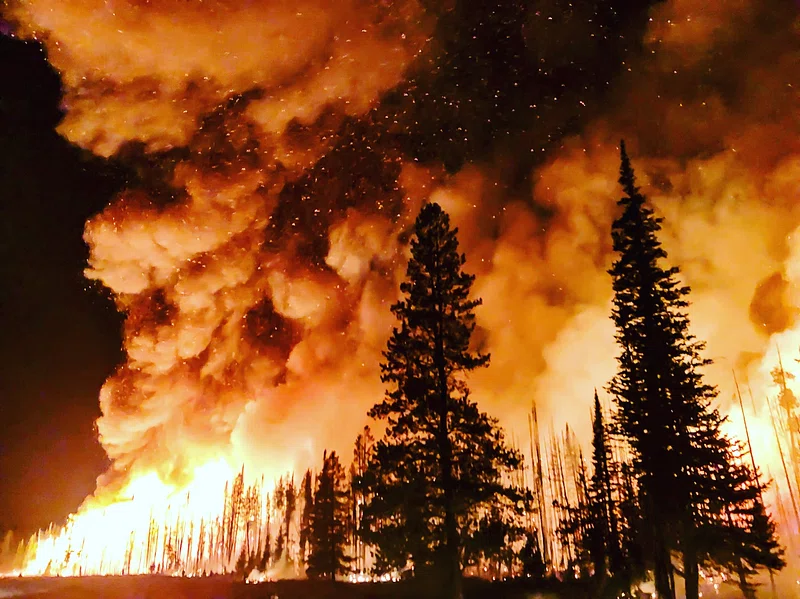
Canadian wildfire 2023

A new report released Tuesday identifies the United States as “planet-wrecker-in-chief,” pointing to the nation’s plans for a massive expansion of oil and gas production over the next two and a half decades even as it postures as a climate leader on the world stage.

According to Oil Change International’s (OCI) research, planned oil and gas expansion in the U.S.—the largest historical contributor to planet-warming greenhouse gas emissions—accounts for more than a third of prospective global oil and gas expansion through 2050. Much of the U.S. expansion is tied to fracking, the report observes.

The U.S. is one of just 20 countries that are projected to be responsible for nearly 90% of the carbon dioxide pollution from new oil and gas extraction projects between 2023 and 2050.

If those 20 countries follow through with their fossil fuel expansion plans, OCI noted, the projects will emit an estimated 173 billion tonnes of carbon dioxide, the equivalent of the lifetime emissions of more than 1,000 new coal plants.

“If that amount of CO2 is emitted into the atmosphere, then we’re in serious trouble,” Romain Ioualalen, global policy lead for OCI and a co-author of the new report, said during a press conference on Tuesday.

Such emissions, Ioualalen warned, would blow through the world’s dwindling carbon budget and make it “mathematically impossible” to limit global warming to 1.5°FC by the end of the century.

“The planet-wreckers report presents unmistakable evidence of the peril of fossil fuel expansion while reckoning with the world’s historic polluters, namely the United States.”

Five rich countries—the U.S., Canada, Australia, Norway, and the United Kingdom—account for more than half of all planned oil and gas expansion globally, even though they are far less reliant on fossil fuel revenues than other nations and have the resources for a renewable energy transition, OCI said.

The new report takes the Biden administration to task for “pledging climate leadership” while simultaneously facilitating “the continued expansion of fossil fuel production in the United States.”

“In 2023 alone, the administration greenlit the Alaska Willow Project; approved multiple LNG export facilities in Alaska and along the Gulf Coast, held a massive oil and gas lease sale in the Gulf of Mexico, fast-tracked the Mountain Valley Pipeline, and oversaw the weakening of bedrock environmental laws, making it easier for fossil fuel infrastructure to move forward,” the report notes.

The new research was released just over a week before United Nations Secretary-General António Guterres’ Climate Ambition Summit, which will be preceded by more than 400 mobilizations worldwide aimed at pressuring world leaders to urgently phase out fossil fuels.

“The planet-wreckers report presents unmistakable evidence of the peril of fossil fuel expansion while reckoning with the world’s historic polluters, namely the United States, and how we must hold them accountable,” Helen Mancini, a 16-year-old Fridays for Future activist from New York City, said in a statement Tuesday.

“The activism youth are doing is not radical,” Mancini added, “it’s a demand for survival that the planet-wreckers must heed.”

Original article by JAKE JOHNSON republished from Common Dreams under Creative Commons (CC BY-NC-ND 3.0). 

Continue ReadingNew Study Identifies United States as ‘Planet-Wrecker-in-Chief’

NOAA Finds Carbon Concentrations Highest in 800,000 Years as Sea Level Rise Hits Record

Spread the love

Original article by JESSICA CORBETT republished from Common Dreams under Creative Commons (CC BY-NC-ND 3.0).

The new global report states that burning fossil fuels is “the main driver of increasing atmospheric CO2.”

Amid a summer of extreme heat across the Northern Hemisphere, an international report led by the U.S. National Oceanic and Atmospheric Administration revealed Wednesday that greenhouse gas concentrations, global sea level, and ocean heat content hit record highs last year.

“This report is a truly international effort to more fully understand climate conditions around the globe and our capacity to observe them,” NOAA National Centers for Environmental Information (NCEI) Director Derek Arndt said of State of the Climate in 2022, which features contributions from more than 570 scientists in over 60 countries.

“It is like an annual physical of the Earth system, and it serves present and future generations by documenting and sharing data that indicate increasingly extreme and changing conditions in our warming world,” Arndt added of the 33rd annual report, published by the Bulletin of the American Meteorological Society.

As humanity continued to extract and burn fossil fuels and engage in polluting agricultural practices, all three of the main atmospheric greenhouse gases—carbon dioxide, methane, and nitrous oxide⁠—reached record concentrations last year. The CO2 average was 417.1 parts per million, topping not only modern observational records but also paleoclimatic records that go back as far as 800,000 years.

“People are causing the largest known change in global climate since our transition to agriculture thousands of years ago,” said Paul Higgins, associate executive director of the American Meteorological Society.

In the ocean—which has absorbed most warming from greenhouse gases in recent decades—heat content rose to record highs last year. The annual surface temperature was 0.45-0.54°F above the 1991-2020 average, making 2022 among the six warmest years since record-keeping began in the 1800s and the hottest La Niña year on record. The global mean sea level set a record for the 11th straight year, rising about 4 inches above the 1993 average, when satellite measurements began.

While approximately 58% of the ocean surface endured at least one marine heatwave, temperatures also soared on land. As the report details:

Europe as a whole observed its second-warmest year on record, with 16 individual countries observing record warmth at the national scale. Records were shattered across the continent during the summer months as heatwaves plagued the region. On July 18, 104 stations in France broke their all-time records. One day later, England recorded a temperature of 40°C [104°F] for the first time ever. China experienced its second-warmest year and warmest summer on record. In the Southern Hemisphere, the average temperature across New Zealand reached a record high for the second year in a row. While Australia’s annual temperature was slightly below the 1991-2020 average, Onslow Airport in Western Australia reached 50.7°C [123°F] on January 13, equaling Australia’s highest temperature on record.

[…]

The effects of rising temperatures and extreme heat were apparent across the Northern Hemisphere, where snow-cover extent by June 2022 was the third smallest in the 56-year record, and the seasonal duration of lake ice cover was the fourth shortest since 1980. More frequent and intense heatwaves contributed to the second-greatest average mass balance loss for Alpine glaciers around the world since thestart of the record in 1970. Glaciers in the Swiss Alps lost a record 6% of their volume. In South America, the combination of drought and heat left many central Andean glaciers snowfree by mid-summer in early 2022.

Nearly a third of global land faced moderate or worse drought in 2022, from a 63% footprint in the contiguous United States to the continuation of a 13-year megadrought in central Chile. The report notes that an ongoing drought in Africa has “led to crop failure, millions of livestock deaths, water scarcity, and inflated prices for staple food items.”

Meanwhile, in South Asia, “Pakistan received around three times its normal volume of monsoon precipitation in August, with some
regions receiving up to eight times their expected monthly totals,” the report highlights. “Resulting floods affected over 30 million people, caused over 1,700 fatalities, led to major crop and property losses, and was recorded as one of the world’s costliest natural disasters of all time.”

Global conditions last year and Big Oil’s record profits fueled demands for bold action to overhaul agricultural practices and stop burning fossil fuels—which, as the report points out, is “the main driver of increasing atmospheric CO2.” Such calls have continued in recent months, as oil and gas giants kept rewarding shareholders with hefty stock buybacks and dividends during what has been another historically hot summer, according to data released Tuesday.

“Our planet has just endured a season of simmering—the hottest summer on record,” United Nations Secretary-General António Guterres said Wednesday, less than three months away from the U.N. COP28 summit. “Leaders must turn up the heat now for climate solutions.”

Original article by JESSICA CORBETT republished from Common Dreams under Creative Commons (CC BY-NC-ND 3.0).

Related from Common Dreams:

Now End All the Drilling, Campaigners Say as Biden Rescinds Arctic Refuge Leases

‘Worst Possible News’: Scientists Urge Immediate Action as Greenhouse Gas Levels Hit All-Time High

‘Climate Breakdown Has Begun’: Summer of 2023 Was Hottest Ever Recorded

CO2 Levels Are the Highest in a Million Years as Extreme Weather and Flooding Rage Across the Globe

‘This Is Unprecedented’: Record-Breaking Rain Brings Deadly Flooding to Greece, Turkey, Bulgaria

Continue ReadingNOAA Finds Carbon Concentrations Highest in 800,000 Years as Sea Level Rise Hits Record