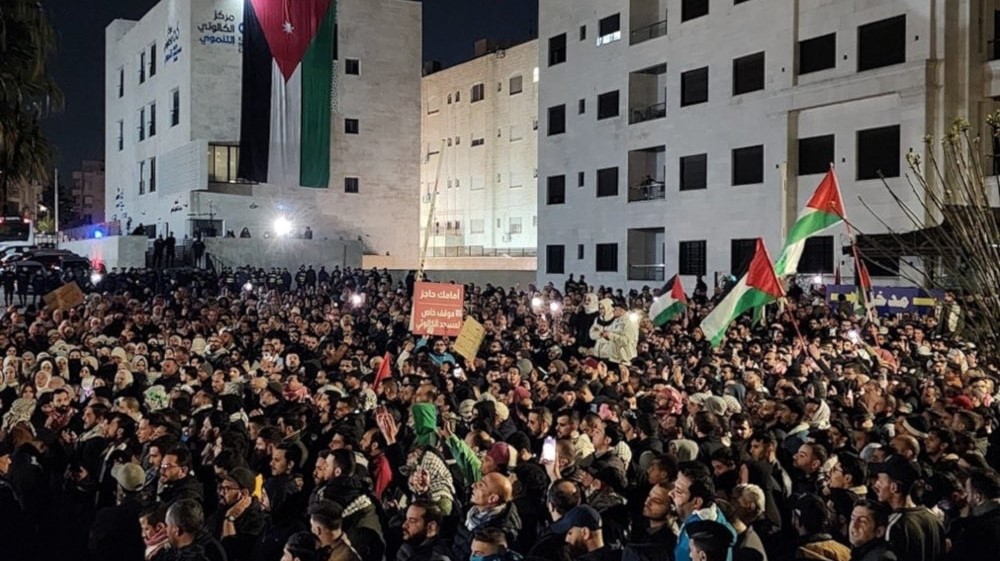
Protesters gather in Amman in Jordan demanding an immediate ceasefire in Gaza. Photo: Al Mayadeen
People took to the streets in a number of countries across West Asia and North Africa after the UN Security Council resolution calling for a ceasefire. However, Israel refused to heed the call and continued its attacks on Gaza on Tuesday
Large-scale protests broke out in different parts of West Asia and North Africa on Monday, March 25 in support of Palestine with people chanting slogans against the Israeli war in Gaza and demanding an immediate ceasefire. People took to the streets in a number of countries in the aftermath of the UN Security Council resolution that called for a ceasefire.
Jordanian security forces fired tear gas shells to disperse protesters who tried to storm the Israeli embassy in Amman. Thousands of these protestors chanted slogans in solidarity with the people in Gaza and in support of the Al-Aqsa mosque. Many of them carried Palestinian flags which they hoisted in nearby buildings.
Similar protests took place in other parts of the country. A day before, Jordanian forces had prevented a large group of people from marching to the Israeli embassy.
Protests were also organized in the Iraqi capital Baghdad and Cairo in Egypt as well on Monday where hundreds gathered to chant slogans in support of Palestine and demand an immediate ceasefire.
"El-Sisi is the enemy of God."
Iraqi women chant slogans decrying Egyptian President Abdel Fattah El-Sisi in front of the Egyptian Consulate in Baghdad in protest of the continued siege of Gaza and the closure of the crossings with Gaza, including the Rafah border crossing with… pic.twitter.com/yzfhi6C0Kw
Hundreds also gathered in Tangiers in Morocco to demonstrate against the continued Israeli genocide of Palestinians in Gaza.
Tens of thousands of Moroccos demonstrated last night in the city of Tangiers in Morocco in solidarity with the Palestinian people amid the ongoing Israeli genocide. pic.twitter.com/NbJXnNCb7u
Protests were also organized in the Nur Shams refugee camp in Tulkarem and in Ramallah in the occupied West Bank on Tuesday. Hundreds of Palestinians, defying Israeli dictates and ongoing attacks, took to the streets in the morning to call for a ceasefire.
The protests followed the UNSC resolution demanding an immediate ceasefire. The resolution was adopted after the US, which had blocked three similar previous resolutions, decided to abstain. All the other members of the Security Council supported the resolution.
The resolution called for an immediate ceasefire during the month of Ramadan and for working towards a permanent cessation of hostilities and the release of all hostages. It was welcomed by the Palestinian resistance group Hamas and most of the countries in the region.
Hamas reiterated its demand for a permanent ceasefire that would lead to the complete withdrawal of all Israeli forces from Gaza and the return of all Palestinians displaced due to the war over five months.
Nearly the entire population of Gaza, around 2.3 million, has been displaced due to the Israeli war which has killed more than 32,000 and wounded close to 74,000 Palestinians.
The Iranian foreign ministry welcomed the UNSC resolution, calling it a positive step and demanded its immediate implementation. It also demanded the lifting of all blockades on the supply of aid to Gaza and the opening of all border crossings to the besieged territory and immediate resumption of reconstruction.
Israel has however rejected the resolution. It carried out fresh attacks on Gaza on Tuesday, killing dozens of Palestinians.
The resolution accepted by the Security Council is binding on all members of the UN. However, only a fresh vote in the Security Council can decide the future course of action in case one particular party chooses not to implement it.
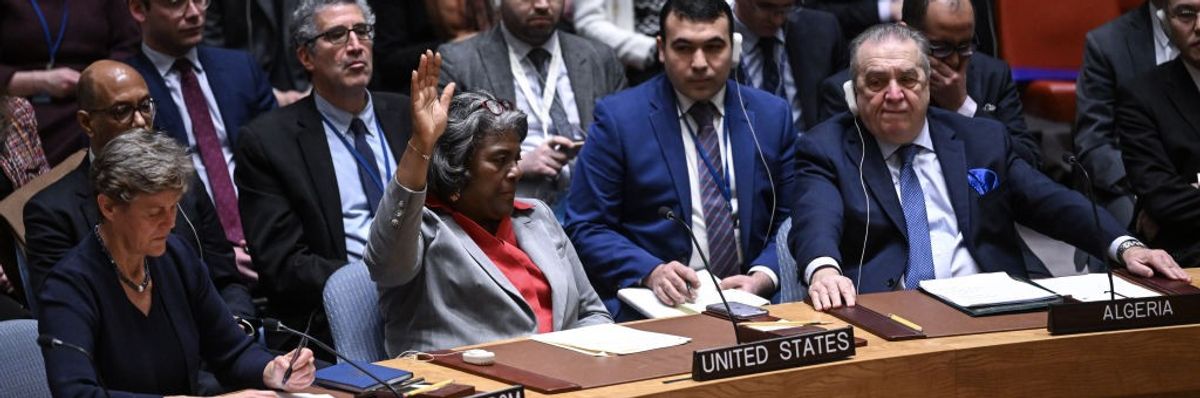
U.S. Ambassador to the United Nations Linda Thomas-Greenfield raises her hand to abstain during a U.N. Security Council vote on a Gaza cease-fire resolution on March 25, 2024 in New York City. (Photo: Fatih Aktas/Anadolu via Getty Images)
“This resolution must be implemented,” said U.N. Secretary-General António Guterres. “Failure would be unforgivable.”
The U.S. on Monday declined to veto but still abstained from a United Nations Security Council on Monday to adopt a resolution demanding an “immediate cease-fire for the month of Ramadan” in the embattled Gaza Strip, a move that came amid an ongoing Israeli genocide in which more than 114,000 Palestinians have been killed or wounded and hundreds of thousands of others are starving.
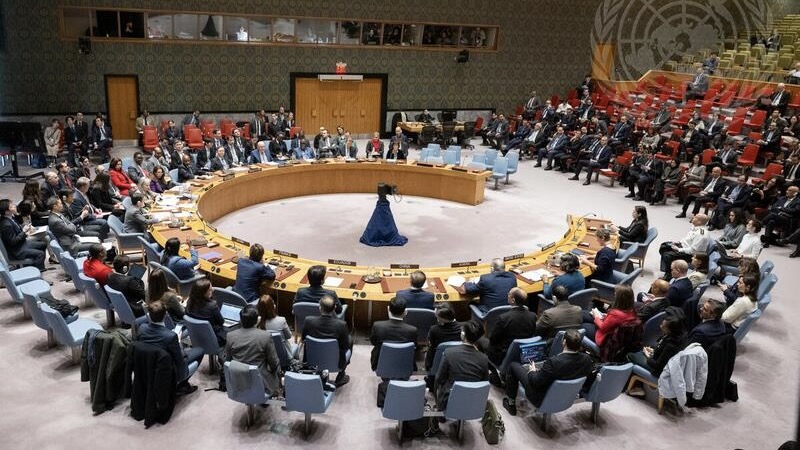
The Security Council voted 14-0, with the U.S. abstaining, to approve a resolution for the cessation of hostilities during the Muslim holy month after member states overcame a sticking point over the removal of the word “permanent” from an earlier draft version. Instead, the resolution calls for an “immediate” cease-fire.
The U.S. had vetoed three of the previous four cease-fire resolutions.
“This resolution must be implemented,” U.N. Secretary-General António Guterres said following Monday’s vote. “Failure would be unforgivable.”
NEW—The United Nations Security Council has voted 14-0 to demand: –immediate ceasefire for Ramadan leading to "lasting" sustainable ceasefire –immediate unconditional release of all hostages
US abstained, even after successfully pushing to replace word "permanent" with "lasting" pic.twitter.com/zAjvI5nqgE
The resolution is a bare-bones call for a cease-fire during the month of Ramadan, which began on March 11. It also demands the return of about 130 hostages seized in Israel and held in Gaza and emphasizes the urgent need to allow ample lifesaving aid to reach a starving population in the besieged enclave.
The demand to end hostilities has so far eluded the council following the Israeli forces’ invasion of Gaza in October after Hamas attacks left almost 1,200 dead and 240 taken hostage.
Since then, Israel’s daily bombardment alongside its near-total blockade of water, electricity, and lifesaving aid has killed more than 32,000 Palestinians in Gaza, according to the health ministry there, where a recent U.N.-backed report showed an imminent famine unfolding.
Palestinians—especially children—are starving to death in Gaza. Hospitals are under attack, with Israeli forces reportedly executing large numbers of people inside al-Shifa Hospital.
Meanwhile, the approximately 1.5 milllion Palestinians in the southern city of Rafah—most of them refugees forcibly displaced from other parts of Gaza—are bracing for an anticipated ground invasion, which Israeli leaders say will proceed despite a warning from U.S. Vice President Kamala Harris that such an operation would have “consequences.”
Monday’s vote followed intense negotiations over the measure introduced by 10 non-permanent Security Council members—Algeria, Ecuador, Guyana, Japan, Malta, Mozambique, Sierra Leone, Slovenia, South Korea, and Switzerland.
The United States—which, despite growing frustration over genocidal atrocities, still arms Israel—brushed off a threat from far-right Prime Minister Benjamin Netanyahu to cancel a planned visit to Washigton by a high-level Israeli delegation if the U.S. did not veto the resolution.
The Associated Press reported Netanyahu followed through with his threat and canceled the trip.
Human rights defenders welcomed Monday’s vote.
“Israel needs to immediately respond to the U.N. Security Council resolution adopted today by facilitating the delivery of humanitarian aid, ending its starvation of Gaza’s population, and halting unlawful attacks,” Louis Charbonneau, director of Human Rights Watch’s U.N. program, said in a statement.
“Palestinian armed groups should immediately release all civilians held hostage,” he added. “The U.S. and other countries should use their leverage to end atrocities by suspending arms transfers to Israel.”
As Israel prepares for a ground invasion of Rafah, the US-authored resolution presented to the UN Security Council merely noted an “imperative” for an immediate ceasefire in Gaza. Algeria, Russia, and China rejected the resolution, stating that it had failed to deliver on the core demand for a ceasefire.
Russia and China vetoed a US-authored resolution in the United Nations Security Council (UNSC) on March 22 on the situation in Gaza. The text “determines the imperative for an immediate and sustained ceasefire” stopping short of an explicit call for a halt to Israel’s six-month long attack on besieged Gaza that has killed almost 32,000 Palestinians.
The US authored the resolution after vetoing three successive UNSC resolutions on Gaza, including a February 20 resolution presented by Algeria that had called for an immediate ceasefire.
Absent an explicit call for a ceasefire, the text presented by the US mentioned allowing for the delivery of essential humanitarian assistance, “alleviate humanitarian suffering and towards that end unequivocally supports ongoing international diplomatic efforts to secure such a cease-fire in connection [emphasis added] with the release of all remaining hostages,” according to a draft circulated in the news media on Thursday.
This unilateral demand for the release of Israeli hostages—without a mention of a reciprocal release of the thousands of Palestinians Israel has imprisoned and tortured— has been inserted by the US in UNSC discussions of a ceasefire. This is all while Israel has continued to bomb Gaza and rejected comprehensive ceasefire proposals presented by the Palestinian resistance. Friday’s vote in the Security Council was held amid ongoing negotiations in Qatar.
The US continued to make this link perhaps not “as firmly”, during the Council on Friday, with Ambassador Linda Thomas-Greenfield speaking of an “immediate and sustained ceasefire as part of a deal that leads to the release of all hostages being held by Hamas and other groups that will help us address the dire humanitarian crisis in Gaza”. She added that adopting the resolution would “put pressure on Hamas to accept the deal on the table”.
The US resolution received 11 votes in favor, and three votes against, with Algeria joining Russia and China who cast the deciding vetoes. Guyana was the sole abstention, reiterating the lack of a call for an immediate ceasefire.
US resolution a “hypocritical spectacle”
Addressing the Council ahead of the vote, Russian Ambassador Vassily Nebenzia accused the US of presenting a “hypocritical spectacle” wrapped up in a ceasefire, that the US had been trying to “sell a product” to the international community. He added that the language of an “imperative” was not enough to save the lives of the Palestinians and was not stipulated in the mandate of the UNSC, which is vested with a mechanism to “demand a ceasefire and where necessary, to compel compliance”.
“The American product is exceedingly politicized, the sole purpose of which is to help to play to the voters, to throw them a bone in the form of some kind of a mention of a ceasefire in Gaza” and would make the UNSC “instrument in the advancement of Washington’s destructive policy in the Middle East”, and “to ensure the impunity of Israel whose crimes in the draft are not even assessed.”
“The US draft contains an effective green light for Israel to mount a military operation in Rafah”, adding that the text’s authors had tried to make it that “nothing would prevent” Israel from “continuing their brutal cleansing of the south of the Gaza Strip”.
Algerian Ambassador Amar Bendjama stated that the adoption of the February ceasefire resolution could have saved thousands of lives, adding that the present resolution had fallen short “due to the absence of a clear demand for a ceasefire those who believe that the Israeli occupying power will choose to uphold its international legal obligation are mistaken, they must abandon this fiction”.
He stated that the US draft resolution had been circulated a month ago following which Algeria had made proposed edits to “achieve a more balanced and acceptable text”, however, finally, the draft fell short as “core concerns remained unaddressed”.
Addressing the Council on Friday, China’s Ambassador Zhang Jun explained the country’s veto, stating that despite the urgent need and demand for an immediate, unconditional, and sustained ceasefire, “the Council had dragged its feet and wasted too much time”.
He added that the US-authored draft had “always evaded and dodged the most central issue- that of a ceasefire. The final text remains ambiguous and does not call for an immediate ceasefire, nor does it even provide an answer to the question of realizing a ceasefire in the short-term”.
Zhang further stated that an immediate ceasefire was a “fundamental prerequisite” for “saving lives, expanding humanitarian access and preventing greater conflicts. The US draft on the contrary sets up preconditions for a ceasefire which is no different from giving a green light to continued killings which is unacceptable.”
He noted that the draft was “very imbalanced” particularly in regard to Israel’s plans to invade Rafah. “The draft does not clearly and unequivocally state its opposition which would send an utterly wrong signal and lead to severe consequences.”
His Algerian counterpart, Bendjama, had similarly stated that the text “does not convey a clear message of peace. It tacitly allows continuing civilian casualties and lacks clear safeguards to prevent further escalation. It is a laissez-passer to continue killing the Palestinian civilians. The emphasis on ‘measures to reduce civilian harm from ongoing and future operations’ implies a license for continuing bloodshed,” Bendjama added, highlighting Israel’s looming invasion of Rafah.
Rafah invasion still on the table despite international outcry
Israeli Prime Minister Benjamin Netanyahu has reiterated the Occupation’s plan to launch a ground invasion of Rafah in southern Gaza, where 1.5 million people forcibly displaced by Israeli attacks on other parts of Gaza are currently trapped.
While the US continues to make a display of its supposed efforts to halt the looming invasion, Netanyahu has declared that Israel is “rejecting” growing international pressure “in order to achieve the goals of the war”. Following a phone call with President Joe Biden, Netanyahu stated that he “made it as clear as possible” that there was no way around a ground incursion.
“We see no way to eliminate Hamas militarily without destroying these remaining battalions. We are determined to do this”, he said. Netanyahu reiterated this in a meeting with US Secretary of State Antony Blinken, saying on Friday, “I told him that I hope we will do it with the support of the US, but if we have to— we will do it alone”.
“A major military ground operation is not the way to do it”, Blinken told reporters, then going on to say, “We’re determined that Israel succeed in defending itself and becomes integrated into the region with its security.”
Meanwhile, the ten elected, non-permanent members (E-10) of the Security Council have drafted a separate resolution calling for an immediate humanitarian ceasefire for the Muslim holy month of Ramadan, “leading to a permanent sustainable ceasefire”.
It also demands “the immediate and unconditional release of all hostages”, without linking it to the ceasefire, and stresses the need to protect civilians in Gaza and provide humanitarian assistance. France has also stated that it will be drafting a separate resolution.
A vote on the E-10 text is reportedly expected to take place later on Friday or Saturday morning.
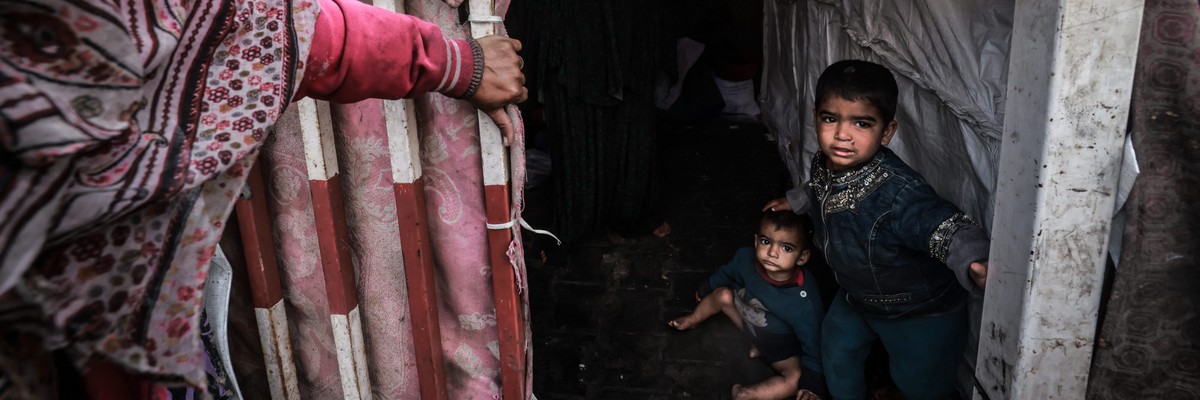
Displaced Palestinian children are pictured inside a makeshift tent in Rafah, Gaza on March 13, 2024. (Photo: Mohammed Abed/AFP via Getty Images
“There is nothing humanitarian about Israel’s proposal to push civilians into ‘humanitarian islands’ in Gaza.”
Aid groups reacted with alarm Thursday to the Israeli military’s stated plan to transfer much of the population of Rafah—a small city in southern Gaza that’s currently packed with more than 1.5 million people—to so-called “humanitarian islands” in the central part of the enclave.
William Bell, the head of Middle East policy and advocacy at Christian Aid, called the proposal “a preposterous idea” that the international community must reject in favor of an immediate, permanent cease-fire and a massive surge of humanitarian assistance.
“The half-baked plan to force more than a million displaced civilians out of Rafah into so-called ‘humanitarian islands’ further north beggars belief,” said Bell. “And the suggestion that they will be safe simply cannot be given credence.”
“How long will it take to build and equip these islands? And how much longer to get people to them?” Bell asked. “With Gaza on the brink of famine, children dying of malnutrition, and desperate families reportedly eating grass to survive, men, women, and children need lifesaving aid now.”
“The past five months have taught us that places labeled ‘safe zones’ in Gaza quickly become death zones.”
During a news briefing on Wednesday, Israel Defense Forces (IDF) spokesperson Daniel Hagari said the planned humanitarian zones would be created in concert “with the international community,” but he did not provide specifics or a timeline.
Ahead of a planned ground invasion of Rafah, Hagari said the IDF intends to direct a “significant” portion of the city’s population—most of which is living in makeshift tents—to designated areas in central Gaza, where he claimed they would be provided with temporary housing, food, and other necessities that Israel has systematically restricted.
Given that Rafah was once considered a relatively safe area for Palestinians displaced by Israel’s assault and is currently under IDF bombardment, aid campaigners expressed deep skepticism that the plan outlined by Hagari is in any way viable or humane.
“There is nothing humanitarian about Israel’s proposal to push civilians into ‘humanitarian islands’ in Gaza,” said Melanie Ward, CEO of Medical Aid for Palestinians. “They are dangerous and must be stopped. The past five months have taught us that places labeled ‘safe zones’ in Gaza quickly become death zones.”
An investigation published Wednesday by the London-based research firm Forensic Architecture shows how the Israeli military has used supposed humanitarian measures to advance its assault on Gaza’s civilian population.
The investigation details the IDF’s repeated bombardment of so-called “safe zones” to which it has instructed desperate Gazans to flee and makes the case that Israel’s evacuation orders have functioned “as a tool of mass displacement, pushing civilians into unlivable areas that later come under attack.”
NEW INVESTIGATION: Since 7 Oct 23, the Israeli army has weaponised humanitarian measures such as ‘evacuation orders’, ‘safe routes’ & ‘safe zones’ to support their military operations & facilitate the mass displacement of Palestinians.
“Military evacuation of civilian populations is only legal under select, rare circumstances, and requires that displaced civilians be temporarily relocated to areas safe from conflict and with access to fundamental provisions for their safety and survival,” the Forensic Architecture analysis said. “Where Israel’s evacuation orders might individually be framed as humanitarian in nature, in fact when closely analyzed and considered over time, they reveal patterns of systematic mass displacement, with Palestinians deliberately and repeatedly being expelled from one unsafe and under-resourced location to another.”
“A ground invasion in Rafah,” the research firm argued, “would exacerbate the already dire humanitarian situation for the 1.5 million displaced Palestinians taking refuge there.”
In an interview this past weekend, U.S. President Joe Biden said that an IDF incursion into Rafah would cross a “red line”—a remark that the White House has since tried to walk back after Israeli Prime Minister Benjamin Netanyahu vowed the planned assault would go ahead.
Asked about Israel’s “humanitarian islands” proposal on Thursday, White House National Security Council spokesperson John Kirby said, “We can’t confirm that that is in fact a plan that they have.”
“Our position has not changed,” Kirby said of a potential Rafah invasion. “We do not want to see large-scale operations in Rafah… unless there is [a] legitimate, executable plan to provide for the safety and security of the civilians that are there.”
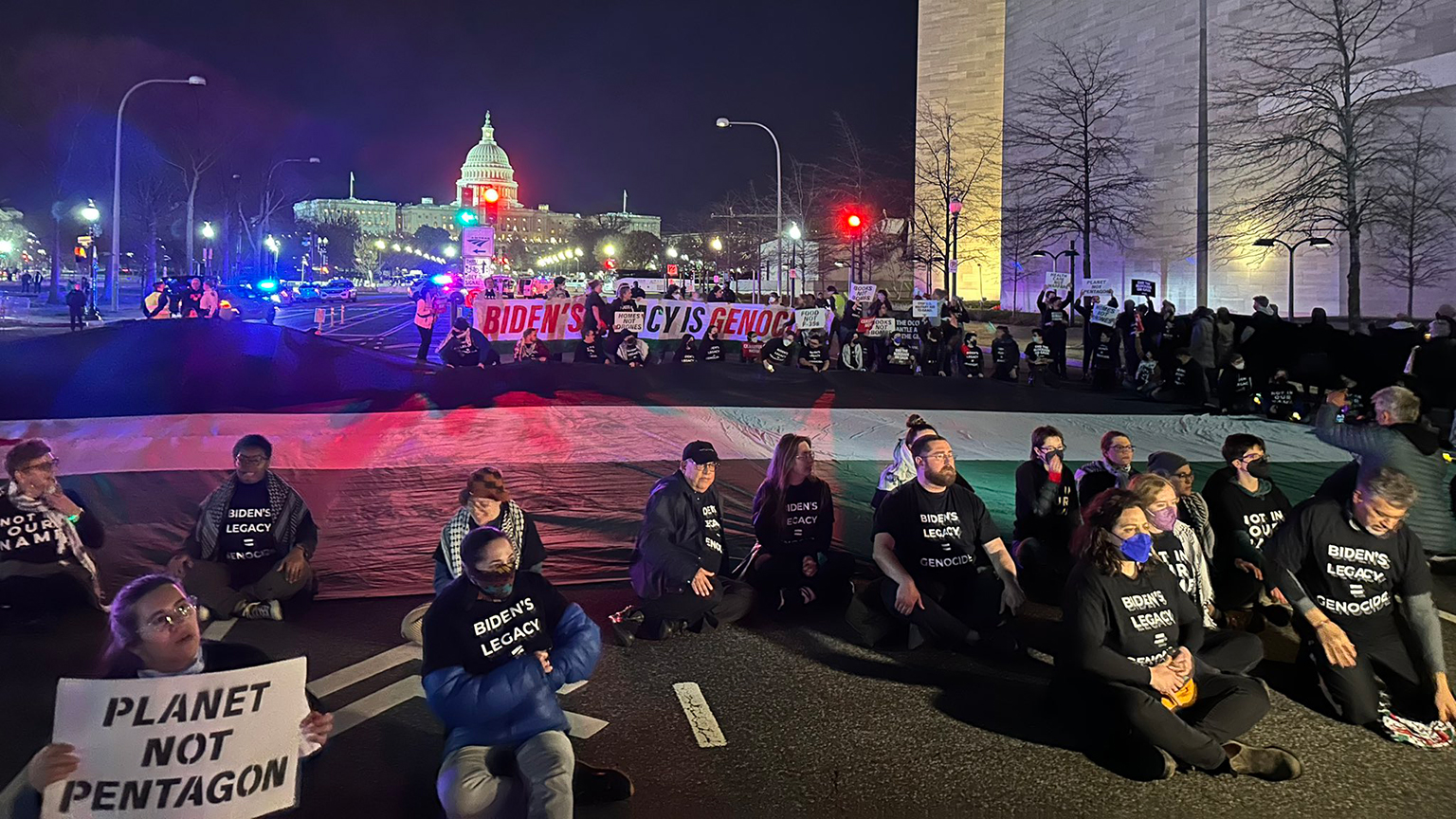
Demonstrators outside of the Capitol blocked Biden’s motorcade, causing a delay in his State of the Union speech (Photo: NYC-DSA)
US President Joe Biden’s unwavering support for Israeli genocide in Gaza has earned him the nickname “Genocide Joe” and made it necessary to hide from constituents on the campaign trail, due to the frequency of pro-Palestine disruptions at his events.
Yesterday, on March 7, Biden gave the annual “State of the Union” address amid protests from lawmakers themselves on his Gaza policy. When Biden began to bring up Gaza in his speech, Rashida Tlaib, the only Palestinian in Congress, was joined by several other progressive representatives in holding up signs that said “lasting ceasefire now.” Biden did say in his speech that “we’ve been working non-stop to establish an immediate ceasefire that would last for at least six weeks,” however, he still does not support a permanent ceasefire. Israel seeks the ability to revisit any ceasefire after six weeks.
Outside of the Capitol, where Biden gave his speech, hundreds of protesters gathered to hold a “People’s State of the Union” and blocked the major streets outside the building. The protest was large enough to cause Biden’s motorcade to take the “long way” to the House of Representatives chamber to give his address, delaying his speech. Protesters held banners that read “Biden’s legacy is genocide” and “The people demand: stop arming Israel”. Left-wing and Palestine solidarity organizations such as the Democratic Socialists of America, Dissenters, Jewish Voice for Peace, and Adalah Justice Project participated in the demonstration.
“Biden, Biden you can’t hide, We charge you with genocide.”
During Biden’s speech, he claimed that he is directing the US military to build a temporary pier on the Gaza coast that would increase the amount of humanitarian aid entering the Strip. At least five people were killed on March 8 after being struck by aid dropped into Gaza via planes. The United States has been carrying out aid drops, despite posing danger, in lieu of pressuring Israel to open land routes to allow aid trucks to move into Gaza freely.
Aid to the besieged Gaza Strip has fallen due in part to Israeli restrictions on two crossing points, according to the UN. In February, an average of just 98 trucks entered Gaza per day, in comparison to around 200 trucks per day in January. Before October 7, Israel would allow around 500 trucks a day into the besieged territory for a population of over 2.3 million.
“That’s not what Gaza needs,” said a protester outside of the Capitol. “Gaza needs liberation. They need an end to US military funding for Israel, and they need to be able to finally end… 75 plus years of ethnic cleansing.”
Biden caves to right-wing on immigration
In his speech, Biden also appeared to continue the process of caving entirely to the right-wing about tougher policies against migrants and refugees, and the further militarization of the US-Mexico border. Biden was heckled at one point during his speech by ultra-right-wing lawmaker Marjorie Taylor-Greene, who shouted about Laken Riley, a student in Georgia allegedly killed by an undocumented immigrant.
The right-wing has been using the example of Riley to push a racist anti-migrant policy, despite many studies showing that undocumented immigrants are less likely to engage in violent crime than US residents.
Instead of challenging the right, Biden caved to Taylor-Greene’s remarks by holding a pin that allegedly she gave him, and going on an anti-migrant rant. Getting Riley’s name wrong and referring to undocumented migrants as “illegals”, Biden made a jumbled comment saying, “Lincoln Riley, an innocent young woman who was killed by an illegal. That’s right. But how many of the thousands of people being killed by illegals—to her parents, I say my heart goes out to you.”
Biden also promoted a bipartisan bill to restrict immigration at the border, which would expand the authority of the president to crack down on migrants. “It would also give me as President new emergency authority to temporarily shut down the border when the number of migrants at the border is overwhelming,” he said.
Protest votes threaten Biden’s run
Biden has been hemorrhaging support in the statewide Democratic primaries, with large percentages of Democratic voters casting protest votes against the incumbent President. This movement began with the Michigan primary, where over 100,000 voters voted “uncommitted”, with Arab-majority city Dearborn voting 56.22% uncommitted. The recent Democratic primary in US-occupied Hawaii generated 29.1% uncommitted votes, the highest percentage of any statewide primary in this election cycle.
The growing deluge of protest votes against Biden poses a looming threat for him in the election. Anger at Biden’s support for Israel’s genocide is growing in states like Georgia, which, like Michigan, became critical for Biden’s win in the 2020 presidential election. In 2020, Biden won Georgia by only 11,779 votes.
Peoples Dispatch spoke to Edward Ahmed Mitchell, a board member with CAIR Action, the newly formed political arm of the Council on American-Islamic Relations. CAIR Action is a part of the Listen to Georgia coalition, which is encouraging Georgia voters to cast a protest vote against Biden in the March 12 Georgia Democratic primary.
“The people of Georgia, like many people across America, do not want our tax dollars funding a genocide overseas,” Mitchell said. “That’s why Georgia voters are trying to send a message to President Biden in the Democratic primary. The message is: you risk losing the state of Georgia and the 2024 election if you continue to enable the genocide in Gaza.”