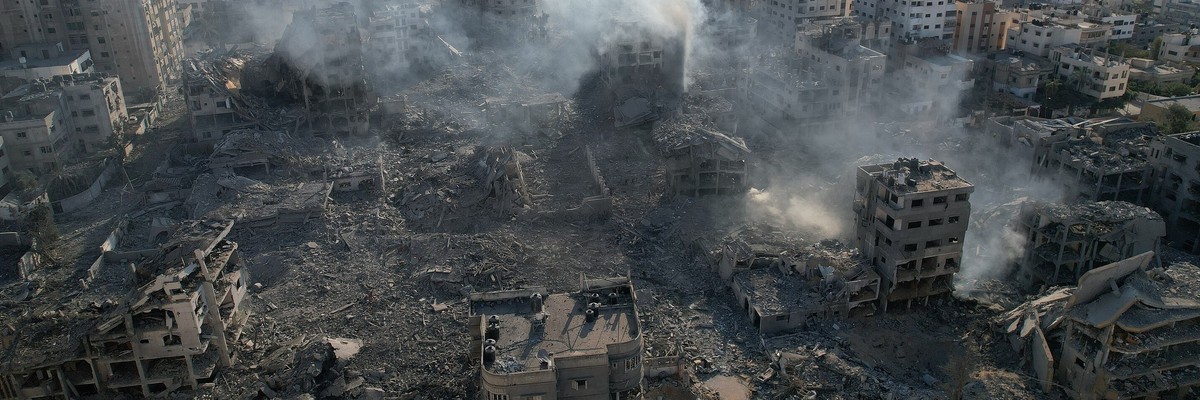
An aerial photography taken October 10, 2023 shows a neighborhood of Gaza City destroyed by Israeli bombardment. (Photo: Al Araby/Wikimedia Commons)
U.N. Secretary-General António Guterres reiterated his call for an “immediate humanitarian cease-fire, the unconditional release of all hostages, the protection of civilians, and the unimpeded delivery of humanitarian aid.”
Peace and human rights advocates on Sunday renewed calls for an immediate cease-fire in Gaza and an increase in lifesaving humanitarian aid for its starving people as the embattled enclave marked six months since the start of Israel’s genocidal retaliation for the October 7 attacks.
In six months of bombardment by air, land, and sea following the Hamas-led attacks that killed more than 1,100 people in Israel—with over 240 people taken hostage—Israeli forces have killed or maimed more than 116,000 Palestinians, including people believed to be dead and buried beneath the rubble of hundreds of thousands of bombed-out homes and other buildings. Gazans—especially children—are starving to death as Israel severely restricts the amount of aid allowed to enter the strip. Women are “burying their newborns every day” as they have nothing to feed them.
Around 90% of Gaza’s 2.3 million people have been forcibly displaced, perhaps permanently, in what many Palestinians and international observers are calling a new Nakba, the ethnic cleansing catastrophe perpetrated by Jewish militants during the establishment of the modern state of Israel in 1948. Gaza’s infrastructure has been obliterated, with reconstruction expected to cost $18.5 billion, or nearly Palestine’s entire annual gross domestic product.
“Over the last six months, the Israeli military campaign has brought relentless death and destruction to Palestinians in Gaza—with more than 32,000 people reportedly killed and more than 75,000 injured—the vast majority women and children,” United Nations Secretary-General António Guterres said during a press conference marking six months of a war in which the International Court of Justice has found that Israel is plausibly committing genocide.
"6 months on, we are at the brink of mass starvation, of regional conflagration, of a total loss of faith in global standards & norms."
“During my visit to the Rafah crossing 10 days ago, I met veteran humanitarians who told me categorically that the crisis and suffering in Gaza is unlike any they have ever seen,” Guterres continued. “Meanwhile—as I saw on my way to the Rafah crossing—long lines of trucks loaded with humanitarian aid continued to face obstacle after obstacle.”
“When the gates to aid are closed, the doors to starvation are opened,” he said. “More than half the population—over a million people—are facing catastrophic hunger. Children in Gaza today are dying for lack of food and water. This is incomprehensible, and entirely avoidable. Nothing can justify the collective punishment of the Palestinian people.”
Guterres noted the 196 humanitarian aid workers—including more than 175 U.N. personnel and members of Doctors Without Borders, the International Red Crescent, World Central Kitchen, and other organizations—who have been killed by Israeli bombs and bullets over the past six months.
“I repeat my urgent appeals for an immediate humanitarian cease-fire, the unconditional release of all hostages, the protection of civilians, and the unimpeded delivery of humanitarian aid,” Guterres said.
Demonstrators took to the streets of cities around the world to condemn Israel’s genocide and demand an immediate cease-fire.
There were also protests in cities including Tel Aviv and New York calling for the release of all Israelis and others held hostage in Gaza. New York rabbi Ellen Lippman said she wouldn’t be attending the rally because she “cannot call for the release of the hostages without an explicit demand for an immediate cease-fire and an end to the Israeli assault on Gaza.”
Left-wing Israelis held vigils outside the U.S. embassies in Jerusalem and Tel Aviv on Friday to demand an end to Washington’s military and diplomatic support for Israel’s genocide.
“The United States supplies the guns, and Israel pulls the trigger,” organizer Erez Bleicher told the crowd.
Today marks six months of Israel's genocide in Gaza.
With US support, over a hundred thousand Palestinians have been killed, kidnapped, tortured, or injured. Over a million are at risk of starving to death.
President Joe Biden in recent days has urged an immediate cease-fire, even as the U.S. continues to provide the bulk of Israel’s weapons. In a Thursday call with Israeli Prime Minister Benjamin Netanyahu, Biden “made clear the need for Israel to announce and implement a series of specific, concrete, and measurable steps to address civilian harm, humanitarian suffering, and the safety of aid workers,” the White House said in a statement. “He made clear that U.S. policy with respect to Gaza will be determined by our assessment of Israel’s immediate action on these steps.”
Israel responded by saying it would temporarily allow more aid to enter Gaza.
The Green Party has repeated its call for a full bilateral ceasefire, the release of all hostages, the suspension of arms exports to Israel, and for key players in the Netanyahu government to be held accountable for possible war crimes, six months on from the 7 October attacks by Hamas.
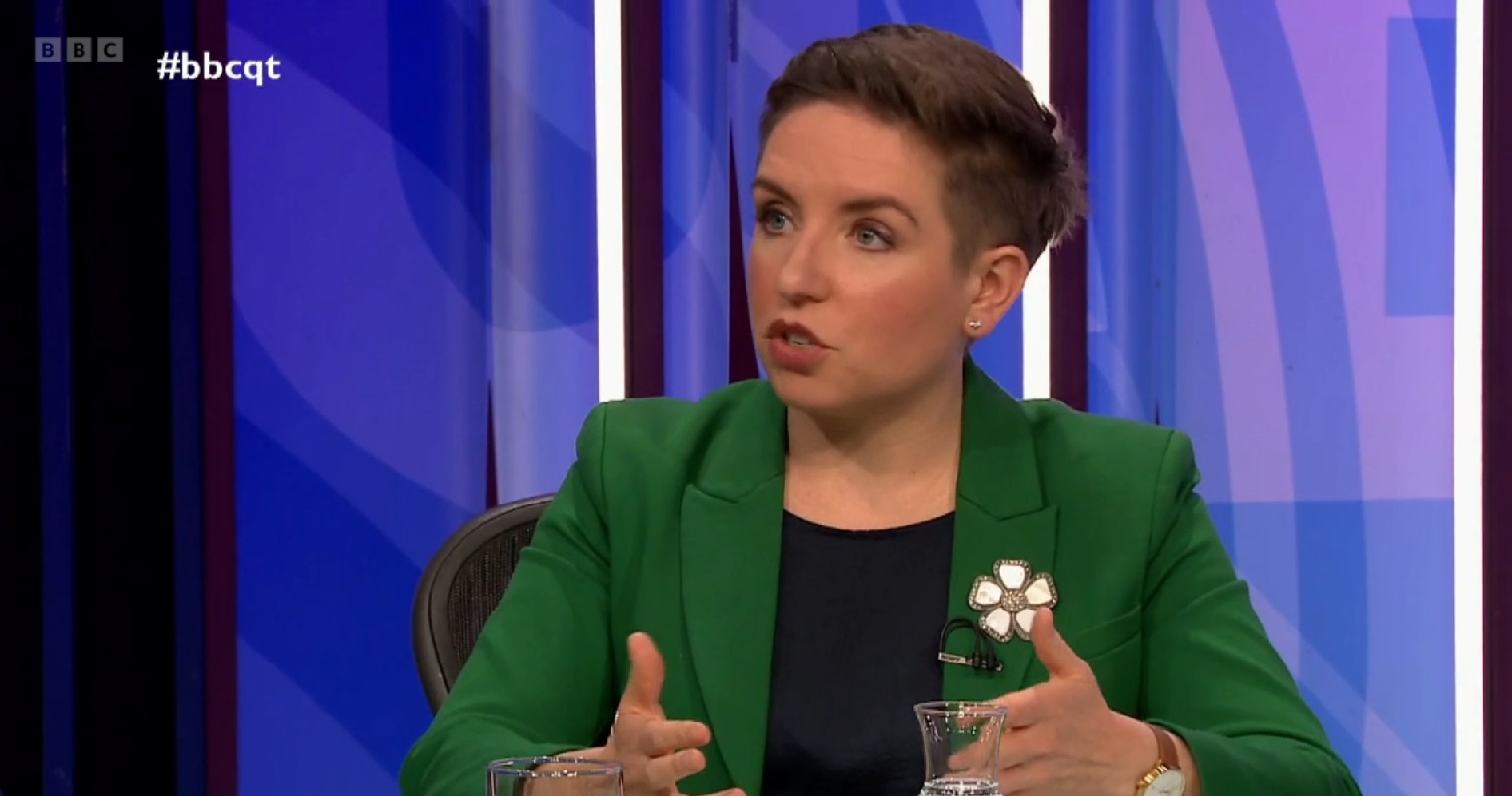
Image of the Green Party’s Carla Denyer on BBC Question Time.
Co-leader of the Green Party, Carla Denyer, said:
“This isn’t just a far away conflict that we have nothing to do with. By consistently refusing to call for a ceasefire and continuing to supply arms, the UK Government has been complicit in the deadly assault on Gaza by the Israel Defence Forces.
“Six months on from the horrific Hamas attacks on Israeli citizens, it is clear that the Netanyahu government’s response has been totally disproportionate. Over 33,000 innocent Palestinian civilians have now been killed, the majority of them women and children. This is not an act of self defence. As the UN’s Human Rights Council has resolved, the actions by the Israeli government are possible war crimes and crimes against humanity. Indeed, the UK Government itself has reportedly concluded secretly that Israel is breaking international humanitarian law.
“It is time for our Government to end their complicity and start leading efforts towards peace. They must finally call for a ceasefire, immediately suspend arms exports to Israel and back the UN Human Rights Council’s call for accountability for all violations of international humanitarian law and international human rights law.”
In the six months since October 7th, the Green Party of England and Wales has called for:
A full bilateral ceasefire
The release of all hostages
A suspension of all arms export licences to Israel until the violence stops
The cessation of all military collaboration with Israel, including use of British bases by Israeli forces, and intelligence sharing
Targeted Boycott, Divestment and Sanctions against individuals and institutions supporting or facilitating Israel’s occupation of Palestine
An investigation by the Metropolitan Police and Director of Public Prosecutions of war crimes committed against UK citizens, or where UK citizens are potential perpetrators
The UK government to use its position as a permanent member of the UN Security Council to vote for, rather than abstain on, ceasefire votes
Targeted sanctions against key individuals in the Israeli leadership, including travel bans and asset freezes on Israel’s government ministers
An end to occupation of the Palestinian territories
The UK government to return to international law being the benchmark for UK policy, and repair the UK’s international reputation as a defender of the international rules-based order.
The editorial boards of the nation’s major media organizations must have been frantic last week.
Used to reporting on US foreign policy, wars and arms exports so as to portray the United States as a benevolent, law-abiding and democracy-defending nation, they were confronted on March 25 with a real challenge dealing with Israel and Gaza. No sooner did the Biden administration, for the first time, abstain and thus allow passage of a United Nations Security Council resolution that was not just critical of Israel, but demanded a ceasefire in Gaza, than US officials began declaring that the resolution that they allowed to pass was really meaningless.
It was “nonbinding,” they said.
The New York Times (3/25/24) reported that US’s UN Ambassdor “Thomas-Greenfield called the resolution ‘nonbinding’”—and let no one contradict her.
That was enough for the New York Times (3/25/24), which produced the most one-sided report on the decision. That article focused initially on how Resolution 2728 (which followed three resolutions that the US had vetoed, and a fourth that was so watered down that China and Russia vetoed it instead) had led to a diplomatic dust-up with the Israeli government: Prime Minister Benjamin Netanyahu canceled a planned visit to Washington by a high-level Israeli delegation to discuss Israel’s planned invasion of Rafah and the future of Gaza and the West Bank.
The Times quoted Richard Gowan, a UN expert at the International Crisis Group: “The abstention is a not-too-coded hint to Netanyahu to rein in operations, above all over Rafah.”
Noting that “Security Council resolutions are considered to be international law,” Times reporters Farnaz Fassihi, Aaron Boxerman and Thomas Fuller wrote, “While the Council has no means of enforcing the resolution, it could impose punitive measures, such as sanctions, on Israel, so long as member states agreed.”
This was nevertheless followed by a quote from Washington’s UN Ambassador Linda Thomas-Greenfield, who abstained from the otherwise unanimous 14–0 vote of the rest of the Security Council, characterizing the resolution as “nonbinding.”
The Times offered no comment from any international law scholars, foreign or US, to rebut or even discuss that claim. Such an expert might have pointed to the unequivocal language of Article 25 of the UN Charter: “The members of the United Nations agree to accept and carry out the decisions of the Security Council in accordance with the present Charter.”
If the US offered its claim that this language only applies to resolutions explicitly referencing the UN Charter’s Chapter VII, dealing with “threats to the peace,” an international law expert (EJIL: Talk!, 1/9/17) might note that the International Court of Justice stated in 1971, “It is not possible to find in the Charter any support for this view.”
‘Creates obligations’
The Washington Post (3/26/24) quoted an international law expert to note that the resolution “creates obligations for Israel and Hamas.”
The Washington Post (3/26/24), though like the Times a firm defender of Washington’s foreign policy consensus, did marginally better. While the Times didn’t mention Britain or France, both major US NATO allies, in its piece on the Security Council vote, the Post noted that the four other veto powers—Britain and France, as well as China and Russia—had all voted in favor of the resolution, along with all 10 elected temporary members of the Council.
The Post also cited one international law legal expert, Donald Rothwell, of the Australian National University, who said the “even-handed” resolution “creates obligations for Israel and Hamas.”
While that quote sounds like the resolution is binding, the Post went on to cite Gowan as saying, “I think it’s pretty clear that if Israel does not comply with the resolution, the Biden administration is not going to allow the Security Council members to impose sanctions or other penalties on Israel.”
The Post (3/25/24) actually ran a stronger, more straightforward piece a day earlier, when it covered the initial vote using an AP story. AP did a fairer job discussing the fraught issue of whether or not the resolution was binding on the warring parties, Israel and Hamas (as well as the nations arming them).
That earlier AP piece, by journalist Edith M. Lederer, quoted US National Security spokesperson John Kirby as explaining that they decided not to veto the resolution because it “does fairly reflect our view that a ceasefire and the release of hostages come together.”
Because of the cutbacks to in-house reporting on national and international news in most of the nation’s major news organizations, most Americans who get their news from television and their local papers end up getting dispatches—often edited for space—from the New York Times, Washington Post or AP wire stories. (The Wall Street Journal, for example, ran the same AP report as the Post.)
‘A demand is a decision’
CNN (3/27/24) quoted US officials claiming the resolution was nonbinding—and noted that “international legal scholars” disagree.
In TV news, CNN (3/27/24) had some of the strongest reporting on the debate over whether the resolution was binding. The news channel said straight out, “While the UN says the latest resolution is nonbinding, experts differ on whether that is the case.”
It went on to say:
After the resolution passed, US officials went to great lengths to say that the resolution isn’t binding. State Department spokesperson Matthew Miller repeatedly said during a news conference that the resolution is nonbinding, before conceding that the technical details of are for international lawyers to determine. Similarly, White House National Security Council spokesman John Kirby and US ambassador to the UN Linda Thomas-Greenfield separately insisted that the resolution is nonbinding.
Those US positions were challenged by China’s UN Ambassador Zhang Jun, who “countered that such resolutions are indeed binding,” and by UN spokesperson Farhan Haq, who said Security Council resolutions are international law, and “so to that extent they are as binding as international law is.”
CNN quoted Maya Ungar, another International Crisis Group analyst:
The US—ascribing to a legal tradition that takes a narrower interpretation—argues that without the use of the word “decides” or evocation of Chapter VII within the text, the resolution is nonbinding…. Other member states and international legal scholars are arguing that there is legal precedence to the idea that a demand is implicitly a decision of the Council.
‘A rhetorical feint’
According to the Guardian (3/26/24), the US’s “nonbinding” interpretation “put the US at odds with other member states, international legal scholars and the UN itself.”
To get a sense of how one-sided or at best cautious the US domestic coverage of this critically urgent story is, consider how it was covered in Britain or Spain, two US allies in NATO.
The British Guardian (3/26/24), which also publishes a US edition, ran with the headline: “Biden Administration’s Gaza Strategy Panned as ‘Mess’ Amid Clashing Goals.” The story began:
The Biden administration’s policy on Gaza has been widely criticized as being in disarray as the defense secretary described the situation as a “humanitarian catastrophe” the day after the State Department declared Israel to be in compliance with international humanitarian law.
But the real contrast is with the Spanish newspaper El País (3/29/24), which bluntly headlined its story “US Sparks Controversy at the UN With Claim That Gaza Ceasefire Resolution Is ‘Nonbinding.’” Not mincing words, the reporters wrote:
By abstaining in the vote on the UN Security Council resolution demanding an immediate ceasefire in Gaza, the United States on Monday sparked not only the anger of Israel, which had asked it to veto the text, but also a sweeping legal and diplomatic controversy due to its claims that the resolution—the first to be passed since the start of the Gaza war—was “nonbinding.” For Washington, it was a rhetorical feint aimed at making the public blow to its great ally in the Middle East less obvious.
El País (3/29/24) quoted the relevant language from the UN Charter: “The members of the United Nations agree to accept and carry out the decisions of the Security Council in accordance with the present Charter.”
After quoting Thompson-Greenfield saying it was a “nonbinding resolution,” and Kirby saying dismissively, “There is no impact at all on Israel,” they wrote,
These claims hit the UN Security Council—the highest executive body of the UN in charge of ensuring world peace and security—like a torpedo. Were the Council’s resolutions binding or not? Our was it that some resolutions were binding and others were not?
The reporters answered their own rhetorical question:
Diplomatic representatives and legal experts came out in force to refute Washington’s claim. UN Secretary-General António Guterres made his opinion clear: the resolutions are binding. Indeed, this is stated in Article 25 of the UN Charter: “The members of the United Nations agree to accept and carry out the decisions of the Security Council in accordance with the present Charter.” Several representatives of the Security Council, led by Mozambique and Sierra Leone, pointed to case law to support this argument. The two African diplomats, both with legal training, said that the Gaza ceasefire resolution is binding, regardless of whether one of the five permanent members of the Council abstains from the vote, as was the case of the US. The diplomats highlighted that in 1971, the advisory opinion of the International Court of Justice (ICJ) established that all resolutions of the UN Security Council are legally binding. The Algerian ambassador to the UN summed it up even more categorically: “Security Council resolutions are binding. Not almost, not partly, not maybe.”
Unlike most most US news organizations, El País went to an expert, in this instance seeking out Adil Haque, a professor of international law at Rutgers University, where he is a professor, and also executive editor of the law journal Just Security. Haque, they wrote, “has no doubts that the resolution is binding.” He explains in the article:
According to the UN Charter, all decisions of the Security Council are binding on all member states. The International Court of Justice has ruled that a resolution need not mention Chapter VII of the Charter [action in case of threats to the peace, breaches of the peace or acts of aggression], refer to international peace and security, or use the word “decides” to make it binding. Any resolution that uses “mandatory language” creates obligations, and that includes the term “demands” used in the resolution on Gaza.” He adds, “For now, it does not seem that the US has a coherent legal argument.”
It should be noted that the New York Times, when there is a dispute regarding a document, typically runs a copy of the document in question—or, if it is too long, the relevant portion of it. In the case of Resolution 2728, which even counting its headline only runs 263 words, that would have not been a hard call. Despite the disagreement between the US and most of the Council over the wording of the ceasefire resolution, the Times chose not to run or even excerpt it.
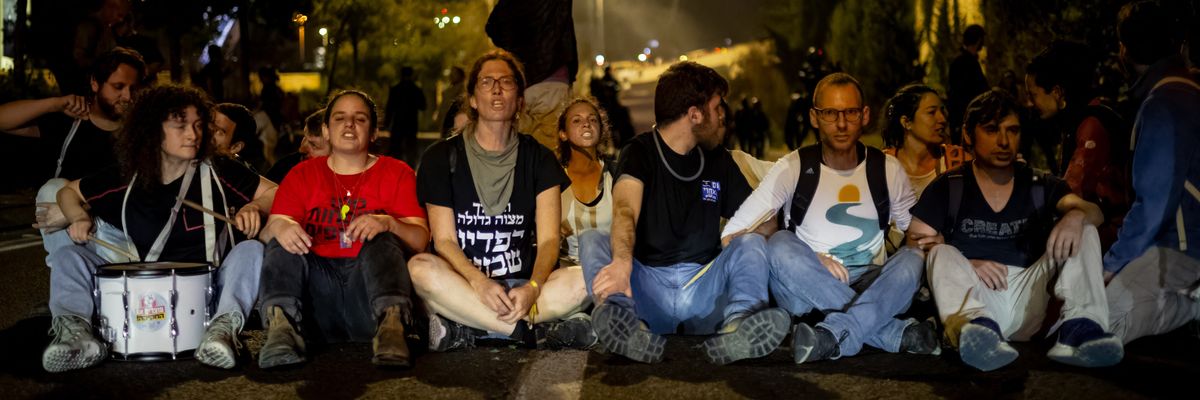
Demonstrators sit on the main road and block it at a demonstration for a hostage deal near the Knesset, on March 31, 2024, in Jerusalem, Israel. (Photo: Yahel Gazit/Middle East Images/AFP via Getty Images)
“Our country is being led by a gang of nut cases that jeopardize not only our existence but our well-being,” one demonstrator said.
Tens of thousands of Israelis demonstrated against the government of Prime Minister Benjamin Netanyahu Saturday and Sunday, in what were described as the largest protests in the country since Hamas’ October 7 attack on southern Israel and Israel’s war on Gaza that followed.
Participants carried signs reading, “Hostage deal now,” and arguing for Netanyahu’s “immediate removal,” according toThe New York Times. They demanded early elections and a cease-fire deal that would see the remaining hostages freed from Gaza, calls that came as indirect negotiations between Hamas and Israel resumed in Egypt on Sunday.
“Our country is being led by a gang of nut cases that jeopardize not only our existence but our well-being,” 70-year-old protester Shaul Dwek told The Washington Post. “This is not the way we grew up and these are not the values that we hold.”
“After six months, it seems like the government understands that Bibi Netanyahu is an obstacle.”
Netanyahu faced months of internal protests before the October 7 attacks over his government’s planned overhaul of the judiciary to weaken the oversight powers of the Supreme Court. However, protests have been muted since Hamas killed 1,139 people on October 7 and took around 250 hostages into Gaza. Since then, Israel and the Netanyahu government have faced global protests and credible accusations of genocide over the war they launched in retaliation, which has killed nearly 33,000 people and subjected the survivors to famine and mass displacement.
In Israel, the war itself is still popular, according to The Associated Press. However, protesters are concerned about Netanyahu’s personal corruption and the degree to which he is prioritizing the release of hostages. While around half were released during a temporary cease-fire and prisoner exchange in 2023, the Israeli government estimates that around 130 are still being held in Gaza, including 34 who have died, The Guardian reported.
“The people of Israel were deep in sorrow and pain after 7 October, that is why it took so long, but when they understood there is no other option, this government is not functioning and is hurting us economically, diplomatically, in our security and in our values […] that is why people are out,” Naama Lazimi, a Labor party member of the Knesset who attended Sunday’s protest, said, as The Guardian reported.
The weekend’s protests were organized by a coalition of hostage family members and civil society and opposition groups, according to The Washington Post.
“The families of the hostages have reached a breaking point with Netanyahu,” Josh Drill, who heads a group called Change Generation that demands a new government and the freeing of the hostages, told the Post.
Family members also spoke out directly.
“We believe that no hostages will come back with this government because they’re busy putting sticks in the wheels of negotiations for the hostages,” Boaz Atzili, whose cousin and cousin’s wife were both taken hostage, told AP. “Netanyahu is only working in his private interests.”
Atzili’s cousin’s wife was freed, but his cousin died in Gaza.
Einav Moses, meanwhile, still has a father-in-law being held in Gaza.
“After six months, it seems like the government understands that Bibi Netanyahu is an obstacle,” Moses told the AP. “Like he doesn’t really want to bring them back, that they have failed in this mission.”
On Saturday, protests were concentrated in Tel Aviv, but also took place in other cities including Jerusalem and Haifa. On Sunday, the main demonstration was held outside the Knesset in Jerusalem, which organizers said was the largest in Israel since October 7.
“Reservists rushing between the Kaplan Street demonstrations and the ruins of Gaza or its skies, peppered with bombers or predator drones, are also respondents to a poll, whose answer is unambiguous.”
Protesters blocked the main highway in Tel Aviv on Saturday and lit bonfires in the streets, The Washington Post reported. Police sprayed them with water cannons and arrested 16, including family members of hostages. On Sunday, demonstrators also blocked roads in Tel Aviv and Jerusalem.
Some protesters set up tents and prepared to stay until Wednesday, according to The New York Times.
“I will camp here in front of the Knesset until the PM resigns,” demonstrator Yaacov Godo, who lost a son on October 7, told The Guardian.
Israel is not scheduled to hold elections again until spring 2026, but Netanyahu’s coalition currently trails the opposition in the polls.
However, Israeli journalist Amira Hass, who covers the Occupied Territories for Haaretz, argued in a column for that paper that the majority of Israelis continue to support Netanyahu by backing the devastation wrought on Gaza.
“Reservists rushing between the Kaplan Street demonstrations and the ruins of Gaza or its skies, peppered with bombers or predator drones, are also respondents to a poll, whose answer is unambiguous,” Hass said, referring to a major Tel Aviv thoroughfare.
Hass wrote that the Israeli government’s plan for Palestinians amounted to forcing them to choose between accepting second-class status, leaving their homes entirely, or war and death.
“This is the plan now carried out in Gaza and the West Bank, with most Israelis serving as active and enthusiastic accomplices, or passively acquiescing in its realization, regardless of their revulsion for this government and its members,” Hass concluded. “The vast majority still believe that war is the solution.”
A wounded person receives treatment at a local hospital in the southern Gaza Strip city of Rafah on March 24, 2024. (Photo: Khaled Omar/Xinhua via Getty Images
U.N. member states must “use their influence” to push Israel to halt its bombardment of Gaza and blocking of humanitarian aid, said the group’s secretary general.
“The time to act to prevent genocide is now,” Amnesty International’s secretary general said Tuesday, a day after the United Nations Human Rights Council released a draft report detailing how the panel found that there are “reasonable grounds to believe” that Israel is already committing genocidal violence in Gaza.
Amnesty’s Agnes Callamard called the 25-page report a “crucial body of work that must serve as a vital call to action to states,” many of which have called for a cease-fire in Gaza for several months.
After the U.N. report found that “the overwhelming nature and scale of Israel’s assault on Gaza… reveal an intent to physically destroy Palestinians as a group,” Callamard said “states must now focus their efforts on making these calls a reality.”
“Third states must apply political pressure on the warring parties to implement the U.N. Security Council resolution adopted yesterday demanding an immediate cease-fire, use their influence to insist that Israel abides by the resolution, including by stopping the shelling and lifting restrictions on humanitarian aid,” said Callamard. “They must impose a comprehensive arms embargo against all parties to the conflict. They must also pressure Hamas and other armed groups to free all civilian hostages.”
“The time to act to prevent genocide is now": #UN Special Rapporteur report on #Gaza provides crucial evidence that must spur international action. Read more below: https://t.co/z8r6FSi7Wl
The U.N. report was released the same day that the U.N Security Council adopted a resolution demanding an immediate, temporary cease-fire for the remainder of the month of Ramadan—the first cease-fire resolution to pass at the council following three that failed due to the U.S. vetoing the measures.
The U.S., which gives Israel $3.8 billion in annual military aid and has continued to provide support throughout the bombardment, abstained from voting on Monday’s resolution and infuriated human rights experts by baselessly claiming the vote was “nonbinding.”
It was irresponsible on the part of the US Ambassador to suggest that a resolution meant to save lives and address massive devastation and suffering can be disregarded. Just plain irresponsible. https://t.co/9VZIGfpJ88
The U.N. report, titled Anatomy of a Genocide, detailed actions Israel has taken since beginning its bombardment of Gaza in October that could violate Article II of the Genocide Convention, including killing members of the group, causing serious bodily or mental harm to members of the group, deliberately inflicting conditions of life calculated to bring about its physical destruction, and imposing measures intended to prevent births.
Along with killing at least 32,414 Palestinians in Gaza—73% of whom have been women and children, and the remaining 27% were not proven to have been Hamas members—Israel has also imposed mass starvation on the population, killing “10 children daily,” according to the report. Israel has detained thousands of Palestinian men and boys in undisclosed locations; injured 70,000 people; forced medical personnel to perform “hazardous health procedures, such as amputations without anesthetics, including on children”; and “destroyed or severely damaged most life-sustaining infrastructure.”
Callamard noted on Tuesday that the report came two months after the International Court of Justice (ICJ) announced an interim ruling that Israel is “plausibly” committing a genocide in Gaza and ordered the country to take action to prevent genocidal violence by its forces.
“In that time, the situation in Gaza has grown exponentially worse, with thousands more Palestinians killed and Israel continuing to refuse to comply with the ICJ ruling to ensure provision of sufficient humanitarian aid to Palestinians as human-made famine edges closer each day and more people starve to death,” said Callamard.
The secretary general echoed a call in the report, which was compiled by Francesca Albanese, special rapporteur on human rights in the occupied Palestinian territories, for the full funding of the U.N. Relief and Works Agency for Palestine Refugees in the Near East (UNRWA).
Israel said Sunday it will no longer permit UNRWA aid trucks to deliver humanitarian relief in northern Gaza, where one-third of children under age 2 are now suffering from acute malnutrition. The U.S. officially suspended UNRWA funding through March 2025 on Monday after President Joe Biden signed a new spending package into law.
The U.S. led several countries in cutting funding to the agency in January after Israel claimed 12 of UNRWA’s 13,000 employees in Gaza had been involved in the Hamas-led attack on southern Israel in October. Countries including Finland, Canada, and Australia have since reinstated funding.
Callamard also called on all states, particularly powerful Western countries that are allied with Israel, including the U.S., to support international authorities as they try to hold Israeli officials to account for the mass killing and starving of civilians in Gaza. Israel has refused to allow U.N. experts and other independent human rights monitors access to Gaza.
“Helping to prevent genocide also means supporting accountability efforts including the ongoing investigation by the Office of the Prosecutor of the International Criminal Court and exercising universal jurisdiction to bring those suspected of crimes under international law to justice,” said Callamard.
The secretary general noted that momentum has grown in recent days around international calls for a cease-fire, but said a desperately needed halt in fighting requires a concerted push by influential states to become a reality.
“An enduring cease-fire,” said Callamard, “remains the best way to enforce the ICJ’s provisional measures to prevent genocide and further crimes and civilian suffering.”