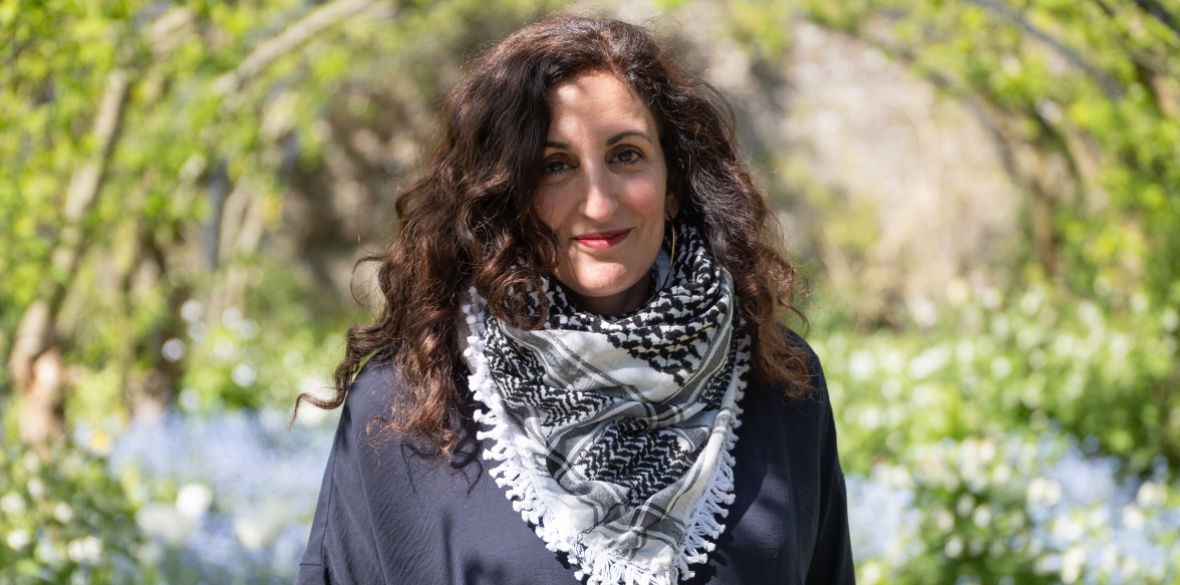
VOTING for Labour MPs who have failed to back a ceasefire in Gaza is supporting complicity in genocide, a British-Palestinian independent candidate says.
Tanushka Marah, who is standing in Hove and Portslade, told the Morning Star that Labour MPs who abstained in last year’s ceasefire vote in the Commons have blood on their hands.
She was selected by pro-Palestine and socialist groups to challenge Peter Kyle, a member of Sir Keir Starmer’s shadow cabinet who has held the constituency for nine years.
The shadow science, innovation and technology secretary is a vice-chairman of Labour Friends for Israel and has consistently defended the pariah state.
He was named in a Declassified UK investigation this week as among the quarter of MPs who have accepted funds from pro-Israel lobbyists.
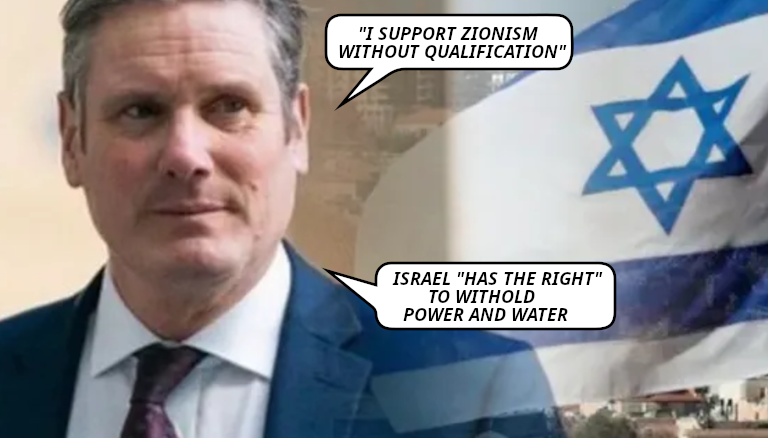
Zionist Keir Starmer supports Israel’s Gaza genocide. He needs to hold his seat to become prime minister.
Labour’s leader thinks he can get away with supporting genocide in Gaza. It’s time to teach him a lesson in his own backyard.
Our democracy is in crisis. The two main parties are virtually indistinguishable in their offers of permanent austerity, forever wars and environmental degradation.
Keir Starmer, the MP for Holborn and St. Pancras where my family and I have lived for around 22 years, is emblematic of this crisis. His politics are mendacious, unprincipled and in the interests of his billionaire donors rather than the constituents he was elected to serve.
I have seen real leadership in action: I was privileged to serve under Nelson Mandela as an MP in South Africa. His leadership was selfless, principled, accountable, transparent and honest. Everything that Keir Starmer is not.
His almost immediate abandonment of many of the ten progressive pledges on which he was elected to lead the Labour Party is a clear sign he cannot be trusted.
Starmer has now gone a step too far by refusing to support an unqualified ceasefire and a halt to arms sales to Israel amid the greatest human tragedy since World War Two: the genocide being committed in Gaza.
How is it possible that a former human rights lawyer, who must see the horrific images that we all view on our screens every day, has not even commented on the highest court in the world’s interim ruling that Israel is likely committing genocide and ethnic cleansing?
As peace activists occupied common spaces on campuses across the country, some in corporate media very clearly took sides, portraying student protesters as violent, hateful and/or stupid. CNN offered some of the most striking of these characterizations.
CNN‘s Dana Bash (Inside Politics, 5/1/24) blames the peace movement for “destruction, violence and hate on college campuses across the country.”
Dana Bash (Inside Politics, 5/1/24) stared gravely into the camera and launched into a segment on “destruction, violence and hate on college campuses across the country.” Her voice dripping with hostility toward the protests, she reported:
Many of these protests started peacefully with legitimate questions about the war, but in many cases, they lost the plot. They’re calling for a ceasefire. Well, there was a ceasefire on October 6, the day before Hamas terrorists brutally murdered more than a thousand people inside Israel and took hundreds more as hostages. This hour, I’ll speak to an American Israeli family whose son is still held captive by Hamas since that horrifying day, that brought us to this moment. You don’t hear the pro-Palestinian protesters talking about that. We will.
By Bash’s logic, once a ceasefire is broken, no one can ever call for it to be reinstated—even as the death toll in Gaza nears 35,000. But her claim that there was a ceasefire until Hamas broke it on October 7 is little more than Israeli propaganda: Hundreds of Palestinians were killed by Israeli forces and settlers in the year preceding October 7 (FAIR.org, 7/6/23).
‘Hearkening back to 1930s Europe’
“They didn’t let me get to class using the main entrance!” complains Eli Tsives in one of several videos he posted of confrontations with anti-war demonstrators. “Instead they forced me to walk around. Shame on these people!”
Bash continued:
Now protesting the way the Israeli government, the Israeli prime minister, is prosecuting the retaliatory war against Hamas is one thing. Making Jewish students feel unsafe at their own schools is unacceptable, and it is happening way too much right now.
As evidence of this lack of safety, Bash pointed to UCLA student Eli Tsives, who posted a video of himself confronting motionless antiwar protesters physically standing in his way on campus. “This is our school, and they’re not letting me walk in,” he claims in the clip. Bash ominously described this as “hearkening back to the 1930s in Europe.”
Bash was presumably referring to the rise of the Nazis and their increasing restrictions on Jews prior to World War II. But while Tsives’ clip suggests protesters are keeping him off UCLA campus, they’re in fact blocking him from their encampment—where many Jewish students were present. (Jewish Voice for Peace is one of its lead groups.)
So it’s clearly not Tsives’ Jewishness that the protesters object to. But Tsives was not just any Jewish student; a UCLA drama student and former intern at the pro-Israel group Stand With Us, he had been a visible face of the counter-protests, repeatedly posting videos of himself confronting peaceful antiwar protesters. He has shown up to the encampment wearing a holster of pepper spray.
One earlier video he made showing himself being denied entry to the encampment included text on screen claiming misleadingly that protestors objected to his Jewishness: “They prevented us, Jewish students, from entering public land!” (“You can kiss your jobs goodbye, this is going to go viral on social media,” he tells the protesters.) He also proudly posted his multiple interviews on Fox News, which was as eager as Bash to help him promote his false narrative of antisemitism.
‘Attacking each other’
“Security and [campus police] both retreated as pro-Israel counter-protesters and other groups attacked protesters in the encampment,” UCLA’s student paper (Daily Bruin, 5/1/24) reported.
UCLA protesters had good reason to keep counter-protesters out of their encampment, as those counter-protesters had become increasingly hostile (Forward, 5/1/24; New York Times, 4/30/24). This aggression culminated in a violent attack on the encampment on April 30 (Daily Bruin, 5/1/24).
Late that night, a pro-Israel mob of at least 200 tried to storm the student encampment, punching, kicking, throwing bricks and other objects, spraying pepper spray and mace, trying to tear down plywood barricades and launching fireworks into the crowd. As many as 25 injuries have been reported, including four student journalists for the university newspaper who were assaulted by goons as they attempted to leave the scene (Forward, 5/2/24; Democracy Now!, 5/2/24).
Campus security stood by as the attacks went on; when the university finally called in police support, the officers who arrived waited over an hour to intervene (LA Times, 5/1/24).
(The police were less reticent in clearing out the encampment a day later at UCLA’s request. Reporters on the scene described police in riot gear firing rubber bullets at close range and “several instances of protesters being injured”—LA Times, 5/3/24.)
The mob attacks at UCLA, along with police use of force at that campus and elsewhere, clearly represent the most “destruction, violence and hate” at the encampments, which have been overwhelmingly peaceful. But Bash’s description of the UCLA violence rewrote the narrative to fit her own agenda: “Pro-Israel and pro-Palestinian groups were attacking each other, hurling all kinds of objects, a wood pallet, fireworks, parking cones, even a scooter.”
When CNN correspondent Stephanie Elam reported, later in the same segment, that the UCLA violence came from counter-protesters, Bash’s response was not to correct her own earlier misrepresentation, but to disparage antiwar protesters: Bash commended the Jewish Federation of Los Angeles for saying the violence does not represent the Jewish community, and snidely commented: “Be nice to see that on all sides of this.”
“For me, never again is never again for anyone,” says a Jewish participant in the UCLA encampment (Instagram, 5/2/24).
‘Violence erupted’
Bash wasn’t the only one at CNN framing antiwar protesters as the violent ones, against all evidence. Correspondent Camila Bernal (5/2/24) reported on the UCLA encampment:
The mostly peaceful encampment was set up a week ago, but violence erupted during counter protest on Sunday, and even more tense moments overnight Tuesday, leaving at least 15 injured. Last night, protesters attempted to stand their ground, linking arms, using flashlights on officers’ faces, shouting and even throwing items at officers. But despite what CHP described as a dangerous operation, an almost one-to-one ratio officers to protesters gave authorities the upper hand.
Who was injured? Who was violent? Bernal left that to viewers’ imagination. She did mention that officers used “what appeared to be rubber bullets,” but the only participant given camera time was a police officer accusing antiwar students of throwing things at police.
Earlier CNN reporting (5/1/24) from UCLA referred to “dueling protests between pro-Palestinian demonstrators and those supporting Jewish students.” It’s a false dichotomy, as many of the antiwar protesters are themselves Jewish, and eyewitness reports suggested that many in the mob were not students and not representative of the Jewish community (Times of Israel, 5/2/24).
CNN likewise highlighted the law and order perspective after Columbia’s president called in the NYPD to respond to the student takeover of Hamilton Hall. CNNNewsroom (5/1/24) brought on a retired FBI agent to analyze the police operation. His praise was unsurprising:
It was impressive. It was surprisingly smooth…. The beauty of America is that we can say things, we can protest, we can do this publicly, even when it’s offensive language. But you can’t trespass and keep people from being able to go to class and going to their graduations. We draw a line between that and, you know, civil control.
CNN host Jake Tapper (4/29/24) criticized the Columbia president’s approach to the protests—for being too lenient: “I mean, a college president’s not a diplomat. A college president’s an authoritarian, really.” (More than a week earlier, president Minouche Shafik had had more than a hundred students arrested for camping overnight on a lawn—FAIR.org, 4/19/24.)
‘Taking room from my show’
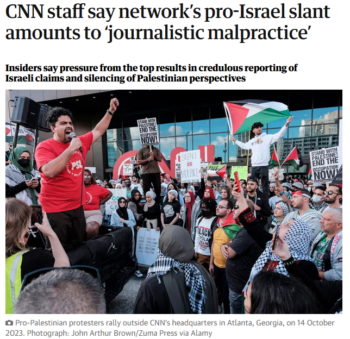
**** MISSING IMAGE (difficult for WordPress to copy) **** captioned “The majority of news since the war began…has been skewed by a systemic and institutional bias within the network toward Israel,” a CNN staffer told the Guardian (2/4/24).
Tapper did little to hide his utter contempt for the protesters. He complained:
This is taking room from my show that I would normally be spending covering what is going on in Gaza, or what is going on with the International Criminal Court, talking about maybe bringing charges. We were talking about the ceasefire deal. I mean, this—so I don’t know that the protesters, just from a media perspective, are accomplishing what they want to accomplish, because I’m actually covering the issue and the pain of the Palestinians and the pain of the Israelis—not that they’re protesting for that—less because of this.
It’s Tapper and CNN, of course, who decide what stories are most important and deserve coverage—not campus protesters. Some might say that that a break from CNN‘s regular coverage the Israel’s assault on Gaza would not altogether be a bad thing, as CNN staffers have complained of “regurgitation of Israeli propaganda and the censoring of Palestinian perspectives in the network’s coverage of the war in Gaza” (Guardian, 2/4/24)
The next day, Tapper’s framing of the protests made clear whose grievances he thought were the most worthy (4/30/24): “CNN continues to following the breaking news on college campuses where anti-Israel protests have disrupted academic life and learning across the United States.”
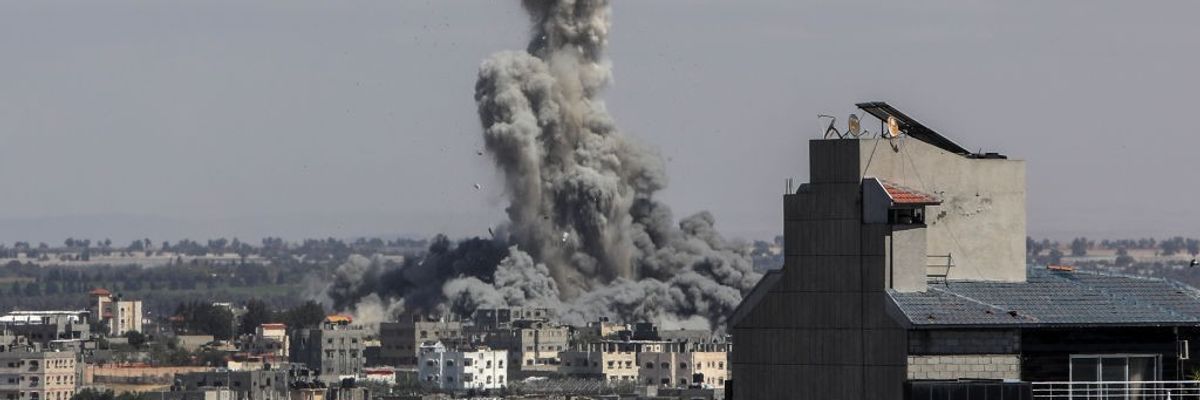
Smoke rises from buildings after Israeli strikes on Rafah, Gaza on May 6, 2024. (Photo: Abed Rahim Khatib/Anadolu via Getty Images)
“Why?” asked Israeli lawmaker Ofer Cassif. “Because killing Palestinians is more important for the Israeli government than saving Israelis.”
Israel on Monday launched long-awaited strikes on Rafah in the southern Gaza Strip despite Hamas publicly confirming it agreed to a cease-fire and hostage release proposal from Egyptian and Qatari mediators.
The Israel Defense Forces said on social media that “the IDF is currently conducting targeted strikes against Hamas terror targets in eastern Rafah,” the city to which over a million Palestinians have fled since October 7, when Israel launched a retaliatory war that has already killed at least 34,735 people in Gaza and wounded another 78,108.
Earlier Monday, the IDF had dropped leaflets directing residents and refugees in that part of Rafah to relocate to a strip along Gaza’s coast, ignoring warnings from the international community and humanitarian groups that a full-scale Israeli attack on the crowded city would further endanger civilians and relief efforts.
“It is obvious Netanyahu wants this genocidal war to continue indefinitely so that he can remain in power.”
In addition to sparking outrage around the world, the Israeli government’s Rafah attack and rejection of the Hamas-backed proposal was met with criticism from people across Israel. The Associated Press reported that “thousands of Israelis rallied around the country Monday night calling for an immediate deal to release the hostages still held in the Gaza Strip.”
Ofer Cassif, a member of the Knesset who was almost expelled by fellow Israeli lawmakers earlier this year for backing South Africa’s ongoing genocide case against Israel at the International Court of Justice (ICJ), again called out his own government.
“Israeli tanks and infantry enter east Rafah while planes bomb from above, just hours after Hamas’ decision to accept the hostages/prisoners exchange deal,” Cassif said Monday. “Why? Because killing Palestinians is more important for the Israeli government than saving Israelis. War criminals!”
Well, so much for hostages being the number one priority for Netanyahu. (Never was.) It's all about land grab and cleansing. His cabinet is filled with extremists who have recently used genocidal language against Palestinians. Look at Smotrich and Ben Gvir. Disaster for all. https://t.co/0GU3YeBqAO
The office of Israeli Prime Minister Benjamin Netanyahu said Monday that “the War Cabinet unanimously decided this evening Israel will continue its operation in Rafah, in order to apply military pressure on Hamas so as to advance the release of our hostages and achieve the other objectives of the war.”
Along with the prime minister, Israel’s War Cabinet includes Defense Minister Yoav Gallant and Benny Gantz, former IDF chief of the general staff, along with three observers.
Netanyahu added that “while the Hamas proposal is far from meeting Israel’s core demands, Israel will dispatch a ranking delegation to Egypt in an effort to maximize the possibility of reaching an agreement on terms acceptable to Israel.”
This stuff doesn't fool anybody anymore. Israel rejected the deal. Netanyahu said so publicly. There's no ruse. https://t.co/3z286o6A1g
Reuters reported that “an Israeli official said the deal was not acceptable to Israel because terms had been ‘softened.’”
According to the news outlet, the first part of a three-phase plan that Hamas—which has controlled Gaza for nearly two decades—agreed to includes a 42-day pause in fighting, the release of 33 hostages held by the group and some Palestinians in Israeli jails, a partial IDF withdrawal, and free movement in the besieged enclave.
Phase two would be “another 42-day period that features an agreement to restore a ‘sustainable calm’ to Gaza, language that an official briefed on the talks said Hamas and Israel had agreed in order to take discussion of a ‘permanent cease-fire’ off the table,” Reuters detailed. This phase also includes withdrawing most Israeli troops and Hamas releasing some soldiers and reservists.
The third phase would involve the exchange of bodies; reconstruction of Gaza overseen by Egypt, Qatar, and the United Nations; and ending the complete blockade on the strip, the outlet added.
Shortly before Israel’s Monday night strikes on Rafah began, Stéphane Dujarric, a spokesperson for United Nations Secretary-General António Guterres, said that the U.N. chief “reiterates his pressing call to both the government of Israel and the leadership of Hamas to go the extra mile needed to make an agreement come true and stop the present suffering.”
Expressing concern about the then-imminent Israeli operation in Rafah, the spokesperson said that “we are already seeing movements of people—many of these people are in desperate humanitarian condition and have been repeatedly displaced. They search safety that has been so many times denied. The secretary-general reminds the parties that the protection of civilians is paramount in international humanitarian law.”
ALL EYES ON RAFAH
Rafah is under bombardment Israel is vowing to proceed with a ground invasion of Rafah 1.5 million displaced Palestinians are trapped with nowhere to go
Demand that Congress pressure Israel to end its assault now!
Other U.N. officials have been warning of what an assault on Rafah will mean for the over 1.4 million Palestinians there, among them 600,000 children. So have humanitarian and political leaders, including U.S. Sen. Bernie Sanders (I-Vt.)—who on Monday urged President Joe Biden to stand by his earlier position that attacking the city was a “red line” and “end all offensive military aid to Israel.”
Council on American-Islamic Relations national executive director Nihad Awad issued a similar call Monday evening, warning that “the Israeli government is hellbent on using American financial, military, and diplomatic support to ethnically cleanse what remains of Gaza and commit another massacre.”
“President Biden must stand up to Benjamin Netanyahu and take concrete action to end the genocide now,” Awad continued, nodding to the Israeli leader’s legal trouble. The prime minister faces not only potential consequences on a global scale for what the ICJ has deemed a “plausibly” genocidal war on Gaza but also a corruption trial in his own country.
“It is obvious Netanyahu wants this genocidal war to continue indefinitely so that he can remain in power, avoid jail, and fulfill his racist, far-right Cabinet’s demands for the complete destruction of Gaza and the massacre of its people,” Awad said. “It is long past time for President Biden to end our nation’s complicity in this 21st-century genocide.”
Yup. This has been the central issue. He does not care how many more die so long as he gets to sit on his little throne instead of a prison cell. https://t.co/dL7PAuxQlB
Biden spoke with Netanyahu by phone ahead of the IDF strikes on Monday and “reiterated his clear position on Rafah,” according to a White House readout. They also discussed the hostage negotiations, humanitarian aid, the Holocaust, and antisemitism.
Trita Parsi, executive vice president of the Quincy Institute for Responsible Statecraft, also suggested that the Israeli prime minister wants the bloodshed in Gaza to continue for personal reasons.
“Netanyahu does not want an end to the war because the moment the war ends, his political career ends as well. And his prison sentence will commence,” said Parsi. “Yet, Biden has for seven months deferred to Netanyahu.”