THE Labour leadership faced demands today to tax the rich instead of inflicting more painful spending cuts in its Budget on Wednesday.
Chancellor Rachel Reeves has warned that her fiscal announcement will involve “difficult decisions” because of a £22 billion “black hole” left by the Tories in the nation’s finances, which has since led her to talk of finding £40-50bn in spending cuts and tax rises.
Today Labour MP Richard Burgon presented a 50,000-strong petition in Parliament calling for wealth taxes as an alternative.
…
The petition calls for a 2 per cent wealth tax on assets over £10 million, which could raise £24bn a year.
It also suggested equalising capital gains tax with income tax rates and ending state subsidies for fossil fuel giants, which could raise another £21bn.
Ms Reeves stated that the upcoming Budget will focus on “strivers,” invoking the rhetoric of austerity architect George Osborne, though a speech by Prime Minister Sir Keir Starmer today stressed Labour would raise taxes to invest in public services.
Labour MP John McDonnell tweeted: “Simple request to whoever is now running Labour’s communications strategy, drop the ‘strivers’ language as it inevitably has led in the past to reference to ‘skivers’ prefacing attacks on welfare benefit claimants and cuts in social security support.”
Over 120 charities under the End Child Poverty Coalition have called on the Chancellor to use the Budget to finally ditch the two-child benefit cap.
The coalition says that doing so would lift 300,000 children out of poverty.
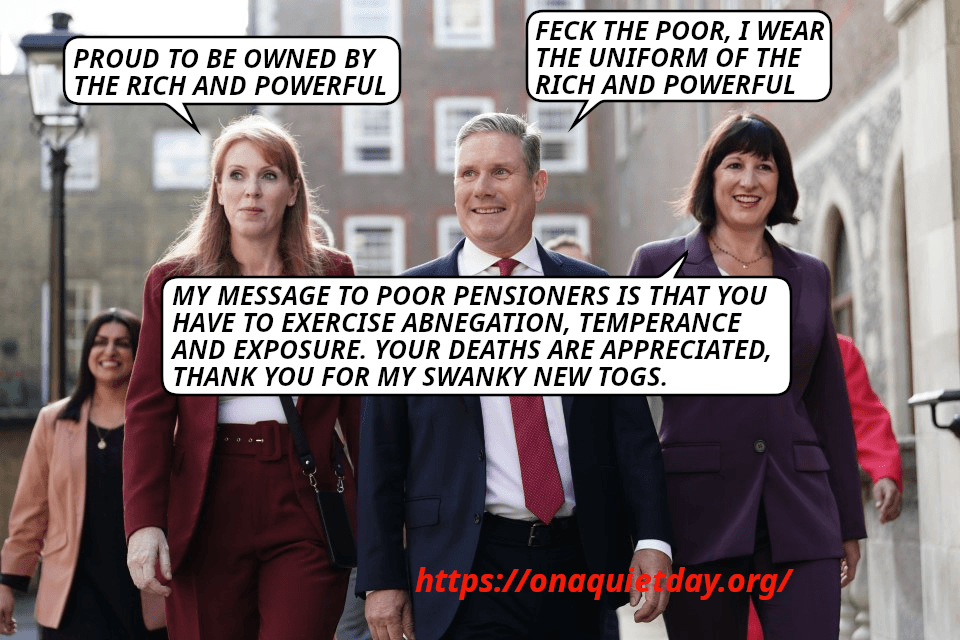
Keir Starmer, Angela Rayner and Rachel Reeves wear the uniform of the rich and powerful. They have all had clothes bought for them by multi-millionaire Labour donor Lord Alli. CORRECTION: It appears that Rachel Reeves clothing was provided by Juliet Rosenfeld.Keir Starmer says pensioners can freeze to death and poor children can starve and be condemned to failure and misery all their lives.
Keir Starmer says pensioners can freeze to death and poor children can starve and be condemned to failure and misery all their lives. The child poverty and neglect discussed in this article occurred previously to Keir Starmer and the Labour Party being in office. They polices are however certainly continuing and reproducing child poverty and destitution.
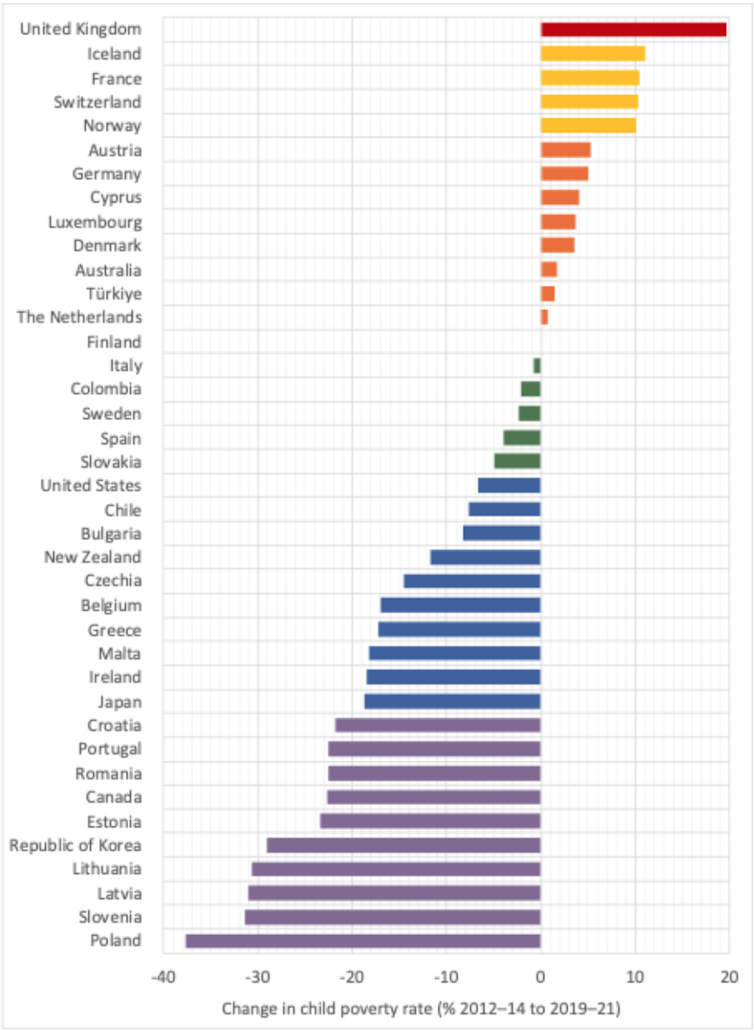
But why did this happen to our children? This rise in child poverty is a change that has not been found to have occurred to the same extent anywhere else in the world, among all the places that the United Nations measures in the same way.
This graph tells a story of hope and success. In much of Eastern Europe, child poverty has fallen by between as much as a third – and often at least a quarter – in a mere seven years.
But it also shows that child poverty has risen the most in the UK. The poorest fifth of households in the UK are poorer than the poorest fifth in most of Eastern Europe. For many people in the UK, this will come as a surprise. Some will refuse to believe it can be this bad.
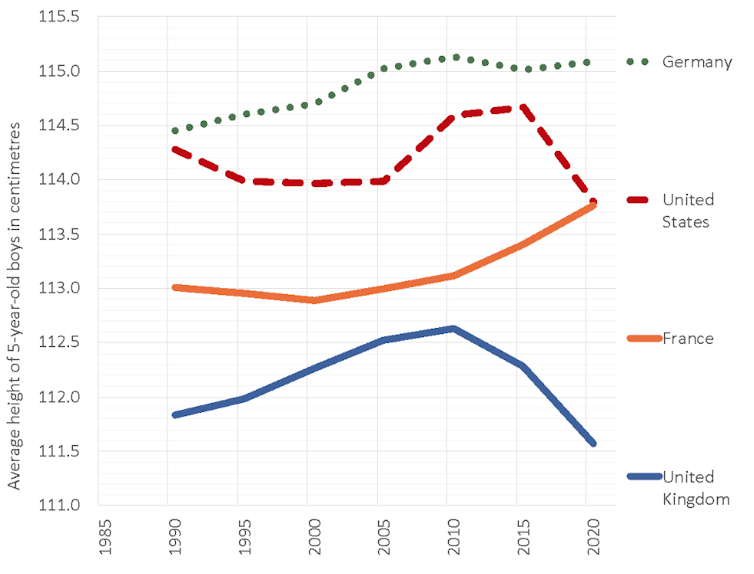
The evidence for this poverty is seen in the declining heights of five-year-olds since 2010.
A 5-year-old in 1990 would have been born in 1985 and their height influenced mostly by nutrition in the years 1985–1990. Those were hard years for the UK: mass poverty resulting from over three million people being out of work in the early 1980s. But the average height of children was still increasing.
It was not until 2010, for those children who had lived between 2005 and 2010, that we first saw heights plateau and then fall, coinciding with the post-2010 austerity years.
My forthcoming book attempts to make sense of what has happened to the UK: why, in 2024, it is not merely one of the countries in Europe with a high rate of child poverty, but the one country above all others that the UN has singled out as having had the greatest rises in child poverty among all those it surveyed.
Seven children
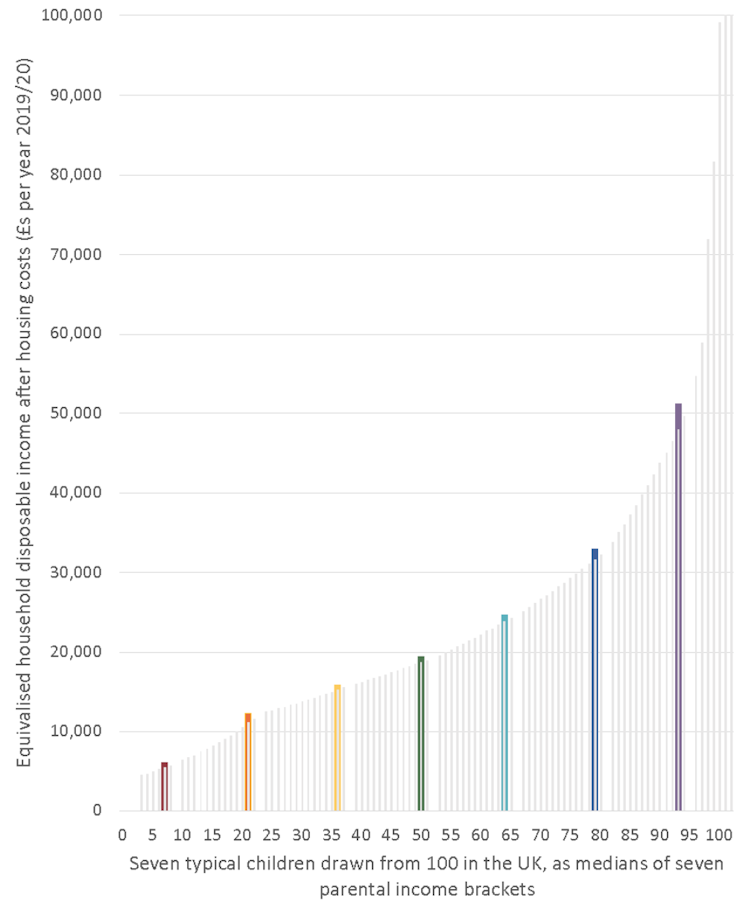
To try to understand more about children’s lives in the UK, I constructed seven typical children. I divided all 14 million children living in the UK into seven groups of 2 million, according to the income of their families in 2018 and 2019. I then chose the middle child of each 2 million. I next looked at what had happened to those families between 2018 and 2024.
Annual household incomes after tax, benefits and housing costs in the UK, families with children 2019/20
Annual household incomes after tax, benefits and housing costs in the UK, families with children 2019/20: seven typical children marked in colour. Danny Dorling, CC BY-NC-ND
The first thing to note is just how incredibly well-off the children are who are better-off than our seven typical children.
Some 6% of all children in the UK live in households richer than the best-off typical child in my analysis. Those 6% of children, the best-off children of all, live in families that each year receive and spend a third of all the income in the UK.
Want more politics coverage from academic experts? Every week, we bring you informed analysis of developments in government and fact check the claims being made.
These 6% are not typical, and neither are the 6% poorest: those most destitute, those whose families are most likely to use food banks. If you pick seven typical children, equally spaced out across the income scale, then these extremes are not part of what you see.
But four of our typical seven children now live lives that most better-off people would consider to be in poverty. The other three are hardly well-off.
The least well-off are in families struggling to pay bills and making sacrifices others do not have to think about. For instance, whether to save £10 a month, or have insurance against the effects of flood, fire or theft. Increasingly often they cannot afford both.
But even the most well-off of our seven children lives in a family that worries about paying for an annual holiday. That is rare among the most affluent two million families, but possible.
The UK in 2024 demonstrates to the world what living with high inequality means in a once affluent country. It means a few using up far more resources than the vast majority of other children, such as having access to many more school teachers – per child – as compared to the rest, better food, better shelter, more warmth, more toys, better material everything; often more than you might think any child needed.
In future, almost all our children will tell their stories of growing up in the UK of the 2020s and – hopefully – what changed to make things better. It is hard to imagine them becoming much worse.
After 14 years of billionaires doubling their wealth, the political elite’s choice of starving pensioners and children shows austerity as a complete con job.
Jeremy Corbyn MP, former leader of the Labour Party
Every day, my constituents make tough choices. Tough choices like deciding whether to heat their homes or put food on the table. Tough choices like taking out a loan to pay for this month’s rent. Tough choices like selling their home to pay for their family’s social care.
People are making tough choices because governments have made the wrong choices. We warned that Tory austerity would weaken our economy and decimate our public services. We were ignored, and the poorest in society paid the price. Austerity is not just a buzzword. It is the ongoing, brutal reality for millions of people who have been pushed into destitution. It is the face of desperation and anxiety of those forced into a spiral of debt. It is a freezing cold night for the record numbers of people sleeping rough on the streets. It is the graveyard for those left without vital support: more than 300,000 excess deaths have been attributed to austerity policies.
We often talk about austerity in terms of cuts to public spending, but that is just one side of the coin. By starving public services of resources, the government manufactured a convenient excuse for their privatisation. We saw this most acutely with the NHS: an underfunded public service does not just cause satisfaction to plummet, but the belief in the principle of public healthcare itself. Austerity was never about saving money (the UK’s debt pile increased every single year under the Tories). It was about transferring money from the poorest to the richest. Between 2010 and 2018, aggregate wealth in the UK grew by £5.68 trillion. 94% went to the richest 50% of households. 6% went to the poorest 50%. As child poverty was heading towards its highest levels since 2007, Britain’s billionaires more than doubled their wealth.
It was a political decision to defund, dismantle and auction off our public services. And it will be a political decision to repeat this failed economic experiment. ‘It’s going to be painful’, the Prime Minister told the nation last week, prepping the public for ‘difficult choices’ ahead. Did he get permission from the Tories to reuse their trademark slogans? Other ministers have gone one step further, indicating that they do not have any choice at all but to impoverish children and pensioners. Keeping children in poverty is unavoidable, apparently, if we want to restore the public finances. Scrapping the winter fuel allowance is a necessity, we were risibly told, if we want to stop a run on the pound.
It is astonishing to hear government ministers try to pull the wool over the public’s eyes. The government knows that there is a range of choices available to them. They could introduce wealth taxes to raise upwards of £10 billion. They could stop wasting public money on private contracts. They could launch a fundamental redistribution of power by bringing water and energy into full public ownership. Instead, they have opted to take resources away from people who were promised things would change. There is plenty of money, it’s just in the wrong hands — and we will not be fooled by ministers’ attempts to feign regret over cruel decisions they know they don’t have to take.
The new Labour government has promised an ‘ambitious plan’ to end child poverty, but it is yet to commit to ending the two-child limit
The new Labour government has launched a taskforce to work towards ending child poverty, but charities have warned that “good intentions are not enough” as they ramp up calls for the two-child benefit cap to be scrapped.
Keir Starmer’s party has promised an “ambitious” plan for ending child poverty, but it has so far refused to commit to removing the two-child limit, which is also referred to as the two-child benefit cap and has been described as “one of the cruellest welfare policies of the past decade”.
It means that families who have a third child or subsequent children born after April 2017 are denied up to £3,500 a year compared with those whose children were born sooner.
…
Alison Garnham, chief executive of Child Poverty Action Group, said: “The taskforce is a welcome first step towards fulfilling the government’s pledge to bring in an ambitious child poverty strategy.
“But with a record number of kids in poverty now, scrapping the two-child limit on benefits has to happen in the government’s first budget. The two-child limit is driving up child poverty more than any other policy, children need it to be removed as a priority.”
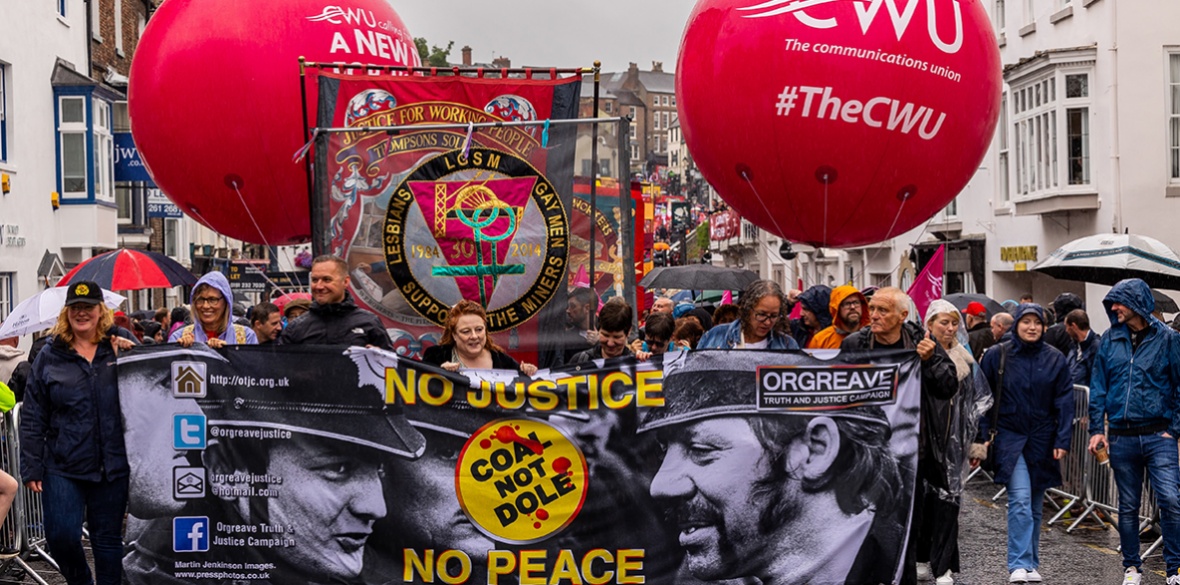
Marchers at the Durham Miners’ Gala, July 13, 2024Photo: Neil Terry / neilterryphotography.co.uk
DEMANDS for action by the Labour government to end child poverty, end arms sales to Israel and abolish all Tory anti-trade union laws were cheered at the 138th Durham Miners’ Gala.
The gala crowd of tens of thousands roared on Saturday as speakers called on Labour to use its record 172-seat majority in the Commons to transform society for working people in Britain.
Speakers called on the government to end arms sales to Israel and Britain’s complicity in the continuing slaughter in Gaza.
The 138th Durham Miners’ Gala began with the traditional marching of dozens of proudly raised trade union and campaign banners and brass bands through the streets of the city to the gala field for Durham Miners’ Association’s (DMA) Big Meeting.
…
The gala celebrated the 40th anniversary of the miners’ strike against pit closures, and Matt Wrack, general secretary of the Fire Brigades Union (FBU), praised the courage of the miners for the strike which he said “has been vindicated ever since.”
He said the strike had also seen the power of the state unleashed. “They used the press to lie, the police to batter, the courts to lock people up for defending their jobs and communities,” he said.
He warned: “That was the message from the boss class in 1984-5.