NHS news review

Spread the love

The Labour Party are ridiculing the Con-Dems’ coalition governments’ proposed changes to the NHS as excessively complex and incomprehensible. Previous to the 2010 general election Cameron promised no more top-down reorganisation of the NHS and said “The recent history of the NHS reads like a wretched bowl of Alphabetti Spagetti and it has got to stop”.

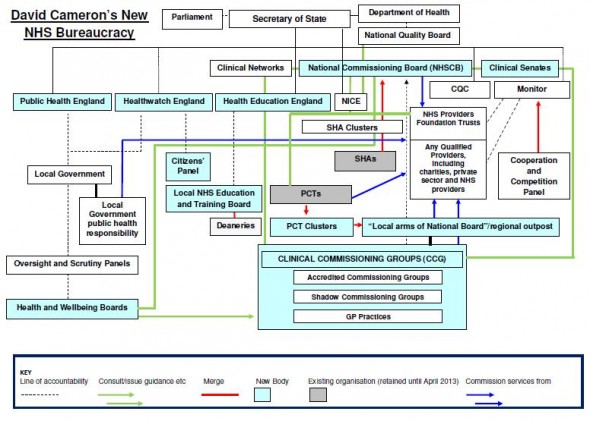
These organograms(?) – credited to Labour policy wonks – show the current and proposed excessive spagetti-like top-down re-organisation of the NHS that Cameron said would not happen and “has got to stop”.
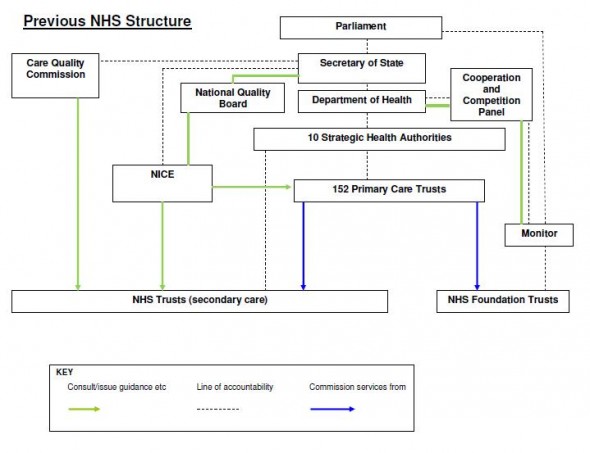
NHS current spagetti-like organisation


Extreme spagetti-like organisation proposed by the Con-Dems' destroy the NHS bill

The Guardian reports  that

The Liberal Democrats will not debate a formal motion on the future of the NHS at their conference, but will hear from a balanced group of speakers including Baroness Williams on whether the reforms sought by the party at its spring conference have been achieved through the listening exercise.

Perhaps they should amend their name to the Liberals or Conservatives?
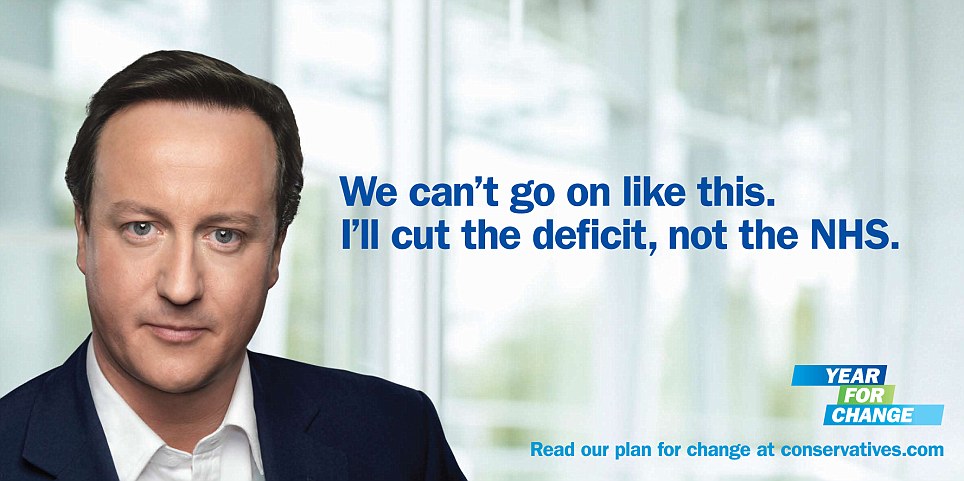
 

Conservative election poster 2010

A few recent news articles about the UK’s Conservative and Liberal-Democrat coalition government – the ConDem’s – brutal attack on the National Health Service.

Organograms show NHS becoming even more complex | Westminster blog | Jim Pickard and Kiran Stacey share their views on the UK’s political scene for the Financial Times – FT.com

David Cameron, pre-election, told National Health Service staff there would be no more “top-down reorganisations”. The recent history of the organisation had been “like a bowl of alphabetty spaghetti“, he pointed out.

The government is getting rid of primary care trusts. At the same time it is creating a National Commissioning Board, Clinical Senates, Public Health England, Healthwatch England, Health Education England, Citizens’ Panels, Local Education and Training Boards and Health and Wellbeing Boards and shadow Clinical Commissioning Groups.

Even now Cameron has insisted that he has been “taking out” bureaucracy out of the National Health Service. These two graphics would suggest a rather different situation.

Labour ridicules David Cameron’s NHS structure | Politics | The Guardian


Before the election, David Cameron promised NHS staff there would be no more top-down reorganisation of the NHS, describing its recent history as “like a bowl of alphabetti spaghetti”. His commitment was reiterated in the coalition agreement and was widely welcomed by health service staff. At the latest relaunch of his reorganisation plans, he claimed that he was “taking out a huge amount of bureaucracy” from the NHS.

Yet Cameron’s new NHS structure includes the creation of a National Commissioning Board, intended to be separate from ministers, at the apex of the reformed organisation. The chief executive designate of the board, Sir David Nicholson, has acknowledged that it “could become the greatest quango in the sky we have seen”.

Other new bodies to be created include clinical senates, Public Health England, Healthwatch England, Health Education England, citizens’ panels, local education and training boards, and health and wellbeing boards. Primary care trusts (PCTs) will be replaced by accredited and shadow clinical commissioning groups (CCGs). Labour said confusion remained about the transfer of responsibility from PCTs to CCGs, with senior officials at the Department of Health reportedly raising concerns about the danger of operating a two-tier commissioning system.

One senior commissioner was reported as saying “You can just about tolerate a two-tier provision system but we can’t operate two-tier commissioning” and another as saying “Either it doesn’t really work like this [as announced] or it will be a feverishly expensive bureaucracy”.

We all need to get behind anti-Health Bill campaign » Hospital Dr

The NHS Consultants’ Association backs the BMA campaign to withdraw the Health and Social Care Bill.

Following the Executive Committee meeting of the NHSCA on the 4 August 2011, there was a unanimous decision to congratulate and support the BMA over its decision to mount a public campaign to call for withdrawal of the Health and Social Care Bill.

The NHSCA continues to believe that the Health and Social Care Bill represents the greatest threat to the NHS in its history. Despite the government’s proposed changes to the Bill following the Future Forum report, the key policy levers to deliver a full blooded market based system with increasing NHS privatisation remain intact. Worse still, the bill is now even more complicated and will be more costly to implement.

The Royal College of GPs has worked out that the number of NHS statutory bodies is going to increase from 163 bodies to 521! No wonder why Dr Hamish Meldrum, chair of BMA council stated that the Bill was: “Hopelessly complex and it really would be better if it were withdrawn.”

We are now left with a policy mess, at a time when the NHS is facing the greatest funding crisis in its history, with the QIPP efficiency drive aiming to deliver £20bn of savings by 2014. This will actually act as a catalyst to drive increasing privatisation of the NHS, as PCT clusters are forced to ration NHS care due to financial constraints, and NHS trusts come under huge financial pressure to cut costs.

We are already seeing an increase in NHS waiting lists and many PCTs reducing their lists of ‘NHS core services’, both of which result in increasing uptake of private health insurance policies.

GP warning over ‘crazy’ rapid roll-out of NHS 111 | GPonline.com

Strategic health authorities have been given seven weeks to tell the DoH how and when they plan to roll-out NHS 111 hotlines across their area.

But one senior GP warned the deadline was ‘crazy’ given that the pilot NHS 111 schemes across the UK were either incomplete, or yet even to begin.

Tories’ circular logic / Features / Home – Morning Star

The government is demanding that the National Health Service doesn’t use NHS hospitals.

Instead, the NHS must pay David Cameron’s dinner guests for their operations.

It sounds quite mad but it is, sadly, quite true. At the end of July a little-known government quango called the NHS Co-operation and Competition Panel ruled that Wiltshire and Bath NHS were wrong not to give a company called Circle Health millions of pounds for operations.

The Tories love to talk about “social enterprises,” claiming they are a new type of firm that use market methods but are driven by ethical impulses.

Circle claims to be such a beast.

Last January future Tory Health Secretary Andrew Lansley spoke at the firm’s glamorous private hospital in Bath to praise its work.

Of course, the fact that behind all the waffle about “social enterprises” lurk some very profit-hungry Tory donors may well have encouraged Lansley to go to the shindig.

Circle is 49 per cent owned by its employees, which is why it calls itself a “social enterprise.”

But the firm is also 51 per cent owned by private investors, including around 40 per cent by hedge funds Odey Asset Management and Lansdowne Holdings.

Since 2003 Crispin Odey and Lansdowne’s Paul Ruddock and David Craigen have between them donated £561,000 to the Tories.

This money buys them membership of the Tories’ Leader’s Club and regular dinners with Cameron.

‘Miracle’ MS Pill Won’t Get NHS Funding | LBC

Fingolimod is the first pill to treat MS, but now NICE, the health watchdog, has ruled it should not be funded by the NHS because it is not cost effective.

Amanda Cook from Norfolk has taken the tablet for the past three years.

She told Sky News: “This tablet has changed my life completely. I think it’s a very disappointing decision.

“It takes away another option for MS therapies and I think it’s the wrong decision.”

Research found that Fingolimod reduces the number of relapses for sufferers by more than a half, and cuts disability progression by 30 percent in some cases.

Continue ReadingNHS news review

NHS news review

Spread the love

It has emerged that Andrew Taylor, head of the Co-operation and Competition Panel has been liaising extremely closely with private-sector lobbying groups to produce the report claiming that PCTs impose waiting so that patients either pay for treatment or die. There’s a feint, familiar ring to that … a circular echo, something in a spin?

Anyway then he got taken to a Health Investor’s dinner. Of course, Health Investor’s dinner would be packed with higher management of private health care companies – the perfect situatuion for Taylor to be networked.

Hypocrite Andrew Lansley condemned PCTs for the actions claimed by the report when – of course – he is largely responsible for them. It is Lansley and the Con-Dems that are destroying the NHS and imposing huge cuts. It is clear that this was the intention.

There are reports on Labour’s analysis that deprived areas will see greater cuts than relatively prosporous areas. The Con-Dems’ are stealing from the poor to give to the rich.

Conservative election poster 2010

A few recent news articles concerning the UK’s Conservative and Liberal-Democrat coalition government – the ConDem’s – brutal attack on the National Health Service.

Private healthcare group lobbied competition body for NHS inquiry | Society | The Guardian

The close links between a private sector lobby group and an NHS regulator in the runup to the launch of a groundbreaking inquiry into competition in the health service have emerged in a series of documents passed to the Guardian.

Emails released under the Freedom of Information Act show that NHS Partners Network, a lobby group which represents companies including Care UK, Circle, General Healthcare Group, Bupa and United Health, helped draft a letter requesting a formal investigation into how firms were being blocked from getting NHS work. A week later the private healthcare lobby group took the regulator out to a £250-a-head gala dinner.

The network began lobbying the Co-operation and Competition Panel (CCP) last October for an inquiry into restrictions on the use of non-state companies in the health service – an investigation that was given the go-ahead two months later. The result was a report published this week which included recommendations to offer patients “more choice” because people were “dying” while waiting for operations in NHS hospitals.

Since 2006, patients have had a right to choose where they go for treatment for elective surgery, including private hospitals. In this week’s landmark ruling the panel found that almost half of NHS primary care trusts, the state bodies which control health budgets, were unreasonably restricting patients’ choice over where they go for operations.

The tactics employed included setting minimum waiting times before patients were getting treated – even when private providers could treat them – and directing GPs to refer patients to keep cash flowing into a local hospital.

In a contentious passage the regulator claimed that “we understand that patients will ‘remove themselves from the waiting list’ either by dying or by paying for their own treatment at private sector providers”.

Andrew Lansley, the health secretary, leapt on the findings, telling the BBC that “too many [trusts] have been operating in a cynical environment where they can game the system – and in which political targets, particularly the maximum 18-week waiting time target, are used to delay treatment.”

However, David Stout, director of the PCT Network, described this claim as “unsubstantiated”, pointing out that average waiting times were just eight weeks for what were non-emergency and therefore non-life threatening operations. He said the regulator’s statements “cause unnecessary public anxiety and alarm”.

Emails, obtained by Spinwatch which campaigns for greater transparency in government, between the head of the CCP, Andrew Taylor, and David Worskett, the director of the NHS Partners Network, reveal the inquiry followed a letter from the lobby group to the Department of Health, which Taylor helped draft.

It’s obvious why PCTs are making patients wait » Hospital Dr

You really have to wonder what it’s like in the world of a Tory minister. It’s evidently a place where nobody has to rely on a public service. David Cameron’s gratitude to the NHS for treating his son Ivan, frequently repeated in the run up to the election, seems to have been conveniently forgotten.

First we have Steve Hilton, David Cameron’s director of ‘strategy’ (for which his qualification are…ummm…I’ll have to get back to you on that one), suggesting the abolition of maternity leave, job centres and consumer rights legislation.

Then Oliver Letwin claiming public sector workers need more ‘fear and discipline’ (how about a spot of whipping?). Thanks for that, boys – if that’s the direction of travel, we’ll soon be opening workhouses again. Let’s admit this government is devoid of intelligent ideas for deficit reduction, or indeed, any grasp on the realities of life for the majority who don’t have a trust fund and didn’t go to Eton.

Then we have the Cooperation and Competition Panel doing what it was set up to do – clobbering the NHS and cosying up to the private sector. Its report last week claims that PCT’s are unfairly giving work to local hospitals, and restricting access for elective surgery to save money.

Making patients wait for treatment, we’re told, is designed expressly to force those who can afford it to go privately. Not only that – those wicked managers are hoping that many others will tidy themselves off the waiting list by dying before they finally get an op date. With breathtaking hypocrisy, the government piles in with expressions of horror, completely ignoring the reason why PCT’s are so desperate to save money. It’s a shame PCTs are so strapped for cash that they can’t treat CCP members to the same corporate entertainment package that lobbyists from the private healthcare industry recently did, according to a report in The Guardian. It was obviously be money well spent.

What the government also fails to acknowledge, is that this was always the plan – i.e. to force NHS waiting lists to increase so that the private sector is able to ride in and save the day – patients will either pay privately, or demand an alternative provider. And this is before the Health and Social Care Bill has even become law.

Deprived areas in England will ‘lose out’ in NHS reforms – UK Politics, UK – The Independent

Deprived areas in England will lose out to affluent parts of the country under health spending reforms, Labour has claimed.

Changes to funding formulas means poor health rates will be given less consideration when cash is allocated, the party said.

It suggested areas like Manchester and the London borough of Tower Hamlets would lose out to parts of the wealthy south east, such as Surrey and Hampshire.

Labour based the claims on an assessment of funding reforms by public health bodies in Manchester.


27/11/13 Having received a takedown notice from the Independent newspaper for a different posting, I have reviewed this article which links to an article at the Independent’s website in order to attempt to ensure conformance with copyright laws.

I consider this posting to comply with copyright laws since
a. Only a small portion of the original article has been quoted satisfying the fair use criteria, and / or
b. This posting satisfies the requirements of a derivative work.

Please be assured that this blog is a non-commercial blog (weblog) which does not feature advertising and has not ever produced any income.

dizzy

Continue ReadingNHS news review

NHS news review

Spread the love

David Cameron is accused by Labour of breaking an election pledge that NHS spending would not be cut.

NHS cuts costs by delaying operations so that patients either go private or die.

Unhealthy foods kill. Lansley consults with junk food pushers.

Conservative election poster 2010

A few recent news articles concerning the UK’s Conservative and Liberal-Democrat coalition government – the ConDem’s – brutal attack on the National Health Service.

Cameron accused of breaking pledge on NHS, as health spending falls | Politics | The Guardian

David Cameron was accused of breaking his biggest pledge at the general election – a guarantee that health spending will increase every year in real terms – after Treasury figures showed a fall in spending in the coalition’s first year in government.

Labour accused the government of burying figures in a Treasury document which show that spending on the NHS was cut in real terms to £101.9bn in the coalition’s first year in office from £102.7bn in Labour’s last year in government.

John Healey, the shadow health secretary, said: “David Cameron has broken his NHS pledge. He put up posters pledging to cut the deficit, not the NHS, but we see now that the Tory-led government has already cut spending on the NHS in its first year.

“On top of this cut, Cameron’s reckless NHS reorganisation is set to cost £2bn, money which could be better spent treating patients. And there are more cuts forecast in future years. This proves again what people have seen before: that you can’t trust the Tories with the NHS.”

Labour criticised the government after figures in the Treasury’s Public Expenditure Statistical Analyses (PESA) for this month showed a cut in NHS spending in real terms from £102.7bn in 2009-10 to £101.9bn in 2010-11. The Tories opened their NHS section in their general election manifesto with the words: “We will back the NHS. We will increase health spending every year.”

In a question and answer session on 14 June the prime minister said: “I want to make this clear, you know we are not cutting spending on the NHS, we are increasing spending on the NHS. This government took a very big decision, given that the NHS is one of the biggest budgets there is in the country, we took a decision to increase by more than inflation in each year NHS spending.”

Related: Parties trade blows on NHS spending – Mortgages, Money – The Independent

Labour accuses David Cameron of breaking NHS spending pledge | Politics

NHS cuts waiting lists ‘by letting patients die’ | News

Health bosses are deliberately making patients wait for treatment so they will remove themselves from waiting lists by either going private or dying, a report has suggested.

Some Primary Care Trusts (PCTs) are refusing to operate before 15 weeks in a bid to save money, an independent agency that advises the Department of Health has discovered.

The tactic was employed by PCTs after they found that if patients were made to wait longer “some will remove themselves from the list or will no longer require treatment when it is finally offered.

“A PCT may therefore save money overall by increasing waiting times,” the report said.

“We understand that patients will ‘remove themselves from the waiting list’ either by dying or by paying for their own treatment at private sector providers,” the report by the Co-operation and Competition Panel (CCP) said.

Related: NHS delays operations ‘as it waits for patients to die or go private’ – Telegraph

Health News – Laws that restrict unhealthy food ‘would save lives and money’

The government could protect lives and save the NHS money by introducing laws that restrict unhealthy foods, experts say.

According to an article in the British Medical Journal, measures such as reducing the salt content of foods and eliminating industrial trans-fats could prevent thousands of cases of heart disease in England and Wales each year.

Researchers at the University of Birmingham’s School of Health and Population Sciences concluded that measures to reduce people’s salt intake by 3g per day or trans-fats by 0.7 per cent could save the NHS £40 million or £230 million, respectively, per year.

‘The findings are reassuringly consistent with results from very different methods in the United States, Australia and the UK Treasury,’ the study authors wrote.

McDonald’s and PepsiCo to help write UK health policy | Politics | The Guardian

The Department of Health is putting the fast food companies McDonald’s and KFC and processed food and drink manufacturers such as PepsiCo, Kellogg’s, Unilever, Mars and Diageo at the heart of writing government policy on obesity, alcohol and diet-related disease, the Guardian has learned.

In an overhaul of public health, said by campaign groups to be the equivalent of handing smoking policy over to the tobacco industry, health secretary Andrew Lansley has set up five “responsibility deal” networks with business, co-chaired by ministers, to come up with policies. Some of these are expected to be used in the public health white paper due in the next month.

The groups are dominated by food and alcohol industry members, who have been invited to suggest measures to tackle public health crises. Working alongside them are public interest health and consumer groups including Which?, Cancer Research UK and the Faculty of Public Health. The alcohol responsibility deal network is chaired by the head of the lobby group the Wine and Spirit Trade Association. The food network to tackle diet and health problems includes processed food manufacturers, fast food companies, and Compass, the catering company famously pilloried by Jamie Oliver for its school menus of turkey twizzlers. The food deal’s sub-group on calories is chaired by PepsiCo, owner of Walkers crisps.

The leading supermarkets are an equally strong presence, while the responsibility deal’s physical activity group is chaired by the Fitness Industry Association, which is the lobby group for private gyms and personal trainers.

In early meetings, these commercial partners have been invited to draft priorities and identify barriers, such as EU legislation, that they would like removed. They have been assured by Lansley that he wants to explore voluntary not regulatory approaches, and to support them in removing obstacles. Using the pricing of food or alcohol to change consumption has been ruled out. One group was told that the health department did not want to lead, but rather hear from its members what should be done.


27/11/13 Having received a takedown notice from the Independent newspaper for a different posting, I have reviewed this article which links to an article at the Independent’s website in order to attempt to ensure conformance with copyright laws.

I consider this posting to comply with copyright laws since
a. Only a small portion of the original article has been quoted satisfying the fair use criteria, and / or
b. This posting satisfies the requirements of a derivative work.

Please be assured that this blog is a non-commercial blog (weblog) which does not feature advertising and has not ever produced any income.

dizzy

Continue ReadingNHS news review

NHS news review

Spread the love

The Guardian reports that the cost of the Con-Dems’ assault on the NHS is rising at almost £1m a day.

Many operations are routinely refused because of cuts. This may be the beginning of the end of the NHS and exposes David Cameron as a blair-faced liar.

Conservative election poster 2010

A few recent news articles concerning the UK’s Conservative and Liberal-Democrat coalition government – the ConDem’s – brutal attack on the National Health Service.

Cost of NHS changes rising by £1m a day, official figures show | Society | guardian.co.uk

The cost of the government’s plans to restructure the NHS is rising at almost £1m a day, the Guardian has learned. Buried in a spreadsheet put out by the Department of Health as part of its revised business plan last week, officials admitted that the cost of transition was now £1.49bn.

This figure is £160m more than the previous estimate, issued six months ago, when the reforms bill was first published. In January the department estimated the total cost of the structural change to be £1.33bn. The health bill was amended after suggestions by a committee set up by David Cameron, the Future Forum, to head off criticism over the wide-ranging reforms. But the effect appears to have been to increase significantly the cost of the upheaval to the taxpayer.

A new impact assessment will now be completed by the Department of Health following the forum’s recommendations. Analysis by the Health Service Journal has shown that the transition to placing health budgets in the hands of GPs had already cost £228m since July last year.

The size, scale and cost of the reforms have long troubled MPs and health service professionals, who point out that cutting staff also costs huge sums in redundancy payments. Trade unions claim that three-quarters of the estimated cost of the transition will go towards redundancy payments to 20,000 staff, suggesting average settlements of more than £45,000.

John Healey, the shadow health secretary, said: “People will be shocked at the scale of wasted cost due to David Cameron’s NHS upheaval. These new figures, slipped out by the Department of Health, show that the costs of this unnecessary reorganisation are spiralling out of control.” Alan Maynard, professor of health economics at York University, said: “The delays and time taken for the reforms have really begun to affect morale and work ethic. People just won’t work if they don’t know where they will be next year or whether they have a job.”

Cataracts, hips, knees and tonsils: NHS begins rationing operations – Health News, Health & Families – The Independent

Hip replacements, cataract surgery and tonsil removal are among operations now being rationed in a bid to save the NHS money.

Two-thirds of health trusts in England are rationing treatments for “non-urgent” conditions as part of the drive to reduce costs in the NHS by £20bn over the next four years. One in three primary-care trusts (PCTs) has expanded the list of procedures it will restrict funding to in the past 12 months.

Examples of the rationing now being used include:

* Hip and knee replacements only being allowed where patients are in severe pain. Overweight patients will be made to lose weight before being considered for an operation.

* Cataract operations being withheld from patients until their sight problems “substantially” affect their ability to work.

* Patients with varicose veins only being operated on if they are suffering “chronic continuous pain”, ulceration or bleeding.

* Tonsillectomy (removing tonsils) only to be carried out in children if they have had seven bouts of tonsillitis in the previous year.

* Grommets to improve hearing in children only being inserted in “exceptional circumstances” and after monitoring for six months.

* Funding has also been cut in some areas for IVF treatment on the NHS.

The alarming figures emerged from a survey of 111 PCTs by the health-service magazine GP, using the Freedom of Information Act.

Doctors are known to be concerned about how the new rationing is working – and how it will affect their relationships with patients.

Related: NHS begins rationing operations in cost-cutting drive – Telegraph


27/11/13 Having received a takedown notice from the Independent newspaper for a different posting, I have reviewed this article which links to an article at the Independent’s website in order to attempt to ensure conformance with copyright laws.

I consider this posting to comply with copyright laws since
a. Only a small portion of the original article has been quoted satisfying the fair use criteria, and / or
b. This posting satisfies the requirements of a derivative work.

Please be assured that this blog is a non-commercial blog (weblog) which does not feature advertising and has not ever produced any income.

dizzy

Continue ReadingNHS news review

NHS news review

Spread the love

The main NHS news is that the British Medical Association (BMA) is to “start a public campaign to call for the withdrawal of the health and social care bill”.

http://www.guardian.co.uk/society/2011/jul/20/doctors-campaign-against-nhs-reforms  NB article recommended.

The BMA, which represents 140,000 doctors, voted to “reject the idea that the government’s proposed changes to the bill will significantly reduce the risk of further marketisation and privatisation of the NHS” and “agreed that the government is misleading the public by repeatedly stating that there will be ‘no privatisation of the NHS'”.

Dr Hamish Meldrum, chairman of council at the BMA, said: “Whilst the BMA recognises there have been some changes following the listening pause, there is widespread feeling that the proposed legislation is hopelessly complex, and it really would be better if the bill were withdrawn.”

His colleague on the council Dr Peedell said that the health bill was “just a privatisation bill with a third of it devoted to [producing] an economic regulated market”.

In the same article, campaigning group 38degrees received huge support to their campaign to save the NHS.

To underline that the government’s attempts to dissipate professional and public anger – such as the legislative pause – have had little effect, internet campaigners at 38 Degrees, which has 850,000 members in the UK, claimed to have raised cash at the rate of £56 a minute via an email marketing campaign on Wednesday.

The money will be used to get lawyers to comb through the 180 amendments produced by the government when it re-submitted the bill for its second reading earlier this month.

“38 Degrees members want to cut through the tangled web of amendments which make up Andrew Lansley’s re-written NHS plans. So we’re chipping in to hire legal experts to go through them with a fine tooth comb,” said the organisation’s executive director, David Babbs. “We’re concerned that real threats to our NHS may still lurk behind Lansley and [David] Cameron’s warm words. Are we on a slippery slope to the NHS being broken up by EU competition laws? Why does Lansley seem to be watering down his legal duty to provide a national health service?”


Health treatment restrictions for smokers and fat people. It should be noted that this is rationing of care as a result of cuts.

Cuts hitting the NHS in Wales.

Many articles report on yesterday’s news of Lansley extending privatisation through Any Qualified (Willing) Provider.

Conservative election poster 2010

A few recent news articles concerning the UK’s Conservative and Liberal-Democrat coalition government – the ConDem’s – brutal attack on the National Health Service.

Doctors to launch public campaign against proposed NHS reforms | Society | The Guardian

The government faces a summer of discontent over its NHS reforms after doctors voted to launch a public campaign against the health bill, and one of the UK’s internet campaign groups raised £10,000 in three hours after emailing members to pay for expert legal advice over the bill.

The British Medical Association’s council, the executive committee of the union, voted to pass a series of motions critical of the government’s bill – and crucially accepted that doctors “start a public campaign to call for the withdrawal of the health and social care bill”.

Put forward by NHS consultants Clive Peedell and Jacky Davis, the motion will ratchet up the pressure on ministers over the summer break who had hoped that the bill’s third reading in early September would be an easy ride.

The BMA, which represents 140,000 doctors, voted to “reject the idea that the government’s proposed changes to the bill will significantly reduce the risk of further marketisation and privatisation of the NHS” and “agreed that the government is misleading the public by repeatedly stating that there will be ‘no privatisation of the NHS'”.

Dr Hamish Meldrum, chairman of council at the BMA, said: “Whilst the BMA recognises there have been some changes following the listening pause, there is widespread feeling that the proposed legislation is hopelessly complex, and it really would be better if the bill were withdrawn.”

The Operating Theatre Journal : GPs agree ban on operations for smokers and obese patients

GPs have signed off a series of sweeping referral restrictions by NHS managers that will bar smokers and overweight patients from being referred for surgery, as PCTs across the country bring in new cost-saving restrictions.

Both LMCs and GP consortium leaders have backed moves by NHS Hertfordshire to block any patient with a BMI over 30 from being referred for routine joint replacement surgery without first being referred to a weight management scheme. GPs will also be prevented from referring smokers for any orthopaedic surgery until they have been referred for smoking cessation.

GPC leaders are seeking legal advice on the controversial plans and are warning that a number of trusts across England have suggested they may follow suit. Locally, the move has driven a wedge between GPs – with consortium leaders divided over the ethics of the restrictions and Hertfordshire LMC backing the plans by just one vote.

Meanwhile, a Pulse investigation covering 41 PCTs has found two-thirds have added new procedures to ‘low clinical priority’ lists since April, as trusts struggle to cut costs.

Procedures subject to new restrictions include the treatment of ganglions in Hampshire and DEXA scanning in primary prevention of osteoporotic fractures in men and women over 50 in Bristol. NHS Warrington has added 13 restrictions, including the treatment of obstructive sleep apnoea.

But it is the restrictions on treatment for smokers and obese patients that have prompted fiercest debate.

Fears for patient care as Welsh NHS battles to make £455m saving – Health News – News – WalesOnline

Patient services could be threatened as health boards battle to save almost half a billion pounds this year.

The scale of the financial challenge facing the NHS comes after “unprecedented” savings of £435m made last year and a further £1bn made over the course of recent years.

Experts believe patient services will not escape the spending cuts this year and the Western Mail has learned Wales’ seven health boards have not yet identified how they can find almost a third of the £455.7m total saving needed.

Hywel Dda and Cardiff and Vale University health boards have yet to find £39m and £31.5m of savings respectively.

Professor Marcus Longley, director of the Welsh Institute for Health and Social Care, at the University of Glamorgan, said: “Clearly this cannot be done with no impact on patient care because there isn’t half a billion pounds in the system that’s not needed.

More NHS care open to external providers – Public Service
NHS community and mental health services opened up to competition » Hospital Dr
Unions Criticize Government Plans for Patient Choice, Amid Fears of Privatization

Continue ReadingNHS news review