Pro-Trump Platform Promotes Climate Science Denial Ads to Millions Across Europe

Spread the love

Original article by Joey Grostern republished from DeSmog.

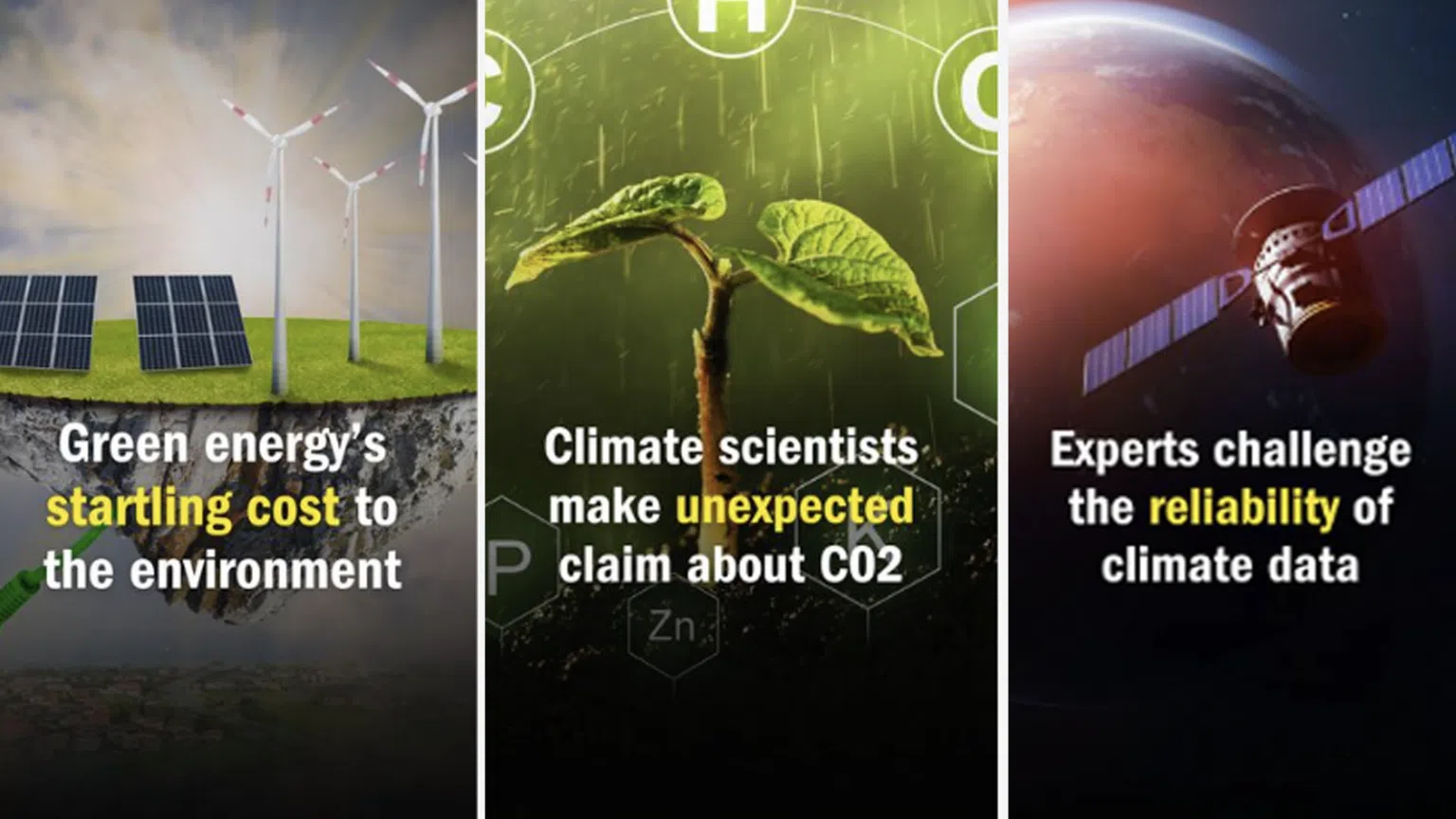
A mashup of three Epoch Times adverts posted on Meta. Credit: The Epoch Times / Meta

Campaigners have referred the Epoch Times to the UK advertising regulator for “stoking the climate culture war” on social media.

The pro-Trump Epoch Times has run hundreds of anti-climate social media adverts in Europe since the beginning of 2024 that have been seen millions of times, DeSmog can reveal. 

Epoch Times accounts in Europe have run 425 adverts on Facebook, Instagram, and X (formerly Twitter) that have attacked or undermined climate science, green energy, or climate action since the start of the year. These adverts have been run in the UK, Germany, Slovakia, and Bulgaria, appearing on social media feeds at least 2.3 million times across Facebook and Instagram, and 3.1 million times on X. 

These anti-climate ads were active for 22 days on average on Meta platforms (Facebook and Instagram), while they were displayed for 9.5 days on average on X.

Four of the adverts posted by Epoch Times on Meta have now been referred to the Advertising Standards Agency (ASA), a UK watchdog, by the campaign group Global Witness. The group is calling for the ASA to open an investigation into whether the Epoch Times breached the Committee of Advertising Practice (CAP) Code and, if so, to ban these adverts.

The Epoch Times claims to be the fastest growing independent news outlet in the United States. It claims to host websites across 22 languages in 35 countries, publishing online and in print. The publication has gained a substantial online following in recent years, amassing more than 10 million followers across its various Facebook accounts.

Based in New York, the Epoch Times is affiliated with the Falun Gong new religious movement in China and is staunchly anti-communist. Though the source of its income isn’t publicly declared, former employees told the New York Times that the publication was financed “by a combination of subscriptions, ads and donations from wealthy Falun Gong practitioners.”

The publication has propelled itself on Facebook by filling its feeds with viral, feel-good videos alongside its often partisan news coverage. 

According to NewsGuard, an independent company that rates the credibility of news sites, Epoch Times articles “frequently include distorted, misleading, or unsubstantiated claims.” The Epoch Times claims on its website that its reporters are “guided by the highest code of conduct and ethics”.

The Epoch Times spent at least $1.5 million on adverts in support of then Republican President Donald Trump from 2018 to 2019 – more than any group other than the Trump campaign. 

The publication was banned from advertising by Meta following these revelations, and the social media company told DeSmog that it ”continues to enforce this ban”. However, a number of Epoch Times offshoots have been allowed to promote climate science denial across Europe this year. 

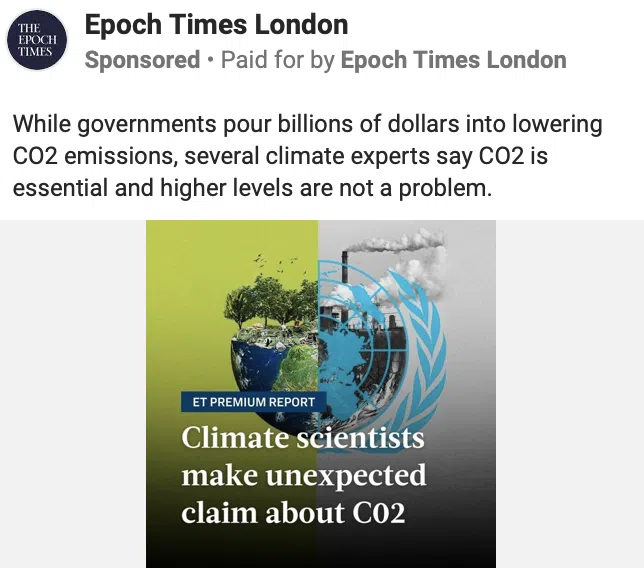
Many of these adverts have explicitly questioned the contribution of carbon dioxide (CO2) to climate change. The adverts have featured statements including “Several climate scientists say CO2 is essential and higher levels are not a problem”, and “What if more CO2 is actually good for the environment?”

The UN’s Intergovernmental Panel on Climate Change (IPCC), the world’s foremost climate science body, has stated that carbon dioxide “is responsible for most of global warming” since the late 19th century, which has increased the “severity and frequency of weather and climate extremes, like heat waves, heavy rains, and drought”.

The adverts ran for months, and reached millions of people, despite Meta’s pledge to tackle climate misinformation. Ten were removed prior to DeSmog contacting Meta, of which six were removed over a failure to include an appropriate advertising disclaimer.

“After sowing division and disinformation in the U.S., everyone in the UK should be alarmed that the Epoch Times is using the same playbook here,” said Nienke Palstra, campaign strategy lead at Global Witness. “We have already seen politicians trying to stoke a climate culture war and the Epoch Times is spending big to tap into this sentiment. We cannot allow the future of our planet to be put at threat for the political gain of extremists and populists.”

A spokesperson for the Epoch Times told Global Witness that scientists have always differed in their opinion on climate change and that “To ban different opinions does not help a civilised open society and erodes freedom of speech.”

Climate Denial Content

The bulk of the anti-climate adverts seen by DeSmog were posted by Epoch Times London, a Facebook page created in October 2023 that has fewer than 600 followers. 

Many of the adverts posted by Epoch Times London questioned climate science, for example claiming that “the greenhouse effect is real but irrelevant”, and that “new studies undercut the ‘scientifically empty’ global warming narrative.”

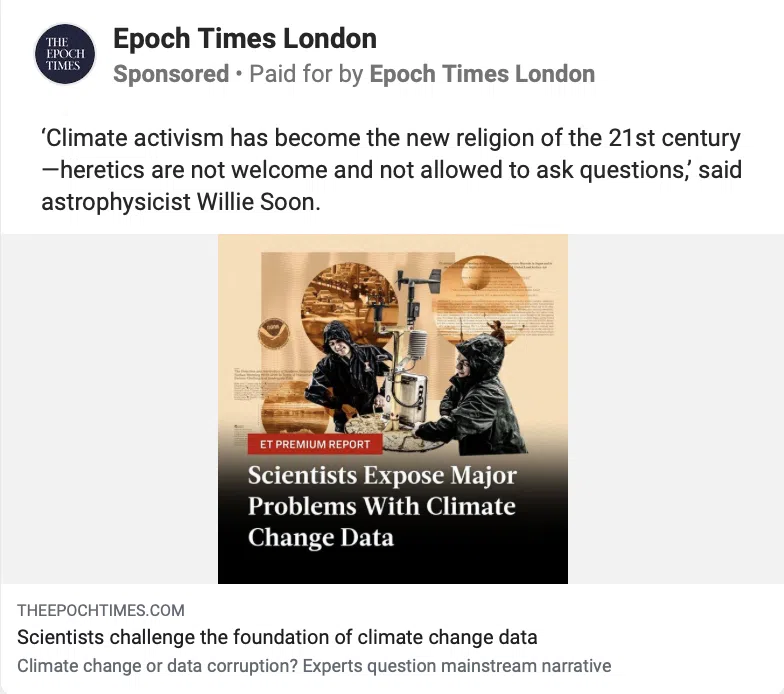
One advert entitled “Scientists Expose Major Problems With Climate Change Data” was linked to an Epoch Times article that claimed climate change can be best explained by “natural variation”. The article also said that attempts to create a scientific consensus around human-caused climate change are the product of “deliberate fraud” according to “some experts.”

The same article quoted Willie Soon, a scientist who has cast doubt on climate science and who has openly admitted accepting research funding from fossil fuel interests.

A number of the Epoch Times London adverts suggested that the consensus on climate change is based on a wilful misinterpretation of evidence by the scientific community, asking questions such as “Climate change or data corruption? Experts question mainstream narrative.”

DeSmog’s analysis found that Epoch Times London ran at least 392 unique adverts on Meta since the start of the year that attacked or attempted to undermine climate science, green energy, or climate action.

Of those adverts, 146 were still active prior to DeSmog contacting Meta. According to an analysis of Meta’s ad archive, Epoch Times London has spent between £12,600 and £51,715 on its anti-climate advertising since the start of the year, with those adverts having been seen between 1.9 million and 2.5 million times. Meta has now blocked Epoch Times London’s ability to post adverts.

According to Companies House, Epoch Times London was incorporated in 2014. The publication drew criticism in the UK in 2020 for posting free editions of its paper to Brighton and Hove residents, the front page of which included claims that the Chinese Communist Party had deliberately covered up evidence of COVID-19’s existence. 

Following complaints from constituents, Lloyd Russell-Moyle, the Labour MP for Kemptown in Brighton, publicly criticised the Epoch Times in the House of Commons and called on Royal Mail to stop posting its print edition.

Epoch’s European Operations

Elsewhere in Europe, DeSmog has seen evidence of anti-climate advertising from Epoch Times-affiliated accounts. 

The most prolific source of these adverts has been the German Epoch Times account on X, which has run 61 anti-climate adverts since the beginning of the year, reaching at least 1.5 million people and appearing 3.2 million times on X feeds across the German-speaking world. 

Of the adverts that made a funding declaration, all stated that they were paid for Epoch Times Europe Gmbh, a company that has existed in Germany since at least 2009 according to the country’s company register. 

A number of these adverts directly questioned the role of CO2 on climate change, saying that “CO2, especially anthropogenic emissions, hardly play a role”, “Climate change: CO2 not to blame”, “Climate change is too complex to blame on CO2”, and “CO2 is the most expensive fraud in history.”

While there were fewer ads run on Meta in Germany than in the UK, they still generated at least 100,000 impressions, representing an ad spend of between €1,500 and €3,777. 

An account run by German Epoch Times journalist Erik Rusch has also run at least 24 anti-climate adverts since its creation in January – though the adverts state that they were paid for by Rusch. 

Some of the adverts run by Epoch Times Germany suggested that wind turbines produce nefarious health effects, including claims such as, “Don’t ignore the health effects: Doctor warns against wind turbines”, and “Wind energy under scrutiny: Dr Bellut-Staeck on the low-frequency risks to humans and animals.”

One of the German adverts quoted Fritz Vahrenholt, who is a scientific advisor to the UK’s leading climate science denial group, the Global Warming Policy Foundation (GWPF).

Other adverts promoted by the German Epoch Times, as well as Epoch Times London, quoted fellow GWPF advisor Richard Lindzen. In one of these adverts, Lindzen was quoted as saying: “If we could get rid of 60 percent of CO2, we would all be dead.” 

Germany Epoch Times adverts also linked back to articles on its website, directing readers to the claim by climate science denier John F. Clauser that the perceived climate threat is a “dangerous corruption of science.” 

Another advert quoted Lindzen as asking, “Is climate change the existential threat we’ve been led to believe?” and linked to an Epoch Times interview with Lindzen on its YouTube series “American Thought Leaders”. 

Former UK Prime Minister Liz Truss was recently interviewed on this series, while a parallel series, “British Thought Leaders”, has interviewed a number of climate science deniers. Since the beginning of March, this series has featured Martin DurkinRupert Darwall, and GWPF advisor Gwythian Prins. These interviews were headlined: “The Science Simply Does Not Support the Ridiculous Hysteria Around Climate At All”, “This Obsession With Carbon Dioxide Emissions Has Led to Tragedy”, and “The World Is at War – The West’s Green Policies Are Playing Into Our Enemy’s Hands”.

Epoch Times Bulgaria has posted three anti-climate ads since the beginning of the year, one of which was entitled “scientists alarmed that there is no real evidence that CO2 is causing climate change”.

Meta has pledged to take action against false narratives on climate change, and the platform has committing to using a “suite of tools, such as fact checking and labels, to help combat climate misinformation.”

In May 2021, Facebook said that it would begin attaching informational labels to posts about climate change, directing users to the platform’s new “Climate Science Information Center”.

However, research conducted in 2022 by the Center for Countering Digital Hate found that Facebook is failing to flag at least half of climate misinformation content.

“Despite claiming to take climate misinformation seriously, Meta has a history of allowing climate disinformation posts with high-engagement to go unchecked,” said Ilana Berger, senior climate and energy disinformation researcher at the misinformation watchdog Media Matters. “If Meta is committed to combating climate disinformation on its platform, it must at the very least consistently enforce its existing policies.”

Meanwhile, following his takeover of Twitter in 2022, Elon Musk has slashed the number of staff who identify harmful content and misinformation. X did not respond to DeSmog’s request for comment.

“Climate misinformation threatens all of our futures – and with elections pending across Europe, the stakes could not be higher,” said Richard Wilson, director of the campaign group Stop Funding Heat. “But the same money that is fuelling this problem could also be the key to a solution. If enough advertisers speak out, and urge Facebook and Twitter to stop climate lies being promoted through their platforms, they will have to clean up their act.”

Original article by Joey Grostern republished from DeSmog.

Continue ReadingPro-Trump Platform Promotes Climate Science Denial Ads to Millions Across Europe

Keeping 1.5 alive, phasing out fossil fuels and tackling climate inequality must be priorities for COP28 climate talks

Spread the love

As the COP28 climate talks begin today in Dubai, the Green Party has set out three key demands. They are to ‘keep 1.5 alive’; an agreement on the fair and managed phase-out of all fossil fuels; and measures to address ‘climate inequality.’ Greens are challenging the UK government to lead by example and put into practice policies that will help meet these demands. 

Image of the Green Party's Carla Denyer on BBC Question Time.
Image of the Green Party’s Carla Denyer on BBC Question Time.

Co-leader of the Green Party, Carla Denyer, said:  

“We need to hear a clear unambiguous commitment from the UK government to the 1.5C Paris Agreement target which was signed up to by 196 countries eight years ago at COP21. The government must agree to whatever it takes to get this target back on track. It’s going to require a hugely ambitious strategy, but the massive scaling up of climate action that is now necessary is because of dither and delay by countries like the UK in taking the bold action needed. 

“Another vital outcome of COP28 must be the fair and managed phase-out of all fossil fuels. As one of the rich countries most responsible for the climate crisis, the UK must stand on the side of future generations and those on the front line of climate breakdown and agree to urgently move away from fossil fuels. The UK government must resist pressure from the petrostates and others at COP who wish to continue with business as usual and keep the world hooked on fossil fuels. At home this means leading by example with an immediate end to all new oil and gas licences and a rapid acceleration towards renewable energy. 

“Thirdly, these climate talks must recognise that it is a super-rich elite who are super-heating the planet. The UK government must be willing to challenge the grotesque inequality driving climate breakdown and reform our tax system to make the polluter pay. This means taxing the wealth of the super-rich and introducing a carbon tax on the most polluting corporations and individuals. Such taxes, introduced globally, could generate the funds needed for a generous new Loss and Damage Fund to finance climate action in the poorest countries – those suffering the most from the impacts of climate breakdown but contributing the least to the crisis.” 

Continue ReadingKeeping 1.5 alive, phasing out fossil fuels and tackling climate inequality must be priorities for COP28 climate talks

6 reasons why global temperatures are spiking right now

Spread the love
Jonas Weckschmied/Unsplash

Andrew King, The University of Melbourne

The world is very warm right now. We’re not only seeing record temperatures, but the records are being broken by record-wide margins.

Take the preliminary September global-average temperature anomaly of 1.7°C above pre-industrial levels, for example. It’s an incredible 0.5°C above the previous record.

So why is the world so incredibly hot right now? And what does it mean for keeping our Paris Agreement targets?

Here are six contributing factors – with climate change the main reason temperatures are so high.

1. El Niño

One reason for the exceptional heat is we are in a significant El Niño that is still strengthening. During El Niño we see warming of the surface ocean over much of the tropical Pacific. This warming, and the effects of El Niño in other parts of the world, raises global average temperatures by about 0.1 to 0.2°C.

Taking into account the fact we’ve just come out of a triple La Niña, which cools global average temperatures slightly, and the fact this is the first major El Niño in eight years, it’s not too surprising we’re seeing unusually high temperatures at the moment.

Still, El Niño alone isn’t enough to explain the crazily high temperatures the world is experiencing.

2. Falling pollution

Air pollution from human activities cools the planet and has offset some of the warming caused by humanity’s greenhouse gas emissions. There have been efforts to reduce this pollution – since 2020 there has been an international agreement to reduce sulphur dioxide emissions from the global shipping industry.

It has been speculated this cleaner air has contributed to the recent heat, particularly over the record-warm north Atlantic and Pacific regions with high shipping traffic.

It’s likely this is contributing to the extreme high global temperatures – but only on the order of hundredths of a degree. Recent analysis suggests the effect of the 2020 shipping agreement is about an extra 0.05°C warming by 2050.

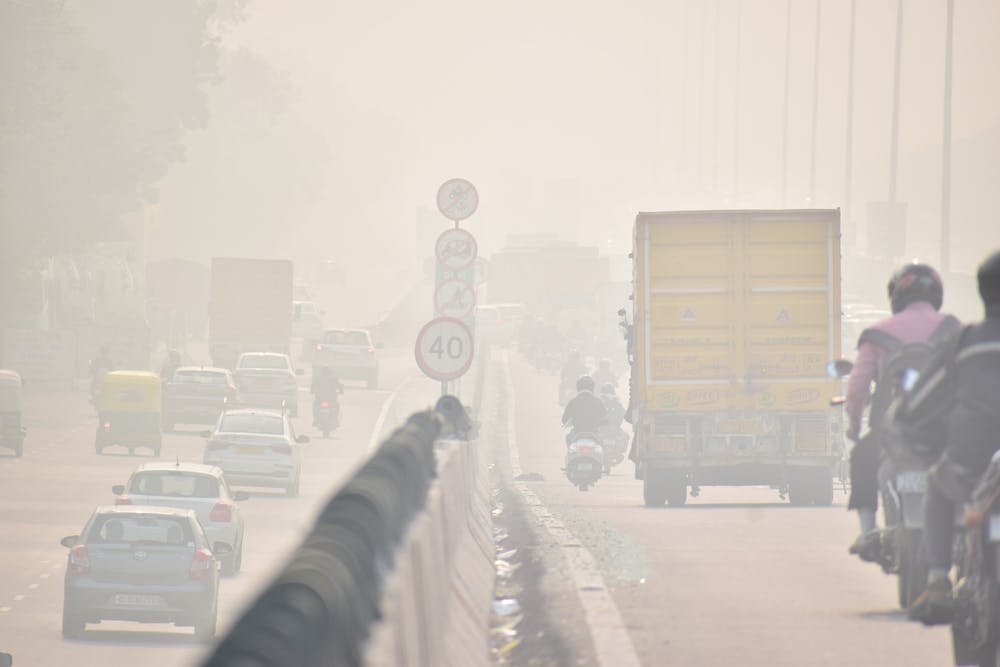
A smog shrouded road with motorcycles, trucks and cars barely visible through the pollution
People pass through the rising pollution on the Delhi-Jaipur Expressway in Gurgaon, Haryana, India, on November 12 2021.
Shutterstock

3. Increasing solar activity

While falling pollution levels mean more of the Sun’s energy reaches Earth’s surface, the amount of the energy the Sun emits is itself variable. There are different solar cycles, but an 11-year cycle is the most relevant one to today’s climate.

The Sun is becoming more active from a minimum in late 2019. This is also contributing a small amount to the spike in global temperatures. Overall, increasing solar activity is contributing only hundredths of a degree at most to the recent global heat.

4. Water vapour from Hunga Tonga eruption

On January 15 2022 the underwater Hunga Tonga–Hunga Haʻapai volcano erupted in the South Pacific Ocean, sending large amounts of water vapour high up into the upper atmosphere. Water vapour is a greenhouse gas, so increasing its concentration in the atmosphere in this way does intensify the greenhouse effect.

Even though the eruption happened almost two years ago, it’s still having a small warming effect on the planet. However, as with the reduced pollution and increasing solar activity, we’re talking about hundredths of a degree.

5. Bad luck

We see variability in global temperatures from one year to the next even without factors like El Niño or major changes in pollution. Part of the reason this September was so extreme was likely due to weather systems being in the right place to heat the land surface.

When we have persistent high-pressure systems over land regions, as seen recently over places like western Europe and Australia, we see local temperatures rise and the conditions for unseasonable heat.

As water requires more energy to warm and the ocean moves around, we don’t see the same quick response in temperatures over the seas when we have high-pressure systems.

The positioning of weather systems warming up many land areas coupled with persistent ocean heat is likely a contributor to the global-average heat too.

6. Climate change

By far the biggest contributor to the overall +1.7°C global temperature anomaly is human-caused climate change. Overall, humanity’s effect on the climate has been a global warming of about 1.2°C.

The record-high rate of greenhouse gas emissions means we should expect global warming to accelerate too.

While humanity’s greenhouse gas emissions explain the trend seen in September temperatures over many decades, they don’t really explain the big difference from last September (when the greenhouse effect was almost as strong as it is today) and September 2023.

Much of the difference between this year and last comes back to the switch from La Niña to El Niño, and the right weather systems in the right place at the right time.

The upshot: we need to accelerate climate action

September 2023 shows that with a combination of climate change and other factors aligning we can see alarmingly high temperatures.

These anomalies may appear to be above the 1.5°C global warming level referred to in the Paris Agreement, but that’s about keeping long-term global warming to low levels and not individual months of heat.

But we are seeing the effects of climate change unfolding more and more clearly.

The most vulnerable are suffering the biggest impacts as wealthier nations continue to emit the largest proportion of greenhouse gases. Humanity must accelerate the path to net zero to prevent more record-shattering global temperatures and damaging extreme events.The Conversation

Andrew King, Senior Lecturer in Climate Science, The University of Melbourne

This article is republished from The Conversation under a Creative Commons license. Read the original article.

Continue Reading6 reasons why global temperatures are spiking right now

Dramatic climate action needed to curtail ‘crazy’ extreme weather

Spread the love

https://www.theguardian.com/environment/2023/aug/28/dramatic-climate-action-needed-curtail-extreme-weather

Heatwaves, wildfires and floods are just the ‘tip of the iceberg’, leading climate scientists say

‘Crazy off-the-charts records’: has humanity finally broken the climate?

Canadian wildfire 2023
‘Crazy off-the-charts records’: has humanity finally broken the climate?Canadian wildfire 2023

The “crazy” extreme weather rampaging around the globe in 2023 will become the norm within a decade without dramatic climate action, the world’s leading climate scientists have said.

The heatwaves, wildfires and floods experienced today were just the “tip of the iceberg” compared with even worse effects to come, they said, with limitations in climate models leaving the world “flying partially blind” into the future.

“We need to stop burning fossil fuels,” said Dr Friederike Otto at Imperial College London. “Now. Not some time when we’ve allowed companies to make all the money they possibly can.”

Prof Emily Shuckburgh at the University of Cambridge in the UK said: “Anyone in any way perpetuating the fossil fuel era is firmly on the wrong side of history.”

“Knowing that we will look back on today’s extreme events as mild relative to what lies in our future is truly mind-boggling,” said Prof Andrea Dutton at the University of Wisconsin-Madison, US. “The speed at which we make this transition will define the future that we get.”

https://www.theguardian.com/environment/2023/aug/28/dramatic-climate-action-needed-curtail-extreme-weather

Continue ReadingDramatic climate action needed to curtail ‘crazy’ extreme weather

World’s largest asset managers block climate action 

Spread the love

https://www.energymonitor.ai/finance/sustainable-finance/worlds-largest-asset-managers-block-climate-action-amid-anti-esg-backlash/

Fresh analysis of asset managers’ 2022 proxy voting patterns reveals the world’s largest investors are backsliding on climate-related votes, mainly in the energy sector.

By Polly Bindman

While 2022 was the hottest year on record for a number of countries globally, the world’s largest asset managers’ progress on climate action has cooled. 

Investors filed a record number of shareholder resolutions relating to environmental and social issues during 2022’s proxy season. However, new analysis by non-profit ShareAction of how US, UK and European asset managers voted on these resolutions reveals that those with the biggest influence worked to block a number of key climate votes last year. 

The overall share of support across surveyed investors for environmental or social resolutions (filed mainly in the US, with a handful from other countries) increased from 60% in 2021 to 66% last year, but this was mainly down to a surge of supportive votes from asset managers in Europe, where sustainability disclosures are tightening.

Overall, the total number of supportive votes from US and UK investors barely changed between 2021 and 2022. Worryingly, the data reveals how the world’s four largest asset managers – BlackRock, State Street Global Advisors, Vanguard Group and Fidelity Investments – have worked to block key climate votes going through. 

This is particularly notable within the energy sector, where the world’s largest asset manager, BlackRock, went from supporting 72% of such votes in 2021 to just 16% in 2022.

https://www.energymonitor.ai/finance/sustainable-finance/worlds-largest-asset-managers-block-climate-action-amid-anti-esg-backlash/

Continue ReadingWorld’s largest asset managers block climate action