A protester is seen in Los Angeles during a climate change demonstration holding a placard that says, “There is no Planet B.” (Photo by Ronen Tivony/SOPA Images/LightRocket via Getty Images)
“Seven of nine planetary boundaries are transgressed, and pressure on all seven is at its highest recorded level,” said one scientist.
Like other recent warnings from climate scientists, the message sent by the latest Planetary Health Check report on Monday was clear: “We need to move fast,” as the director of the Potsdam Institute for Climate Impact Research, the group behind the report, said.
“Seven of nine planetary boundaries are transgressed, and pressure on all seven is at its highest recorded level,” said Johan Rockström, director of the Potsdam Institute (PIK).
The report finds that seven measures of the Earth’s health are no longer within the “safe operating space”: ocean acidification, freshwater change, land system change, climate change, modification of biogeochemical flows, introduction of novel entities, and change in biosphere integrity.
Just two markers, stratospheric ozone depletion and the increase in atmospheric aerosol loading, have shown improvement over the last decade, said the Planetary Boundaries Science Lab at PIK.
Today, we launched the Planetary Health Check 2026. Seven of nine Planetary Boundaries are transgressed, and pressure on all seven is at its highest recorded level. Yet, we still have a window to change course. But we need to move fast.https://t.co/QQM6PKOQSf
“The diagnosis is unambiguous,” said Boris Sakschewski, the lead author of the report. “Pressure is rising across every planetary boundary already outside the safe operating space. It means that the risk of large-scale, persistent, and potentially irreversible change is increasing, while our margin for error in tackling these problems is shrinking.”
The scientists behind the report emphasized that with recent news regarding the state of the planet’s crucial coral reefs, forests, and extreme weather events like heatwaves and flooding, it should come as no surprise that the Earth’s boundaries have been transgressed, as continued fossil fuel emissions have caused runaway planetary heating.
Earlier this month, United Nations scientists said the planet can no longer avoid at least a temporary temperature rise above 1.5°C over preindustrial levels.
Oceans have also become so warm that stressed coral reefs have less and less time to recover from climate damage, as Common Dreams reported last month, and a UN report last year found that the world’s governments are not moving fast enough to end the destruction of forests.
Last month and the summer of 2026 both set heat records, with extreme heatkilling more than 1,000 people across Europe, and wildfiresspreading across the continent and Canada. Record-breaking heat was also recorded in parts of Asia and the Middle East.
In June, the UN Children’s Fund found that nearly every child on Earth is now exposed to at least one climate hazard driven by fossil fuel emissions, including flooding, heatwaves, and drought.
“Pakistan’s 2025 monsoon floods affected more than 6.9 million people,” said PIK. “Global ocean heat content reached a new record in 2025, with Hurricane Melissa rapidly ramping up to a Category 5 hurricane and striking Jamaica after passing over exceptionally warm seas. From January 2023 to September 2025, bleaching-level heat stress impacted about 84.4% of the world’s coral reef area, making it the largest global coral-bleaching event observed to date.”
Hindou Oumarou Ibrahim, chair of Planetary Guardians, implored readers of the Planetary Health Check report to “read that list again: Pakistan, the Caribbean, Europe, the reefs beneath our oceans. These are not separate emergencies; the planet is telling us, in every region at once, that it is out of balance.”
“As chair of Planetary Guardians, I hear this same story wherever I go, whether from a pastoralist watching the rains fail season after season or a coastal community watching the sea rise,” said Ibrahim. “The 2026 Planetary Health Check puts data behind what communities on the frontlines already know from living it. We do not have the luxury of treating these as separate crises any longer.”
Rockström emphasized that while “we do not have the luxury of time… we do have the knowledge, capacity, and solutions to change course.”
“Accelerating action to return to the safe operating space across all planetary boundaries is essential to protect lives and livelihoods,” said Rockström, “and to deliver on the promise of shared future prosperity.”
Donald Trump urges you to ignore facts and reality and be a Climate Science denier like him. He says that he makes millions and millions for destroying the planet, Burn, Baby, Burn and Flood, Baby, Flood.Orcas comment on killer apes destroying the planet by continuing to burn fossil fuels.Climate science denier Donald Trump confirms that he knows nothing about democracy and that more liquid gold is being secured according to his policy of global privateering.
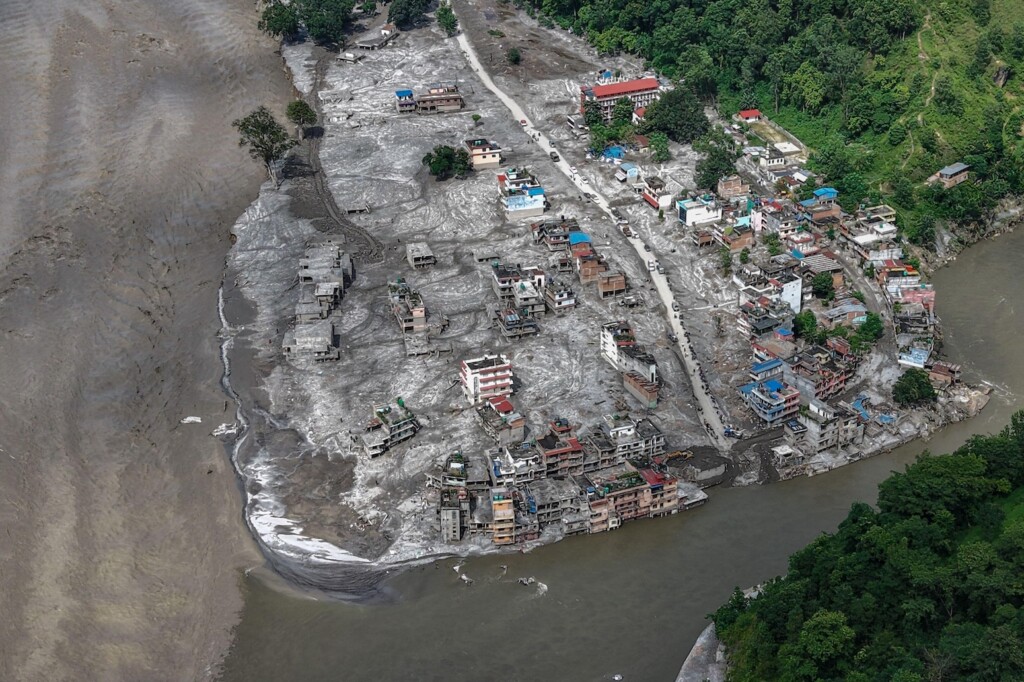
An aerial view of Devighat Bazaar in Nuwakot, Nepal, following the floods of 26 August 2026. Credit: ZUMA Press / Alamy Stock Photo
Can the event be attributed to climate change?
On the morning of 26 August, flash floods surged through a Himalayan border region of Nepal and the Chinese region of Tibet, killing more than 1,300 people, with thousands still missing.
In the days since the floods, scientists have examined satellite imagery, drone footage and seismic data in order to understand and explain the forces behind the event.
While initial theories pinned the flood on a glacial collapse, scientists now understand the event as a “multi-hazard cascade”, which began with a bedrock collapse.
Some climate sceptics have tried to use this to falsely claim that human-caused climate change had no impact on the event.
Yet, scientists havenoted that, while no formal attribution study has been carried out thus far, warming is making such ice-rock avalanches in the region more likely.
Researchers have highlighted how rapid warming is dramatically reshaping Asia’s high-mountain region – and identified rising temperatures, glacier retreat and permafrost thaw as factors that may have all contributed to the disaster.
Balendra Shah, Nepal’s prime minister, has called the floods a “serious signal that…the risks we must bear in the Himalayan region are increasing” due to climate change.
Here, Carbon Brief unpacks what scientists currently know about the causes of the catastrophic event and what they can – and cannot – say about the role of climate change.
A report published on 28 August by the HiRisk scientific consortium of high mountain experts detailed the events that led to the flash floods.
It said that events were set in motion on 26 August when a mass of bedrock, as well as the glacier ice on top of it, broke off a slope of Langtang-Lirung mountain in the Nepalese Himalaya, plunging from approximately 5,200 metres above sea level to the valley floor at 3,000 metres.
The landslide shook the ground hard enough that, at 8:37am Nepal local time, the US Geological Survey (USGS) initially reported a magnitude 4.4 earthquake. Later that day, it clarified the shaking was caused by glacier collapse and debris flow, equivalent to a magnitude 5.2 earthquake.
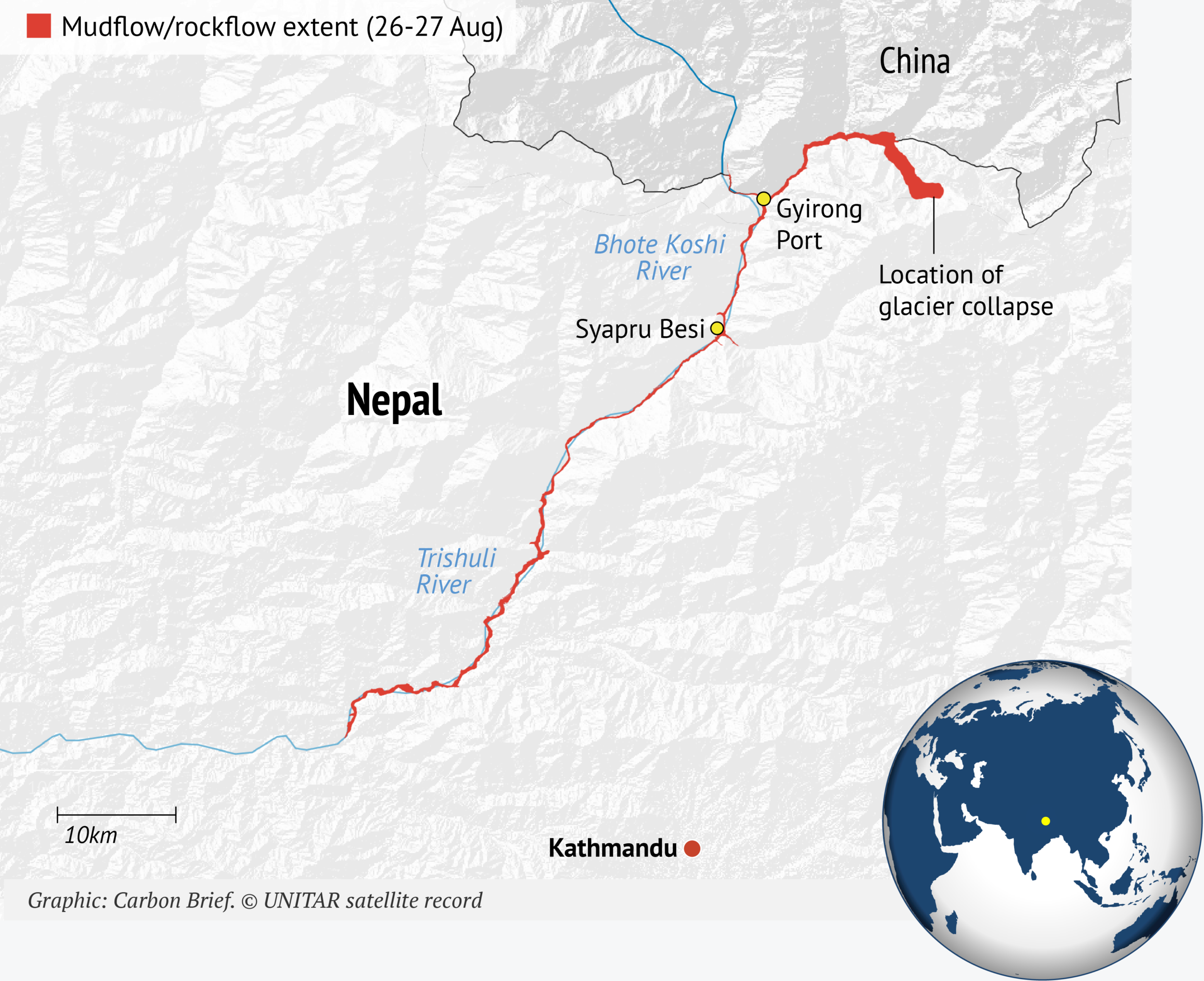
On the valley floor, the melting ice, water and debris slammed into the Lhende Khola river, a high-altitude river that runs along Nepal’s border with China.
Known downstream as the Bhote Koshi river in Nepal and the Poiqu or Poqu in China, the Lhende Khole feeds a network of rivers across Nepal and the Chinese region of Tibet, including the Trishuli river. (In China, the Lhende Khola is known as the Donglin Tsangpo.)
The designations employed and the presentation of the material on this map do not imply the expression of any opinion whatsoever on the part of Carbon Brief concerning the legal status of any country, territory, city or area or of its authorities, or concerning the delimitation of its frontiers or boundaries. Credit: Carbon Brief.
A large “debris” lake was briefly formed on the valley floor. When this lake burst, a wall of water and rock travelled downstream, killing more than a thousand people and destroying settlements, roads, bridges, hydropower plants and border posts across Nepal and Tibet.
HiRisk said that the floodwave travelled down rivers as fast as 30km an hour (around 19 miles per hour) and reached Mugling – a Nepalese town more than 130km downstream – at around 1pm local time.
A separate report from the Center for Land Surface Hazards in the US noted that the flood moved “exceptionally fast, was sediment-laden and extreme in scale”. For example, in the Nepalese municipality of Galchhi, the Trishuli river rose by nine metres in 30 minutes, it said.
He continued that a new “barrier lake” – estimated to hold a few million cubic metres of water – had developed in a location where two rivers meet in Tibet before crossing into Nepal. This lake burst on 28 August and the river rose again, he said.
On 4 September, the chief of Nepal’s National Disaster Risk Reduction and Management Authority, told Reuters that property and infrastructure worth “at least” $2.5bn (£1.9bn) had been lost. Dharma Raj Upreti estimated the cost to build roads and temporary shelters, provide drinking water and restore power would be around $53m (£39m).
How did bedrock collapse trigger the flash floods?
In the immediate aftermath of the floods, initial reports suggested that the trigger was a collapsing glacier or earthquake in the high mountains of Nepal.
After confirming that a seismic tremor was as a result of falling rock and ice, the USGS said the trigger was likely a “glacial collapse and debris flow”. This was widelypickedupby the media.
Subsequently, satellite imagery revealed that an “enormous chunk of the mountainous bedrock” beneath the glacier had also given way, reported the New York Times.
“It was not a glacier that collapsed. It was the mountain below the glacier that collapsed and the glacier had no other chance but to go with it because it was sitting on top of it.
“The trigger for that is something that we are not 100% certain about, but, in the end, it very much looks like simply a mechanical failure of the rock material because of stressors that have built up over a long period of time.”
Failures of “bedrock” – the hard, solid rock that sits below looser rocks and soil – are an “increasingly common occurrence”, says Prof Bethan Davies, a professor of glaciology at Newcastle University. She tells Carbon Brief:
“These massive landslides occur in mountain regions, commonly following rapid deglacierisation [the melting away of a glacier]. Similar events happened in the Chamoli event in 2021 [in the Indian Himalaya] and in the Blatten landslide last year in Switzerland. They’ve also occurredrecently in Alaska.”
With a shift in focus from the failure of a glacier to the bedrock underneath, some climatescepticsseized on the development to falsely claim that climate change had not played any role in the disaster.
However, scientists have highlighted the likely contribution of rapid warming in the region. These factors include the thawing of permafrost and glacier retreat. (For more, seesectionsbelow).
Fundamentally, “this would have been a much less significant tragedy if it had been just a rock-slope failure”, notes Davies.
The initial landslide took a mixture of rock and ice into a valley that “contains buried ice” as well, she says, providing the water that “resulted in the hyperconcentrated flow, which took so many lives”.
How have temperatures risen in the affected region?
Global temperatures have risen by roughly 1.4C since the pre-industrial period. However, this increase is not uniform across the planet, with some regions warming faster than others.
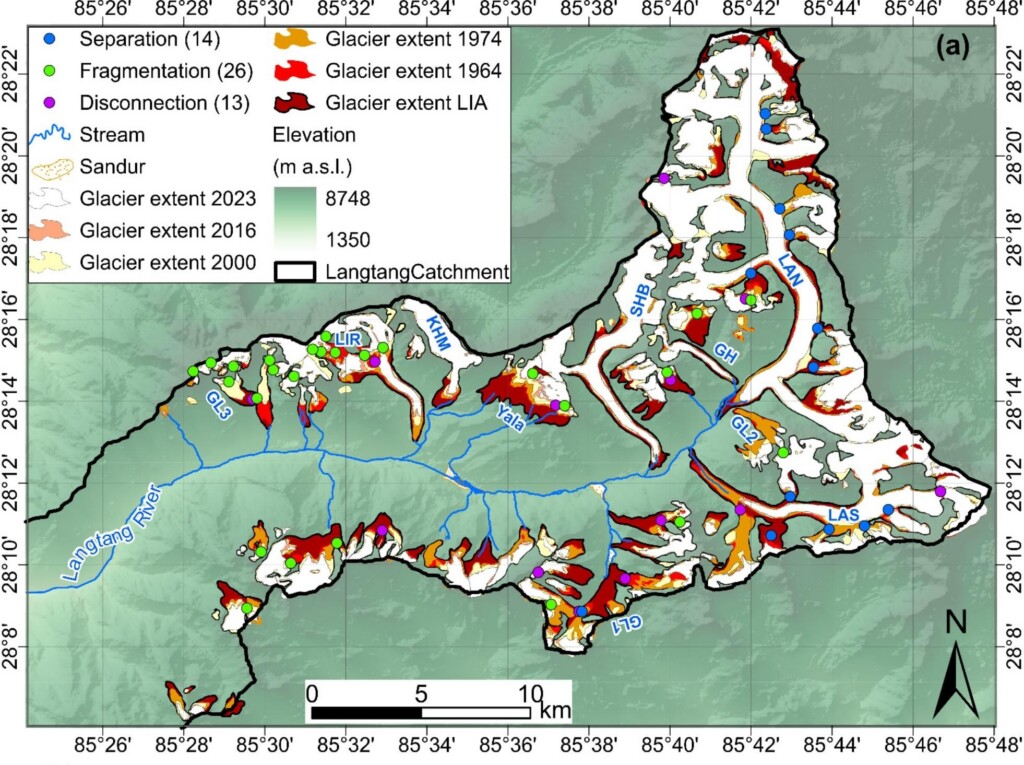
A study published in Global and Planetary Change in June 2026 investigated changes in the Langtang catchment – a river basin in central Nepal, in which the Langtang-Lirung mountain is located, which eventually drains into the Ganges. Around one-quarter of the area is made up of glaciers.
The paper found that glacial areas of the catchment – found at 4,000 metres above sea level – warmed at 0.31C per decade over 1960-2023. This was “more than three times” the rate observed at a lower elevation weather station, the authors said.
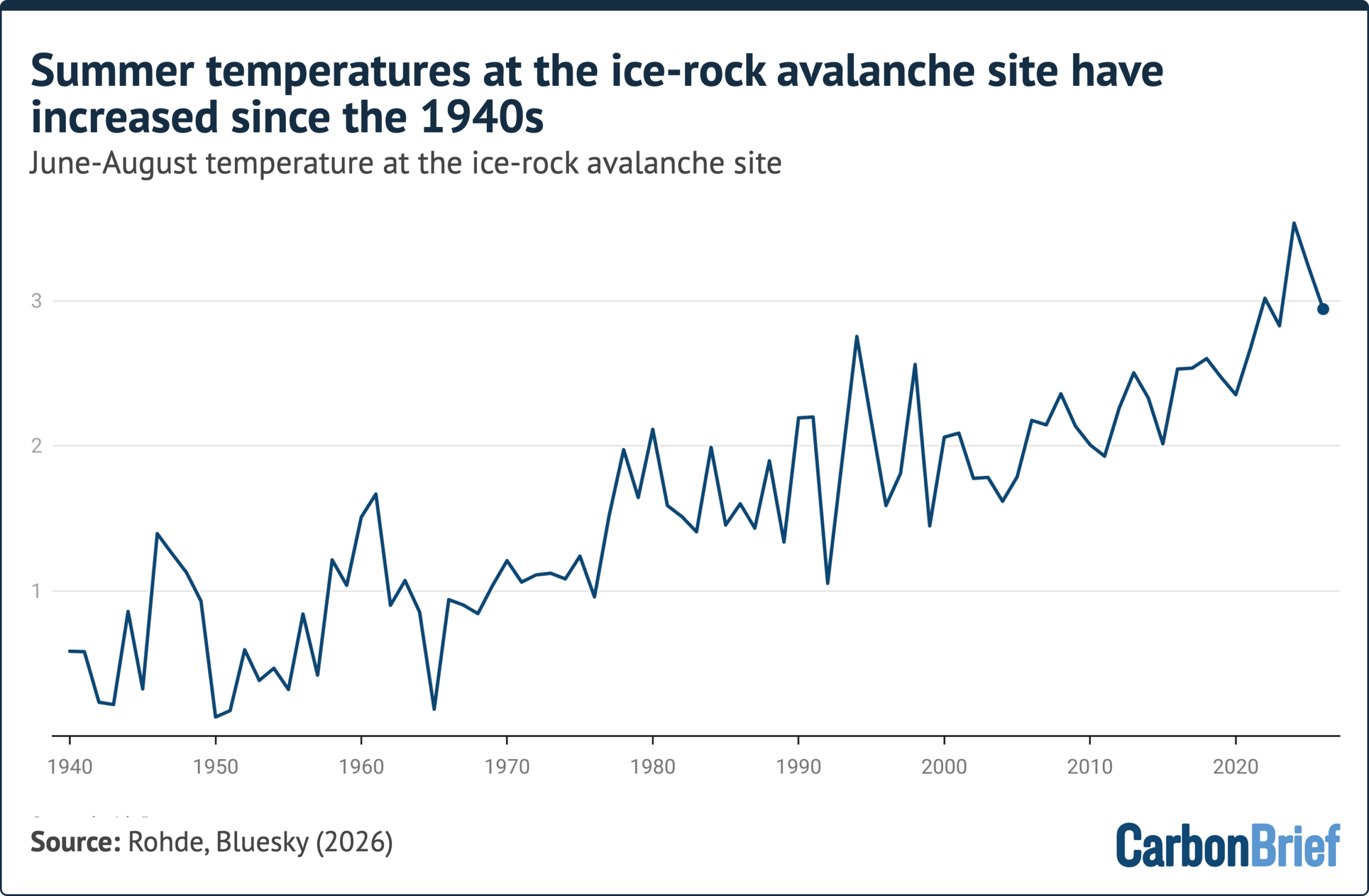
Looking in more detail at the site of the glacial collapse, Dr Robert Rohde, chief scientist for Berkeley Earth, used ERA5 reanalysis data to show how temperature has changed at the 5,200-metre elevation site where the mass of ice and rock broke loose.
Rohde’s analysis found that June-to-August temperatures have been rising at the site of the glacier collapse since the year 1940, with 2026’s summer the fourth warmest on record, behind 2024, 2025 and 2022. This is shown in the graph below.
Average summer (June-August) temperature at the ice-rock avalanche site over 1940-2026. Data source: Rohde, Bluesky (2026)
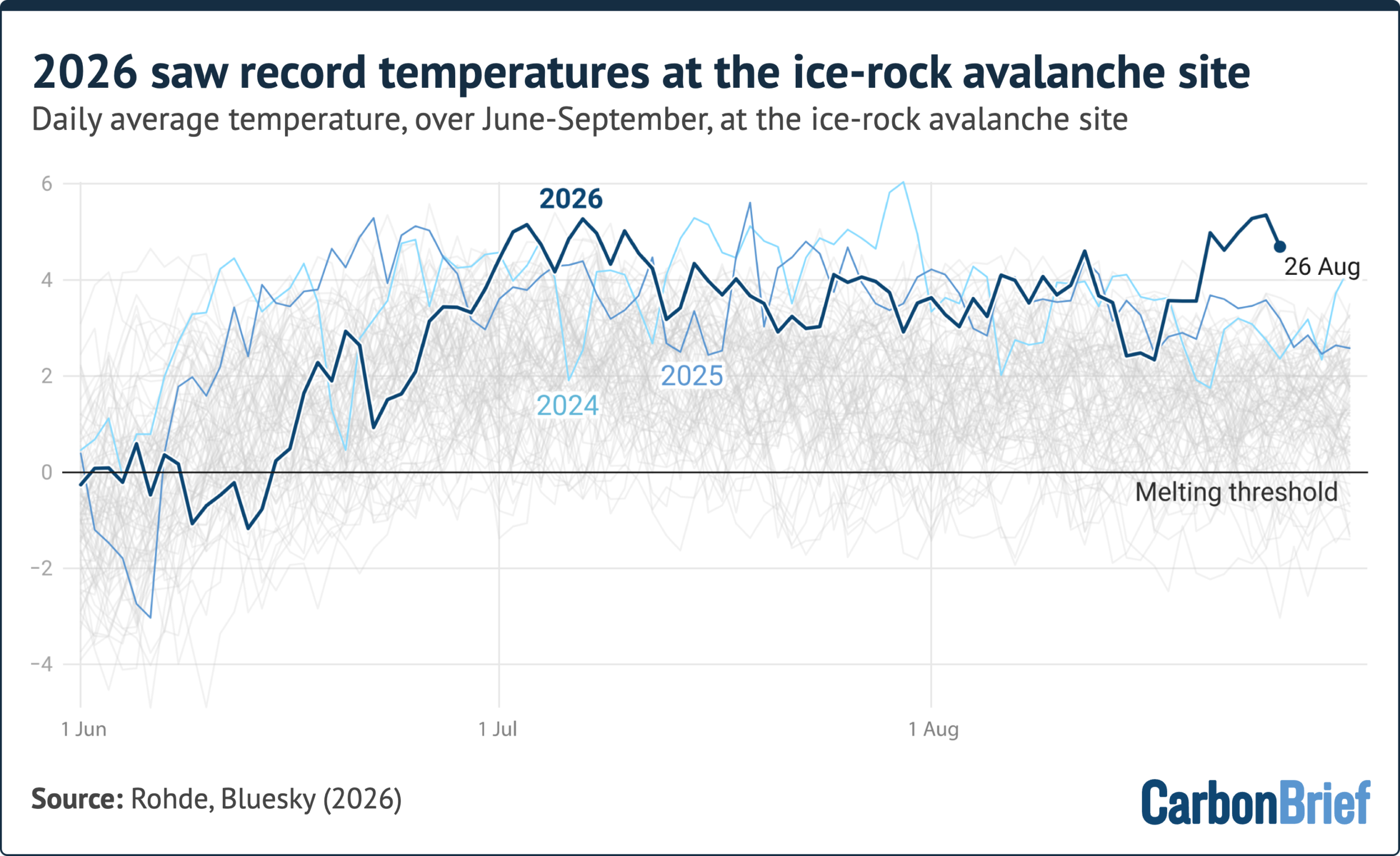
Rohde also found that the days leading up to the disaster recorded the hottest August temperatures ever experienced at the site. This is shown in the graph below.
Daily average temperature, from 1 June-1 September, at the ice-rock avalanche site. 2026, 2025 and 2024 are shown in dark, mid and light blue. All other years from 1940-2023 are shown in grey. Source: Rohde, Bluesky (2026)
“Given the warming trend, this Nepali glacier had probably been thinning and weakening for years, or even decades. But it ultimately failed during the warmest week in one of its warmest years on record. It would be a hell of a coincidence if global warming wasn’t at least partially to blame.”
How have rising temperatures affected mountain stability?
Many experts have linked warming temperatures in the region to thawing permafrost – ground that has been frozen for at least two consecutive years, whose thickness ranges from less than one metre to more than a kilometre.
Steiner is part of a research team that has been using sensors to monitor permafrost in the region since 2014. He tells Carbon Brief that it is “pretty clear” the permafrost has been thawing “very actively” at elevations as high as 5,200 metres above sea level “for many years”. He adds:
“This means that the ground has, over the last decades, moved from being in a solid state into – at least, periodically during the warm season – patchy ground where some is frozen and some isn’t…
“If you have frozen ground next to non-frozen ground, you have dynamics happening between that because there are different densities and there’s movement happening, which is conducive to interventional failure – and that we know from many other cases.”
Davies also points to the “degradation” of perennially frozen ground as a factor in the disaster:
“This permafrost acts as a glue to hold together the rocks and, as it melts, the rock can become weakened.”
Permafrost thaw can also result in saturated ground, says Davies, which adds “pressure in the joints” of rock and can “facilitate” failure. She continues:
“Sources of the water include melting permafrost and meltwater from the overlying glacier. We know that this event happened during a period of warmth, but in the absence of heavy precipitation, pointing to ice melt as the source of water.”
A 2025 study of rock and ice avalanches in High Mountain Asia found that more than two-thirds started in areas “where permafrost is probable”.
How have glaciers retreated in the affected region?
Glaciers – frozen rivers of ice holding three-quarters of the global freshwater supply – are extremely vulnerable to climate change.
In the Himalaya, the rate of glacier retreat has doubled since the late 20th century, according to a 2019 study in Science Advances.
The Global and Planetary Change study found that glacier area loss rates in the Langtang catchment increased more than fourfold from 1964 to 2023 – with melting accelerating after 2000.
It added that glaciers in the region also experienced “fragmentation” and “widespread thinning” over this period.
The study noted that this loss “coincided with elevation dependent warming”.
The figure below provides an overview of glacier loss in the Langtang catchment over 1964-2023, with orange, red and dark red indicating areas of retreat.
In addition, green dots note points of glacier fragmentation, while blue dots show separation and pink show disconnection.
Glacier loss in the Langtang catchment over 1964-2023. Orange, red and dark red indicate areas of retreat. Green dots note points of glacier fragmentation, while blue dots show separation and pink show disconnection. Credit: Silwal et al. (2026)
In comments released by the University of Reading, Prof Maria Shahgedanova, a climate scientist researching climate impacts on mountain glaciers, said that the glacier involved in the floods had “retreated by approximately 450 metres between 1990 and 2020”.
She adds that this “potentially reduce[d] the mechanical support provided by the glacier to the underlying rock slope”.
Speaking to Carbon Brief, Davies reiterates that the retreat of the glacier is “potentially a contributing factor” to the bedrock collapse and subsequent disaster.
This is because the removal of the glacier from the lower slopes leaves the “upper rock slopes less stable”, she says.
The most recent assessment by the International Centre for Integrated Mountain Development said that glaciers in the Hindu Kush Himalaya region are “rapidly shrinking” as a result of climate change. (This region extends 3,500km over Afghanistan, Bangladesh, Bhutan, China, India, Myanmar, Nepal and Pakistan.)
It said this loss is threatening the safety of the nearly two billion people, including by increasing the risk of “glacial lake outburst floods” (GLOFs). A GLOF is a sudden and catastrophic release of meltwater from a glacial lake.
Although this disaster was not caused by a GLOF, it is known that climate change is making such events more likely.
However, many climate scientists have cautioned that it is too early to say precisely how climate change impacted the disaster.
Davies tells Carbon Brief:
“These events happen so quickly that the exact causes and drivers can take a little time to uncover, especially if the event was a surprise and there had been no monitoring system in place.”
When trying to determine the role human-caused climate change played in the intensity or likelihood of extreme weather, scientists turn to the field of “attribution science”.
To date, no formal rapid attribution study has been produced that attempts to quantify whether – and how – climate change contributed to the event.
Scientists have noted that climate attribution of ice-rock avalanches – which are typically driven by a variety of factors – remains limited, in part because of the lack of a long-term observational record of previous collapses in high mountain areas.
Meanwhile, the studies that do exist stop short of directly linking such disasters to climate change. For example, the authors of a 2021 study into the Chamoli ice-rock avalanche concluded that “we cannot attribute this individual disaster specifically to climate change”.
However, they added, the “possibly increasing frequency of high-mountain slope instabilities can likely be related to observed atmospheric warming and corresponding long-term changes in cryospheric conditions (glaciers and permafrost)”.
In the aftermath of the disaster, many researchers have similarly highlighted that climate change could not be singled out as the cause of the disaster, even if warming likely increased the probability of its occurrence.
On the Climate Brink substack, Carbon Brief’s climate science contributor Dr Zeke Hausfather noted that a “definitive single-event attribution” of the more recent disaster “may never be possible” due to the “messy causality of rock-ice avalanches”.
However, he added that both the existing scientific literature and “essentially every scientist working on these hazards point in the same direction” – namely, that warming is making such events more likely in the Himalaya.
Steiner tells Carbon Brief it might be possible to attribute different factors that played a role in the disasters to climate change – for instance, the recession of the glacier – but it would be more difficult to do so for the event as a whole.
Part of the reason for this, he says, is that rock failures in this region of the Himalaya have occurred for millennia, well before humans started altering the climate.
However, he continues:
“The physics of it is not something that has been made possible by climate change. This could have happened without it. But the chance of it happening – and the likelihood of it happening five years after a previous, similar event [in Chamoli] – we, as the scientific community, can be pretty confident about that [being increased because of a changing climate].
“This is because so many of the changes that we know are related to climate change can potentially drive the build-up to eventual failure.”
Ultimately, says Davies, a “careful attribution study is needed, but it is hard to argue that the rapidly warming climate is not having an effect in these regions”. She adds:
“A single event may have multiple drivers, but we are seeing an increase in these events and are likely to see more as the permafrost and glacier melt continues.”
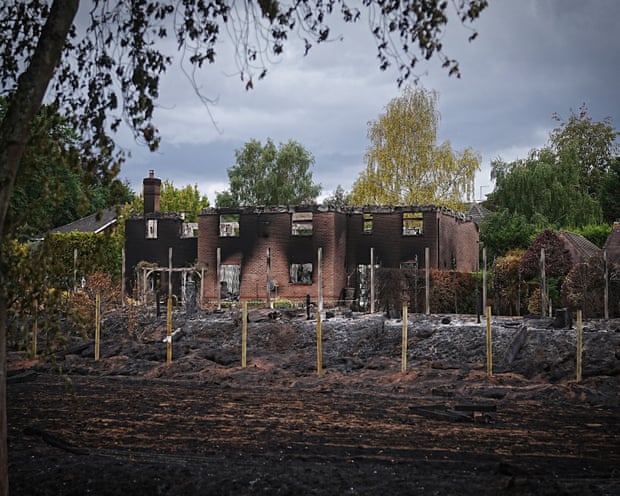
The fire-gutted remains of homes on Quarry Park Road on 17 August in Stourbridge, England after a wildfire that broke out across the West Midlands. Photograph: Christopher Furlong/Getty
Government resilience campaign aims to ensure people can cope in a national disaster, in order to free resources for most vulnerable
UK citizens will be told to stock up on tinned food and take steps to ensure they are prepared for national emergencies as part of a new government campaign to improve the nation’s resilience.
The new campaign from the Cabinet Office will set out ways people can prepare for and potential attacks from hostile states, including stocking up on bottled water, sources told the Guardian.
The aim will be to ensure most households have basic supplies and knowledge about how to cope in a crisis, in order to free up immediate government resources for the most vulnerable.
Translation by dizzy: The government wants you to stock up for when the shelves are empty caused by climate change – the long dry summer has decimated agricultural produce.
Donald Trump urges you to be a Climate Science denier like him. He says that he makes millions and millions for destroying the planet, Burn, Baby, Burn and Flood, Baby, Flood.Nigel Farage urges you to ignore facts and reality and be a climate science denier like him and his Deputy Richard Tice. He says that Reform UK has received £Millions and £Millions from the fossil fuel industry to promote climate denial and destroy the planet.Orcas comment on killer apes destroying the planet by continuing to burn fossil fuels.
As I have already noted today, The Times has chosen to question whether Chris Packham is really autistic, despite the fact that he has a diagnosis saying that he is. I have already discussed some aspects of this issue. I also think it is worth asking why they have done this.
I stress that question because I cannot know the motivation of those involved. I have no access to the editorial discussions at The Times, and I am not suggesting that I do. But newspapers make choices. They decide whom to feature, what questions to ask, which doubts to amplify and what associations they want their readers to make. So asking why Chris Packham has become a target is entirely reasonable.
There are, I think, several possible explanations, and they obviously overlap, creating a credible explanation as a consequence.
The first is that Chris Packham is becoming an important figure in British public life. He is no longer simply a television presenter who talks about wildlife. Increasingly, he appears to be assuming the mantle that Sir David Attenborough wore for decades.
That matters. Attenborough acquired authority because millions of people trusted him. He could talk about the destruction of the natural world in a way that politicians could not because people did not think of him as a politician. They thought of him as someone who knew what he was talking about.
Packham has some of that authority, but there is an important difference. He is more explicitly political. He does not simply say that a species is disappearing or that an ecosystem is under threat. He asks why that is happening, who is responsible and what we should do about it. That makes him potentially threatening to some powerful interests.
Packham is a prominent advocate of action on climate change. He challenges the fossil fuel economy. He questions environmentally destructive forms of agriculture. He supports environmental protest. More broadly, he challenges the idea that the pursuit of profit should take priority over the survival of the ecosystems on which human beings depend.
…
Chris Packham’s diagnosis tells us nothing about whether he is right about climate change. The evidence on climate change stands or falls on its own merits. If The Times, or anyone else, disagrees with what Packham says about the climate, biodiversity, fossil fuels or the environment, there is an obvious response available to them. They should challenge his arguments. But what they should not do is challenge who he is, or seek to undermine him, and others, by doing so. That is not just unethical, it provokes prejudice to support profit at cost to many.
We should not be surprised that profit is promoted at cost to many. That is what extractive capitalism does. That is not a flaw in its design. It is what it is designed to do. The well-being of millions and maybe billions of people have been sacrificed to that false god over decades and maybe centuries. But should Chris Packham be added to that list, to be discarded by being discredited because he asks awkward questions? I think not. And that is why this case matters.
At a press conference today, Zack Polanski delivered a ‘reality check’ to the Prime Minister as he sounded the alarm on the emergency of extreme heat and outlined three immediate actions he would take to tackle the crisis.
After highlighting the multiple threats we face – to our safety, our food and water supply, and our way of life – Zack called for action to keep people cool and safe, taxes on oil and gas giants to fund our fire services, and public ownership of water to end the failed experiment of privatisation.
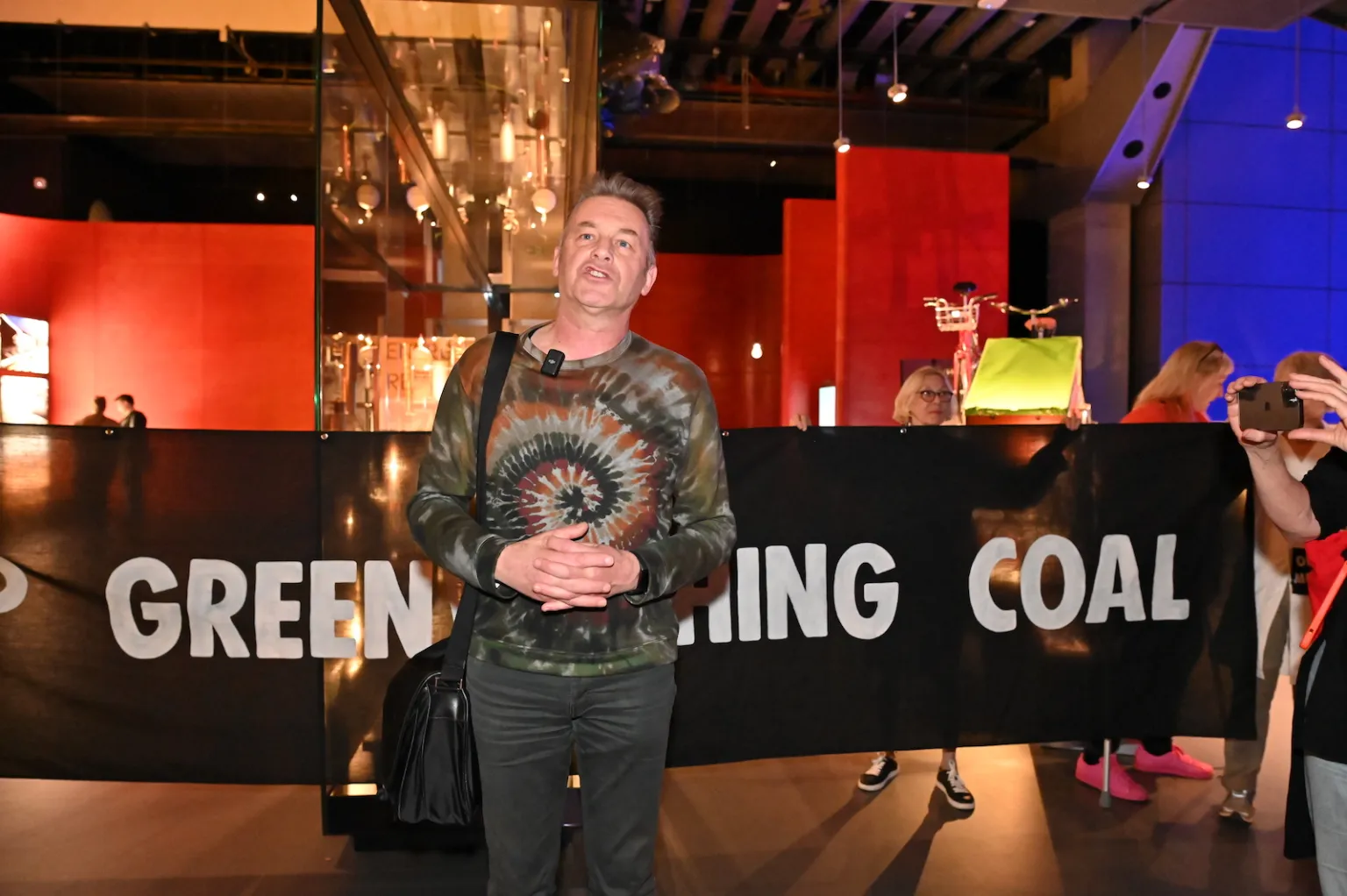
Zack was joined on stage by an ex-soldier and engineer, a doctor, and a firefighter, who described the consequences of extreme weather they had seen in their work – as well as broadcaster and environmental campaigner Chris Packham who warned of the present and future risks of the climate crisis.
“Trees reduced to charcoal”
Zack started his press conference with a vivid description of the consequences of the extreme heat that has hit the UK this year.
The day before he had witnessed the aftermath of the devastation caused by a wildfire in Oxfordshire.
“Trees reduced to charcoal. Cars turned to burnt out wrecks. The smell of smoke still lingering in the air, on the site of what was once a thriving local business – now reduced to ash.
“Wildfires. Literal scorched earth. And that looming sense that this is only the beginning.
“These days feel exceptional, but what we’re living through right now are likely some of the least extreme summer temperatures we’ll experience in our lifetimes.”
This is what climate failure looks like. Nature, homes and livelihoods are being destroyed. The Government must act now.
The week before, while a wildfire the size of two hundred football pitches was raging across Suffolk, Zack had called on the Prime Minister to urgently call a COBRA meeting to address the crisis.
Six days later, and with another heat alert having just ended, where is the Government response? There has been no COBRA meeting, no emergency briefing, no new plan.
And so Zack stepped up to challenge the Prime Minister to act.
“We are facing the biggest threat to this country since the Second World War”
His challenge to the PM started with a stark reality check: “We are facing the biggest threat to this country since the Second World War.”
“Extreme weather is now the new normal – and without action, the impact on the people of this country will be unimaginably grave.”
And Zack broke down exactly what that impact will be.
First, the threat to our safety.
The dangers of extreme heat to our health are very real – especially for older people and those with pre-existing conditions – forcing people to stay indoors for days on end, to try to wait out the heat.
Zack Polanski delivers ‘reality check’ to Burnham over ‘biggest crisis since WWII’ after summer of extreme heat
As Zack explained, “Almost three thousand people have died from the effects of extreme heat this summer.”
Those “whose bodies were under such intense strain in trying to stay cool that their hearts or kidneys could no longer cope.”
And then there are the fires – forcing hundreds to evacuate their homes, “while many thousands more wait anxiously with flames on the horizon and smoke in their lungs.”
And Zack pointed to Europe as a warning of how bad things can get.
“Hundreds of thousands evacuated. Half a million acres burnt.
“The sheer scale of the devastation is hard to comprehend. But we need to look it in the face – because this is only a taster of what’s to come if we don’t act now.”
Decimated crops, leaking pipes, and no new reservoirs since 1992
After the danger to our physical safety, the second threat Zack identified concerned the basis of any society: our food and water supply.
Half of England is currently experiencing serious drought, and eight of our water reservoirs are at risk of running dry.
“The threat is so severe”, Zack said, “that the UK’s national risk register warns that if we had three years of exceptionally dry weather like this, we could face water rationing.”
And what of the private water companies?
The private water companies that haven’t built a single new reservoir since 1992.
Well, they are losing nearly three billion litres of water a day from leaky pipes – or as Zack put it “five times more than a nationwide hosepipe ban would save”.
Our farmers and growers, meanwhile, are on the frontlines of climate breakdown – facing in turn the extreme rainfall and flooding of recent winters, and the extreme heat and drought of our summers.
Zack noted that despite farmers working through the nights to avoid the heat, food production has been hit by this chaotic combo of flooding and drought, and food prices are set to rise as a result.
“A threat to our way of life”
The third threat Zack named was far-reaching: the threat to our way of life.
“Parents unable to take their children to the playground because the slides are so hot it could burn their skin off. Temperatures so high they keep us inside for days for the sake of our health. Cities feeling like ghost towns. Parks turned into deserts.”
As climate change progresses – bringing more frequent, more damaging extreme weather – the way each of us lives our life will be more severely impacted.
Zack Polanski holds a press conference to deliver an urgent message to Prime Minister Andy Burnham. (Photo: Aldo Ciarrocchi)
And we don’t have to look far to see what may face us in the years ahead.
Zack pointed to the “apocalyptic” scenes of “Wildfires. Droughts. Deadly floods.” coming out of Europe, noting that the continent “is heating at twice the rate of the rest of the world.”
It is there for all of us to see.
And yet the response from the Government, and most of the media, has been to look the other way.
In Zack’s words: “It’s an astonishing dereliction of duty from those whose first responsibility is to keep us safe.”
Zack’s demands for action: cool spaces, water in public hands, and taxing oil and gas giants to fund fire services
The need for action is urgent.
And Zack set out immediate steps the Prime Minister could take “to protect people right now and keep us safe from what we know is coming down the track.”
“We need to keep people safe from extreme temperatures. That means a free, accessible cool space in every local area. And financial support for households to heatproof their home.”
Secondly, Zack called for a robust wildfire prevention strategy – and a fire service with the resources it needs to tackle blazes when they come.
“This should be funded,” Zack said, “by taxing the fossil fuel giants who are profiting from fuelling these infernos.”
And thirdly Zack called for public ownership of our water.
“To secure our water supply, prevent droughts and protect our food system we need to bring water back into public hands.”
“Every penny households pay for their water needs to go back into strengthening our infrastructure, building new reservoirs, and protecting us from the droughts of the future.”
Extreme weather is now the new normal.The Prime Minister must act like this is the emergency it is.
Zack’s message to the PM: “There can be no new drilling for oil and gas”
Before handing the microphone over to the assembled experts, Zack finished with a powerful message direct to the Prime Minister.
“If we are to secure a liveable future for our children and grandchildren, there can be no new drilling for oil and gas. On this, the science is crystal clear.
“As politicians, we have a moral responsibility to do what’s right for the people we serve, even when it’s not politically convenient.
“And I know that whatever our differences, we both care deeply about the people of this country – and the future of our world.
“So when the time comes, I hope you will have the courage to be truthful, be brave – and hold firm to your party’s commitment to no new oil and gas drilling in the north sea – including both Rosebank and Jackdaw.
“Some will say we can’t afford to make these changes. These last few weeks are showing we can’t afford not to.”
“A dereliction of duty”: four expert voices on extreme heat
Zack was followed by four speakers with unique expertise on the extreme heat emergency.
First up was Carl Benfield, a former soldier and engineer, who since leaving the military has turned his engineering expertise to the challenges posed by climate breakdown.
His view? “Climate change is the single greatest threat to human security that we face.”
And his conclusion on successive governments’ failure to prioritise this threat was damning: “A government’s first duty is to keep its citizens safe. Ignoring extreme heat and raging fires isn’t just complacency, it’s a dereliction of duty.”
He was clear about what’s required: “We need an immediate COBRA-level response. We need climate change reinstated at the top of our defence and security agenda. And we need the bold leadership of Zack Polanski for our nation.”
"Ignoring extreme heat and raging fires isn't just complacency. It's a dereliction of duty."Experts warn the climate crisis is already costing lives and urgent action from the Government is needed.
Next to speak was London firefighter James Rodgers.
His powerful testimony of a worker on the frontlines of extreme heat highlighted the immediacy of the crisis, and how rapidly the conditions in which firefighters work are changing due to extreme heat.
“When people talk about climate change, they often talk about the year 2050. I’m a firefighter and I want to talk about now.”
“Because for firefighters, climate change isn’t a prediction. It’s a shift we are already working.
“Climate change is the fire call to multiple back gardens alight, children’s clothing burning on the washing line.
“Climate change is the acrid smell as you affect entry into a flat because someone has succumbed to heat stroke and hasn’t been checked on in weeks. Climate change is the sound of people in floods of tears when they are stuck in a lift 20 floors up in 30 degree heat.
“Climate change is the taste of dust in your dry mouth, watching a fire sweep uncontrollably across a park you used to play football in as a child in your summer holidays. Climate change is this becoming a day to day reality. ”
Dr Veena Aggarwal speaks at the press conference on the emergency of extreme heat. (Photo: Aldo Ciarrocchi)
Next was Dr Veena Aggarwal, a GP in Bristol and the Climate and Sustainability Co-Lead and Clinical Adviser at the Royal College of GPs.
She emphasised the growing danger to health, and – as with the fire services – the extreme pressure placed on health services by the heat:
“As a GP, I’ve been seeing firsthand the health impact of the recent heat waves.
“Ambulances are so stretched we couldn’t get an ambulance for a patient with sepsis or another one with very low oxygen levels, because the ambulance service was so completely overwhelmed.
“The London Ambulance Service saw its busiest ever day during the heatwave in June, on 26th June. That’s even busier than the days at the height of the Covid pandemic emergency.
“We’re seeing people having more asthma attacks; having flares up of their chronic lung disease so extreme they need to be in hospital; more people having heart attacks, strokes; or having falls and collapsing due to the heat, especially those who are frail and more vulnerable.”
Dr Aggarwal also highlighted the impact of the heat on staff and patients in NHS buildings, the human cost of the heat waves, and the need for immediate action.
“An extra almost 3000 deaths occurred within just one week in June during the heatwaves. That’s almost double what was recorded in that season in 2025. In Europe those deaths are 14,000 in that same period.
“We need to act now. The climate crisis is a health crisis.”
Chris Packham speaks at the press conference on the emergency of extreme heat. (Photo: Aldo Ciarrocchi)
The final speaker was broadcaster and nature campaigner Chris Packham.
Chris was excoriating in his appraisal of the Government and media’s response to the climate crisis.
Citing the same death figures as Dr Aggarwal, he said “If these deaths had been the result of terrorism or a pandemic, the Government would have cancelled its summer holiday.
“There would have been COBRA meetings, and there would have been public information campaigns the likes of which we saw during Covid, designed to protect us in this time of crisis.”
“And yet what do we get?
“We get rumours of possibly more drilling for oil and gas, and we get articles in the Telegraph suggesting we ought to adapt to a Mediterranean climate…
“If that isn’t reckless and irresponsible, I don’t know what is.”