Awesome, unexpected and unforgettable: a sudden bolt of silver as a tuna jumped clear of the sea. Nobody else saw it, and I (Angus Atkinson) almost thought I was hallucinating. But since I first saw one from a boat just off the south Devon coast ten years ago, Atlantic bluefin tuna have steadily increased in the southwest UK. Last year I even saw them from the shore, and tuna now supports a local fishery.
Tuna is not the only species to make a rapid change in the southwest UK about a decade ago. Blue, thresher and porbeagle sharks suddenly increased dramatically. Spiny lobsters suddenly increased. Meanwhile basking sharks and many important fish species like cod and pollack declined. What is going on?
Fortunately, in the southwest UK, help is at hand. Not only does this peninsula host some of the most complete long-term recordings of observations in the UK, we also have a burgeoning network of marine observers.
This was the brainchild of marine consultant Bob Earll, who 15 years ago set up a network called South West Marine Ecosystems. This links scientists, marine charities, fishermen, conservation trusts, managers and citizen scientists many of whom have natural history skills to match the best. This network enables members to more easily share observations and recordings about marine life.
Alongside established high-tech and long-term monitoring such as at the Western Channel Observatory (a set of sampling sites at sea within a 30-mile-radius from Plymouth), many pairs of eyes are looking at the sea along the entire coast of this peninsula. Each year we meet and put data together to report on the status of everything in the marine ecosystem, whether it swims, crawls or flies, and from nutrients right up to the numbers of stranded whales.
South West Marine Ecosystems’ annual reports and annual conferences put the previous year’s observations into the context of all that has gone before. That includes strange new events such as the 2025 octopus outburst. This near-real time reporting, with everyone comparing notes, provided a lightbulb moment: these species shifts were not continuous but seemed to be concentrated into a short intense period of massive change around 2014 to 2016.
In the southwest UK, tuna have increased to the extent that they support a tightly regulated fishery, with a UK catch quota of 230 tonnes for 2026-28. Fishing is always an emotive subject, and some people say we should be leaving these beautiful animals alone.
Kayakers have a close encounter with tuna while photographing marine wildlife off the coast of Devon in 2024.
A recent announcement by the Marine Stewardship Council (MSC) offers some hope that tuna fisheries worldwide are moving in the right direction.
The MSC endorses those seafood sources that have been harvested sustainably, meaning that they abide by the rules of well-managed fisheries based on scientific advice, with minimal collateral ecological damage. This most recent announcement shows an important positive result: the proportion of tuna products available with an MSC endorsement has just risen to nearly 50%, compared to less than 20% only five years ago.
Remarkably, tuna has just overtaken cod as the main seafood bought in the UK. This probably reflects the increasing availability of more sustainably-sourced tuna and sharply declining cod stocks.
A state of flux
Managing these fisheries involves treading that tightrope between allowing livelihoods for the fishing industry, but allowing the whole ecosystem to flourish. The challenges of climate change, shifting distributions and fishing pressure combine into a real headache to manage fisheries responsibly.
Abrupt shifts in ecosystems, as we have witnessed in the southwest of the UK, are critical for fisheries management. In just a few years an ecosystem can lurch into a different operating space with different species and links.
Computer simulation models of ecosystems can broadly project how food webs might respond to the average pace of climate change. Importantly, these models are notoriously poor for predicting abrupt shifts, often known as regime shifts, that punctuate the steadier pace of change.
With these challenges, fisheries managers need all the help they can get to understand abrupt ecosystem shifts. The tuna increase was well documented by South West Marine Ecosystems. The success of this network means that similar programmes are spinning up around the other coasts of the UK.
Similar initiatives are underway elsewhere. The Norwegian Institute of Marine Research provides a data network from public reporting of jellyfish increases, which are important for the management of Norwegian aquaculture.
Joined-up science efforts like South West Marine Ecosystems, alongside long-term scientific monitoring studies and, of course, traditional fish stock assessments, will help us know better whether tuna should stay on the menu.
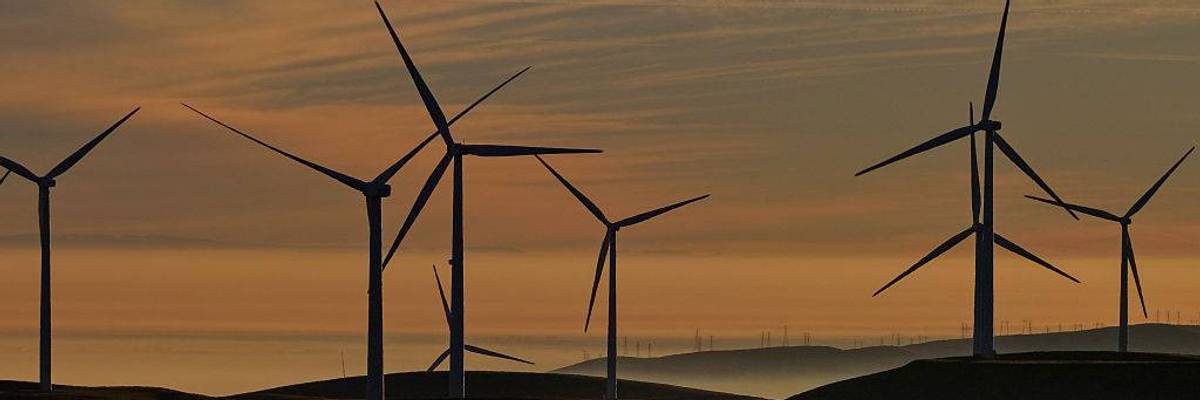
Wind turbines seen at the Altamont Pass wind farm on January 13, 2026 in Livermore, California. (Photo by Justin Sullivan/Getty Images)
“The most corrupt presidency ever—and it’s not even close,” said one critic.
Critics slammed the Trump administration on Monday after it announced a deal to pay almost $1 billion to a French energy company to cancel its plans to construct wind farms across the eastern US.
As reported by The New York Times, French firm TotalEnergies has agreed to forfeit its leases in federal waters off the coasts of New York and North Carolina, and will instead invest the money it received from the Trump administration into oil and gas projects in the US, “including a facility in Texas that would export liquefied natural gas to global markets.”
TotalEnergies paid nearly $928 million for the rights to access federal waters during former President Joe Biden’s administration.
The Times described the agreement as “an extraordinary transfer of taxpayer dollars to a foreign company for the purposes of boosting the production of fossil fuels, a main driver of climate change, while throttling offshore wind power.”
Patrick Pouyanné, the chief executive of TotalEnergies, said that the firm decided to abandon its US wind farm plans due to “practical” considerations, while emphasizing that the firm wasn’t giving up on wind power all together.
“When the Trump administration came to power and began setting US energy policy, we said that we’ll have to reconsider, clearly, these offshore wind project developments,” explained Pouyanné, adding that “we continue to invest in onshore solar, onshore wind, batteries.”
Many critics expressed disbelief that the Trump administration would go to such extraordinary lengths to kill a clean energy project, especially after the president sent oil and gasoline prices soaring earlier this month when he launched an unprovoked and unconstitutional war with Iran.
“Let’s call this what it is: a taxpayer-funded bribe to kill homegrown clean energy and hand the money straight to oil and gas executives,” wrote climate advocacy organization Evergreen Action in a social media post. “Trump is once again making Americans pay more for energy so his Big Oil donors can rake in even more profits.”
Melanie D’Arrigo, executive director of the Campaign for New York Health, expressed a similar sentiment.
“$1 billion of our tax dollars to kill a clean energy program that creates jobs, just so Trump’s Big Oil donors can make more profit,” D’Arrigo wrote. “The most corrupt presidency ever—and it’s not even close.”
Matt Gertz, senior fellow at press watchdog Media Matters for America, argued that the agreement was a corrupt bargain aimed at hurting the president’s political foes, including the Democratic leaders of New York and North Carolina.
“Climate/renewables arguments aside, this is the president’s administration paying a foreign company to invest in states where Republicans are in charge rather than ones where Democrats are in charge,” Gertz wrote, “using tax dollars to punish people who didn’t vote for his party.”
US Sen. Lisa Blunt Rochester (D-Del.) said that the deal to kill the planned wind farms was yet another example of the Trump administration making life in the US less affordable.
“This administration just spent $1 BILLION of your money to make sure wind farms don’t get built,” Blunt Rochester wrote. “You’’ll have them to thank for higher electric bills each month.”
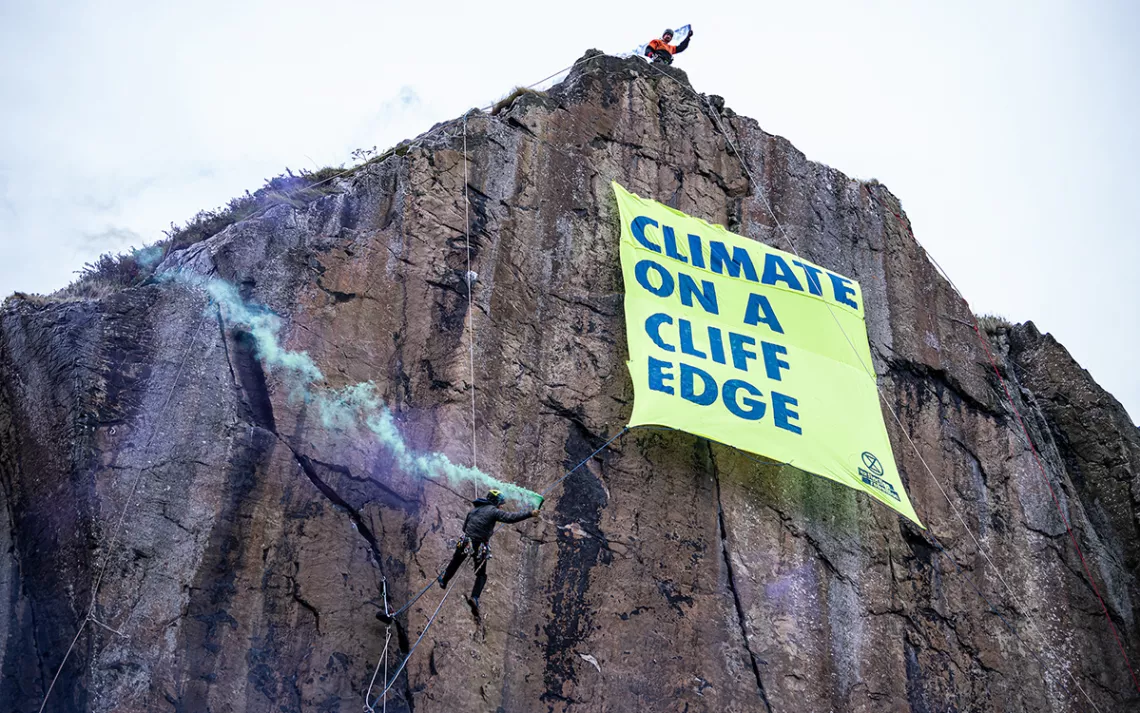
Neo-Fascist Climate Science Denier Donald Trump says Burn, Baby, Burn.Experienced climbers scale a rock face near the historic Dumbarton castle in Glasgow, releasing a banner that reads “Climate on a Cliff Edge.” One activist, dressed as a globe, symbolically looms near the edge, while another plays the bagpipes on the shores below. | Photo courtesy of Extinction Rebellion and Mark RichardsDonald Trump warns against following the Onaquietday.org blog, says that he’s heard that she’s a which with a black cat and a dangerous kitchen.
Policymakers, civil society, investors, business, and the media all must answer key questions fast — before the regulatory rollback turns into a rout.
The European Union’s package of major corporate environment and sustainability laws was years in the making — and has just been quietly gutted.
A debate that reshaped corporate Europe unfolded almost entirely within Brussels policy circles. Millions of Europeans who believe climate action should be prioritised and favour greater corporate accountability never realized the regulations were under threat.
This should prompt serious reflection among those of us who believe that the climate and human rights focus of the regulations was deadly serious, but that support among politicians was not.
The so-called “Omnibus” rollback — a regulatory rationalisation ascribed to competitiveness concerns amid pressure from the United States – has exempted 90 percent of Europe’s companies from climate reporting. In parallel, supply chain reporting has been seriously watered down and postponed until the end of the decade.
The overturned rules included mandatory reporting by most EU companies of their impact on climate change, and how environmental dangers could affect their business. They also forced companies selling products on the continent to report on child and forced labour issues, as well as potentially dangerous working conditions in their international supply chains.
In today’s economy, corporate lobbyists seize moments of regulatory weakness to ram home anti-growth or relative competitiveness arguments that instantly gather financial and political support.
Indeed, the printer ink had barely dried on the official publication of the EU Omnibus — finalised this month — before companies started attacking the EU’s 20-year-old Emissions Trading System (ETS) carbon pricing regime on similar international competition grounds.
If we don’t quickly digest the lessons of the Omnibus debacle, sterner tests will come as populists challenge for power across the bloc.
Why Was the Rollback Invisible?
Why was the European public largely unaware of such a huge regulatory rollback?
The reason is that it took place in a legacy media vacuum. No major polling organisation measured citizen awareness. The BBC, The Guardian, Le Monde, and Der Spiegel barely — if at all — covered the vote.
Further, how can we support and defend policies when we hide them behind letter jumbles like CSRD, SFDR, CSDDD — acronyms that mean nothing to the public? (The Corporate Sustainability Reporting Directive, Sustainability Finance Disclosure Regulation, and Corporate Sustainability Due Diligence Directive, respectively.)
Fluency in Brussels acronyms becomes a political liability when success requires public mobilisation.
Campaigns succeed with vivid phrases that citizens quickly understand. Surveys consistently show that large numbers of Europeans support corporate accountability when it’s described in plain language. Germany’s “Supply Chain Law” campaign gathered over 200,000 supporters by using a clear, native-language label.
No comparable EU-wide branding effort for the sustainable finance regulations emerged. Defenders of the EU sustainability rules never attempted an equivalent translation.
By contrast, industry lobbyists framed their arguments with accessible language such as “simplification” and “cutting red tape,” while pushing the convenient elements of the Draghi report on EU competitiveness. Advocates countered with “transposition deadlines,” “ESRS requirements,” and “regulatory coherence.” The contrast was decisive.
Post-defeat reflection on this communications failure has been nearly non-existent.
Green Groups: Bureaucratised and Compromised?
Typically, the rallying call to voters on environmental and rights regulations comes from non-governmental organisations (NGOs). In the case of the EU climate and sustainability Omnibus, more than 360 NGOs and other civil society organisations signed a coalition statement against the “disastrous” and “dangerous” deregulation.
Over the decades, many European climate and human rights groups have evolved into Brussels-based policy shops that are staffed by lawyers and technical experts fluent in EU procedure, but which seem to be relatively poorly equipped for mass public and political campaigning.
Their efforts produced no mass protests, no breakthrough petitions, and no broad public mobilisation.
Some NGO funding structures appear to reinforce this limitation. Major foundations often restrict grants against “political or partisan activities,” while EU funding frameworks have introduced reputational-risk benchmarks that discourage confrontational advocacy. Funders also often seek short-term results to long-term problems that require deep, structural change, not “hope-for-the-best” strategy thinking.
A coalition spanning 27 countries that relies on consensus decision-making could not move quickly. The NGOs deployed the only tools their structures supported: letters, technical briefings, and procedural complaints. The limitation was not a strategic choice; it was institutional.
Big-spending corporate lobbyists, meanwhile, began organising months before public announcements on the Omnibus were made. In addition, the accelerated legislative timeline of the Omnibus compressed the opposition response time from multiple years to less than one, leaving opponents flat-footed.
ExxonMobil alone is reported to have had more than 25 meetings with the European Commission to lobby against the CSDDD, and allegedly threatened to withhold $20bn in renewables spending in Europe if it was not rolled back.
We hear there have been reflections by major NGOs on what went wrong. To stop mistakes from recurring, the publication of these learnings is essential.
Why Doesn’t Capital Defend Itself?
Institutional investors representing €6.6 trillion in assets had strong financial incentives to oppose the Omnibus. Their risk analysis was clear: Stranding of major fossil-fuel assets would likely accelerate without transition planning; weakened disclosure rules would leave investors short of necessary climate information; regulatory uncertainty would stall long-term investment; and Europe would forfeit advantages in green technology.
Citizens’ pensions and long-term savings could face potential portfolio-wide losses if systemic climate risks go unmanaged.
Investors wrote detailed letters explaining these dangers.
Then they watched the regulations collapse.
They did not mobilize beneficiaries, fund public campaigns, or coordinate with the 362 NGOs in the field. The UN-backed Principles for Responsible Investment, the huge investor environment, sustainability and governance (ESG) coalition, could only muster a hundred or so of its 5,000-plus investors to sign a letter warning against a serious unravelling of the regulations. Many of the heavyweight investors in its ranks weren’t there.
The failure reveals a deeper structural problem: Even when capital’s interests align with regulation, financial institutions often lack the political capacity and institutional mechanisms to defend those interests against coordinated opposition.
Why Didn’t Progressive Business and Labour Fight?
Allies with different tools and constituencies struggled to convert shared positions into effective action.
Eighty-eight companies — including Unilever, Mars, Nestlé, Ferrero, DP World, and Primark — signed letters opposing the rollback and acknowledged that customers demanded consistent sustainability standards.
Why didn’t they also launch consumer campaigns, threaten relocation, withdraw from trade associations backing deregulation, or apply coordinated market pressure?
Competitive dynamics discouraged unilateral action by business, and company executives feared appearing overtly political during an ESG backlash. Meanwhile, trade associations often lobbied in the opposite direction.
Trades unions showed similar restraint. Despite representing tens of millions of workers, major confederations limited their involvement largely to signing coalition letters.
Unions excel at domestic workplace negotiations but often struggle with international supply chain issues and EU-level regulatory processes. When industry framed the debate as “regulation kills jobs,” unions faced an apparent dilemma between global labour protections and local employment security.
Did the Regulation Work?
Businesses and investors respond to clear regulatory signals. They rarely get out ahead of politics or the market without a strong policy or pricing foundation to lean on.
One of the overarching responses we’ve heard from business and finance professionals to the Omnibus policy rollback is that the EU regulatory approach in its Action Plan on green and sustainable finance suffered from a “first principles” problem, skewing heavily towards bureaucratic solutions for policy or incentives problems.
Many told us, for example, that the EU was not prepared to put the budget stimulus alongside hard regulations to seize the future green technology opportunity. Instead, they opted for a lower cost, weaker, reporting-led investment approach (more data encourages more finance) where actual green output (business R&D, investment flows) may be slow or unclear.
This risks creating a sort of Potemkin Village of climate and sustainability progress, because reporting and compliance solutions cannot replace market drivers such as incentives, infrastructure, or price signals.
Some of these issues are being addressed, but they have been long in the amendment, despite concerns being raised.
To work, reporting frameworks require a clear, gradual shift in rules or pricing that can surmount competition barriers by underpinning market shifts.
Without it, data collection and research are costly and lack an underlying economic “materiality” (policy push, pricing, time-horizon). They quickly become a comparative drag.
The addition of important but complicated regulations, like supply chain reporting, then gets scapegoated as a further cost to EU companies in globally competitive markets. Bureaucratic overreach is easily lobbied against on competitiveness grounds. Policy row-back then becomes itself highly disruptive, creating a cycle of negativity.
Rationalising data points for corporate reporting and focusing, for example, on the biggest corporate CO2 emitters, as the Omnibus proposes, are not in themselves problematic reforms.
But it is vital to ensure that policy is smart, joined-up, backed by developments in the real economy, competitive, and road-tested for outcome.
This will be key to embedding regulations that align with the capital spending decisions that companies are already taking (according to EU data) as a result of the EU’s green taxonomy for sustainable activities.
How Should We Understand the Authoritarian-Fossil Fuel Alliance?
The Omnibus was not a result of routine corporate lobbying. It reflected a broader geopolitical alignment.
Corporate actors, political movements, and transnational advocacy networks converged around shared economic and ideological interests. Months before public announcement, extensive lobbying campaigns began, leveraging substantial financial resources to coordinate messaging across institutions.
This alignment shifted the terrain from a conventional policy dispute to a power asymmetry.
Civil society coalitions and institutional investors faced opponents with larger budgets and stronger political backing. Investor inaction and NGO limitations become more understandable in this context: The imbalance was structural, not incidental.
We need to reflect deeply on this and what it means for EU sustainability regulations.
Europe’s Own Leverage: What Can Still Work?
The Omnibus outcome is not final. The EU rules can be improved and made to work with the right public and business support, political will, and technical know-how.
Member states can move ahead independently, setting stronger national standards like Germany’s Supply Chain Law, which companies must meet to access their markets. The EU can lean in to sustainability initiatives via issues of global security, energy transition, and justice.
The economic momentum favours transition: Renewable energy capacity continues to expand and market trends are rewarding low-carbon shifts.
Practical paths forward include coordinated member-state regulation, economic-sovereignty instruments tied to market access, judicial challenges, cross-sector coalitions among cities and businesses, and clearer public narratives that link sustainability to competitiveness and security.
Europe’s regulatory influence remains significant when it acts decisively. Large markets can still set de facto global standards. But to get there we need to start answering these hard questions.
Donald Trump urges you to be a Climate Science denier like him. He says that he makes millions and millions for destroying the planet, Burn, Baby, Burn and Flood, Baby, Flood.Nigel Farage urges you to ignore facts and reality and be a climate science denier like him and his Deputy Richard Tice. He says that Reform UK has received £Millions and £Millions from the fossil fuel industry to promote climate denial and destroy the planet.Elon Musk urges you to be a Fascist like him, says that you can ignore facts and reality then.
Large parts of the UK are experiencing relentless rainfall, with some places seeing rain for 41 consecutive days and counting. In Reading, in the south east of England, our university’s official rain gauge has recorded precipitation on 31 consecutive days – unprecedented in records stretching all the way back to 1908.
The pattern has not just made 2026 a bit dreary. It also reveals one way in which climate change is making the already naturally variable (some would say gloriously variable) British weather increasingly extreme.
In those 31 days, Reading has received 141mm of rain, compared to the 30-year average over that period of just 58mm – well over twice what we would expect at the time of year.
Higher than average rainfall totals are expected, well, half of the time. This is just how mean averages work. But it’s the nature of this current weather pattern that is so unusual, and is in keeping with the type of wetter winter situation for UK weather that climate scientists have been warning us to expect – even if we are still only just learning why exactly this is happening on a regional level.
Over the full breadth of a British year, the bigger picture is even more revealing. Last year, the UK was grappling with one of the hottest and driest summers on record. A succession of hot spells, combined with long periods that saw less than average rainfall, meant water supplies dwindled and widespread hosepipe bans were put in place.
As a whole, 2025 from spring onwards was exceptionally dry. Fast forward to the new year, and we’re facing the opposite – weeks of rainfall and flooding. These extremes are what we expect to see in this part of the world, as heat builds up in the global atmosphere and oceans. For British people, this is what climate change right now feels like.
More rain, more intense rain
What is causing this link between a warmer planet and wetter British winters? One fundamental link is in basic physics of the atmosphere as temperatures rise. Warmer air can hold more moisture – about 7% more for every one degree celsius of warming. This means that when it rains, on average it rains harder. Bigger, heavier downpours become more common.
Climate change is also disrupting the patterns of currents and cycles within the atmosphere and oceans that bring the UK much of its weather. As an island archipelago on the edge of three competing climate masses – the wet, mild Atlantic, the cold, dry Arctic, and the wildly variable temperatures of the Eurasian landmass – it is used to variability.
But one constant feature plays an oversized role in the type of weather we get: the jet stream – a ribbon of fast-flowing air high in the atmosphere. The position of the jet stream makes a big difference. Sometimes it flows to the north of Scotland, sometimes it is hundreds of miles further south towards Spain. This location matters, because the jet stream helps to blow whole weather systems – think of a big “bubble” of air carrying its own weather with it – from the Atlantic towards the UK.
Currently, the jet stream is positioned further south than typical for the time of year, steering consecutive wet and often windy weather systems directly towards the UK. At the same time, a high pressure system is sitting over parts of northern Europe, blocking the wet weather from moving further east.
The impact of climate change on the jet stream is complex, because this river of air circling the north pole from west to east is influenced by a lot of different factors. One thing we do know: the Arctic, at surface level, is warming faster than other parts of the planet. This means that the temperature difference between the poles and the equator, for air at lower levels at least, is not as big as it used to be. This may be influencing the jet stream to weaken and meander.
With less energy to push them along, these weather patterns can get stuck in one location, meaning that the systems of low air pressure associated with rainfall and storms can slow down or get stuck. When a system bringing rain parks itself over the UK for days on end, only to be followed by another system, and another, the result is relentless rainfall.
To complicate things further, high up in the atmosphere where the jet stream blows, climate change is actually making the temperature difference between equator and poles increase. This may be strengthening the speed and turbulence within the jet stream itself, and just adds to a complex picture of varying influence on UK rainfall.
The challenge of managing extremes
These rapid swings between drought and deluge pose serious practical challenges for everyone in the UK. Water companies must plan for both droughts and floods, even within the same year. Farmers face uncertain growing conditions, with crops rotting in the wet soil one month, and drying out in droughts a few months later. Infrastructure designed for the climate of the past may not cope with the extremes of the future.
Understanding these changes isn’t just an academic exercise. It’s essential for helping communities, businesses and governments prepare for what’s coming. As Britain experiences these climate extremes at first-hand, it is crucial to build resilience into plans for hotter and drier summers, and warmer wetter winters.
Nigel Farage urges you to ignore facts and reality and be a climate science denier like him and his Deputy Richard Tice. He says that Reform UK has received £Millions and £Millions from the fossil fuel industry to promote climate denial and destroy the planet.Donald Trump urges you to be a Climate Science denier like him. He says that he makes millions and millions for destroying the planet, Burn, Baby, Burn and Flood, Baby, Flood.Elon Musk urges you to be a Fascist like him, says that you can ignore facts and reality then.
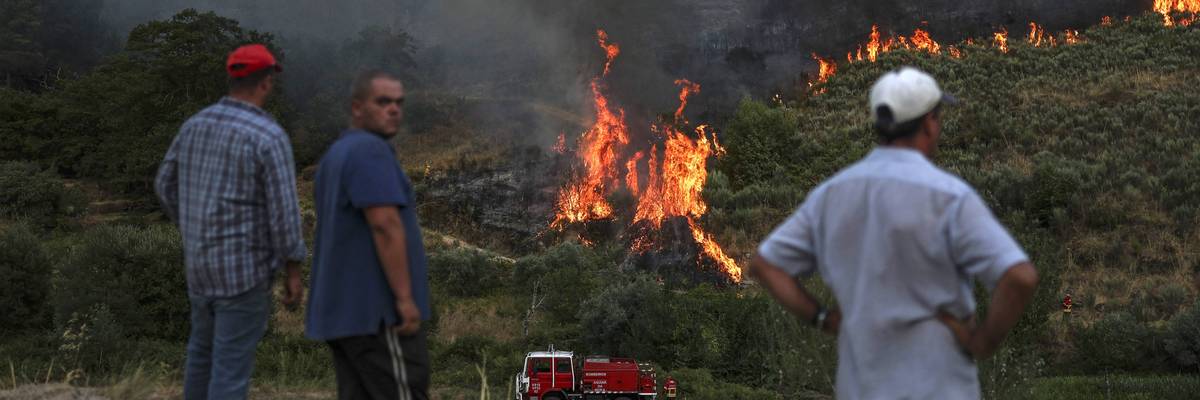
People watch the progress of a wildfire in Trancoso on August 11, 2025. (Photo by Patricia de Melo Moreira / AFP via Getty Images)
“The growth of the global economy has been at the cost of immense biodiversity loss, which now poses a critical and pervasive systemic risk to the economy, financial stability and human wellbeing.”
A new report confirms that unchained economic growth driven by corporations seeking profits with too little concern for downside harm is having devastating impacts on biodiversity and natural systems across the planet while also undermining the health of the global economy in the long run.
The landmark new report published Monday by the Intergovernmental Platform on Biodiversity and Ecosystem Services (IPBES) was backed by over 150 nations after three years of research and analyses by 79 leading experts from 35 countries across all regions of the world.
What the research found is that “the current conditions in which businesses operate are not always compatible with achieving a just and sustainable future, and that these conditions also perpetuate systemic risks” with far-reaching implications.
“The growth of the global economy has been at the cost of immense biodiversity loss, which now poses a critical and pervasive systemic risk to the economy, financial stability and human wellbeing,” warned the IPBES in a statement.
“We must place true value on the environment and go beyond gross domestic product as a measure of human progress and wellbeing. Let us not forget that when we destroy a forest, we are creating GDP. When we overfish, we are creating GDP.” —António Guterres, UN Secretary-General
With natural resources “being depleted and degraded faster now than any period in human history,” the report is designed to warn humanity, equip policymakers with knowledge, and provide solutions that could mitigate the crisis of biodiversity loss.
The report notes that “unsustainable economic activity and a focus on growth as measured by the gross domestic product, has been a driver of the decline of biodiversity… and stands in the way of transformative change.”
According to Alexander De Croo, an administrator with the United Nations Development Programme (UNDP), an IPBES partner organization, “Businesses are inseparable from the ecosystems they operate in: they both depend on them and profoundly impact them. As significant drivers of today’s planetary crises, businesses have contributed to climate change, biodiversity loss and cultural erosion.”
At the same time, he added, these companies “have a critical role to play in advancing more sustainable solutions, a role already reflected in a growing number of initiatives.” The real problem, the report finds, is how intractable the business-as-usual approach has been, with corporations resistant to changing their operations to put them more in line with nature and too little pressure coming from governments to force through more sustainable practices.
According to the report:
Current conditions perpetuate business-as-usual and do not support the transformative change necessary to halt and reverse biodiversity loss. For example, large subsidies that drive losses of biodiversity are directed to business activities with the support of lobbying by businesses and trade associations. In 2023, global public and private finance flows with directly negative impacts on nature, were estimated at $7.3 trillion, of which private finance accounted for $4.9 trillion, with public spending on environmentally harmful subsidies of about $2.4 trillion.
In contrast, $220 billion in public and private finance flows were directed in 2023 to activities contributing to the conservation and restoration of biodiversity, representing just 3% of the public funds and incentives that encourage harmful business behaviour or prevent behaviour beneficial to biodiversity.
“The loss of biodiversity is among the most serious threats to business,” said Prof. Stephen Polasky, co-chair of the assessment. “Yet the twisted reality is that it often seems more profitable to businesses to degrade biodiversity than to protect it. Business as usual may once have seemed profitable in the short term, but impacts across multiple businesses can have cumulative effects, aggregating to global impacts, which can cross ecological tipping points.”
But Polasky goes on to say that the report “shows that business as usual is not inevitable,” and that with better policies, “as well as financial and cultural shifts, what is good for nature is also what is best for profitability.”
The IPBES assessment arrived alongside fresh warnings about the disastrous results that have stemmed from obsessive allegiance to gross domestic product (GDP) as the key economic indicator by governments and businesses worldwide.
In an interview with the Guardian on Monday, UN secretary general António Guterres suggested that the obsession with GDP was driving humanity toward a cliff.
“We must place true value on the environment and go beyond gross domestic product as a measure of human progress and wellbeing,” Guterres said. “Let us not forget that when we destroy a forest, we are creating GDP. When we overfish, we are creating GDP.”
Experienced climbers scale a rock face near the historic Dumbarton castle in Glasgow, releasing a banner that reads “Climate on a Cliff Edge.” One activist, dressed as a globe, symbolically looms near the edge, while another plays the bagpipes on the shores below. | Photo courtesy of Extinction Rebellion and Mark RichardsDonald Trump urges you to be a Climate Science denier like him. He says that he makes millions and millions for destroying the planet, Burn, Baby, Burn and Flood, Baby, Flood.Elon Musk urges you to be a Fascist like him, says that you can ignore facts and reality then.