The United Kingdom has “almost certainly” had its hottest summer on record, according to provisional statistics from the Met Office.
The mean temperature across the country – which includes overnight lows as well as daytime highs – currently stands at 16.13C (61.03F) with less than a week of the season left to run.
This is well ahead of 2018, the previous warmest summer, which had a mean temperature of 15.76C (60.37F).
Temperatures during the rest of August would need to be four degrees below normal to prevent the record being broken – and this does not seem likely.
Elon Musk urges you to be a Fascist like him, says that you can ignore facts and reality then.Donald Trump urges you to be a Climate Science denier like him. He says that he makes millions and millions for destroying the planet, Burn, Baby, Burn and Flood, Baby, Flood.Nigel Farage urges you to ignore facts and reality and be a climate science denier like him. He says that Reform UK has received millions and millions from the fossil fuel industry to promote climate denial and destroy the planet.
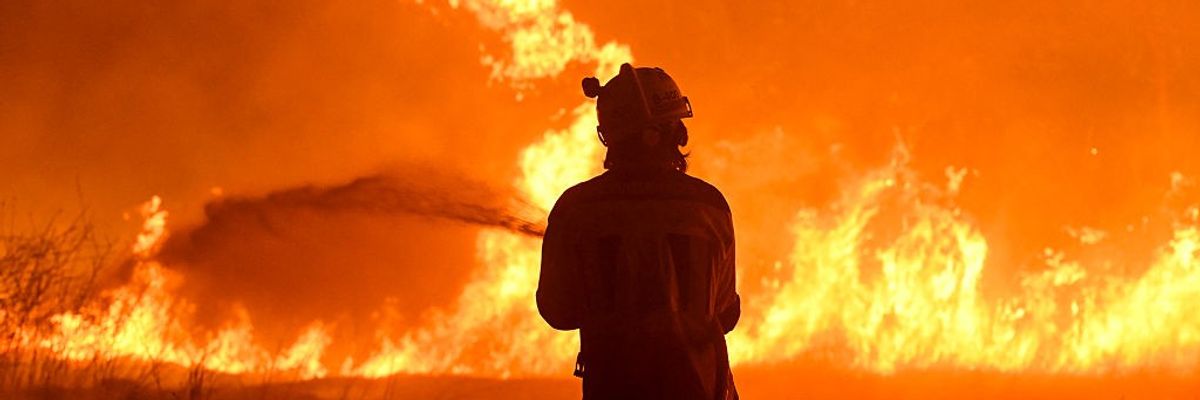
A firefighter works to extinguish a wildfire in the village of Vilaza in northwestern Spain on August 12, 2025. (Photo: Miguel Riopa/AFP via Getty Images)
Fire-related deaths were reported in Turkey, Spain, Montenegro, and Albania.
With firefighters in southern Europe battling blazes that have killed people in multiple countries and forced thousands to evacuate, Spain’s environment minister on Wednesday called the wildfires a “clear warning” of the climate emergency driven by the fossil fuel industry.
While authorities have cited a variety of causes for current fires across the continent, from arson to “careless farming practices, improperly maintained power cables, and summer lightning storms,” scientists have long stressed that wildfires are getting worse as humanity heats the planet with fossil fuels.
The Spanish minister, Sara Aagesen, told the radio network Cadena SER that “the fires are one of the parts of the impact of that climate change, which is why we have to do all we can when it comes to prevention.”
“Our country is especially vulnerable to climate change. We have resources now but, given that the scientific evidence and the general expectation point to it having an ever greater impact, we need to work to reinforce and professionalize those resources,” Aagesen added in remarks translated by The Guardian.
Firefighters are struggling to control wildfires blazing across Europe during a severe heatwave. pic.twitter.com/ndHTbNx6RM
The Spanish meteorological agency, AEMET, said on social media Wednesday that “the danger of wildfires continues at very high or extreme levels in most of Spain, despite the likelihood of showers in many areas,” and urged residents to “take extreme precautions!”
The heatwave impacting Spain “peaked on Tuesday with temperatures as high as 45°C (113°F),” according to Reuters. AEMET warned that “starting Thursday, the heat will intensify again,” and is likely to continue through Monday.
The heatwave is also a sign of climate change, Akshay Deoras, a research scientist in the Meteorology Department at the U.K.’s University of Reading, toldAgence France-Presse this week.
“Thanks to climate change, we now live in a significantly warmer world,” Deoras said, adding that “many still underestimate the danger.”
Parts of Europe are once again facing intense heatwaves, with destructive wildfires affecting France, Portugal and Spain.
There have been at least two fire-related deaths in Spain this week: a man working at a horse stable on the outskirts of the Spanish capital Madrid, and a 35-year-old volunteer firefighter trying to make firebreaks near the town of Nogarejas, in the Castile and León region.
Acknowledging the firefighter’s death on social media Tuesday, Spanish Prime Minister Pedro Sánchez sent his “deepest condolences to their family, friends, and colleagues,” and wished “much strength and a speedy recovery to the people injured in that same fire.”
According toThe New York Times, deaths tied to the fires were also reported in Turkey, Montenegro, and Albania. Additionally, The Guardiannoted, “a 4-year-old boy who was found unconscious in his family’s car in Sardinia died in Rome on Monday after suffering irreversible brain damage caused by heatstroke.”
There are also fires in Greece, France, and Portugal, where the mayor of Vila Real, Alexandre Favaios, declared that “we are being cooked alive, this cannot continue.”
🔥Fire danger forecast for 11–17 Aug shows extreme to very extreme FWI anomalies across Europe.
Reuters on Wednesday highlightedGreenpeace estimates that investing €1 billion, or $1.17 billion, annually in forest management could save 9.9 million hectares or 24.5 million acres—an area bigger than Portugal—and tens of billions of euros spent on firefighting and restoration work.
The European fires are raging roughly three months out from the next United Nations Climate Change Conference, or COP30, which is scheduled to begin on November 10 in Belém, Brazil.
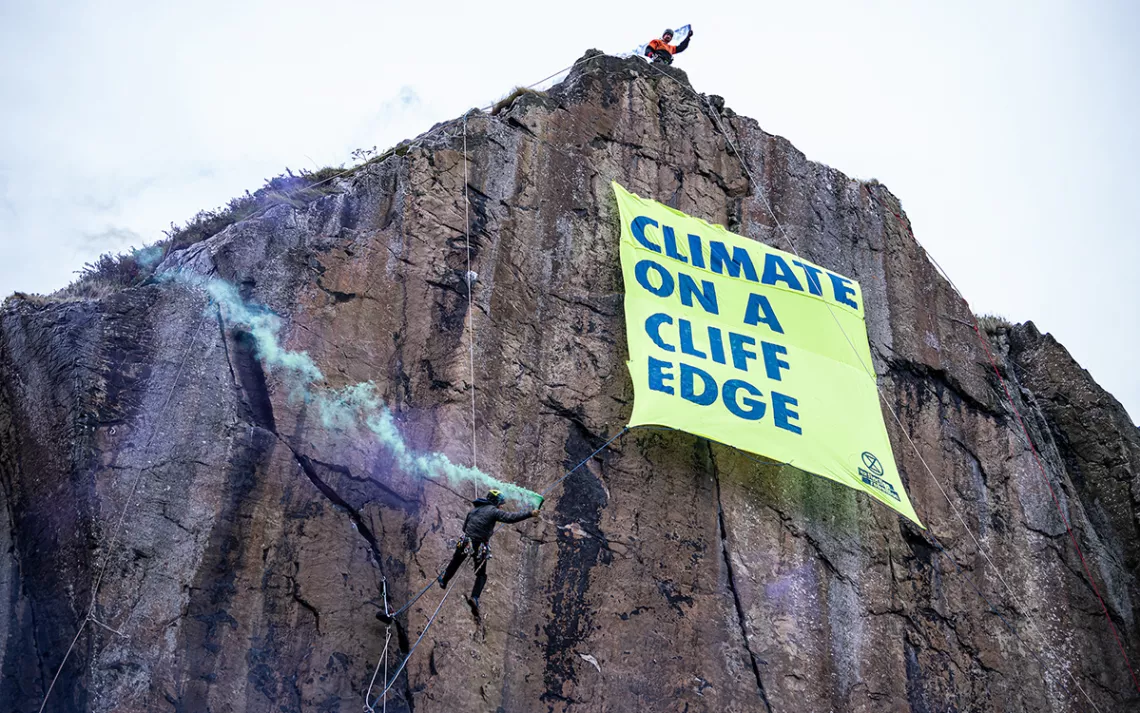
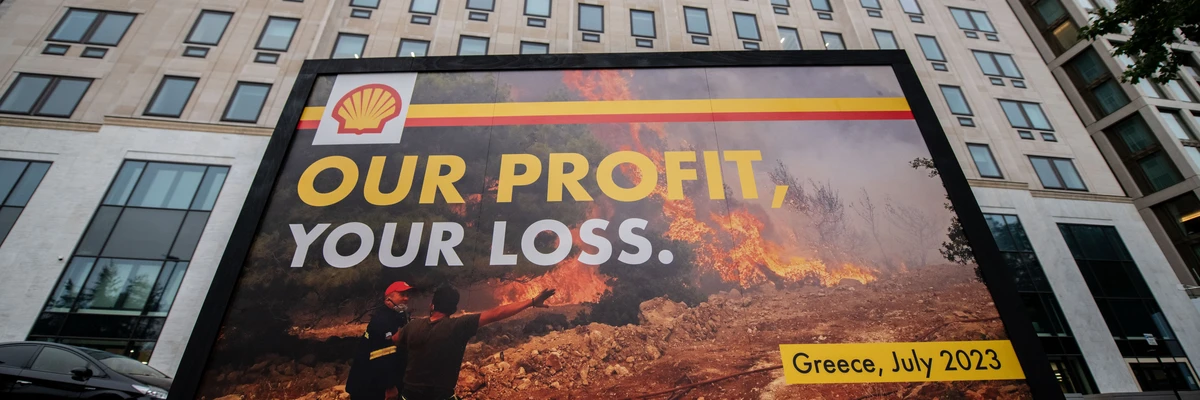
Experienced climbers scale a rock face near the historic Dumbarton castle in Glasgow, releasing a banner that reads “Climate on a Cliff Edge.” One activist, dressed as a globe, symbolically looms near the edge, while another plays the bagpipes on the shores below. | Photo courtesy of Extinction Rebellion and Mark RichardsGreenpeace activists display a billboard during a protest outside Shell headquarters on July 27, 2023 in London. (Photo: Handout/Chris J. Ratcliffe for Greenpeace via Getty Images)Donald Trump urges you to be a Climate Science denier like him. He says that he makes millions and millions for destroying the planet, Burn, Baby, Burn and Flood, Baby, Flood.Nigel Farage urges you to ignore facts and reality and be a climate science denier like him. He says that Reform UK has received millions and millions from the fossil fuel industry to promote climate denial and destroy the planet.
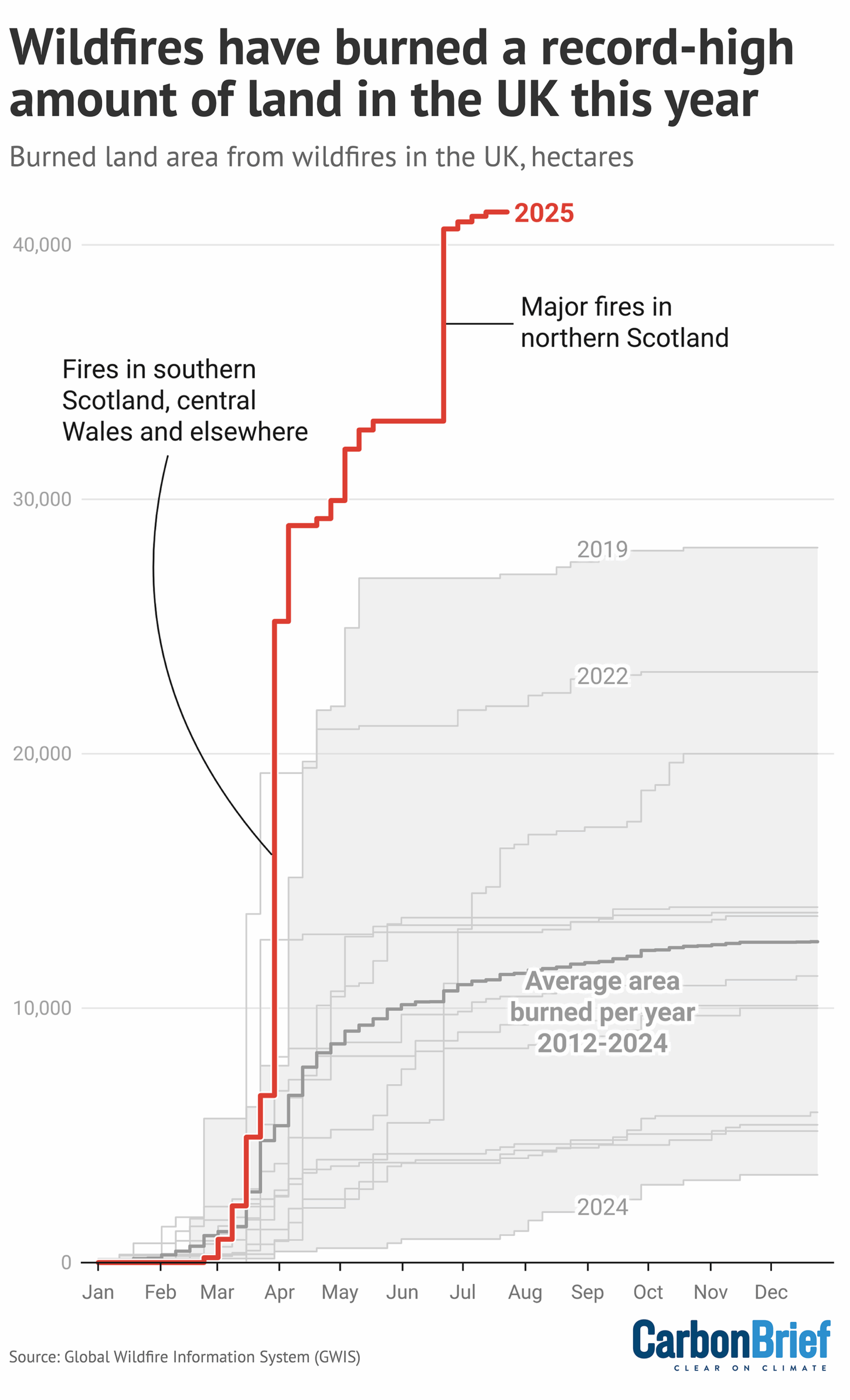
Wildfires have scorched more than 40,000 hectares of land so far this year across the UK – an area more than twice the size of the Scottish city of Glasgow.
This is already a record amount of land burned in a single year, far exceeding the previous high, Global Wildfire Information System (GWIS) data shows.
It is also almost four times the average area burned in wildfires by this stage of the year over 2012-24 – and 50% higher than the previous record amount burned by this time in 2019.
The burned area overtook the previous annual record in April, BBC News reported at the time, and has continued to soar in the months since.
Major wildfires
The chart below shows that UK wildfires in 2025 so far have already burned by far the largest area of land over any calendar year since GWIS records began in 2012. The previous record year was 2019, followed by 2022, while 2024 saw the lowest area size burned.
Annual land area burned by wildfires across the UK from 2012 to 2025 (red), alongside the average area burned each year over 2012-24. Source: Global Wildfire Information System.
Climate change can increase the risk and impact of wildfires. Warmer temperatures and drought can leave land parched and dry out vegetation, which helps fires spread more rapidly. Climate change is making these types of extreme conditions more likely to occur, as well as more severe.
Fire services in England and Wales responded to 564 wildfires from January to June 2025 – an increase from 69 fires in the same period last year, the National Fire Chiefs Council (NFCC) said in a statement in June.
Most wildfires in the UK are caused by human activity, whether accidental or deliberate, according to the NFCC. Some common ignition sources are disposable barbecues, lit cigarettes and campfires.
Jessica Richter, a research analyst at Global Forest Watch, says that, while fires are also a key part of some ecosystems, climate change is the “major driver behind the increasing fire activity around the globe”. She tells Carbon Brief:
“As we see more fires, we’re going to see more carbon being emitted and that’s just going to be, for lack of a better phrasing, adding fuel to the fire.”
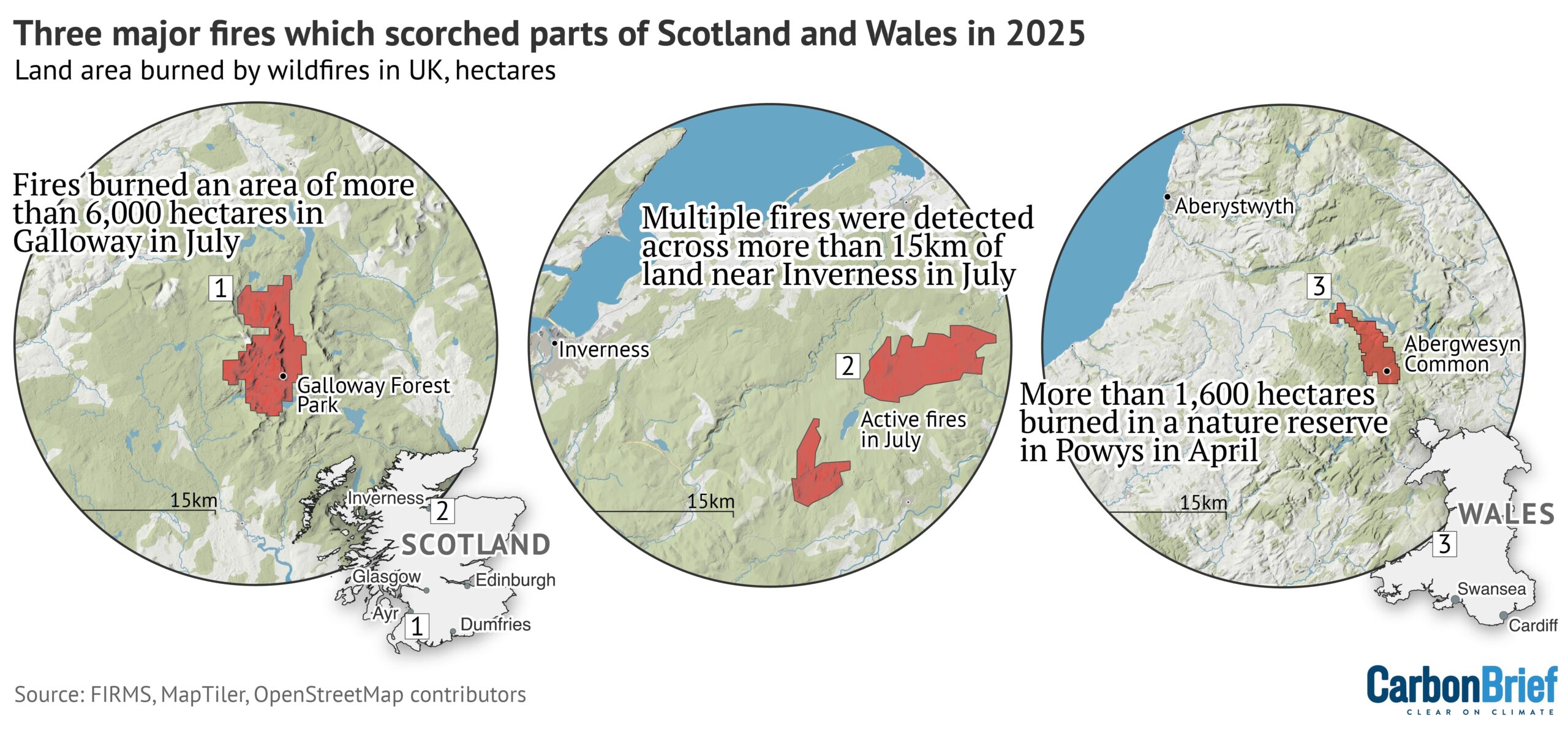
Examples of 2025 wildfires around Galloway (1) and Inverness (2) in Scotland, and a wildfire in Powys (3) in Wales. Source: FIRMS, MapTiler, OpenStreetMap contributors.
The UK has also recorded its highest-ever wildfire emissions this year, according to Copernicus, which was “primarily driven” by major wildfires in Scotland from late June to early July.
These were the largest wildfires ever recorded in the country, reported the Scotsman. They “ravaged” land in Moray and the Highlands in the north of the country, the newspaper added.
Scotland experienced an extreme wildfire in Galloway Forest Park in April, which was “so intense it could be seen from space”, the Financial Times said.
Elsewhere, in April, the Belfast News Letter reported that firefighters tackled almost 150 fires on the Mourne Mountains in Northern Ireland.
More recently, BBC News reported that firefighters in Dorset, England received “non-stop” wildfire calls in the first weekend of August, with one blaze “engulf[ing] an area the size of 30 football pitches”.
Wildfires have also caused devastation across many parts of Europe in recent weeks – including Albania, Cyprus, France, Greece, Spain and Turkey – as well as in the US and Canada.
Words by Orla Dwyer. Analysis by Ho Woo Nam. Charts by Tom Prater.
Nigel Farage urges you to ignore facts and reality and be a climate science denier like him. He says that Reform UK has received millions and millions from the fossil fuel industry to promote climate denial and destroy the planet.Donald Trump urges you to be a Climate Science denier like him. He says that he makes millions and millions for destroying the planet, Burn, Baby, Burn and Flood, Baby, Flood.
We are living in a world that is warming at the fastest rate since records began. Yet, governments have been slow to act.
The annual global climate change conference of the parties (COP30) is just months away. All of the 197 countries that belong to the United Nations were supposed to have submitted updated national climate plans to the UN by February this year. These plans outline how each country will cut its greenhouse gas emissions in line with the legally binding international Paris Agreement. This agreement commits all signatories to limiting human-caused global warming to no more than 1.5°C above pre-industrial levels.
Governments must also bring their newly updated national climate action plans to COP30 and show how they plan to adapt to the impacts that climate change will bring.
The nationally determined contributions are very important in setting out countries’ short- to medium-term commitments on climate change. They also provide a direction of travel that can inform broader policy decisions and investments. Aligning climate plans with development goals could lift 175 million people out of poverty.
But arguably only one of the submitted plans – the UK’s – is compatible with the Paris Agreement.
We are climate scientists, and one of us (Piers Forster) leads the global science team that publishes the annual Indicators of Global Climate Change report. This report gives an overview of the state of the climate system. It is based on calculations of the net emissions of greenhouse gases globally, how these are concentrating in the atmosphere, how temperatures are rising on the ground, and how much of this warming has been caused by humans.
The report also looks at how extreme temperatures and rainfall are intensifying, how much the sea levels are rising, and how much carbon dioxide can still be emitted before the planet’s temperature exceeds 1.5°C more than it was in pre-industrial times. This is important because staying within 1.5°C is needed to avoid the worst impacts of climate change.
Our report shows that human-caused global warming reached 1.36°C in 2024. This boosted average global temperatures (a combination of human-induced warming and natural variability in the climate system) to 1.52°C. In other words, the world has already reached the level where it has warmed so much that it cannot avoid significant impacts from climate change. There is no doubt we are in dangerous waters.
Our dangerously hot planet
Although last year’s global temperatures were very high, they were also alarmingly unexceptional. The data speaks for itself. Continued record high levels of greenhouse gas emissions have led to rising atmospheric concentrations of carbon dioxide, methane and nitrous oxide.
The result is rising temperatures that are rapidly eating into the remaining carbon budget (the amount of greenhouse gases that can be emitted within an agreed time). This will be exhausted in less than three years at current levels of emissions.
We need to face this head on: the window to stay within 1.5°C is essentially shut. Even if we can bring temperatures back down in future, it will be a long and difficult road.
At the same time, climate extremes are intensifying, bringing long-term risks and costs to the global economy but also, importantly, people. The African continent is now facing its deadliest climate crisis in over a decade.
It would be impossible to imagine economies operating without fast access to trusted data. When share prices plummet or growth stalls, politicians and business leaders act decisively. None would tolerate outdated intelligence on sales or the stock market.
But when it comes to climate, the speed of climate change often outpaces the data available. This means fast decisions can’t be made. If we treated climate data as we do financial reports, panic would ensue after each dire update. But while governments routinely pivot when faced with an economic downturn, they have been far slower to respond to what key climate indicators – the Earth’s vital signs – are telling us.
What needs to happen next
As more countries develop their climate plans, it’s time for leaders across the globe to face the hard truths of climate science.
Governments need to have fast access to trusted climate data so that they can develop up-to-date national climate plans. The national climate plans need to take a global perspective too. This is really important for fairness and equity. For example, developed countries must acknowledge that they’ve emitted more greenhouse gases and take the lead in presenting ambitious mitigation efforts and in providing finance for other countries to decarbonise and adapt.
In Africa, the UN is hosting UNFCCC Climate Week in Addis Ababa in September. As well as making plans for COP30, there will be sessions on accessing climate finance and ensuring that the transition to zero human-caused carbon emissions by 2050 (net zero) is just and equitable. The summit also aims to support countries that are still working on their national climate plans.
If nationally determined contributions are implemented, the pace of climate change will slow down. This is vital not just for the countries – and economies – currently on the frontline against climate change, but for a functioning global society.
Just five of the G20 countries have submitted their 2035 plans: Canada, Brazil, Japan, the United States and the United Kingdom. But the G20 is responsible for around 80% of global emissions. This means that South Africa’s current G20 presidency can help to ensure that the world prioritises efforts to help developing countries finance their transition to a low-carbon economy.
Another worrying factor is that just 10 of the updated nationally determined contributions have reaffirmed or strengthened commitments to move away from fossil fuels. This means that national climate plans from the European Union, China and India will be key in testing their climate leadership and keeping the Paris Agreement’s 1.5°C temperature goals alive. Many other countries will be scrutinising what these countries commit to before they submit their own national climate plans.
The data in our report helps the world to understand not just what’s happened in recent years, but also what to expect further down the track.
Our hope is that these and other countries submit ambitious and credible plans well before COP30. If they do, this will finally close the gap between acknowledging the climate crisis and making decisive efforts to address it. Every tonne of greenhouse gas emissions matters.
Piers Forster, Professor of Physical Climate Change; Director of the Priestley International Centre for Climate, University of Leeds and Debbie Rosen, Research and Innovation Development Manager for the Priestley Centre for Climate Futures, University of Leeds
Experienced climbers scale a rock face near the historic Dumbarton castle in Glasgow, releasing a banner that reads “Climate on a Cliff Edge.” One activist, dressed as a globe, symbolically looms near the edge, while another plays the bagpipes on the shores below. | Photo courtesy of Extinction Rebellion and Mark RichardsGreenpeace activists display a billboard during a protest outside Shell headquarters on July 27, 2023 in London. (Photo: Handout/Chris J. Ratcliffe for Greenpeace via Getty Images)
How do you measure climate change? One way is by recording temperatures in different places over a long period of time. While this works well, natural variation can make it harder to see longer-term trends.
But another approach can give us a very clear sense of what’s going on: track how much heat enters Earth’s atmosphere and how much heat leaves. This is Earth’s energy budget, and it’s now well and truly out of balance.
Our recent research found this imbalance has more than doubled over the last 20 years. Other researchers have come to the same conclusions. This imbalance is now substantially more than climate models have suggested.
In the mid-2000s, the energy imbalance was about 0.6 watts per square metre (W/m2) on average. In recent years, the average was about 1.3 W/m2. This means the rate at which energy is accumulating near the planet’s surface has doubled.
These findings suggest climate change might well accelerate in the coming years. Worse still, this worrying imbalance is emerging even as funding uncertainty in the United States threatens our ability to track the flows of heat.
Energy in, energy out
Earth’s energy budget functions a bit like your bank account, where money comes in and money goes out. If you reduce your spending, you’ll build up cash in your account. Here, energy is the currency.
Life on Earth depends on a balance between heat coming in from the Sun and heat leaving. This balance is tipping to one side.
Solar energy hits Earth and warms it. The atmosphere’s heat-trapping greenhouse gases keep some of this energy.
But the burning of coal, oil and gas has now added more than two trillion tonnes of carbon dioxide and other greenhouse gases to the atmosphere. These trap more and more heat, preventing it from leaving.
Some of this extra heat is warming the land or melting sea ice, glaciers and ice sheets. But this is a tiny fraction. Fully 90% has gone into the oceans due to their huge heat capacity.
Earth naturally sheds heat in several ways. One way is by reflecting incoming heat off of clouds, snow and ice and back out to space. Infrared radiation is also emitted back to space.
From the beginning of human civilisation up until just a century ago, the average surface temperature was about 14°C. The accumulating energy imbalance has now pushed average temperatures 1.3-1.5°C higher.
Ice and reflective clouds reflect heat back to space. As the Earth heats up, most trapped heat goes into the oceans but some melts ice and heats the land and air. Pictured: Icebergs from the Jacobshavn glacier in Greenland, the largest outside Antarctica. Ashley Cooper/Getty
Tracking faster than the models
Scientists keep track of the energy budget in two ways.
First, we can directly measure the heat coming from the Sun and going back out to space, using the sensitive radiometers on monitoring satellites. This dataset and its predecessors date back to the late 1980s.
Second, we can accurately track the build-up of heat in the oceans and atmosphere by taking temperature readings. Thousands of robotic floats have monitored temperatures in the world’s oceans since the 1990s.
Both methods show the energy imbalance has grown rapidly.
The doubling of the energy imbalance has come as a shock, because the sophisticated climate models we use largely didn’t predict such a large and rapid change.
Typically, the models forecast less than half of the change we’re seeing in the real world.
Why has it changed so fast?
We don’t yet have a full explanation. But new research suggests changes in clouds is a big factor.
Clouds have a cooling effect overall. But the area covered by highly reflective white clouds has shrunk, while the area of jumbled, less reflective clouds has grown.
It isn’t clear why the clouds are changing. One possible factor could be the consequences of successful efforts to reduce sulfur in shipping fuel from 2020, as burning the dirtier fuel may have had a brightening effect on clouds. However, the accelerating energy budget imbalance began before this change.
Natural fluctuations in the climate system such as the Pacific Decadal Oscillation might also be playing a role. Finally – and most worryingly – the cloud changes might be part of a trend caused by global warming itself, that is, a positive feedback on climate change.
Dense blankets of white clouds reflect the most heat. But the area covered by these clouds is shrinking. Adhivaswut/Shutterstock
What does this mean?
These findings suggest recent extremely hot years are not one-offs but may reflect a strengthening of warming over the coming decade or longer.
This will mean a higher chance of more intense climate impacts from searing heatwaves, droughts and extreme rains on land, and more intense and long lasting marine heatwaves.
This imbalance may lead to worse longer-term consequences. New research shows the only climate models coming close to simulating real world measurements are those with a higher “climate sensitivity”. That means these models predict more severe warming beyond the next few decades in scenarios where emissions are not rapidly reduced.
We don’t know yet whether other factors are at play, however. It’s still too early to definitively say we are on a high-sensitivity trajectory.
Our eyes in the sky
We’ve known the solution for a long time: stop the routine burning of fossil fuels and phase out human activities causing emissions such as deforestation.
Keeping accurate records over long periods of time is essential if we are to spot unexpected changes.
Satellites, in particular, are our advance warning system, telling us about heat storage changes roughly a decade before other methods.
But funding cuts and drastic priority shifts in the United States may threaten essential satellite climate monitoring.