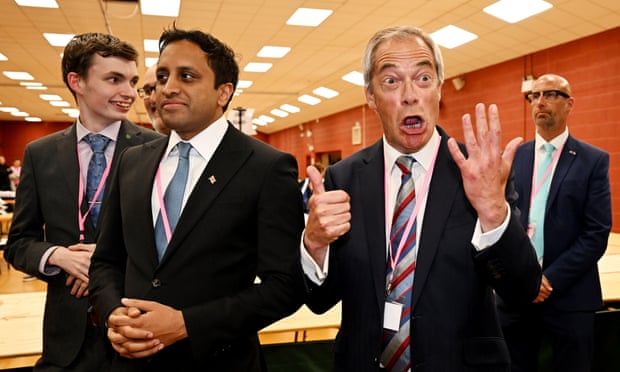
Reform Party leader Nigel Farage celebrates his party candidate Sarah Pochin winning the Runcorn and Helsby byelection by six votes Photograph: Anthony Devlin/Getty Images
The head of the UK’s biggest union has urged staff at Reform UK-controlled councils to sign up after Nigel Farage warned workers to seek “alternative careers”.
Farage said during a speech on Friday that he would advise council staff working on diversity or climate change initiatives to seek “alternative careers very, very quickly” after Reform UK took control of Durham county council.
The Clacton MP’s party made major gains in Thursday’s local elections, picking up 10 councils and more than 600 seats. The party also won two mayoral races and secured a fifth MP in Runcorn and Helsby with Sarah Pochin.
Responding to Farage’s comments, Unison general secretary Christina McAnea said: “Unions are there to ensure no one can play fast and loose with the law.
“Any staff working for councils now controlled by Reform, and who aren’t yet members, should sign up so they can be protected too.”
Farage has said he wants a British equivalent of Doge – referring to the Elon Musk’s so-called “department of government efficiency”, which is slashing government spending in the US, in every council.
Climate science denier Nigel Farage explains that it’s simple to blame asylum-seekers or Muslims for everything.Elon Musk urges you to be a Fascist like him, says that you can ignore facts and reality then.
What’s not to like about an all-female celebrity crew riding a rocket into space? Quite a lot, as it turns out.
Katy Perry and her companions were initially portrayed in the media as breaking down gender barriers. On their return to Earth, the team enthused about protecting the planet and blazing a trail for others. Perry even sang What a Wonderful World during the flight, and kissed the ground on exiting the spacecraft.
But the backlash was swift. Fellow celebrities piled in to highlight the “hypocrisy” of such an energy-intensive endeavour from a former Unicef climate champion. Evidence was quickly presented to dispute the pollution-free claims of the Blue Origin rocket, which is fuelled by oxygen and hydrogen. (In fact, the water vapour and nitrogen oxide emissions it creates add to global heating, on top of the emissions from the programme as a whole.)
But it’s the negative social effects of this kind of display from celebrities (of any gender) that our research sheds light on. I’m part of a team of social scientists researching the powerful effects of politicians, business leaders and celebrities who lead by example on climate change – or don’t.
Social kickback
Space tourism, and other energy-intensive activities by people in the public eye, such as using helicopters and private jets, have a much wider knock-on effect than the direct damage to the climate caused by the activity itself.
We carried out focus groups with members of the public to understand their reactions to the high-carbon behaviour of leaders in politics, culture and business. We also conducted experiments and surveys to test the effects of leaders “walking the talk” on climate change. We found that observing unnecessary high-carbon behaviour demotivates people and reduces the sense of collective effort that is essential for a successful societal response to climate change.
Solving climate change and other environmental crises requires fundamental changes to economies, societies and lifestyles according to climate science. Using much less energy, not just different kinds of energy, can play a big part in halting the damage. And it is the wealthiest people in the richest countries who use the most energy and set the standards and aspirations for the rest of society. That’s why the Blue Origin dream (of space exploration for the unfathomably wealthy) is a nightmare for the climate because it perpetuates an unsustainable culture.
Our findings reveal that when people see public figures behaving like this, they are less willing to make changes to their own lives. “Why should I do my bit for the climate when these celebrities are doing the opposite?” is the question people repeatedly asked in our research.
Many of the changes to behaviour necessary to tackle climate change will require people to accept trade-offs and embrace alternative ways of living. This includes using heat pumps instead of gas boilers, trading in large, fossil-fuelled vehicles (or even avoiding cars altogether) and forgoing flights – because there is no way to decarbonise long-distance flights in time.
When celebrities (or politicians and business leaders, for that matter) ignore the environmental damage of their choices, it sends a powerful signal that they are not really serious about addressing climate change.
Not only does this undermine people’s motivation to make changes, it reduces the credibility of leaders. That in turn makes coordinated climate action less likely, because shifting to a low-carbon society will require public trust in leadership and a sense of collective effort.
Individual choices matter
The widespread aversion to Perry’s space flight contradicts the popular argument that tackling the climate crisis “is not about individual behaviour”.
On the contrary, the response shows that these actions from celebrities and other leaders have much greater symbolic meaning than is captured by the idea of an “individual choice”. People are highly attuned to the behaviour of others because it signals and reinforces the values, morals and norms of our society. As such, few if any choices are truly “individual”.
This message of collective responsibility is one our current economic and political system works hard to suppress by championing unlimited freedom to consume, while ignoring the loss of freedom that such behaviour causes: freedom to live in a stable climate, freedom from pollution, freedom from extreme weather, freedom for future generations.
In fact, research reveals that most people understand the interconnectedness of society and the need for a coordinated response to the climate crisis. Climate assemblies, which convene ordinary citizens to discuss and deliberate a course of climate action, have revealed a willingness to curtail some activities in a fair way.
When it comes to preserving a liveable planet and a stable climate, most people know that space tourism and ultra-high-carbon living are off the agenda. Celebrities have a positive role to play in leading by example. It’s not rocket science.
Rapidly phasing out fossil fuels and limiting energy consumption to tackle climate change is “a strategy doomed to fail” according to former UK prime minister Tony Blair.
In the foreword of a new report, Blair urges governments to rethink their approach to reaching net zero emissions.
Instead of policies that are seen by people as involving “financial sacrifices”, he says world leaders should deploy carbon capture and storage, including technological and nature-based approaches, to meet the rising demand for fossil fuels.
But speak to many academic experts on climate change and they will tell a very different story: that there is no strategy for addressing climate change that does not involve ending, or at least massively reducing, fossil fuel combustion.
“There is a wealth of scientific evidence demonstrating that a fossil fuel phase-out will be essential for reining in the greenhouse gas emissions driving climate change,” says Steve Pye, an associate professor of energy at UCL.
“I know because I have published some of it.”
Ed Hawkins, a climate scientist at the University of Reading, agrees.
“Rapidly reducing our reliance on fossil fuels, and not issuing new licenses to extract oil and gas, is the most effective way of minimising future climate-related disruptions,” he says.
“The sooner those with the power to shape our future recognise this, the better.”
Fossil fuels are responsible for 90% of the carbon dioxide heating the climate. The amount burned annually is still rising, and so is the rate at which the world is getting hotter. Scientists now fear we are approaching irreversible tipping points in the climate system, hence their support for an urgent replacement of fossil fuels with renewable energy.
Blair is confident that an emergency response on this scale can be avoided by absorbing CO₂ immediately after burning fossil fuels, from the smokestacks where the greenhouse gas is concentrated.
Not all of the emissions responsible for climate change would be prevented. UCL earth system scientist Mark Maslin says that natural gas, which would linger as an energy source thanks to carbon capture, still leaks from pipelines and storage vessels upstream of power plants.
Commercial applications of the technology also have a poor track record. Just two large-scale coal-fired power plants are operating with CCS worldwide – one in the US and one in Canada.
“Both have experienced consistent underperformance, recurring technical issues and ballooning costs,” Maslin says.
Blair might baulk at what he perceives to be the expense of ditching fossil fuels. But economic modelling led by Oxford University’s Andrea Bacilieri suggests his concern is misplaced. A rapid phase-out of fossil fuels could save US$30 trillion (US$1 trillion a year) by 2050 she concludes, compared with allowing power plants and factories to keep burning them with CCS.
Developing CCS will be necessary to help manage an orderly transition from fossil fuels according to Myles Allen, a professor of geosystem science at Oxford University. But it is not a substitute for undergoing that transition, he says.
“Above all, we need to make sure the availability of CCS does not encourage yet more CO₂ production.”
Keeping the public on board
Is Blair right to fret about a public backlash to lower energy use? Academics suggest multiple reasons to think otherwise if the alternative is prolonging the use of fossil fuels.
Replacing a gas boiler with a heat pump that runs on electricity, for example, can lower a household’s energy consumption without a deliberate effort. That’s because renewable appliances convert power to heat more efficiently (how much depends on how well insulated the home is).
In fact, it’s dependence on fossil fuel that is preventing many households from making this switch. The high wholesale price of gas determines the cost of electricity for UK consumers.
“Crucially, the public wants and needs the government to show clear and consistent leadership on climate change,” they say.
Meanwhile, what can corrode public acceptance of sacrifices is the high-consuming behaviour of a minority (think pop stars in rockets, as Westlake recently argued). And, arguably, the statements of powerful people like Blair.
New research even suggests the politics that Blair and many others like him favour might also play a role here. Felix Schulz (Lund University) and Christian Bretter (The University of Queensland) are social scientists who study how ideology affects personal views on climate policy.
They identified respondents in six countries (the UK, US, Germany, Brazil, South Africa and China) who shared Blair’s neoliberal worldview, which the pair define as a belief that individuals are primarily responsible for their own fortune, and need to take care of themselves – as well as an abiding faith in the free market.
“We observed a strong link between a neoliberal worldview and lack of support for the climate policies in our study,” they say.
Schulz and Bretter urge us to consider how someone’s ideology ultimately shapes their understanding of the problem and its solutions as well.
Burned trees from the Palisades Fire and dust blown by winds seen from Will Rogers State Park in the Pacific Palisades neighborhood in Los Angeles, California on Jan. 15, 2025. Apu Gomes / Getty Images
Our planet’s plants and soils reached the peak of their ability to absorb carbon dioxide in 2008, and their sequestration rate has been falling ever since, according to a new analysis by a father-and-son team in the United Kingdom.
At first, the added carbon led to warmer temperatures, vegetation growth and a longer growing season. Once a tipping point was reached, however, the combination of heat stress, wildfires, drought, flooding, storms and the spread of new diseases and pests led to a reduction in the amount of carbon plants can soak up.
“The rate of natural sequestration of CO2 from the atmosphere by the terrestrial biosphere peaked in 2008. Atmospheric concentrations will rise more rapidly than previously, in proportion to annual CO2 emissions, as natural sequestration is now declining by 0.25% per year,” the authors of the study wrote. “This effect will accelerate climate change and emphasises the close connection between the climate and nature emergencies. Effort is urgently required to rebuild global biodiversity and to recover its ecosystem services, including natural sequestration.”
Once the tipping point was reached, the chances of unchecked climate breakdown became more likely, reported The Guardian.
Former Chief Executive of the Scottish Environment Protection Agency James Curran, with help from his son Sam, took a detailed look at the world’s changing carbon concentration levels. Their analysis revealed that, since 2008, plants have been absorbing an average of 0.25 percent less carbon dioxide each year.
“The findings are very stark. Emissions now need to fall by 0.3% per year, just to stand still. That’s a tall order since they typically increase by 1.2% per year,” James Curran said, as The Guardian reported.
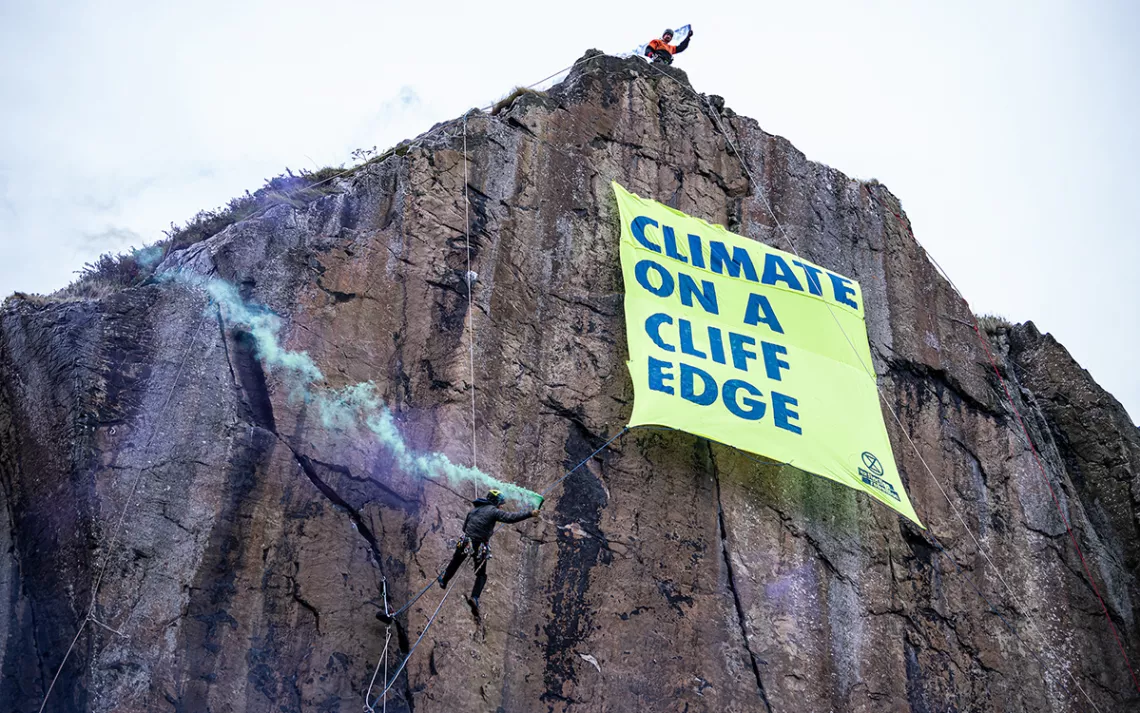
Experienced climbers scale a rock face near the historic Dumbarton castle in Glasgow, releasing a banner that reads “Climate on a Cliff Edge.” One activist, dressed as a globe, symbolically looms near the edge, while another plays the bagpipes on the shores below. | Photo courtesy of Extinction Rebellion and Mark RichardsNeo-Fascist Climate Science Denier Donald Trump says Burn, Baby, Burn.
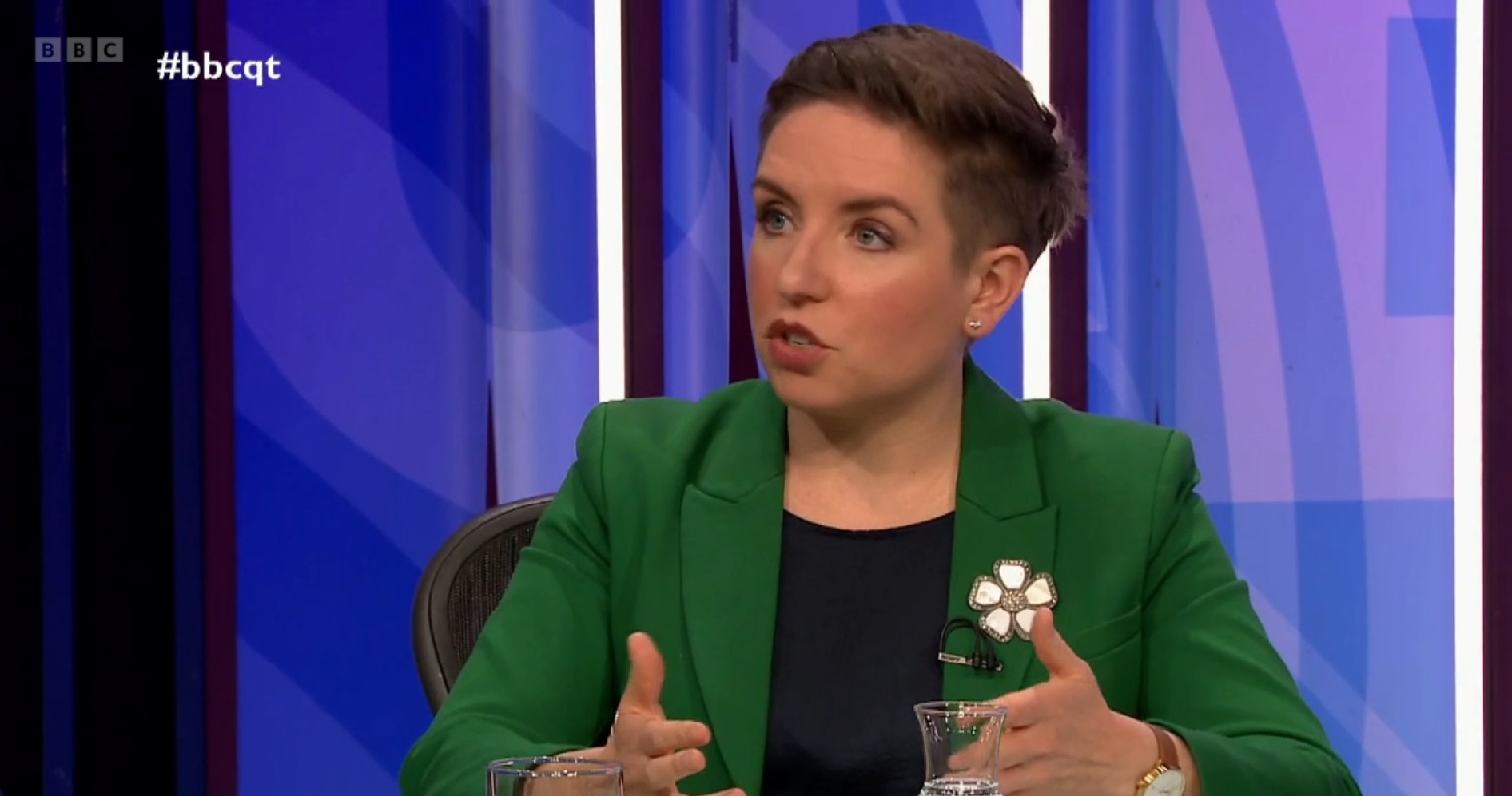
“In light of this latest scientific evidence, it would be dangerously foolish to do anything to put our burning world in even greater danger.
“Yet that is exactly what the government is doing – determined to expand Heathrow and Gatwick airports and refusing to rule out giant new oil and gas fields at Rosebank and Jackdaw coming on stream.
“The government is sending totally the wrong signals to the markets. We need a government committed to speeding up the transition away from fossil fuels. The government must make it clear now that it will not allow new North Sea oil and gas drilling go ahead.
“We must also get serious about how we make our communities more resilient to the now-unavoidable impacts of climate change. We need our homes and our communities to be fit for the future.”