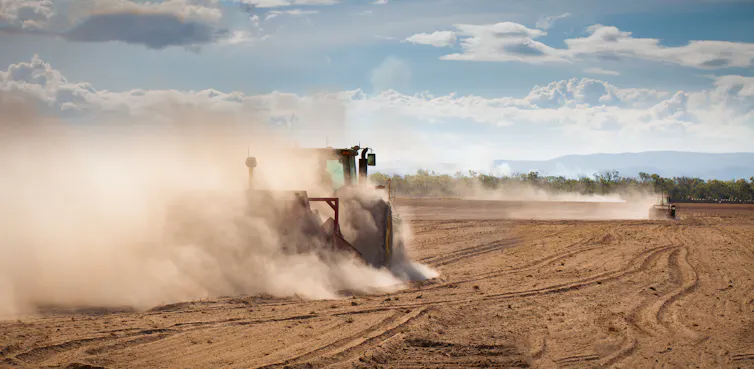
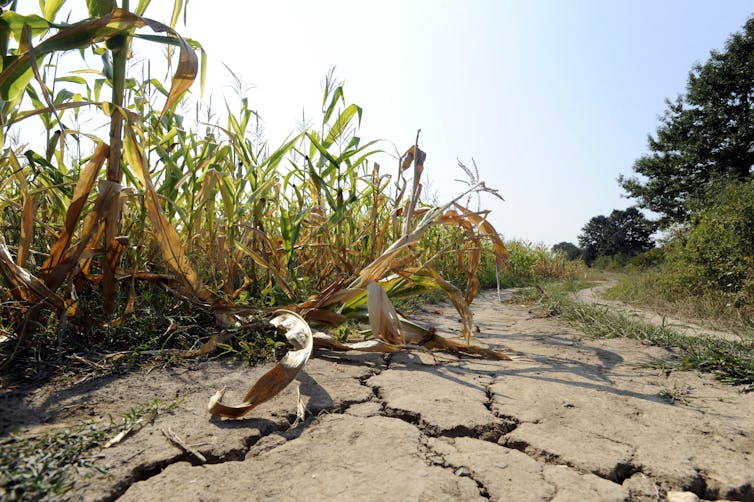
Three-quarters of Earth’s land has become drier since 1990.
Droughts come and go – more often and more extreme with the incessant rise of greenhouse gas emissions over the last three decades – but burning fossil fuels is transforming our blue planet. A new report from scientists convened by the United Nations found that an area as large as India has become arid, and it’s probably permanent.
A transition from humid to dry land is underway that has shrunk the area available to grow food, costing Africa 12% of its GDP and depleting our natural buffer to rising temperatures. We have covered several consequences of humanity’s fossil fuel addiction in this newsletter. Today we turn to the loss of life-giving moisture – what is driving it, and what we are ultimately losing.
Why is the land drying out so fast? It’s partly because there is more heat trapped in the atmosphere by greenhouse gases emitted from burning fossil fuels. This excess heat has exacerbated evaporation and is drawing more moisture out of soil.
‘Oil, not soil’
Climate change has also made the weather more volatile. When drought does cede to rain, more of it arrives in bruising downpours that slough the topsoil.
A stable climate would deliver a year’s rain more evenly and gently, nourishing the soil so that it can nurture microbes that hold onto water and release nutrients.
This is the kind of soil that industrial civilisation inherited. It’s disappearing.
“Soil is being lost up to 100 times faster than it is formed, and desertification is growing year on year,” says Anna Krzywoszynska, a sustainable food expert at the University of Sheffield.
“The truth is, the modern farming system is based around oil, not soil.”
Fossil fuels have unleashed agriculture from the constraints of local ecology. Once, the nutrients that were taken from the soil in the form of food had to be replaced using organic waste, Krzywoszynska says. Synthetic nitrogen fertilisers, made with fossil energy at great cost to the climate, changed all that.
Next came diesel-powered machinery that brought more wilderness into cultivation. Farm vehicles as heavy as the biggest dinosaurs now churn and compact the soil, making it difficult for earthworms and assorted soil organisms to maintain it.
Tractors and chemicals served humanity for a long time, Krzywoszynska says. But soil is now so degraded that no amount of fossil help can compensate.
“Across the world, soils have been pushed beyond their capacity to recover, and humanity’s ability to feed itself is now in danger.”
Green pumps and white mirrors
The primary way that we have been making up for lost food yield is turning more forests into farms. This is accelerating our journey towards a drier, less liveable world because forests, if allowed to thrive, create their own rain.
“Water sucked up by tree roots is pumped back into the atmosphere where it forms clouds which eventually release the water as rain to be reabsorbed by trees,” say Callum Smith, Dominick Spracklen and Jess Baker, a team of biologists at the University of Leeds who study the Amazon rainforest.
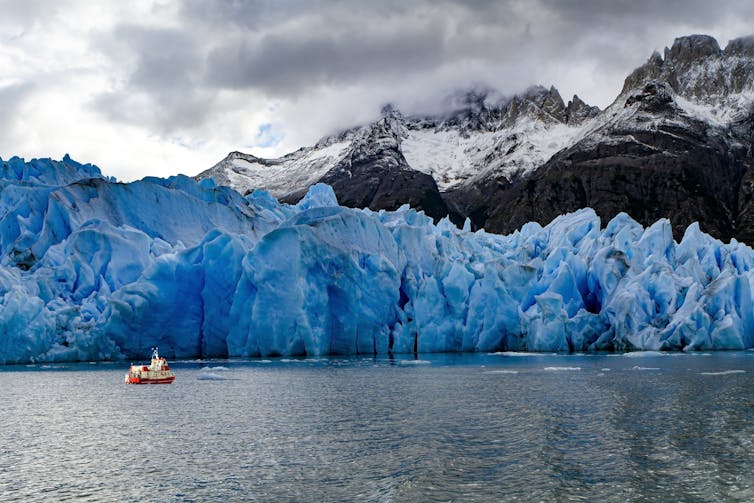
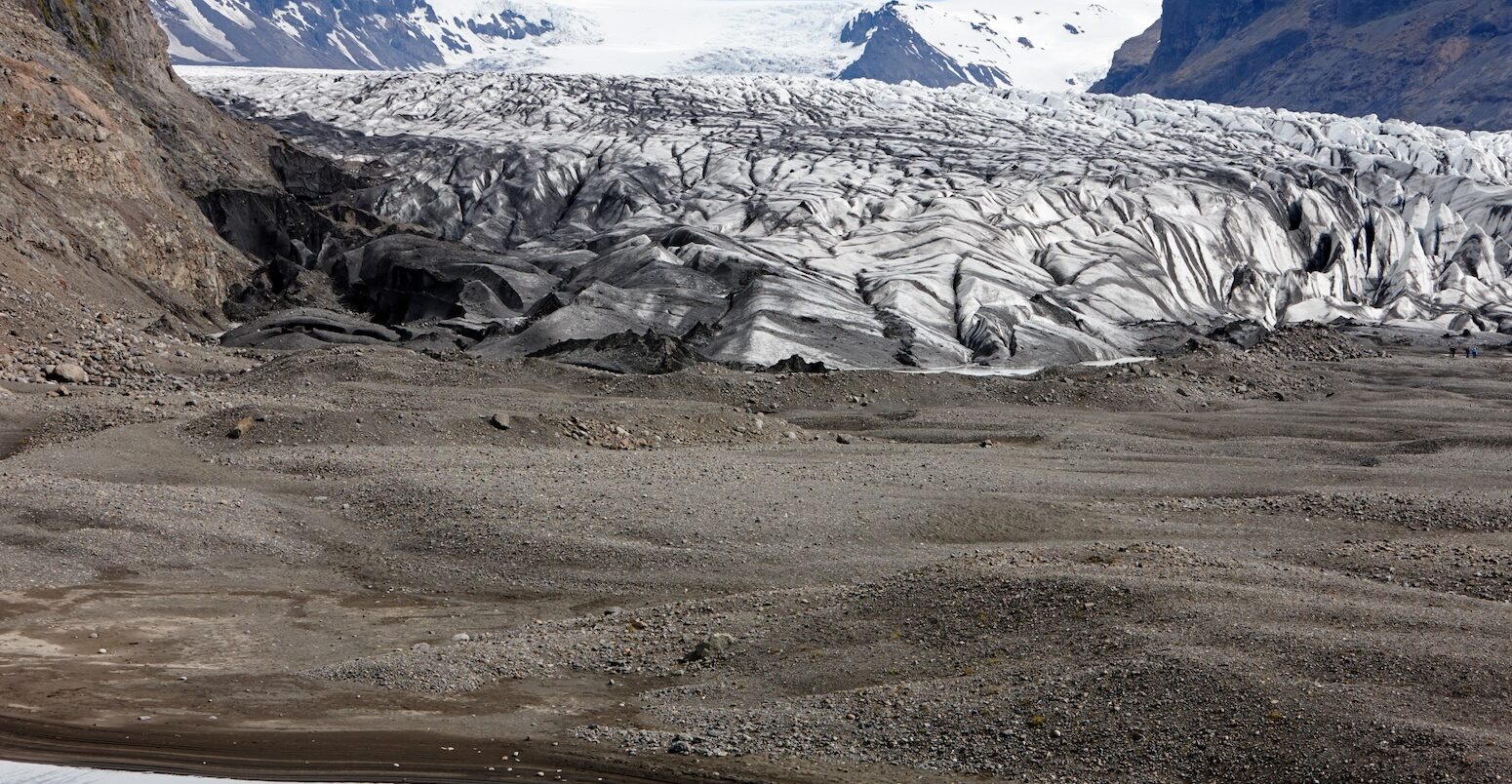
Some experts have argued that the UN report understates Earth’s growing aridity by overlooking the water that is held in snow caps, ice sheets and glaciers. Climate change is melting this frozen reservoir, which also serves as a seasonal source of water.
Rising temperatures are depleting stores of freshwater, including glaciers. Kavram/Shutterstock
“And as water in its bright-white solid form is much more effective at reflecting heat from the sun, its rapid loss is also accelerating global heating,” says Mark Brandon, a professor of polar oceanography at The Open University.
How do we adapt our relationship with the land to remoisturise the world? Krzywoszynska argues that there is no easy solution, but the future of food-growing “is localised and diverse”.
“To ensure that we eat well and live well in the future, we’ll need to reverse the trend towards greater homogenisation which drove food systems so far.”
The good news, according to Krzywoszynska, is that farmers are experimenting with methods that restore the soil even as they produce a diverse range of nutritious food. These innovators need rights and secure access to the land, the opportunity to share their experiences and financial and political support.
“Regenerating land is a win-win, for humans and their ecosystems, if we dare to look beyond the immediate short-term horizon,” she says.
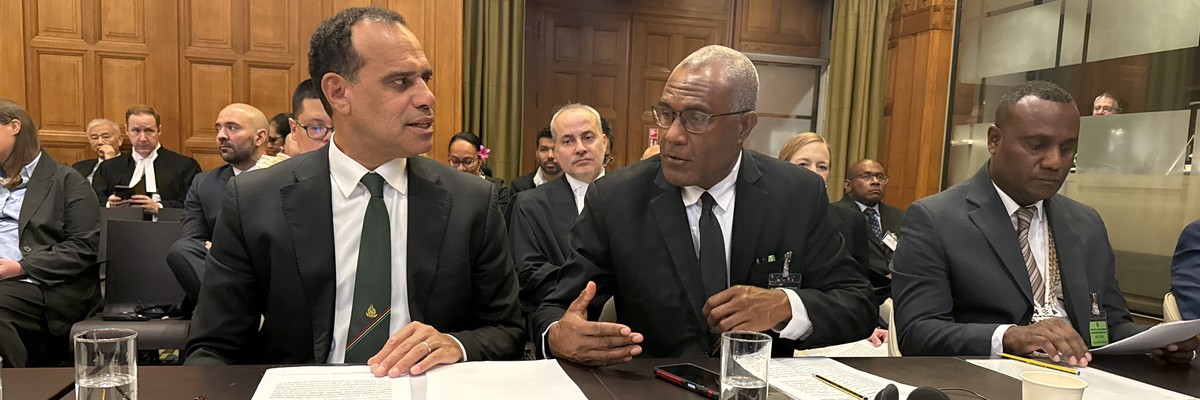
Ralph Regenvanu (left), Vanuatu’s special envoy on climate change and the environment; Arnold Kiel Loughman (center), attorney general of Vanuatu; and Ilan Kiloe (right), legal advisor to the Melanesian Spearhead Group attend the advisory opinion sessions at the International Court of Justice (ICJ) in The Hague, Netherlands on December 2, 2024. (Photo: Selman Aksunger/Anadolu via Getty Images)
“What started in the Pacific is now a historic climate justice campaign, as the world’s most urgent problem of climate change reaches the worlds highest court,” said one campaigner.
The International Court of Justice (ICJ) heard arguments Monday in the largest climate case ever brought before it as a coalition of low-lying and developing nations demanded larger polluting nations be held to account under international law for causing “significant harm to the climate system and other parts of the environment” with runaway fossil fuel emissions over recent decades.
In the first day of hearings in The Hague that could last weeks, multiple representatives from the Pacific island of Vanuatu, which is leading the coalition of over 100 countries and allied organizations, laid the blame for the climate crisis at the feed of a small number of states that are large emitters of greenhouse gases.
“We know what the cause of climate change is: a conduct of specific States … Vanuatu’s contribution to global greenhouse gas emissions is negligible, and yet we are among those most affected by climate change,” said Arnold Kiel Loughman, attorney general of the Republic of Vanuatu.
“We find ourselves on the frontlines of a crisis we did not create,” said Ralph Regenvanu, Vanuatu’s special envoy for climate change and environment, told the court.
Monday’s historic moment at The Hague follows years of work on the part of Pacific Island nations, particularly Vanuatu, to push for the ICJ to take up the issue of global warming and human rights. The stakes of the planetary emergency are particularly high for these countries, which are under threat from rising seas and other climate impacts.
Ilan Kiloe, legal counsel for the Melanesian Spearhead Group, a regional subgroup that includes Fiji, Papua New Guinea, Solomon Islands, and Vanuatu, issued a stark warning during his remarks to the court: “Climate change is now depriving our peoples, again, of our ability to enjoy our right to self-determination in our lands. The harsh reality is that many of our people will not survive.”
Last year, the United Nations General Assembly unanimously adopted a resolution calling on the ICJ to issue an advisory opinion on climate change and human rights. The measure, which was introduced by Vanuatu and co-sponsored by more than 130 governments, requested that the world’s highest court outline countries’ legal responsibilities for combatting fossil fuel-driven climate change and the legal consequences of failing to meet those obligations.
Over the next two weeks, the court will hear statements from nearly 100 nations, including wealthy developed countries such as the United States. Advisory opinions, unlike judgments, are not binding—but Vanuatu and other supporters hope that a forthcoming opinion would accelerate action around the climate emergency.
The country began pushing for the ICJ resolution in 2021, following a campaign launched in 2019 by a group of students from the University of the South Pacific.
“What started in the Pacific is now a historic climate justice campaign, as the world’s most urgent problem of climate change reaches the world’s highest court,” said Shiva Gounden of Greenpeace Australia Pacific.
“The next two weeks of hearings are the culmination of collective campaigning from 2019, powerful advocacy, and mobilizing the world behind this landmark campaign, to ensure the human rights of current and future generations are protected from climate destruction, and the biggest emitters are held accountable.”
Polly Banks, Vanuatu country director for Save the Children, who travelled to The Hague for the proceedings, said that “the hearing before the Court goes to questions about the efficacy, equity and fairness of the current responses to climate change, which are particularly relevant for children, who have contributed the least to climate change but will be most affected by its consequences.”
“Currently, only 2.4% of climate finance from multilateral funding sources is child-responsive. Even without the Court’s opinion, we know that states need to do far more to protect children from the worst impacts of this crisis, by significantly increasing climate finance to uphold children’s basic rights and access to health, education and protection,” Banks added.
The start of hearings at The Hague come on the heels of a COP29 climate summit that was heavily criticized. The summit focused heavily on climate finance, but the resulting deal was panned by critics as rich nations agreed to voluntarily provide just $300 billion to help developing nations decarbonize and deal with the impacts of the climate emergency. Poor nations and climate campaigners had demanded over a trillion dollars in funding in the form of debt-free grants and direct payments.
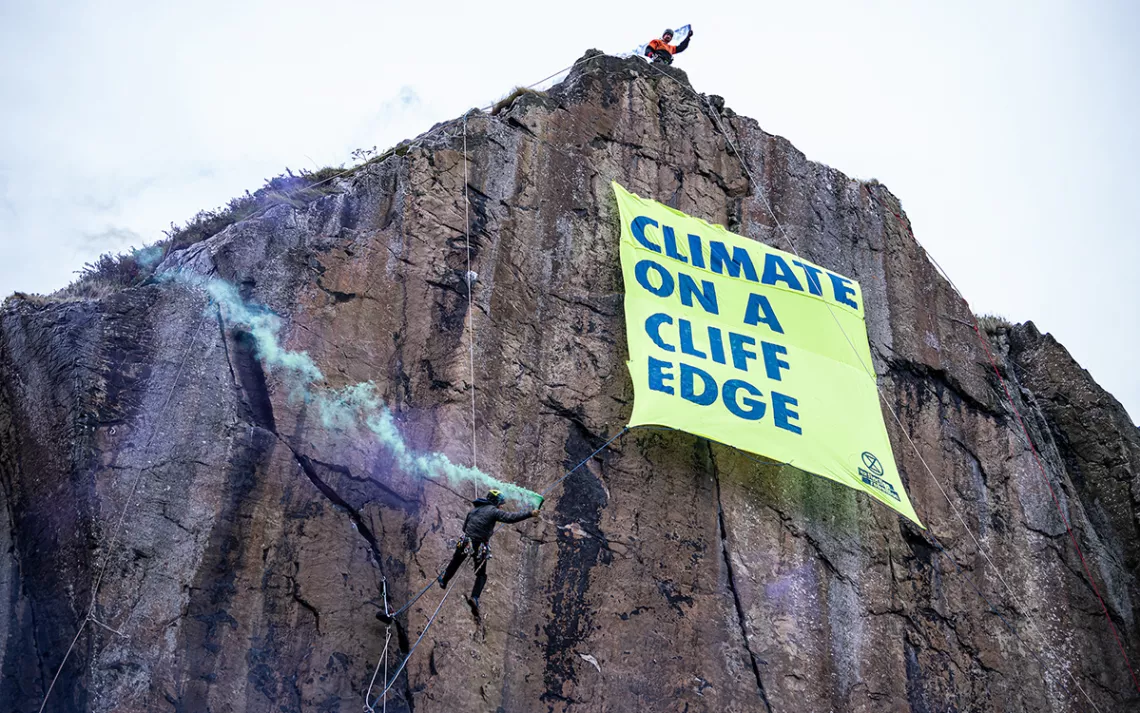
Experienced climbers scale a rock face near the historic Dumbarton castle in Glasgow, releasing a banner that reads “Climate on a Cliff Edge.” One activist, dressed as a globe, symbolically looms near the edge, while another plays the bagpipes on the shores below. | Photo courtesy of Extinction Rebellion and Mark Richards
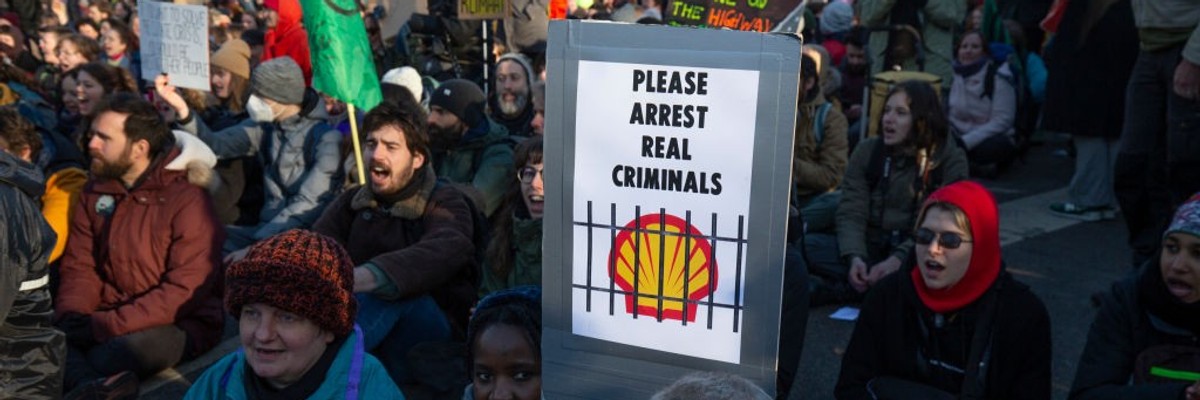
A protester holds a sign with a Shell logo during a demonstration on March 11, 2023 in The Hague, Netherlands. (Photo: Michel Porro/Getty Images)
“This setback will only help us grow stronger,” said the Dutch climate group that originally brought the case. “Large polluters are powerful. But united, we as people have the power to change them.”
Climate campaigners didn’t sugarcoat their reactions to a Dutch court decision on Tuesday that overturned a landmark 2021 ruling ordering the oil behemoth Shell to cut its planet-warming emissions nearly in half by the end of this decade.
“We are shocked by today’s judgment,” said Donald Pols, director of Milieudefensie, the Netherlands-based environmental group that originally filed suit against Shell in 2018.
“It is a setback for us, for the climate movement, and for millions of people around the world who worry about their future,” Pols said of Tuesday’s ruling by the Hague Court of Appeal. “But if there’s one thing to know about us, it’s that we don’t give up. This setback will only help us grow stronger. Large polluters are powerful. But united, we as people have the power to change them.”
The original 2021 ruling, as CNBC noted, marked “the first time in history that a company was found to have been legally obliged to align its policies with the Paris Agreement” and “sparked a wave of lawsuits against other fossil fuel companies.”
Despite acknowledging that Shell has “an obligation toward citizens to reduce CO2 emissions,” the appeals court on Tuesday scrapped a legal mandate compelling the company to slash its emissions by 45% by 2030 compared with 2019 levels, saying it was “unable to establish that the social standard of care entails an obligation for Shell to reduce its CO2 emissions by 45%, or some other percentage.”
“It is primarily up to the government to ensure the protection of human rights,” the court added.
Laurie van der Burg of Oil Change Internationalsaid in response that “while we mourn today’s setback, the ruling establishes a responsibility for Big Oil and Gas to act that future litigation can build on.”
“The court ruled protection against climate change is a human right, and corporations have a responsibility to reduce their emissions,” she added. “As far as we know, this is the first case where a court has acknowledged that new investments in oil and gas are incompatible with international climate goals.”
“Today’s ruling underscores the importance of world leaders now negotiating at the U.N. Climate Summit in Baku taking responsibility.”
Shell, which is responsible for just over 2% of global CO2 emissions, said in a statement that it was “pleased” with the court’s ruling and claimed to be “making good progress in our strategy to deliver more value with less emissions.”
But research by the human rights organization Global Witness has found that Shell has consistently overstated the scale of its investments in green energy—including by characterizing fossil fuels as “renewable.”
“Even as Shell claims to be reducing its oil production, it is planning to grow its gas business by more than 20% over the next few years, leading to significant additional emissions,” Global Witness wrote in a complaint to the U.S. Securities and Exchange Commission last year.
Andy Palmen, the director of Greenpeace Netherlands, said Tuesday that while campaigners working toward a just phaseout of fossil fuel emissions are “disappointed that Shell is being allowed to continue polluting,” they “will not give up the fight.”
“This only motivates us more to take action against major polluters,” said Palmen. “It really gives hope that the court finds that Shell must respect human rights and has a duty to reduce its CO2 emissions.”
“Today’s ruling underscores the importance of world leaders now negotiating at the U.N. Climate Summit in Baku taking responsibility,” Palmen added, referring to the COP29 gathering that kicked off on Monday in Azerbaijan’s capital city. “The summit in Dubai last year marked the end of coal, oil, and gas, now governments must come up with concrete plans to move away from fossil fuels.”
The Dutch appeals court’s ruling came in the wake of new research showing that oil and gas production surged to an all-time high in 2023—the hottest year on record.
“The oil and gas industry is not transitioning,” the environmental group Urgewald and dozens of other NGOs found. “In fact, 95% of the upstream companies on [the Global Oil and Gas Exit List] are still exploring or developing new oil and gas resources. This includes the oil and gas producers TotalEnergies, Shell, BP, Eni, Equinor, OXY, OMV, and Ecopetrol, which all claim to be targeting net zero emissions by 2050.”
Nils Bartsch, head of oil and gas research at Urgewald, said Tuesday that the 2023 oil and gas production record is “deeply concerning.”
“If we do not end fossil fuel expansion and move towards a managed decline of oil and gas production,” said Bartsch, “the 1.5°C goal will be out of reach.”
With average global temperatures set to see another record high this year, the chances of holding warming to no more than 1.5C continue to dwindle.
Keeping warming below 1.5C by the end of the century – in line with the long-term goal of the Paris Agreement – now likely involves “overshooting” 1.5C and then bringing temperatures back down later by removing carbon dioxide (CO2) from the atmosphere.
(What this means for “net-negative” emissions is covered in a previous guest post.)
This raises a number of unknowns in terms of what overshoot means for the impacts of climate change on the planet, people and ecosystems.
For example, even if global temperatures can be brought back down again by the end of the century, will the impacts of climate change also reduce? Will coral reefs be able to recover or will glaciers reform? What will it mean for the world’s coastlines, food production and endangered species?
For the past three years, we have been working on a Horizon Europe-funded project called PROVIDE to dive deeper into what overshoot really looks like for countries, regions and cities.
This data is available on the Climate Risk Dashboard – a tool to help people see how climate change will affect them and how it depends on the actions taken today.
Until carbon emissions are reduced to net-zero, the world will not stop warming. Delay will result in ever more intense climate impacts – and increase the risk of crossing irreversible thresholds.
Urban heat stress under overshoot
One of the clearest and most acute impacts of climate change is on extreme heatwaves. Our findings suggest that, were global average temperatures to decline, extreme heat events in most locations will also decrease, on average.
But achieving a new balance in local climates would be a slow process, influenced by ongoing climate system adjustments for decades – if not centuries – to come.
Reversing climate change would most probably take several decades, even if overshoot is limited to a few tenths of a degree. This implies that the climate risks that generations alive today will be exposed to are largely determined by collective actions today.
We can illustrate these differences for the risks of extreme heat stress for the Indian city of Chennai, one of 140 cities for which we modelled urban heat stress risks at 100-metre spatial resolution.
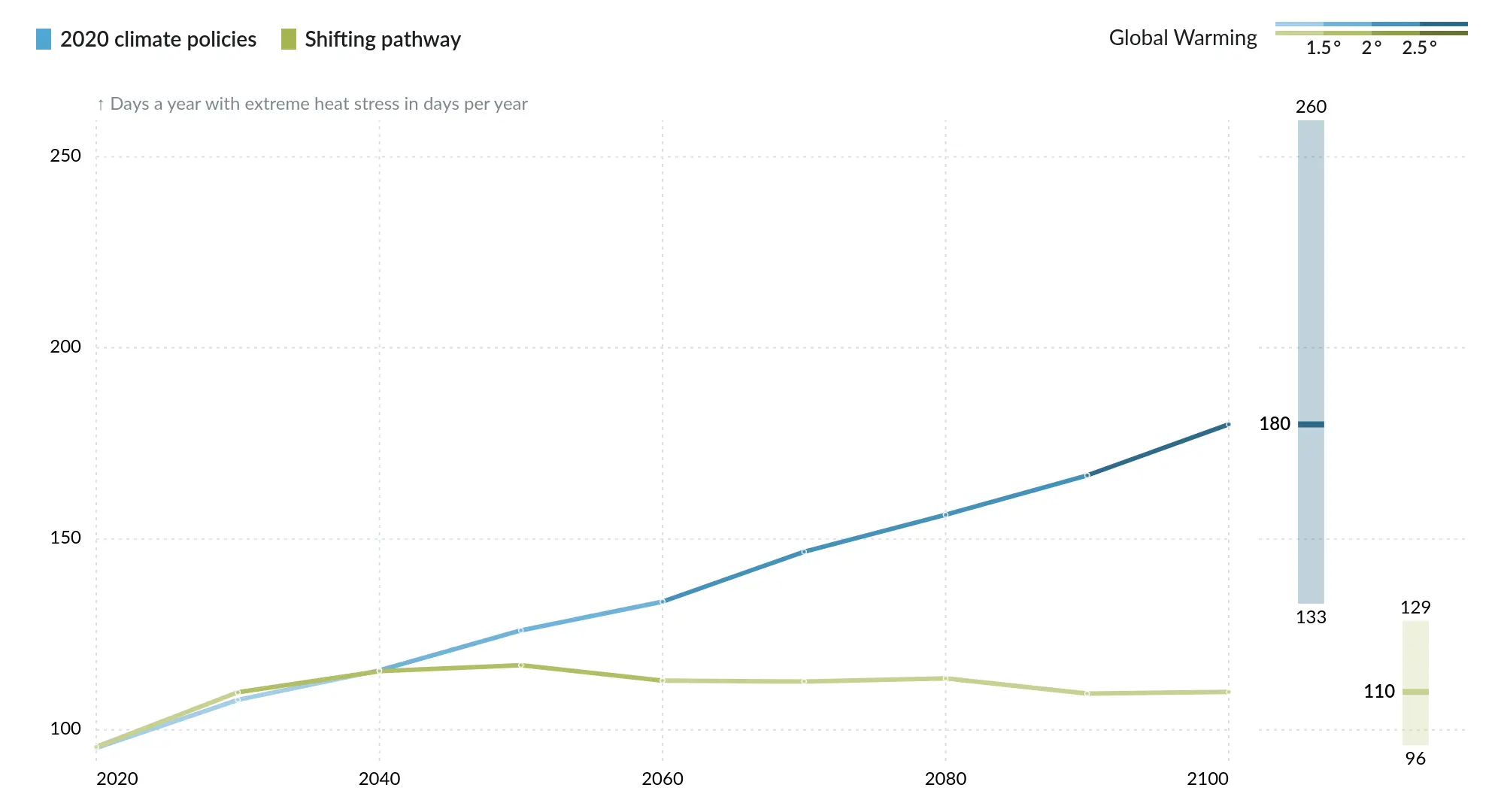
The chart below shows the projected annual number of days of extreme heat stress in Chennai – defined as days where wet-bulb globe temperature (WBGT) goes over 31C. (WBGT is a metric that combines air temperature, humidity and exposure to direct sunlight.)
This level of heat stress approaches the limits of human survivability (without adaptation) – for example, physical outdoor labour is almost impossible under these conditions.
Under current 2020 climate policies, leading to a best estimate of about 3C of warming in 2100, extreme heat days increase pretty much unchecked. By the end of the century, around half of the days (180) per year would experience extreme heat stress conditions (or even higher).
In contrast, in a 1.5C low-overshoot scenario (the IPCC Shifting Pathway), the number of extreme heat stress days would peak mid-century at around 120 days , before declining again to around 110 days by 2100 as global average temperature decreases from just above 1.5C to around 1.3C. This is a modest decline in extreme heat risk, yet a profound difference from a 3C world.
Projected days a year with extreme heat stress in Chennai from 2020 to 2100 under the climate policies of 2020 (blue) and 1.5C low-overshoot scenario called “IPCC Shifting Pathway” (green). Source: PROVIDE Dashboard
Irreversible consequences from overshoot
There are many other impacts of climate change that will be irreversible – for centuries to millennia – at peak temperatures, let alone if society is able to bring warming back down.
Yet, a lot of these losses can still be avoided by stringent mitigation. For example, our multi-scenario framework allows us to explore glacier futures showing unavoidable, or “locked-in”, risks even under the lowest emission scenario we have explored, and compare them with the avoidable risks through stringent mitigation.
Below, we provide an example for glacier volume projections for Peru, where glaciers serve as an essential freshwater resource during the extremely dry season of June to September. Due to past warming, glacier loss will continue over the coming decades. Under a current policy scenario (blue dots), 50% of the glacier volume might be lost as early as 2050.
Yet this does not need to happen. In fact, stringent mitigation pathways (green dots) are still possible that give a four-in-five chance of preserving 50% of today’s glacier ice in Peru, avoiding the worst and helping to maintain some of their vital uses.
Chart illustrating risks of losing 50% of 2020 glacier volume for Peru today and in 2030, 2050 and 2100, under the climate policies of 2020 (blue) and 1.5C low-overshoot scenario called “IPCC Shifting Pathway” (green). Shading highlights the avoidable risk. Source: PROVIDE Dashboard.
Overshoot risks for the biosphere
Climate change represents a major threat to biodiversity globally. We modelled species at risk from local extinction for about 135,000 terrestrial fungi, plants, invertebrates and vertebrates based on the Wallace Initiative.
Under the assumption that the 1950-2000 reference climate was suitable for the species at question, we model the proportion of species for which the local climate becomes unsuitable under ongoing climate change.
In the chart below, we illustrate the risks to species in one of the countries with the world’s richest terrestrial biodiversity, Brazil. Under the current policy scenario (blue dots), the likelihood of 50% of species being at risk of local extinction rises to 74% by 2100. Yet, our analysis shows that this likelihood can still be avoided almost entirely by stringent mitigation (green dots).
Chart showing the likelihood of 50% of Brazilian species being at risk of local extinction today and in 2030, 2050 and 2100, under the climate policies of 2020 (blue) and 1.5C low-overshoot scenario called “IPCC Shifting Pathway” (green). Shading highlights the avoidable risk. Source: PROVIDE Dashboard.
It is important to highlight that species loss does depend on a range of factors – of which climate suitability is only one. Yet there is a range of other human-caused stressors to biodiversity loss and a complex interdependencies of species and food webs in particular in the most biodiverse ecosystems implies the risk of knock-on effects and ecosystem tipping points.
We also note that our results do not necessarily imply global species extinction and do not allow us to quantify if and how species survival under different overshoot trajectories would emerge.
Overshoot will stress adaptation planning
Overshoot outcomes matter for climate risk assessments. Yet, in contrast with the prominence of overshoot pathways in the climate mitigation literature, their implications for adaptation planning have not been widely explored.
Overshoot would increase the threat of climate change that society needs to adapt to – and make that adaptation more difficult. Some options may become unavailable due to limits of adaptation.
Also, timescales matter. Reversing an overshoot will take decades. Even assuming reversibility of climate hazards in the future as temperatures come down, this might only matter for adaptation decisions that involve a planning horizon of 50 years or more.
This is illustrated in the chart below, from our recent Nature study. This shows a stylised trajectory of warming (top chart) with overshoot (red bars) and how it compares to planning horizons for some example adaptation options (green bars), the lifetime of those measures (blue bars) and the intergenerational equity they involve (bottom chart).
The possibility of reversing long-term impacts in the future does not reduce the urgent need to act now on closing the wide gap in current adaptation efforts.
Figure showing: a) stylised temporal evolution of a reversible climate impact driver under a peak and decline scenario. Dashed lines indicate a low and high overshoot outcome with median timescales of global temperature reversibility typically in line with those from the IPCC AR6 database; and b) stylised illustration of adaptation-relevant timescales starting in 2030, including different planning horizons for adaptation planning (green bars) and lifetimes of individual adaptation measures (blue), and the effect of applying discounting (reflecting societal preferences towards intergenerational equity) to future damages and adaptation benefits. Source: Schleussner et al. (2024)
Limit peak warming and aim for long-term decline
While our results clearly underscore the importance of limiting peak warming to as low as possible, there are also very good arguments for aiming for a long-term global temperature decline, irrespective of the peak warming level.
For a wide range of time-lagged climate impacts, such as ice sheet, peatland and permafrost loss, as well as large-scale irreversible tipping points, achieving temperature decline well below 1.5C is key to limiting long-term risks from global warming.
Overshoot is clearly not an alternative way to achieve a similar climate outcome. Effectively limiting climate risks requires restricting peak warming as low and as close to 1.5C as possible – and then aim for long-term decline to reduce the climate impact legacy of human-caused emissions.
Parts of Sanibel Causeway and its bridge are washed away after Hurricane Ian passed through in Sanibel, Florida on Sept. 29, 2022. Joe Raedle / Getty Images
According to a new report by the International Chamber of Commerce and consultancy firm Oxera, extreme weather events over the past 10 years have cost a total of $2 trillion globally. The countries that have faced the biggest losses include the U.S., China and India.
The report tracked nearly 4,000 extreme weather events from 2014 through 2023. In total, the results found that these events affected more than 1.6 billion people and cost around $2 trillion in economic losses.
Over just the past two years, losses linked to extreme weather cost the world $451 billion. According to the report, that is about 19% more than the losses from the previous 8 years analyzed in the study.
“The data from the past decade shows definitively that climate change is not a future problem: major productivity losses from extreme weather events are being felt in the here and now by the real economy,” John W.H. Denton AO, secretary-general of the International Chamber of Commerce, said in a statement.
The report also warned about the increase in frequency of these extreme weather events, noting that there has been an 83% increase in climate disasters when comparing 1980–1999 to 2000–2019.