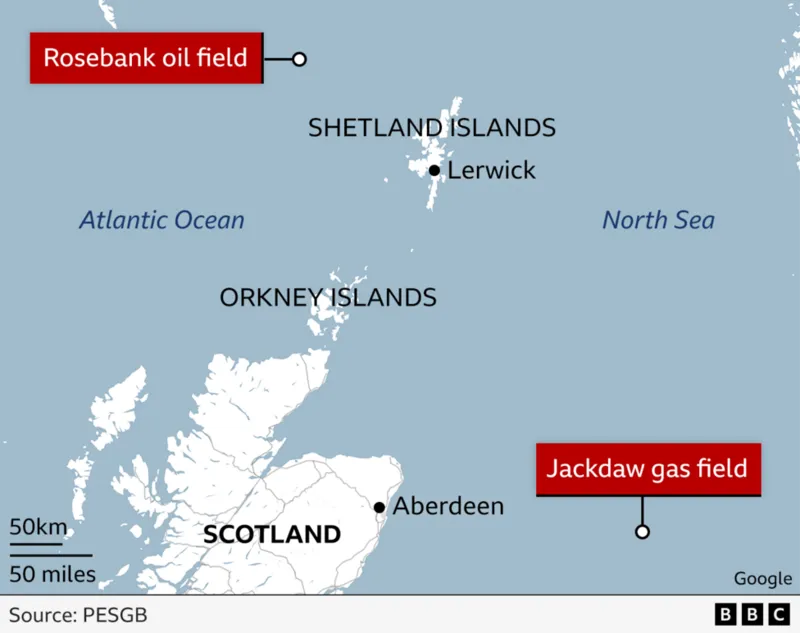
A court has ruled that consent for two new Scottish oil and gas fields was granted unlawfully and their owners must seek fresh approval from the UK government before drilling can begin.
The written judgement on the Rosebank and Jackdaw fields came after a case brought by environmental campaigners, Uplift and Greenpeace, at the Court of Session in Edinburgh.
In his judgement, Lord Ericht said a more detailed assessment of the fields’ environmental impact was required, taking into account the effect on the climate of burning any fossil fuels extracted.
He said work on both fields could continue while the new information was gathered but no oil and gas could be extracted unless fresh approval was granted.
Permission for the Rosebank oil development, 80 miles west of Shetland in the North Atlantic, was granted in autumn 2023.
In a 57-page judgement, Lord Ericht wrote that there was a public interest in having the decision “remade on a lawful basis” because of the effects of climate change – which he said outweighed the interests of the developers.
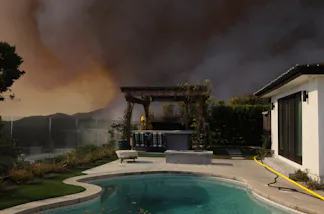
Climate change was a major factor behind the hot, dry weather that gave rise to the devastating LA fires, a scientific study has confirmed.
It made those weather conditions about 35% more likely, according to World Weather Attribution – globally recognised for their studies linking extreme weather to climate change.
The authors noted that the LA wildfire season is getting longer while the rains that normally put out the blazes have reduced.
The scientists highlight that these wildfires are highly complex with multiple factors playing a role, but they are confident that a warming climate is making LA more prone to intense fire events.
“Climate change increased the risk of the devastating LA wildfires,” said Dr Clair Barnes, from Imperial College London, the study’s lead author.
“Drought conditions are more frequently pushing into winter, increasing the chance a fire will break out during strong Santa Ana winds that can turn small ignitions into deadly infernos.”
A mariscadora collects shellfish at the coast in Pobra do Caraminal, Galicia, Spain on June 21, 2013. Pablo Blazquez Dominguez / Getty Images
Spanish fishers in Galicia — Europe’s main source of shellfish and the biggest producer of mussels in the world — are reporting a “catastrophic” collapse in shellfish populations due to the climate crisis.
Some shellfish stocks have plummeted by 90 percent in just a few years, reported The Guardian.
“Either the shellfish adapt, or they die, and us too,” said Patricia Piñeiro, who harvests clams in the small fishing town of Cambados, but has been having an increasingly difficult time finding ones big enough to harvest, as Mongabay reported. “They’re just too small.”
Piñeiro held a measuring device provided by local fishing authorities that was set to 1.5 inches — the minimum size for harvesting the bivalves.
There has been a steep decline in clams, mussels and cockles, according to a fishing website, reported The Guardian. The cockles and clams are collected at low tide by hand, while mussels are taken from the ocean on ropes attached to wooden rafts.
Cockle numbers fell by 80 percent in 2023, compared with the year before, while some clam varieties dropped by 78 percent. Oyster production has seen a slight increase.
Mussel production in 2024 was the lowest in 25 years, falling to 178,000 tonnes from 250,000 tonnes in 2021.
The UK government is set to back plans for a third runway at Heathrow, the country’s busiest airport, and to expand two other airports near London: Gatwick and Luton. The move is designed to support the government’s “mission” to grow the economy.
Air transport is notoriously hard to decarbonise. Unlike the energy system, or even road transport, there is no renewable alternative to switch to immediately. If electric or hydrogen planes become reality, it won’t be for many years yet. Therefore it’s not clear this airport expansion can fit within the UK’s legal and arguably moral requirement to cut emissions and remain within its carbon budget.
It certainly goes against what the government’s official advisory body the Committee on Climate Change (CCC) recommends. The CCC’s 2023 report to parliament stated that: “No airport expansions should proceed until a UK-wide capacity management framework is in place to annually assess and, if required, control sector GHG [greenhouse gas] emissions and non-CO₂ effects.”
Those non-CO₂ effects of aviation include water vapour, soot and other gases like nitrous oxides and sulfur dioxide, all released directly into the high atmosphere where they help form heat-trapping clouds. Estimates suggest they could triple the greenhouse impact of aviation.
In 2019, the last year of available data pre-COVID, domestic and international aviation accounted for around 8% of the UK’s total emissions. The non-CO₂ effects makes aviation a larger contributor to climate change than that number suggests.
The sector itself struggles to build a coherent decarbonisation roadmap based solely on “supply-side” improvements to things like fuel efficiency or, in a recent example from EasyJet, thinner paint. The demand side – taking fewer flights, frequent flyer levies, or restrictions on domestic flights as have been introduced in France – is rarely mentioned.
Unfortunately aviation is a prime example of the Jevons effect where any improvement in efficiency has been wiped out by increased demand. With a growing global middle class pursuing a higher consumption lifestyle, aviation emissions continue to grow even while other sectors have shows some efforts to reduce their own.
A third runway at Heathrow was first proposed back in the 2000s. This photo is from a 2016 protest. Dinendra Haria / shutterstock
The UK has mandated that synthetic aviation fuel (SAF), a more sustainable alternative to regular jet fuel, must make up 10% of aviation fuel by 2030. But only 1.2% of aviation fuel is currently SAF and the industry has not published any plans to show it can scale up in time. Indeed, the sector’s own plans for growth will outstrip efforts to decarbonise through synthetic fuel, delivering a neutral effect at best.
The consumer-facing airport sector has also been accused of greenwash. For instance, Luton Airport recently published adverts making the claim that its own expansion would be stopped if it did not meet stringent environmental targets. However, the Advertising Standards Authority found that consumers would naturally believe that would include air traffic and not just terminal operations (a terminal’s heating or lighting is, of course, largely irrelevant when its core business is as emissions-intensive as flying).
The difficulty of decarbonising aviation while the sector still grows is exemplified by the government’s recently launched consultation on adopting the Corsia carbon offsetting scheme for international flights and how it might work with existing cap and trade schemes. All of which encourage or excuse excess emissions through a charging mechanism.
Growing pains
“Kickstarting economy growth” and “Make Britain a clean energy superpower” are two of the UK government’s six “missions”. However, by expanding airports in support of the former, it risks failing the latter.
A new report by thinktank the New Economics Foundation shows that airport expansion could balance out all of the emissions saved by the government’s clean power plans by 2050.
There is evidence that airport expansion can bring some of the economic benefit that government needs. However, another New Economics Foundation report has found that air travel is no longer a catalyst for productivity growth. So the economic benefits of a new runway are really confined to the airport operation itself – projects for engineers and builders, service jobs for people living near Heathrow, and so on.
Aviation is the privilege of the richer part of society, both globally and within the UK. Figures from Our World in Data shows the richest 50% of the global population produces 90% of the aviation emissions.
While many more UK residents have experienced flying than in the past, most flights are still taken by a small, wealthy subset of the population, which will typically capture the largest share of any new capacity. Each year, around half of British residents do not fly at all.
The focus on London airports for the largest scale expansions will shift the balance of the economy further towards south-east England, and increase inequality within the UK economy. And while these plans might bring some of the GDP gains the government is desperate to deliver, all the evidence shows they will be at the expense of its environmental targets.
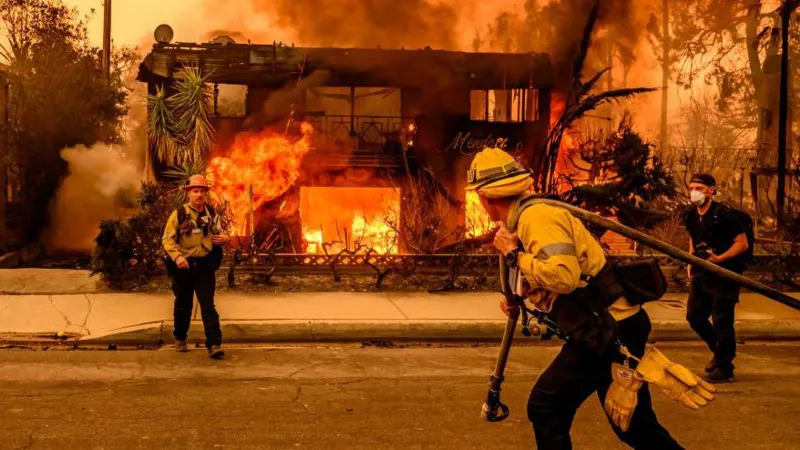
The fires that have engulfed Los Angeles cap the hottest decade in history.
Each year in the last ten was record-warm, but 2024 was the warmest ever recorded. Last year, Earth was 1.6°C hotter than the temperature average of the late 19th century, which was before widespread fossil fuel burning had significantly altered the climate.
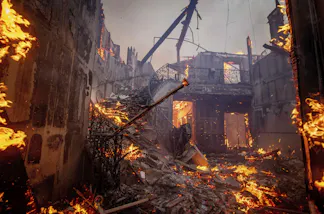
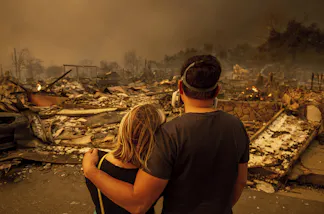
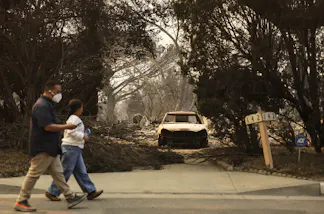
Still, the conflagrations which have so far claimed 25 lives and razed thousands of homes are not inevitable – even on our overheating planet.
“While climate change sets the stage for larger and more intense fires, humans are actively fanning the flames,” says Virginia Iglesias, a climate scientist at the University of Colorado Boulder.
Extreme heat dries out vegetation and the soil. Wildfires ignite more easily, spread faster and burn with greater intensity in these conditions, as parched land is more flammable. In the western US, aridity caused by climate change has helped double the amount of combustible forest since 1984.
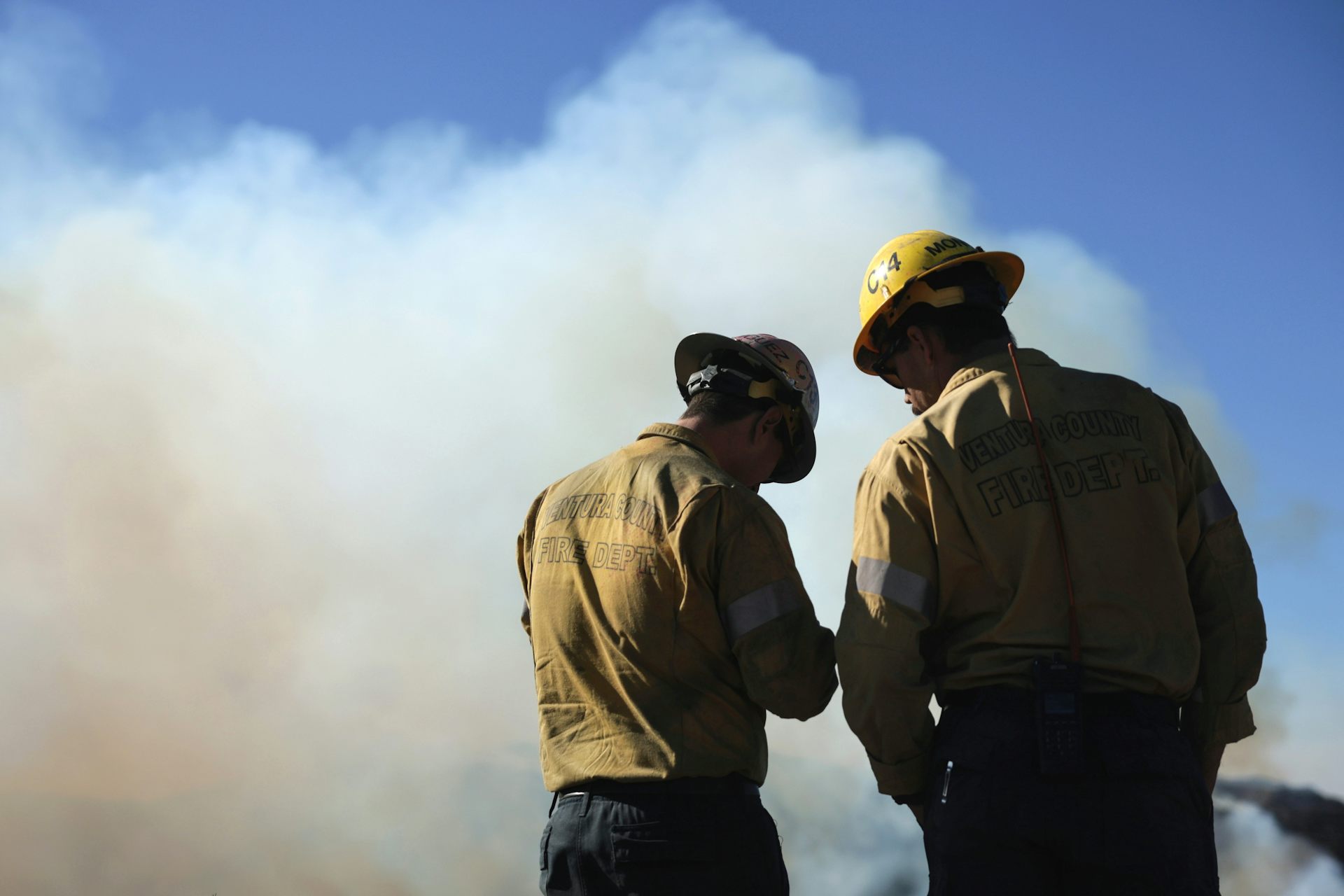
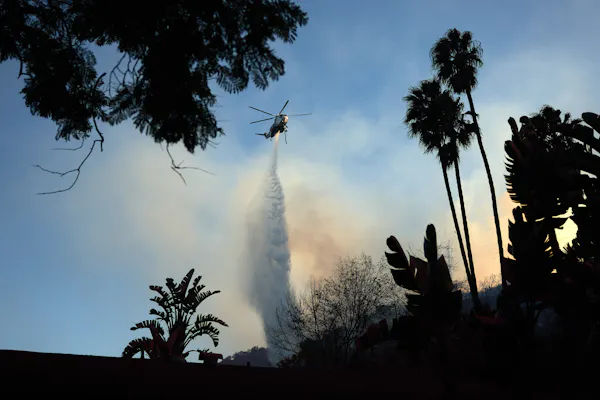
Nights are warming faster than days globally, and dusk has brought no reprieve from the fires menacing the residential areas of Pacific Palisades and Altadena. It’s been more than a week since the first spark but firefighters warn several more may pass before the flames are fully contained.
High winds and whiplash
Something is filling the fires with oxygen and spreading their embers to dry brush. The Santa Ana winds that blow down the San Gabriel Mountains between autumn and January lose moisture and gain heat as they rush downslope, and these gusts reached hurricane strength (exceeding 80 miles per hour) at the start of 2025.
“When the wind is blowing like this, there is very little chance of stopping fires,” says Jon Keeley, a plant ecologist at the University of California, Los Angeles.
Gusts have whipped the fire front onward and made containing the blazes difficult. EPA-EFE/Allison Dinner
Santa Ana would cause much less havoc in a more typical wet season, which runs from October to April in California. Ming Pan, a hydrologist who tracks the state’s water supplies, estimates that soil moisture in southern California is in the bottom 2% of historical records for early January.
In other words, the area around LA is about as dry as scientists have ever known it to be at this time of year. Why? Well, southern California has received less than 10% of the rain it would normally get from October onward. But it had the opposite problem last winter.
“Unusually wet winters in both 2022-23 and 2023-24 led to increased vegetation growth, providing more fuel for the fires,” says Doug Specht, a geographer at the University of Westminster.
“This cycle of wet and dry extremes, known as ‘hydroclimate whiplash’, is part of the increasingly intense climate cycles caused by climate change.”
Affluent LA is the most recent arena of climate disaster to capture the world’s attention. Yet it is the poorest 20% of humanity who have felt the sting of whiplashes between drought and downpour most keenly according to Specht.
When unusually heavy rain meets baked ground that cannot easily absorb it, as it did across much of east Africa in spring 2024, flash floods and landslides follow.
‘Perpetually on the brink of catastrophe’
Now we come to the more immediately tractable causes of these fires.
“Fire is a natural process that has shaped ecosystems for over 420 million years,” Iglesias says.
“Indigenous people historically used controlled burns to manage landscapes and reduce fuel buildup. However, a century of fire suppression has allowed vast areas to accumulate dense fuels, priming them for larger and more intense wildfires.”
European colonisation has transformed relationships with the land. Subsequent arrivals to southern California have included invasive plants capable of overrunning native flora and forming dense, uninterrupted fuel beds.
The legacy of these fires may be more invasive plants, and more flammable landscapes. That’s because invasive species are typically better at exploiting extreme weather, their tendrils colonising land disturbed by fire before native species can recover.
The overwhelming majority of wildfires that affect people are also ignited by them, intentionally or otherwise. Lightning has been ruled out for the LA fires so that leaves a wealth of human explanations: arson, unattended campfires, overheating engines or sparks from power lines that utilities have neglected to replace.
“More people now live in and at the edges of wildland areas, and the power grid has expanded with them. That creates more opportunities for fires to start,” Keeley adds.
The Eaton fire which erupted near Altadena on January 7 would have probably burned out in citrus orchards 50 years ago. Today, there is no buffer between homes and the wildland, Keeley says.
Fast-moving wildfires have engulfed residential neighbourhoods with stunning speed. EPA-EFE/Allison Dinner
Whether it was wise to bring flammable homes and cars into this fire-adapted wildland is a debate that should have started nearly a century ago, after the catastrophic Malibu fire in 1930. It didn’t, and late urban historian Mike Davis had a lot to say about why.
“Davis, who died in 2022, painted a vivid, if pessimistic picture of Los Angeles as both a real and imagined city perpetually on the brink of catastrophe,” says Alexander Howard, a senior lecturer in English and writing at the University of Sydney.
“Davis’ Los Angeles is a place where – as he comprehensively details – commercial greed overrides common sense and the social good, where institutional racism marginalises vulnerable communities, and where wilful political inertia ensures history repeats itself with devastating consequences.”
Davis criticised liberal California politicians who greeted each new fire with calls to cut greenhouse gas emissions, but continued to allow real estate developers to “profitably but insanely, [build] in high-fire-risk areas”.
Although motivated by greed, these developers were not alone in their assessment of southern California as a tranquil paradise ripe for luxury housing. LA’s urbanisation occurred “during one of the most unusual episodes of climatic and seismic benignity” according to Davis, who traced natural disasters and climate change back several centuries.
“These spans are too short to serve as reliable proxies for ecological time or to sample the possibilities of future environmental stress,” he writes. “In effect, we think ourselves gods upon the land but we are still really just tourists.”