Green party leader Zack Polanski stands with party members at King’s Place in London, after he was picked as the Green Party candidate for the Holborn and St Pancras by-election, Friday September 11, 2026
GREEN Party leader Zack Polanski accused Labour today of “running scared,” following reports that Prime Minister Andy Burnham will delay announcing his decision on drilling in the Jackdaw gas field until after the Holborn and St Pancras by-election.
Mr Polanski, who was announced today as his party’s candidate in the election on October 8, said that Labour had “started the campaign with an act of dishonesty and betrayal.”
He argued: “They are clearly going to allow new drilling in the North Sea but want to keep it under wraps during a byelection where they know the public want tougher action on climate, not backsliding.
“Labour talks about change, but this is change for the worse. We have a climate crisis, but Labour is taking the side of fossil fuel corporations….”
UK Prime Minister Andy Burnham says that he’s going to permit the Jackdaw and Rosebank North Sea fossil fuel projects. He urges you to ignore facts and reality and be a climate science denier like himNigel Farage urges you to ignore facts and reality and be a climate science denier like him and his Deputy Richard Tice. He says that Reform UK has received £Millions and £Millions from the fossil fuel industry to promote climate denial and destroy the planet.Donald Trump urges you to be a Climate Science denier like him. He says that he makes millions and millions for destroying the planet, Burn, Baby, Burn and Flood, Baby, Flood.
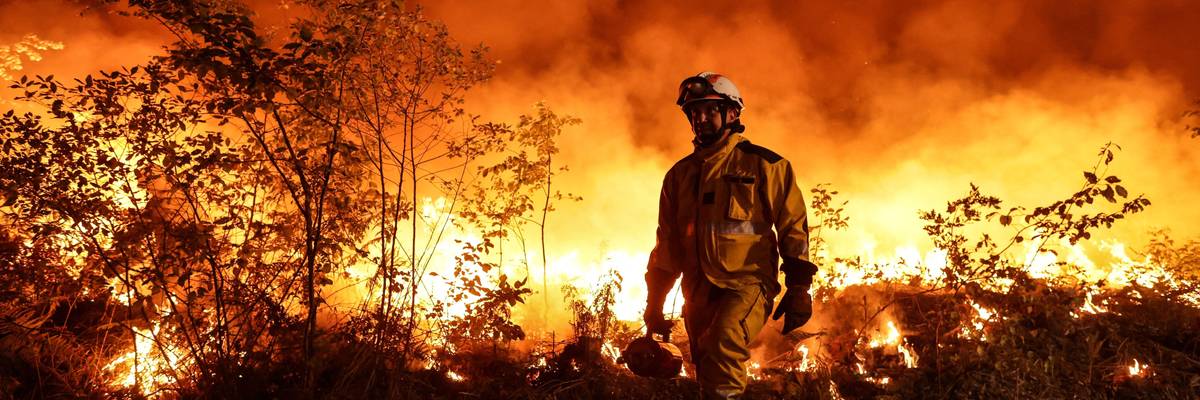
Tactical firefighters set a backfire to a plot of land to prevent the wildfire from spreading as the winds change in Louchats, France, on July 17, 2022. (Photo by Thibaud Moritz/AFP via Getty Images)
“Overshoot doesn’t have to mean surrender,” said one campaigner. “The size and length of that overshoot is still being written by the decisions governments make this year.”
The world has officially moved past the point where preventing a temperature rise above 1.5°C will be possible, scientists said in a United Nations report released Wednesday, which made clear that communities can expect sea levels to continue rising, heatwaves to intensify, and hurricanes, wildfires, and flooding to become more frequent and dangerous—all climate impacts that experts have long warned about as policymakers have failed to rapidly draw down greenhouse gas emissions.
But the authors of the report, published by the UN Environment Program (UNEP) and titled “Limiting Overshoot,” emphasized that the inevitable temperature rise must not be viewed as a point of no return, and that steps can and must be taken to ensure the overshoot of the 1.5°C goal is only temporary.
The best-case scenario is now a peak global temperature of 1.8°C, said the report’s dozens of authors, with an “overshoot, peak, and decline” pathway still possible before the end of this century if policymakers ensure that planet-heating fossil fuel emissions are drastically reduced—starting immediately.
The report is the first ever to establish the inevitability of overshooting the 1.5°C goal that countries were tasked with working toward when the Paris climate agreement was signed in 2015, and to chart a path toward ensuring the planet can ultimately make its way back down to 1.5°C—hopefully limiting the time above the threshold to a few decades.
We can't avoid exceeding 1.5°C—but we can still limit the damage.
The new UNEP Limiting Overshoot report is a powerful reminder that the climate crisis is already reshaping our world. Coral reefs are bleaching, glaciers are disappearing, and biodiversity is under growing… pic.twitter.com/hbfLvedqIx
If the world remains above 1.5°C over preindustrial temperatures long-term, said UNEP Executive Director Inger Andersen, “there are no good outcomes.”
Last year, global temperatures were already about 1.3°C to 1.4°C above the preindustrial average, The Washington Postreported, and the effects on the Earth have been made clear as wildfires have engulfed parts of Canada and South America; a glacial collapse led to flooding that killed more than 1,000 people in Nepal last week; and extreme heatkilled more than 1,000 people across Europe this summer.
“Across the globe, extreme heatwaves are already proving that climate impacts will strike faster, hit harder, and last longer—costing more lives and causing deeper disruption,” said Andersen. “Now is the time we must double down on climate action. We can—and must—get on the right path. By cutting greenhouse gas emissions, strengthening resilience and adaptation, and ensuring exceedance of 1.5°C is as small and short as possible.”
The scientists said planet-heating fossil fuel emissions must be slashed by 55% by 2035 and almost entirely eliminated by the middle of the century to limit the global temperature rise to 1.8°C above preindustrial levels.
Climate scientist Joeri Rogeli of Imperial College London, a lead author of the report, told the Post that swift action is crucial, as “for every five years that humanity delays reducing emissions… the peak temperature the world will ultimately face rises by at least a 10th of a degree.”
The scientists emphasized that avoiding the 1.5°C limit would have been a less daunting goal than reversing the temperature rise. Policies that continue allowing oil, gas, and coal companies to extract fossil fuels will make both goals difficult to achieve.
The report was released weeks after President Donald Trumpterminated offshore wind energy projects in the US—the latest of several renewable energy projects he’s killed—and moved to take ownership of Venezuelan oil fields. Recent global climate summits have been attended by an outsized number of corporate lobbyists for fossil fuel industries, weakening the climate commitments that have come out of the meetings.
Fenton Lutunatabua of 350.org Pacific noted that the report was also released as Pacific countries meet at the 55th Pacific Islands Forum Leaders Meeting.
“All eyes are on one of the world’s largest fossil fuel exporters, Australia, and how they act on this urgent warning,” said Lutunatabua. “The climate crisis is here and any delay in mitigation, in phasing out coal, oil, and gas, will only make our adaptation pressures harder and more expensive to bear.”
The report emphasizes that even if the world is able to reduce planetary heating once global temperatures shoot above 1.5°C, some impacts of continued fossil fuel extraction will be irreversible, including the melting of glaciers and the extinction of some species.
But UN Secretary-General António Guterres was among those who said “an overshoot of ambition” is now required to mitigate the damage as much as possible.
“This summer’s scorching heat, raging wildfires, and deadly floods are a warning of what lies ahead. We must make the overshoot above 1.5 degrees as small and short as possible,” said Guterres.
Along with rapidly cutting emissions, the report calls “carefully governed carbon dioxide removal (CDR)—the process of removing carbon from the air and storing it through afforestation or other means—an essential part of the mix.”
CDR methods—from planting forests to act as carbon sinks to technological fixes—come with limitations and are potentially reversible. Forests that are planted could be destroyed by wildfires, while CDR technology is largely unproven and can be energy-intensive—negating many of the benefits.
“Overall, even optimistic CDR scaling is unlikely to deliver a temperature reversal beyond a few tenths of a degree this century,” reads the report. “This emphasizes the importance of focusing on reducing greenhouse gas emissions.”
Richard Betts, a climate scientist at the University of Exeter and another report author, told the Post that CDR cannot be relied upon as a “get-out-of-jail-free card.”
At 350.org, head of campaigns and networks Savio Carvalho said that “there is no version of ‘limiting overshoot’ that doesn’t start with ending new coal, oil, and gas expansion today.”
“This report confirms what communities on the frontlines of the climate crisis have been telling us for years: that delay is not a neutral act, it is a decision,” said Carvalho. “We’ve just watched a glacier collapse bury Himalayan communities under mud and water, and we’re watching Pacific nations lose land to the sea in real time. UNEP is right that overshoot doesn’t have to mean surrender: The size and length of that overshoot is still being written by the decisions governments make this year, on fossil fuel phase-out, technology transfer, and on finance for the countries least responsible and most exposed.”
Murat Kurum, Türkiye’s minister of environment, urbanization, and climate change and the president-designate of the 31st UN Climate Change Conference (COP31), said the upcoming summit scheduled for November “must turn this urgency into concrete action.”
“Every fraction of a degree matters, and every year spent in overshoot increases climate risks and the potential for irreversible losses,” said Kurum. “The Overshoot Report makes clear that exceeding 1.5°C should not be seen as a new destination, but as a pathway we must urgently work to minimize and reverse. This requires rapid and sustained emissions reductions, alongside ambitious adaptation to protect people, communities, and ecosystems.”
“We need to accelerate global electrification, reduce methane emissions from waste, strengthen the climate resilience of cities, and enhance the resilience of marine and coastal ecosystems,” he added. “The choices we make today will determine how high temperatures peak, how long they remain there, and how safely we can return to 1.5°C.”
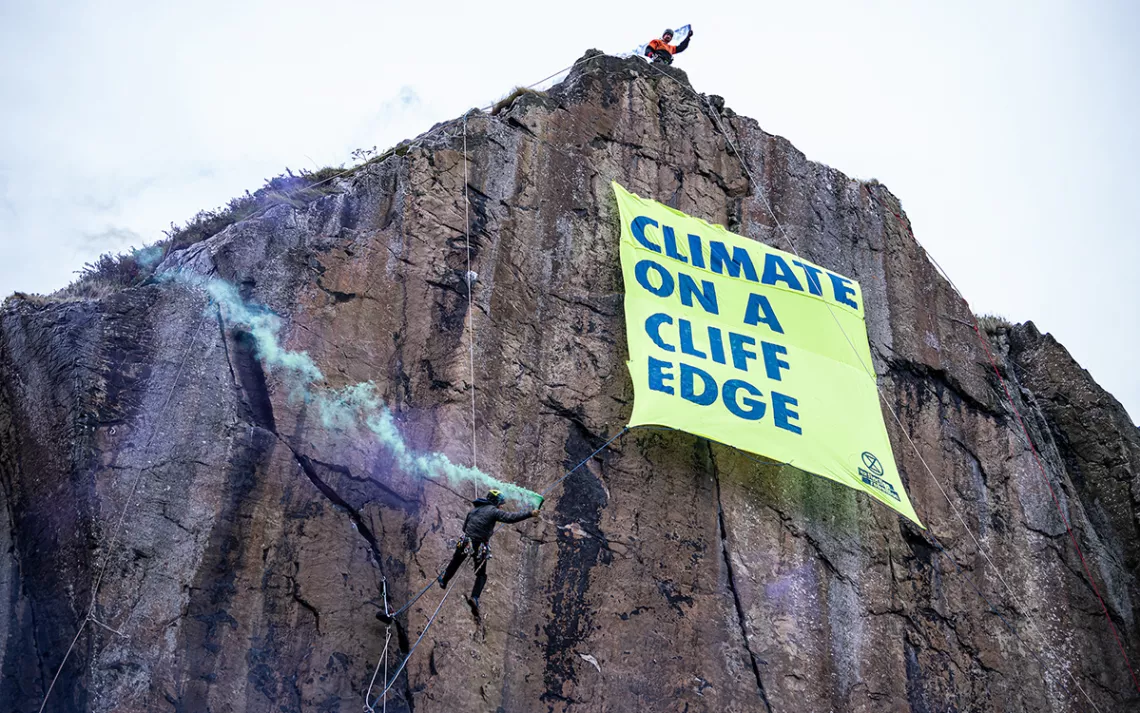
Donald Trump urges you to be a Climate Science denier like him. He says that he makes millions and millions for destroying the planet, Burn, Baby, Burn and Flood, Baby, Flood.Nigel Farage urges you to ignore facts and reality and be a climate science denier like him and his Deputy Richard Tice. He says that Reform UK has received £Millions and £Millions from the fossil fuel industry to promote climate denial and destroy the planet.Experienced climbers scale a rock face near the historic Dumbarton castle in Glasgow, releasing a banner that reads “Climate on a Cliff Edge.” One activist, dressed as a globe, symbolically looms near the edge, while another plays the bagpipes on the shores below. | Photo courtesy of Extinction Rebellion and Mark Richards
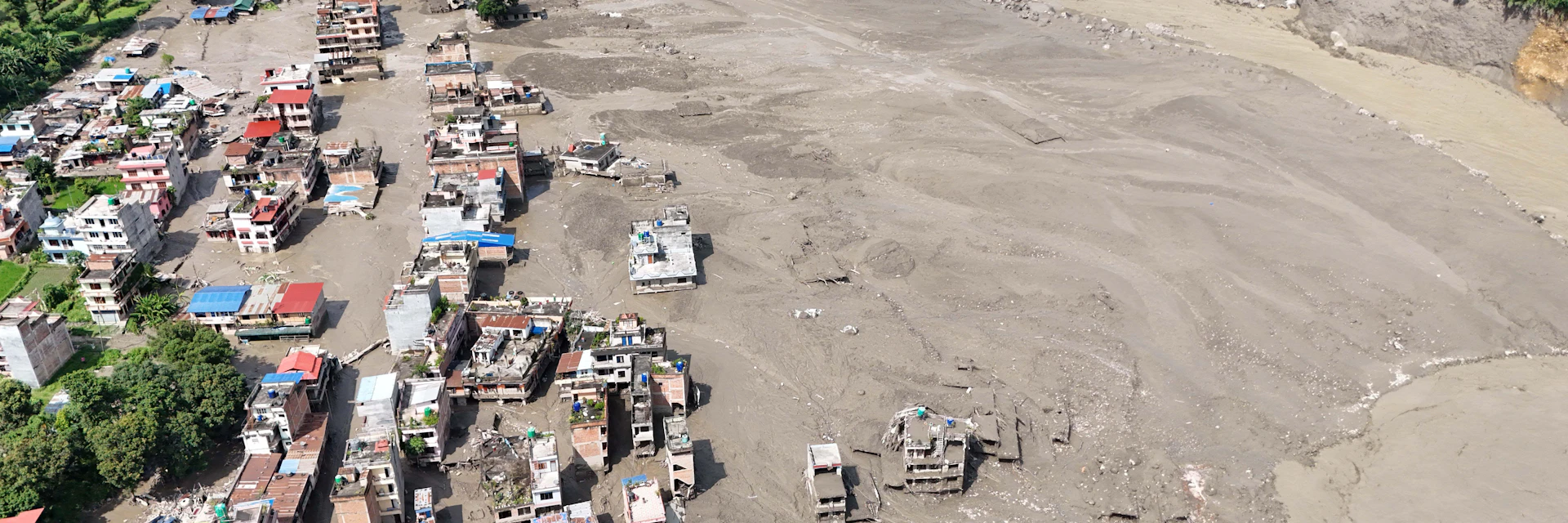
A flash flood triggered by an avalanche of ice and rock near Nepal’s border with Tibet has caused hundreds of deaths and massive destruction. Sopa/Alamy
The cause of the huge floods and debris flow on the border between Nepal and Tibet, which has caused hundreds of deaths, appears to have been an ice avalanche – the result of a huge piece of a glacier collapsing and cascading down the mountain more than 1,000 metres to the valley floor. The Conversation asked Jonathan Bamber, a professor of glaciology at the University of Bristol, about the risks of glaciers melting faster than ever.
Is this region particularly at risk from glacier melt?
The greater Himalayan region, called High Mountains Asia (HMA), is often referred to as the third pole because it contains more glacier ice than anywhere outside the polar regions. Many of those glaciers lie along the northern border of Nepal and China, forming an east-west arc of the Himalayas. Tibet is an autonomous region of China.
Eight of the 14 peaks above 8,000m lie in Nepal. Its northern half is extremely mountainous and precipitous, making it susceptible to landslides, rockfalls and glacier-related hazards such as glacial lake outburst floods and ice cliff collapses. When glaciers flow over steep bedrock slopes, the ice fractures into what are called seracs: ice cliffs that are inherently unstable and break off from time to time.
Are glaciers melting more quickly now?
It should come as no surprise that in a warming world, ice melts faster. Since the start of the industrial revolution, typically taken to be 1850, the world has warmed by 1.4°C.
However, that warming is a global average and there are large regional variations. The Arctic has warmed by more than double that amount, and the Himalayan region has also warmed by more than the global average . The rate of warming has accelerated significantly over about the last four decades. As a consequence, glaciers around the world have been melting faster.
The most comprehensive assessment of glacier melting (called glacier mass balance) combines satellite observations with ground-based data to reconstruct melt rates from 1976-2024. They find that the rate is greater for the most recent decade compared with the long-term mean for every region except Iceland. For the HMA, the increase is about 25%. For the European Alps, it is more than double.
What are the consequences?
When glaciers melt, the primary consequence is the release of meltwater that flows, seasonally, into meltstreams which then feed into larger river systems. However, the glaciers lie on permafrost: ground that is permanently frozen to some depth. As this permafrost warms and thaws, the rock, ice and mud become unstable, resulting in rockfalls and destabilisation of ice in steep terrain.
In the case of the Nepal-Tibet disaster, imagine a block of ice some 600m wide and about 50m thick collapsing. That represents around half a million tons of ice crashing into the valley.
Serac collapses are more common during warmer periods, when surface melting weakens the ice. That is why mountaineers try to pass serac barriers at night or in the early morning, before the sun has warmed them.
A further consequence of glacier melt is the formation of lakes dammed by ice or moraines (debris left behind by glacier melt) at the glacier front. These lakes form glacial lake outburst floods that occur when the dam fails. Many trails in Nepal and India carry warning signs for these.
Floods in Nepal have caused hundreds of deaths.
What else should nations be doing?
Increased glacier melting is one of many consequences of living in a warming world. The unprecedented wildfires across Spain and France, the heatwaves across Europe, more intense and common droughts are all consequences of a climate system that is out of equilibrium. The UK declared a climate emergency in 2019, as has the EU and a number of other states.
Progress has been made in reducing our dependency on carbon-intensive fossil fuels, but emissions are still increasing. One definition of an emergency is an existential threat that requires immediate action. Not enough has been done to tackle this yet, despite the encouraging words from many governments and states.
We have the know-how and technology to address the climate crisis. What is lacking is the political will and vision. If this is not forthcoming, melting glaciers are just one aspect of this human-made climate crisis, and the consequences will be devastating.
Donald Trump urges you to be a Climate Science denier like him. He says that he makes millions and millions for destroying the planet, Burn, Baby, Burn and Flood, Baby, Flood.
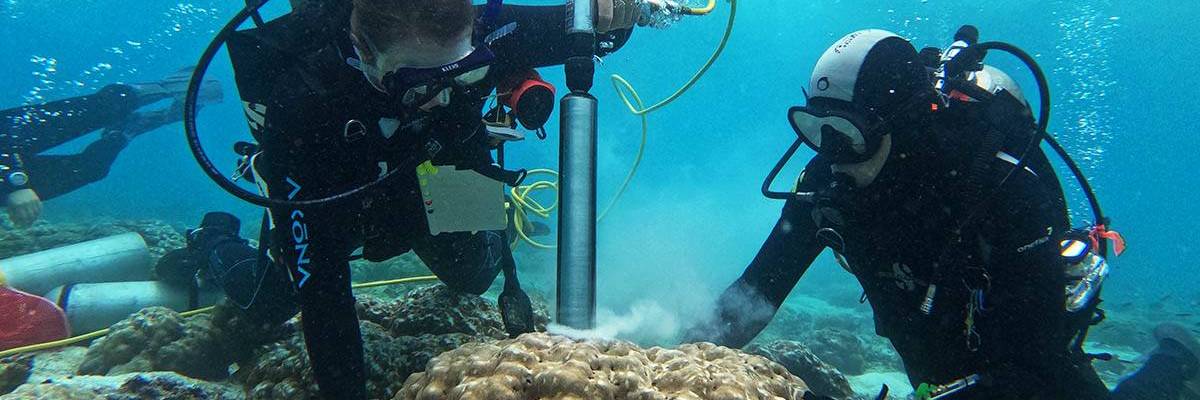
A study published August 27, 2026 in the journal Science concludes that fossil fuel-driven global warming has intensified the warm phase of the El Niño-Southern Oscillation in the Pacific Ocean. (Photo by Julia Cole/Science)
“We are seeing a trend of stronger El Niños, and the one we have now is consistent with that trend,” said the lead author. “That is bad news for climate hazards and for people.”
As the flooding disaster in Tibet and Nepaldemonstrates the deadly consequences of the climate emergency, experts wrote Thursday in the journal Science that fossil fuel-driven global heating has intensified the warm phase of a key pattern in the Pacific Ocean.
The El Niño-Southern Oscillation (ENSO) has a warm phase, called El Niño, as well as a neutral phase and a cold one, La Niña. In June, scientists declared the start of a warm event nicknamed “Godzilla,” which helped push last month’s average global ocean surface temperature to the hottest ever recorded in July.
The current event is expected to become not only a super El Niño, but the most intense one on record—and it could contribute to 2027 possibly being the hottest year humanity has ever endured.
While ENSO is a naturally occurring phenomenon, the scientists behind the new paper studied coral skeletons from the Galápagos Islands and concluded that global warming—tied to humans continuing to burn fossil fuels—has intensified El Niño phases.
“Our findings suggest El Niño can supercharge global warming, but also global warming can supercharge El Niño—that is what we are seeing,” said lead author Julia Cole, who chairs the University of Michigan’s Department of Earth and Environmental Sciences.
The scientist also spoke with Inside Climate News, which noted that “the first documented super El Niño in 1982-83 killed about 95% of the shallow-water corals around the Galápagos Islands, right around the time Cole began her research career.”
Based on the team’s analysis, “after the El Niño in 1982, we start seeing much more variability; it’s a lot more extreme and looks like nothing in the previous 1,000 years,” Cole told The Guardian. “What surprised me was how consistent it was. There is just such a large, distinct difference between what has been happening in the last 40 years compared to preindustrial times.”
As Inside Climate News reported:
When Cole visited the islands in 1989, many of the large mapped corals that could have served as sample material were gone, wiped out by the El Niño early in the decade and then decomposed quickly by organisms in the biologically active waters. But in 2006, her team discovered fossil coral remnants, often perched as boulders near remote east-facing coastlines, tossed inland by large waves or tsunamis.
Cole said the signal of El Niños intensified by human-caused warming would have been even stronger if the study had included the most recent occurrences. All the events categorized as super El Niños have occurred since the 1980s and have triggered flooding in East Africa, led to disease outbreaks, and intensified tropical storms. This year’s El Niño is intensifying drought in Indonesia, fueling widespread fires that are sending smoke and hazardous air pollution across Southeast Asia, Cole said. Her team is currently analyzing corals to show the changes from the El Niños in 2015-16 and 2023-24, she added.
“We are seeing a trend of stronger El Niños, and the one we have now is consistent with that trend—it’s not a fluke. We are seeing a shift where El Niño doesn’t look like what it did prior to industrial times,” Cole said. “That is bad news for climate hazards and for people, particularly those who are badly impacted and yet have done little to cause climate change.”
According to the United States’ National Oceanic and Atmospheric Administration, consequences of El Niño include “increased rainfall across the southern tier of the US and in Peru, which has caused destructive flooding, and drought in the West Pacific, sometimes associated with devastating brush fires in Australia.”
Dalhousie University marine scientist Boris Worm wasn’t involved with the new study but told The Associated Press on Thursday that “El Niño is the most violent aspect of climate variability worldwide, with effects ranging from local fisheries collapse, to widespread coral die-offs to severe droughts, and food shortages around the world.”
Experts are already worried about the latest El Niño’s impact on food security and prices, with the United Nations World Food Program projecting earlier this month that almost 50 million more people worldwide face the prospect of acute hunger.
Pointing to late climate scientist Wallace Broecker’s warning that “the climate system is an angry beast and we are poking it with sticks,” Worm said that “human emissions are the stick, and El Niño is [one] of the ‘angry’ outbursts that can be so threatening to our collective safety.”
Donald Trump urges you to be a Climate Science denier like him. He says that he makes millions and millions for destroying the planet, Burn, Baby, Burn and Flood, Baby, Flood.Orcas discuss rotting brain, front Orca says Sundown Syndrome is a dead givaway and he wishes someone would Lock Him Up
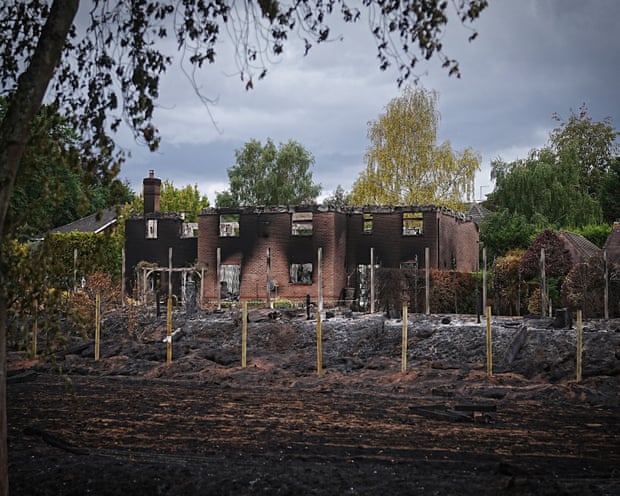
The fire-gutted remains of homes on Quarry Park Road on 17 August in Stourbridge, England after a wildfire that broke out across the West Midlands. Photograph: Christopher Furlong/Getty
Government resilience campaign aims to ensure people can cope in a national disaster, in order to free resources for most vulnerable
UK citizens will be told to stock up on tinned food and take steps to ensure they are prepared for national emergencies as part of a new government campaign to improve the nation’s resilience.
The new campaign from the Cabinet Office will set out ways people can prepare for and potential attacks from hostile states, including stocking up on bottled water, sources told the Guardian.
The aim will be to ensure most households have basic supplies and knowledge about how to cope in a crisis, in order to free up immediate government resources for the most vulnerable.
Translation by dizzy: The government wants you to stock up for when the shelves are empty caused by climate change – the long dry summer has decimated agricultural produce.
Donald Trump urges you to be a Climate Science denier like him. He says that he makes millions and millions for destroying the planet, Burn, Baby, Burn and Flood, Baby, Flood.Nigel Farage urges you to ignore facts and reality and be a climate science denier like him and his Deputy Richard Tice. He says that Reform UK has received £Millions and £Millions from the fossil fuel industry to promote climate denial and destroy the planet.Orcas comment on killer apes destroying the planet by continuing to burn fossil fuels.

 Green party leader Zack Polanski stands with party members at King’s Place in London, after he was picked as the Green Party candidate for the Holborn and St Pancras by-election, Friday September 11, 2026