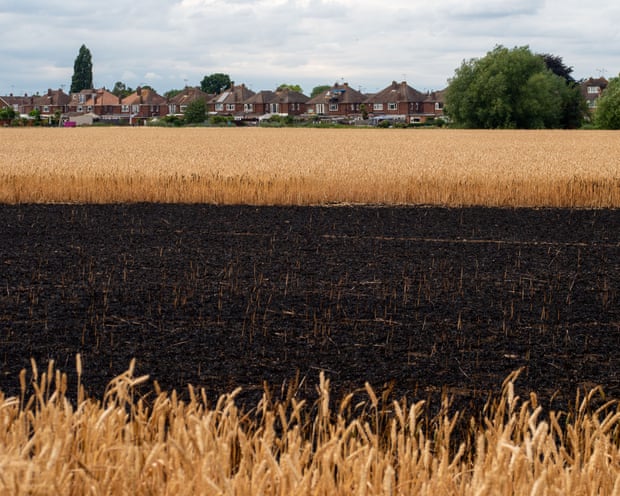
A burned field of wheat in Eton Wick, Windsor, in July. Experts say the UK should regenerative agriculture approaches to increase food resilience. Photograph: Maureen McLean/REX/Shutterstock
Rejecting North Sea drilling licences and protecting nature are just some measures Andy Burnham must implement to ready country
From record-smashing temperatures, wildfires, hosepipe bans and thousands of premature deaths, the climate crisis has left its mark across the summer of 2026.
Tackling the root cause – the burning of fossil fuels – and ending the crisis will take years. So will fixing the UK government’s calamitousfailure to protect lives and livelihoods against the long-predicted affects of global heating.
But the climate emergency is right here, right now, and here are 10 policies that Andy Burnham’s government should consider announcing urgently.
1. Reject drilling licences for the Jackdaw and Rosebank oil and gasfields
This would be a vital and confidence-boosting sign that the UK is committed to putting a rocket-booster under the clean, green and very fast-growing economy of the 21st century, not the fossil-fuelled one of the last. It would also give diplomatic weight to the UK as it works internationally to cut emissions and end the climate crisis.
The supposed benefits of approving the North Sea oil and gasfields are mostly fantasy. They will have no impact on UK energy prices – oil and gas are commodities whose price is set by international markets. As the UK Energy Research Council says: “Assertions that drilling the North Sea will provide energy resilience and affordability in the face of current fuel price shocks are a delusion.”
As for jobs, the licences would support very few – again, unlike the growing green economy. Some also argue North Sea production is less carbon intensive than imports, but that ignores the far cleaner record of our main gas importer, Norway, as well as the methane emissions from LNG, and in any case the differences are small compared with CO2 savings of using renewable energy and storage instead of gas.
2. Increase windfall tax on fossil fuel giants to pay for adaptation measures
…
3. Make grey water reuse mandatory in new buildings and incentivise rainwater harvesting
…
4. Bring the water industry under national control
…
5. Invest in proper equipment for firefighters
…
6. Implement a maximum workplace temperature
…
7. Fund cool spaces in every community
…
8. Launch a national retrofit programme
Homes in the UK are among the draughtiest and least energy-efficient in Europe. This means they are often too hot in summer and too cold in winter, leading to high bills and spiralling carbon emissions.
Efforts to persuade the private sector to take on the challenge of making homes fit for the changing climate have failed. But a report earlier this year suggested councils could take the lead on a retrofitting programme backed by national government. Under the plan, councils would train and employ their own retrofitting workforce and, starting with key public services such as hospitals and care homes, then work through council and social housing before moving on to privately owned homes. The report said it would not only make the country’s homes and public services more climate resilient, but it would also tackle the cost of living, create secure jobs and stimulate growth. They added it would also be a more efficient way of spending the public funds already allocated for insulation.
9. Plant more trees and protect existing nature
…
10. Encourage regenerative agriculture approaches to increase food resilience
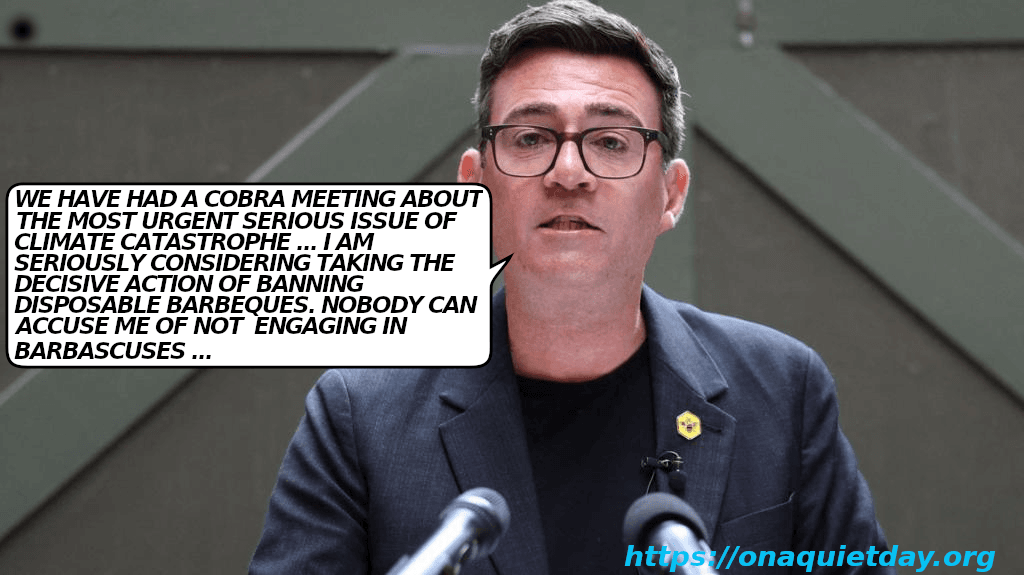
Andy Burnham addresses the climate crisis by considering banning disposable barbecues.Nigel Farage urges you to ignore facts and reality and be a climate science denier like him and his Deputy Richard Tice. He says that Reform UK has received £Millions and £Millions from the fossil fuel industry to promote climate denial and destroy the planet.Orcas comment on killer apes destroying the planet by continuing to burn fossil fuels.
dizzy:
11. Make private jets and superyachts history
…
12. Tax the rich so much that they’re not able to destroy the planet
The rich hugely drive climate breakdown. Tax them out of existence.
13. Recognise Carbon Capture and Storage as a false solution and abandon it
…
14. End all fossil fuel subsidies
…
15/8/26 9.50pm
15. Abandon nuclear power
Nuclear is far too expensive, too centralised and takes far too long. Renewables is the way to go and will create far more employment for more people.
At a press conference today, Zack Polanski delivered a ‘reality check’ to the Prime Minister as he sounded the alarm on the emergency of extreme heat and outlined three immediate actions he would take to tackle the crisis.
After highlighting the multiple threats we face – to our safety, our food and water supply, and our way of life – Zack called for action to keep people cool and safe, taxes on oil and gas giants to fund our fire services, and public ownership of water to end the failed experiment of privatisation.
Zack was joined on stage by an ex-soldier and engineer, a doctor, and a firefighter, who described the consequences of extreme weather they had seen in their work – as well as broadcaster and environmental campaigner Chris Packham who warned of the present and future risks of the climate crisis.
“Trees reduced to charcoal”
Zack started his press conference with a vivid description of the consequences of the extreme heat that has hit the UK this year.
The day before he had witnessed the aftermath of the devastation caused by a wildfire in Oxfordshire.
“Trees reduced to charcoal. Cars turned to burnt out wrecks. The smell of smoke still lingering in the air, on the site of what was once a thriving local business – now reduced to ash.
“Wildfires. Literal scorched earth. And that looming sense that this is only the beginning.
“These days feel exceptional, but what we’re living through right now are likely some of the least extreme summer temperatures we’ll experience in our lifetimes.”
This is what climate failure looks like. Nature, homes and livelihoods are being destroyed. The Government must act now.
The week before, while a wildfire the size of two hundred football pitches was raging across Suffolk, Zack had called on the Prime Minister to urgently call a COBRA meeting to address the crisis.
Six days later, and with another heat alert having just ended, where is the Government response? There has been no COBRA meeting, no emergency briefing, no new plan.
And so Zack stepped up to challenge the Prime Minister to act.
“We are facing the biggest threat to this country since the Second World War”
His challenge to the PM started with a stark reality check: “We are facing the biggest threat to this country since the Second World War.”
“Extreme weather is now the new normal – and without action, the impact on the people of this country will be unimaginably grave.”
And Zack broke down exactly what that impact will be.
First, the threat to our safety.
The dangers of extreme heat to our health are very real – especially for older people and those with pre-existing conditions – forcing people to stay indoors for days on end, to try to wait out the heat.
Zack Polanski delivers ‘reality check’ to Burnham over ‘biggest crisis since WWII’ after summer of extreme heat
As Zack explained, “Almost three thousand people have died from the effects of extreme heat this summer.”
Those “whose bodies were under such intense strain in trying to stay cool that their hearts or kidneys could no longer cope.”
And then there are the fires – forcing hundreds to evacuate their homes, “while many thousands more wait anxiously with flames on the horizon and smoke in their lungs.”
And Zack pointed to Europe as a warning of how bad things can get.
“Hundreds of thousands evacuated. Half a million acres burnt.
“The sheer scale of the devastation is hard to comprehend. But we need to look it in the face – because this is only a taster of what’s to come if we don’t act now.”
Decimated crops, leaking pipes, and no new reservoirs since 1992
After the danger to our physical safety, the second threat Zack identified concerned the basis of any society: our food and water supply.
Half of England is currently experiencing serious drought, and eight of our water reservoirs are at risk of running dry.
“The threat is so severe”, Zack said, “that the UK’s national risk register warns that if we had three years of exceptionally dry weather like this, we could face water rationing.”
And what of the private water companies?
The private water companies that haven’t built a single new reservoir since 1992.
Well, they are losing nearly three billion litres of water a day from leaky pipes – or as Zack put it “five times more than a nationwide hosepipe ban would save”.
Our farmers and growers, meanwhile, are on the frontlines of climate breakdown – facing in turn the extreme rainfall and flooding of recent winters, and the extreme heat and drought of our summers.
Zack noted that despite farmers working through the nights to avoid the heat, food production has been hit by this chaotic combo of flooding and drought, and food prices are set to rise as a result.
“A threat to our way of life”
The third threat Zack named was far-reaching: the threat to our way of life.
“Parents unable to take their children to the playground because the slides are so hot it could burn their skin off. Temperatures so high they keep us inside for days for the sake of our health. Cities feeling like ghost towns. Parks turned into deserts.”
As climate change progresses – bringing more frequent, more damaging extreme weather – the way each of us lives our life will be more severely impacted.
Zack Polanski holds a press conference to deliver an urgent message to Prime Minister Andy Burnham. (Photo: Aldo Ciarrocchi)
And we don’t have to look far to see what may face us in the years ahead.
Zack pointed to the “apocalyptic” scenes of “Wildfires. Droughts. Deadly floods.” coming out of Europe, noting that the continent “is heating at twice the rate of the rest of the world.”
It is there for all of us to see.
And yet the response from the Government, and most of the media, has been to look the other way.
In Zack’s words: “It’s an astonishing dereliction of duty from those whose first responsibility is to keep us safe.”
Zack’s demands for action: cool spaces, water in public hands, and taxing oil and gas giants to fund fire services
The need for action is urgent.
And Zack set out immediate steps the Prime Minister could take “to protect people right now and keep us safe from what we know is coming down the track.”
“We need to keep people safe from extreme temperatures. That means a free, accessible cool space in every local area. And financial support for households to heatproof their home.”
Secondly, Zack called for a robust wildfire prevention strategy – and a fire service with the resources it needs to tackle blazes when they come.
“This should be funded,” Zack said, “by taxing the fossil fuel giants who are profiting from fuelling these infernos.”
And thirdly Zack called for public ownership of our water.
“To secure our water supply, prevent droughts and protect our food system we need to bring water back into public hands.”
“Every penny households pay for their water needs to go back into strengthening our infrastructure, building new reservoirs, and protecting us from the droughts of the future.”
Extreme weather is now the new normal.The Prime Minister must act like this is the emergency it is.
Zack’s message to the PM: “There can be no new drilling for oil and gas”
Before handing the microphone over to the assembled experts, Zack finished with a powerful message direct to the Prime Minister.
“If we are to secure a liveable future for our children and grandchildren, there can be no new drilling for oil and gas. On this, the science is crystal clear.
“As politicians, we have a moral responsibility to do what’s right for the people we serve, even when it’s not politically convenient.
“And I know that whatever our differences, we both care deeply about the people of this country – and the future of our world.
“So when the time comes, I hope you will have the courage to be truthful, be brave – and hold firm to your party’s commitment to no new oil and gas drilling in the north sea – including both Rosebank and Jackdaw.
“Some will say we can’t afford to make these changes. These last few weeks are showing we can’t afford not to.”
“A dereliction of duty”: four expert voices on extreme heat
Zack was followed by four speakers with unique expertise on the extreme heat emergency.
First up was Carl Benfield, a former soldier and engineer, who since leaving the military has turned his engineering expertise to the challenges posed by climate breakdown.
His view? “Climate change is the single greatest threat to human security that we face.”
And his conclusion on successive governments’ failure to prioritise this threat was damning: “A government’s first duty is to keep its citizens safe. Ignoring extreme heat and raging fires isn’t just complacency, it’s a dereliction of duty.”
He was clear about what’s required: “We need an immediate COBRA-level response. We need climate change reinstated at the top of our defence and security agenda. And we need the bold leadership of Zack Polanski for our nation.”
"Ignoring extreme heat and raging fires isn't just complacency. It's a dereliction of duty."Experts warn the climate crisis is already costing lives and urgent action from the Government is needed.
Next to speak was London firefighter James Rodgers.
His powerful testimony of a worker on the frontlines of extreme heat highlighted the immediacy of the crisis, and how rapidly the conditions in which firefighters work are changing due to extreme heat.
“When people talk about climate change, they often talk about the year 2050. I’m a firefighter and I want to talk about now.”
“Because for firefighters, climate change isn’t a prediction. It’s a shift we are already working.
“Climate change is the fire call to multiple back gardens alight, children’s clothing burning on the washing line.
“Climate change is the acrid smell as you affect entry into a flat because someone has succumbed to heat stroke and hasn’t been checked on in weeks. Climate change is the sound of people in floods of tears when they are stuck in a lift 20 floors up in 30 degree heat.
“Climate change is the taste of dust in your dry mouth, watching a fire sweep uncontrollably across a park you used to play football in as a child in your summer holidays. Climate change is this becoming a day to day reality. ”
Dr Veena Aggarwal speaks at the press conference on the emergency of extreme heat. (Photo: Aldo Ciarrocchi)
Next was Dr Veena Aggarwal, a GP in Bristol and the Climate and Sustainability Co-Lead and Clinical Adviser at the Royal College of GPs.
She emphasised the growing danger to health, and – as with the fire services – the extreme pressure placed on health services by the heat:
“As a GP, I’ve been seeing firsthand the health impact of the recent heat waves.
“Ambulances are so stretched we couldn’t get an ambulance for a patient with sepsis or another one with very low oxygen levels, because the ambulance service was so completely overwhelmed.
“The London Ambulance Service saw its busiest ever day during the heatwave in June, on 26th June. That’s even busier than the days at the height of the Covid pandemic emergency.
“We’re seeing people having more asthma attacks; having flares up of their chronic lung disease so extreme they need to be in hospital; more people having heart attacks, strokes; or having falls and collapsing due to the heat, especially those who are frail and more vulnerable.”
Dr Aggarwal also highlighted the impact of the heat on staff and patients in NHS buildings, the human cost of the heat waves, and the need for immediate action.
“An extra almost 3000 deaths occurred within just one week in June during the heatwaves. That’s almost double what was recorded in that season in 2025. In Europe those deaths are 14,000 in that same period.
“We need to act now. The climate crisis is a health crisis.”
Chris Packham speaks at the press conference on the emergency of extreme heat. (Photo: Aldo Ciarrocchi)
The final speaker was broadcaster and nature campaigner Chris Packham.
Chris was excoriating in his appraisal of the Government and media’s response to the climate crisis.
Citing the same death figures as Dr Aggarwal, he said “If these deaths had been the result of terrorism or a pandemic, the Government would have cancelled its summer holiday.
“There would have been COBRA meetings, and there would have been public information campaigns the likes of which we saw during Covid, designed to protect us in this time of crisis.”
“And yet what do we get?
“We get rumours of possibly more drilling for oil and gas, and we get articles in the Telegraph suggesting we ought to adapt to a Mediterranean climate…
“If that isn’t reckless and irresponsible, I don’t know what is.”
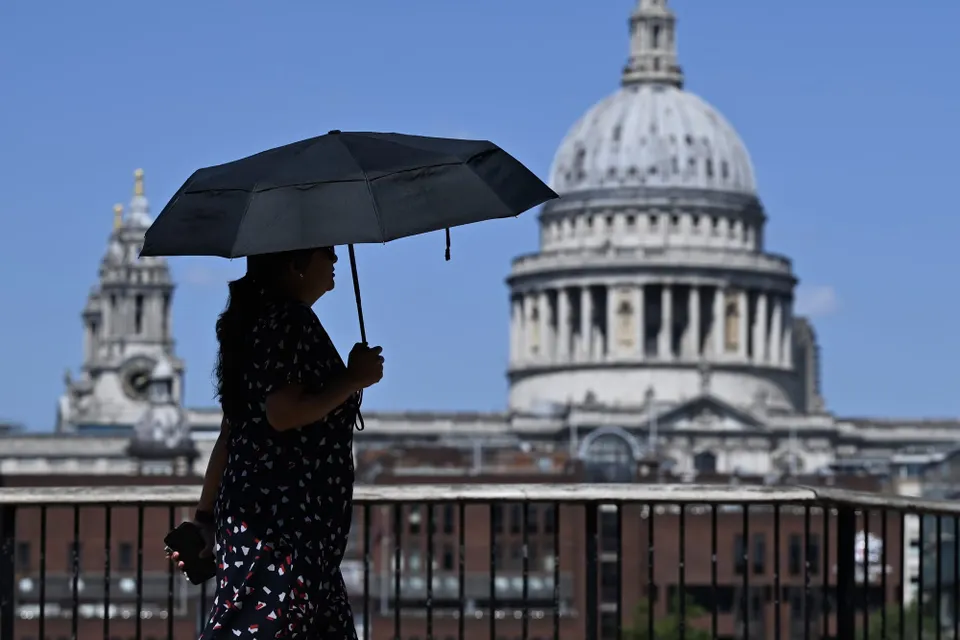
A woman uses an umbrella to try to cope with the scorching heat in London on 8 July. Rasid Necati Aslim/Anadolu via Getty Images
For months, ministers have refused to publish a report on how climate crisis will affect the UK. Burnham must release it
The past two months have seen exceptionally hot weather across much of Western Europe, with even the UK witnessing record temperatures. Even now, England and Wales are well into their third heatwave this year, with some areas on their 13th consecutive day of temperatures above 30°C.
More than 2,700 people are thought to have died as a result of the extreme heat in England and Wales, with scientists estimating that 440 people died during each of the three peak days of June’s record-breaking heatwave, when temperatures reached 37.7°C.
The situation was perhaps best summarised by the Met Office’s State of the UK Climate report for 2025, published last week: “What we used to think of as extreme, we increasingly see as normal.”
Introducing the report, its lead author, climate information scientist Mike Kendon, notes that “2025 was the UK’s warmest year on record, the sixth time this record has been broken in the 21st century so far”. He adds: “The latest 10-year period (2016-2025) is 1.33°C warmer than the period from 1961-1990”.
In these elevated temperatures, wildfires are a particular concern. This week, local authorities across France cancelled many Bastille Day events to minimise fire risks, not least from firework displays, and in the UK there were fears about what are becoming known as “firewaves”. Less cold winters mean more vegetation earlier in the spring, which, when dried out by heatwaves like those seen this year, increases the risk of wildfires. Last Tuesday, emergency services dealt with 19 such fires, including two major incidents, according to the National Fire Chiefs Council.
Speaking to the Guardian, Maria Barbosa of the UK Centre for Ecology and Hydrology said: “What we are witnessing is climate change actively rewriting the vulnerability of the British landscape.” Perhaps the key element to draw out here is that this is not a change likely to affect us in the future; it is happening now.
Moreover, it relates to one of the surprising elements of the June heat: a public disconnect in the UK between acceptance of climate breakdown and relating this to carbon dioxide emissions from burning coal, oil or gas. People seemed unwilling or unable to make this link, even with the widespread personal experience of heat, the risk of wildfires and those reports of thousands of deaths.
One explanation is that many of our biggest media outlets often fail to point to the connection.
Researchers at the Energy and Climate Intelligence Unit reviewed 2,500 news reports on the heatwaves from the nine main national daily newspapers, finding that nearly three-quarters made no mention of climate breakdown. The Financial Times was most likely to mention the climate crisis, doing so in 50 of its 78 articles on the heatwaves, while The Sun was least likely to do so – making the link in only four of its 69 articles.
All too often, the reports gave the impression that the main challenge regarding the heatwaves will be adapting to the “new normal” of a hotter world, with plenty of coverage on changing our behaviour, converting buildings and being prepared for new health concerns.
But the challenge we face goes way beyond that. Adapting to a world where average temperatures are 2.5°C above current levels might be possible at considerable cost and human suffering, but unless we also cut carbon dioxide emissions, then we will have to keep on adapting to ever-higher temperatures. Concentrating on current adaptation alone is barely half the answer.
This is a known issue within government and is causing such concern that publicity is unwelcome, as shown by events relating to a study prepared by the Joint Intelligence Committee, which was officially described as a “national security assessment” and titled somewhat ominously: Global biodiversity loss, ecosystem collapse and national security.
The study was supposed to be launched at a landmark event on 9 October last year, but was held back, with one source telling The Guardian that insiders “feared it was being suppressed because the government was unwilling to face the issues raised.”
After pressure from MPs, including the official environmental audit committee, and Freedom of Information requests to publish the report, the government eventually released a redacted 14-page version in January this year. It warns of a high probability that the UK’s national security, financial prosperity and food security will come under threat from the climate crisis and the subsequent collapse of vital ecosystems that support food production.
Even that makes for very sober reading. The report identifies nine “planetary boundaries” as the safe limits identified for human pressure on nine Earth system processes crucial to maintaining a stable planet, such as climate change, biosphere integrity and oceanic acidification. Six have already been crossed.
The report concludes that ecosystem degradation is occurring across all global regions and every critical ecosystem is on a “pathway to collapse”, which it helpfully defines as “irreversible loss of function beyond repair”.
The implications are huge. This is an official government study by the combined intelligence agencies, and even if redacted, it is unable to hide the crisis ahead. One conclusion is obvious: if this is the greatest threat to our security and the integrity of the global ecosystem, we should be redirecting money away from conventional military spending and towards human and environmental security.
A key requirement of Andy Burnham as incoming prime minister should be the immediate release of the full report, followed by a vigorous public debate on where we go from here.
Donald Trump urges you to be a Climate Science denier like him. He says that he makes millions and millions for destroying the planet, Burn, Baby, Burn and Flood, Baby, Flood.Nigel Farage urges you to ignore facts and reality and be a climate science denier like him and his Deputy Richard Tice. He says that Reform UK has received £Millions and £Millions from the fossil fuel industry to promote climate denial and destroy the planet.Orcas comment on killer apes destroying the planet by continuing to burn fossil fuels.
“This of course reflects Trump administration policy, which counters any focus on climate at international meetings,” said a US researcher and former diplomat.
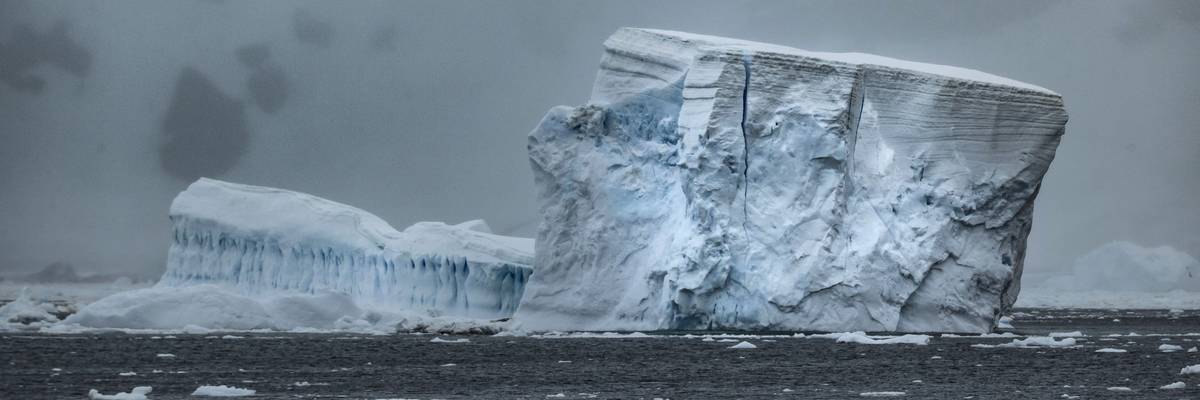
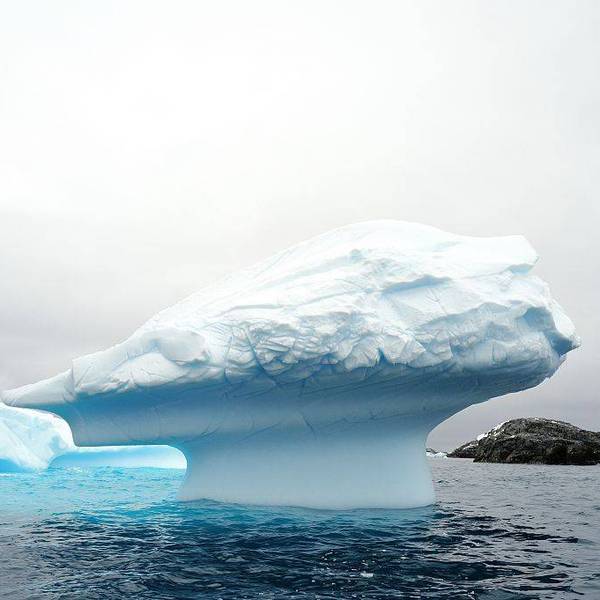
The Trump administration is under fire over its efforts to have any mention of the climate crisis removed from a scientific report, published this week, aimed at informing nations that are party to a global treaty designed to protect the Antarctic.
Details of the “diplomatic tensions” surrounding the report, which took place during a meeting in May with delegates from around the world focused on the Antarctic Treaty, were detailed by Australian Broadcasting Corporation (ABC) correspondent Jano Gibson.
The report reveals that France took issue with the US’s suggestion not to use broad terms such as “climate change” and instead refer to “specific” environmental changes.
“France … expressed it had strong concern about the gradual disappearance of references to climate change in the work of the Committee [for Environmental Protection],” the report states.
“France emphasized that climate change was a reality affecting all countries, regardless of borders.
Claire Christian, executive director of the Antarctic and Southern Ocean Coalition, told ABC that there’s zero controversy within the scientific community that a changing climate due to global warming is having deep impacts on the Antarctic region.
“The evidence is clear: the Antarctic region is undergoing rapid climate change, and this is already having significant effects on planetary systems,” Christian said. “If we don’t reduce our carbon emissions rapidly, these effects will only become more severe and unpredictable.”
While a France warned that “refusing to even name climate change” would set “a dangerous precedent,” Evan Bloom, a former US diplomat and Antarctic researcher involved in international negotiations on the topic said the position taken by the US at the Antarctic Treaty Consultative Meeting was very much in keeping with the behavior and policies of President Donald Trump.
The US position, said Bloom, “shows how out of step the US is with most of the rest of the world on climate change. Yet, this of course reflects Trump administration policy, which counters any focus on climate at international meetings.”
Donald Trump urges you to be a Climate Science denier like him. He says that he makes millions and millions for destroying the planet, Burn, Baby, Burn and Flood, Baby, Flood.
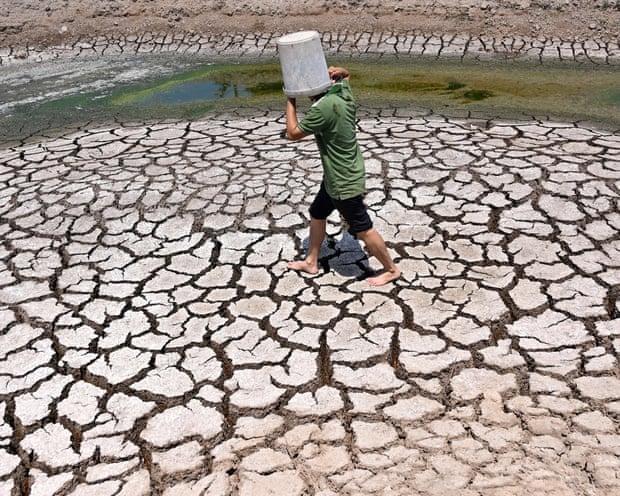
Southern Vietnam in 2024, the hottest year ever recorded globally. Photograph: Nhac Nguyen/AFP/Getty Images
Global temperature record could be broken as soon as 2027, with El Niño expected later this year
A record-breaking hot year is almost certain by 2030 as the climate crisis intensifies, the UN’s World Meteorological Organization has warned.
With an El Niño event expected later this year, the global temperature record could fall as soon as 2027.
Carbon dioxide emissions from fossil fuels are continuing to rise, trapping more heat and driving more extreme weather, including the record-breaking heatwave that has hit the UK and Europe this week.
Global heating is already estimated to be taking one life every minute, with the toll likely to rise unless emissions fall rapidly.
The report, produced for the WMO by the UK Met Office, predicts an 86% chance that at least one year between 2026 and 2030 will surpass 2024 as the hottest ever recorded. There is a 75% chance that the average temperature for the five-year period from 2026 to 2030 will be more than 1.5C above the pre-industrial average.
Simon Stiell, the UN climate chief, said: “The latest heatwave in Europe is a brutal reminder of the spiralling impacts of the climate crisis, both human and economic. Many other parts of the world are also getting hit hard, such as India and other parts of Asia.”
Donald Trump urges you to be a Climate Science denier like him. He says that he makes millions and millions for destroying the planet, Burn, Baby, Burn and Flood, Baby, Flood.Nigel Farage urges you to ignore facts and reality and be a climate science denier like him and his Deputy Richard Tice. He says that Reform UK has received £Millions and £Millions from the fossil fuel industry to promote climate denial and destroy the planet.Elon Musk urges you to be a Fascist like him, says that you can ignore facts and reality then.