“In a landmark ruling today the ICJ has made clear that failure to take decisive action to protect the climate, through continued fossil fuel production and consumption and granting fossil fuel exploration licences, can be considered as acting ‘wrongfully’. This means the UK has a legal duty to speed up the transition towards a cleaner, greener economy and block any new licences for the extraction of fossil fuels.
“The ruling also made clear that human rights must be at the heart of climate action because climate breakdown affects our rights to health, homes, and livelihoods.
“The court has recognised that rich countries like the UK, responsible for ongoing and historic pollution, have a special responsibility to act, and to offer compensation to countries and communities already suffering from floods, droughts, and rising sea levels.
“Today’s ruling should be the moment we draw a line. Governments that fail to act and polluters that refuse to clean up their act must no longer be allowed to harm communities either at home or across the globe with impunity.”
Weather records clearly show the UK’s climate is different now compared with just a few decades ago. Photograph: Geoffrey Swaine/Shutterstock
Increasing frequency of heatwaves and flooding raises fears over health, infrastructure and how society functions
Record-breaking extreme weather is the new norm in the UK, scientists have said, showing that the country is firmly in the grip of the climate crisis.
The hottest days people endure have dramatically increased in frequency and severity, and periods of intense rain have also ramped up, data from hundreds of weather stations shows. Heatwaves and floods leading to deaths and costly damage are of “profound concern” for health, infrastructure and the functioning of society, the scientists said.
The weather records clearly show the UK’s climate is different now compared with just a few decades ago, the scientists said, as a result of the carbon pollution emitted by burning fossil fuels.
The analysis found that the number of days with temperatures 5C above the average for 1961-1990 had doubled in the last 10 years. For days 8C above average, the number has trebled and for 10C above average it has quadrupled. The UK has also become 8% sunnier in the last decade.
…
The assessment, called the State of the UK Climate 2024 and published in the International Journal of Climatology, found the last three years were in the UK’s top five hottest years on record. The warmest spring on record was seen in 2024 although this has already been surpassed in 2025.
The UK has particularly long meteorological records and the Central England Temperature series is the longest instrumental record in the world. It shows that recent temperatures have far exceeded any in at least 300 years. However, today’s high temperatures are likely to be average by 2050, and cool by 2100, the scientists said.
…
Donald Trump urges you to be a Climate Science denier like him. He says that he makes millions and millions for destroying the planet, Burn, Baby, Burn and Flood, Baby, Flood.Nigel Farage urges you to ignore facts and reality and be a climate science denier like him. He says that Reform UK has received millions and millions from the fossil fuel industry to promote climate denial and destroy the planet.
Ed Miliband said the Conservatives had ‘abandoned 20 years of bipartisanship when to comes to climate’. Photograph: UK Parliament
Energy and net zero secretary lays out stark picture of how climate crisis and nature depletion is affecting UK
Ed Miliband has accused the Conservatives of being “anti-science” by abandoning a political consensus on net zero as he gave MPs a stark outline of how the climate crisis and nature depletion are already affecting the UK.
In the first of what is promised to be an annual “state of the climate” report, the energy and net zero secretary set out the findings of a Met Office-led study that detailed how the UK was already hotter and wetter, and faced a greater number of extreme weather events.
Miliband, who told the Guardian before the statement that politicians who rejected net zero policies needed to be accountable for their decisions, called for opposition parties to unite around the need for urgent action.
But speaking after Miliband, Andrew Bowie, a shadow energy minister, criticised what he called the government’s “shrill” language, saying the party was sticking by Kemi Badenoch’s decision to ditch the 2050 target for the UK to reach net zero.
…
Miliband quoted the former prime minister Theresa May, who put net zero targets into law in 2019 and had argued that the real climate zealots were “populists who offer only easy answers to complex questions”. He added: “I couldn’t put it better myself.”
…
“The lesson is clear. The choices we make as a country have influenced the cause of global action, and in doing so, reduced the impact of the climate and nature crisis on future generations in Britain. To those who say Britain cannot make a difference. I say: you are wrong. Stop talking our country down. British leadership matters.”
UK Conservative Party leader Kemi ‘not a genocide’ Badenoch explains her reality that the Earth is flat, the Moon is made of cheese and that she was born from Unicorn horn dustNigel Farage urges you to ignore facts and reality and be a climate science denier like him. He says that Reform UK has received millions and millions from the fossil fuel industry to promote climate denial and destroy the planet.
The climate crisis is no longer a future threat — it’s a terminal diagnosis, and the only moral response now is to act like everything depends on us, because it does.
Francisco Goya – The Third of May 1808 (1814), A scream against institutional violence and helplessness.
There comes a point in your life when the facts won’t let you look away. You feel it before you know it: something is terribly wrong, and we are running out of time.
So let’s begin with something simple. How do you know something is true?
Take the example of cancer. If you feel a lump or have symptoms, you don’t just ask your mate what they think. You go to a doctor. And not just any doctor — you want a specialist. Someone who’s legally obliged to tell you the truth, however hard it is to hear. You want the tests, the scan, the data. And above all, you want a number: “What’s the likelihood I have it?” Because that number changes everything.
You don’t want vague reassurances. You want the truth. If the doctor says there’s a 50% chance, your life changes in that moment. You go into action. You start making decisions — fast. Because the alternative is death. And no one can run from that.
It’s this same clarity, this same objectivity, that we need to bring to the climate crisis. Because the truth is — and I mean this literally — the planet has cancer. It is spreading. It is terminal. And it is going to kill us if we don’t act, immediately.
This isn’t ideology. It’s not politics. It’s not “just your opinion.” It is physical reality. And just like cancer, it doesn’t care what you believe.
In 1989, NASA scientist James Hansen warned the UN that if we didn’t slash emissions, society would collapse. That was 35 years ago. In 2025, global temperatures have now risen to 1.6°C above pre-industrial levels. And the rate of warming is accelerating. For most of the 20th century, the rise was around 0.18°C per decade. In the last ten years, it’s more than doubled to 0.37°C per decade. We’re now on course to hit 2°C around 2035 — and that’s being optimistic.
But what does that number mean?
A landmark peer-reviewed paper, “The Future of the Human Niche,” published by Tim Lenton and colleagues, makes it brutally clear: at 2°C of warming, around 1 billion people will no longer be able to live where they currently do. That’s 25% of the Earth’s surface becoming uninhabitable. One billion refugees — in just a few years.
To put that into context: there were 50 million refugees after the Second World War. That was the worst war in human history. What’s coming is twenty times worse.
And that figure — one billion — only covers the effects of extreme heat. It doesn’t include what happens when rising sea levels drown coastal cities, when droughts kill crops, when wildfires consume whole regions, when freshwater disappears. The truth is, climate collapse is not just an environmental issue. It is a full-system breakdown. It affects food, health, housing, energy, migration, and war — all at the same time.
Still think this is just about polar bears?
If you’re still not convinced, don’t take it from me. Take it from the insurance industry. In 2024, the British actuarial society — a group of people whose job it is to measure risk for a living — released a report projecting that at 2°C of warming, we’ll see 2 billion deaths. At 3°C? 4 billion. That’s half the population of the Earth.
And this is not worst-case modelling. This is their baseline. This is what the people who insure your life, your business, your pension, believe is most likely to happen if we stay on our current course.
It gets worse. Because climate breakdown isn’t a one-off crisis — it triggers runaway feedback loops. Ice melts and reduces the planet’s ability to reflect sunlight, which makes it heat up faster. Permafrost thaws and releases methane, a greenhouse gas 80 times more potent than CO₂. Forests burn and release carbon. Soils lose their ability to absorb emissions. Everything begins to feed on itself. Even if we stopped all human emissions tomorrow, these systems may continue warming the planet — potentially beyond the point of recovery.
Most tipping points are estimated to be triggered between 1°C and 2°C. We are already at 1.6°C. We are now in the danger zone. There is no longer a buffer. There is no margin of error. This is happening in real time.
So what do we do?
Well, the answer is no different from the cancer patient. Two things: stop making it worse, and start trying to repair the damage. That means ending fossil fuel emissions as fast as humanly possible. That means scaling up emergency carbon removal. That means mobilising everything we’ve got.
Will it work? We don’t know. But what we do know is this: if we do nothing, billions will die. And not in some abstract future. In our lifetimes. In the lifetimes of our children.
This is not a problem for “someone else to solve.” This is your responsibility, your emergency, your world.
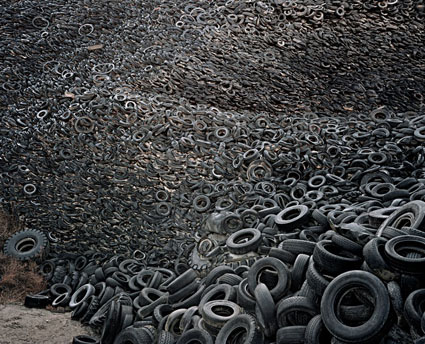
Edward Burtynsky – Manufactured Landscapes, a pyre waiting to burn.
And if you think you still have a choice — let me be blunt: you don’t. If your actions or inactions contribute to this collapse, you don’t just destroy your own future. You destroy the lives of everyone around you. You condemn entire generations to hell on Earth because you couldn’t face the truth.
It’s not just foolish. It’s not just selfish. It’s evil.
Let me speak personally for a moment. I’ve met hundreds of people who, after hearing this reality, decided to act. Ordinary people. Teachers, nurses, students, grandparents. They quit their jobs. They faced arrest. Some went to prison. Not because they were heroes. But because they understood this one, simple thing: if we don’t fight, we die. If we don’t rise up, we burn.
You can’t half-commit to this. You can’t give a little donation, feel a bit guilty, and move on. Once you’ve heard the truth, you are accountable. And the only question left is what you’re going to do about it.
So this is your moment. This is the turning point. If you’ve read this far, you already know. You know what’s coming. You know the scale of the crisis. You know the failure of our leaders.
You also know this: we are not powerless. There are millions of us waking up. Rising up. Organising. We are building the resistance that history will remember.
Join us.
Because history is watching. And your children will ask what you did. And one day, in the final hours of your life, you will ask yourself the same question.
Don’t wait for the flood. Don’t wait for the fire. We have no choice but to act. And act we will.
This was meant to be Roger Hallam’s climate briefing for the Rev21 Convention. But prison authorities blocked it. They’ve now banned him from posting on social media altogether.
To keep up with Roger’s work and the revolutionary movement he helped build, follow Rev21 across platforms:
Roger’s release has once again been delayed — originally expected in March, then May, and now postponed indefinitely. First, his designated home was deemed “unsuitable” for rehabilitation because someone associated with Just Stop Oil was present. Then, following press coverage that included the name of his probation officer (quoted directly in the piece), Roger was placed on a high-risk list — supposedly due to the psychological impact on staff. That probation officer has since been replaced, but the new officer has refused to respond to legal communications from Roger’s team.
It now appears that prison staff are refusing to meet with Roger directly, citing the “risk” he poses to them. His lawyers have written to the prison, but there is no legal requirement for them to respond within a set timeframe, leaving him in a state of limbo.
At the same time, Roger’s ability to contribute to public work has been severely restricted. Prison authorities have blocked over 20,000 words of his writing, and his input into the Convention and our social media efforts has been censored. Despite this, Roger continues to engage with projects through prison phone and email, where possible. He remains deeply committed to the cause and continues to support our work with unwavering clarity and determination.
Donald Trump urges you to be a Climate Science denier like him. He says that he makes millions and millions for destroying the planet, Burn, Baby, Burn and Flood, Baby, Flood.Nigel Farage urges you to ignore facts and reality and be a climate science denier like him. He says that Reform UK has received millions and millions from the fossil fuel industry to promote climate denial and destroy the planet.Orcas discuss how Trump was re-elected and him being an insane, xenophobic Fascist.
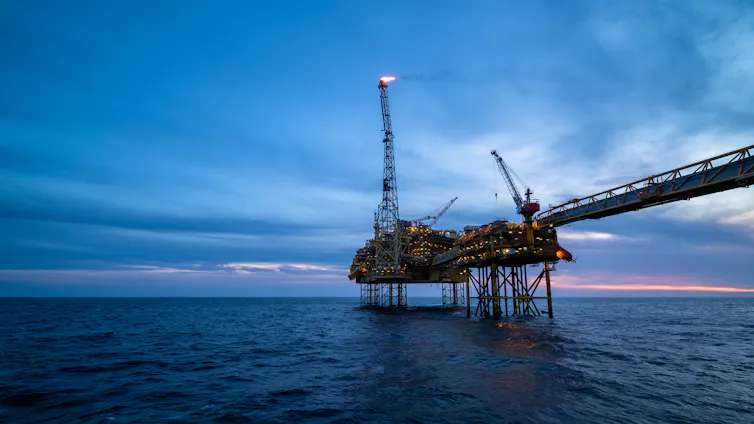
The UK government will soon face a momentous decision over whether to approve production in the Rosebank oilfield off the coast of Shetland.
Rosebank is the UK’s biggest undeveloped field. Its proponents – the largest of which is Norwegian state-owned petroleum company, Equinor – estimate that it will produce the equivalent of up to 500 million barrels of oil between 2026 and 2051. When burned, this oil will generate up to 200 million tonnes of carbon dioxide, which is more than the combined annual emissions of 28 low-income countries.
Thanks to recent courtcases, the climate effects of those “combustion emissions” will need to be taken into account by the government when it decides whether to approve production at Rosebank. In a new report, two colleagues and I reviewed the evidence concerning the implications of new oil and gas fields in the UK.
Get your news from actual experts, straight to your inbox.Sign up to our daily newsletter to receive all The Conversation UK’s latest coverage of news and research, from politics and business to the arts and sciences.
There is a rapidly dwindling global carbon budget for holding temperature increases to below 1.5°C of warming (the more conservative end of the Paris agreement’s temperature goal).
Globally, the emissions from burning the fossil fuels in oil and gas fields and coalmines that are already operating or under development far exceed that budget. In this context, Rosebank’s combustion emissions are highly significant, as they add considerably to that excess.
We also found that the projected production from existing fields is sufficient to meet or exceed global oil and gas demand in modelled economic scenarios in which climate warming is restrained to within 1.5°C. This is further evidence that new fields are not consistent with achieving globally agreed temperature goals.
However, it is often asserted by supporters of new fields that keeping UK oil in the ground won’t reduce global emissions, because another producer will supply the demand and reap the benefits. This is a gross and dangerous oversimplification which, according to the United Nations Environment Programme, “defies basic economics of supply and demand”.
Allowing a new field like Rosebank would increase the supply of oil globally, resulting in a fall in its price which, though small, would cause more oil to be consumed. As UK government advisers at the Climate Change Committee have acknowledged, new petroleum projects “support a larger global market overall” for petroleum. Stopping Rosebank would have the opposite effect, and lead to less oil consumed.
Rosebank is found about 80 miles west of Shetland and its puffins. Philippe Clement / shutterstock
The oil industry likes to trumpet the UK’s relatively low upstream emissions – that is, from the process of extracting oil – compared with those of competitors overseas. But this is a distraction from the bigger issue: the additional greenhouse gases emitted from consuming the extra oil that new fields produce.
A recent peer-reviewed study by economists and experts in the emissions-intensity of oil and gas production concluded that limiting oil supply will almost always lead to lower overall emissions, regardless of the intensity of upstream emissions from different fields. It is highly likely that leaving Rosebank’s oil in the ground will result in lower global greenhouse gases than would occur if the field were developed.
However, this focus on Rosebank’s aggregate emissions ignores two further reasons the field’s development consent should be refused on climate grounds.
A litmus test of climate leadership
First, exploiting new sources of oil supply like Rosebank locks in future oil and gas production, ultimately making it economically, politically and legally harder to wind the industry down.
Second, as the Climate Change Committee also stated, decisions by the UK government concerning petroleum production have an important “signalling effect” internationally and at home.
Internationally, the UK government has rightly acknowledged that climate action “must be accelerated drastically” to keep the average global temperature rise “below 1.5°C”.
The UK has a proud reputation for climate leadership. It was the first country to enact a legally binding framework to reduce greenhouse gas emissions, it rapidly phased out coal-fired power generation, and in 2019 it became the first country to adopt a net zero emissions target.
Building on this legacy, the foreign secretary David Lammy has vowed to “push for the ambition needed to keep 1.5 degrees alive”. But approving Rosebank would signal to the world that the UK government is not sincere about keeping the Paris agreement’s 1.5°C goal “alive”, after all.
Some might think that aspirations to climate leadership are futile given the Trump administration’s “drill, baby, drill” approach to fossil fuels. But Trump’s recklessness at a critical time for global climate efforts makes UK climate leadership more important than ever.
The UK already chairs a suite of international energy transition alliances focused on the international phase-out of coal-fired power, the scale-up of renewables, and the financing of these transitions. It could plug a gap in its influence by rejecting Rosebank and joining the Beyond Oil & Gas Alliance, a “club” of (currently) 25 national and sub-national governments that are working to phase-out oil and gas production and persuade other countries to follow suit.
And it could deepen cooperation with the EU to drive down oil and gas demand and scale up clean energy throughout the region, yielding benefits that will outlive the Trump administration.
Domestically, rejecting Rosebank would send a powerful signal to investors about the sincerity of the government’s commitment to achieve economic growth by becoming a “clean energy superpower”, as the governing Labour party pledged to do at the last election.
But the benefits of clean prosperity must extend to the people and communities caught up in the transition, too. The UK’s North Sea oil and gas reserves, along with the jobs their production supports, are in terminal decline.
Oil and gas workers and the communities in which they are based already face a volatile future. New fields like Rosebank would create some additional jobs in this declining industry. But they cannot arrest its long-term decline.
The government recognises that this transition is already taking place and will continue. With targeted regional and industrial investment, support for workers and their families, and careful planning that meaningfully involves affected communities, the UK has an opportunity to demonstrate to the world how to achieve a just transition away from oil and gas.