Tag: climate

  • Labour’s biggest corporate donor Ecotricity accused of ‘greenwashing’

    Spread the love

    Original article by Martin Williams republished from OpenDemocracy under a Creative Commons Attribution-NonCommercial 4.0 International licence.

    Ecotricity’s founder, Dale Vince.  Bloomberg / Contributor

    Exclusive: Energy firm making ‘misleading’ claims about ‘neutralising’ gas with carbon credits

    The Labour Party’s biggest corporate donor has been accused of “greenwashing” after an investigation by openDemocracy.

    Ecotricity Ltd, which has given almost £3.4m to Labour since Keir Starmer became leader in 2020, claims to be “Britain’s greenest energy supplier”.

    Yet 99% of the gas it supplies comes from fossil fuels. The company claims this gas is “carbon-neutralised” because it invests in “carbon reduction programmes to cancel out the carbon burned”.

    But openDemocracy has learned that Ecotricity has no active carbon credits – despite listing four environmental projects on its website that it says it supports.

    When questioned about the company’s claims that “carbon emissions from our fossil fuel gas are offset by investing in carbon reduction schemes”, a spokesperson admitted that some of the schemes it previously supported had not done “as promised” – and said that information on its website would be “refreshed”.

    But experts warned that even if the company held active carbon credits, its claims that these “neutralise” its fossil fuel gas would still be misleading.

    “It is highly misleading for a company to claim that its product – or itself – is carbon- or climate-neutral,” said Lindsay Otis Nilles from Carbon Market Watch. “These false claims are based on heavily flawed scientific principles and lead to consumer confusion.”

    The company has not broken any laws, but it will be illegal to claim that carbon offsets can “neutralise” fossil fuel products in the EU from 2026, as the bloc looks to crack down on greenwashing. An EU directive says these claims create a “false impression to consumers that the consumption of that product does not have an environmental impact”.

    Analysis by openDemocracy shows that some of the carbon offset projects that Ecotricity previously pumped money into have been linked to environmental concerns and human rights abuses.

    In some cases, records cast doubt on whether the company’s offsetting credits actually helped to reduce emissions at all – since the projects it invested in were already fully funded.

    For example, two years ago, Ecotricity purchased credits in the Soubré hydropower plant, the largest hydroelectric dam in Ivory Coast, which was completed in 2017.

    The project cost around £452m, 85% of which had already been secured by January 2017, with a loan from EXIM Bank of China. The remaining 15% was covered by the Ivory Coast government.

    The Soubré powerplant previously came under fire in a 2019 report that accused it of having an “irresponsible” approach to monitoring its potential environmental impact.

    The report, which was published by American environment and human rights organisation International Rivers, also included complaints by workers at the dam of instances of “discrimination and physical abuse” and “threats from the government” when they spoke out.

    Meanwhile, the project’s main contractor, Chinese firm Sinohydro – which is responsible for its engineering, procurement and construction – has faced allegations of fraud elsewhere.

    The company is currently excluded from projects financed by the European Investment Bank, following an investigation into “misconduct”. And in 2018, another investigation by the African Development Bank found that Sinohydro had “engaged in a fraudulent practice”.

    Ecotricity has also held carbon credits in another hydroelectric power plant in Indonesia, called Asahan 1. Reports from as far back as 2012 say the company behind it, PT Bajradaya Sentranusa, had already secured funding from a bank “to take over the entire existing project loans for the construction” when Ecotricity bought the credits.

    A spokesperson for Ecotricity said: “The information on the website about carbon reduction projects is being refreshed.”

    They added: “We used carbon credits to entirely offset our gas supply for the financial year 2024 which is now closed and our offsetting programme for the financial year 2025 is currently under review which is why we do not currently hold any credits. Any suggestion that we do not or will not offset our gas in the future is false and misleading.”

    “Offsetting is an annual accounting period practice and can take place at any point in that [financial year] – that is standard practice. Our offsetting programme for the financial year 2025 is currently under review. Any suggestion that we do not or will not offset our gas is wrong.”

    The spokesperson added that Ecotricity is looking at “more direct carbon capture methods”, adding: “Carbon offsetting has been a bridge. We have always been clear about that.”

    ‘Greenwashing’

    Ecotricity not only boasts about its own climate credentials, it also actively warns customers about “greenwashing” by rival energy suppliers.

    “A number of energy companies claim green credentials for themselves or for some of their tariffs,” it says, “but are their claims genuine?”

    But Ecotricity has itself now been accused of greenwashing. Responding to the company’s claims about carbon offsets, Nilles of Carbon Market Watch told openDemocracy: “It is a fallacy to think that purchasing carbon credits on the voluntary carbon market can magically ‘cancel out’ or ‘offset’ climate harm. Greenwashing practices like this must stop once and for all.”

    Ecotricity’s founder, Dale Vince, recently joined Labour’s campaign in Bristol. His involvement in the constituency is controversial because it is seen as one of the few seats the Green Party has a genuine chance of winning in this week’s general election. But Vince tweeted: “Labour has a green manifesto and can make it happen.”

    The self-styled “green industrialist” is the outright owner of Ecotricity’s parent company, Green Britain Group Limited. According to the latest accounts filed with Companies House, this firm made £38m profit in the year ending 30 April last year, after bringing in more than £550m turnover.

    Responding to openDemocracy, Vince repeated the claim that carbon credits were used to achieve “net neutrality”.

    He said: “Ecotricity bought carbon credits from the Asahan and Soubre schemes two years ago – we no longer do so. We’ve been reducing our carbon footprint annually for decades and only recently used carbon credits to achieve net neutrality, for our green gas while we built new gasmills.

    “It’s important to reduce as far as possible before using credits, but that world is full of uncertainty, risk and projects that don’t do as promised, which these two schemes appear to be an example of. We welcome the EU move to clamp down on all forms of greenwashing.”

    Vince accused openDemocracy of a “smear attack” with a “rather distorted presentation of facts”.

    Prior to this response, openDemocracy had repeatedly asked Ecotricity to provide a complete and up-to-date list of its carbon credit portfolio, but it failed to do so.

    Last week, Vince told the Financial Times that he was not seeking support for his own energy projects from Labour. “I don’t want support for my projects,” he said, “I’m not interested, life’s too short to be chasing money.”

    The latest accounts filed by Green Britain Group Limited show it received £123m in “government grants” in the year ending April 2023. The financial support was designed to pay energy firms to cap prices for consumers.

    The previous year, the company received a £9.4m Covid “business interruption” loan to support large companies in the pandemic.

    However, Vince told openDemocracy: “Ecotricity hasn’t had any government subsidies.”

    Original article by Martin Williams republished from OpenDemocracy under a Creative Commons Attribution-NonCommercial 4.0 International licence.
  • Politicians ‘awol’ on the environment despite 60,000 strong protest, charity says

    Spread the love
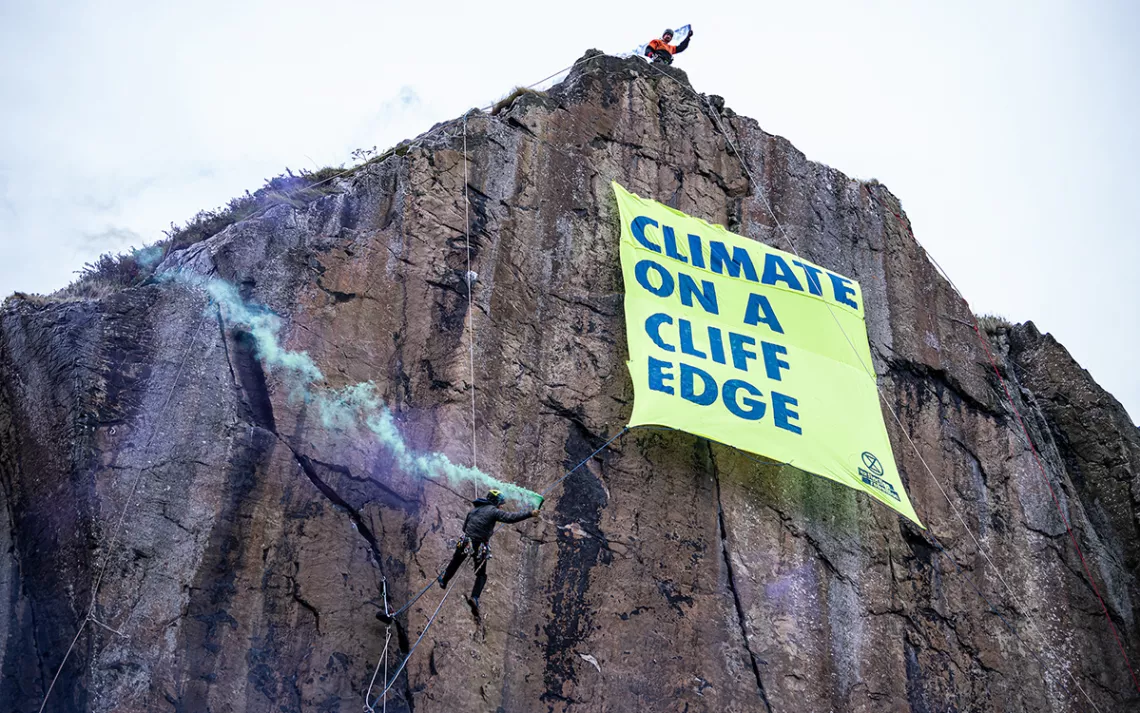
    Experienced climbers scale a rock face near the historic Dumbarton castle in Glasgow, releasing a banner that reads “Climate on a Cliff Edge.” One activist, dressed as a globe, symbolically looms near the edge, while another plays the bagpipes on the shores below. | Photo courtesy of Extinction Rebellion and Mark Richards
    Experienced climbers scale a rock face near the historic Dumbarton castle in Glasgow, releasing a banner that reads “Climate on a Cliff Edge.” One activist, dressed as a globe, symbolically looms near the edge, while another plays the bagpipes on the shores below. | Photo courtesy of Extinction Rebellion and Mark Richards

    https://morningstaronline.co.uk/article/politicians-awol-environment-despite-60000-strong-protest-charity-says

    POLITICIANS have gone “awol” on the environment despite four in five voters expressing concern about the climate and the natural world, conservationists warned today.

    New polling for conservation charity WWF shows that while 80 per cent say they care about issues relating to climate, nature and the environment, only 45 per cent believe that politicians share their level of concern.

    They face increasing pressure to do more on the environment after tens of thousands of people marched through London at the weekend.

    WWF warned today that the next five years will be “absolutely vital” for conservation efforts in Britain and abroad, with native wildlife from puffins to bluebells and mountain hares at risk from climate change, pollution and habitat loss.

    Chief executive Tanya Steele said: “Our polling shows the environment is clearly a key issue for the public and they deserve to hear what the next government plans to do to restore nature and meet our climate targets.

    “Unfortunately, politicians have largely gone awol on the environment during this campaign, but the next five years will be absolutely vital in bringing nature back from the brink, both at home and around the world.

    “As the campaign enters the final straight, we’re calling on all parties to commit to action on nature and climate that’s hugely popular with the public.”

    https://morningstaronline.co.uk/article/politicians-awol-environment-despite-60000-strong-protest-charity-says

  • How climate experts have rated parties’ green policies ahead of the election

    Spread the love

    https://leftfootforward.org/2024/05/how-climate-experts-have-rated-parties-green-policies-ahead-of-the-election/

    How do Labour, Conservatives, Greens and Lib Dems compare on their promises for the environment

    Groups and campaigners have called on parties to make climate and nature a core issue at the general election as meticulous scrutiny begins on party policies ahead of the general election.

    Party manifestos are yet to be published, however environmental experts at Friends of the Earth have scored Labour, the Conservatives, Greens and the Lib Dems on their green commitments so far.

    It comes as no surprise that the Conservative Party have come in a dismal last, scoring pretty disastrously on most of the ten policy areas analysed. Campaign group Greenpeace recently slammed the Tory Party for leaving the country, “crumbing, bereft of hope, and its climate record in tatters” after the last 14 years.

    Most alarmingly the Tory Party scored the only 0 out of 10 in the category of ‘defending democracy’ based on its recent introduction of draconian legislation clamping down on protest. 

    Also unsurprisingly the Green Party came in top, with the Lib Dems second and Labour third. Labour’s commitment to creating Great British Energy has been praised by green campaigners. However Friends of the Earth has said the party must go further, as its score lagged behind the Lib Dems and Greens and “falls well short of what’s needed to deliver on the climate and nature emergencies”.

    Friends of the Earth stressed that the ratings are a snapshot of the current moment, and policies published in the coming weeks will better reveal how the party’s commitments shape up in real terms. 

    Overall, the environmental group scored the Conservatives 27/100, Labour 51/100, the Lib Dems 68/100 and the Green Party 82/100.

    Article continues at https://leftfootforward.org/2024/05/how-climate-experts-have-rated-parties-green-policies-ahead-of-the-election/

  • Satellites are burning up in the upper atmosphere – and we still don’t know what impact this will have on the Earth’s climate

    Spread the love

    Paul Fleet / shutterstock

    Fionagh Thomson, Durham University

    Elon Musk’s SpaceX has announced it will dispose of 100 Starlink satellites over the next six months, after it discovered a design flaw that may cause them to fail. Rather than risk posing a threat to other spacecraft, SpaceX will “de-orbit” these satellites to burn up in the atmosphere.

    But atmospheric scientists are increasingly concerned that this sort of apparent fly-tipping by the space sector will cause further climate change down on Earth. One team recently, and unexpectedly, found potential ozone-depleting metals from spacecraft in the stratosphere, the atmospheric layer where the ozone layer is formed.

    The relative “low earth orbit” where satellites monitoring Earth’s ecosystems are found is increasingly congested – Starlink alone has more than 5,000 spacecraft in orbit. Clearing debris is therefore a priority for the space sector. Newly launched spacecraft must also be removed from orbit within 25 years (the US recently implemented a stricter five-year rule) either by moving upwards to a so-called “graveyard orbit” or down into the Earth’s atmosphere.

    Lower orbiting satellites are usually designed to use any remaining fuel and the pull of the Earth’s gravity to re-enter the atmosphere. In a controlled reentry, the spacecraft enters the atmosphere at a pre-set time to land in the most remote part of the Pacific Ocean at Point Nemo (aka the spacecraft cemetery). In an uncontrolled re-entry, spacecraft are left to follow a “natural demise” and burn up in the atmosphere.

    Nasa and the European Space Agency promote this form of disposal as part of a design philosophy called “design for demise”. It is an environmental challenge to build, launch and operate a satellite robust enough to function in the hostility of space yet also able to break up and burn up easily on re-entry to avoid dangerous debris reaching the Earth’s surface. It’s still a work in progress.

    Satellite operators must prove their design and re-entry plans have a low “human-hit” rate before they are awarded a license. But there is limited concern regarding the impact on Earth’s upper atmosphere during the re-entry stage. This is not an oversight.

    Initially, neither the space sector nor the astrophysics community considered burning up satellites on re-entry to be a serious environmental threat – to the atmosphere, at least. After all, the number of spacecraft particles released is small when compared with 440 tonnes of meteoroids that enter the atmosphere daily, along with volcanic ash and human-made pollution from industrial processes on Earth.

    Bad news for the ozone layer?

    So are atmospheric climate scientists overreacting to the presence of spacecraft particles in the atmosphere? Their concerns draw on 40 years of research into the cause of the ozone holes above the south and north poles, that were first widely observed in the 1980s.

    Today, they now know that ozone loss is caused by human-made industrial gases, which combine with natural and very high altitude polar stratospheric clouds or mother of pearl clouds. The surfaces of these ethereal clouds act as catalysts, turning benign chemicals into more active forms that can rapidly destroy ozone.

    Colourful cloud in night sky
    Mother of pearl cloud in the stratosphere above Norway.
    Uwe Michael Neumann / shutterstock

    Dan Cziczo is an atmospheric scientist at Purdue University in the US, and a co-author of the recent study that found ozone depleting substances in the stratosphere. He explains to me that the question is whether the new particles from spacecraft will help the formation of these clouds and lead to ozone loss at a time when the Earth’s atmosphere is just beginning to recover.

    Of more concern to atmospheric scientists such as Cziczo is that only a few new particles could create more of these types of polar clouds – not only at the upper atmosphere, but also in the lower atmosphere, where cirrus clouds form. Cirrus clouds are the thin, wispy ice clouds you might spot high in the sky, above six kilometres. They tend to let heat from the sun pass through but then trap it on the way out, so in theory more cirrus clouds could add extra global warming on top of what we are already seeing from greenhouse gases. But this is uncertain and still being studied.

    Cziczo also explains that from anecdotal evidence we know that the high-altitude clouds above the poles are changing – but we don’t know yet what is causing this change. Is it natural particles such as meteoroids or volcanic debris, or unnatural particles from spacecrafts? This is what we need to know.

    Concerned, but not certain

    So how do we answer this question? We have some research from atmospheric scientists, spacecraft builders and astrophysicists, but it’s not rigorous or focused enough to make informed decisions on which direction to take. Some astrophysicists claim that alumina (aluminium oxide) particles from spacecraft will cause chemical reactions in the atmosphere that will likely trigger ozone destruction.

    Atmospheric scientists who study this topic in detail have not made this jump as there isn’t enough scientific evidence. We know particles from spacecraft are in the stratosphere. But what this means for the ozone layer or the climate is still unknown.

    It is tempting to overstate research findings to garner more support. But this is the path to research hell – and deniers will use poor findings at a later date to discredit the research. We also don’t want to use populist opinions. But we’ve also learnt that if we wait until indisputable evidence is available, it may be too late, as with the loss of ozone. It’s a constant dilemma.The Conversation

    Fionagh Thomson, Senior Research Fellow in Space Ethics and Sustainability, Durham University

    This article is republished from The Conversation under a Creative Commons license. Read the original article.

  • Supreme Court Hears Koch-Backed Cases Designed to Unleash Deregulatory Bonanza

    Spread the love

    Original article by JAKE JOHNSON republished from Common Dreams under Creative Commons (CC BY-NC-ND 3.0). 

    Supreme Court Justice Neil Gorsuch attends an event in Hagerstown, Maryland on March 11, 2022.  (Photo: Andrew Lichtenstein/Corbis via Getty Images)

    The conservative-dominated U.S. Supreme Court on Wednesday heard oral arguments in a pair of cases taking direct aim at a critical precedent that, if overturned, would gut federal agencies’ ability to set and enforce regulations—a potentially massive blow to the climate, civil rights, public health, and more.

    Central to Loper Bright Enterprises v. Raimondo and Relentless, Inc. v. Department of Commerce is the so-called Chevron doctrine, which stems from a 1984 Supreme Court opinion that said judges should defer to federal agencies’ reasonable interpretation of a law if Congress has not specifically addressed the issue.

    The precedent has long been a target of the fossil fuel industry and right-wing groups that are backing the plaintiffs in Loper and Relentless, both of which involve herring fishermen who challenged federal rules requiring them to pay for onboard compliance monitors.

    Organizations that have received millions of dollars from the oil-soaked Koch network are supporting the effort to overturn the Chevron doctrine. In Loper, the plaintiffs’ lawyers are “working pro bono and belong to a public-interest law firm, Cause of Action, that discloses no donors and reports having no employees,” The New York Timesreported Tuesday.

    “However,” the Times added, “court records show that the lawyers work for Americans for Prosperity, a group funded by [Charles] Koch, the chairman of Koch Industries and a champion of anti-regulatory causes.”

    Relentless plaintiffs are represented by the New Civil Liberties Alliance, a right-wing group that has received millions from the Charles G. Koch Charitable Foundation.

    Caroline Ciccone, president of the watchdog group Accountable.US, said in a statement Wednesday that “the special interests who spent big to stack the court may get their way if the Supreme Court weakens the government’s ability to hold industry accountable when they pollute for profit.”

    “Everything from the climate to consumer safety could be worse off thanks to this potential decision and the corporate lobbyists who brought us to this point,” Ciccone added.

    Earlier this week, Accountable.US urged right-wing Justice Neil Gorsuch—who has criticized the Chevron doctrine—to recuse from Loper, citing his ties to a billionaire oil tycoon who is positioned to benefit from a ruling that scraps the decades-old precedent. Justice Clarence Thomas also faced calls to recuse over his ties to the Koch network.

    Neither agreed to step away from the case.

    At the start of the Supreme Court’s hearing Wednesday, liberal Justice Elena Kagan expressed concern that gutting Chevron would give judges who lack subject-matter expertise power over policy decisions previously made by agencies staffed with scientists and other experts.

    “You think that the court should determine whether a new product is a dietary supplement or a drug, without giving deference to the agency where it is not clear from the text of the statute or from using any traditional methods of statutory interpretation whether in fact the new product is a dietary supplement or a drug?” Kagan asked Roman Martinez, an attorney for the plaintiffs in Relentless. “You want the courts to decide that?”

    The U.S. Supreme Court, which includes three justices appointed by former President Donald Trump, has recently shown a willingness to curb federal agencies’ power to enforce key laws. In its 2022 ruling in West Virginia v. Environmental Protection Agency, the court’s conservative supermajority limited the EPA’s authority to regulate power plants under the 1970 Clean Air Act.

    But environmentalists and others warned that a ruling in favor of the plaintiffs in Loper and Relentless would strike a far more sweeping and devastating blow.

    “The consequences of this case will be serious for fishery management, yes,” said Meredith Moore, director of Ocean Conservancy’s fish conservation program. “But it also puts at risk all of the environmental and social programs that keep our air and water clean, our homes and workplaces safe, and ourselves and our children healthy.”

    “If the Supreme Court eradicates Chevron deference, it will overturn 40 years of foundational administrative and environmental law that has provided stable public resource management,” Moore added. “It will allow science-based management and agency expertise to be replaced with the inexpert policy and ideological preferences of unelected judges, potentially resulting in dramatically different interpretations of law across the country.”

    Tishan Weerasooriya, senior associate of policy and political affairs at Stand Up America, echoed those concerns, saying in a statement that “if the MAGA justices of the court overturn another decades-old precedent, it will greatly reduce the ability of scientists and experts at government agencies to defend every Americans’ right to clean water and air, worker protections, healthcare, and more.”

    “Billionaires and elite corporations have been gunning to overturn this precedent for years, hoping to increase their profits even further if experts and scientists are no longer setting safety standards,” said Weerasooriya. “If the Roberts court overturns Chevron, it will continue to erode our fundamental freedoms and safety in deference to the wealthy and corporations.”

    Original article by JAKE JOHNSON republished from Common Dreams under Creative Commons (CC BY-NC-ND 3.0).