Tag: commondreams

  • Thousands March Across Europe Against Inequality and ‘for Young People’s Future’

    Spread the love

    Article by Olivia Rosane republished from Common Dreams under Creative Commons (CC BY-NC-ND 3.0).
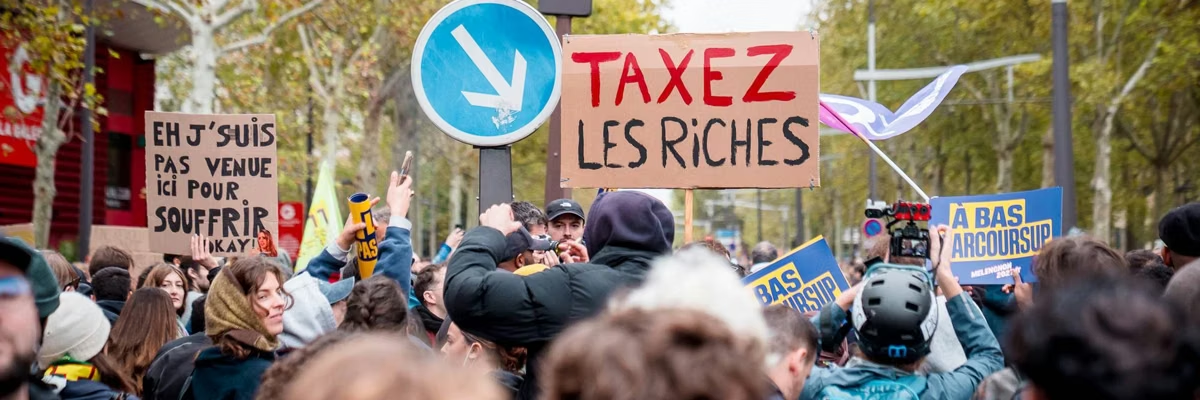
    People march in Paris for education reform and against inequality on October 24, 2026.
    (Photo by Jean-Luc Mélenchon /X)

    “Looking at countries like the United States, we don’t want to end up like them, where part of the population has everything and the others have nothing,” one French protester said.

    Hundreds of thousands of people took to the streets across Europe on Saturday as anger continues to build over the rising cost of living and deteriorating social services.

    While demonstrators emphasized different demands in different countries, the protest wave reflects a sense that the status quo has ceased to work for ordinary people, especially the young.

    RECOMMENDED…
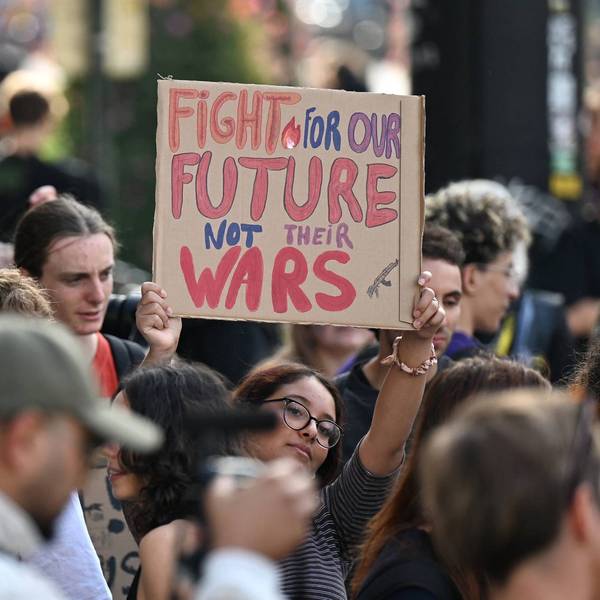
    Student Protests in Belgium

    ‘This Is Going Global’: Anti-Austerity Protests Spread From Spain and France to Chile, Belgium, and Beyond
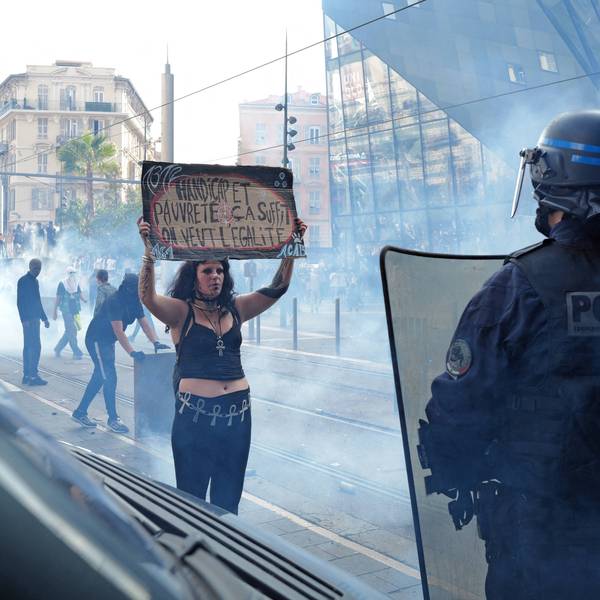
    'The Government Is Trembling': Protests Erupt in France, Spreading to 140 Cities

    ‘The Government Is Trembling’: Protests Erupt in France, Spreading to 140 Cities

    “I see so many more similarities than differences,” Alice de Brito, the vice president of French student union UNEF, told CNN of the protests. “We are all talking about the need for investments in education, in the universities, in youth in general. But we are also talking about the cost of living, about housing.”

    France

    Across France, between 410,000 and 800,000 people turned out in the continuation of protests that erupted in September when students began to mobilize against underfunding, teacher shortages, and other poor conditions in their schools. Adult workers have joined with the students, criticizing widespread inequality and the rising cost of living, leading to mass demonstrations on October 17 and again a week later.

    “Looking at countries like the United States, we don’t want to end up like them, where part of the population has everything and the others have nothing,” Paris protester Louis Ledoux–Xatard told The Associated Press.

    “Too many billionaires; we are preparing the revolution,” one group of protesters chanted, according to Al Jazeera.

    There were 289 protests in France, including in Marseilles, Nantes, Nice, Lyon, Bordeaux, and Orleans. Interior Minister Laurent Nunez said that almost 1,000 people were arrested, though the number was expected to grow. Two people sustained significant injuries.

    “Behind every police officer, a compliant camera.”

    The protest in Paris had originally been scheduled to run through the center of the city, but authorities relocated it to outskirts and banned marches organized by groups other than unions.

    “It won’t stop the movement. It won’t stop students from demanding better conditions in schools,” nurse Soumaya Abed told AP of the changes.

    Jean-Luc Mélenchon, who leads the left-wing France Unbowed party, criticized the government of President Emmanuel Macron for changing the route, but also praised the marchers for carrying on.

    “Total victory for the social movement,” Mélenchon wrote on social media. “The march gathered at the new authorized point and is now flowing calmly over more than four kilometers. The provocations for disorder by the Paris police prefect and [French Prime Minister Sébastien] Lecornu are a total failure. For the authorities, it is time to give in, or soon they will have only the exit door left.”

    Media reported that the Parisian demonstration was largely peaceful until the end, when police released tear gas and fired water cannons and some black-clad protesters threw projectiles.

    Reporters with Agence France-Presse said they saw:

    police charge several times and vigorously use tear gas and batons against some, mostly young, protesters.
    “The police started moving towards everyone, telling them to get down and back off. They were just taking people down, you know, beating protesters,” one demonstrator bleeding from a baton blow to his face, who gave his first name as David, told AFP.

    Other witnesses also described a repressive police response to The Guardian:

    Mike, a 23-year-old student who also declined to give his surname, said: “Look around, they’re just teenagers. Is it normal for teenagers to be teargassed and beaten with batons?”

    For Jessica, a 24-year-old student, said: “I just don’t understand why there’s so much violence. I feel like our right to protest is being trampled on.”

    Mélenchon lambasted the police and the media for working together to discredit the movement.

    “In Paris, to ruin the day and unwind, the so-called forces of law and order gas and fire into the crowd at the back of the procession, all in a bid to get footage for the domestic news channels that spent the whole week airing the images that spurred the Trappes killer,” he wrote on social media, referring to a racially motivated shooting west of Paris on Friday that killed one and wounded five.

    In a second post, he added: “It continues with the policing of minds through the televisions of power. Tonight, staging of the « tails of the procession » to spew hatred against the popular movement. Without a single image of the masses in peaceful action. Behind every police officer, a compliant camera.”

    He encouraged readers to “turn off the televisions! Form your own opinion without a guardian. Journey through social networks. Stay free to think for yourselves.”

    Belgium

    In neighboring Belgium, hundreds of people marched in Brussels in a continuation of demonstrations for improvements in the education system.

    “We are here for young people’s future, for better work,” rally speaker Celia Ponce told the crowd, as The Brussels Times reported.

    She also accused governments of wanting to “destroy public services.”


    Police used tear gas to disperse some protesters and, in an incident reported by Reuters, kicked and hit one demonstrator after they fell during a chase.

    Spain

    Approximately 25,000 people marched in Madrid to support Spain’s pension system and demand that it keep pace with inflation and that a gender gap be eliminated, according to Al Jazeera.

    “How beautiful Madrid is when it defends its rights,” Emilio Delgado, deputy spokesperson for left party Mas Madrid, wrote on social media. “We propose that no pension should be below the minimum wage. A lifetime of work deserves a dignified retirement.”

    The protests come a month ahead of Spain’s general election, in which current Prime Minister Pedro Sanchez’s Spanish Socialist Workers’ Party will face off against the right-wing Popular Party. Popular Party leader Alberto Nunez Feijoo has promised to adjust pensions according to inflation if his party wins, but demonstrators are still concerned about what a right-wing victory would mean for the pension system.

    Portugal

    In Portugal, meanwhile, the main demand was affordable housing.

    People marched in Lisbon, continuing a movement that began October 10 in the city of Porto calling on the government to address the country’s housing crisis, according to The Resident.

    “We have no home, so we set up tents!” read the slogan of the March, organized by the Acampada de Lisboa movement.

    The protesters also opposed new policies from Prime Minister Luis Montenegro that would weaken a limit on annual rent increases and make it easier to evict people who are unable to make rent payments, according to AP.

    Italy

    Thousands of people joined demonstrations across Italy to protest the affordability crisis as well as the right-wing government of Prime Minister Giorgia Meloni. Protests were called for eight cities including Milan, Turin, and Rome, with 10,000 attending the Milan demonstration alone.

    “We are here because of the rising prices and because I believe that our government has no respect for its citizens,” a 17-year-old student participant, who did not give a name, told Al Jazeera. “There are four people in my family. My mother works in a factory, but my father is about to lose his job. It’s hard to make ends meet on just one salary.”

    The Italian protests were a continuation of demonstrations that have taken place throughout October. There were fewer clashes between police and demonstrators on Saturday compared with earlier marches, though some protesters tried to enter the Colosseum before being pushed back.

    Albania

    In Albania, outrage over plans by US President Donald Trump’s son-in-law Jared Kushner to build a luxury resort near a protected wildlife area—which is widely seen as an example of government corruption—has dovetailed with demands by students for less corruption in the education system specifically as well as lower tuition fees and more funding.

    A demonstration in the capital of Tirana on Saturday marked the 12th day of anti-government protests this month following a summer of mobilizations against the luxury hotel.

    Some protesters lit fires and threw projectiles, while police used tear gas, rubber bullets, and water cannons.

    One demonstrator, the ⁠28-year-old Daniel Tahiri, told Reuters that the Albanian government was a “dictatorship with the clothes of democracy.”

    “Albanians have woken up,” Tahiri said.

    Article by Olivia Rosane republished from Common Dreams under Creative Commons (CC BY-NC-ND 3.0).

  • Atmospheric CO2 Levels Haven’t Been This High in 800,000 Years: NOAA

    Spread the love

    A major report on climate says both greenhouse gas concentrations and global sea levels hit record highs in 2020.

    Republished under a Creative Commons Licence. Original article at CommonDreams

    KENNY STANCILAugust 25, 2021

    Bolstering the case for meaningful climate action, a major report released Wednesday found that Earth’s atmospheric greenhouse gas concentrations and sea levels both hit record highs in 2020.

    “This situation is urgent, but it’s not hopeless. We have an opportunity to lead the global response in the fight against the climate crisis—we cannot afford to waste it.”
    —Rep. Eddie Bernice Johnson

    Based on the contributions of more than 530 scientists from over 60 countries and compiled by the U.S. National Oceanic and Atmospheric Administration (NOAA), State of the Climate in 2020 is the 31st installment of the leading annual evaluation of the global climate system.

    “The major indicators of climate change,” officials from NOAA’s National Centers for Environmental Information pointed out in a statement, “continued to reflect trends consistent with a warming planet. Several markers such as sea level, ocean heat content, and permafrost once again broke records set just one year prior.”

    “Annual global surface temperatures were 0.97°–1.12°F (0.54°–0.62°C) above the 1981–2010 average” in 2020, said NOAA, making last year one of the three warmest on record “even with a cooling La Niña influence in the second half of the year.”

    Last year was the warmest on record without an El Niño effect, and “new high-temperature records were set across the globe,” NOAA said. The agency added that the past seven years (2014-2020) had been the seven warmest on record.

    Although the coronavirus-driven economic slowdown resulted in an estimated 6% to 7% reduction of carbon dioxide (CO2) emissions in 2020, the global average atmospheric concentration of CO2 increased to a record high of 412.5 parts per million. The atmospheric concentrations of other major greenhouse gases (GHG), including methane and nitrous oxide, also continued to climb to record highs last year despite the pandemic.

    According to NOAA, last year’s CO2 concentration “was 2.5 parts per million greater than 2019 amounts and was the highest in the modern 62-year measurement record and in ice core records dating back as far as 800,000 years.” Moreover, “the year-over-year increase of methane (14.8 parts per billion) was the highest such increase since systematic measurements began.”

    In addition, global sea levels continued to rise, surpassing previous records.

    “For the ninth consecutive year,” said NOAA, “global average sea level rose to a new record high and was about 3.6 inches (91.3 millimeters) higher than the 1993 average,” which is when satellite measurements began. As a result of melting glaciers and ice sheets, warming oceans, and other expressions of the climate crisis, the “global sea level is rising at an average rate of 1.2 inches (3.0 centimeter) per decade.”

    Other notable findings of the new report include:

    • Upper atmospheric temperatures were record or near-record setting;
    • Oceans absorbed a record amount of CO2, global upper ocean heat content reached a record high, and the global average sea surface temperature was the third highest on record;
    • The Arctic continued to warm at a faster pace than lower latitudes—resulting in a spike in carbon-releasing fires—and minimum sea ice extent was the second smallest in the 42-year satellite record;
    • Antarctica witnessed extreme heat and a record-long ozone hole; and
    • There were 102 named tropical storms during the Northern and Southern Hemisphere storm seasons, well above the 1981–2010 average of 85.

    In contrast to the release less than three weeks ago of the latest assessment from the United Nations’ Intergovernmental Panel on Climate Change, which warned that fossil fuel emissions are intensifying extreme weather disasters—provoking a flurry of reactions and even garnering a short-lived uptick in corporate media’s coverage of the climate emergency—NOAA’s new report was met with less fanfare.

    In one of the few early statements issued by members of Congress in response to the report, Rep. Eddie Bernice Johnson (D-Texas) said that “scientists sounded the alarm on the climate crisis again.”

    “It is clear that without swift action, we can, unfortunately, expect to set new records like these every year,” said Johnson, chair of the House Committee on Science, Space, and Technology. “The consequences of climate change impact every American—especially disadvantaged communities—across the country; from the devastating floods in Tennessee a few days ago to the record-breaking wildfires in the West.”

    “Building a better future for all means acting on climate now,” the lawmaker added. “This situation is urgent, but it’s not hopeless. We have an opportunity to lead the global response in the fight against the climate crisis—we cannot afford to waste it.”

    Our work is licensed under Creative Commons (CC BY-NC-ND 3.0). Feel free to republish and share widely.

  • ‘Civil Disobedience Is Our Duty’: Swiss Climate Campaigners Occupy Zürich Financial Center

    Spread the love

    Republished from https://www.commondreams.org/ under a Creative Commons licence

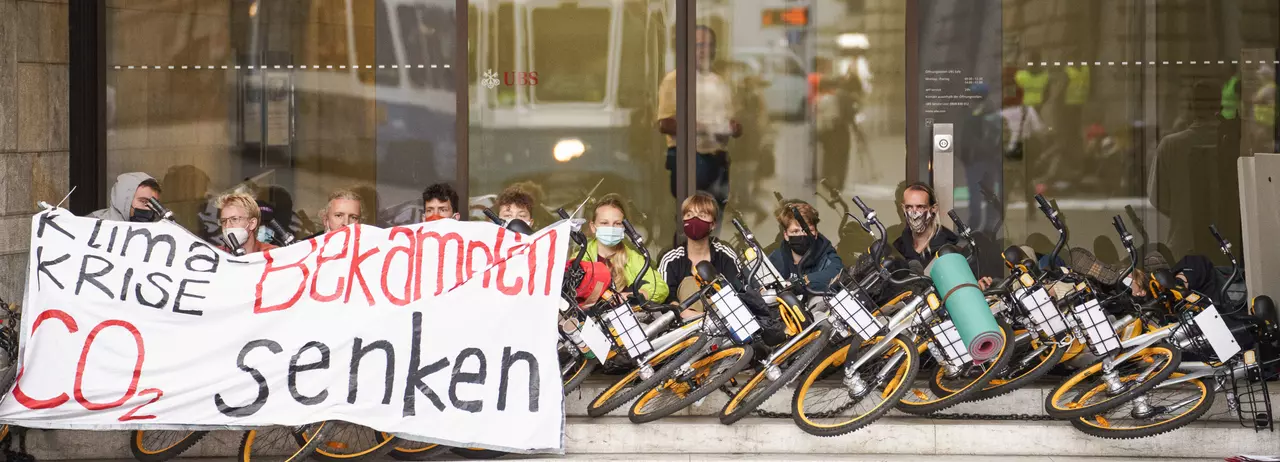
    Climate justice activists occupied the center of Zürich’s financial district on August 2, 2021 to demand that the two biggest banks in Switzerland divest from oil, gas, and coal. (Photo: Rise Up for Change/flickr/cc)

    “We have no other choice. Either phase out fossil fuels or face forest fires, famines, droughts, and floods.”

    KENNY STANCILAugust 2, 2021

    Climate justice campaigners occupied the center of Zürich’s financial district Monday to demand that the two biggest banks in Switzerland divest from oil, gas, and coal.

    Dozens of “singing and chanting activists” blocked entrances to the headquarters of Credit Suisse and a UBS office building on Paradeplatz square, Reuters reported. Police officers arrested about 30 people who refused to disperse during the peaceful demonstration.

    Frida Kohlmann, spokesperson for the Rise Up for Change group, said in a statement that Credit Suisse and UBS have failed to respond appropriately to the climate emergency. 

    “That is why the climate justice movement is occupying the Credit Suisse headquarters and the nearby UBS office today to draw attention to the consequences of the Swiss financial institutions’ inaction,” Kohlmann said.

    https://www.commondreams.org/news/2021/08/02/civil-disobedience-our-duty-swiss-climate-campaigners-occupy-zurich-financial-center?utm_term=AO&utm_campaign=Daily%20Newsletter&utm_content=email&utm_source=Daily%20Newsletter&utm_medium=Email

    “Civil disobedience is our duty,” tweeted Collectif BreakFree Suisse, part of the movement to stop financial actors from continuing to fund dirty energy projects that are fueling extreme weather-related disasters. “Either phase out fossil fuels or face forest fires, famines, droughts, and floods.”

    https://www.commondreams.org/news/2021/08/02/civil-disobedience-our-duty-swiss-climate-campaigners-occupy-zurich-financial-center?utm_term=AO&utm_campaign=Daily%20Newsletter&utm_content=email&utm_source=Daily%20Newsletter&utm_medium=Email

    In response to the protest, UBS said in a statement: “Climate protection is a top priority at UBS… We are committed to reducing greenhouse gas emissions across our business to net zero by 2050, with science-based interim targets for 2025, 2030, and 2035.”

    Despite having “decreased fossil fuel financing by 73%, from $7.7 billion in 2016 to $2.1 billion in 2020,” UBS continues to invest money in “thermal coal mining, oil refining, shale gas drilling,” and more, according to a recent analysis by CNBC.

    Credit Suisse asserted that it “is committed to climate protection and achieving the goals of the Paris Climate Agreement,” referring to the 2015 international treaty that seeks to reduce carbon pollution and limit global temperature rise to below 1.5°C.

    On its “DisCreditSuisse” campaign website, Collectif BreakFree Suisse said that while “Credit Suisse claims to align itself with the objectives of the Paris Agreement… it is one of the banks that is fueling the climate catastrophe the most.” According to a recent analysis (pdf) of the world’s largest asset managers, the bank ranks 72 out of 75 in terms of responsible investing.

    “Although Credit Suisse officially supports the objectives of the Paris climate agreement, it has been financing companies in the coal, oil, and gas sectors since 2015 with billions of dollars for the exploration, production, and processing of fossil fuels,” the group said. “Between 2016 and 2019, Credit Suisse invested (pdf) a total of $74.3 billion in fossil fuels. In particular, the bank provided almost $23 billion in financial support for global firms actively expanding their fossil fuels businesses.”

    “The existing instruments and guidelines do not appear to have led to any changes in the bank’s decision-making processes,” the group added. “The bank’s loan and investment portfolios are simply not being decarbonized at a pace commensurate with IPCC recommendations and the climate crisis. The bank is thus discrediting itself.”

    Republished from https://www.commondreams.org/ under a Creative Commons licence

    With Amazon Rainforest at ‘Tipping Point,’ Big Banks Told to End Fossil Fuel Financing

    1. Planet’s Vital Signs Are Reaching Dangerous ‘Tipping Points’ Amid Climate Crisis, Scientists Warn
    2. For First Time on Record, US Renewables Generated More Electricity Than Either Coal or Nuclear in 2020
    3. As Bipartisan Infrastructure Deal Reached, Sinema Comes Out Against $3.5 Trillion Package
    4. ‘Just Say That the Election Was Corrupt,’ Trump Told DOJ in December
    5. Progressives Threaten to Tank Bipartisan Infrastructure Deal If Their Demands Aren’t Met
    6. Science Museum Just Killed Its ‘Own Reputation,’ Says Greta Thunberg After Docs Reveal Gag Clause With Shell
    7. Bush, Pressley, and Omar Sleep Outside Capitol to Demand Extension of Eviction Moratorium
    8. Pelosi Under Fire for Parroting ‘Right-Wing Lies’ Against Student Loan Debt Cancellation
    9. Moving From Neglect to Dignity in the S.S.I. Program
    10. ‘Turn This Destruction Around’: 5 Months Left in 2021 But Humanity’s Used Up Earth’s Ecological Budget