This work by Middle East Monitor is licensed under a Creative Commons Attribution-NonCommercial-ShareAlike 4.0 International License.
People carry the coffins during a funeral ceremony held for three civil defense members who lost their lives in the town of Majdal Zoun in an Israeli strike that violated the ceasefire in the city of Tyre, Lebanon, on April 30, 2026. [Houssam Shbaro – Anadolu Agency]
The death toll in Israeli attacks on Lebanon since March 2 has reached 2,659, with 8,183 others injured, the Lebanese Health Ministry said on Saturday.
In a statement, the ministry said 41 people were killed and 11 others injured in Israeli raids over the past 24 hours.
Israel launched the offensive in Lebanon following Hezbollah’s retaliation linked to the Iran war. Besides the casualties, the attacks have displaced more than 1 million people.
A 10-day ceasefire that began on April 17 was later extended until mid May, but Israel continues to violate it daily through airstrikes and the demolition of homes.
Israel also maintains what it describes as a “buffer zone” in southern Lebanon, saying it is meant to prevent attacks from Hezbollah. An earlier truce in Lebanon was reached in November 2024.
Donald Trump sings and dances, says that it’s fun to kill everyone …Donald Trump calls for help from NATO allies in securing the Strait of Hormuz despite saying on 7 March 2026 that they don’t need people to join wars after they’ve already won. He’s challenged with the claim that he lies as much as the IDF.
This work by Middle East Monitor is licensed under a Creative Commons Attribution-NonCommercial-ShareAlike 4.0 International License.
An Israeli soldier aims his weapon during an Israeli army raid in the northern West Bank city of Nablus, in Nablus, West Bank, Palestine on April 12, 2026. [Nedal Eshtayah – Anadolu Agency]
The US State Department said Friday that it approved the possible sale of Advanced Precision Kill Weapon System (APKWS) and related equipment to Israel, Anadolu Agency reports.
The estimated total cost is $992.4 million, it said in a statement.
“The proposed sale will improve Israel’s capability to meet current and future threats, strengthen its homeland defense, and serve as a deterrent to regional threats. Israel will have no difficulty absorbing these articles and services into its armed forces,” it added.
The principal contractor will be BAE Systems in the US state of New Hampshire.
The US has long been criticized for providing support to Israel for its genocideal war in the Gaza Strip, where more than 72,000 people, mostly women and children, have been killed since October 2023. A ceasefire was reached in October 2025, but violations have been frequent.
Several American lawmakers have demanded that the US stop supplying weapons to Israel and accused it of being complicit in Israel’s war in Gaza.
Donald Trump sings and dances, says that it’s fun to kill everyone …Donald Trump calls for help from NATO allies in securing the Strait of Hormuz despite saying on 7 March 2026 that they don’t need people to join wars after they’ve already won. He’s challenged with the claim that he lies as much as the IDF.
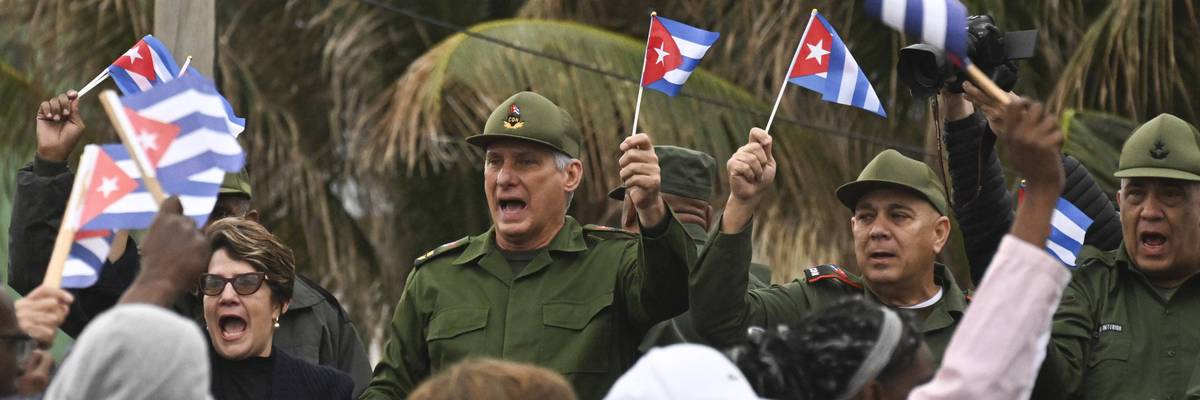
Cuba’s President Miguel Diaz-Canel (C) takes part in the “Anti-Imperialist” protest in front of the US Embassy against the US incursion in Venezuela, where 32 Cuban soldiers lost their lives, in Havana on January 16, 2026. (Photo by Yamil Lage/ POOL / AFP via Getty Images)
After the US president again threatened invasion, Cuban President Miguel Díaz-Canel Bermúdez said he would only “find a people determined to defend sovereignty and independence in every inch of the national territory.”
President Miguel Díaz-Canel Bermúdez of Cuba on Saturday responded with stark and defiant words to the latest attacks coming from US President Donald Trump, who on Friday signed a new executive order authorizing even more aggressive sanctions against the island nation and later threatened to invade the country.
“The President of the United States escalates his threats of military aggression against Cuba to a dangerous and unprecedented scale,” said Díaz-Canel in a statement. “The international community must take note and, together with the people of the United States, determine whether such a drastic criminal act will be allowed to satisfy the interests of a small but wealthy and influential group, driven by desires for revenge and domination.”
“No aggressor, no matter how powerful, will find surrender in Cuba,” he added. If Trump were to attack the country, the Cuban president said, “he will find a people determined to defend sovereignty and independence in every inch of the national territory.”
“What does ‘No Kings’ mean when one man can snap his fingers and kill innocent Cubans on a whim?”
In addition “to blocking the US assets of foreign individuals and entities operating in Cuba’s energy, defense, financial services, metals, mining, and security sectors, as well as anyone acting on behalf of the Cuban government,” as Drop Site News notes, Friday’s executive order also “authorizes sanctions on foreign financial institutions that conduct significant transactions with designated Cuban entities, potentially cutting them off from US correspondent banking.”
As such, the outlet continued, the new sanctions “could further isolate Cuba from the international financial system, limit foreign investment, and exacerbate the island’s already severely restricted access to medicine, food imports, and basic goods.”
In addition to the signed executive order, Trump said during a Friday campaign-style event in Florida that the US “will be taking [Cuba] over almost immediately.”
Upon their return from Iran, where Trump has waged a deeply unpopular war, the US president told the crowd, “We’ll have maybe the USS Lincoln [aircraft carrier] come in offshore, and they’ll give up.”
In a floor speech earlier this week, Sen. Chris Van Hollen (D-Md.) rebuked the Trump administration for the humanitarian disaster it has unleashed in Cuba, which follows what he described as a “failed” policy towards the island country over decades.
As Trump ramps up his threats of war against Cuba, we must understand what led us to this point: 65 years of a bankrupt Cuba policy.
If we want to avoid war with Cuba, we must rein in this lawless President & learn from the failed, bipartisan policies that led us to this point. pic.twitter.com/H9MqviSe6d
— Senator Chris Van Hollen (@ChrisVanHollen) April 30, 2026
“If we want to avoid war with Cuba,” said Van Hollen, “we must rein in this lawless president and learn from the failed, bipartisan policies that led us to this point.”
David Adler, the co-general coordinator of Progressive International, condemned the relative silence of US opponents to the Trump administration, who have not done, in his mind, nearly enough to challenge the blockade or condemn the administration’s repeated and ongoing threats to invade the island nation or overthrow its government.
“ Donald Trump has given [Secretary of State] Marco Rubio the green light to annihilate a peaceful nation and its people—and the ‘resistance’ is silent,” said Adler. “What does ‘No Kings’ mean when one man can snap his fingers and kill innocent Cubans on a whim?”
Orcas discuss how Trump was re-elected and him being an obviously insane, xenophobic Fascist.Donald Trump explains why he established his Bored of PeaceClimate science denier Donald Trump confirms that he knows nothing about democracy and that more liquid gold is being secured according to his policy of global privateering.
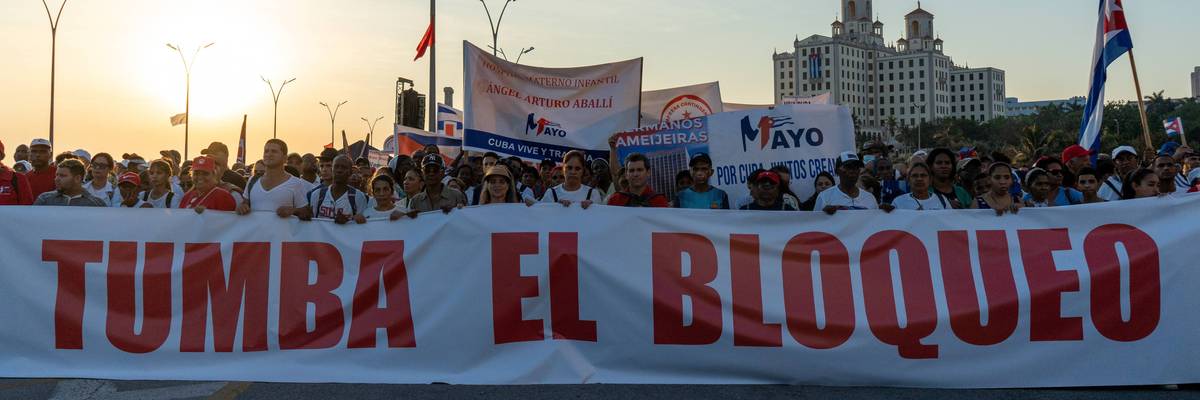
Cubans hold a banner reading, “Knock Down the Blockade” during an International Workers’ Day rally near the US Embassy in Havana on May 1, 2026. (Photo by Magdalena Chodownik/Anadolu via Getty Images)
The president’s latest aggression toward Cuba comes amid his repeated threats to “take” the island.
Citing Cuba’s ties with its ally Iran, President Donald Trump on Friday signed an executive order expanding the already crippling US sanctions regime against Cuban officials, as the US administration has the island in its crosshairs after ousting Venezuela’s socialist leader.
Trump’s executive order cites highly dubious “national security threats posed by the communist Cuban regime,” including Havana’s alignment “with countries and malign actors hostile to the United States.”
The directive “imposes new sanctions on entities, persons, or affiliates that support the Cuban regime’s security apparatus, are complicit in government corruption or serious human rights violations, or are agents, officials, or material supporters of the Cuban government,” without identifying any of the affected groups or individuals.
🇨🇺 Trump signs executive order dramatically escalating "sanctions" on Cuba, targeting energy, finance, and security sectors
President Trump signed an executive order Friday, marking one of the most sweeping expansions of US economic pressure on Cuba in decades, blocking the US… pic.twitter.com/5d1mSc3We6
For 65 years, the US has imposed an economic embargo on Cuba that has adversely affected all sectors of the socialist island’s economy and severely limited Cubans’ access to basic necessities including food, fuel, healthcare, and medicines—with disastrous results. The Cuban government claims the blockade cost the country’s economy nearly $5 billion in just one 11-month period in 2022-23 alone. United Nations member states have perennially—and overwhelmingly—condemned the embargo.
The Trump administration also imposed a fuel blockade and reinstated Cuba on the US State Sponsors of Terrorism list, from which former President Joe Biden removed the country before leaving office in 2021. Cuba was initially added to the list during the Reagan administration amid a decadeslong campaign of US-backed Cuban exile terrorism, failed assassination attempts, economic warfare, and covert operations large and small in a futile effort to overthrow the revolutionary government of longtime leader Fidel Castro.
Cuba says US-backed terrorism has killed or wounded more than 5,000 Cubans and cost its economy billions of dollars.
The Cuban government—which was celebrating International Workers’ Day on Friday—did not immediately respond to the expanded sanctions.
Experts warned that the new sanctions are worryingly broad, with Georgetown Law visiting scholar Peter Harrell writing on X that “basically any non-US person or company doing any business in/with Cuba could be sanctioned.”
Harrell noted that the edict “gives the Trump administration a fair amount of easy-to-deploy firepower to drive remaining international businesses out of Cuba.”
“The questions will be in implementation,” he added. “For example, will Trump sanction a Chinese firm installing renewable energy in Cuba?”
Trump’s edict comes months after the president ordered the invasion of Venezuela and abduction of socialist President Nicolás Maduro and amid the ongoing US-Israeli war on Iran, the 10th country bombed during the course of Trump’s two terms in office.
Trump last month declared that “we may stop by Cuba after we’re finished with this,” referring to war on Iran that’s left thousands of people dead or wounded, including hundreds of children. The president has also said that he believes he’ll “be having the honor of taking Cuba,” language echoing the 19th century US imperialists who conquered the island along with Puerto Rico, Guam, and the Philippines from Spain in another war waged on dubious pretense.
“Whether I free it, take it—I think I can do anything I want,” Trump said of the island and its 11 million inhabitants.
Orcas discuss how Trump was re-elected and him being an obviously insane, xenophobic Fascist.Donald Fuhrump says that Amerikkka doesn’t bother with crimes or charges anymore, not being 100% Amerikkkan and opposing his real estate intentions is enough.Donald Trump sings and dances, says that it’s fun to kill everyone …
Public sector pensions have ploughed billions into opaque investment funds which are financing ruinous gas projects on the US Gulf Coast
In brief
UK public sector pension schemes are bankrolling rapid expansion of liquefied natural gas production in the US South, posing a major climate threat
US gas projects are reaping rewards from price shocks caused by Trump’s war in Iran
Gas terminals are frequently built in poor neighbourhoods, causing health problems in nearby communities
Trump’s war in Iran has boosted the fortunes of US gas companies – and UK savers are unwittingly bankrolling their expansion.
Sixty local government pension funds have invested a total of £8bn into funds paying for the rapid construction of gas infrastructure on the Gulf Coast of the US. Residents say these terminals are already causing health problems in their communities. Experts say they represent one of the biggest threats to the future of the planet.
Over 7 million school staff, civil servants and other public sector workers either save with, or receive their pension from, local government pension schemes. Our revelations have sparked concerns among local councillors, who have urged fund managers to divest from fossil fuels.
While the companies behind these projects are enjoying a boost from the war in Iran, they could tumble in value as the world switches to renewable forms of energy. Councillor Andrew Scopes, who sits on an advisory panel for West Yorkshire Pension Fund, said: “We will still be paying benefits out in 60 years’ time. We need to be looking beyond the possible short-term gains, at the long-term risk.”
Members of the scheme were dismayed to find what they were bankrolling. “The UK could be funding a safer, healthier future for all via renewable energy generated in the UK that is cheap, safe, clean and owned by us,” said Jane Thewlis, a retired social worker.
The news comes as the government is making changes to the law governing pension schemes. During a debate in the House of Lords, peers from several parties raised the issue of pension fund investments in climate-wrecking companies.
Baroness Hayman, a crossbench peer, told us: “Many UK pension funds are already reducing their exposure to fossil fuels, recognising the risks these investments pose. But with £3 trillion held in UK pensions, and the climate and nature challenge growing, there is a clear opportunity to better protect savers from rising financial and environmental risks.”
A gas explosion
The giant white orbs containing liquefied natural gas (LNG) look almost alien. Scores of these terminals are popping up along the 1,200km Louisiana and Texas coastline, a building frenzy turbo-charged by Trump’s second term. If all the planned terminals are built, the LNG produced in the US would generate the same amount of greenhouse gases each year as every EU country combined, says Jeremy Symons, a former official at the US environmental regulator.
UK pension funds have supported this expansion for years. In 2019, a little-known infrastructure fund called Stonepeak put up $1.3bn to complete the construction of the Calcasieu Pass gas terminal in the south-west corner of Louisiana. Twenty miles inland, building has started on another terminal also funded by Stonepeak.
Calcasieu Pass LNG terminalVenture Global
UK savers in 12 local government pension schemes, including West Yorkshire, South Yorkshire and Worcestershire, have invested over £360m in Stonepeak funds that financed these plants, according to figures from council records and data provider Pitchbook.
Since starting operations, Calcasieu Pass has reported hundreds of emissions violations and paid authorities a $245,000 settlement. That’s unlikely to make much difference to its owner, Venture Global, a major Trump donor. Its shares rocketed by more than 80% after the US and Israel started bombing targets in Iran.
Roishetta Ozane, a resident turned activist, lives near both terminals. She told us that pollution from the nearby gas, petrochemicals and oil infrastructure has caused asthma and an increase of cancer in the area – an account borne out by academic research.
“We’re seeing more women develop health issues that are living near these facilities, having pre-term babies or having miscarriages,” she said. “We’re seeing our air quality deteriorate. We have a drinking water crisis.” She said residents had to deal with noise pollution from construction and the flaring of excess gas from the terminals.
Roishetta Ozane (second left)
Two of her children have asthma. She told us the doctor said pollution may have exacerbated the seizures suffered by her son, who died last year. “When my son passed away, I was like, what are we doing this for?” she said. “We’re fighting for our children, for our future, for our community, but yet they’re dying.”
Further down the coast, a huge fireball at Freeport LNG in June 2022 made the risks of these installations vividly clear. IFM Global Infrastructure Fund – which counts among its investors more than 20 UK pension funds, including Avon, East Sussex and Aberdeen – paid $1.3bn to help build Freeport LNG in 2013. It continues to hold a stake in the project.
Travelling south, the construction boom continues. Right next to the Mexican border, Rio Grande LNG is building a sprawling complex that the NGO Sierra Club estimates will match the emissions of 50 coal-fired power plants every year. Campaigners say the project is already contributing to habitat loss in an area critical for endangered animals such as ocelots, falcons and sea turtles.
French bank Société Générale backed out of funding the controversial project. But it was able to proceed thanks to a $5bn commitment from BlackRock’s Global Infrastructure Partners Fund V – which is supported by nearly £200m of UK savers’ pensions, from Waltham Forest to Greater Manchester.
In total, we found eight US-based LNG terminals backed by UK pension money. Taken together, those terminals would give rise to more CO₂ every year than the entire UK several times over, according to Sierra Club data.
A spokesperson for IFM Investors told us that the fund publicly discloses its infrastructure equity assets. They added: “Natural gas is increasingly utilised as a transition fuel for decarbonisation globally … These assets benefit from investment from long-term, trusted capital partners like pension funds, who can reinvest in them and pave the way for carbon emissions reduction.”
LNG is often promoted as a cleaner alternative to traditional fossil fuels. However, a peer-reviewed study found it is 33% worse in terms of planet-heating emissions over a 20-year period compared with coal.
Worcestershire Pension Fund said it invests through structures that mean “exposure to any single asset is indirect, limited, and a very small component of a broader portfolio.” It said the Stonepeak fund in question “publishes detailed annual reports and complies fully with statutory disclosure requirements”.
A greener pension
When it comes to curbing carbon emissions, council pension funds and campaigners have tended to focus on selling their shares in companies like BP and Shell. But a growing portion of pension funds are invested in so-called “private markets”. Typically this involves putting money into a number of big funds, which in turn invest in everything from private equity to property to company loans.
Private markets can offer healthy returns. They’re also something of a black hole for information, which makes following the money much more difficult. And they’re often excluded from the scope of council climate commitments.
The upshot is that even pension schemes that have promised not to invest in fossil fuels have ploughed money into funds that are paying for major gas projects.
Take Waltham Forest Pension Fund, which in 2016 became the first local authority to make such a commitment. Simon Miller, a former councillor who chaired the pension fund committee, said the council already had a number of green goals to improve the lives of residents. “[But] we had a pension fund that was merrily invested in fossil fuels that was absolutely out of lockstep with the political direction and philosophy of the borough.”
The council’s pension fund proceeded to sell its investments in fossil fuel companies over the following five years.
According to its latest report, however, Waltham Forest is still invested in funds managed by Global Infrastructure Partners that have financed Rio Grande LNG and Allete, which owns an 18,000-acre coal mine in North Dakota.
Lewisham Pension Fund has also brought down the emissions associated with its investments after committing to sell its holdings in fossil fuel companies. But it remains invested in a huge infrastructure fund operated by JP Morgan Asset Management. While this fund has substantial investments in renewable energy, it continues to hold a 50% stake in Third Coast, which spilled over 1 million gallons of oil into the Gulf of Mexico in 2023.
In February 2024, West Yorkshire Pension Fund said it would no longer lend to the oil, gas and coal sector. According to the new standards set by the authority, councillor Andrew Scopes said, the decision to invest in a Stonepeak fund that bankrolled an LNG plant on Ozane’s doorstep would be “very difficult to justify”.
Jane Thewlis, a campaigner and member of the scheme, said: “We are particularly concerned if [West Yorkshire Pension Fund] is funding LNG infrastructure in the US, which is not compatible with a livable climate. We expect our elected representatives to use our money to fund a safe future – not to hasten the end of humanity.”
West Yorkshire Pension Fund said its environmental, social and governance policy “takes account of the current status and role of gas and oil within the energy transition, particularly with regard to reliability, affordability and coal displacement”. It said LNG is seen as “a bridge between today’s fossil‑fuel‑dominated energy system and a future low or zero‑carbon one”.
JP Morgan, Stonepeak and Waltham Forest council declined to comment on the record. Lewisham council said it cannot comment in a pre-election period. Third Coast, the LNG port operators, Global Infrastructure Partners and other local councils did not respond to requests for comment.
What next?
We are providing our research to campaigners and pension fund advisory panels so they can challenge decision makers on investments in infrastructure funds
New rules mean that council pension funds will be combined into pension fund pools, limiting councillors’ power over investment decisions. We will investigate what that means for funds that have committed to invest responsibly
Parliament is discussing the first of a number of pension reforms, where campaigners are pushing for greater recognition of climate risk
Neo-Fascist Climate Science Denier Donald Trump says Burn, Baby, Burn.Elon Musk urges you to be a Fascist like him, says that you can ignore facts and reality then.










 Calcasieu Pass LNG terminalVenture Global
 Roishetta Ozane (second left)

