This work by Middle East Monitor is licensed under a Creative Commons Attribution-NonCommercial-ShareAlike 4.0 International License.
The head of the Iranian parliament’s National Security and Foreign Policy Committee Ebrahim Azizi [X]
The head of the Iranian parliament’s National Security and Foreign Policy Committee warned Saturday that a “single miscalculation” could render Israel uninhabitable in less than an hour, posting a map marking infrastructure sites across the country, Anadolu reports. “A single miscalculation is all it takes: the occupied lands rendered uninhabitable in under an hour,” Ebrahim Azizi wrote on US social media company X.
The map identified desalination plants, power stations, oil facilities, bridges, and transport routes, as well as the Dimona nuclear research center in the Negev desert in southern Israel.
In the north, it marked the Haifa oil refineries, Carmel Tunnels in Haifa, and Yokne’am viaducts on Highway 6.
Along the Mediterranean coast, it identified the Hadera desalination plant and Orot Rabin power plant, the Sorek desalination plant, and desalination facilities in Ashdod and Ashkelon. It also marked the Eshkol power plant in Ashdod and a site labeled “Ashdod Oil Refineries & Fuel Storage.”
Transport infrastructure included the Ayalon interchange bridges on Highway 20 in Tel Aviv, the Anava interchange linking Highways 1 and 6, the Motza Valley road and rail bridges near Jerusalem, and Jerusalem’s Chords Bridge.
The map also traced an oil pipeline running between Eilat in the south and Ashkelon on the Mediterranean coast.
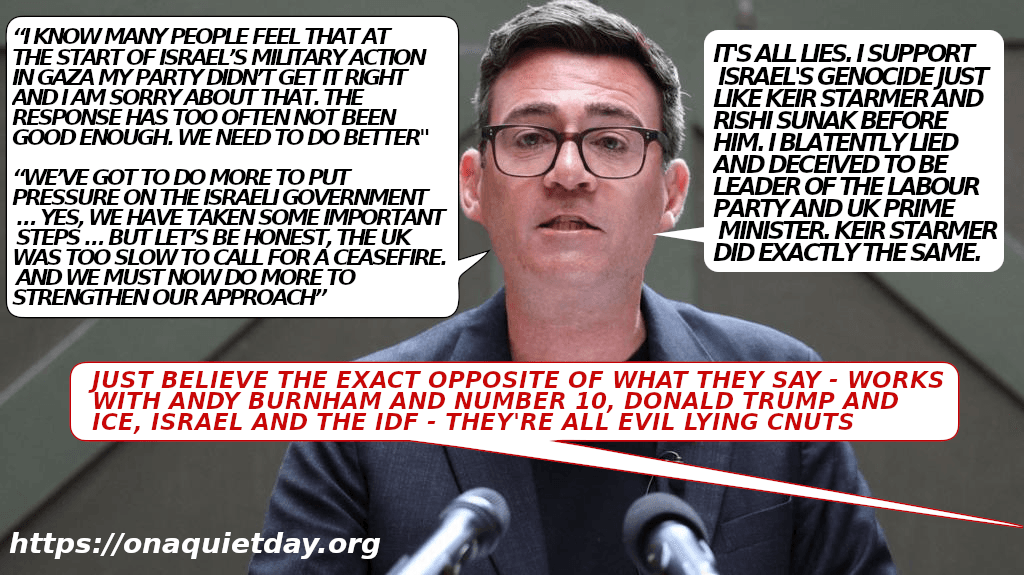
Keir Starmer objects to criticism of the IDF. He asks how could anyone object to them starving people to death, forced marches like the Nazis did, bombing Gaza’s hospitals and universities, mass-murdering journalists, healthworkers and starving people queuing for food, killing and raping prisoners and murdering children. He calls for people to stop obstructing his genocide for Israel. New Labour UK Prime Minister Andy Burnham continues Labour party policy of active support and complicity in Israel’s genocide.UK Prime Minister Andy Burnham admits to blatently lying and engaging in deception to become leader of the UK Labour Party and Prime Minister.Ed Miliband says that he and the Labour Party are full of shit criminalising people holding signs as terrorists despite anything he says.
This work by Middle East Monitor is licensed under a Creative Commons Attribution-NonCommercial-ShareAlike 4.0 International License.
Israeli Prime Minister Benjamin Netanyahu gives a speech at the White House on September 29, 2025 in Washington, DC. [Alex Wong/Getty Images]
The Bank of Israel said Saturday that cryptocurrencies cannot be used to circumvent potential economic sanctions in response to Prime Minister Benjamin Netanyahu’s proposal to prepare alternative financial arrangements, according to a media report.
The public broadcaster said the central bank’s response followed Netanyahu’s interview on Friday with an Israeli business channel, during which he proposed using cryptocurrencies as part of contingency plans for possible economic and banking sanctions, Anadolu reports.
The bank said cryptocurrencies “cannot be used as a route for bypassing sanctions,” according to the broadcaster.
“The right thing for Israel’s economy is preserving the economic relationships with our principal trade partners and focusing on preventing sanctions and their negative influence on the economy,” said the bank.
It stressed that the issue fell within the political leadership’s responsibilities, urging efforts to prevent sanctions and limit their consequences.
Netanyahu expressed concern about possible economic and banking sanctions.
He explained that one contingency plan he had ordered officials to prepare involved cryptocurrencies.
Netanyahu also warned that US aid could end and Washington’s position toward Israel could change after President Donald Trump leaves office.
– Opposition criticism
Opposition leader Yair Lapid criticized Netanyahu’s remarks.
“Netanyahu’s statement is insane, but it is true: If his government is elected, security assistance will stop and severe economic sanctions will be imposed on Israel,” said Lapid.
Yoav Horowitz, a former head of the Prime Minister’s Office and a co-founder of the opposition Yashar party, also warned of economic consequences.
In an interview with the public broadcaster, Horowitz said reactions to Netanyahu’s remarks would become apparent Sunday and Monday.
“We will see entities withdrawing their money from here,” he said. “Instead of telling us how he will prevent sanctions and ensure they are not imposed, he explains what should be done when sanctions are imposed.”
Horowitz added that “Netanyahu, Ben-Gvir and Smotrich equal sanctions,” referring to National Security Minister Itamar Ben-Gvir and Finance Minister Bezalel Smotrich.
He warned that Netanyahu’s remarks could discourage people from living in Israel, establishing businesses, opening bank accounts or investing, prompting them to look abroad instead.
The exchanges come three days before Tuesday’s Knesset elections, amid growing debate about the potential economic consequences of Netanyahu’s policies and Israel’s international trade and financial relations.
– European measures
European calls for punitive measures against Israel have intensified during its war on the Gaza Strip and illegal settlement activity in the occupied West Bank. EU members, however, remain divided about the scope of the measures.
In September 2025, the European Commission proposed suspending some trade preferences granted to Israel under the bilateral Association Agreement, alongside sanctions against extremist Israeli ministers and violent occupiers.
The proposals also included freezing bilateral EU support for Israel, except assistance to civil society and the Yad Vashem center.
In May 2026, EU foreign ministers agreed on sanctions targeting Israeli occupiers and organizations supporting settlement activities, while disagreements about broader economic measures against Israel continued.
Donald Trump sings and dances, says that it’s fun to kill everyone … unless he gets distracted or falls asleep.
Keir Starmer objects to criticism of the IDF. He asks how could anyone object to them starving people to death, forced marches like the Nazis did, bombing Gaza’s hospitals and universities, mass-murdering journalists, healthworkers and starving people queuing for food, killing and raping prisoners and murdering children. He calls for people to stop obstructing his genocide for Israel. New Labour UK Prime Minister Andy Burnham continues Labour party policy of active support and complicity in Israel’s genocide.UK Prime Minister Andy Burnham admits to blatently lying and engaging in deception to become leader of the UK Labour Party and Prime Minister.Ed Miliband says that he and the Labour Party are full of shit criminalising people holding signs as terrorists despite anything he says.
This work by Middle East Monitor is licensed under a Creative Commons Attribution-NonCommercial-ShareAlike 4.0 International License.
Clashes break out between Israeli settlers, accompanied by Israeli soldiers, and Palestinian farmers harvesting olives in the town of Deir Ibzi, near Ramallah in West Bank, on October 9, 2026. [Issam Rimawi – Anadolu Agency]
The persistent violence from Israeli settlers against Palestinians in the occupied territories of the West Bank has become such common fare it risks becoming banal. Unfortunately, it takes events such as those befalling veteran photojournalist Heidi Levine of The Washington Post and European diplomats to return the attention to something that is not only grotesque but programmatic.
On 16th October, while covering the annual olive harvest in the West Bank Levine, fellow journalists and a group of Palestinians became the ripe targets of Israeli settlers. The auguries of violence were already present: over the course of 24 days since the season commenced, 125 physical attacks on Palestinian olive harvesters had been reported. After an initial gathering at a hilltop in the proximity of Abu Falah, the numbers of the assailants ominously swelled. They approached the group menacingly, burning olive trees on route. Then came tear gas and shots. A Palestinian was wounded in the leg.
Levine, in her description, was forced to the ground. “They just kept kicking me and hitting me with sticks, and it just kept going on and on. And then I actually thought, okay, maybe I’ll just play dead and pretend I’m dead, and they’ll stop and they’ll leave me alone.” The decision failed to yield the desired result.
Her camera bag, lenses, pouch filled with her US passport, credit cards, documents and relevant items were seized. She was hauled to her feet.
Eventually, a group of Palestinian men intervened to stand “in front of me to protect us, me and my rescuers from being attacked again.” Without that involvement, the group “would have been in the same situation as me.” In that encounter, Levine suffered a broken rib, a broken vertebra and a severe finger injury needing surgery.
In a separate attack on 17th October, French, Belgian and Polish diplomats and dignitaries of the Catholic Church found themselves targets at the mostly Christian village of Taybeh near Ramallah.
The window of a car from the Belgian consulate was smashed. Bernard Baudoux, mayor of the northern French town of Aulnoye-Aymeries, was beaten
The response from the Israeli government was, as to be expected, guarded, qualified and, in the end, light on the egregious conduct of the assailants. Israeli Foreign Minister Gideon Sa’ar merely called the attacks on the European officials the cavalier work of “Israeli rioters”, blaming those who had organised the convoy for not coordinating “with the IDF in advance. Such coordination could have helped safeguard the visitors’ security.” Presumably, irresponsible Palestinian olive pickers do not coordinate with the IDF sufficiently to prevent settler attacks they invite upon themselves for simply being there.
An official statement from Israeli Prime Minister Benjamin Netanyahu’s office suggested that “serious questions” remained unanswered regarding the attack on Levine, a neat way of suggesting that non-settler accounts were to be treated as mendacious, self-interested and ultimately, unreliable. “Reports indicate some 200 Arabs and far-left activists confronted approximately 40 Israeli youths.” Those Arabs, those leftists, in a struggle against unblemished Israeli youth. The violence that ensued had a certain equivalence – so the PM’s office seemed to imply. “Footage shows masked individuals on both sides hurling objects, amid reports of fireworks fired at Jewish youths.”
As for Levine, was she to be trusted? After all, “footage appears to show Levine knocked down and immediately helped to her feet by the same unidentified individual.” Not so, rebutted Levine.
The attackers “only stood me up because they couldn’t manage to get everything off my shoulders to rob me, including ripping off my gold necklace that my daughter gave me for my birthday.”
The statement went on to reveal the whole rationale of such parrying responses. “We will not allow disputed incidents to be exploited to demonize the hundreds of thousands of law-abiding Jewish residents of Judea and Samaria.” Hard to be law abiding if one’s entire presence is premised on illegal occupation.
Stung into modest, cosmetic action, the Israeli authorities detained ten suspects regarding the two attacks on 19th October. On 21st October, nine of them were ordered by a Jerusalem court to be released to house arrest. “In the vast majority of attacks against Palestinians, no arrests are made at all,” explained Yonatan Kanonich, head of research at the Israeli rights outfit Yesh Din. “In cases that receive media coverage … the police arrest several settlers and release most of them shortly afterward.” Assaf Gonen of the legal aid organisation Honenu, bluntly claimed that such arrests were only “for show” with the intention of satisfying “media pressure and foreign interests.”
Interest has now shifted to the latest spate of bloodletting, with the 23rd October shooting deaths of two IDF soldiers at a checkpoint in Hebron giving Netanyahu the pretext to dig in, condemn and authorise acts of collective punishment. The IDF describes its avenging operation as “focused and limited to the area from which the terrorists operated”, which suggest that the area in question is likely to be flattened. Finance Minister Bezalel Smotrich is unreserved in justifying the demolition orders against “illegal structures” to “create deterrence and exact a price for the serious attack”.
The PM has an election to win, and the security and military forces have become his electioneering playthings. As for the terrorising settlers, Netanyahu only has warm words of praise. They were “heroic” emissaries of Israel’s broader project of settlement. “You are standing in the breach. You are a role model for the people of Israel, you are role model for the State of Israel. We are going to destroy the terror infrastructures, and we are going to build the settlement infrastructures.”
Levine acknowledges the asymmetrical interest shown for Palestinian residents relative to the tenacious, gluttonous coverage given notable foreign visitors who have suffered injury at the hands of the same assailants. “What hurts me most is I can now really understand what others have gone through, what Palestinian women, children, men have gone through,” she reflected in an 22nd October interview with CNN’s Jake Tapper.
“I’m an American, I work for The Washington Post, my story is getting a lot of attention around the world, everyone wants to talk to me – but I can’t imagine what it’s like for all the victims that have gone through the same ordeal and are living with the threat of this violence on a daily basis.”
The response from Democratic Congresswoman Rosa DeLauro from Connecticut to the attack had the good sense to note that the Palestinian “farmers in the grove had no flak jackets and no helmets. They had no major American newspaper behind them. If the settlers will do this to an American journalist on camera, in broad daylight, imagine what Palestinian families face when no one is watching.” Heroic deeds, according to Netanyahu, with more to come.
The views expressed in this article belong to the author and do not necessarily reflect the editorial policy of Middle East Monitor.
Donald Trump sings and dances, says that it’s fun to kill everyone … unless he gets distracted or falls asleep.
Keir Starmer objects to criticism of the IDF. He asks how could anyone object to them starving people to death, forced marches like the Nazis did, bombing Gaza’s hospitals and universities, mass-murdering journalists, healthworkers and starving people queuing for food, killing and raping prisoners and murdering children. He calls for people to stop obstructing his genocide for Israel. New Labour UK Prime Minister Andy Burnham continues Labour party policy of active support and complicity in Israel’s genocide.UK Prime Minister Andy Burnham admits to blatently lying and engaging in deception to become leader of the UK Labour Party and Prime Minister.Ed Miliband says that he and the Labour Party are full of shit criminalising people holding signs as terrorists despite anything he says.
This work by Middle East Monitor is licensed under a Creative Commons Attribution-NonCommercial-ShareAlike 4.0 International License.
Election campaign posters featuring candidates are displayed along streets and roads in Jerusalem on October 10, 2026, as campaigning continues ahead of Israel’s general elections scheduled for October 27. [Mostafa Alkharouf – Anadolu Agency]
Amnesty International on Saturday warned that upcoming elections must not deflect attention from Israel’s international crimes, urging continued scrutiny and accountability, Anadolu reports.
In a statement, Erika Guevara Rosas, Amnesty International’s senior director for research, policy, advocacy and campaigns, said Palestinians have little reason to expect the outcome to deliver positive human rights change as much of the world’s attention focuses on Israel’s upcoming parliamentary elections on Oct. 27.
Explaining this, she pointed out that electoral candidates have “shamelessly exploited” anti-Palestinian sentiment or even threatened to step up human rights violations and crimes under international law in a bid to score political points.
“Candidates have used dehumanizing rhetoric against Palestinians, promised to further entrench Israel’s illegal annexation measures in the occupied West Bank, and threatened further devastation of the occupied Gaza Strip,” Rosas noted.
The rights advocate underlined that across the occupied West Bank, including illegally annexed East Jerusalem, Israel continues to “ruthlessly displace” families and carry out home demolitions while imposing military restrictions on Palestinian farmers.
“In the occupied Gaza Strip, where Israel’s genocide continues unabated, a year after the so-called ceasefire, killings of Palestinian civilians continue, and the expansion of access-restricted zones and the indefinite delay of reconstruction have left Gaza’s population trapped in a state of protracted displacement and despair.”
– International community urged to increase pressure on any incoming government
She went on to say that “persisting impunity for decades of atrocity crimes” associated with Israel’s “cruel system of apartheid and its brutal unlawful occupation,” perpetuated by successive Israeli governments, has only fueled more crimes against Palestinians.
“Millions of people, including Palestinians in the OPT, as well as civilians in Lebanon and Syria, face the consequences of Israeli policies and actions, yet have no say or vote in the elections that will impact their lives,” added Rosas.
She called on the international community to increase pressure on any incoming government to “stop Israel’s genocide in Gaza, dismantle its system of apartheid, end the ethnic cleansing of communities in the West Bank, and end its unlawful occupation of the OPT.”
Rosas stressed that they must also pressure Israel to end unlawful attacks and abide by its obligations under international humanitarian law across the region, withdraw its troops from southern Lebanon and allow the return of displaced Lebanese people to their towns and villages.
“States can and must act now to hold Israel accountable and halt its relentless assault on human rights in the region,” she said.
The official added: “This includes suspending the EU-Israel Association Agreement, imposing an arms embargo on Israel, and ending any cooperation that may contribute to maintaining Israel’s unlawful occupation of Palestinian territory.”
Donald Trump sings and dances, says that it’s fun to kill everyone … unless he gets distracted or falls asleep.
Keir Starmer objects to criticism of the IDF. He asks how could anyone object to them starving people to death, forced marches like the Nazis did, bombing Gaza’s hospitals and universities, mass-murdering journalists, healthworkers and starving people queuing for food, killing and raping prisoners and murdering children. He calls for people to stop obstructing his genocide for Israel. New Labour UK Prime Minister Andy Burnham continues Labour party policy of active support and complicity in Israel’s genocide.UK Prime Minister Andy Burnham admits to blatently lying and engaging in deception to become leader of the UK Labour Party and Prime Minister.Ed Miliband says that he and the Labour Party are full of shit criminalising people holding signs as terrorists despite anything he says.
This work by Middle East Monitor is licensed under a Creative Commons Attribution-NonCommercial-ShareAlike 4.0 International License.
Seyed Abbas Araghchi, Minister for Foreign Affairs, Islamic Republic of Iran, holds a press conference at the Security Council Stakeout at the UN Headquarters, New York City, U.S., September 25, 2026. [Selçuk Acar – Anadolu Agency]
Iranian Foreign Minister Abbas Araghchi said on Sunday that “nothing will be the same” in the region after the recent war with the US and Israel, including the management of the Strait of Hormuz, Anadolu reports.
“The current war has changed everything. We must acknowledge that new realities have emerged,” Araghchi said in a speech at the Foreign Ministry, as cited by Iran’s Press TV.
“The shipping routes through the Strait of Hormuz will no longer be the same as before, nor will the strait be managed as it was in the past,” he added.
The top diplomat stressed that Tehran would welcome “any security plan originating from within the region itself.”
Iran and the US remain at odds over control of the strategic waterway since the US-Israeli war that began in February. While Tehran insists on its authority to manage passage through the strait, Washington demands unrestricted navigation.
The US and Iran signed an interim deal in June to resolve their conflict, but diplomatic negotiations have stalled amid rising tensions between the two sides.
Keir Starmer objects to criticism of the IDF. He asks how could anyone object to them starving people to death, forced marches like the Nazis did, bombing Gaza’s hospitals and universities, mass-murdering journalists, healthworkers and starving people queuing for food, killing and raping prisoners and murdering children. He calls for people to stop obstructing his genocide for Israel. New Labour UK Prime Minister Andy Burnham continues Labour party policy of active support and complicity in Israel’s genocide.UK Prime Minister Andy Burnham admits to blatently lying and engaging in deception to become leader of the UK Labour Party and Prime Minister.Ed Miliband says that he and the Labour Party are full of shit criminalising people holding signs as terrorists despite anything he says.