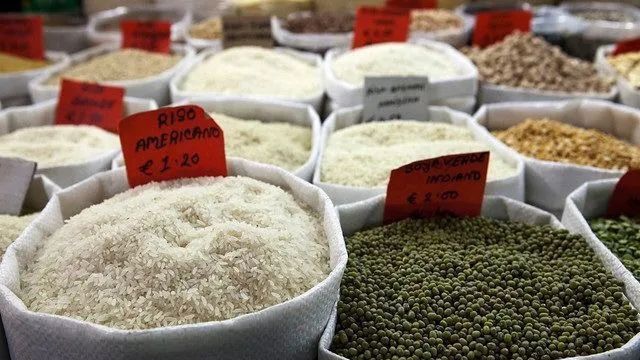
The United Nations Food and Agriculture Organization’s (FAO) food price index registered a 1% rise in April in comparison to March and a 22% rise compared to the same month last year.
Global food prices recorded an increase in April largely due to the tariff war waged by Donald Trump’s administration in the US, the UN agency Food and Agricultural Organization (FAO) said in a report last week.
Major food products such as cereals, dairy products, and meat registered a rise in their prices across the globe in April in comparison to March.
Grains and cereals such as wheat, rice, and maize make the largest component of FAO’s food price index. Their prices increased the most, raising its index by 1% month over month.
The price of dairy products increased by 2.4% month over month while the price of meat soared by 3.2%, making life significantly more difficult for people. Compared to the same month last year, dairy prices rose by 22.9%.
Year over year, the global food prices were higher by 7.6% in comparison to April last year.
The rise in food prices is attributed to several factors, including the seasonal rise in demands. However, the FAO notes that the main driver of the increase is the tariff policies announced by the Trump administration in the US in early April.
“Adjustments to the US’ import tariff policies-including the exemption to Mexico, the leading importer of US maize, and a 90 day pause on import tariffs above 10% for several other trading partners-further contributed to the upward price pressure,” the FAO said.
Fulfilling his threats to impose high tariffs on most of its trade partners Trump announced its “reciprocal tariff” policy in early April. Imports from most of the countries faced tariffs ranging between a minimum 10% to a whopping 145% against China.
Trump later suspended the imposition of reciprocal tariffs for three months, seeking bilateral agreements with several countries. However, the announcement of the high tariffs has already created uncertainty in the global economy.
Rise in food prices impacts the poor the most
Though the FAO acknowledged there were several factors impacting the rise in global food prices, such as the reduction in wheat exports from Russia due to sanctions, the war in Ukraine, and a weaker US dollar, the tariff war made the “strongest impact.”
Several economists and experts have already warned of a rise in local food prices, due to the Trump administration’s tariff policies creating a similar or worse impact than the war in Ukraine did in its initial months.
The global food markets are closely interconnected so major global events may affect prices at the local level – just as they did in the initial days of the war in Ukraine, after European and US sanctions led to a reduction in Russian wheat.
According to the FAO, its food price index recorded its highest jump in March 2022, immediately after the war in Ukraine started. The rise in prices at the time intensified a cost of living crisis even in relatively richer countries in Europe and intensified food insecurity in the developing and poorest countries.
Increases in food prices affect the poor the most as their share of expenditure on food is higher. It is expected to intensify the existing food crisis situation in most of the developing and poorer countries in Asia and Africa.
If Trump’s tariff war drags on, the prices of fertilizers will also see a jump, affecting agricultural production in the developing world and affecting the prices of food products further, claims Lotanna Emediegwu, who teaches economics at Manchester Metropolitan University.
US and European sanctions have already negatively affected the global supply of fertilizers from Russia.
Neo-Fascist Climate Science Denier Donald Trump says Burn, Baby, Burn.Elon Musk urges you to be a Fascist like him, says that you can ignore facts and reality then.
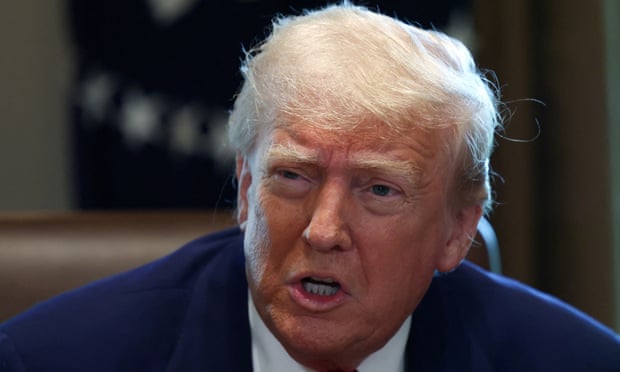
Donald Trump speaks during a cabinet meeting at the White House in Washington DC, on Wednesday. Photograph: Evelyn Hockstein/Reuters
President has repeatedly expressed idea of expansion into autonomous territory within fellow Nato member Denmark
Donald Trump would not rule out using military force to gain control of Greenland, the world’s largest island and an autonomous territory within Denmark, a fellow Nato member with the US.
Since taking office, the US president has repeatedly expressed the idea of US expansion into Greenland, triggering widespread condemnation and unease both on the island itself and in the global diplomatic community. Greenland is seen as strategically important both for defense and as a future source of mineral wealth.
In an interview on NBC’s Meet The Press on Sunday, Trump was asked whether he would rule out using force against the territory.
“I don’t rule it out. I don’t say I’m going to do it, but I don’t rule out anything. No, not there. We need Greenland very badly. Greenland is a very small amount of people, which we’ll take care of, and we’ll cherish them, and all of that. But we need that for international security,” Trump said.
Neo-Fascist Climate Science Denier Donald Trump says Burn, Baby, Burn.Elon Musk urges you to be a Fascist like him, says that you can ignore facts and reality then.
Original article by Alan Macleod republished from MPN under a Creative Commons Attribution-NonCommercial-ShareAlike 3.0 International License.
The Trump administration’s deal to send large numbers of people to prisons in El Salvador has thrust its president, Nayib Bukele, into the international spotlight. Bukele has been praised, especially in conservative media, as a dynamic and popular leader who has saved his country from the grips of gang violence. But beneath this polished image, he has cemented his rule based on assigning himself autocratic powers, jailing and persecuting his political opponents, and overseeing the creation and expansion of the world’s first prison state. MintPress News explores the dark side of the man who calls himself “the world’s coolest dictator.”
Cruelty is the Point
The hundreds of migrant detainees the U.S. sent to Central America should be kept in Salvadoran jails “for the rest of their lives,” according to Homeland Security Secretary Kristi Noem in an April interview. This is despite the fact that a Bloomberg investigation found that around 90% of those deported have no criminal records or charges against them.
Noem’s words reflect an administration eager to find a partner willing to help them outsource America’s prison-industrial complex. In February, Salvadoran President Nayib Bukele offered to use El Salvador’s sprawling and rapidly growing network of jails to receive thousands of “dangerous American criminals” for a fraction of the cost of detaining them in the United States. “No country has ever made an offer of friendship such as this,” said a delighted Secretary of State Marco Rubio, a strong Bukele supporter.
The migrants have been sent to the Terrorism Confinement Center (Centro de Confinamiento del Terrorismo, or CECOT), a $115 million facility widely criticized by human rights groups that opened its doors in October 2023. The 23-hectare site is situated in a rural area of the country, around 70 km (45 miles) from the capital, San Salvador, and is set to house 40,000 people, making it, by quite some margin, the largest prison in world history.
Conditions inside the jail have been widely condemned. Those incarcerated are packed into cells of up to 100 people. Sleeping on metal or concrete bunks, inmates must defecate in front of their cellmates. A 2024 report from the Inter-American Commission on Human Rights found an average of just 0.6 square meters (6.45 square feet) per inmate. Lights are kept on 24 hours a day.
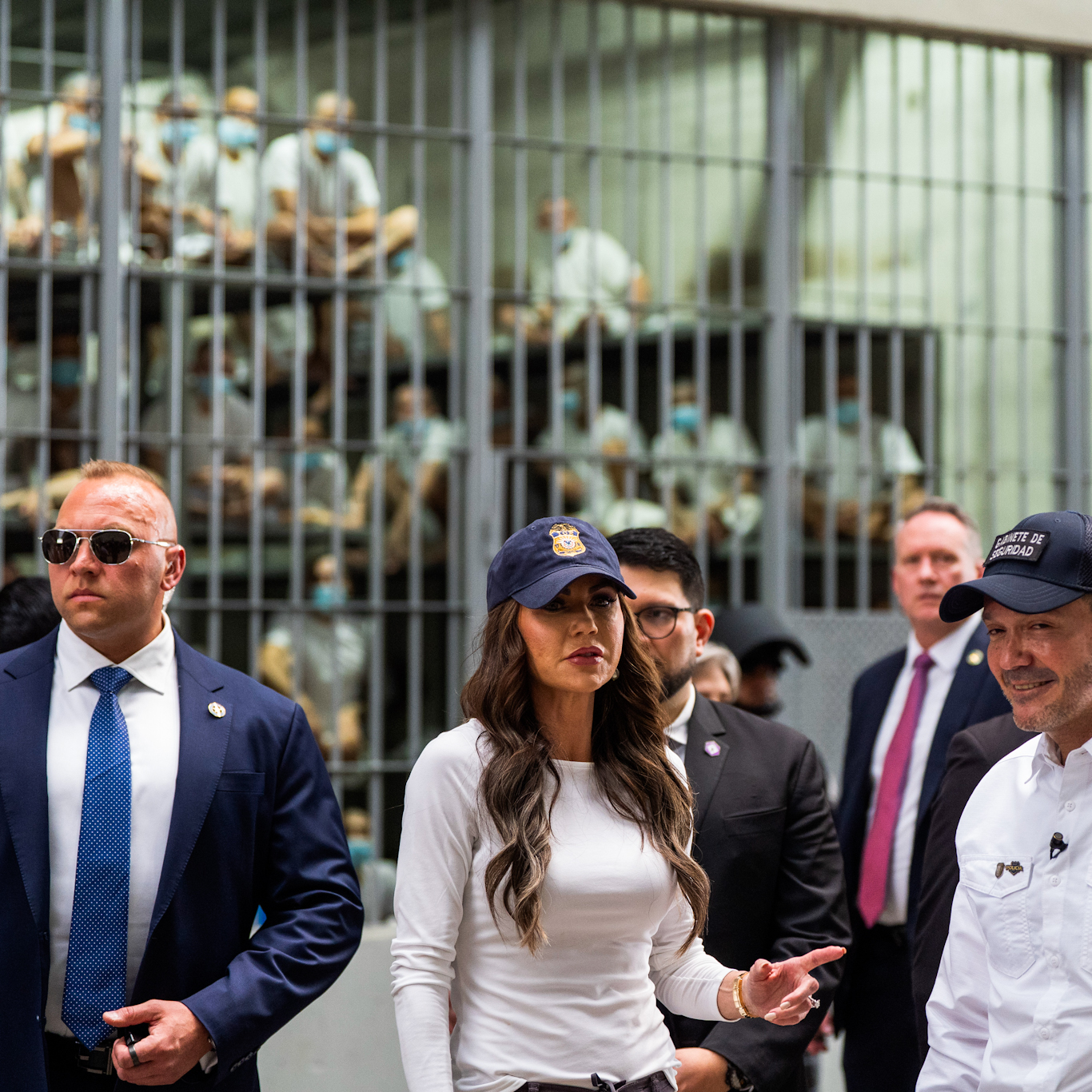
Kristi Noem tours El Salvador’s mega-prison with Minister Héctor Villatoro, March 26, 2025. Alex Brandon | AP
The food is as sparse as the personal space. Detainees are fed just 450 grams of the same meal every day, consisting of beans, pasta and tortillas, along with coffee or another drink. Provided no utensils, they must eat with their hands only.
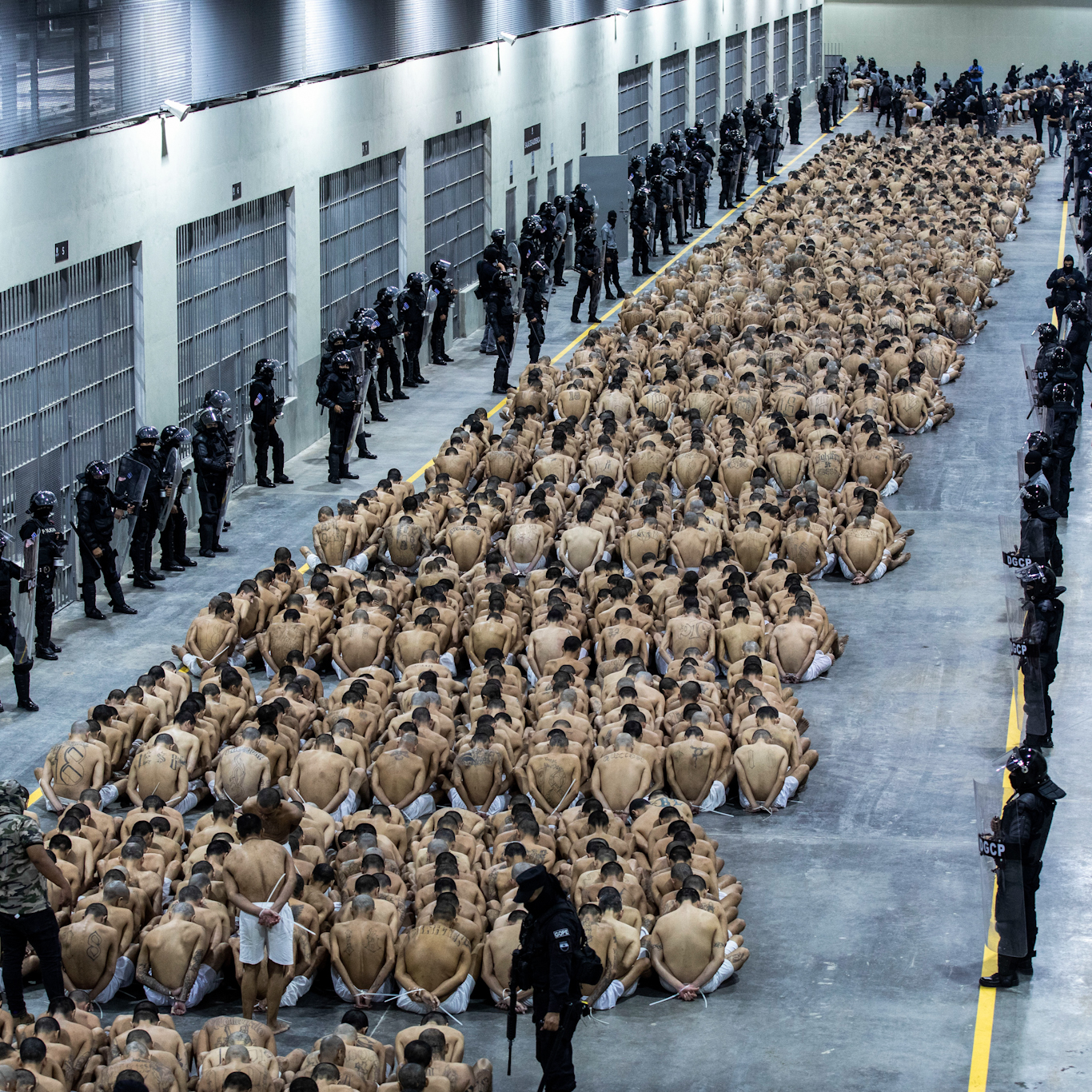
CECOT offers no outside recreation space, and those inside are allowed only 30 minutes per day out of their cells. Upon arrival, prisoners have their heads shaved, and are often forced to sit close together in formations resembling the conditions on trans-Atlantic slave ships. They are not allowed any contact with their friends, family, or lawyers. Often, the first news a family receives of the whereabouts of their disappeared relative is a note explaining that they have died in prison. The Bukele administration has made clear that they intend to make sure those inside CECOT’s walls “will never leave.”
The Trump administration had shown little concern for the reported condition at CECOT. In March, Noem herself traveled to the complex to pose in front of dozens of incarcerated people, warning others that they could be next. The Trump administration has justified its move as legal under an obscure law from 1798, and claimed that those deported were members of Tren de Aragua, a Venezuelan criminal group.
Prison Nation
Yet the conditions at CECOT are actually considerably better than at many other Salvadoran jails, as it is one of the few facilities not (yet) overflowing with inmates. In 2022, under the rubric of fighting gang violence, Bukele declared a state of exception, suspending civil liberties and overseeing the arrest and imprisonment of 85,000 people. The prison population has tripled in just a few years, to the point where around 2% of the country’s adult population is behind bars—equivalent to roughly seven million Americans.
“El Salvador, under the dictatorship of Nayib Bukele, has overtaken the U.S. as the global leader in incarcerating its own people,” Wanda Bertram, a spokesperson for the Prison Policy Initiative, told MintPress News. Today, the country imprisons more than twice as many people per capita as the next highest nation. “As horrific as El Salvador’s mass incarceration program is, we shouldn’t overlook that it had a clear role model in the United States,” she added, pointing out that nearly half of all U.S. adults have an immediate family member who has been incarcerated.
Few of those caught up in Bukele’s massive dragnet have had due process. Unable to prove their guilt or connections to MS-13 or other gangs, prosecutors continue to extend their pretrial detentions. Torture is widespread. “It’s a system that by design is mistreating and torturing people,” said Ana Piquer, Amnesty International’s Americas Director. Hundreds have died in custody.
Since he declared the state of exception, Bukele’s forces have arrested at least 3,000 children. Far from releasing them, in February, the president signed a bill into law transferring child detainees into adult prisons.
The U.S. government is intimately aware of the nature of Bukele’s rule. A 2023 State Department report detailed widespread abuses, including:
[U]nlawful or arbitrary killings; enforced disappearance; torture or cruel, inhuman, or degrading treatment or punishment by security forces; harsh and life-threatening prison conditions; arbitrary arrest or detention; [and] serious problems with the independence of the judiciary.”
It also noted that, even before the massive surge in prisoner numbers, conditions inside Bukele’s jails were “harsh and life-threatening,” and recounted how prison guards beat victims to death and used electric stun guns on the prison’s wet floors to deliver shocks to prisoners en masse.
Osiris Luna, the director of El Salvador’s prison system, had been sanctioned by the U.S. government for his role in “gross human rights abuses.”
Despite the long list of documented abuses, the Trump administration has chosen El Salvador as the location to dump migrants and has promised that this is the beginning of a long partnership between the two nations.
“Salvadoran prisons are the product of the U.S. justice department, Drug Enforcement Agency, and other officials’ work in Latin America over the course of the decades. The United States has aided and abetted the construction of these gulags of the Americas. And so, in a lot of ways, Bukele is a monster made in the U.S.,” Roberto Lovato, a Salvadoran-American writer and professor at the University of Nevada, Las Vegas, told MintPress News.
Accused gang members sit on the floor of El Salvador’s Terrorism Confinement Center, March 15, 2023. Via AP
“The combination of importing U.S. prison and gang culture with U.S. government-funded digital technology applied to politics is how we get Bukele now,” he added. Lovato’s 2020 memoir, “Unforgetting: A Memoir of Family, Migration, Gangs, and Revolution in the Americas,” explores the relationship of violence between the U.S. and El Salvador.
President Bukele has justified the crackdown as a necessary response to the country’s overwhelming organized crime problem, with groups such as MS-13 and Barrio 18 terrorizing the nation. His uncompromising approach has produced results: El Salvador’s official murder rate has fallen dramatically, and many say the country’s streets are safe again. His policies have certainly gained him significant public backing and praise in the West.
“Nayib Bukele’s iron fist has transformed El Salvador,” wrote Time magazine, noting he is “arguably the most popular head of state in the world.” He also has a fan in billionaire turned government official Elon Musk, who met with him in September, describing him as an “amazing leader.” Bukele’s achievements, including the drop in homicides, Musk later stated that such policies, “need to happen and will happen in America.”
One major issue with this narrative, however, is that as soon as the state of exception was declared, the government began radically undercounting homicides by changing the way deaths were recorded. As Foreign Policy noted, unidentified bodies, or those discovered in mass graves, were no longer classified as homicides, nor were prison homicides, or individuals killed by Bukele’s police or security forces, a number known to total in the hundreds.
Persecuting Opponents
El Salvador’s youngest president has used these same security forces to attack those who oppose him, such as union leaders and human rights campaigners.
In January, the spokesperson for the Human Rights and Community Defense Union, along with 20 local leaders fighting the eviction of hundreds of families from their land, were arrested and absorbed into the country’s sprawling prison network. Public union leaders who organized a protest against the government’s failure to pay its workers were also jailed. Likewise, officials and activists from the country’s main left-wing political party, the FMLN (in power between 2009 and 2019), are prime targets.
Journalists unwilling to toe the official line have faced scrutiny and persecution. A 2022 report from Citizen Lab and Amnesty International found Pegasus spyware on the devices of dozens of Salvadoran reporters and civil society leaders.
Outlets critical of Bukele have been subjected to costly audits and other legal measures to financially cripple them. In 2023, El Faro, one of the nation’s leading outlets, moved its operations to neighboring Costa Rica, citing ongoing threats against its staff. “The dismantling of democracy, the lack of checks and balances on the exercise of power of a small group of people, the attacks against press freedom, and the shuttering of all transparency and accountability mechanisms gravely threaten Salvadorans’ right to be informed,” its editorial board lamented.
Another potential check on Bukele’s power is the judiciary, and the president has taken steps to dismantle it, replacing older judges with loyalists and packing the courts. In 2021, in what was widely described as a “self-coup,” he swiftly removed the Attorney General and five judges from the Supreme Court.
With few impediments to his power, Bukele could then concentrate on implementing his agenda of economic shock therapy, which largely consisted of firing tens of thousands of public workers and reducing taxes on the rich and the international business community.
More than 22,000 public sector employees have been laid off in a country of only 6.3 million people. Most of them have not received their legally mandated compensation, and some of those who protested have been arrested.
Bukele has been careful to enrich his backers in El Salvador’s business community. Indeed, he has gone so far as to announce his intent to charge municipal governments who do not lower business taxes with “extortion”—a crime usually associated with organized criminal groups. In a country supposedly fighting an all-out war against gangs, the consequences of being labeled as such could be severe.
Another of Bukele’s projects is to try to turn El Salvador into a tech hub, building data centers and science parks across the country. To much international fanfare, in 2021, he made Bitcoin legal tender, although it failed to gather significant domestic traction. He has also used social media to carefully craft his image as a maverick risk-taker. Lovato was unimpressed by Bukele’s branding, telling MintPress:
El Salvador is a digital dictatorship. It is innovating fascism for the digital age. The country has always been a laboratory for U.S. repression tactics. Both Democrat and Republican administrations would study and experiment with everything from death squads, torture, surveillance technology, and now imprisonment in El Salvador, and then they would bring it back to the U.S.”
Made in the USA
Internationally, Bukele has aligned himself with the Trump administration and the global right-wing movement. This has included Israel.
Despite being a member of El Salvador’s large Palestinian diaspora, Bukele has made pains to associate himself with Tel Aviv. In 2019, he traveled to Jerusalem to meet with local officials and to be photographed at the Western Wall. And in the wake of the October 7 attack, he described Hamas as “savage beasts” and said that the “best thing that could happen to the Palestinian people is for Hamas to completely disappear.”
The conditions that led to El Salvador’s poverty and Bukele’s rise were intimately shaped by the United States. Throughout the late twentieth century, successive administrations provided the cash, weapons, and training for far-right death squads to rampage throughout Central America, in an attempt to suppress the then-armed FMLN guerrillas.
Trade policies, crafted in Washington, locked El Salvador into a dependent relationship with the U.S., turning the country into a source of cheap labor, where American corporations could outsource poorly-paid jobs, like those in textiles. Predictably, millions of Salvadorans attempted to escape this fate. Two and a half million have moved to the United States. Aroundhalf of those living there now are undocumented, meaning that they could be swept up by the very system Bukele is enabling Trump to roll out. Remittances continue to sustain the economy. Furthermore, the insatiable appetite for drugs in the U.S. has left deep scars on the Central American nation, as rival cartels vie for supremacy and control over the lucrative drug trade.
Rather than stop the harm that is triggering it in the first place, Washington’s solution to the predictable migrant wave is to militarize the border, using many of the tactics honed by the same death squads it funded in the 1980s.
Perhaps most ominously, the Trump administration is looking to drastically expand the outsourcing of the carceral state to El Salvador, including sending American citizens to the country.
In a meeting between the two presidents in the Oval Office in April, Trump stated that “Home-growns are next. The home-growns. You have got to build about five more places. It [CECOT] is not big enough.” Bukele appeared delighted by the proposal. “Yeah, we’ve got space,” he replied.
This development has shocked onlookers. “The U.S. system of mass incarceration is already draconian, oppressive, and racist. Sending U.S. citizens to El Salvador would be an extremely dark turn for an already misguided system,” Bertram told MintPress.
“El Salvador serves the U.S. as a laboratory of repression,” Lovato said:
Just as the U.S. provided El Salvador with schools of oppression, like the School of the Americas. And now we see what I call the Salvadorization of the United States. The wealth gap between rich and poor has reached Latin American proportions, and even surpassed them. The dismantling of the welfare state, coup attempts, mass imprisonment, counterinsurgency theory and practice, the militarization of the police. The U.S. is becoming a Latin American country in many ways, and therefore, it is having to learn repression techniques from places like El Salvador.”
It is, therefore, crucial for those wishing to understand American politics to study the Salvadoran model. “If you want to look to the future of the U.S., you can look at the history of El Salvador, and you can see some of the things that are coming our way now. And we should be signaling red alert,” Lovato said.
Follow Alan on Twitter for more of his work and commentary: @AlanRMacLeod.
Original article by Alan Macleod republished from MPN under a Creative Commons Attribution-NonCommercial-ShareAlike 3.0 International License.
Neo-Fascist Climate Science Denier Donald Trump says Burn, Baby, Burn.Elon Musk urges you to be a Fascist like him, says that you can ignore facts and reality then.
U.S. President Donald Trump takes a question from a reporter at the White House in Washington, D.C. on April 29, 2025. (Photo: Andrew Harnik/Getty Images)
RSF says Trump’s moves “have jeopardized the country’s news outlets and indicate that he intends to follow through on his threats, setting up a potential crisis for American journalism.”
Press freedom in the United States has fallen to its lowest level since Reporters Without Borders began publishing its annual ranking more than 20 years ago, with President Donald Trump’s return to power “greatly exacerbating the situation,” RSF said Friday.
The U.S. fell from 55th to 57th place on RSF’s World Press Freedom Index, marking the second straight year that the situation in the country which lists freedom of the press first in its Bill of Rights has been classified as “problematic.” The report comes ahead of World Press Freedom Day on May 3.
The U.S. has been trending downward on RSF’s index since 2013, when it ranked 32nd in global press freedom. A decade later, it had fallen to 45th place before plunging to 55th place last year amid Trump’s attacks on the media.
“Trump was elected to a second term after a campaign in which he denigrated the press on a daily basis and made explicit threats to weaponize the federal government against the media,” the report states.
Press freedom in the United States has hit a record low, according to the latest World Press Freedom Index published annually by Reporters Without Borders.
“His early moves in his second mandate to politicize the Federal Communications Commission (FCC), ban The Associated Press from the White House, or dismantle the U.S. Agency for Global Media, for example, have jeopardized the country’s news outlets and indicate that he intends to follow through on his threats, setting up a potential crisis for American journalism,” the publication continues, accusing Trump of using “false economic pretexts” to “bring the press into line.”
“The First Amendment to the U.S. Constitution provides broad protections for the press. However, no meaningful press freedom legislation has been passed at the national level in recent years despite the country’s consistent slide on the Press Freedom Index,” the report notes. “The PRESS Act, a federal shield law, failed to pass for a second successive time in 2024. More than a dozen states and communities have proposed or enacted laws to limit journalists’ access to public spaces, including barring them from legislative meetings and preventing them from recording the police.”
RSF continued:
Economic constraints have a considerable impact on journalists. Roughly one-third of the American newspapers operating in 2005 have now shuttered. While some public media outlets, and radio stations in particular, have been able to offset this decline thanks to online subscription models, others have found ways to sustain growth through individual donations. Massive waves of layoffs swept the U.S. media throughout 2023 and 2024 and have continued into 2025, affecting both local newsrooms and major legacy outlets. Many parts of the country are now considered news deserts, with the disappearance of local news outlets reaching crisis levels. Since 2022, more than 8,000 journalists have been laid off in the U.S.
Furthermore, “more Americans have no trust in the media than trust it a fair amount. Online harassment, particularly towards women and minorities, is also a serious issue for journalists and can impact their quality of life and safety.”
“Politicians’ open disdain for the media has trickled down to the public,” RSF added. “Journalists reporting on the ground can face harassment, intimidation, and assault while working. When covering demonstrations, journalists are sometimes attacked and physically assaulted by protestors or wrongfully arrested by police. According to the U.S. Press Freedom Tracker, there were 49 journalist arrests in 2024 compared to only 15 in 2023. The last journalist to be killed in the course of his work was Dylan Lyons in February of 2023.”
RSF paints a grim picture for journalism around the world.
“The conditions for practicing journalism are bad in half of the world’s countries,” as “less than 1% of the world’s population lives in a country where press freedom is fully guaranteed,” the report states.
Noting that economic self-sufficiency is critical to a free press, RSF editorial director Anne Bocandé said in a statement that “guaranteeing freedom, independence,s and plurality in today’s media landscape requires stable and transparent financial conditions.”
“Without economic independence, there can be no free press,” Bocandé continued. “When news media are financially strained, they are drawn into a race to attract audiences at the expense of quality reporting, and can fall prey to the oligarchs and public authorities who seek to exploit them. When journalists are impoverished, they no longer have the means to resist the enemies of the press—those who champion disinformation and propaganda.”
“The media economy must urgently be restored to a state that is conducive to journalism and ensures the production of reliable information, which is inherently costly,” she added. “Solutions exist and must be deployed on a large scale. The media’s financial independence is a necessary condition for ensuring free, trustworthy information that serves the public interest.”
RSF’s new rankings come days after U.S. Attorney General Pam Bondi ended a Biden administration policy that strictly limited the Justice Department’s authority to seize journalists’ records and compel them to testify in leak investigations.
On Wednesday, the Committee to Protect Journalists (CPJ) published a report on Trump’s first 100 days in office, which the group said were “marked by a flurry of executive actions that have created a chilling effect and have the potential to curtail media freedoms.”
"It is disturbing that, on the eve of #WorldPressFreedomDay, the Trump administration has dealt major blows to journalists and the public they serve." — Katherine Jacobsen, CPJ's U.S., Canada, and Caribbean program coordinator
“From denying access to upending respect for the independence of a free press to vilifying news organizations to threatening reprisals, this administration has begun to exert its power to punish or reward based on coverage,” CPJ said. “Whether in the states or on the streets, this behavior is setting a new standard for how the public can treat journalists.”
“The uncertainty and fear resulting from these actions have caused requests for safety advice to increase as journalists and newsrooms aim to prepare for what might be next,” the group added. “These moves represent a notable escalation from the first Trump administration, which also pursued banning and deriding elements of the press. After nearly a decade of repeating insults and falsehoods, and filing lawsuits, Trump has normalized disdain for media to an alarming degree.”
Orcas discuss how Trump was re-elected and him being an insane, xenophobic Fascist.Climate Science Denier Donald Trump says Burn, Baby, Burn.Elon Musk urges you to be a Fascist like him, says that you can ignore facts and reality then.
A Yemeni soldier inspects the damage reportedly caused by U.S. airstrikes in Sanaa, Yemen, April 27, 2025
WHILE today electors endured the rituals of our vastly undemocratic electoral system, Britain was at war. As we approach the anniversary of the victory over fascism in Europe, the Royal Air Force is in action against our former colonial subjects in the Yemen.
Far from defending our shores from foreign invaders, the Royal Air Force is attacking Yemeni targets in co-ordination with Donald Trump’s military as part of the multi-national operation in the Middle East in defence of Israel.
Parliament has not met to discuss launching a war, the British people have not been consulted and only the most alert will have noticed this dangerous escalation in a region where British public opinion is overwhelmingly in sympathy with the Palestinian people who, both in devastated Gaza and in the Occupied Territories and the West Bank, are bearing the brunt of Israel’s genocidal attack.
Make no mistake, US and British logistical support allows Israel’s assault on the Palestinian people. It is a joint operation with intelligence and communications support from British military assets in the region including in Cyprus where an unequal treaty imposed on that country permits Britain to maintain military bases, airfields and electronic intelligence gathering installations.
Long deployed to Israel’s strategic advantage, now these assets are targeted on Yemenis who have leveraged their advantageous strategic position aside the Red Sea and the approaches to the Suez Canal to interdict shipping they suspect of supplying Israel.
UK Labour Party government Keir Starmer, Angela Rayner and Rachel Reeves explain that they are participants and complicit in Israel’s Gaza genocide providing Israel with army and air force support.





 A Yemeni soldier inspects the damage reportedly caused by U.S. airstrikes in Sanaa, Yemen, April 27, 2025
