Tag: Donald Trump

  • ‘By and For the Ultra-Wealthy’: Here Are the Billionaires Set to Run Trump’s Administration

    Spread the love

    Original article by Jake Johnson republished from Common Dreams under Creative Commons (CC BY-NC-ND 3.0).
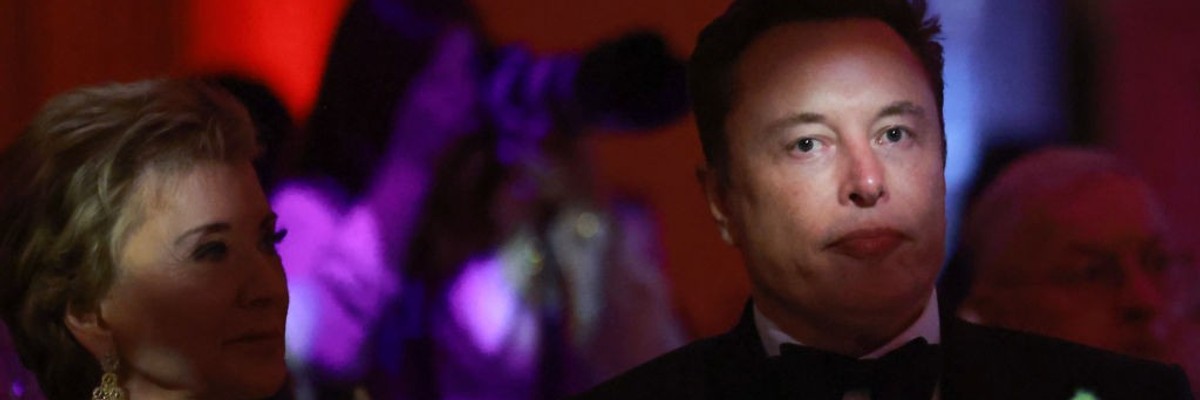
    Linda McMahon and Elon Musk attend the America First Policy Institute gala held at Mar-a-Lago on November 14, 2024 in Palm Beach, Florida.  (Photo: Joe Raedle/Getty Images)

    “Trump paid plenty of lip service to working-class Americans, but as president-elect, he’s moved quickly to stack his administration with billionaires that share his vision of a rigged economy that only works for people like them.”

    Since winning the presidential election earlier this month, Donald Trump has wasted no time working to fill his incoming administration with billionaires and other ultra-rich individuals who are poised to benefit from the GOP agenda of tax cuts for the wealthy and large-scale deregulation.

    In separate analyses published this week, Americans for Tax Fairness (ATF) and Accountable.US offered overviews of the president-elect’s key nominations and their potential conflicts of interest as Trump prepares to retake power in January.

    So far, Trump has announced plans to nominate billionaire hedge fund manager Scott Bessent to head the Treasury Department, WWE billionaire Linda McMahon to head the Education Department, billionaire crypto banker Howard Lutnick to head the Commerce Department, and billionaire entrepreneurs Elon Musk and Vivek Ramaswamy to head the Department of Government Efficiency—an outside advisory commission tasked with slashing federal spending and regulations.

    “These appointments clearly show the incoming administration will be run by and for the ultra-wealthy,” said David Kass, ATF’s executive director. “They’ve already announced plans to spend trillions of dollars to renew the Trump tax bill, to further enrich large corporations and wealthy elites like themselves while advocating for cuts to vital programs that working and middle-class Americans depend on.”

    ATF’s analysis, released Monday, shows that the combined wealth of Trump’s richest nominees and transition team members—including the president-elect and Sen. JD Vance (R-Ohio), the vice president-elect—is over $313 billion. By comparison, the combined net worth of President Joe Biden’s Cabinet is an estimated $118 million.

    “Even excluding Elon Musk—the world’s richest man and Trump’s co-director of the Department of Government Efficiency—the average net worth of Trump, his vice president, and top appointees is $616 million,” ATF observed. “This figure is over 616 times higher than the mean average wealth of the typical American household, which is a little more than $1 million.”

    ATF and Accountable.US also highlighted other ultra-rich individuals nominated for key roles in the incoming administration, including drilling enthusiast Doug Burgum, worth an estimated $100 million; Mehmet Oz, worth up to $315 million; and Chris Wright, who as of earlier this month held nearly $47 million worth of stock in his fracking company, Liberty Energy.

    https://twitter.com/accountable_us/status/1861433024581112204?ref_src=twsrc%5Etfw%7Ctwcamp%5Etweetembed%7Ctwterm%5E1861433024581112204%7Ctwgr%5E613844b34ff786b7d0c11bb9f514df799c4a1f8b%7Ctwcon%5Es1_c10&ref_url=https%3A%2F%2Fwww.commondreams.org%2Fnews%2Fbillionaires-trump-cabinet

    Sorry, this content could not be embedded. [again]

    X

    Tony Carrk, executive director of Accountable.US, said in a statement Tuesday that “Donald Trump paid plenty of lip service to working-class Americans” during the 2024 campaign, “but as president-elect, he’s moved quickly to stack his administration with billionaires that share his vision of a rigged economy that only works for people like them.”

    “Should the Senate rubber stamp these nominations,” Carrk added, “Trump’s department heads will be among the biggest beneficiaries of another promised tax giveaway for big corporations and the top 1%, paid for with deep cuts for seniors, veterans, and everyday workers.”

    Billionaires have already gotten significantly richer since Trump’s election victory, according to research published last week by ATF. In roughly the week after Trump’s win, the combined net worth of the nation’s 815 billionaires jumped by around $280 billion—with Musk’s wealth surge accounting for 20% of that gain.

    Original article by Jake Johnson republished from Common Dreams under Creative Commons (CC BY-NC-ND 3.0).

  • COP29 puts world on course for more extreme weather – and more deaths

    Spread the love

    Original article by Paul Rogers republished from Open Democracy under a Creative Commons Attribution-NonCommercial 4.0 International licence.

    After a disappointing COP29, we should prepare for more extreme weather events like the floods that hit Valencia last month
     | David Ramos/Getty Images

    Summit proves change won’t come until floods and wildfires are killing tens of thousands in rich Global North cities

    While COP29 in Baku narrowly avoided collapsing, its results were bitterly disappointing for delegations from across the Global South, who ended up with barely a quarter of the annual $1.3trn of support they were seeking by 2035 to respond to climate breakdown.

    Quite apart from other factors, more than 1,500 pro-carbon lobbyists worked hard to limit progress and ensure that burning oil, gas and coal at profit continues for as long as possible whatever the global consequences. After all, the world’s fossil fuel industries rake in around a trillion dollars in profits a year.

    Meanwhile, more and more examples are emerging of accelerating climate breakdown. The flooding in Valencia is just one, but scarcely noticed in Europe is the thoroughly weird weather being experienced in the eastern United States.

    This autumn there have been over five hundred wildfires in New Jersey alone, a 5,000-acre fire has been burning for a week on the New York-New Jersey border prompting a voluntary evacuation, and New York City’s Fire Department was called out to deal with 271 brush fires in the first two weeks of November alone.

    As if timed for that and certainly released with COP29 in mind, Carbon Brief, a website covering the latest developments in climate science, climate policy and energy policy, has mapped every published study on ‘impossible’ weather events – record heatwaves or storms that would not have happened without the overall global climate changes.

    The first such study came in 2004, the year after weeks of extreme heat hit Europe and killed 70,000 people across the continent over several months. That early example of an ‘impossible’ weather event kick-started a new field of research known as ‘extreme event attribution’, which looks at how climate change has influenced extreme weather.

    There are now 600 studies of 750 such extreme events spanning the past 20 years – a tiny fraction of the total number of these kinds of events. Of these 750, Carbon Brief found that scientists and researchers had concluded that 74% were made more likely or more severe because of climate change.

    This has added to the growing sense of urgency right across the climate science community coupled with a highly critical view of the whole COP process. Even before the dismaying summit in the Azerbaijani capital, both last year’s COP in Abu Dhabi and the year before in Egypt were notable for their lack of progress even as the urgency of preventing climate breakdown was becoming more and more obvious.

    There are other risks to global security including nuclear weapons, pandemics, cyber warfare, AI misuse and the progressive destruction of biodiversity, but climate breakdown is different from all of these. It is not a future risk, it is a current happening, it is accelerating, and we now have very few years left to get on top of it. If we don’t then a worldwide catastrophe with many hundreds of millions dying and societal collapse will become increasingly likely.

    Does it have to be like that?

    As things stand, in terms of changing attitudes, developments in renewables, resistance of the fossil carbon industries and, of course, Donald Trump’s looming presidency in the US, a reasonable prognosis for the next decade has three elements.

    First, the use of renewable energy resources does continue to increase but not at anything like the rate required, so net carbon emissions will continue to rise, not fall, for most of the next ten years. Second, resistance to decarbonisation will continue from many quarters, no doubt now including the White House. Finally, severe weather events will become both more common and more destructive.

    Eventually, and it might take more than a decade, the disasters will be so great, including sudden weather events in rich cities in the Global North killing many tens of thousands of people, that public pressure across the world will force governments to respond. There will be no alternative to engage in truly transformative change.

    But what that means is that the task ahead by then will be hugely greater than if the transformation starts much sooner, so timescales become crucial, especially what can speed up the process.

    There is, though, one thing to remember at a time of widespread pessimism. If nations had got their act together 25 years ago after the Kyoto Protocols, were signed we would be in a far more favourable position worldwide than we are now. We are acting more than two decades late.

    But climate breakdown is not happening as a slow, steady process of change, creeping up almost unawares. If that had been the case then with all the reasons not to act, especially the global fossil carbon lobby, we would have been in an even worse position now. Instead, it is happening at variable rates in two respects, some parts of the world – such as the polar regions – are warming up much faster than others and extreme weather events are happening much more often.

    We are therefore getting a foretaste of what will affect everyone a few years before it does, and this gives us just a little more time to act. It means that the next ten years, and perhaps even the five years to 2030, will be the key time for us to come to terms with the transformation in society that is essential for global well-being. That is possible, just.

    Original article by Paul Rogers republished from Open Democracy under a Creative Commons Attribution-NonCommercial 4.0 International licence.

  • Bolsonaro and 36 Others Indicted in Brazil Over Right-Wing Coup Attempt

    Spread the love

    Original article by Jessica Corbett republished from Common Dreams under Creative Commons (CC BY-NC-ND 3.0). 
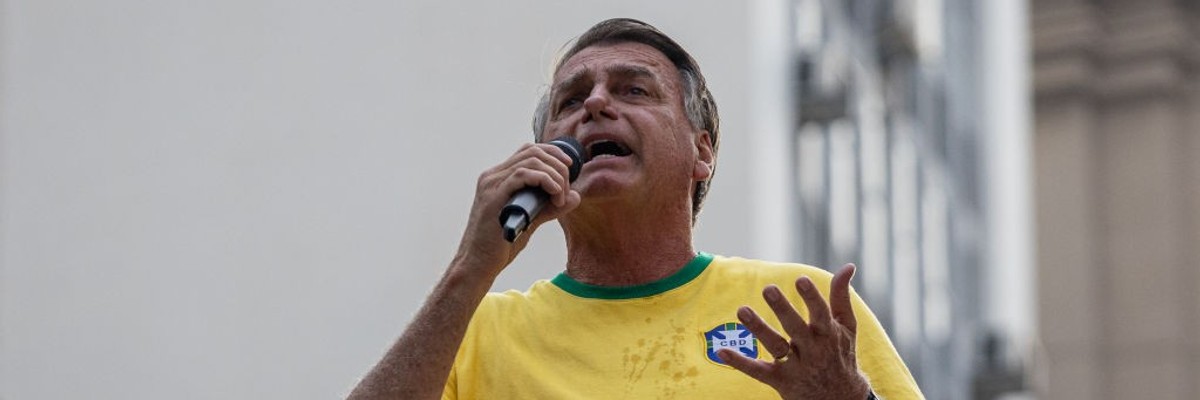
    Former Brazilian President Jair Bolsonaro speaks during a rally on September 7, 2024 in São Paulo, Brazil.  (Photo: Allison Sales/picture alliance via Getty Images)

    “Well, look at this thing called ‘accountability,’” said one MSNBC host.

    The Brazilian Federal Police on Thursday indicted former President Jair Bolsonaro and 36 others for allegedly plotting the “violent overthrow of the democratic state” after the country’s current leftist president, Luiz Inácio Lula da Silva, defeated the right-wing leader in 2022.

    “The final report has been sent to the Supreme Court with the request that 37 individuals be indicted for the crimes of the violent overthrow of the democratic state, coup d’ etat, and criminal organization,” police said in a statement about the conclusion of the two-year investigation.

    As The New York Times explained: “Although the police in Brazil can make recommendations about criminal prosecutions, they do not have the power to formally charge Mr. Bolsonaro. The country’s top federal prosecutor, Paulo Gonet, must now… decide whether to pursue charges against Mr. Bolsonaro and compel him to stand trial before the nation’s Supreme Court.”

    The recommendations for charges came after the arrest of four members of the military and a federal police officer earlier this week over an alleged plot to kill Lula and Vice President Geraldo Alckmin before they were sworn in, as well as Supreme Court Justice Alexandre de Moraes. Police said that “a detailed operational plan called ‘Green and Yellow Dagger’ was identified, which would be executed on December 15, 2022, aimed at the murder of the elected candidates for president and vice president.”

    According to CNN, “Police reportedly allege that Bolsonaro had ‘full knowledge’ of a plan to prevent Lula and his government from taking office after his election victory.”

    https://twitter.com/KatiePhang/status/1859683912886386737?ref_src=twsrc%5Etfw%7Ctwcamp%5Etweetembed%7Ctwterm%5E1859683912886386737%7Ctwgr%5Ec91ca59fb3b52a8061332cede99bfaeba698041d%7Ctwcon%5Es1_c10&ref_url=https%3A%2F%2Fwww.commondreams.org%2Fnews%2Fbolsonaro-indicted

    Sorry, this content could not be embedded.
    X

    Bolsonaro has repeatedly denied any wrongdoing, including with two other pending cases: In March he was indicted for allegedly falsifying his Covid-19 vaccination data and in July he was indicted for crimes including embezzlement related to alleged misappropriation of diamond jewelry and other state property. Those indictments came after Brazil’s highest election authority last year barred him from running for any public office for eight years over his lies about the 2022 contest.

    In addition to Bolsonaro, the other three dozen people indicted on Thursday include “some of the most important members of his far-right administration,” The Guardian reported. As the newspaper detailed:

    They included Bolsonaro’s former spy chief, the far-right Congressman Alexandre Ramagem; the former defense ministers, Gen. Walter Braga Netto and Gen. Paulo Sérgio Nogueira de Oliveira; the former minister of justice and public security, Anderson Torres; the former minister of institutional security, Gen. Augusto Heleno; the former navy commander Adm. Almir Garnier Santos; the president of Bolsonaro’s political party, Valdemar Costa Neto; and Filipe Martins, one of Bolsonaro’s top foreign policy advisers.

    Also named is the right-wing blogger grandson of Gen. João Baptista Figueiredo, one of the military rulers who governed Brazil during its 1964-85 dictatorship.

    The list contains one non-Brazilian name: that of Fernando Cerimedo, an Argentinian digital marketing guru who was in charge of communications for Argentina’s president, Javier Milei, during that country’s 2023 presidential campaign. Buenos Aires-based Cerimedo is close to Bolsonaro and his politician sons.

    Given that Bolsonaro previously traveled to the United States when faced with legal trouble shortly after his loss two years ago, in this case, “precautionary measures have been issued, including a ban on international travel, which led to the confiscation of Bolsonaro’s passport months ago,” EL País noted Thursday.

    vBolsonaro was among the right-wing leaders around the world who celebrated U.S. President-elect Donald Trump’s victory earlier this month. The Brazilian—who is sometimes called the “Trump of the Tropics” and like the American incited an insurrection after his last electoral loss—said that the impact of Trump’s win “will resonate across the globe… empowering the rise of the right and conservative movements in countless other nations.”

    Trump’s return to office is expected to at least stall if not end his various legal issues, including for trying to overturn his 2020 loss.

    Original article by Jessica Corbett republished from Common Dreams under Creative Commons (CC BY-NC-ND 3.0). 

  • Honest Government Ad: Congratulations President Trump

    Spread the love

    Actually more about Australian politics.

  • Young People Can’t Afford to Give Up on International Climate Action

    Spread the love

    Original article by Hailey Campbell republished from Common Dreams under Creative Commons (CC BY-NC-ND 3.0). 

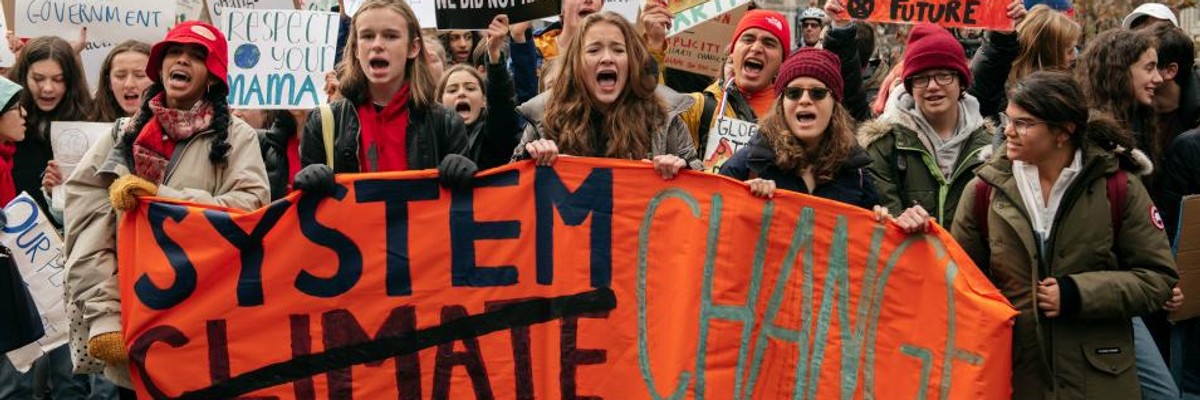
    Demonstrators from several environmental groups including Extinction Rebellion and Sunrise Movement demand broad action at a youth-led climate strike near City Hall on December 6, 2019 in New York City. (Photo: Scott Heins/Getty Images)

    Youth voices at COP represent the needs of the upcoming generations who will have to either assert our rights to a just climate future or figure out how to survive the catastrophic impacts that accompany a warmer planet.

    Donald Trump is once again elected president of the United States only days before more than 30,000 people are expected to attend COP29 in Baku, Azerbaijan to negotiate new global commitments on protecting the planet not only for those inhabiting it today, but also for future generations. Trump’s victory is sounding alarm bells in the climate community as his administration has made their disregard for global climate action abundantly clear across their campaign, but the world recognizes we cannot afford inaction.

    When Trump announced his plans in 2017 to withdraw the country from the Paris agreement, an international treaty to limit global temperature rises to 1.5°C, Gebru Jember Endalew, chair of the Least Developed Countries group, which represents 48 countries, stated “global climate momentum will continue with or without the U.S.” China also joined the E.U., Canada, and many more governments to reiterate their commitment to the agreement and global climate action.

    Even if the Trump administration chooses to ignore the importance of investing in our planet, climate change will continue to affect our lives.

    In 1995, the first Conference of the Parties (COP) was held in Berlin, Germany and subsequent COPs have produced targets to curb emissions, appropriate much-needed funds to tackle climate change, and build transparent reporting processes. The U.S. often sets the tone at COP as the country’s decisions around climate ambitions and climate finance have a global ripple effect. This year’s conference will be the fifth COP I’ve attended. It’s always been clear to me that youth climate activists and frontline communities are a crucial part of the COP process—pushing governments, like the U.S., which is the world’s largest historical polluter, to create and abide by ambitious targets and to address loss and damage so the planet is livable for all. And it’ll be no different this year, especially with a Trump win. Youth voices at COP represent the needs of the upcoming generations who will have to either assert our rights to a just climate future or figure out how to survive the catastrophic impacts that accompany a warmer planet.

    We need all the help we can get. U.S. state and local officials are stepping up, as they did in 2017. A coalition of more than two dozen governors committed to achieving “the Paris agreement’s goal of keeping temperature increases below 1.5°C” as did large coalitions of U.S. mayors, county officials, and business leaders. In fact, I had the honor of being present as an intern for the City of San Antonio when my mayor signed a resolution with his commitment. The bipartisan group consists of governors from Washington state all the way to Puerto Rico who are committed to curbing emissions and accelerating climate action. States like California have also been working with other nations, such as China, to promote climate policy. Even if the U.S., at a national level, fails to act once again, it’s encouraging to see local and global communities committed to multilateral action.

    My first COP was under the first Trump administration, and I remember feeling disappointed and embarrassed seeing my country failing to step up and lead on climate action. While everyone else had pavilions, announcements, and a large presence, the U.S. had a small office. Because of all the advantages the U.S. has gained by exploiting other communities, cultures, and nature, the U.S. had and still has so much historical and current responsibility to do better. Seeing national and global leaders reiterate their climate commitments gave me hope then and serves as a reminder today—efforts to tackle the climate crisis will continue regardless of the U.S. election results.

    Even if the Trump administration chooses to ignore the importance of investing in our planet, climate change will continue to affect our lives. Attribution studies show human-induced climate change is making heatwaves, like the ones in the Southwest, hotter and more likely, while hurricanes and droughts have become more severe and destructive. Climate change is severely costing the environment and the economy. According to the World Economic Forum, “climate change is costing the world $16 million per hour.”

    This horrific and costly reality isn’t inevitable. Phasing out fossil fuels, the biggest contributor to climate change, and investing in a greener and cleaner future for all are the antidotes. This is not the time to give up on climate cooperation, but rather strengthen the commitment to it. We cannot be paralyzed by fear. We’ll be at Baku calling for equitable and funded climate solutions, because if climate multilateralism is in jeopardy, so is our future, and we can’t afford to give up on either.

    Original article by Hailey Campbell republished from Common Dreams under Creative Commons (CC BY-NC-ND 3.0).