This work by Middle East Monitor is licensed under a Creative Commons Attribution-NonCommercial-ShareAlike 4.0 International License.
Fatih Varol, attorney and Member of the Board of Directors of the Global Sumud Flotilla, is seen during an exclusive interview, where she evaluates the preparations of the Global Sumud Flotilla’s “2026 Spring Mission”, in Sicily, Italy, on April 24, 2026. [Barış Seçkin – Anadolu Agency]
Turkish activists participating in the Global Sumud Flotilla’s Spring 2026 Mission have reaffirmed their determination to break the blockade on Gaza and deliver humanitarian assistance, Anadolu reports.
Fatih Varol, a board member of the Global Sumud Flotilla, told Anadolu that the Turkish delegation is among the initiative’s most significant components.
“Turkiye has deep-rooted historical ties with Palestine. As a people, we feel the tragedy unfolding in Gaza much more profoundly. In this regard, both public support in Turkiye and the backing of Turkish civil society organizations are very strong,” he said.
Varol said the Turkish delegation has contributed not only to the fleet’s administration and coordination, but also to vessel preparations at Mediterranean ports through financial support.
He also noted that more than 10 lawmakers from both governing and opposition parties in Turkiye attended the Global Sumud Parliamentarians Congress in Brussels on April 22, forming the diplomatic arm of the mission.
According to Varol, lawmakers from around the world agreed during the meeting to raise calls in their respective parliaments to end the genocide in Gaza, lift the blockade on Palestine, ensure Israel complies with international law, and activate international criminal justice mechanisms.
He said the initiative would help increase international political pressure on Israel and grow through coordinated efforts aimed at paving the way for a freer world.
Gorkem Duru, another Turkish activist, said participants are preparing to sail toward Gaza as part of the 2026 mission, stressing that a “fake ceasefire” has not ended occupation, blockade, or violence.
“Last year, the Global Sumud Flotilla set sail. This year, despite the ceasefire, the blockade and occupation continue, so we are setting out again, stronger and more numerous, to break the blockade,” he said.
Duru added that final preparations are underway at Italy’s Augusta Port, while vessels departing from Barcelona have already arrived.
Activist Omer Aslan, known as the “Local John Wick” due to his resemblance to the character portrayed by Keanu Reeves, said he joined the mission out of humanitarian responsibility.
“While innocent babies and civilians in Gaza suffer oppression and violence, I could not live comfortably in my own country. I joined this peaceful humanitarian action to raise awareness both among my followers and globally,” he said.
Aslan said activists from across the world have joined the flotilla regardless of language, religion, or nationality, united by a common cause.
Flotilla’s Spring 2026 Mission
The Global Sumud Flotilla was created to break Israel’s blockade of Gaza, deliver humanitarian aid, and draw international attention to the situation in the enclave.
Created in 2025 by NGO representatives, activists and volunteers from various countries, the flotilla launched its second mission to Gaza.
Its Spring 2026 Mission departed from Barcelona on April 12 with around 70 vessels and nearly 1,000 participants from 70 countries, significantly larger than a previous mission in September 2025, which included 42 boats and 462 participants.
This work by Middle East Monitor is licensed under a Creative Commons Attribution-NonCommercial-ShareAlike 4.0 International License.
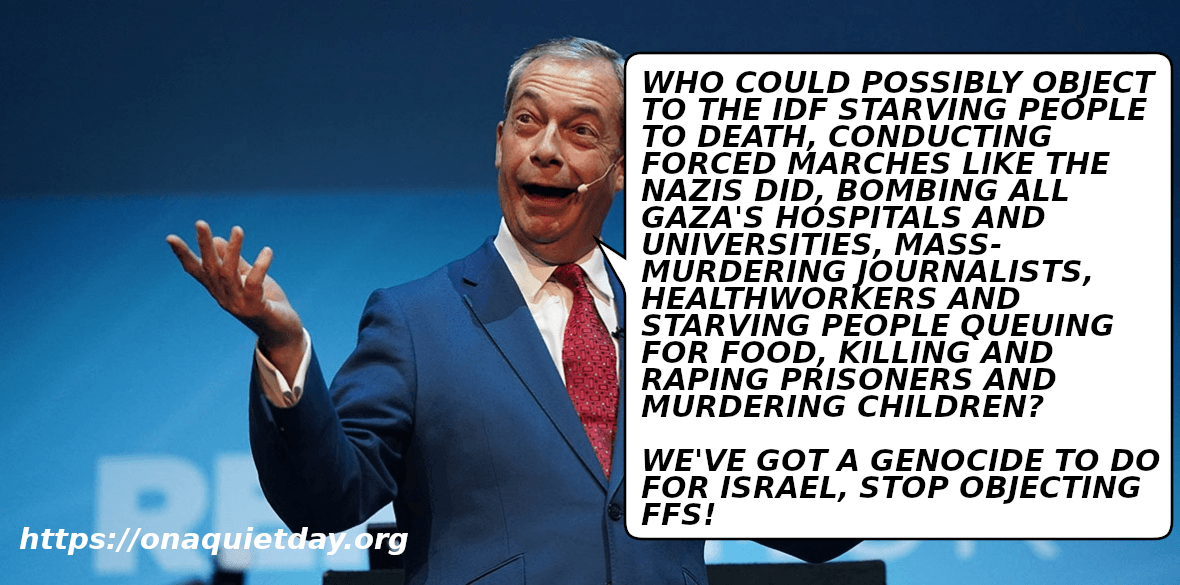
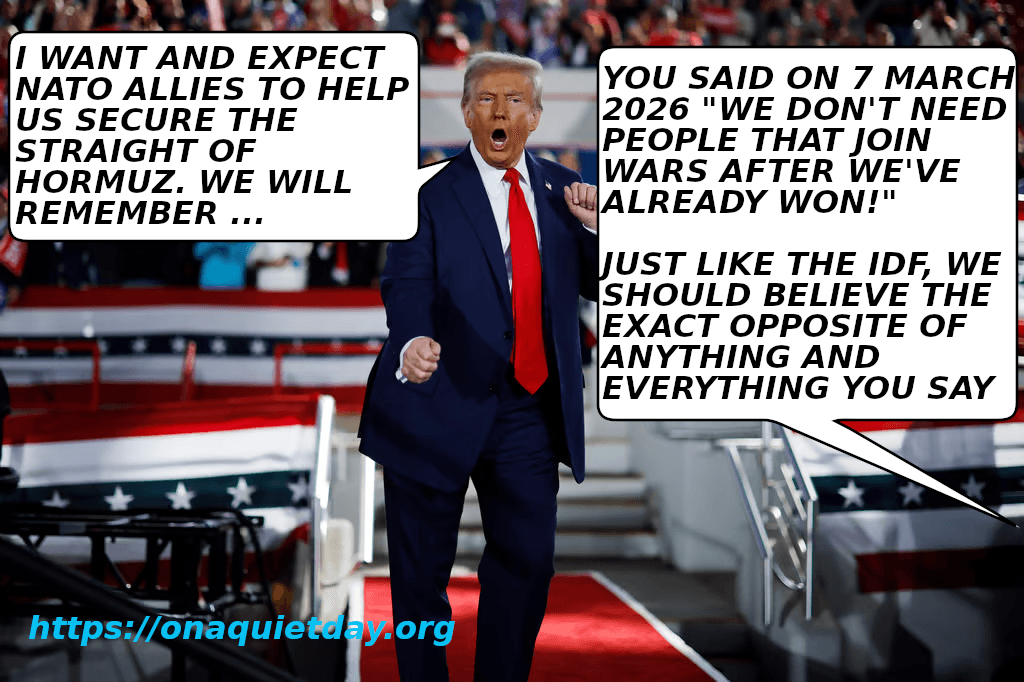
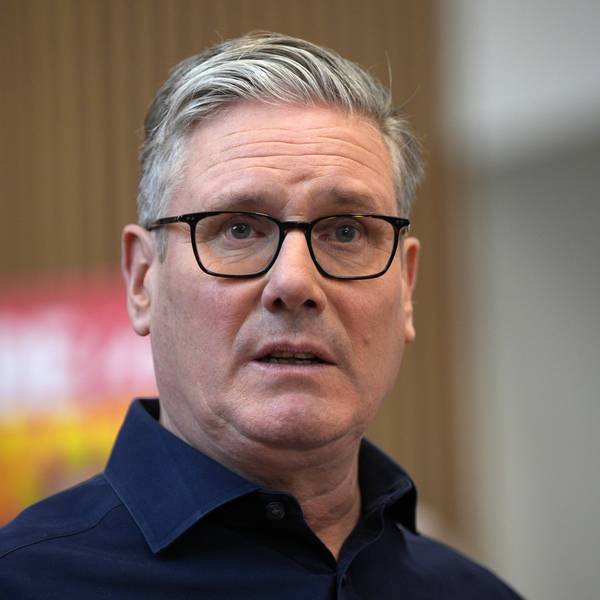
Nigel Farage objects to criticism of the IDF. He asks how could anyone object to them starving people to death, forced marches like the Nazis did, bombing Gaza’s hospitals and universities, mass-murdering journalists, healthworkers and starving people queuing for food, killing and raping prisoners and murdering children. He calls for people to stop obstructing his genocide for Israel.Keir Starmer explains that UK is actively supporting Israel’s genocidal expansion and repeats his previous quotation that he supports Zionism “without qualification”. Keir Starmer said “I said it loud and clear – and meant it – that I support Zionism without qualification.” here: https://www.jewishnews.co.uk/keir-starmer-interview-i-will-work-to-eradicate-antisemitism-from-day-one/Donald Trump calls for help from NATO allies in securing the Strait of Hormuz despite saying on 7 March 2026 that they don’t need people to join wars after they’ve already won. He’s challenged with the claim that he lies as much as the IDF.
This work by Middle East Monitor is licensed under a Creative Commons Attribution-NonCommercial-ShareAlike 4.0 International License.
People attend funeral ceremony for journalist Amal Khalil, who was killed in an Israeli military strike targeting the village of Tayri, in Nabatieh, Lebanon on April 23, 2026. [Elif Öztürk – Anadolu Agency]
There is a particular cruelty in silencing those whose sole weapon is a camera, a notebook, or a voice. The killing of Lebanese journalist Amal Khalil in southern Lebanon is not an isolated tragedy; it is part of a pattern that is becoming impossible to ignore, and even harder to explain away. In a war already saturated with grief, the deliberate or reckless targeting of journalists signals something deeper than battlefield error. It suggests an erosion of the very rules that once attempted to civilise conflict.
On 22nd April 2026, during what was meant to be a brief, US-mediated ceasefire, Israeli strikes hit a civilian vehicle near al-Tayri. When Khalil and her colleague Zeinab Faraj moved to report on the aftermath, a second strike hit the building where they had taken shelter. Rescue teams attempting to reach them were themselves targeted, delaying aid for hours. By the time access was finally granted, Khalil was dead beneath the rubble.
She became the fourth Lebanese journalist killed in just weeks. The sequence—strike, response, second strike—has been described by observers as a ‘double tap’, a tactic that raises serious legal and moral questions.
The outrage from Lebanese officials was immediate and justified. The language used—“flagrant violation”, “brazen crime”—was not diplomatic excess; it reflected a growing consensus among legal experts and press-freedom organisations that such incidents may constitute grave breaches of international humanitarian law.
Journalists are civilians. That principle is not ambiguous. The Geneva Conventions and the Rome Statute are explicit: targeting civilians, including media workers, is a war crime.
Yet the facts on the ground continue to collide with official denials. Israel maintains that it does not target journalists and often asserts that strikes are aimed at militants. In some cases, it has posthumously alleged links between slain reporters and armed groups. These claims, frequently unsubstantiated, have been repeatedly challenged by organisations such as Human Rights Watch and the Committee to Protect Journalists, which point to video evidence and patterns of strikes on clearly marked media personnel. The dissonance between assertion and evidence is widening, and with it, the credibility gap.
The scale of the violence underscores the urgency. As of March 2026, more than 2,400 people have reportedly been killed in Lebanon, with over a million displaced. Across the broader conflict landscape, including Gaza and the West Bank, dozens of journalists have lost their lives since late 2023. One investigation counted at least 61 journalists killed in that period alone, making it one of the deadliest eras for the profession in modern history. These are not incidental losses; they represent a systemic threat to the flow of information itself.
What is unfolding in Lebanon cannot be disentangled from a far larger and more troubling pattern that has already taken shape in Gaza, where the scale of journalist killings has reached historic proportions.
By late 2025, nearly 250 journalists had been killed since October 2023—more than in Vietnam, Iraq, Syria and Ukraine combined, according to the Committee to Protect Journalists and United Nations assessments.
Gaza has, in effect, become the deadliest environment for media workers ever recorded, a distinction that should unsettle any government that claims allegiance to international humanitarian law. The killing of figures such as Abed Shaat, a clearly identified cameraman struck while documenting an aid convoy, underscores how ambiguity has replaced accountability, and how denial has become routine rather than exceptional. experts warn that this erosion is not contained; it is setting precedent, normalising impunity, and accelerating a global decline in journalist safety, with UNESCO reporting a 67 per cent increase in deaths in conflict zones in recent years.
In this light, the strike that killed Amal Khalil does not stand alone as an aberration—it sits within an emerging doctrine of war in which the elimination of witnesses risks becoming tacitly permissible. For policymakers, the implication is stark: when the systematic silencing of journalists is absorbed into the background of conflict, the collapse is not only operational but normative, corroding the credibility of the very international order that depends on the visibility of truth.
What is at stake extends beyond individual lives. When journalists are killed, the immediate effect is silence. Stories go untold, evidence goes unrecorded, and accountability becomes more elusive. In conflicts where narratives are fiercely contested, controlling information can be as strategically valuable as controlling territory. Analysts have noted that targeting journalists reflects a shift towards ‘information warfare’, where the aim is not only to defeat an opponent but to shape the story that reaches the outside world.
This dynamic is not unique to Lebanon, but the current context is particularly stark. The perception—widely held in Beirut and increasingly echoed in international circles—is that impunity persists. Despite repeated condemnations from the United Nations, UNESCO, and global NGOs, meaningful accountability remains elusive. The continued military support provided to Israel by key allies, including the United States and several European nations, complicates efforts to enforce compliance with international norms.
It raises uncomfortable questions about whether the so-called rules-based order applies equally to all, or only to those without powerful backers.
For policymakers everywhere, this is no longer a distant or containable crisis but a direct test of the integrity of the international system itself. States that claim fidelity to international law, press freedom and a rules-based order cannot afford the luxury of selective consistency without paying a strategic price.
When the killing of journalists provokes outrage in one theatre yet equivocation in another, the signal sent is not nuance but hierarchy—of whose lives, whose truths, and whose laws matter.
That inconsistency does more than weaken moral authority; it actively erodes deterrence, inviting repetition by those who see that consequences are negotiable. In such an environment, silence is not restraint but complicity, and credibility—once fractured—rarely returns intact.
There is also a strategic dimension. Erosion of international norms does not occur in isolation; it invites replication. If one state can target journalists without consequence, others may follow. The result is a more dangerous world for reporters, and by extension, for anyone who relies on accurate information to make decisions—governments included. Intelligence, diplomacy, and humanitarian response all depend on credible reporting from conflict zones.
The human dimension, however, remains central. Amal Khalil was not a statistic. She was a witness, a storyteller, and a participant in the essential democratic function of informing the public. Her death resonates not only in Lebanon but across a global community of journalists who increasingly find themselves on the front lines. The message her killing sends—to hesitate, to withdraw, to remain silent—is precisely the message that must be resisted.
There are practical steps that can and should be taken. Ceasefire agreements must include explicit protections for journalists and humanitarian workers, with mechanisms for real-time coordination and verification. Independent investigations into alleged violations must be supported, not obstructed. Military aid and cooperation should be conditioned on adherence to international humanitarian law, with clear consequences for breaches. These measures are not radical; they are the minimum required to preserve a semblance of order in war.
Ultimately, the question is not only about legality but about values. The protection of journalists is a proxy for the protection of truth itself. When that protection erodes, so too does the capacity of the international community to respond effectively to crises. Decisions become less informed, debates more polarised, and solutions more elusive.
The killing of Amal Khalil is a warning. It signals that the boundaries of acceptable conduct in war are being tested, and perhaps redrawn. Whether those boundaries hold will depend on the willingness of states—large and small—to insist that they matter. Silence, in this context, is not neutrality. It is acquiescence.
In the end, wars are remembered not only for their outcomes but for the principles they uphold or abandon. The fate of journalists in Lebanon will be one measure of that legacy.
The views expressed in this article belong to the author and do not necessarily reflect the editorial policy of Middle East Monitor.
This work by Middle East Monitor is licensed under a Creative Commons Attribution-NonCommercial-ShareAlike 4.0 International License.
Keir Starmer explains that UK is actively supporting Israel’s genocidal expansion and repeats his previous quotation that he supports Zionism “without qualification”. Keir Starmer said “I said it loud and clear – and meant it – that I support Zionism without qualification.” here: https://www.jewishnews.co.uk/keir-starmer-interview-i-will-work-to-eradicate-antisemitism-from-day-one/Donald Trump calls for help from NATO allies in securing the Straight of Hormuz despite saying on 7 March 2026 that they don’t need people to join wars after they’ve already won. He’s challenged with the claim that he lies as much as the IDF.
This work by Middle East Monitor is licensed under a Creative Commons Attribution-NonCommercial-ShareAlike 4.0 International License.
Iranian President Masoud Pezeshkian delivers a speech during an inspection visit to the Ministry of Sports and Youth in Tehran, Iran on April 19, 2026. [Iranian Presidency – Anadolu Agency]
Iranian President Masoud Pezeshkian and Parliament Speaker Mohammad Bagher Ghalibaf have rejected claims by US President Donald Trump that there is an internal infighting within Iran’s leadership.
Pezeshkian said: “There are no hardliners or moderates in Iran. We are all Iranians and revolutionaries.” “With the iron unity of the nation and the state, and full obedience to the Supreme Leader, we will make the criminal aggressor regret its actions.”
He added: “One God, one nation, one leader, and one path; victory for Iran, dearer than life.”
Ghalibaf reposted the same message on his account on X.
Trump had earlier claimed there was a “crazy” internal conflict in Iran between rival factions within the leadership.
Writing on his Truth Social platform, he said: “Iran is having a very hard time figuring out who their leader is! They just don’t know! The infighting is between the ‘Hardliners,’ who have been losing BADLY on the battlefield, and the ‘Moderates,’ who are not very moderate at all (but gaining respect!), is CRAZY!”
This work by Middle East Monitor is licensed under a Creative Commons Attribution-NonCommercial-ShareAlike 4.0 International License.
Keir Starmer explains that UK is actively supporting Israel’s genocidal expansion and repeats his previous quotation that he supports Zionism “without qualification”. Keir Starmer said “I said it loud and clear – and meant it – that I support Zionism without qualification.” here: https://www.jewishnews.co.uk/keir-starmer-interview-i-will-work-to-eradicate-antisemitism-from-day-one/Donald Trump calls for help from NATO allies in securing the Straight of Hormuz despite saying on 7 March 2026 that they don’t need people to join wars after they’ve already won. He’s challenged with the claim that he lies as much as the IDF.
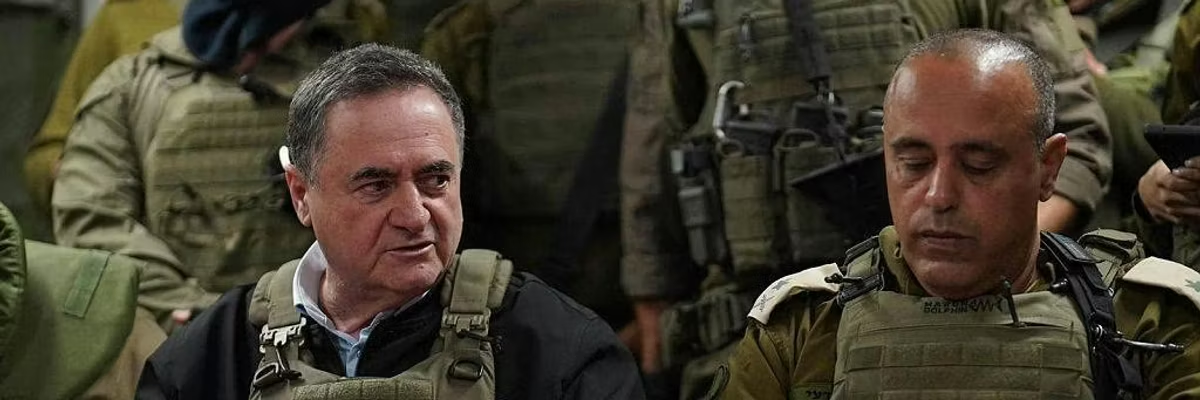
Israeli Defense Minister Yisrael Katz visits a military base and the military unit in the occupied territory of southern Lebanon on April 12, 2026. (Photo by Elad Malka (IMoD)/Handout/Anadolu via Getty Images)
One critic described the Israeli official’s remarks as the country’s “official statement of intent to commit further war crimes in Iran.”
Israeli Defense Minister Israel Katz on Thursday said his country was ready to unleash devastating new attacks on Iran should it get approval from US President Donald Trump.
As reported by Amichai Stein, diplomatic correspondent for iNews24, Katz said that Israel is “prepared to resume the war” and is “awaiting a green light from the United States.”
Katz also vowed that Israel would hit Iran even harder than in previous strikes, vowing “to complete the elimination of the Khamenei family and to push Iran back into a dark age.”
“This time, the strike will be different and far more lethal, delivering devastating blows at the most sensitive points,” Katz warned, “ones that will shake and undermine its very foundations.”
Dylan Williams, vice president for government affairs at the Center for International Policy, described Katz’s remarks as “Israel’s official statement of intent to commit further war crimes in Iran.”
Drop Site News reporter Ryan Grim observed that the Israeli defense minister’s threats are reminiscent of the strategy that it has employed in Gaza in its effort to dislodge Hamas over the last three years.
“Israel believes it is always a few good assassinations away from total victory,” Grim commented. “Now pledging more.”
Trump, in partnership with Netanyahu, illegally launched a war with Iran in late February without any congressional authorization. In response to the attack, Iran shut down all shipping traffic through the Strait of Hormuz, choking off roughly 20% of the global oil supply.
In that time, the price of oil has soared, Trump’s approval ratings have crashed to record lows, and a UN expert warned on Wednesday about the possibility of a global food crisis if the strait is not soon reopened to fertilizer shipments.
There has been a fragile ceasefire agreement in effect between the US, Israel, and Iran for the last two weeks, which Trump extended indefinitely on Tuesday.
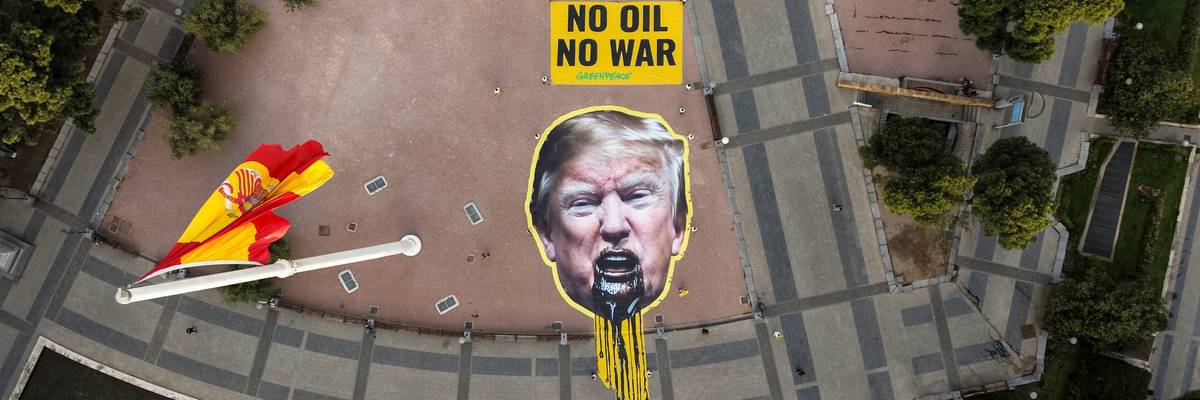
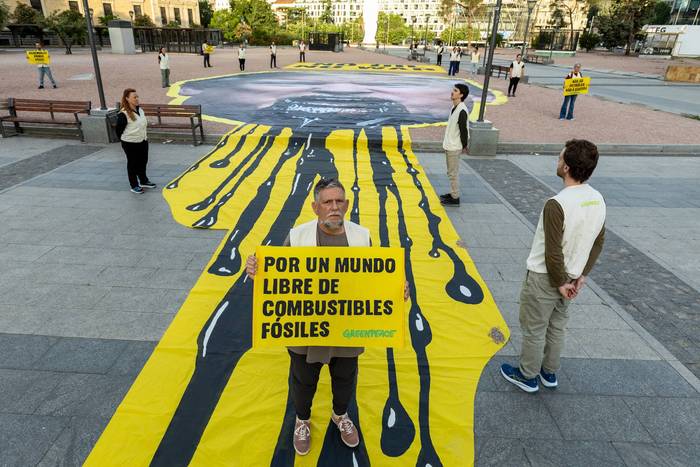
Greenpeace Spain activists displayed a giant image of US President Donald Trump vomiting oil into a black-stained fountain in Madrid’s Plaza de Colón, alongside the message in English, “No oil, no war,” on April 23, 2026. (Photo by Pablo Blazquez/Greenpeace)
“Current conflicts prove that moving away from fossil fuels is an urgent necessity for security, well-being, and the climate,” said Greenpeace campaigner.
“We are saying no to oil and war!” said Greenpeace Spain climate and energy campaigner Pedro Zorrilla Miras in a Thursday statement. “Current conflicts prove that moving away from fossil fuels is an urgent necessity for security, well-being, and the climate.”
Since returning to power last year with help from the fossil fuel industry, Trump has spent his second term attacking already inadequate US climate policies and trying to deliver on his promise to “drill, baby, drill,” despite the harm that causes to the planet and its inhabitants.
After sending in US troops to abduct Venezuelan President Nicolás Maduro as part of an effort to take over the country’s nationalized oil industry in January, Trump, alongside Israeli forces, began bombing Iran in February. Although there is now a fragile ceasefire in place, Iran responded to the US-Israeli attack by restricting ship traffic through the Strait of Hormuz, a key trade route, including for fertilizer and fossil fuels.
As fuel prices have soared, green groups—including Greenpeace—have called for a permanent end to the US and Israel’s assault on Iran, a windfall profits tax for fossil fuel giants that have cashed in on the conflict, and making “food and energy secure for all.” They have also argued that the war highlights the need for a just shift away from oil and gas.
“Instead of war, ending our reliance on fossil fuels is our best possible defense,” said Zorrilla Miras. “That is why governments must show leadership at the Santa Marta conference to accelerate a just transition away from fossil fuels. We are calling for clear and ambitious action from Spain that matches its rhetoric and embraces pathways that show Spain can achieve a 99% decarbonization rate by 2040.”
“Fossil fuel dependence is exposing countries to volatile global markets, where conflict, disruption, and political tensions rapidly translate into higher energy, food, and transport prices,” the campaigner continued. “The Santa Marta summit is therefore a key political moment for leaders to progress the delivery of energy systems that are affordable, stable, and resilient in an increasingly uncertain world.”
Colombia and the Netherlands are co-hosting the summit, which is set to run from Friday to Wednesday and is “intended to support practical action by those already prepared to move forward,” according to organizers. “It does not seek to deliver a negotiated outcome, but rather to generate shared understanding and actionable guidance that can help accelerate a just, orderly, and equitable transition away from fossil fuels.”
Standing on top of and around the visual of puking Trump in Madrid, Greenpeace activists carried signs calling for such a transition. The messages included: “Renewables, Power, Peace” in English, “No Oil, No War” in Portuguese, and “For a world free of fossil fuels” in Spanish.
A Greenpeace Spain activist holds a sign that says “For a world free of fossil fuels” in Spanish during a protest in Madrid on April 23, 2026. (Photo by Pablo Blazquez/Greenpeace)
“In the midst of a fossil fuel-driven energy crisis, the Santa Marta meeting offers light on the horizon,” said Greenpeace International climate politics expert Tracy Carty. “Rather than prolonging exposure to volatile and conflict-prone fossil fuels, governments must use this moment to accelerate a just transition to renewable energy that protects people from price shocks and builds long-term stability.”
“The coalition of committed states coming together in Santa Marta has the potential to spark bolder national action and international cooperation,” she noted. “That requires the development of national roadmaps for transitioning away from fossil fuels, including ambitious renewable energy targets, and to scale up predictable, accessible, and affordable climate finance to support developing countries in delivering a just transition.”
Donald Trump urges you to be a Climate Science denier like him. He says that he makes millions and millions for destroying the planet, Burn, Baby, Burn and Flood, Baby, Flood.Nigel Farage urges you to ignore facts and reality and be a climate science denier like him. He says that Reform UK has received millions and millions from the fossil fuel industry to promote climate denial and destroy the planet.