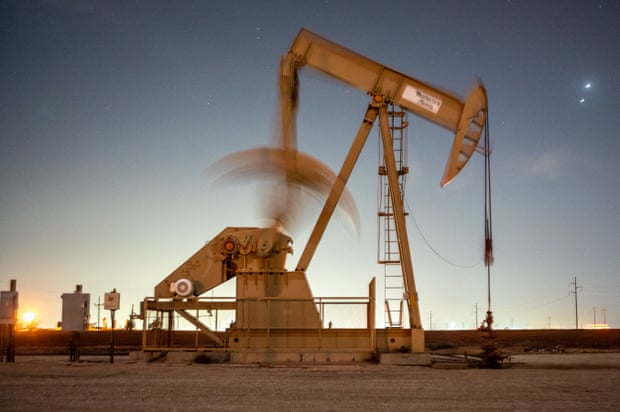
Expected greenhouse gas emissions from US oil and gas fields has jumped under Trump, after previously dropping under Biden, forecasts show. Photograph: Bloomberg/Getty Images
Tariff chaos hampers Trump’s pledge to ‘drill, baby, drill’, but analysis still shows surge in planet-heating emissions
Donald Trump’s ambitions for the US to “drill, baby, drill” for more fossil fuels have ironically been hampered by the economic chaos unleashed by his own tariffs, but the US is still on track to increase oil and gas extraction, causing a surge in planet-heating emissions, a new analysis shows.
The US was already the world’s leading oil and gas power, producing more of the fossil fuels than any country in history during Joe Biden’s administration. But Trump has sought to escalate this further, declaring an “energy emergency” to open up more land and ocean for drilling and launching an unprecedented assault on environmental regulations in his first 100 days back in the White House.
This new political climate means that the expected amount of greenhouse gas emissions from active and planned projects in US oil and gas fields has jumped under Trump, after previously dropping under Biden, forecasts shared with the Guardian show.
Despite awarding more drilling leases than Trump in his first 100 days, Biden also pursued policies to combat the climate crisis that saw oil and gas companies revise down their production estimates. That situation has now reversed, threatening a pulse of new pollution that will further add to the fever of a planet already suffering from heatwaves, floods, droughts and other disasters accelerated by global heating.
“The uptick in embodied emissions from forecast US oil and gas production is worrying,” said Olivier Bois von Kursk, policy adviser at the International Institute for Sustainable Development, which tracks emissions projections from the lifetime of projects, based on data from research consultancy Rystad Energy. “The world can’t afford more climate chaos.”
…
The International Energy Agency, which has forecast that global oil and gas demand will peak by 2030, has said that no new major fossil fuel projects can occur if the world is to stay within agreed temperature limits and avoid catastrophic climate impacts. Last year was the hottest, worldwide, ever recorded and governments are collectively failing to meet targets to avert escalating disasters.
…
Tariffs on solar panels from Vietnam, Cambodia and Malaysia have been ratcheted up to as much as 3,521%. “We don’t want windmills in this country,” the president said shortly after his inauguration in January. “We don’t want windmills. You know what else people don’t like? Those massive solar fields.”
Neo-Fascist Climate Science Denier Donald Trump says Burn, Baby, Burn.Elon Musk urges you to be a Fascist like him, says that you can ignore facts and reality then.Orcas discuss Donald Trump and the killer apes’ concept of democracy. Front Orca warns that Trump is crashing his country’s economy and that everything he does he does for the fantastically wealthy.
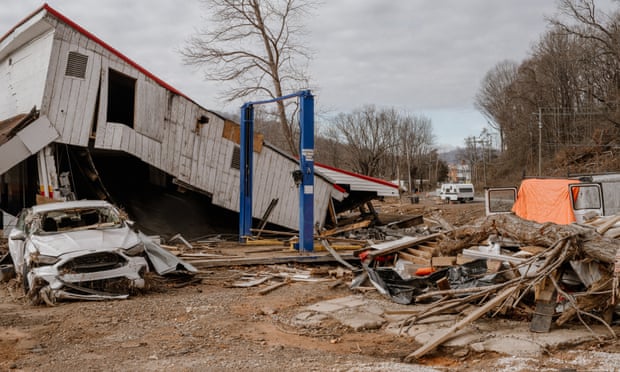
A destroyed mechanic’s shop in downtown Swannanoa, North Carolina, US, December 2024, nearly three months after Hurricane Helene in late September. Photograph: Mike Belleme/The Guardian
Floods, heatwaves and supercharged hurricanes occurred in hottest climate human society has ever experienced
…
The world is already deep into the climate crisis, with the WMO report saying that for the first time, the 10 hottest years on record all occurred in the last decade. However, global carbon emissions have continued to rise, which will bring even worse impacts. Experts were particularly critical of the purge of climate scientists and programmes by the US president, Donald Trump, saying that ignoring reality left ordinary people paying the price.
“Leaders must step up – seizing the benefits of cheap, clean renewables for their people and economies – with new national climate plans due this year,” said the UN secretary general, António Guterres.
Dr Luke Parsons, of the Nature Conservancy, said: “Every year, we venture further into uncharted territory, with 2024 the hottest year modern human society has ever experienced. Yet the coming decade is expected to be even hotter, pushing us deeper into this unprecedented climate.”
Previous research determining the role of the climate crisis in what are now unnatural disasters has shown that at least 550 heatwaves, floods, storms, droughts and wildfires had been made significantly more severe or more frequent by global heating.
Neo-Fascist Climate Science Denier Donald Trump says Burn, Baby, Burn.Elon Musk urges you to be a Fascist like him, says that you can ignore facts and reality then.Orcas comment on killer apes destroying the planet by continuing to burn fossil fuels.
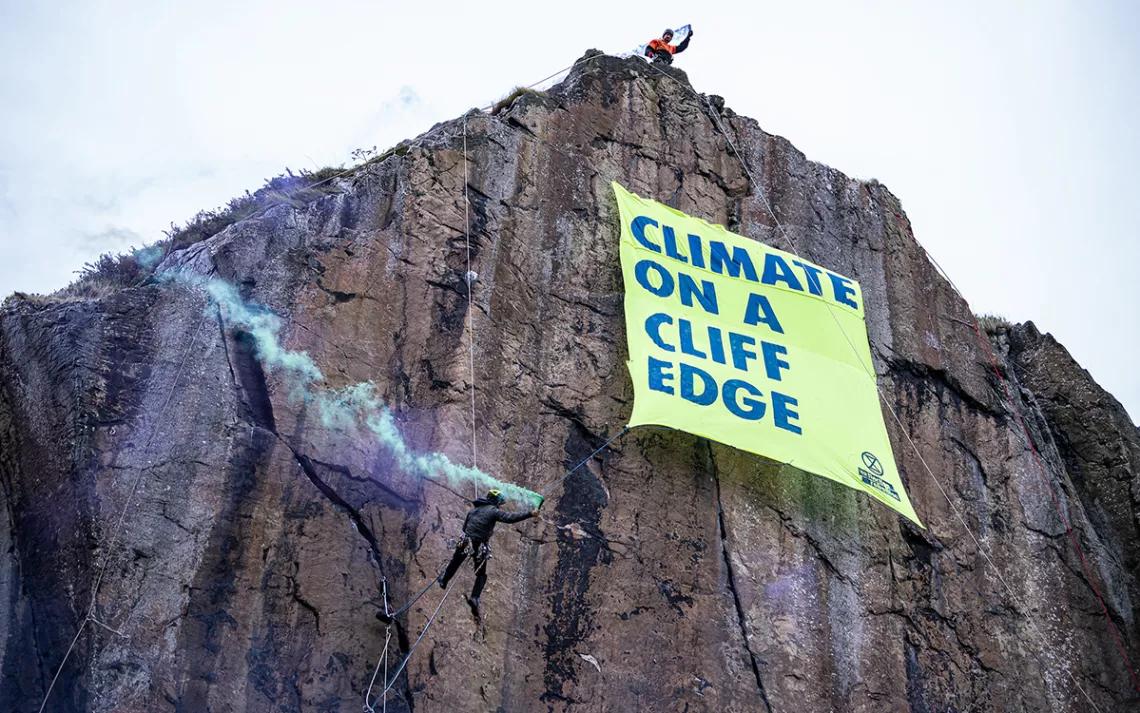
Experienced climbers scale a rock face near the historic Dumbarton castle in Glasgow, releasing a banner that reads “Climate on a Cliff Edge.” One activist, dressed as a globe, symbolically looms near the edge, while another plays the bagpipes on the shores below. | Photo courtesy of Extinction Rebellion and Mark Richards
Without action on climate crisis, far greater numbers will also experience floods, wildfires and droughts, according to report
Eight times as many children around the world will be exposed to extreme heatwaves in the 2050s, and three times as many will face river floods compared with the 2000s if current trends continue, according to the UN.
Nearly twice as many children are also expected to face wildfires, with many more living through droughts and tropical cyclones, according to the annual state of the world’s children report.
…
The report, released on Wednesday, World Children’s Day, forecasts how the climate crisis, demographic shifts (sub-Saharan Africa and south Asia are projected to have the largest child populations in the 2050s) and breakthrough technologies will affect children’s lives in the future.
The report said technologies such as artificial intelligence (AI) will bring benefits and risks to children, who are already interacting with AI embedded in apps, games and learning software. The digital divide remains stark, however. In 2024, almost 95% of people in high-income countries are connected to the internet, compared with about 25% in low-income countries.
“Children are experiencing a myriad of crises, from climate shocks to online dangers, and these are set to intensify in the years to come,” said Catherine Russell, Unicef’s executive director. “The decisions world leaders make today – or fail to make – define the world children will inherit … Decades of progress, particularly for girls, are under threat.”
Much of the emphasis of the report is on the impact of the climate crisis on children, nearly half of whom (approximately 1 billion) live in countries that face a high risk of environmental disasters. Even before they take their first breath, children’s brains, lungs and immune systems are susceptible to pollution, disease and extreme weather. As they grow, their education, nutrition, safety, security and mental health are shaped by the climate and environment.
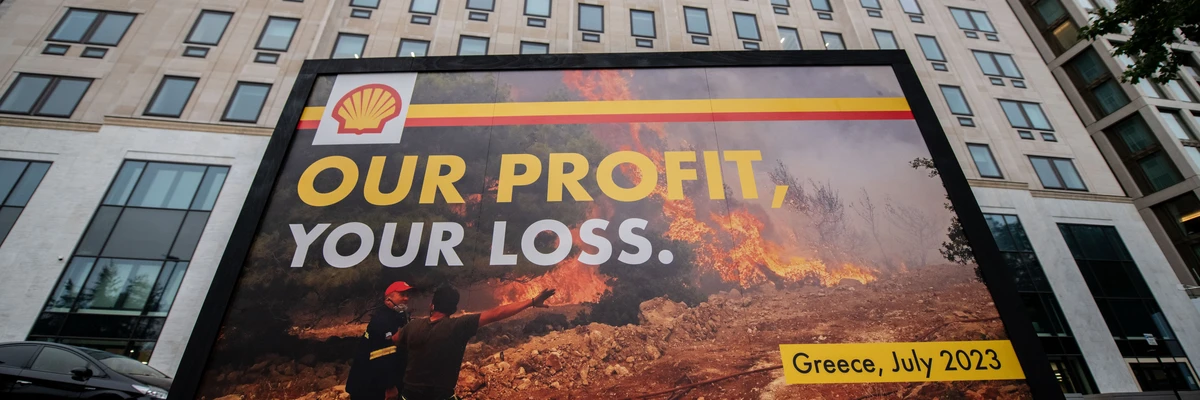
Greenpeace activists display a billboard during a protest outside Shell headquarters on July 27, 2023 in London. (Photo: Handout/Chris J. Ratcliffe for Greenpeace via Getty Images)
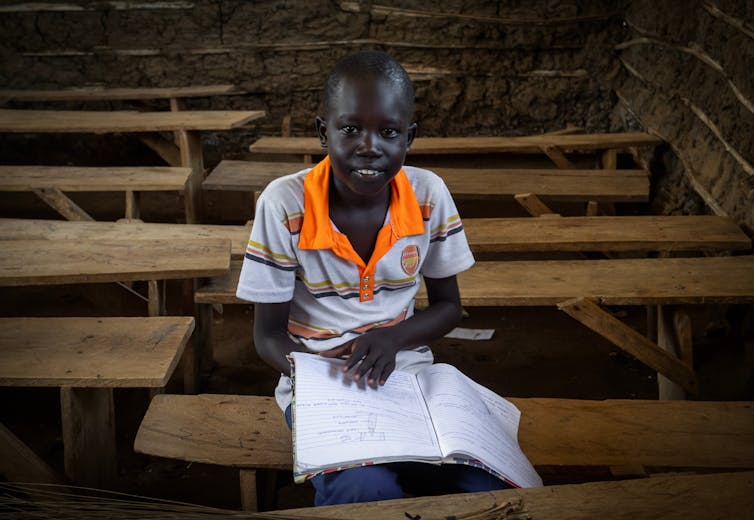
The education of students in countries like Sudan is already being negatively affected by the extremes of climate change. Richard Juilliart/Shutterstock
Schools across South Sudan have been ordered to close as a heat wave of 45°C sweeps across the country. In recent years, severe flooding has already caused major disruptions to schooling in South Sudan where, on average, children complete less than five years of formal education across their lives.
As researchers interested in both climate change and learning, we’ve been surprised that most public debate in this area concerns how best to teach children about climate change as part of the curriculum. Recently, we examined a less discussed, but arguably much more consequential, question: How is climate change impacting children’s education worldwide?
In a recent paper published in Nature Climate Change, we reviewed studies linking climate change-related events or “climate stressors” to education outcomes. One of the clearest connections was between heat exposure and reduced academic performance.
A study in the US found that adolescents’ maths scores decreased significantly on days above 26°C. In China, hotter day-of-test temperatures were associated with a drop in exam performance equal to losing a quarter of a year – or several months – of schooling.
But it’s not just test days that matter. Studies show that raised temperatures also affect learning over longer time periods. For example, pupils’ test scores suffered when there were more hot days across the school year and even when the hotter weather occurred three to four years before exam day.
Our review also highlights how climate-related regional disasters like wildfires, storms, droughts and floods are keeping many children out of school entirely. Floods can prevent children from travelling to school and cause damage to school buildings and materials, which disrupts learning and lowers test scores.
In developing countries, storms and droughts commonly cause children to leave school permanently to join the workforce and support their families. Children in higher-income countries are not immune. They miss school days due to hurricanes and wildfires and these absences have measurable effects on education outcomes.
The impacts of climate disasters can also affect children before they are born with consequences that reverberate across their lives. For example, children whose mothers were pregnant during Hurricane Sandy were more likely to be diagnosed with attention-deficit hyperactivity disorder (ADHD), a condition that can make schooling more challenging.
In India, researchers found that raised temperatures lead to lower test scores due to crop failure and malnutrition, highlighting the importance of indirect links between climate stressors and subsequent school participation and learning.
Educational injustice
Our analysis suggests that climate change will exacerbate existing inequalities in global education access and attainment, with already disadvantaged groups facing the largest learning setbacks. In the US, heat had worse effects on exam scores for racial and ethnic minorities and children living in lower-income school districts.
Following a super typhoon in the Philippines, children whose families had fewer financial resources and smaller social networks were more likely to drop out of school than their better-resourced neighbours. In contexts where girls’ education is less prioritised than boys’, their school attendance and exam scores have suffered more following climate change stressors such as droughts and storms.
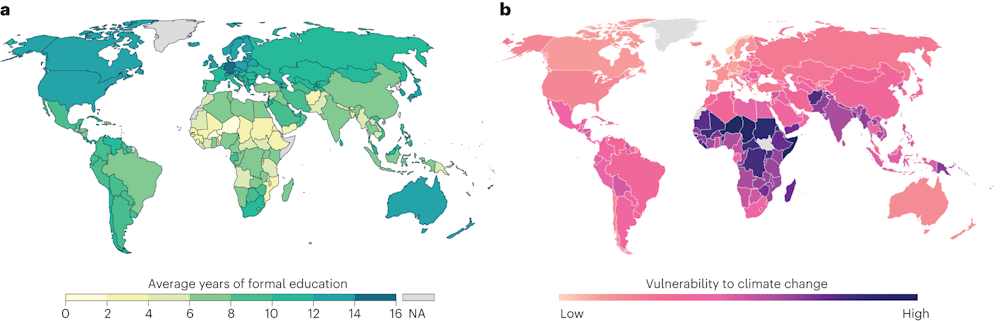
Globally, regions where people are more vulnerable to the effects of climate change – in terms of risk of harmful stressors occurring and resources available to adapt – are also regions where children already receive fewer years of schooling.
These maps show the average years of formal education (left) and vulnerability to climate change by country (right). CC BY
The impacts of climate change on education are already widely visible. While the scale of the problem is daunting, there are many ways to take action. Most critically, global heating urgently needs to be limited by reducing emissions of greenhouse gases.
At the same time, children’s education must be protected from climate change stressors that are already occurring. Possible measures include installing cooling technologies, effective disaster response planning, building stressor-resilient schools and addressing systemic global inequalities related to socioeconomic, gender and racial discrimination.
Preventing harm to children’s education is a worthy goal in itself. But improving education can also contribute to greater awareness and climate literacy, while mitigating climate change and making children more resilient in the face of climate stressors.
Education can help fight climate change. But we must also fight climate change to prevent harm to education. Without action, the future of young people around the world hangs in the balance.
United Nations Secretary-General António Guterres speaks at the U.N. headquarters on February 22, 2023. (Photo: Lev Radin/Pacific Press/LightRocket via Getty Images)
“Geopolitical divides are preventing us from coming together around global solutions for global challenges,” said United Nations Secretary-General António Guterres.
At the World Economic Forum in Davos, Switzerland on Wednesday, United Nations Secretary-General António Guterres warned that multilateralism that includes often overlooked governments in the Global South is the only solution to the rapidly developing crises posed by the climate emergency and artificial intelligence—both of which are worsening “the global crisis in trust.”
“In the face of the serious, even existential threats posed by runaway climate chaos,” said Guterres, “and the runaway development of artificial intelligence without guardrails, we seem powerless to act together.”
While “droughts, storms, fires, and floods are pummeling countries and communities,” particularly in nations that have contributed the least planet-heating fossil fuel pollution, Guterres told the political and business elite assembled in Davos, “countries remain hellbent on raising emissions.”
He reserved particular scorn for the United States fossil fuel industry, which—amid the Biden administration’s approval of pollution-causing infrastructure including the Willow oil project and the Mountain Valley Pipeline—deceives the public with false climate solutions, misinformation, and greenwashing campaigns “to kneecap progress and keep the oil and gas flowing indefinitely.”
As suffering intensifies in communities that are most vulnerable to drought, damage from extreme weather, and other climate catastrophes, Guterres said, fossil fuel giants and powerful governments are risking lives to only delay an “inevitable” shift to renewable energy.
“The phaseout of fossil fuels is essential,” said the secretary-general. “No amount of spin or scare tactics will change that. Let’s hope it doesn’t come too late.”
As trust between the Global South and wealthy governments is frayed by fossil fuel-producing countries’ refusal to leave oil, gas, and coal behind, Guterres warned that the separate threat of “unintended consequences” of artificial intelligence evolution also looms—for people in rich economies as well as developing countries.
“This technology has enormous potential for sustainable development,” said the U.N. chief, while noting that “some powerful tech companies are already pursuing profits with a clear disregard for human rights, personal privacy, and social impact.”
Guterres’ comments came days after the International Monetary Fund (IMF) released a new analysis of AI’s expected impact on the global economy and workers, with nearly 40% of the labor market expected to be “exposed” to AI.
AI will affect almost 40% of jobs around the world, replacing some and complementing others, according to the IMF’s new AI Preparedness Index, with a breakdown by country. Read @KGeorgieva’s blog for more. https://t.co/LMpupRBKr1pic.twitter.com/eHLYeiZYfx
In wealthy countries, about 60% of jobs are projected to be impacted by AI, and about half of those workers are likely to see at least some of their primary tasks being completed by AI tools like ChatGPT or similar technology, “which could lower labor demand, leading to lower wages, and reduced hiring,” according to the IMF. “In the most extreme cases, some of these jobs may disappear.”
The analysis released Sunday noted that the rapidly changing field could worsen inequality within countries, as some higher earners may be able to “harness AI” and leverage its use for increases in their productivity and pay while those who can’t fall behind.
“In most scenarios, AI will likely worsen overall inequality, a troubling trend that policymakers must proactively address to prevent the technology from further stoking social tensions,” said the IMF. “It is crucial for countries to establish comprehensive social safety nets and offer retraining programs for vulnerable workers.”
Guterres called on policymakers to work closely with the private sector—currently “in the lead on AI expertise and resources”—to “develop a governance model” for AI that is focused on “monitoring and mitigating future harms.”
A systematic effort is also needed, said the secretary-general, “to increase access to AI so that developing economies can benefit from its enormous potential.”
Along with the IMF and Guterres, global human rights group Amnesty International this week raised alarm about AI and the “urgent but difficult task” of regulating the technology, noting that in addition to changing how people and companies work, AI has the potential to be “used as a means of societal control, mass surveillance, and discrimination.”
Police agencies in several countries have begun using AI for so-called “predictive policing,” attempting to prevent crimes before they’re committed, while officials have also deployed automated systems to detect fraud, determine who can and can’t access healthcare and social assistance, as well as to monitor migrants’ and refugees’ movement.
Amnesty credited the European Union with making headway in regulating AI in 2023, closing out the year by reaching a landmark agreement on the AI Act, which would take steps to protect Europeans from the automation of jobs, the spread of misinformation, and national security threats.
The AI Act, however, has been criticized by rights groups over its failure to ban mass surveillance via live facial recognition tools.
“Others must learn from the E.U. process and ensure there are not loopholes for public and private sector players to circumvent regulatory obligations, and removing any exemptions for AI used within national security or law enforcement is critical to achieving this,” said Amnesty.
In Davos on Wednesday, Guterres expressed hope that policymakers will agree on climate, AI, and other solutions that center human rights in the coming year, including at the U.N.’s Summit of the Future, planned for September.
“These two issues—climate and AI—are exhaustively discussed by governments, by the media, and by leaders here in Davos,” said Guterres. “And yet, we have not yet an effective global strategy to deal with either. And the reason is simple. Geopolitical divides are preventing us from coming together around global solutions for global challenges.”
“The only way to manage this complexity and avoid a slide into chaos,” he said, “is through a reformed, inclusive, networked multilateralism.”