Actuaries and Scientists Warn Climate Shocks Risk ‘Planetary Insolvency’

Spread the love

Original article by Jessica Corbett republished from Common Dreams under Creative Commons (CC BY-NC-ND 3.0). Published Jan 16, 2025

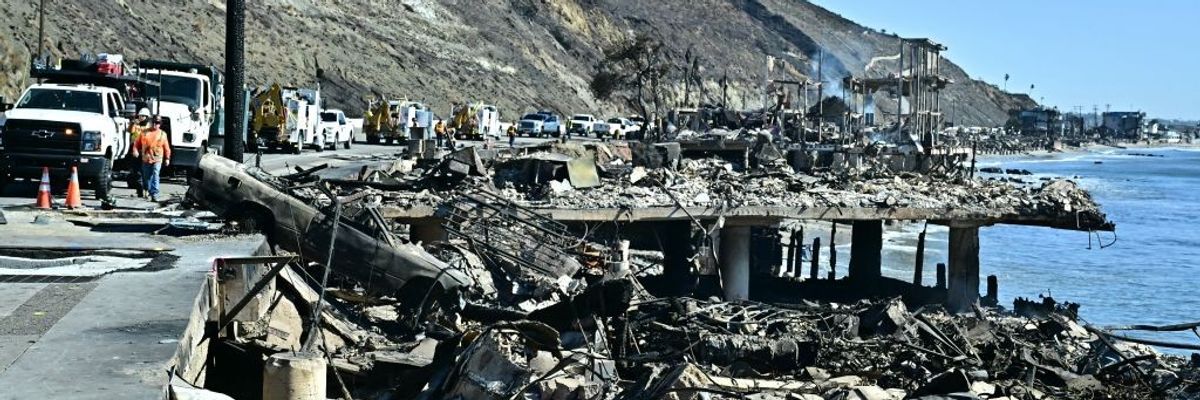
Gas company employees work in Malibu, California, after the Palisades Fire destroyed beach homes on January 12, 2025. (Photo: Frederic J. Brown/AFP via Getty Images)

A new report “shows a 50% GDP contraction between 2070 and 2090 unless an alternative course is chartered,” said the lead author.

U.K. actuaries and University of Exeter climate scientists on Thursday warned that “the risk of planetary insolvency looms unless we act decisively” and urged policymakers to “implement realistic and effective approaches to global risk management.”

Actuaries have developed techniques that “underpin the functioning of the global pension market with $55 trillion of assets, and the global insurance market, collecting $8 trillion of premiums annually, to help us manage risk,” Tim Lenton, University of Exeter’s climate change and Earth system science chair, noted in the foreword of a report released Thursday.

Planetary Solvency—Finding Our Balance With Nature is the fourth report for which the Institute and Faculty of Actuaries (IFoA) has collaborated with climate scientists. In financial terms, solvency is the ability of people or companies to pay their long-term debts. Co-authors of one of the previous publications coined the phrase planetary solvency, “setting out the idea that financial risk management techniques could be adapted to help society manage climate change and other risks.”

Three IFoA leaders—Kalpana Shah, Paul Sweeting, and Kartina Tahir Thomson—explained in their introduction to the latest report how “planetary solvency applies these techniques to the Earth system,” writing:

The essentials that support our society and economy all flow from the Earth system, commodities such as food, water, energy, and raw materials. The Earth system regulates the climate and provides a breathable atmosphere, it is the foundation that underpins our society and economy. Planetary solvency assesses the Earth system’s ability to continue supporting us, informed by planetary boundaries, tipping points in the Earth system, and other scientific discoveries to assess risks to this foundation—and thus to our society and the economy.

Our illustrative assessment of planetary solvency in this report shows a more fundamental, policy-led change of direction is required. Our current market-led approach to mitigating climate and nature risks is not delivering. There is an increasing risk of severe societal disruption (planetary insolvency), as our economic system drives further global warming and nature degradation.

“Impacts are already severe with unprecedented fires, floods, heatwaves, storms, and droughts,” the document points out, emphasizing that human activity—particularly burning fossil fuels—drives climate change and biodiversity loss. “If unchecked they could become catastrophic, including loss of capacity to grow major staple crops, multimeter sea-level rise, altered climate patterns, and a further acceleration of global warming.”

The report was released as wildfires ravage California and shortly after scientific bodies around the world concluded that 2024 was the hottest year on record and the first in which the average global temperature exceeded a key goal of the Paris agreement: 1.5°C above preindustrial levels. In the United States, experts identified 27 disasters with losses exceeding $1 billion.

“We risk triggering tipping points such as Greenland ice sheet melt, coral reef loss, Amazon forest dieback, and major ocean current disruption,” the new publication warns, adding that “tipping points can trigger each other,” and if multiple are triggered, “there may be a point of no return, after which it may be impossible to stabilize the climate.”

Food system shocks and more frequent and devastating disasters increase the risk of mass mortality for humanity—including due to hunger and infectious diseases—along with mass migration and conflict, the report highlights.

“Climate change risk assessment methodologies understate economic impact, as they often exclude many of the most severe risks that are expected and do not recognize there is a risk of ruin,” the document stresses. “They are precisely wrong, rather than being roughly right.”

Specifically, lead author and IFoA council member Sandy Trust said in a statement, “widely used but deeply flawed assessments of the economic impact of climate change show a negligible impact” on gross domestic product (GDP).

However, Trust continued, “the risk-led methodology, set out in the report, shows a 50% GDP contraction between 2070 and 2090 unless an alternative course is chartered.”

To mitigate the risk of planetary insolvency, the co-authors called on policymakers around the world to implement independent, annual assessments; set limits and thresholds that respect the planet’s boundaries; enhance governance structures to support planetary solvency; and “enhance policymaker understanding of ecological interdependencies, tipping points, and systemic risks so they understand why these changes are needed.”

They also underscored the need to limit global warming and avoid triggering tipping points with actions such as accelerating decarbonization, removing greenhouse gases from the atmosphere, restoring damaged ecosystems, and building resilience.

“You can’t have an economy without a society, and a society needs somewhere to live,” said Trust. “Nature is our foundation… Threats to the stability of this foundation are risks to future human prosperity which we must take action to avoid.”

Original article by Jessica Corbett republished from Common Dreams under Creative Commons (CC BY-NC-ND 3.0).

Orcas discuss Donald Trump and the killer apes' concept of democracy. Front Orca warns that Trump is crashing his country's economy and that everything he does he does for the fantastically wealthy.
Orcas discuss Donald Trump and the killer apes’ concept of democracy. Front Orca warns that Trump is crashing his country’s economy and that everything he does he does for the fantastically wealthy.
Neo-Fascist Climate Science Denier Donald Trump says Burn, Baby, Burn.
Elon Musk urges you to be a Fascist like him, says that you can ignore facts and reality then.

Continue ReadingActuaries and Scientists Warn Climate Shocks Risk ‘Planetary Insolvency’

Children born in 2020 will face ‘unprecedented exposure’ to climate extremes

Spread the love

Original article republished from Carbon Brief under a CC license

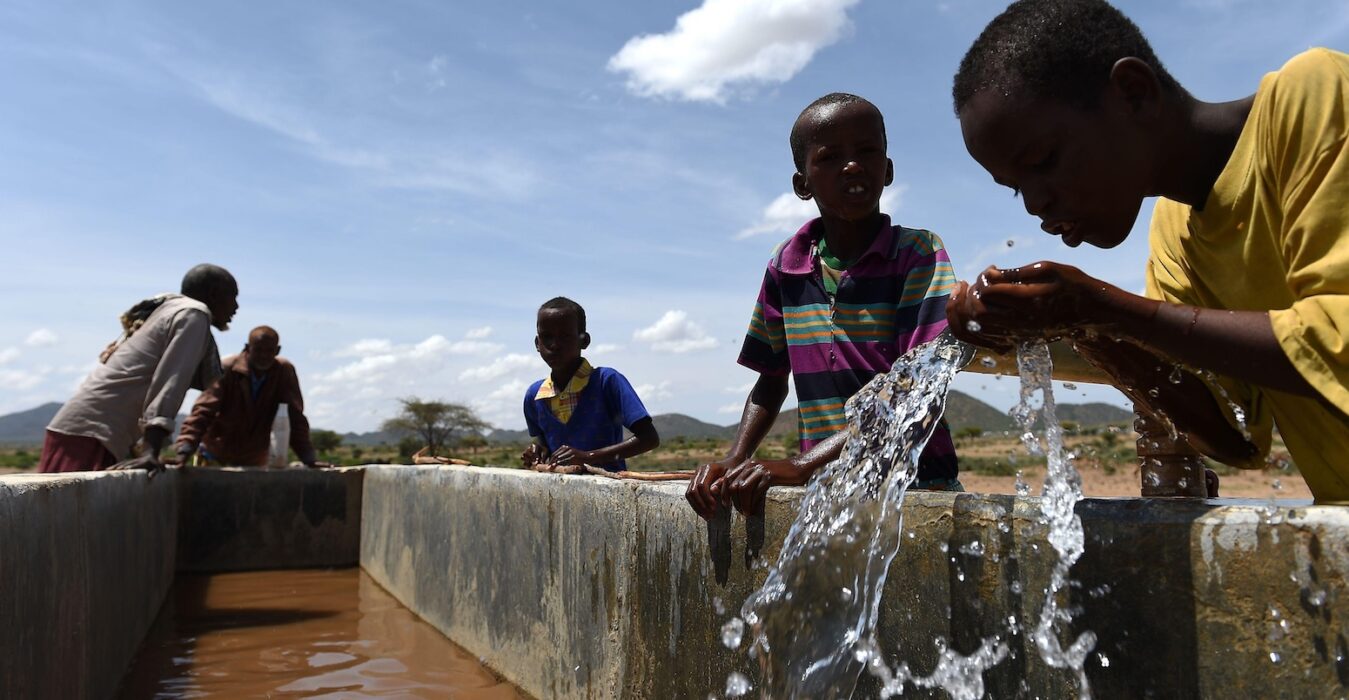
Children drink water from a pipeline in the village of Afraaga, Somaliland. Credit: Joe Giddens / Alamy Stock Photo

Children born in 2020 will face “unprecedented exposure” to extreme weather events, including heatwaves, droughts and wildfires, even if warming is limited to 1.5C above pre-industrial temperatures.

That is according to a new study, published in Nature, which calculates the number of unprecedented extreme events that people born in different decades and countries might live through.

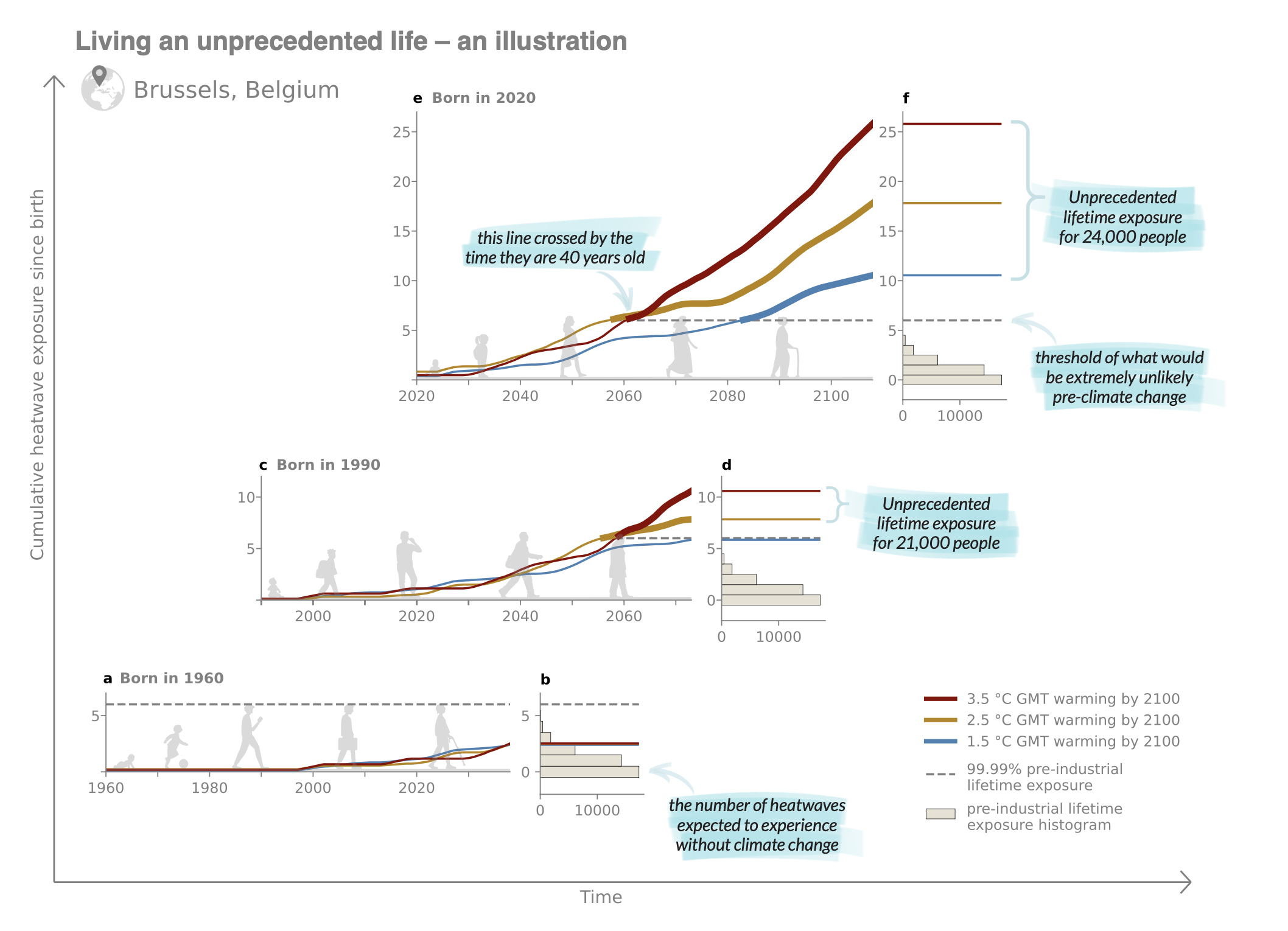
Using a case study focused on Brussels, the researchers find that people born in 2020 will experience an “unprecedented” 11 heatwaves in their lifetime – even if global warming is limited to 1.5C by the end of the century.

In contrast, in a pre-industrial climate, a person living in the Belgian capital would likely experience just three such heatwaves, according to the study.

More than half of children born in 2020 – around 62 million people – will experience “unprecedented lifetime exposure” to heatwaves, even if warming is limited to 1.5C, the study finds. 

However, this number nearly doubles to 111 million under a scenario where warming hits 3.5C.

The study also analyses crop failures, river floods, tropical cyclones, wildfires and droughts. 

The research “helps the climate community build new narratives that better clarify the impacts [of climate change] on younger generations and vulnerable populations”, one expert who was not involved in the study tells Carbon Brief.

Intergenerational justice

As the planet warms, extreme weather events such as heatwaves, floods and droughts are becoming more intense, more frequent and lasting longer.

popular 2021 study found that children born in the 21st century will be exposed to more extreme weather events in their lifetimes than their parents and grandparents.

The paper found that in a scenario of 3C of warming above pre-industrial levels, a child who turns six in 2020 will experience twice as many wildfires and tropical cyclones, three times more river floods, four times more crop failures, five times more droughts and 36 times more heatwaves over their lifetime than a six-year-old living in a pre-industrial climate.

The authors also found a “particularly strong increase” in children’s future exposure to extremes in the Middle East and North Africa.

The lead author of the study – Prof Wim Thiery from Vrije Universiteit Brussel – told Carbon Brief at the time that today’s youth will live “an unprecedented life”, in which they will “face conditions which older generations have never experienced”.

Four years later, Dr Luke Grant – a researcher in Thiery’s team – has led a new study building on the ideas of the 2021 paper.

Grant tells Carbon Brief that rather than counting the number of extreme events that an individual might experience, his new study counts the number of people that reach an “unprecedented state” of exposure to extremes.

Prof Kaveh Madani is the director of the UN University Institute for Water, Environment and Health and was not involved in the study. He tells Carbon Brief that the paper “helps the climate community build new narratives that better clarify the impacts [of climate change] on younger generations and vulnerable populations”.

The authors define “exposure” as the number of extreme events that a person experiences in their lifetime, relative to the number they would have experienced in a pre-industrial climate.

“Unprecedented lifetime exposure” is defined as exposure so high that it has only a one-in-10,000 chance of happening in a world without any greenhouse gas emissions.

‘Unprecedented lifetime exposure’

The authors present a case study of extreme heat in Brussels, Belgium, to explain their method.

They define a heatwave as a three-day extreme heat event, which reaches average temperatures that would be expected once per century in a pre-industrial climate.

Using models from the Inter-Sectoral Impact Model Intercomparison Project (ISIMIP), the authors calculate heatwave frequency in a world without climate change. They also assess scenarios in which warming is limited to 1.5C, 2.5C and 3.5C by the end of the century.

They combine this data with demographic information, including how many people are born in the country each year and their average life expectancy, using data from sources including the ISIMIP database and UN population estimates and projections.

In a world without climate change, the study finds that a person born in 1960 in Brussels would have a one-in-10,000 chance of experiencing six of the pre-defined heatwaves in their lifetime. Any member of this “birth cohort” who experiences more than six heatwaves in their lifetime has therefore faced “unprecedented lifetime exposure” to extreme heat, according to the study.

The authors find that a person born in Brussels in 1960 is likely to experience three heatwaves on average during their lives under all of the three future warming pathways– meaning that they are unlikely to face “unprecedented lifetime exposure” to heat.

By contrast, the researchers find that many younger age cohorts will experience unprecedented heatwave exposure. For many younger age cohorts, lifetime exposure to heatwaves is greater for higher warming pathways. 

For example, people born in Brussels in 2020 will experience 11 heatwaves in their lifetime if global warming is limited to 1.5C by the end of the century. If warming rises to 2.5C or 3.5C, they could experience 18 or 26 heatwaves, respectively. 

The graphic below shows heat exposure since birth in Brussels for three “birth cohorts” of 1960 (bottom row), 1990 (middle row) and 2020 (top row). It presents three future scenarios, in which warming is limited to 1.5C (blue), 2.5C (yellow) and 3.5C (red) by 2100. The dotted line shows the threshold for an “unprecedented” lifetime exposure to extreme heat. 

Lifetime exposure to unprecedented heat for people born in Brussels
Lifetime exposure to unprecedented heat for people born in Brussels in 1960 (bottom row), 1990 (middle row) and 2020 (top row), under scenarios that limit warming to 1.5C (blue), 2.5C (yellow) and 3.5C (red) by the year 2100. The dotted line shows the threshold for an “unprecedented” lifetime exposure to extreme heat. Source: Grant et al (2025).

Heat exposure

The authors repeat their analysis across the Earth’s entire land surface, by dividing it into grid cells and using location-specific temperature and demographic data. 

Of the 81 million people born in 1960, they find that 13 million are likely to face unprecedented exposure to heatwaves in their lifetimes. They add that for this age cohort, lifetime exposure to unprecedented extremes does not vary depending on the warming scenario.

However, 21st century warming has a significant effect on exposure for younger generations. Under a 1.5C warming pathway, 52% of people born in 2020 will face unprecedented exposure to heatwaves. This rises to 92% under a 3.5C warming scenario.

The study adds:

“This implies that 111 million children born in 2020 will live an unprecedented life in terms of heatwave exposure in a world that warms to 3.5C versus 62 million in a 1.5C pathway.”

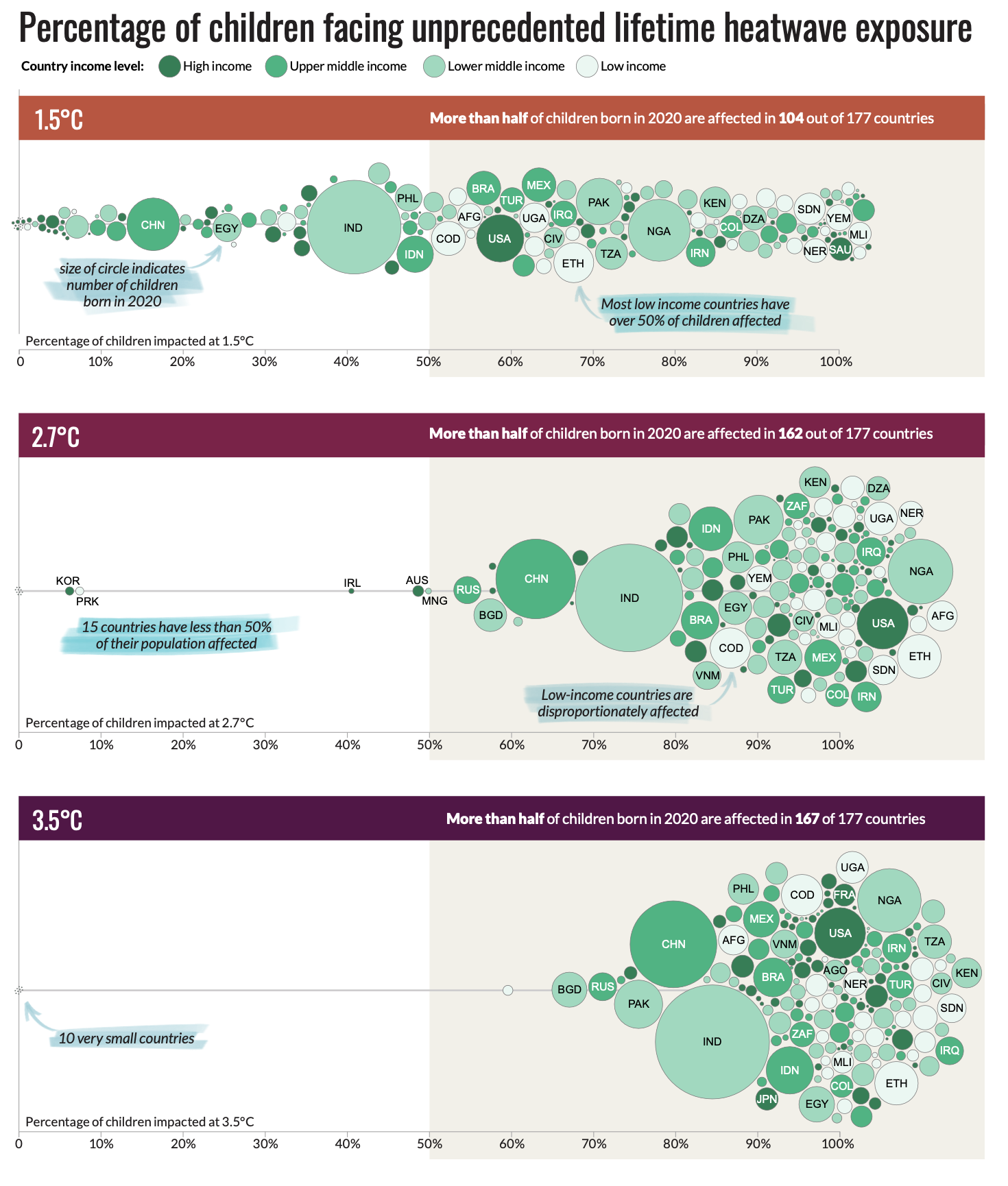
The charity Save the Children has published a report which unpacks the findings of the study. The graphic below, from the report, shows the percentage of people from different countries born in 2020 who will face unprecedented lifetime exposure to heatwaves under the 1.5C (top), 2.5C (middle) and 3.5C (bottom) warming scenarios.

Each circle shows a country, indicated by its three-letter countries code. The size of the circle indicates the number of people in the country. Darker circles indicate higher-income countries. 

Circles on the right hand side of the graphic indicate that more than half of the country’s 2020 cohort will be exposed to unprecedented heatwaves in their lifetime. 

The percentage of people born in 2020 who will face unprecedented lifetime exposure to heatwaves
The percentage of people born in 2020 who will face unprecedented lifetime exposure to heatwaves under the 1.5C (top), 2.5C (middle) and 3.5C (bottom) warming scenarios. Each circle indicates a country, indicated by its three-letter countries code. The size of the circle indicates the number of people in the country. Darker circles indicate higher-income countries. Source: Save the Children

“The evidence is now inescapable that heatwaves impact every community around the world,” Dr Luke Harrington, a senior lecturer in environmental science at the University of Waikato, who was not involved in the study, tells Carbon Brief. He adds: 

“This paper offers the clearest view that climate change is verifiably unfair: those who have done the least to contribute to rising global temperatures will experience the most extreme impacts.”

From floods to fires

The authors apply the same method to five other climate extremes – crop failure, wildfires, droughts, floods and tropical cyclones.

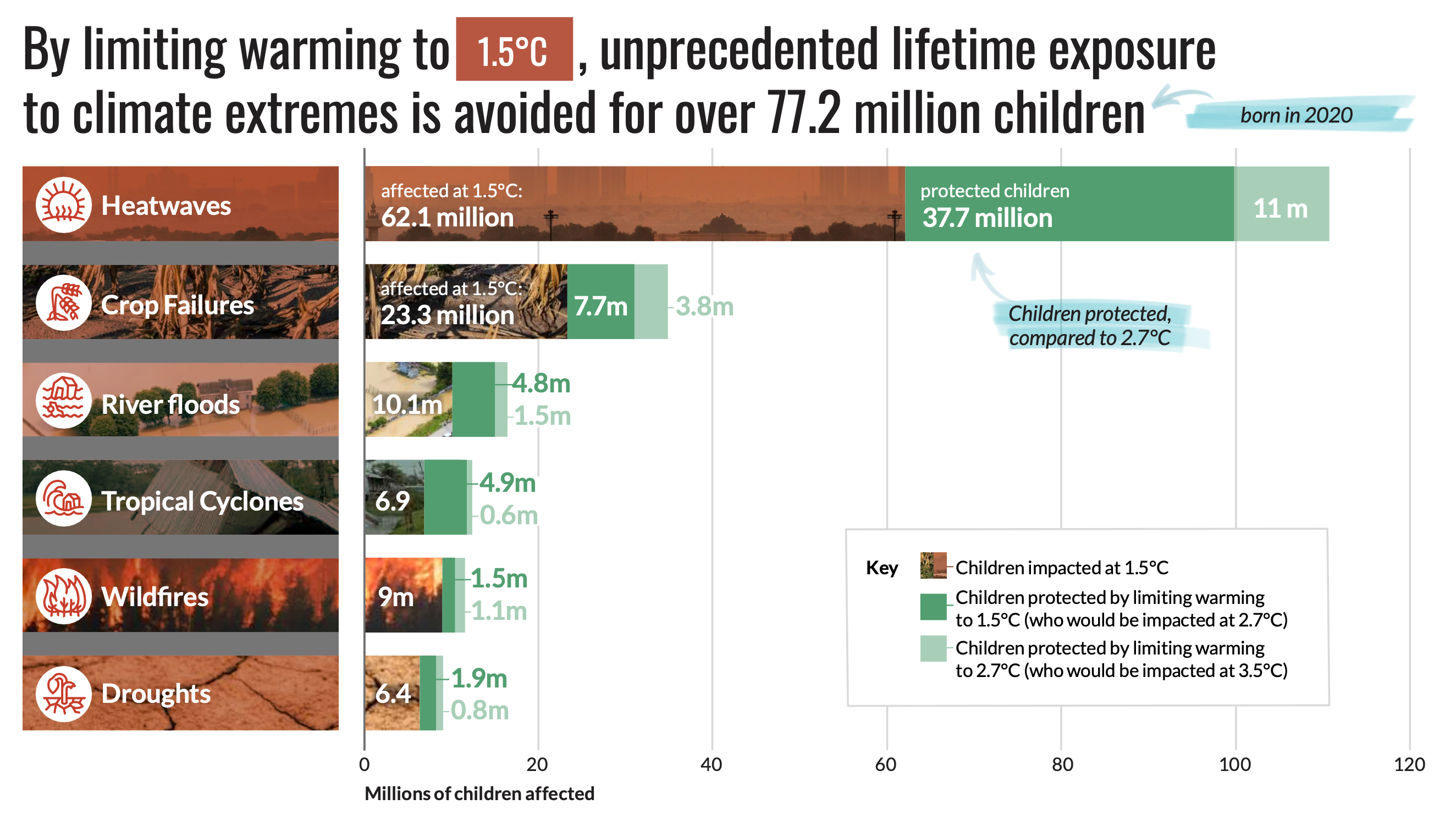
The graphic below shows the key findings. The coloured portion of the bar shows the number of people born in 2020 who will face unprecedented exposure to each extreme under a 1.5C warming pathway. The dark green and light green bars show the additional exposure under 2.7C and 3.5C warming.

Number of people born in 2020 who will face “unprecedented lifetime exposure” to heatwaves, crop failures, river floods, tropical cyclones, wildfires and droughts
Number of people born in 2020 who will face “unprecedented lifetime exposure” to heatwaves, crop failures, river floods, tropical cyclones, wildfires and droughts under 1.5C 2.7C and 3.5C warming. Source: Save the Children

The authors find that unprecedented lifetime exposure to heatwaves will affect the most people, with 62 million people born in 2020 likely to face unprecedented exposure to heat in their lifetimes if warming is limited to 1.5C.

This is followed by crop failures and river floods, which will impact 23 million and 10 million people from the 2020 birth cohort under the 1.5C warming pathway, respectively.

Lead author Grant tells Carbon Brief that he is “most confident” about his heatwave findings because temperature is a “basic” metric for climate models to “get right”.

Meanwhile, extremes such as crop failure depend on a range of factors including soil moisture, land-atmosphere interactions and rainfall, which can make it harder for the models to accurately capture changes, Grant explains.

Vulnerability

The authors also assess how “socioeconomic vulnerability” affects their findings using a global deprivation index – a tool which measures the level of disadvantage and hardship experienced by individuals or communities in a particular geographic area.

The authors use the index to identify the 20% most and least vulnerable people in each age cohort. They find that the most vulnerable groups are overwhelmingly from African countries.

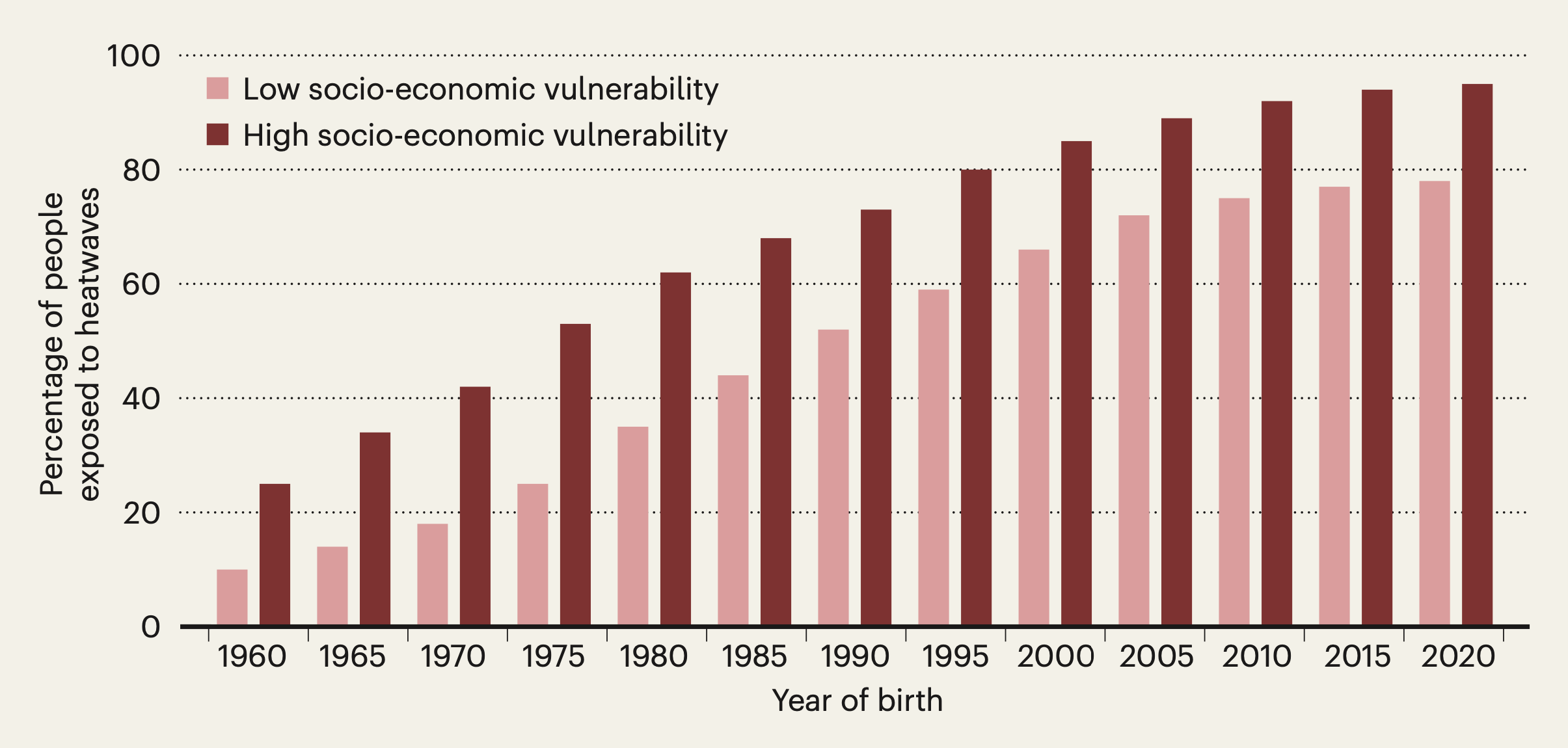
The authors also conclude that “socioeconomically vulnerable people have a consistently higher chance of facing unprecedented lifetime heatwave exposure compared to the least vulnerable members of their generation”.

The graph below, taken from a news and views article about the study, shows the percentage of high vulnerability (red) and low vulnerability (pink) people in each age cohort who would be exposed to unprecedented heat, under a 2.7C warming scenario. 

The percentage of high vulnerability (red) and low vulnerability (pink) people in each age cohort who would be exposed to unprecedented heat,
The percentage of high vulnerability (red) and low vulnerability (pink) people in each age cohort who would be exposed to unprecedented heat, under a 2.7C warming scenario. Source: Gualdi and Muttarak (2025).

Dr Marina Romanello, a research fellow at the University College London and research director of the Lancet Countdown on Health and Climate Change who was not involved in the study, tells Carbon Brief that the paper “is an important addition to the scientific literature, showing how our delays in tackling climate change are putting the future of our children at risk”. 

She adds:

“The authors have used well-established models to project future health threats, framing them around what matters the most: the wellbeing, health and survival of present and future generations.”

Grant, L. et al. (2025) Global emergence of unprecedented lifetime exposure to climate extremes, Nature, doi:10.1038/s41586-025-08907-1

Original article republished from Carbon Brief under a CC license

Continue ReadingChildren born in 2020 will face ‘unprecedented exposure’ to climate extremes

Revealed: Forecasts of greenhouse gas emissions from fossil fuels soar in Trump’s first 100 days

Spread the love

https://www.theguardian.com/us-news/2025/may/02/trump-drill-baby-drill-tariffs

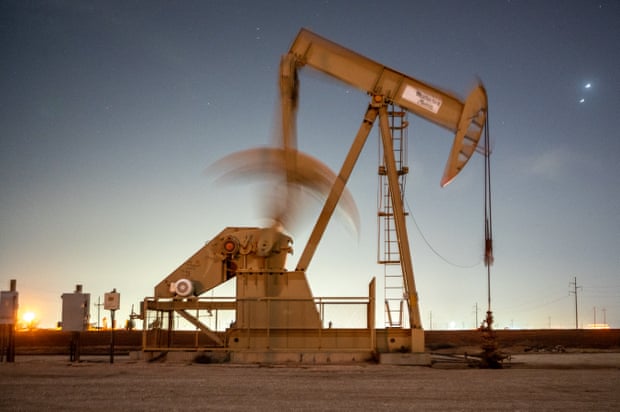
Expected greenhouse gas emissions from US oil and gas fields has jumped under Trump, after previously dropping under Biden, forecasts show. Photograph: Bloomberg/Getty Images

Tariff chaos hampers Trump’s pledge to ‘drill, baby, drill’, but analysis still shows surge in planet-heating emissions

Donald Trump’s ambitions for the US to “drill, baby, drill” for more fossil fuels have ironically been hampered by the economic chaos unleashed by his own tariffs, but the US is still on track to increase oil and gas extraction, causing a surge in planet-heating emissions, a new analysis shows.

The US was already the world’s leading oil and gas power, producing more of the fossil fuels than any country in history during Joe Biden’s administration. But Trump has sought to escalate this further, declaring an “energy emergency” to open up more land and ocean for drilling and launching an unprecedented assault on environmental regulations in his first 100 days back in the White House.

This new political climate means that the expected amount of greenhouse gas emissions from active and planned projects in US oil and gas fields has jumped under Trump, after previously dropping under Biden, forecasts shared with the Guardian show.

Despite awarding more drilling leases than Trump in his first 100 days, Biden also pursued policies to combat the climate crisis that saw oil and gas companies revise down their production estimates. That situation has now reversed, threatening a pulse of new pollution that will further add to the fever of a planet already suffering from heatwaves, floods, droughts and other disasters accelerated by global heating.

“The uptick in embodied emissions from forecast US oil and gas production is worrying,” said Olivier Bois von Kursk, policy adviser at the International Institute for Sustainable Development, which tracks emissions projections from the lifetime of projects, based on data from research consultancy Rystad Energy. “The world can’t afford more climate chaos.”

The International Energy Agency, which has forecast that global oil and gas demand will peak by 2030, has said that no new major fossil fuel projects can occur if the world is to stay within agreed temperature limits and avoid catastrophic climate impacts. Last year was the hottest, worldwide, ever recorded and governments are collectively failing to meet targets to avert escalating disasters.

Tariffs on solar panels from Vietnam, Cambodia and Malaysia have been ratcheted up to as much as 3,521%. “We don’t want windmills in this country,” the president said shortly after his inauguration in January. “We don’t want windmills. You know what else people don’t like? Those massive solar fields.”

https://www.theguardian.com/us-news/2025/may/02/trump-drill-baby-drill-tariffs

Neo-Fascist Climate Science Denier Donald Trump says Burn, Baby, Burn.
Elon Musk urges you to be a Fascist like him, says that you can ignore facts and reality then.
Orcas discuss Donald Trump and the killer apes' concept of democracy. Front Orca warns that Trump is crashing his country's economy and that everything he does he does for the fantastically wealthy.
Orcas discuss Donald Trump and the killer apes’ concept of democracy. Front Orca warns that Trump is crashing his country’s economy and that everything he does he does for the fantastically wealthy.

‘A ruthless agenda’: charting 100 days of Trump’s onslaught on the environment

Continue ReadingRevealed: Forecasts of greenhouse gas emissions from fossil fuels soar in Trump’s first 100 days

More than 150 ‘unprecedented’ climate disasters struck world in 2024, says UN

Spread the love

https://www.theguardian.com/environment/2025/mar/19/unprecedented-climate-disasters-extreme-weather-un-report

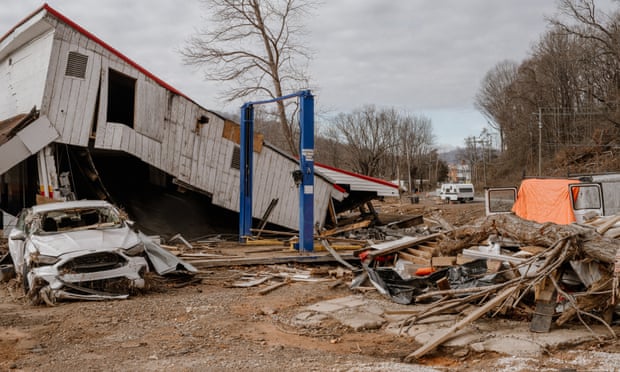
A destroyed mechanic’s shop in downtown Swannanoa, North Carolina, US, December 2024, nearly three months after Hurricane Helene in late September. Photograph: Mike Belleme/The Guardian

Floods, heatwaves and supercharged hurricanes occurred in hottest climate human society has ever experienced

The world is already deep into the climate crisis, with the WMO report saying that for the first time, the 10 hottest years on record all occurred in the last decade. However, global carbon emissions have continued to rise, which will bring even worse impacts. Experts were particularly critical of the purge of climate scientists and programmes by the US president, Donald Trump, saying that ignoring reality left ordinary people paying the price.

“Leaders must step up – seizing the benefits of cheap, clean renewables for their people and economies – with new national climate plans due this year,” said the UN secretary general, António Guterres.

Dr Luke Parsons, of the Nature Conservancy, said: “Every year, we venture further into uncharted territory, with 2024 the hottest year modern human society has ever experienced. Yet the coming decade is expected to be even hotter, pushing us deeper into this unprecedented climate.”

Previous research determining the role of the climate crisis in what are now unnatural disasters has shown that at least 550 heatwaves, floods, storms, droughts and wildfires had been made significantly more severe or more frequent by global heating.

Original article by The Guardian at https://www.theguardian.com/environment/2025/mar/19/unprecedented-climate-disasters-extreme-weather-un-report

Neo-Fascist Climate Science Denier Donald Trump says Burn, Baby, Burn.
Elon Musk urges you to be a Fascist like him, says that you can ignore facts and reality then.
Orcas comment on killer apes destroying the planet by continuing to burn fossil fuels.
Continue ReadingMore than 150 ‘unprecedented’ climate disasters struck world in 2024, says UN

Eight times more children will face extreme heatwaves by 2050s, Unicef says

Spread the love
Experienced climbers scale a rock face near the historic Dumbarton castle in Glasgow, releasing a banner that reads “Climate on a Cliff Edge.” One activist, dressed as a globe, symbolically looms near the edge, while another plays the bagpipes on the shores below. | Photo courtesy of Extinction Rebellion and Mark Richards

https://www.theguardian.com/global-development/2024/nov/20/children-extreme-heatwaves-2050s-un

Without action on climate crisis, far greater numbers will also experience floods, wildfires and droughts, according to report

Eight times as many children around the world will be exposed to extreme heatwaves in the 2050s, and three times as many will face river floods compared with the 2000s if current trends continue, according to the UN.

Nearly twice as many children are also expected to face wildfires, with many more living through droughts and tropical cyclones, according to the annual state of the world’s children report.

The report, released on Wednesday, World Children’s Day, forecasts how the climate crisis, demographic shifts (sub-Saharan Africa and south Asia are projected to have the largest child populations in the 2050s) and breakthrough technologies will affect children’s lives in the future.

The report said technologies such as artificial intelligence (AI) will bring benefits and risks to children, who are already interacting with AI embedded in apps, games and learning software. The digital divide remains stark, however. In 2024, almost 95% of people in high-income countries are connected to the internet, compared with about 25% in low-income countries.

“Children are experiencing a myriad of crises, from climate shocks to online dangers, and these are set to intensify in the years to come,” said Catherine Russell, Unicef’s executive director. “The decisions world leaders make today – or fail to make – define the world children will inherit … Decades of progress, particularly for girls, are under threat.”

Much of the emphasis of the report is on the impact of the climate crisis on children, nearly half of whom (approximately 1 billion) live in countries that face a high risk of environmental disasters. Even before they take their first breath, children’s brains, lungs and immune systems are susceptible to pollution, disease and extreme weather. As they grow, their education, nutrition, safety, security and mental health are shaped by the climate and environment.

https://www.theguardian.com/global-development/2024/nov/20/children-extreme-heatwaves-2050s-un

Greenpeace activists display a billboard during a protest outside Shell headquarters on July 27, 2023 in London.
Greenpeace activists display a billboard during a protest outside Shell headquarters on July 27, 2023 in London. (Photo: Handout/Chris J. Ratcliffe for Greenpeace via Getty Images)

Continue ReadingEight times more children will face extreme heatwaves by 2050s, Unicef says