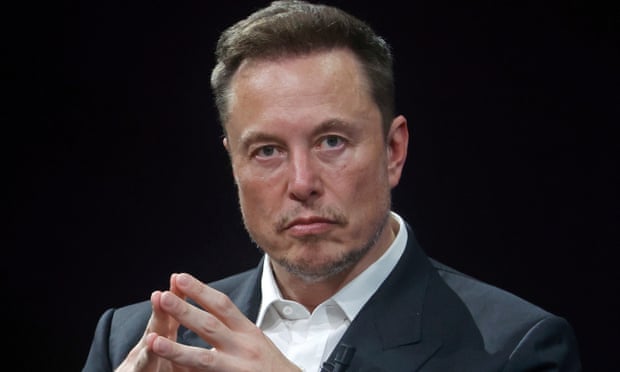
Elon Musk responded on X that ‘parody is legal in America’. Photograph: Chesnot/Getty Images
Doctored campaign video featuring US vice-president reposted by Tesla chief executive watched 128m times
Kamala Harris’s election campaign has accused Elon Musk of spreading “manipulated lies” after the Tesla chief executive posted a doctored video featuring the vice-president on his X account.
Musk reposted a manipulated Harris campaign video on Friday evening in which a fake Harris voiceover says: “I was selected because I am the ultimate diversity hire,” and that anyone who criticises her is “both sexist and racist”.
Amy Klobuchar, a Democratic senator, accused Musk of violating the platform’s guidelines. According to X’s synthetic and manipulated media policy, users are barred from sharing “synthetic, manipulated, or out-of-context media that may deceive or confuse people and lead to harm” although allowances are made for satire provided it does not “cause significant confusion about the authenticity of the media”.
A spokesperson for Harris’s presidential campaign said: “The American people want the real freedom, opportunity and security Vice-President Harris is offering; not the fake, manipulated lies of Elon Musk and Donald Trump.”
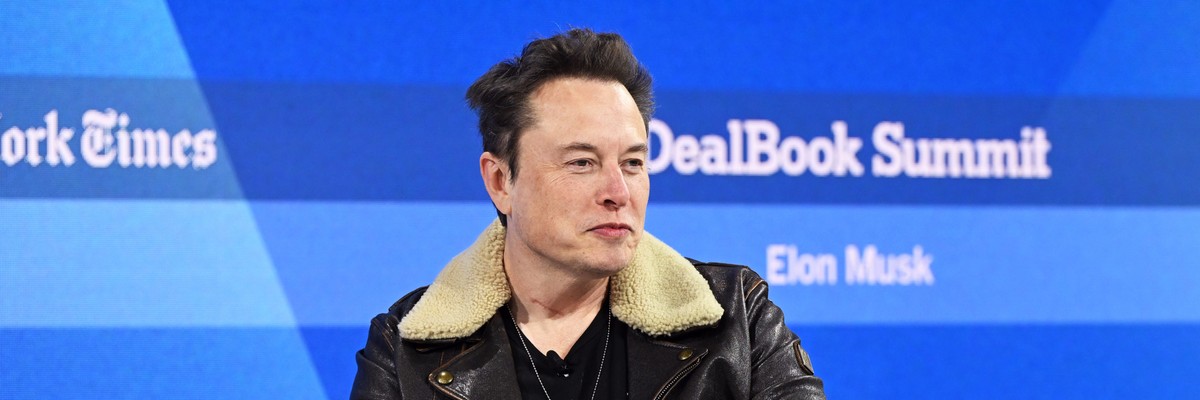
Elon Musk speaks at an event on November 29, 2023 in New York City. (Photo: Slaven Vlasic/Getty Images for The New York Times)
The Vermont senator said Musk has done “an exceptional job of demonstrating a point that we have made for years—and that is the fact we live in an oligarchic society.”
U.S. Sen. Bernie Sanders on Tuesday took the unusual step of applauding Elon Musk—but not for reasons that the Tesla CEO and world’s richest man would likely find flattering.
In the wake of reports indicating that Musk plans to inject $45 million per month into a new super PAC supporting former President Donald Trump’s bid for another four years in the White House, Sanders (I-Vt.) thanked Musk for doing “an exceptional job of demonstrating a point that we have made for years—and that is the fact we live in an oligarchic society in which billionaires dominate not only our economic life and the information we consume, but our politics as well.”
“And let me be clear. While the size of Musk’s financial contribution is particularly egregious, he is not alone in attempting to buy this election to further his own needs,” Sanders continued. “Other billionaires are also playing a significant role—in both political parties. Oh, I know… here goes Bernie Sanders again about Citizens United and the role of money in politics. I have no shortage of critics who accuse me of being boring and of hammering away at the same themes year after year after year.”
“They’re probably right. I am repetitious, but that’s because the problems we care about are only getting worse,” he added. “Let’s be clear. It has never made sense to me, then or now, that a tiny clique of people should have incredible wealth and power while most people have none.”
“While people like Elon Musk try to buy elections for Donald Trump, people who work for low wages, have no health insurance, can’t afford prescription drugs, and can’t find affordable housing are giving up on politics.”
Citing unnamed sources, The Wall Street Journal and Bloomberg reported earlier this week that Musk has pledged to donate $45 million per month to America PAC, whose founding donors include ultra-rich tech investors who are part of Musk’s social circle. The New York Timesseparately reported that “one leader of America PAC told a friend that the group expected to have a major donor who would make donations in four batches, adding up to as much as $160 million over the course of the campaign.”
The Journal and Bloomberg stories—which Musk denied with a meme that included the words “fake gnus”—followed reports that Musk had already given the super PAC a substantial sum of money despite his March declaration that he is “not donating money to either candidate for U.S. president.”
Musk formally endorsed Trump on X—the social media platform Musk owns—following an assassination attempt against the former president this past weekend in Pennsylvania. Conspiracy theories about the attempt on Trump’s life proliferated rapidly on X, with the help of Musk himself.
The Tesla CEO’s name did not appear on America PAC’s disclosure filings for June, which could mean that he donated to the PAC earlier this month.
Musk, who is worth over $250 billion, is one of more than a dozen billionaires supporting Trump and his newly chosen running mate, Sen. JD Vance (R-Ohio). Axios and the Times reported Tuesday that Musk personally lobbied Trump to make Vance his vice presidential pick.
Musk and other U.S. billionaires got $1 trillion richer during Trump’s first four years in office, gains fueled by massive tax cuts he signed into law in 2017.
Why are billionaires like Peter Thiel, Rupert Murdoch, Stephen Schwartzman, and the owner of this website rallying behind Trump?
Yes, the tax cuts. But there's more.
The more Trump tears down democracy, the safer the oligarchy becomes.
Sanders wrote in his email Tuesday that Musk’s influence on the 2024 election could be particularly pronounced given his ownership of X, the social media platform formerly known as Twitter.
Musk, Sanders wrote, has used the platform “to amplify the voices of conspiracy theorists who deny the results of the last election and spread the dangerous idea that Democrats want to allow mass, undocumented migration to the country to replace, electorally, the votes of white people.”
“The reality is that while people like Elon Musk try to buy elections for Donald Trump, people who work for low wages, have no health insurance, can’t afford prescription drugs, and can’t find affordable housing are giving up on politics,” the senator continued. “They see the rich getting richer as they use their wealth to buy influence, and wonder whether anyone in Washington even knows what is going on in their lives.”
Sanders argued that to end the pernicious political influence of Musk and other billionaires, it is essential to elect candidates who support overturning Citizens United v. Federal Election Commission, the 2010 Supreme Court decision that spawned the super PACs now playing a massive role in the nation’s elections.
“It is an issue that should concern all Americans—regardless of their political point of view—who wish to live under a government that represents all of the people and not just a handful of powerful special interests,” Sanders wrote. “Taking action is not just good politics, it is also good policy. Because the truth is, campaign finance reform is the most important issue facing us today, because it impacts all the others.”
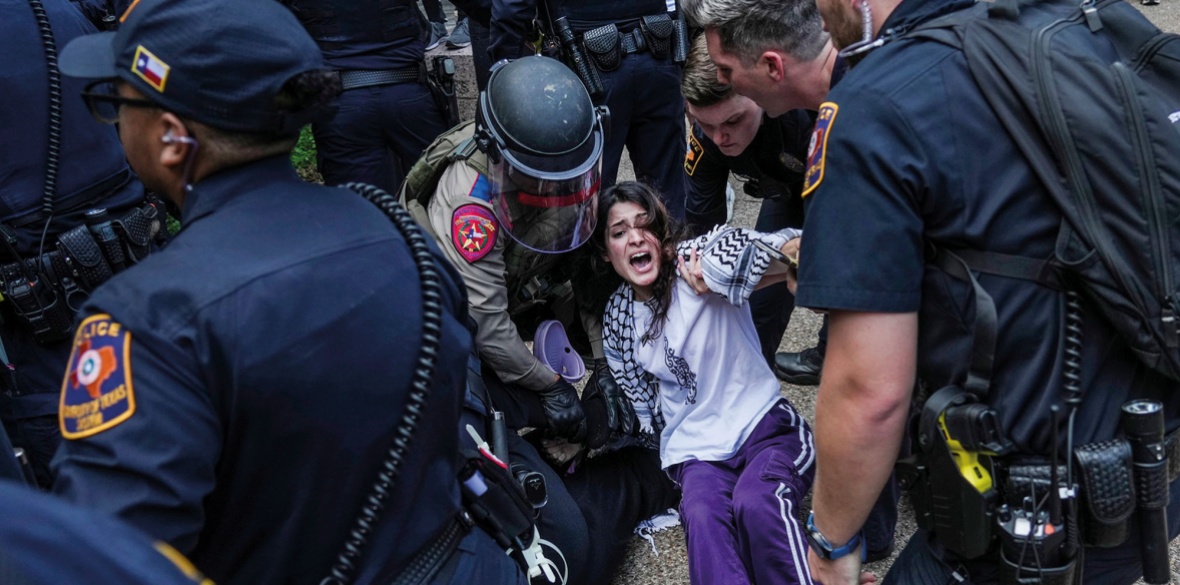
FREE SPEECH NATION? Arrests are made as pro-Palestinian students and protesters are pushed off campus at the University of Texas, Wednesday April 24
While people across the world have been taking bold action in support of Palestine, the global North ruling class has used all tools at its disposal to support Israel’s genocide and criminalise solidarity writes VIJAY PRASHAD
ISRAELI BOMBS continue to fall on Gaza, killing Palestinian civilians with abandon. Al-Jazeera published a story about the destruction of 24 hospitals in Gaza, each of them bombed mercilessly by the Israeli military. Half of the 35,000 Palestinians killed by Israel were children, their bodies littering the overwhelmed morgues and mosques of Gaza.
The former UN assistant secretary-general for human rights, Andrew Gilmour, told BBC Newsnight that the Palestinians are experiencing “collective punishment” and that what we are seeing in Gaza is “probably the highest kill rate of any military, killing anybody, since the Rwandan genocide of 1994.”
Meanwhile, in the West Bank section of Palestine, Human Rights Watch shows that the Israeli military has participated in the displacement of Palestinians from 20 communities and has uprooted at least seven communities since October 2023. These are established facts.
Yet, these facts — according to a leaked memorandum — cannot be spoken about in the “newspaper of record” in the US, the New York Times. Journalists at the paper were asked to avoid the terms “genocide,” “ethnic cleansing” and “occupied territory.”
Indeed, over the past six months, newspapers and television shows in the US have generally written about the genocidal violence using passive voice: bombs fell, people died.
Even on social media, where the terrain is often less controlled, the axe fell on key phrases; for instance, despite his professions of commitment to free speech, Elon Musk said that terms such as “decolonisation” and phrases such as “From the river to the sea” would be banned on X.
“We can’t go beyond the laws of a country,” Musk has said (Wall Street Journal, 4/8/24)—unless, of course, he doesn’t like the government making the laws.
Elon Musk, the right-wing anti-union billionaire owner of Twitter (recently rebranded as X), has cast his defiance of a Brazilian judicial ruling as a free speech crusade against censorship. Such framing is, of course, bullshit. It is instead a political campaign by a capitalist to use social media to reshape global politics in favor of the right. And it’s important that we all understand why that is.
As Reuters (4/7/24) reported, Brazilian Supreme Court Justice Alexandre de Moraes ordered “the blocking of certain accounts” on Twitter, prompting Musk to announce that Twitter would defy the judge’s orders “because they were unconstitutional.” He went on to call for Moraes’ resignation.
It isn’t clear which accounts are being targeted, but the judge is investigating “‘digital militias’ that have been accused of spreading fake news and hate messages during the government of former far-right President Jair Bolsonaro.” He’s also probing “an alleged coup attempt by Bolsonaro.”
The AP (4/8/24) then reported that the judge opened up an inquest into Musk directly, saying the media mogul “began waging a public ‘disinformation campaign’ regarding the top court’s actions.”
Musk claimed that he’s doing this in the name of free speech at the expense of profit, saying “we will probably lose all revenue in Brazil and have to shut down our office there” (Wall Street Journal, 4/8/24). He added that “principles matter more than profit.”
Michael Shellenberger (Public, 4/8/24), an enthusiastic pro-Musk pundit, was less restrained, saying the judge “has taken Brazil one step closer to being a dictatorship.” To Shellenberger, it’s “clear that Elon Musk is the only thing standing in the way of global totalitarianism.”
‘Par for the course’
Verge (1/25/23): “The documentary’s ban isn’t an example of Musk violating a vocal ‘free speech absolutist’ ethos. It’s a reminder that Musk has always been fine with government censorship.”
Anyone with a memory better than Shellenberger’s will recall that Musk’s Twitter has been all too eager to censor content at the request of the Indian government, including a BBC documentary that was critical of Prime Minister Narendra Modi (Verge, 1/25/23). India under Modi, who heads the right-wing Hindu nationalist BJP party, has seen a steep decline in press freedom, worrying journalists and free speech advocates (New York Times, 3/8/23; NPR, 4/3/23; Bloomberg, 2/25/24). At the same time Musk was pretending to defend free speech in Brazil, he was bragging about traveling to India to meet with Modi (Twitter, 4/10/24).
Musk suppressed Twitter content in the Turkish election in response to a request from Turkish President Recep Erdoğan, saying the “choice is have Twitter throttled in its entirety or limit access to some tweets. Which one do you want?” This move, he insisted, was “par for the course for all Internet companies” (Vanity Fair, 5/14/23). Turkey, with its laws against insulting the Turkish identity (Guardian, 11/16/21), is a country that is almost synonymous with the suppression of free speech—it ranks 165 out of 180 on Reporters Without Borders’ press freedom index. Yet Musk didn’t seem to feel the need to intervene to save democracy through his social media network.
The impact of Musk’s decision to censor Twitter when it comes to Turkey and India isn’t just that it exposes his duplicity when it comes to free speech, but it robs the global public of vital points of view when it comes to these geopolitically important countries. In essence, the crime is not so much that Musk is hypocritical, but that his administration of the social media site has kept readers in the dark rather than expanding their worldview.
Grappling with balance
AP (10/25/22) reported that Brazilian social media posts claimed that Lula “plan[ned] to close down churches if elected” and that Bolsonaro “confess[ed] to cannibalism and pedophilia.”
The context in Brazil is that in the last presidential election, in 2022, the leftist challenger Lula da Silva ousted the incumbent, Bolsonaro (NPR, 10/30/22), who has since been implicated in a failed coup attempt that closely resembled the January 6, 2021, riot at the US Capitol (Reuters, 3/15/24). Ever since, tech companies have bristled at Brazil’s attempt to curb the influence of fake news, such as a bill that would put “the onus on the internet companies, search engines and social messaging services to find and report illegal material” (Guardian, 5/3/23).
Brazil experienced a flurry of disinformation about the candidates in the run-up to the election, inspiring the country’s top electoral court to ban “false or seriously decontextualized” content that “affects the integrity of the electoral process” (AP, 10/25/22).
The Washington Post (1/9/23) reported that social media were “flooded with disinformation, along with calls in Portuguese to ‘Stop the Steal,’” and demands for “a military coup” in response to a possible Lula victory. And while these problems existed in various online media, a source told the Post that this occurred after Musk fired people in Brazil “who moderated content on the platform to catch posts that broke its rules against incitement to violence and misinformation.”
While Turkey and India are brazenly attempting to suppress opinions the government doesn’t like, a democratic Brazil is grappling with how to balance maintaining a free internet while protecting elections from malicious interference (openDemocracy, 1/3/23).
Despotic future
Brazilian Report (4/9/24): “Billionaire Elon Musk joined this week a campaign led by the Brazilian far-right to characterize Brazil as a dictatorship.”
Lula’s victory, in addition to being a source of hope for Brazil’s poor and working class (Bloomberg, 4/25/23), was seen as a blow to the kind of right-wing despotism espoused by people like Bolsonaro, who represents a past of US-aligned terror-states that use military force to protect US interests and suppress egalitarian movements in the Western Hemisphere (Human Rights Watch, 3/27/19). As Brazilian Report (4/9/24) put it, Musk has joined a “campaign led by the Brazilian far right.”
Indeed, the Wall Street Journal (4/10/24) noted that Musk’s tussle in the Brazilian judiciary was an extension of his alignment with the Brazilian right:
Supporters of former right-wing President Jair Bolsonaro, who gave Musk a medal during his visit in 2022 to announce plans to install satellites over the Amazon rainforest, have reveled in Musk’s defiance, declaring him a “hero,” as the dividing lines in Brazil’s culture wars deepen.
Erdoğan and Modi represent more successful iterations of neo-fascist ideology over liberal democracy. The dystopian societies they oversee make up the political model that the MAGA movement would like to impose in the United States, where a caudillo is unchecked by independent courts, the press and other civil institutions, while rights for workers and marginalized groups are eviscerated.
Musk isn’t simply displaying hypocrisy when he pretends to fight for free speech in Brazil while Twitter censors speech when it comes to India and Turkey. If anything, he is being consistent in his quest to use his corporate wealth to alter the political landscape against liberal democracy and toward a dark, despotic future.
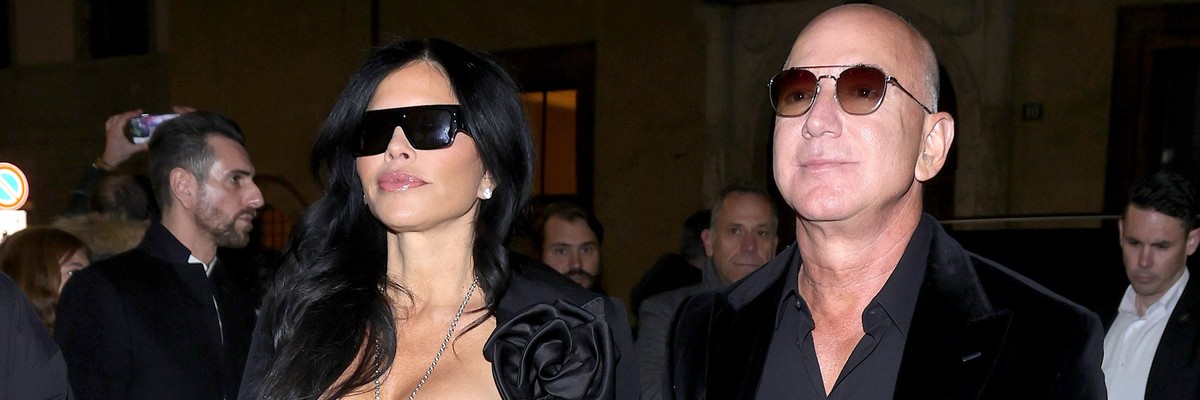
Jeff Bezos and his fiancée Lauren Sánchez arrive at an event in Milan, Italy on January 13, 2024. (Photo: Jacopo Raule/Getty Images)
It’s been a rough few years for most people around the world—but not these folks.
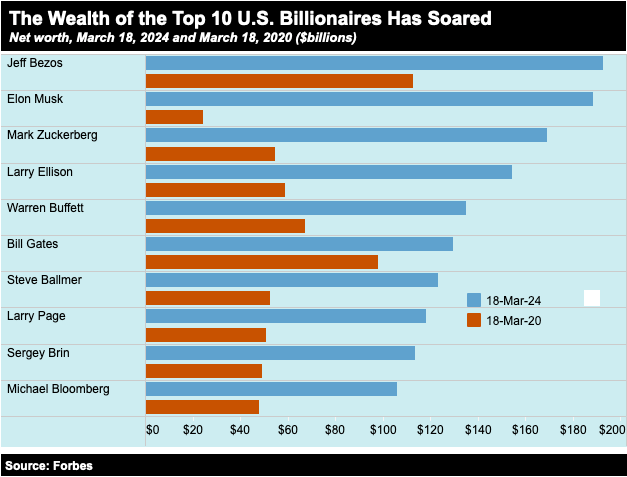
Four years ago, the United States entered the Covid-19 pandemic. Forbes published its 34th annual billionaire survey shortly after with data keyed to March 18, 2020. On that day, the United States had 614 billionaires who owned a combined wealth of $2.947 trillion.
Four years later, on March 18, 2024, the country has 737 billionaires with a combined wealth of $5.529 trillion, an 87.6 percent increase of $2.58 trillion, according to Institute for Policy Studies calculations of Forbes Real Time Billionaire Data. (Thank you, Forbes!)
The last four years have been great for particular billionaires:
On March 18, 2020, Tesla CEO Elon Musk had wealth valued just under $25 billion. By May 2022, his wealth had surged to $255 billion. As of March 18, 2024, Musk is at $188.5 billion, more than a seven-fold increase in four years.
Over four years, Amazon founder Jeff Bezos has seen his wealth increase from $113 billion to 192.8 billion, even after paying out tens of billions in a divorce settlement and donating tens of billions to charity.
Three Walton family members — Jim, Alice, and Rob — are the principal heirs to the Walmart fortune. They saw their combined assets rise from $161.1 billion to $229.6 billion.
In 2020, only one billionaire — Jeff Bezos — had $100 billion or more. Today, the entire top ten are centi-billionaires, bringing their collective wealth to a staggering $1.4 trillion.
The only billionaire on the 2020 top 15 wealthiest Americans list to see their wealth decline in four years was MacKenzie Scott. Four years ago, on March 18, 2020, the ex-wife of Jeff Bezos had a net worth of $36 billion. It has declined to $35.4 billion due to her aggressive giving to charity.
For more details on how America’s billionaires have fared since the onset of the pandemic, check out our updates page.