Tag: Elon Musk

  • Here’s How the ‘Jet-Owning Oligarchy’ Harms Both Planet and Workers

    Spread the love

    Original article by KENNY STANCIL republished from Common Dreams under Creative Commons (CC BY-NC-ND 3.0).

    A new analysis catalogs alarming facts about the destructive private jet industry, which is emblematic of runaway economic and carbon inequality.

    Research published Monday details how the working class is paying the price, in more ways than one, for the “jet-owning oligarchy” to hop around the globe in their personal luxury planes.

    It’s well-established that private jet travel by the super-rich is worsening the fossil fuel-driven climate crisis. Adding insult to injury, this conspicuously carbon-intensive consumption is being subsidized by ordinary taxpayers, as the Institute for Policy Studies (IPS) and Patriotic Millionaires make clear in their new analysis.

    Entitled High Flyers 2023: How Ultra-Rich Private Jet Travel Costs the Rest of Us and Burns Up Our Planet, the report catalogs alarming facts about the private jet industry and makes recommendations about how to rein in this potent symbol and manifestation of escalating inequality.

    To begin with, “private jets emit at least 10 times more pollutants than commercial planes per passenger,” the report notes. “Unsurprisingly, approximately 1% of people are believed to be responsible for about half of all aviation carbon emissions.”

    Amid a surge in wealth inequality since the start of the Covid-19 pandemic, “private jet use has increased by about a fifth, and private jet emissions have increased more than 23%,” the report points out. “The private jet sector set industry records with regards to transaction and dollar volume in 2021 and 2022.”

    While a coronavirus-era boom is evident, the industry has been growing steadily alongside wealth inequality since the turn of the century. As the report states: “The size of the global fleet has increased 133% in the last two decades from 9,895 in 2000 to 23,133 in mid-2022. This bonanza was accompanied by an unprecedented number of business jet operations, 5.3 million in 2022.”

    “If we can’t ban private jets, we should at least tax them and require them to pay to offset their environmental damage and subsidies.”

    According to the report, “The median net worth of a full and fractional private jet owner is $190 million and $140 million respectively.” A minuscule 0.0008% of the global population belongs to the jet-owning class, which consists mostly of financial and real estate tycoons.

    Last year, billionaire Elon Musk, “the most active high flyer in the United States,” bought a new jet and took 171 private flights, or about one every other day, the report notes.

    In so doing, he single-handedly “contributed to the consumption of 837,934 liters of jet fuel,” states the report, and he “was responsible for 2,112 tons of carbon emissions”—132 times more than the entire carbon footprint of an average person in the United States.

    In a statement, report co-author Kalena Thomhave, a researcher with the Program on Inequality and the Common Good at IPS, called private jets “a microcosm of our system of wealth inequality even beyond their image of extravagance.”

    “Private flyers pay just 2% of the taxes that primarily fund the Federal Aviation Administration, yet nearly 17% of flights handled by the FAA are private,” said Thomhave. “Meanwhile, private jets contribute disproportionately to carbon emissions while often representing significant tax savings for their wealthy owners.”

    As the report observes: “Thousands of municipal airports in the U.S. are funded by the public, but many primarily serve private and corporate jets. These airports may not offer scheduled passenger service, but they still offer airport runways subsidized by taxes.”

    Such regressive taxation is the product of industry lobbying, the report explains:

    The largest player in the private jet lobby, the National Business Aviation Association, has spent an average $2.4 million each year since 2008 lobbying the federal government, primarily for tax giveaways. During the Covid-19 pandemic, the industry specifically lobbied for Covid relief, particularly “medium to long-term liquidity assistance and relief from air transportation excise taxes,” even though industry demand was quickly climbing.

    As wealth inequality soars, so too does the value of the private jet market, which grew from $32.3 billion in 2021 to $34.1 billion in 2022, the report notes. With wealth being concentrated in fewer and fewer hands and little to no downward redistribution on the horizon, the private jet industry is projected to expand further in the coming years.

    Report co-author Omar Ocampo, a researcher with the Program on Inequality and the Common Good at IPS, said that the private jet industry’s expected growth this decade “provides us with a great opportunity to levy a luxury transfer tax on private jet sales.” He added that “the revenue raised from this tax can be invested towards developing a green transportation system.”

    According to the report, “A 10% and 5% transfer fee on pre-owned and new private aircraft would have raised $2.4 billion in 2021 and $2.6 billion in 2022.”

    In addition to imposing a transfer tax on all private jet sales, IPS and Patriotic Millionaires recommend the following steps be taken:

    • Levy a private jet fuel tax;
    • Institute a “short hop” surcharge;
    • Resist efforts to increase passenger facility charges until private jet owners pay their fair share;
    • Create a sustainable transportation equity trust fund;
    • Increase TSA security oversight of private jets; and
    • Pass the Aircraft Ownership Transparency Act.

    According to the report, Musk would have paid nearly $4 million in additional taxes last year if a transfer fee and jet fuel tax had been in place.

    “Private jet travel by billionaires and the ultra-wealthy imposes a tremendous cost on the rest of us,” said Chuck Collins, another co-author of the report.

    “Not only do ordinary travelers and taxpayers subsidize the air space for private jets, but the high flyers also contribute considerably more pollution than other passengers,” said Collins. “If we can’t ban private jets, we should at least tax them and require them to pay to offset their environmental damage and subsidies.”

    Original article by KENNY STANCIL republished from Common Dreams under Creative Commons (CC BY-NC-ND 3.0).

  • Ultra-rich private jet travel has soared since the pandemic – and emissions followed

    Spread the love

    https://www.energymonitor.ai/policy/ultra-rich-private-jet-travel-has-soared-since-the-pandemic-and-emissions-followed/

    The private jet sector has boomed since the start of the pandemic, reveals a report from the progressive think tank Institute for Policy Studies (IPS) and nonpartisan organisation Patriotic Millionaires. While there was a drop in private flights in 2020, the sector picked up quickly again and saw an unprecedented number of 5.3 million business jet operations in 2022.

    Compared to 2019, the number of flights globally and in the US increased by around a fifth last year. A 2022 study found that because of the increased flights, private jet emissions have increased by 23%. In the last two decades, the global private jet fleet size increased 133% – from 9,895 in 2000 to 23,122 in mid-2022.

    Private jet travel is reserved for the few. The typical private jet owner has a net worth of $190m, according to the report. Since private jets emit at least ten times more than commercial planes per passenger, these ultra-rich private flyers are causing a disproportionate amount of emissions.

    Awareness about the environmental costs of private jets has been increasing, putting frequent flyers under scrutiny. Celebrity Kylie Jenner made headlines last summer when she used her private jet for a short hop of just 17 minutes, a trip that would have taken less than an hour by car. A Twitter account tracking private jet flights of celebrities – since suspended, together with a similar account tracking Elon Musk’s flights – showed that this trip was far from unusual for the rich and famous.

    https://www.energymonitor.ai/policy/ultra-rich-private-jet-travel-has-soared-since-the-pandemic-and-emissions-followed/

  • The impact of the filthy rich and their private jets

    Spread the love

    Vid also exposes rich Davosians and the Murdoch family as climate destroying high users of private jets.

    My ticket to the London event seems to be delayed in the post ;)

  • Rockets launched by billionaires Elon Musk and Richard Branson emit black carbon in the stratosphere, where it is 500 times worse for the climate than it is on Earth.

    Spread the love

    Space Tourism Poses a Significant ‘Risk to the Climate’

    By Phil McKenna

    June 29, 2022

    The burgeoning space tourism industry could soon fuel significant global warming while also depleting the protective ozone layer that is crucial for sustaining life on Earth, a new study concludes.  The findings, published Saturday in Earth’s Future, raise additional concerns about the “billionaire space race” fueled by some of the world’s richest men.

    A key focus of the study was emissions of black carbon, or soot, from the combustion of rocket fuel. Black carbon, which comes from burning fossil fuels or biomass, absorbs light from the sun and releases thermal energy, making it a powerful climate warming agent.  At lower altitudes black carbon quickly falls from the sky, remaining in the atmosphere for only a matter of days or weeks.

    However, as rockets blast into space, they emit black carbon into the stratosphere where it remains, absorbing sunlight and radiating heat, for up to four years before falling back down to Earth. Black carbon emitted in the stratosphere is nearly 500 times worse for the climate than similar emission on or near the surface of the earth, the study found. Black carbon emissions from all space flights are currently relatively low but could quickly increase if projections for the growth of space tourism prove correct.

  • Now Let’s Do the American Oligarchs

    Spread the love

    What can we do about our oligarchy in the United States? President Biden’s blueprint for ones in Russia is a good place to start.

    Republished from Common Dreams under Creative Commons (CC BY-NC-ND 3.0) licence. Note by dizzy: There’s a photo of Jeff Bezo’s superyacht at the original article. He’s got a new one now of course requiring an historic bridge to be dismantled in Rotterdam.

    12/3/22 ed: I’ve emphasized one paragraph in red typeface. That part is particularly important showing that we do not live in democracy. 13/3/22 The West is imposing it’s model of oligarchs on Russia by imposing sanctions. Western oligarchs control and dictate to Western governments but that’s not the case in Russia.

    RICHARD ESKOWMarch 8, 2022

    From President Biden’s State of the Union:

    Tonight I say to the Russian oligarchs and corrupt leaders who have bilked billions of dollars off this violent regime: no more.

    The U.S. Department of Justice is assembling a dedicated task force to go after the crimes of Russian oligarchs.  

    We are joining with our European allies to find and seize your yachts, your luxury apartments, your private jets. We are coming for your ill-begotten gains.

    With these words, the president unintentionally laid out a blueprint for responding to the American oligarchs, superpredators who dwarf their Russian counterpoints in wealth and political power.

    America’s oligarchs, like their Russian counterparts, have bilked billions—no, make that trillions—from their own regime.

    Oligarchs in a Violent Regime

    About that “violent regime” business: It’s possible to condemn the violence perpetrated by Russia’s government while at the same time recognizing and condemning of our own. Our direct attacks on Iraq and Afghanistan, among other countries, have been matched by the proxy violence we have funded in nations like Palestine and Syria. Our sanctions have taken countless lives around the world, a form of bloodshed we pretend isn’t warfare.

    America’s oligarchs, like their Russian counterparts, have bilked billions—no, make that trillions—from their own regime. Some of their bilking comes directly from its violence, in the form of “defense” contracts to entities like Halliburton, Lockheed Martin, and the Carlyle Group.

    A 2014 Princeton political science study showed that government actions nearly always conform to the wishes of wealthy and powerful US elites. “Our central finding was this: Economic elites and interest groups can shape U.S. government policy — but Americans who are less well off have essentially no influence over what their government does,” wrote co-authors Martin Gilens and Benjamin Page.

    America’s oligarchical influence extends from healthcare and fossil fuels to the industry of war itself. American companies account for more than half of all arms sales worldwide. The Center for Responsive Politics reports that “in the past two decades, (the arms industry’s) extensive network of lobbyists and donors have directed $285 million in campaign contributions and $2.5 billion in lobbying spending to influence defense policy.”

    Arms manufacturers (more commonly known by the Orwellian appellation, “defense industry”) shrewdly concentrate on hiring ex-government officials to advance their agenda and pump up their “ill-begotten gains.” This ensures that their interests are represented by people who know the officials they’re lobbying. Even more importantly, it puts those officials on notice that there is a lucrative future in store for them if they play along. Arms oligarchs have hired more than 200 lobbyists who, in the report’s words, “have worked in the same government that regulates and decides funding for the industry.”

    Arms manufacturers played a dominant role under Trump, but are also well-represented in the Biden Administration:

    While Biden has touted strict ethics rules that attempt to thwart the influence of lobbyists on the administration, several of his earliest appointees, including Secretary of Defense Lloyd Austin and Secretary of State Antony Blinken consulted for a private equity firmthat emphasized its “access, network and expertise” in the defense industry. Austin also had a seat on the United Technologies and Raytheon board, earning more than $250,000 from the now merged companies.

    “Ill-Begotten Gains”

    It’s not just the arms industry, of course. Other oligarchs have bilked the people of the United States in more creative ways. Jeff Bezos built his Amazon empire off his ability to sell products online without charging sales tax. This government-granted loophole made him an oligarch, a position he has used to further cement his power and influence. He has purchased the most influential paper in the nation’s capital—an oligarch’s move if there ever was one—while constantly extending his monopolistic power into new markets.

    Despite the fact that he already possessed great wealth, Elon Musk has received billions in subsidies and contracts for his automobile and space ventures. Bill Gates parlayed a government contract and some aggressive patent strategies into his own oligarchical status. Insurance executives have bilked billions from the violence of our privatized healthcare system, which takes an estimated 45,000 lives per year.

    Money, of course, is only part of an oligarch’s wealth. President Biden also mentioned the property that belongs to Russian oligarchs: “your yachts, your luxury apartments, your private jets. We are coming for your ill-begotten gains.” (He meant “ill-gotten,” but I suppose you could call such malapropisms part of Biden’s charm.)

    If a “supertax” were levied against America’s oligarchs by the federal government, it would produce as much as $755 billion in revenue.

    Russians own an estimated 7-10 percent of the world’s superyachts, leaving plenty for their American counterparts. Luxury apartments? Check out “New York Condo Sells for Close to $190 Million; Hedge-Fund Billionaire Doubles His Money.”  Private jets? Jeffrey Immelt, job outsourcer and financial predator at GE, used to take two jets when he traveled so that he’d have a spare—and charged it back to GE’s shareholders.

    Little Oligarchs, Big Oligarchs

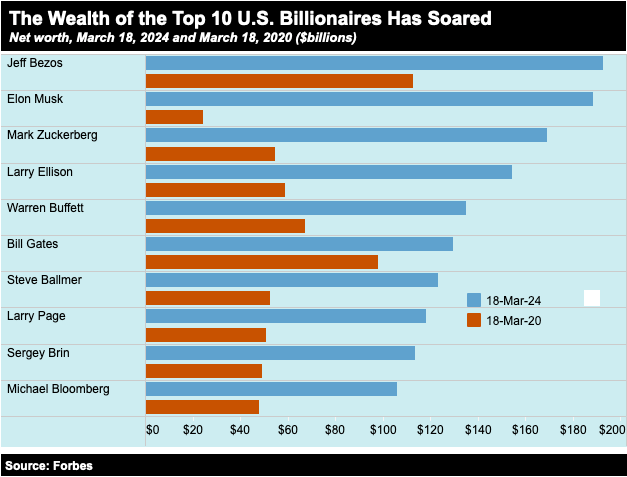
    We’re told that the Russians whose yachts have been seized include Alisher Usmanov, whose net worth is $20 billion, and Alexei Mordashov, whose wealth is described as “nearly” $30 billion. Compare that with Elon Musk, who’s worth nearly $300 billion, or Jeff Bezos at $202 billion. These guys are pikers.

    Globally, in the US-led world financial order, billionaires have gained $5 trillion in wealth since the pandemic began. Think of our economic leadership as a “global endowment for oligarchy.” Oxfam reports that the ten richest men in the world (yes, they’re all men) own more wealth than the bottom 3.1 billion people (“six times more, in fact”). Oxfam also notes that “if the 10 richest men”—nine of whom live in the US—”lost 99.999% of their combined wealth, they would still be richer than 99% of the world.”

    Now that’s oligarchy.

    Making a Killing

    No industry has taken more advantage of government-granted patent monopolies than Big Pharma. Even when its oligarchs misled the country into an opioid epidemic—one of the largest mass-casualty events in American history—they are able to escape criminal culpability for their actions.

    Then came Covid-19. As Forbes reported in January, US billionaires held an estimated $3.5 trillion before the pandemic struck, a figure that reached nearly $5.3 trillion two years later. That’s $1.8 trillion in gains, divided among only twenty oligarchs. Musk led the pack, with Bezos in second place. The billionaires’ list is a cavalcade of monopolists and speculators whose wealth has been fueled by their government’s benign view of their predatory business practices.

    Once the pandemic hit, Big Pharma’s oligarchs were able to parlay their political power into exclusive patent rights for Covid-19 vaccines. Moderna made $17.7 billion from its vaccine in 2021 and anticipates making $22 billion this year, from a formula developed with $2.5 billion in funding commitments from the US government. The money from these government-granted profits could vaccinate the entire world, but they’ve been used to enrich shareholders instead. That’s oligarchy.

    Restoring the Balance

    What can Americans do about their oligarchy? President Biden’s blueprint is a good place to start. A “dedicated task force to go after the crimes of American oligarchs” is an excellent place to start. It could address questions such as:

    1. Why have nine American billionaires acquired more than $755 billion during the Covid pandemic, while so many other people struggled?

    2. What role did government and central bank policy play in this enrichment?

    3. What unethical or illegal actions, if any, were undertaken in amassing this wealth?

    4. What effect will these levels of economic inequality have on social justice, political power, social mobility, and the rights of consumers and workers?

    5. Is there any reason why this money should not be taxed at 99 or 100 percent?

    Item #4 would not be unprecedented. It would revive a proposal from President Franklin D. Roosevelt for a “100 percent war supertax” on extremely high incomes and would echo the 94 percent top tax rate passed during World War II. (The top marginal tax rate stayed above 90 percent for the next two decades.)

    We certainly face a World War-level emergency. Oxfam observes that “a 99% windfall tax on the COVID-19 wealth gains of the 10 richest men could pay for enough vaccines to vaccinate the entire world and fill financing gaps in climate measures, universal health and social protection, and efforts to address gender-based violence in over 80 countries, while still leaving these men $8bn better off than they were before the pandemic.”

    I don’t hate these oligarchs. I see them.

    If a “supertax” were levied against America’s oligarchs by the federal government, it would produce as much as $755 billion in revenue. That’s enough to pay for the original, ten-year “Build Back Better” proposal—twice.

    To See, and to Act

    It’s striking that the current debate about American democracy ignores its biggest antagonist: the oligarchs who have undermined the political process and drained the nation of its wealth. Restraining the oligarchs would help build true democracy. It would be good politics, too.

    “We know from polling that (anti-oligarchical) policies and rhetoric like these are wildly popular,” writes Eleanor Eagan of the Revolving Door Project. “In our deeply divided country, anger at elite impunity and a desire to see it end are among the rare uniting forces that we have left.”

    Not that we can expect an anti-oligarchical agenda from this government any time soon. Politicians know that America’s oligarchs, unlike Russia’s, have the ability to crush their careers at any time. But the rest of us are free to speak out and demand an end to oligarchical rule anywhere in the world. Our condemnation of other country’s oligarchs will ring hollow until we do.

    Someone once asked me, “Why do you hate billionaires?” The answer is, I don’t. I’ve met a few, and they were always sociable enough (unless you worked for them). I don’t hate these oligarchs. I see them. As we build the anti-oligarchical movement here in the US, Noah Liebman’s handy browser add-on (for Firefox only) helps everyone see them. It replaces the word “billionaire” with “oligarch” on every web page, producing headlines like “Bloomberg’s Oligarch Index,” “Forbes’ Oligarchs 2021,” “Inside the Financial Holdings of Oligarch Betsy DeVos” … you get the idea.

    Another headline now reads, “Oligarch investor Bill Ackman says Russia’s attack on Ukraine means World War III has ‘likely already started.’”  Maybe it has, or maybe it will start soon. The best way to prevent it is by eliminating all oligarchies, foreign or domestic, and replacing them with genuine democracy.


    Our work is licensed under Creative Commons (CC BY-NC-ND 3.0). Feel free to republish and share widely.

    RICHARD ESKOW

    Richard (RJ) Eskow is a freelance writer. Much of his work can be found on eskow.substack.com. His weekly program, The Zero Hour, can be found on cable television, radio, Spotify, and podcast media. He is a senior advisor with Social Security Works.