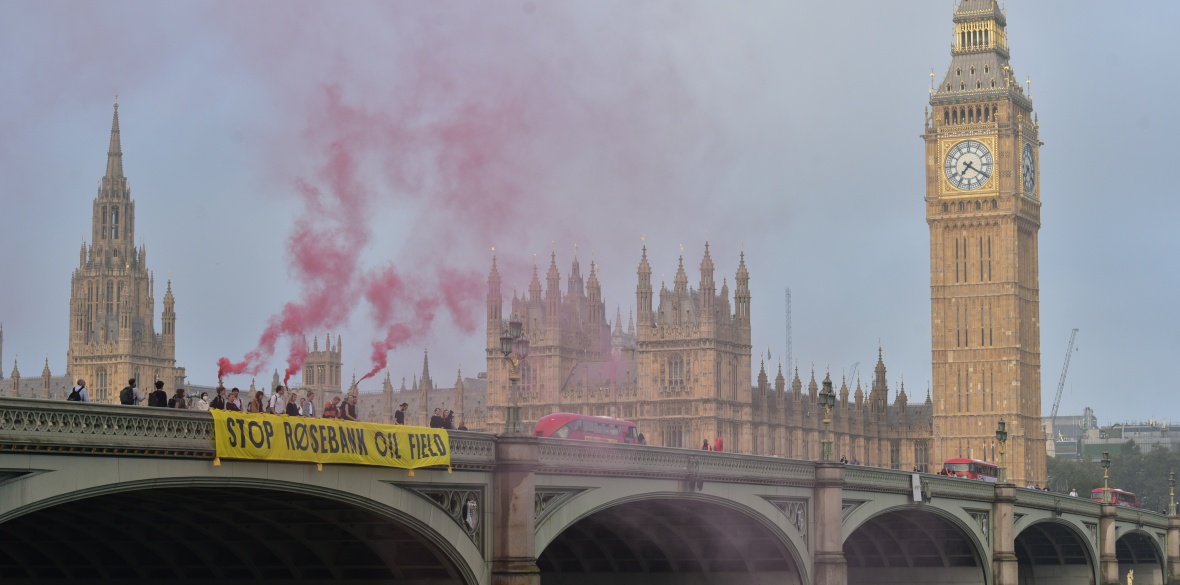
Fossil Free London set off flares and dropped a 15-metre banner Image: Fossil Free London
ENVIORNMENTAL activists have demanded MPs block a “reckless and absurd” climate time-bomb.
MPs returning to Parliament today were welcomed by Fossil Free London, who set off flares and dropped a 15-metre banner from the nearby bridge demanding development of the Rosebank oil field be dropped.
The decision to develop the field has been repeatedly delayed but, if granted, the licence could see oil giant Equinor benefit to the tune of £3.7 billion in tax breaks as the Tory tax giveaway to big oil — costing £10.6bn so far — continues apace.
Fossil Free London’s Joanna Warrington said: “Rishi Sunak wants to give billions of pounds of public money to a giant oil company in exchange for the climate time-bomb, which will do absolutely nothing to lower our energy bills.
In a conversation with the Daily Record, Scotland’s first minister said: “My starting position on Rosebank is I’m not convinced it should go ahead and I’ve said as much publicly, for a number of reasons.
“First and foremost, for example, the majority of Rosebank is oil as opposed to gas – that oil, of course, then gets exported.
“Any suggestion that helps us in terms of our domestic energy security, I think, doesn’t quite stack up.”
Humza Yousaf added: “Unlimited oil and gas extraction is not Scotland’s future,” when asked about the controversial Rosebank oil field.
Fossil Free London climate protestors protest Barclays sponsorship of the arts at Saddlers Wells.
A ballet performance of Romeo and Juliet at Sadlers Wells faced significant disruption on Thursday evening after climate activists stormed the stage to protest the theatre’s Barclays sponsorship.
Five member of the campaign organisation Fossil Free London hijacked the stage after the interval holding a banner that read “Drop Barclays Sponsorship”, whilst two others held placards and chanted “oily money out” from the wings.
Sadlers Wells includes Barclays bank as one of its sponsors. Barclays has continued to fund new oil and gas projects, investing over $190 billion in fossil fuels since 2016.
…
BREAKING: We’ve just disrupted a performance of Romeo and Juliet at Sadler’s Wells theatre, telling them to drop @Barclays dirty oil sponsorship! It’s time to get #OilyMoneyOut of our arts, our city and our futures 🚫 pic.twitter.com/NU9hQjUpou
Barclays also invests in the oil company Equinor who are pushing forward controversial plans for the Rosebank oil and gas field in the North Sea. They are currently waiting on the approval of their environmental report by the government, due in October.
“Instead of providing desperately needed clean energy, they feed us greenwashing garbage.”
A new analysis of the activities of twelve major fossil fuel giants shows that the companies are misleading the public about their emission-reduction commitments while raking in record profits from fossil fuels, which are driving catastrophic extreme weather events across the globe.
In a report published Wednesday, Greenpeace Central and Eastern Europe examines the decarbonization pledges, investments, and profits of six global fossil fuel giants—including Shell, BP, and TotalEnergies—and six European oil companies.
The results indicate that, in 2022, close to 93% of the oil giants’ investments on average went to keeping the companies on the “fossil oil and gas path” while just 7.3% were aimed at promoting “low-carbon solutions” and sustainable production.
“Although most of the sample companies are committed to ‘net zero’ by 2050, a closer look shows that none of them has developed a coherent strategy to achieve this,” the report notes, adding that the examined companies are in fact “scaling back their ambitions” even as their polluting activities wreak havoc worldwide. Shell and BP recently announced they are ditching previous plans to curb oil production and emissions.
The report shows that BP, Equinor, Wintershall and TotalEnergies cut their investments in renewable products last year—a fact that, according to Greenpeace, bolsters the case for “compulsory investment in genuinely green infrastructure” and other government regulations.
Kuba Gogolewski, a finance campaigner at Greenpeace CEE, said Wednesday that “as the world endures unprecedented heat waves, deadly floods, and escalating storms, Big Oil clings to its destructive business model and continues to fuel the climate crisis.”
“Instead of providing desperately needed clean energy, they feed us greenwashing garbage,” Gogolewski added. “Big Oil’s unwillingness to implement real change is a crime against the climate and future generations. Governments need to stop enabling fossil fuel companies, heavily regulate them, and plan our fossil fuel phase-out now. They will never change on their own.”
“Fossil fuel companies like Shell, TotalEnergies, BP Equinor, and ENI have shown the public they are incapable of self-regulation.”
The new report offers several examples of companies offering misleading data in an apparent attempt to convince investors and the public of their commitment to the renewable energy transition.
“Shell reports a ‘renewable capacity’ of 6.4 gigawatts for the 2022 financial year,” the analysis observes. “Only in the footnote… does one learn that this figure also includes plants that are still under construction or committed for sale. The actual capacity at the end of 2022 was only 2.2 gigawatts, as the group admits in another place in its reporting.”
In the case of BP’s 2022 financial disclosures, the report notes, “there is no number that would show the amount of wind and solar power” the company generated last year.
“This lapse is only an indication that no major oil company can show a comprehensible plan for a ‘net zero’ in 2050,” the report states.
“Fossil fuel companies like Shell, TotalEnergies, BP Equinor, and ENI have shown the public they are incapable of self-regulation after scaling back their climate ambitions, despite being heavily responsible for the climate crisis,” said Gogolewski. “That’s why Greenpeace is calling for European governments to strictly regulate the industry and begin its rapid economic and political downsizing.”
🔴NEW REPORT🔴
🏭Fossil fuel companies have NO MEANINGFUL PLANS to reduce their carbon emissions or switch to renewables.
🤥 Yet they continue with their GREENWASHING talking about greener investments and net zero trajectories.
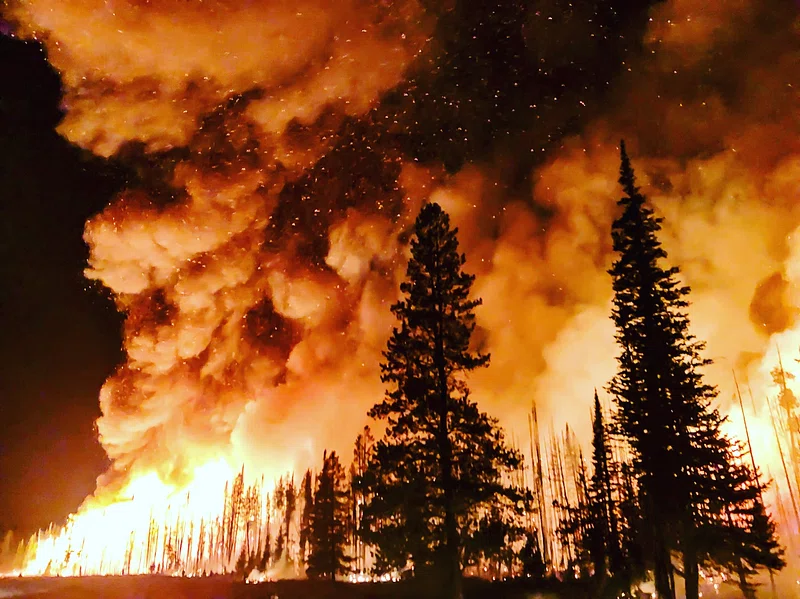
The new analysis comes in the wake of devastating fires in Maui, Hawaii that were fueled by climate change, which contributed to the severely dry conditions that allowed the fires to spread rapidly.
Maui County is currently suing Shell, BP, and other fossil fuel giants, accusing them of engaging in a “coordinated, multi-front effort to conceal and deny their own knowledge” about the climate threat and profiting “from a massive increase in the extraction and consumption of oil, coal, and natural gas, which has in turn caused an enormous, foreseeable, and avoidable increase in global greenhouse gas pollution and a concordant increase in the concentration of greenhouse gases.”
The Maui lawsuit states that “wildfires are becoming more frequent, intense, and destructive in the county” as the planet warms due to ever-rising carbon emissions.
If we have not been warned of the dangers of climate change this summer, we never will be. Extreme heat, forest fires and floods have been all over news reports. Yet the oil and gas industry remains largely in denial.
The International Energy Agency (IEA) says steep cuts in oil and gas production are necessary to reach the Paris (COP 21) goal of keeping global warming at 1.5℃. However, only a tiny fraction of the industry, accounting for less than 5% of oil and gas output, has targets aligned with the IEA’s “net zero” requirements.
The current secretary general of production cartel Opec, Haitham al-Ghais, expects global oil demand to rise by about 10% to 110 million barrels a day by 2045, a volume incompatible with the Paris goals. The UK government has just offered a helping hand, granting around 100 new North Sea licences. What are we to make of this mismatch?
The new denialism
Typical of the new breed of climate denialism is a recent report by the Energy Policy Research Foundation (ERPF), a body funded by the US government and various undisclosed corporate interests and foundations. It sees the IEA’s requirements as a “seal of approval … to block investment in oil and gas production by western companies”. The report views meeting the targets as too costly, too harsh on poor countries and too bad for the energy security of the west.
In fact, it is wrong on each account. Many eminent economists and scientists use the concept of the social cost of carbon (SCC), which is defined as the cost to society of releasing an additional tonne of CO₂. Expert estimates from 2019 put this at between US$171 and US$310 (£133 to £241). If we go with, say, US$240 per tonne, the social cost of continued carbon equivalent emissions comes out at almost US$8.5 trillion every year.
A recent study has factored into the calculation climate feedback loops. This is where one problem caused by global warming leads to others, such as melting permafrost unleashing stores of methane.
When the study estimated the economic damage that this could cause, it produced an SCC in excess of US$5,000. That implies annual costs of more like US$170 trillion a year, which makes the US$4 trillion investment into clean energy that the IEA thinks necessary to meet the Paris climate goals look like a drop in the ocean.
It may help to break this down to one barrel of oil. A special IEA report for COP28 estimates that on average, each barrel of oil emits 0.53 tonnes of CO₂ equivalent in greenhouse gas across its life cycle, 20% of which comes from production.
Going back to our average SSC per tonne of US$240, that points to a social cost of US$126 per barrel. With oil currently at US$85 per barrel, the societal damage from producing, transporting, refining and consuming it is far greater – and that’s before including climate feedbacks.
Meanwhile, the arguments by the EPRF and like-minded supporters about energy security are laughable. The history of the oil and gas industry is a history of wars and geopolitical tensions. Transitioning to cleaner fuels can only increase our energy security and reduce the need to police remote autocracies.
The argument that poor countries need to continue burning carbon for development reasons is no better. In its latest report from 2022, the Intergovernmental Panel on Climate Change (IPCC) said climate change would probably see an increase in “losses and damages, strongly concentrated among the poorest vulnerable populations”.
Equally, the World Health Organization estimates that: “Between 2030 and 2050, climate change is expected to cause approximately 250,000 additional deaths per year from malnutrition, malaria, diarrhoea and heat stress.”
How to respond
The denialists offer no alternatives to cutting carbon emissions, and often simply ignore climate change altogether. The recent ERPF report mentions climate change only four times. It is as if heatwaves, forest fires, flooding, rising sea levels and the demise of natural habitat caused by climate inaction were happening on another planet.
We still have time to limit global warming below 1.5℃. It is true that we will need oil and gas for many years, and that there are currently no alternatives for certain sectors such as air travel, shipping and some industries. Nonetheless, there is still much that can be done now to make a substantial difference.
To incentivise the transition to cleaner energy, governments need to end fossil fuel subsidies, which the IMF estimates amounted to US$5.9 trillion in 2020 alone. We also need to put a proper price on carbon – only 40 countries have attempted this so far, and none has it anywhere near the estimated social cost of emitting carbon.
Countries that resist charging their own polluters should face a carbon border adjustment mechanism, which is a tariff that effectively puts the polluter on the same footing as local players. If all the actors in the fossil fuel supply chain had to face the cost of the damage they cause, the need to phase out long-term investments in fossil fuels would become more obvious.
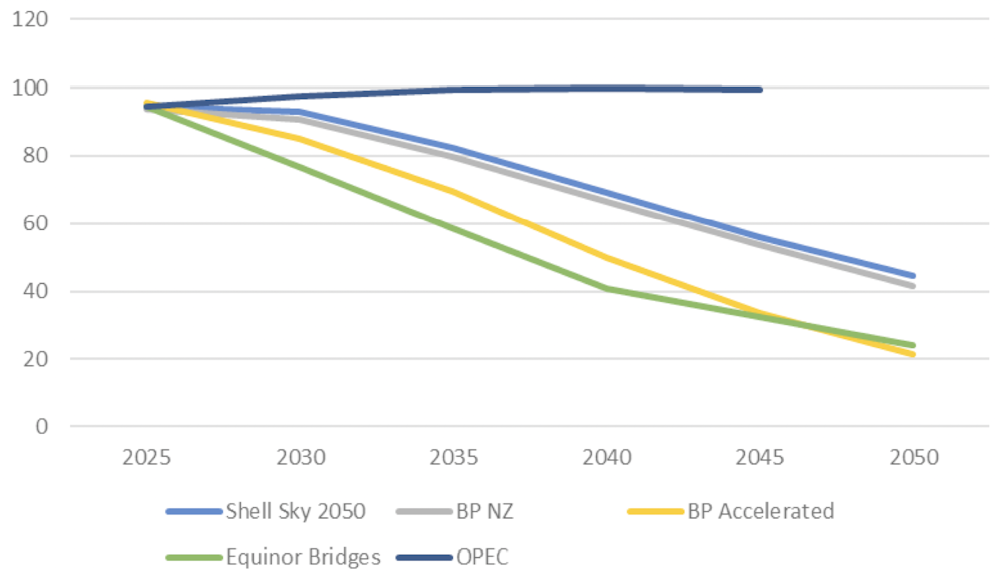
The IEA requirements for “net zero” are just one of the pathways towards meeting the Paris goal of 1.5℃ warming. Others are explored by some of the more credible actors in the petroleum industry, such as Shell, BP and Norway’s Equinor, but all require a substantial decline in oil demand and production by 2050.
Required production cuts
I left the IEA’s scenario off the graph because it published so few datapoints, but it is broadly in line with the others. Meanwhile, the Opec data is for reference and not a net zero scenario. BP, Shell, Equinor and Opec
Instead of criticising efforts to slow climate change and sponsoring ridiculous reports calling for more fossil fuels, the oil industry should eliminate leakages, venting and flaring of methane, and electrify as many processes as possible using renewable power. It should also employ carbon capture, usage and storage technologies over the next ten years – yes this will increase the price of fossil fuels, but that is exactly what we need to make clean sources of energy competitive across the board and speed up the energy transition.
The sooner the industry starts facing up to the realities of climate change, the more chance it has to survive. The companies and even countries that produce fossil fuels will have to face and pay the cost for the damage they cause. Those costs are already massive and will grow. Those that survive will do so only as a provider of clean and sustainable energy.
Don’t have time to read about climate change as much as you’d like?
Climate protesters have gathered outside Norwegian oil giant Equinor’s London offices to oppose the company’s plans to develop the Rosebank oil and gas field.
Rosebank, which lies west of the Shetland Islands, is one of the largest such fields in the North Atlantic, capable of producing up to 500 million barrels of oil.
The International Energy Agency has previously said there must be no new investment in oil and gas if the world is to become net zero by 2050, while the Intergovernmental Panel on Climate Change said emissions from existing fossil fuel infrastructure are already set to push global temperatures beyond safe limits.
…
We’re outside London @Equinor HQ demanding they get #EquinorOut of oil & gas ⏩ Their shareholders are meeting in Norway to decide its future today.
They want to open new oil & gas projects in Argentina, Canada, the UK & Brazil.