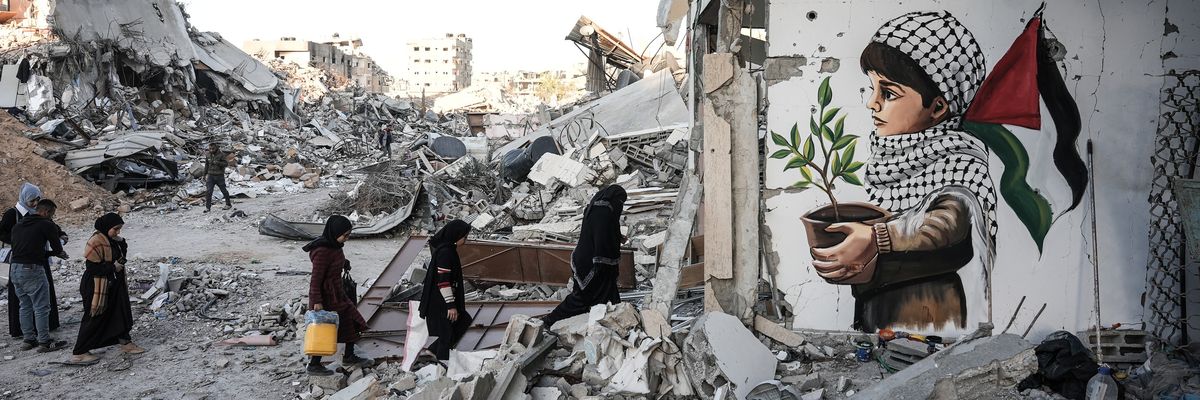
A picture painted on the rubble of houses by a Palestinian artist who returned home after the cease-fire and hostage-prisoner swap deal between Hamas and Israel on January 20, 2025. (Photo by Mahmoud Bassam/Anadolu via Getty Images)
After Trump floated a plan to “clean out” Gaza, Israel’s far-right Finance Minister Bezalel Smotrich said that “the idea of helping [Gazans] find other places to start new, better lives is a great idea.”
Speaking to reporters Saturday, U.S. President Donald Trump said he would like to see most of the population of war-torn Gaza be relocated to Jordan and Egypt, a plan that a number of observers said was tantamount to ethnic cleansing. Trump made the remarks the same day that he lifted a Biden-era hold on the supply of 2,000-pound bombs to Israel.
“I’d like Egypt to take people. And I’d like Jordan to take people,” Trump said, according to the Financial Times. “You’re talking about a million and half people, and we just clean out that whole thing.” Gaza’s population was 2.2 million in 2023.
“‘Clean out’ is barely even a euphemism. This is ethnic cleansing, call it what it is,” wrote Assal Rad, the author of a book on modern Iran, on X, reacting to an Associated Press article about Trump’s comments.
The independent reporter Talia Jane wrote: “What’s it called when you clean out an ethnic group from a region.”
“He’s just openly endorsing/encouraging ethnic cleansing,” wrote the journalist Mehdi Hasan on Saturday. Others chimed in with similar remarks.
Trump’s comments were made nearly a week after a cease-fire deal between Israel and Hamas went into effect, halting 15 months of war that was triggered by a Hamas deadly attack on Israel in October, 2023 and which left tens of thousands of Palestinians dead, according to local health officials.
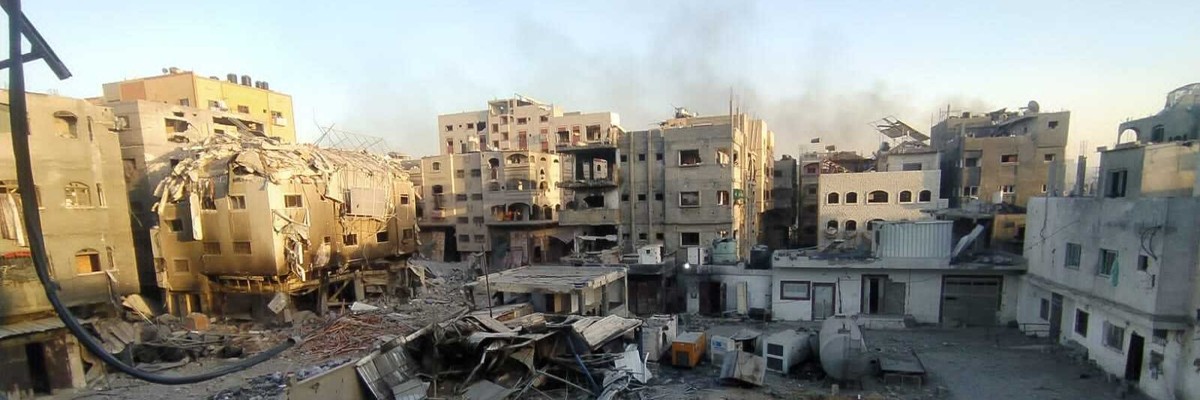
Homes, shelter, and infrastructure has also been largely decimated in the Gaza Strip by Israel’s military campaign there. Trump said that Gaza is “literally a demolition site right now. Almost everything’s demolished and people are dying there, so I’d rather get involved with some of the Arab nations and build housing in a different location where I think they could maybe live in peace for a change,” per CNN.
“What the occupation has failed to achieve through its criminal bombardment and genocide in Gaza will not be implemented through political pressures,” said independent Palestinian politician Mustafa Barghouti, according to CNN. “The conspiracy of ethnic cleansing will not succeed in Gaza or the West Bank.”
Trump also told reporters that he had already discussed the idea to relocate Gazans with King Abdullah of Jordan on Saturday. He said he planned to bring up the plan during a Sunday phone call with Egyptian President Abdel Fattah A-Sisi.
Trump’s proposal would be a departure from the United States’ official position of forging a negotiated “two state solution” for Israel and Palestine, although some say that the United States’ policies towards the region, including the nearly unqualified support for Israel during its campaign in Gaza, have undercut that goal.
Israel’s far-right Finance Minister Bezalel Smotrich endorsed Trump’s remarks, according to CNN, saying “the idea of helping [Gazans] find other places to start new, better lives is a great idea.”
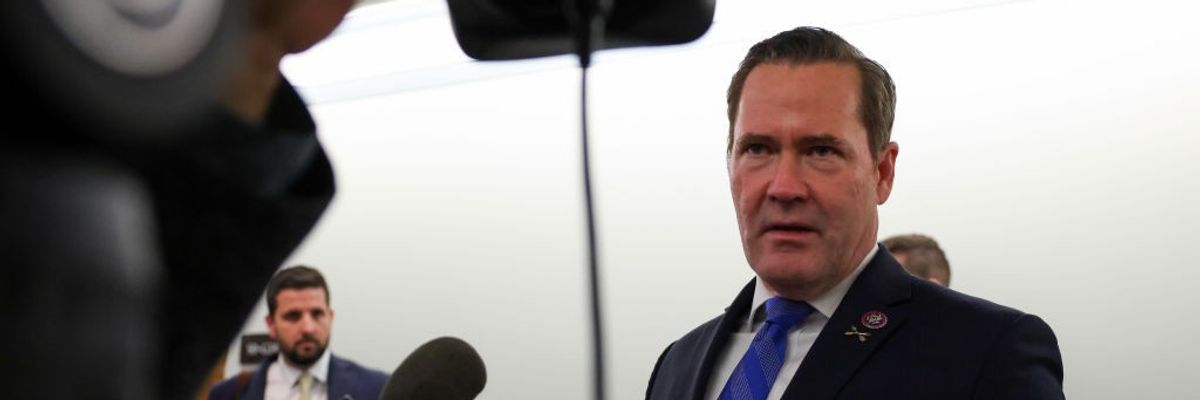
Rep. Mike Waltz (R-Fla.), President-elect Donald Trump’s national security adviser pick, walks to a Senate hearing on January 14, 2025 in Washington, D.C. (Photo: Kayla Bartkowski/Getty Images)
Journalist Jeremy Scahill noted that Mike Waltz’s comments echo “a plan Netanyahu has hinted at: Israel views this deal as only one phase to get the Israeli and U.S. hostages out.”
U.S. President-elect Donald Trump’s pick to serve as national security adviser said late Wednesday that the incoming administration will support future Israeli attacks on Gaza even as Trump hailed the tenuous new cease-fire and hostage-release agreement as a signal “to the entire world that my administration would seek peace.”
In an appearance on Fox News late Wednesday after the agreement was announced, Rep. Mike Waltz (R-Fla.) said that “we’ve made it very clear to the Israelis, and I want the people of Israel to hear me on this: If they need to go back in [to Gaza], we’re with them.”
“Hamas is not going to continue as a military entity and it’s certainly not going to govern Gaza,” Waltz added.
The national security adviser nominee expressed a similar position in a podcast appearance prior to the announcement of the cease-fire deal, which is currently in jeopardy as Israeli Prime Minister Benjamin Netanyahu accuses Hamas of reneging on the terms of the agreement—a claim Hamas has rejected.
Asked whether a cease-fire agreement would mean “the war is over,” Waltz said, “Hamas would like to believe that.”
“But we’ve been clear that Gaza has to be fully demilitarized, Hamas has to be destroyed to the point that it cannot reconstitute, and that Israel has every right to fully protect itself,” he added. “All of those objectives are still very much in place.”
“We need to get our people out,” Waltz continued, “and then we need to achieve those objectives in this war.”
https://twitter.com/i/status/1879851130693488889
Drop Site‘s Jeremy Scahill noted that the approach Waltz laid out mirrors “a plan Netanyahu has hinted at: Israel views this deal as only one phase to get the Israeli and U.S. hostages out.”
Last month, Netanyahu said that Israeli forces would “return to fighting” once hostages are freed.
“There is no point in pretending otherwise,” said Netanyahu, “because returning to fighting is needed in order to complete the goals of the war.”
Under the first phase of the deal announced Wednesday, a six-week cease-fire would begin as soon as Sunday and 33 hostages would be freed in exchange for the release of more than 1,000 Palestinian detainees. The second and third stages of the deal are contingent upon negotiations that will take place during the first.
The text also stipulates the “withdrawal of Israeli forces eastwards from densely populated areas along the borders of the Gaza Strip” and a reduction of Israeli troop presence in the Philadelphi corridor—an issue that has repeatedly emerged as a sticking point in cease-fire negotiations.
The agreement states that “the Israeli side will gradually reduce the forces in the corridor area during stage 1 based on the accompanying maps and the agreement between both sides.”
“After the last hostage release of stage one, on day 42, the Israeli forces will begin their withdrawal and complete it no later than day 50,” the text continues.
But Netanyahu’s office insisted Thursday that the same number of forces would remain in the corridor during the deal’s first phase—a position that critics said runs counter to the agreement.
While Trump and his allies celebrated the announced agreement as a master stroke of dealmaking and aid groups voiced hope for some reprieve for devastated Palestinians in Gaza, Netanyahu’s spokesman told The New York Times in a text message that “there isn’t any deal at the moment.”
Israel’s cabinet was expected to vote on the deal Thursday, but Netanyahu delayed the meeting and accused Hamas of trying to “extort last-minute concessions.”
Hamas officials denied the charge, saying they are committed to the agreed-upon text.
Ruby Chen, the father of a 19-year-old Israeli-American soldier who was taken captive by Hamas on October 7, 2023, suggested Thursday that Netanyahu “might be looking to get out of” the deal as he faces backlash from far-right members of his coalition.
Citing unnamed sources, The Washington Post reported Thursday that “behind closed doors, Netanyahu has been promising his far-right allies that the war could resume after the first, 42-day phase of the cease-fire, when Hamas is to release 33 hostages in exchange for the release of more than 1,000 Palestinian prisoners.”
Paul Pillar, a non-resident fellow at the Quincy Institute for Responsible Statecraft, wrote Thursday that “there remains the possibility that a renewed war in Gaza will, beginning a few weeks from now, become a problem for Trump just as it was for Biden.”
“But two main factors will incline President Trump not to exert any pressure on the Israeli government to turn away from renewing its devastation and ethnic cleansing in the Gaza Strip,” Pillar predicted. “One is Trump’s relationship with his domestic evangelical political base, with its unconditional support for most anything Israel does. The other is that his ally Netanyahu has done him a big favor with his handling of the ceasefire negotiations, and now Trump owes Netanyahu favors in return.”
According to one Israeli report, Trump offered Netanyahu a “gift bag” of concessions in exchange for accepting a pre-inauguration cease-fire deal, including sanctions relief for violent Israeli settlers in the illegally occupied West Bank.
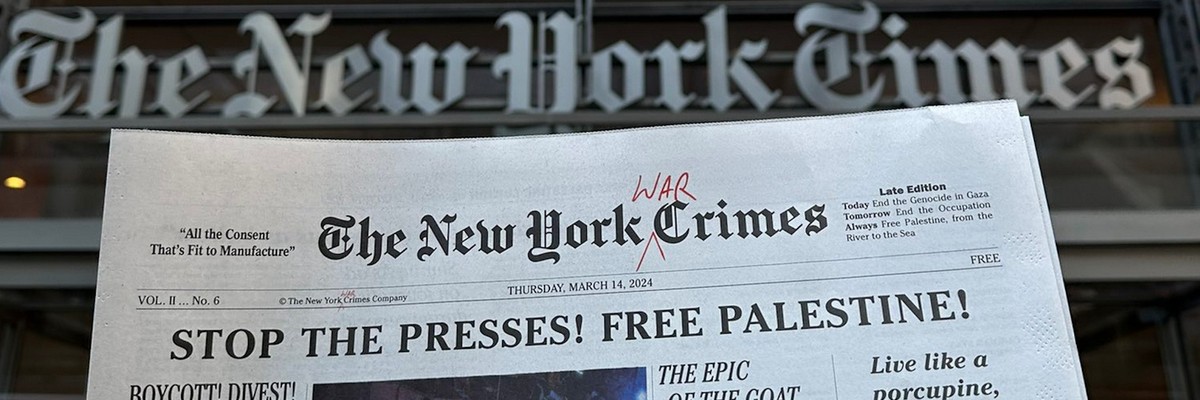
A reader holds up a copy of a satirical paper, “The New York War Crimes,” mocking The New York Times’ biased coverage of the Gaza genocide, on March 14, 2024 in New York City. (Photo: Nicki Kattoura/X)
Despite exceptional coverage at times, what was most profoundly important about war in Gaza—what it was like to be terrorized, massacred, maimed, and traumatized—remained almost entirely out of view.
A few days before the end of 2024, the independent magazine +972 reported that “Israeli army forces stormed the Kamal Adwan Hospital compound in Beit Lahiya, culminating a nearly week-long siege of the last functioning hospital in northern Gaza.” While fire spread through the hospital, its staff issued a statement saying that “surgical departments, laboratory, maintenance, and emergency units have been completely burned,” and patients were “at risk of dying at any moment.”
The magazine explained that “the assault on medical facilities in Beit Lahiya is the latest escalation in Israel’s brutal campaign of ethnic cleansing in northern Gaza, which over the last three months forcibly displaced the vast majority of Palestinians living in the area.” The journalism from +972—in sharp contrast to the dominant coverage of the Gaza war from U.S. media—has provided clarity about real-time events, putting them in overall context rather than episodic snippets.
+972 Magazine is the work of Palestinian and Israeli journalists who describe their core values as “a commitment to equity, justice, and freedom of information”—which necessarily means “accurate and fair journalism that spotlights the people and communities working to oppose occupation and apartheid.” But the operative values of mainstream U.S. news outlets have been very different.
What was sinister about proclaiming “Israel’s 9/11” was what happened after America’s 9/11.
Key aspects of how the U.S. establishment has narrated the “war on terror” for more than two decades were standard in American media and politics from the beginning of the Gaza war in October 2023. For instance:
Routine discourse avoided voices condemning the U.S. government for its role in the slaughter of civilians.
The U.S. ally usually eluded accountability for its high-tech atrocities committed from the air.
Civilian deaths in Gaza were habitually portrayed as unintended.
Claims that Israel was aiming to minimize civilian casualties were normally taken at face value.
Media coverage and political rhetoric stayed away from acknowledging that Israel’s actions might fit into such categories as “mass murder” or “terrorism.”
Overall, news media and U.S. government officials emitted a mindset that Israeli lives really mattered a lot more than Palestinian lives.
The Gaza war has received a vast amount of U.S. media attention, but how much it actually communicated about the human realities was a whole other matter. The belief or unconscious notion that news media were conveying war’s realities ended up obscuring those realities all the more. And journalism’s inherent limitations were compounded by media biases.
During the first five months of the war, the New York Times, Wall Street Journal, and Washington Post applied the word “brutal” or its variants far more often to Palestinians (77%) than to Israelis (23%). The findings, in a study by Fairness and Accuracy In Reporting (FAIR), pointed to an imbalance that occurred “even though Israeli violence was responsible for more than 20 times as much loss of life.” News articles and opinion pieces were remarkably in the same groove; “the lopsided rate at which ‘brutal’ was used in op-eds to characterize Palestinians over Israelis was exactly the same as the supposedly straight news stories.”
Despite exceptional coverage at times, what was most profoundly important about war in Gaza—what it was like to be terrorized, massacred, maimed, and traumatized—remained almost entirely out of view. Gradually, surface accounts reaching the American public came to seem repetitious and normal. As death numbers kept rising and months went by, the Gaza war diminished as a news topic, while most talk shows seldom discussed it.
As with the slaughter via bombardment, the Israeli-U.S. alliance treated the increasing onset of starvation, dehydration, and fatal disease as a public-relations problem. Along the way, official pronouncements—and the policies they tried to justify—were deeply anchored in the unspoken premise that some lives really matter and some really don’t.
The propaganda approach was foreshadowed on October 8, 2023, with Israel in shock from the atrocities that Hamas had committed the previous day. “This is Israel’s 9/11,” the Israeli ambassador to the United Nations told reporters in New York, and he repeated: “This is Israel’s 9/11.” Meanwhile, in a PBS News Weekend interview, Israel’s ambassador to the United States declared: “This is, as someone said, our 9/11.”
What was sinister about proclaiming “Israel’s 9/11” was what happened after America’s 9/11. Wearing the cloak of victim, the United States proceeded to use the horrible tragedy that occurred inside its borders as an open-ended reason to kill in the name of retaliation, self-protection, and, of course, the “war on terror.”
As Israel’s war on Gaza persisted, the explanations often echoed the post-9/11 rationales for the “war on terror” from the U.S. government: authorizing future crimes against humanity as necessary in the light of certain prior events. Reverberation was in the air from late 2001, when the Pentagon’s leader Donald Rumsfeld asserted that “responsibility for every single casualty in this war, whether they’re innocent Afghans or innocent Americans, rests at the feet of the al Qaeda and the Taliban.” After five weeks of massacring Palestinian people, Israel’s Prime Minister Benjamin Netanyahu said that “any civilian loss is a tragedy”—and quickly added that “the blame should be placed squarely on Hamas.”
The licenses to kill were self-justifying. And they had no expiration date.
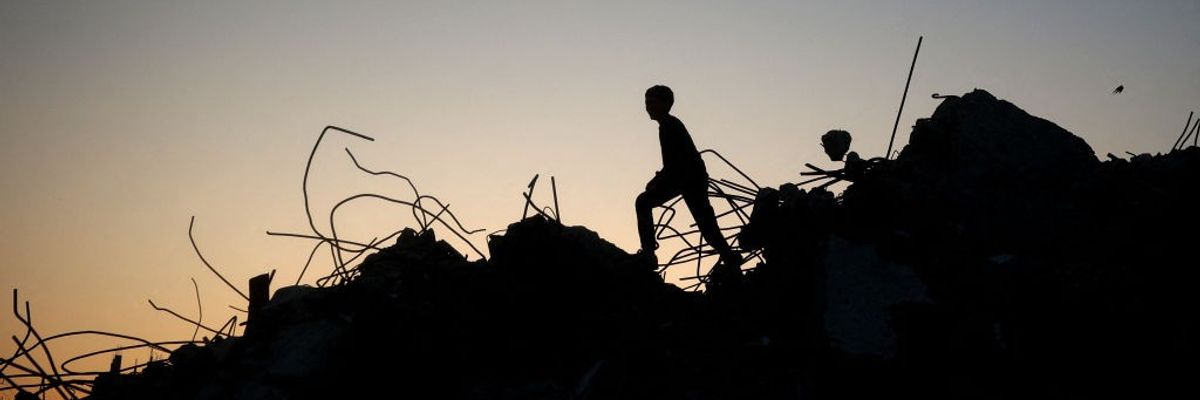
A Palestinian child plays amid the rubble of destroyed buildings at the Bureij refugee camp in Gaza, Palestine on January 2, 2025. (Photo: Eyad Baba/AFP via Getty Images)
The Knesset members are urging the Israeli military to destroy all sources of water, food, and energy—and to kill “anyone not flying a white flag of surrender.”
At least seven far-right members of the Knesset, Israel’s parliament, are calling on the country’s defense minister to order the total destruction of northern Gaza’s food, water, and energy sources—most of which have already been obliterated by 15 months of relentless attacks—and the killing of any Palestinian who isn’t clearly surrendering to the attackers.
In a letter to Israeli Defense Minister Israel Katz dated December 31, the lawmakers assert that the Israel Defense Forces’ (IDF) campaign to forcibly expel Palestinians from northern Gaza—which critics have called ethnic cleansing—”isn’t being done properly” and is not “achieving the war objectives as defined by the government, which is the dismantling of Hamas’ governing and military capabilities.”
According to a translation by international humanitarian law expert Itay Epshtain on Thursday, the letter calls on the IDF to:
Destroy all energy sources including fuel, solar systems, generators, and power lines;
Destroy all food sources including warehouses, water, and water pumps; and
Lay siege and remotely kill everyone not flying a white flag of surrender.
That last demand apparently includes men, women, and children. IDF troops would then “enter gradually for a complete cleansing of the enemy’s nests,” according to the letter.
Lawmakers who signed the letter and their party affiliations include: Avraham Bezalel (Shas), Amit Halevi (Likud), Limor Son Har-Melech (Jewish Power), Osher Shkalim (Likud), Zvi Sukkot and Ohad Tal (Religious Zionism), and Nissim Vaturi (Likud).
Vaturi, the deputy Knesset speaker, previously called for Gaza to be “wiped off the face of the Earth” and argued for Israel to “stop being humane” and “burn Gaza now,” because “there are no innocents there.”
Notably, the lawmakers’ letter does not mention anything about freeing the more than 60 hostages believed to be alive and imprisoned by Hamas and possibly other groups in Gaza.
As Israeli journalist Bar Peleg reported Friday from the Jabalia refugee camp:
When the soldiers and officers in Jabalia are asked about their mission, the answer is destroying Hamas and its infrastructure, until the last terrorist is laid to rest. When they are asked, “And what about the hostages?” One soldier answered, “That concerns us, like it does everyone, but it isn’t a part of our operational considerations.”
Northern Gaza is already in ruins. As Peleg noted, “not a single habitable building remains” in Jabalia. Nearly all homes, hospitals, schools, and other infrastructure have been destroyed or damaged.
“Look at the extent of the destruction and annihilation here,” one IDF officer said. “No one has done this before.”
An IDF officer recently told Haaretz that one commander, Brig. Gen. Yehuda Vach, seeks to personally execute the so-called Generals’ Plan—a blueprint for the starvation and ethnic cleansing of Palestinians from northern Gaza—by besieging and expelling 250,000 Palestinians from the area. United Nations officials estimate that more than 100,000 Palestinians have been forced from northern Gaza, even as the IDF says it disavows the Generals’ Plan.
Israeli policies and actions, as well as written and spoken calls for the destruction of Gaza and its people, have been presented as evidence in the South African-led genocide case against Israel currently before the International Court of Justice in The Hague, Netherlands.
Israeli Prime Minister Benjamin Netanyahu and Yoav Gallant, his former defense minister who ordered the siege of Gaza, are fugitives from the International Criminal Court, which in November issued arrest warrants for the pair and Hamas leader Mohammed Diab Ibrahim Al-Masri.
Israel’s 455-day bombardment, invasion, and siege of Gaza has left at least 165,000 Palestinians dead, maimed, or missing, according to officials there.
A view of destruction following the Israeli attack on the courtyard of Kamal Adwan Hospital and its surrounding buildings in Beit Lahia, Gaza on December 25, 2024. (Photo: Khalil Ramzi Alkahlut/Anadolu via Getty Images)
By targeting hospitals—essential lifelines in a besieged region—Israel not only deepens the humanitarian crisis but also sends a chilling message: no space, not even those dedicated to saving lives, is off-limits.
The recent Israeli raid on Kamal Adwan Hospital, or KAH, the only partially operating hospital in northern Gaza, is the latest phase of Israel’s egregious disregard for international humanitarian law and the sanctity of medical facilities. This audacious act highlights the alarming impunity with which Israel conducts its war of genocide in Gaza, and further aggravate the suffering in Gaza.
In attacking KAH, Israel resorted to the same discredited lies used to justify its assault on al-Shifa Hospital in November 2023, falsely alleging that Hamas operated a command center beneath the facility. This fabricated story has long been employed as a pretext to target medical facilities across Gaza. During its raid on al-Shifa Hospital in November 2023, Israeli forces found no evidence of a military presence yet proceeded to arbitrarily destroy the hospital without justification.
Eyewitness accounts report that Israeli forces stormed KAH under the pretext of searching for individuals allegedly connected to militant groups. Hospital staff were forcibly removed from their posts, and several patients, including children, were left unattended during the raid. Patients and medical staff faced severe intimidation and arrest, critical care was forcibly disrupted as soldiers combed through wards and operating rooms, ultimately setting the hospital on fire after failing to uncover the alleged military infrastructure.
Western media, in particular, frequently report on Israeli atrocities as though they are inevitable natural disasters, devoid of human accountability or compassion.
Two days after setting KAH ablaze, Israel escalated its attacks on Gaza’s medical infrastructure, killing seven civilians in a strike on al-Wafaa Hospital in Gaza City and shelling the nearby Ahli Baptist Hospital. Despite mounting evidence disproving its claims, Israel, unchallenged, repeated the same fabricated justification: that fighters were allegedly operating within the hospitals. This unsubstantiated template has become a routine pretext for targeting healthcare facilities, disregarding international laws designed to protect civilians and medical institutions during conflict.
Israel’s disinformation regarding the presence of military targets within Gaza’s medical facilities continues to be reported unquestionably by Western media, despite a well-documented track record of inaccuracies and history of falsehoods. This uncritical reporting not only undermines journalistic integrity but also perpetuates misleading narratives, often downplaying or outright ignoring Israeli crimes. By omitting the broader context of occupation, two-decade blockade, and systemic oppression, these media platforms contribute to a distorted representation of the reality on the ground. Western media, in particular, frequently report on Israeli atrocities as though they are inevitable natural disasters, devoid of human accountability or compassion. This approach not only erases the agency behind these tragedies but also dehumanizes Palestinian lives, reducing them to mere statistics.
The failure to keenly examine and challenge Israel’s repeated falsehoods reflects a blatant bias in Western journalism. By granting disproportionate weight to Israeli perspectives while sidelining Palestinian voices, these outlets perpetuate stereotypes and reinforce systemic racism. This one-sided, remote reporting on Gaza undermines the principles of journalistic integrity and fuels global indifference to the plight of the civilians. The lack of accountability for such biased coverage underscores the need for a more equitable and truthful approach by reporting directly from inside the war zone.
The targeting and subsequent destruction of hospitals is not random but part of a broader, systematic pattern of military violence against all aspects of civilian life in Gaza.
The raid on KAH is not an isolated incident but a manifestation of a broader military policy aimed at inflicting maximum pain on the people of Gaza. Already deprived of food, water, power, and adequate medical supplies due to Israel’s blockade, the timing of the raid on the only partially functioning hospital in northern Gaza, is emblematic of a systematic strategy to render the region uninhabitable.
The international community’s tepid response to such blatant violations has emboldened Israel to act with impunity. Despite clear evidence of war crimes, accountability remains elusive. The lack of meaningful action from global powers and institutions undermines the credibility of international law and signals to Israel that it can evade consequences.
Hospitals, including military hospitals, are recognized as neutral spaces under international law, protected from military aggression to ensure the uninterrupted provision of critical care during times of war. The United Nations has both a moral and legal obligation to uphold and enforce Article 18 of the Fourth Geneva Convention, which explicitly prohibits attacks on medical facilities. Anything less would be a betrayal of the principles that underpin international humanitarian law and a failure to stop war crimes.
The genocidal war on Gaza is not merely a regional issue; it is a moral litmus test for the global community. Every bomb dropped, every home destroyed, and every life lost in Gaza is a stain on humanity’s conscience. The international community must confront this genocide with the urgency and resolve it demands. Failing to act not only condemns Gaza’s population to further suffering but also erodes the very foundations of international law and human decency.
The international community’s response for the Israeli genocide in Gaza has been woefully inadequate. While some countries issue lukewarm condemnations, others, like the United States, provide unwavering support for Israel to “finish the job.” This double standard exposes the hypocrisy of the U.S. and Western powers that, ostensibly, champion human rights and international law in other contexts while turning a blind eye to the injustice in Palestine.
The Israeli attacks on medical facilities reveal a deliberate intent to coerce the population into forced “voluntary” ethnic cleansing. The targeting and subsequent destruction of hospitals is not random but part of a broader, systematic pattern of military violence against all aspects of civilian life in Gaza. This includes hospitals, schools, shelters, religious centers, agricultural infrastructure, water wells, bakeries, and aid distribution networks. These calculated assaults are designed to dismantle the foundations of daily life, exacerbate the humanitarian crisis, and strip the population of even the most basic means of survival.
The international community’s conspicuous silence and failure to hold Israel accountable have emboldened such actions, creating an environment where impunity reigns. By targeting hospitals—essential lifelines in a besieged region—Israel not only deepens the humanitarian crisis but also sends a chilling message: no space, not even those dedicated to saving lives, is off-limits.
Israeli war crimes in Gaza cannot be ignored. The world must respond—not with platitudes or empty gestures, but with concrete actions to ensure that those responsible for this ongoing genocide are held accountable.
Genocide denier and Current UK Prime Minister Keir Starmer is quoted that he supports Zionism without qualification. He also confirms that UK air force support has been essential in Israel’s mass-murdering genocide. Includes URLs https://www.declassifieduk.org/keir-starmers-100-spy-flights-over-gaza-in-support-of-israel/ and https://youtu.be/O74hZCKKdpAUK Foreign Minister David Lammy confirms that UK government and military are active participants in Israel’s genocides and that the F-35 parts that they suspended from supplying to Israel are instead simply diverted via the United States. He says see https://youtu.be/QILgUHrdWRE