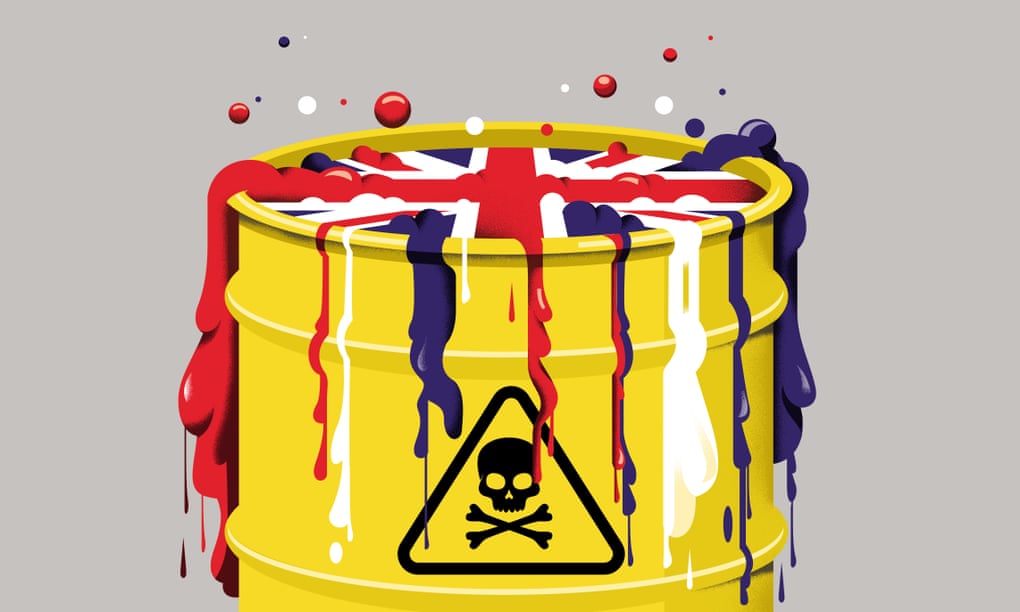
Perhaps our government imagines bulldog spirit will protect us from the dangerous substances that Europe rules unsafe
It’s a benefit of Brexit – but only if you’re a manufacturer or distributor of toxic chemicals. For the rest of us, it’s another load we have to carry on behalf of the shysters and corner-cutters who lobbied for the UK to leave the EU.
The government insisted on a separate regulatory system for chemicals. At first sight, it’s senseless: chemical regulation is extremely complicated and expensive. Why replicate an EU system that costs many millions of euros and employs a small army of scientists and administrators? Why not simply adopt as UK standards the decisions it makes? After all, common regulatory standards make trading with the rest of Europe easier. Well, now we know. A separate system allows the UK to become a dumping ground for the chemicals that Europe rules unsafe.
While negotiating our exit from the EU, the government repeatedly promised that environmental protections would not be eroded. In 2018, for example, the then environment secretary Michael Gove, in a speech titled Green Brexit, claimed “not only will there be no abandonment of the environmental principles that we’ve adopted in our time in the EU, but indeed we aim to strengthen environmental protection measures”. Such pledges turn out to be as dodgy as a £3 coin with Boris Johnson’s head on it.
On February 27, EU lawmakers voted overwhelmingly to make the most serious cases of environmental damage a crime. The vote in the European Parliament saw 499 votes in favour a, just 100 against, and 23 abstentions.
Under the updated environmental crime directive, those responsible for the deliberate destruction of the ecosystem, including illegal logging and habitat loss, will face tougher penalties, including prison sentences.
The vote means that the European Union is the first international body to criminalise eco crimes. EU member states now have two years to bring the updated directive into national law.
The move was hailed by environmentalists across Europe. The EU is “adopting one of the most ambitious legislations in the world,” said Marie Toussaint, a French lawyer and MEP for the Greens/European Free Alliance Group.
“The new directive opens a new page in the history of Europe, protecting against those who harm ecosystems and, through them, human health. It means putting an end to environmental impunity in Europe, which is crucial and urgent,” she added.
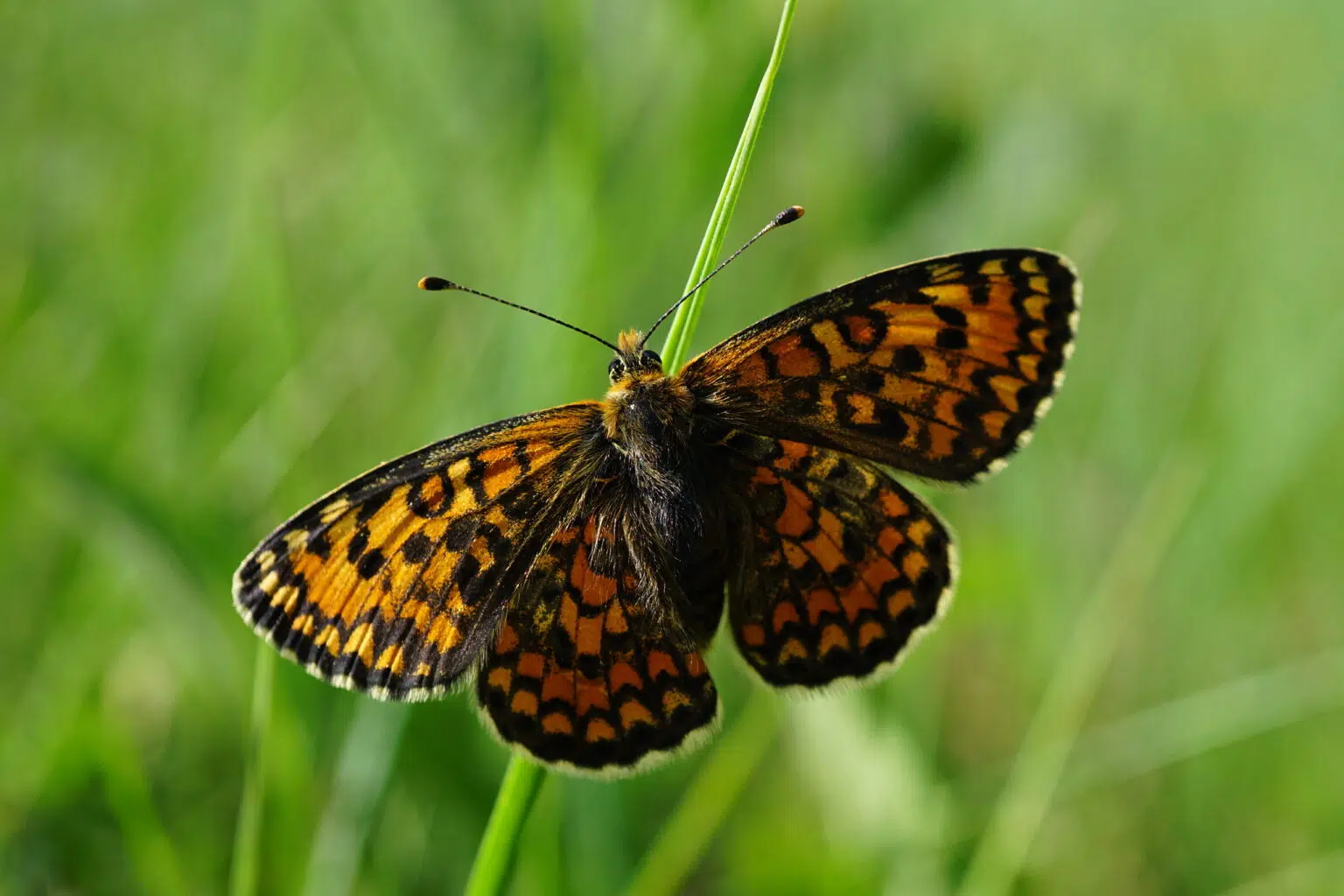
The Melitaea trivia butterfly, one of many endangered species in the EU. The nature restoration law offers a lifeline for natural habitats in the bloc where one in three bees, butterflies and hoverflies are disappearing.
At the eleventh hour, right-wing politicians have launched a bid to block the passing of the EU’s flagship nature protection law, which scientists have described as a “cornerstone of food security and human health”.
The pro-nature plan, which could see as much as 90 percent of damaged ecosystems repaired across the bloc, is due for final sign off in Parliament on Tuesday (27 February).
Usually a formality, the vote follows six months of intense – and at times bitter – negotiation of the law between the European Commission, Parliament and EU member states that saw an agreement reached in November last year.
But on Wednesday the right-wing European Conservatives and Reformists (ECR) party filed amendments calling for Members of the European Parliament (MEPs) to reject outright the so-called Nature Restoration Law – an extremely rare move so late in the decision-making process.
Scientists have condemned the call, as well as six other amendments that could see the law delayed or weakened. They say the proposed policy offers a lifeline for natural habitats in the bloc where one in three bees, butterflies and hoverflies are disappearing.
“In Europe we are in a critical biodiversity situation, which climate change is accelerating,” Daniel Hering, professor of aquatic ecology at the University of Duisburg-Essen, told DeSmog. “Without such an ambitious legislation, it will not be possible to bend the curve of declining biodiversity.”
A number of proposed green laws have been rolled back or delayed over the last 12 months, as opposition mounts to the EU’s Green Deal – a flagship plan to reach net zero by 2030.
The eurosceptic ECR party has justified its last-minute attempt to block the law citing “great social unrest”, in apparent reference to farmer protests that have spread across the continent in recent weeks, with tractors blocking roads and motorways in the majority of EU countries.
But scientists told DeSmog that derailing the law could come at significant cost to farmers, who are facing increasingly uncertain conditions due to climate breakdown and biodiversity loss.
The former EU climate chief Frans Timmerman has stated that “already half of crops in the EU that depend on pollination face a deficit.”
If any of the ECR’s amendments – such as deleting a target to restore 30 percent of Europe’s damaged ecosystems by 2030 – are accepted, a final decision on the law would be delayed until after the EU elections in June when right-wing parties are expected to make major gains.
It is so far unclear whether the proposals will succeed in gaining a majority in the vote next week. But the choice made by the centre-right European Peoples’ Party (EPP) – the largest in the EU parliament – will be a deciding factor.
The EPP’s Christine Schnieder, chief negotiator on the nature law, told DeSmog that her party had “serious concerns” and would “determine its voting behaviour for the vote on Tuesday at the Group meeting on Monday evening”.
‘Misinformation’
The law has long been portrayed as a burden to the farming industry. The EPP has repeatedly attempted to block the legislation following intense lobbying by farm union Copa-Cogeca, which represents producers and agribusinesses across the bloc. It succeeded in deleting the most ambitious agriculture clauses from the law, including targets to re-wild 10 percent of farmland.
However, scientists told DeSmog that jettisoning the legislation would cause major harms to the industry – a stance backed up by some small scale producers who are calling for more environmental support.
“Our food systems are at extreme risk. Looking outside and seeing the current temperatures, we can see that the coming summer will be even worse than the last one,” said Guy Pe’er, an ecologist at the German Centre for Integrative Biodiversity Research and the Helmholtz Centre for Environmental Research. “Farmers will soon need help maintaining production under very difficult conditions. The Nature Restoration law is a crucial part of this package.”
Pe’er also told DeSmog he was concerned Tuesday’s outcome could be “based on misinformation”. He was one of more than 6,000 scientists to sign an open letter in July, warning of a “lack of scientific evidence” for arguments opposing the law, including suggestions that it would harm EU food security and take away farming jobs across the continent.
Christine Schneider of the EPP told DeSmog that the EPP remained concerned that the law would lead to onerous regulations in member states with “far-reaching monitoring and reporting obligations for agriculture and forestry”.
‘Election Strategy’
If parliament supports any amendments on 27 February, negotiations on the Nature Restoration Law will extend beyond EU elections, which are due to take place between 6-9 June later this year.
Polls are currently suggesting a major ballot swing towards right-wing parties, which have pledged to use election success to fight the Green Deal.
In France, Marine Le Pen’s far-right party National Rally is expected to claim more than 30 percent of the country’s vote. It said in January it planned to form a “blocking majority” with other parties that target environmental laws.
The EPP, which is likely to retain the largest number of seats in the EU parliament, has likewise opposed multiple environmental regulations in the run-up to the elections in recent months, including overturning plans to halve pesticide use.
The ECR is so far not expected to gain many seats in the coming election.
Environmental activist Chloé Miko told DeSmog that if the law was voted down on Tuesday it would be “the final nail in the coffin for the Green Deal” – which has been seen as the lead policy package for the current Commission.
She added that the ECR was deploying a cynical “election strategy”, by linking its opposition to the law to farmer protests across the continent.
“It is not a sign of goodwill towards farmers,” she said. “The far-right, sometimes with the help of the Conservatives, have been on a journey to weaken, delay or even kill every remaining part of the Green deal. It is part of this process.”
Jutta Paulus, the Greens’ negotiator on the law in Parliament, told DeSmog: “The ECR’s attempt to stop the legislative procedure is typical for this euro-sceptic group,” adding that the EPP’s concerns about the law had already been addressed during trialogue negotiations between parliament, the commission and the council over recent months.
“I expect the constructive, pro-European parties to take a firm position and vote in favour of the trilogue agreement,” she said.
ECR did not respond to Desmog’s request for comment.
GB News was left embarrassed after the right-wing channel’s own poll showed that an overwhelming majority of respondents want to rejoin the EU, not a result that the channel would’ve been happy with.
Over the weekend, eight years after Britain left the EU, GB News decided to carry out a poll to gauge public opinion on Brexit. They would’ve done well to remember that a number of polls over recent months have shown that a majority favour rejoining the EU, with the demand to reverse Brexit reaching is highest ever level in one poll.
However, GB News decided to put their poll behind a paywall, meaning that only paying readers could participate. Author Edwin Hayward then decided to tweet a link to the poll which bypassed the paywall, allowing others to join in on the voting.
With a wider sample now participating in the poll, the overwhelming majority of votes went to rejoin, with over 90% of voting to rejoin the EU.
“The evidence points to a significant long-run output cost of Brexit,” the economists at Goldman’s wrote.
Yet more evidence has emerged of just how disastrous the decision to leave the EU has been for the UK economy, with economists at Goldman Sachs group saying that real GDP has underperformed by about 5%.
In a research note published earlier this month, Sven Jari Stehn and colleagues said that Brexit had resulted in reduced growth and higher inflation, with ‘reduced international trade, weak business investment and a drop in migrants coming from Britain’s largest trade partner all contributing’, Bloomberg has reported.
It comes as a number of studies have warned of the harmful consequences of Brexit, with the Bank of England saying last year that the decision to leave the EU has cost the average UK household £1,000, due to a lack of investment following the referendum.