PEACE: Former Labour Party leader and now independent MP Jeremy Corbyn speaks at a London rally for Palestine, September 11 2024
Speaking at the Podemos congress over the weekend, JEREMY CORBYN MP outlines three crucial areas for building a powerful leftist movement across Europe: opposing austerity, promoting peace and combating the far right
AS we look to build a united left across Europe, there are three key issues that can form the basis of a strong, powerful movement: anti-austerity, peace and opposition to the far right.
Europe is heading toward a renewed era of austerity. We have witnessed attacks on wages and conditions all over Europe. Working-class living standards have fallen. Wages have stagnated. Meanwhile, there are more billionaires than ever before.
Inequality is not inevitable. It is the result of decisions that governments take to take money from the many and give it to the few. Last week, the British government celebrated its 100-day anniversary.
In that time, it has made two supposedly “tough” choices. One is to keep children in poverty by retaining the two-child benefits cap, refusing to lift 250,000 children out of poverty. The second decision was to cut the winter fuel allowance for 10 million pensioners.
We are told that these have been “tough choices.” Every day, my constituents make tough choices. Tough choices like deciding whether to heat their homes or put food on the table. Tough choices like taking out a loan to pay for this month’s rent. Tough choices like selling their home to pay for their family’s social care.
The government knows that there is a range of choices available to them. They could introduce wealth taxes to raise upwards of £10 billion. They could stop wasting public money on private contracts. They could launch a fundamental redistribution of power by bringing water and energy into full public ownership.
Instead, they have opted to take resources away from people who were promised things would change. There is plenty of money, it’s just in the wrong hands — and we will not be fooled by ministers’ attempts to feign regret over cruel decisions they know they don’t have to take.
Austerity is not a tough choice. It is the wrong choice. The British government tells us there is no money. At the very same time, they are committing to raising defence expenditure to 2.5 per cent of GDP.
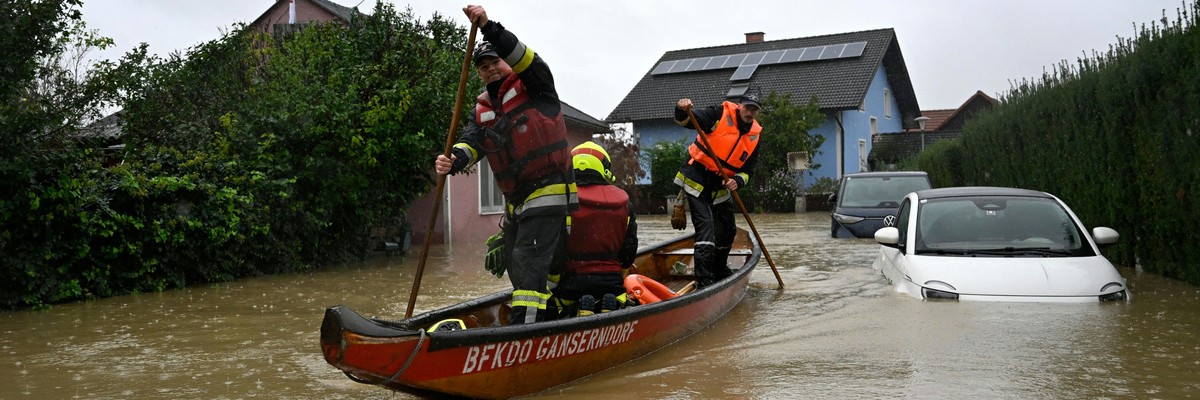
Firefighters in a boat make their way past a car submerged by the floods in Rust im Tullnerfeld, Austria, on September 16, 2024. (Photo: Helmut Fohringer/APA/AFP via Getty Images)
“We are deeply worried such events will get worse until oil and gas giants like Shell, Total, Equinor, Exxon, OMV, and ENI are forced to stop drilling for fossil fuels driving climate change,” said one campaigner.
The international climate group Greenpeace on Friday called on European leaders to “reciprocate” the courage shown by first responders in several countries over the weekend by forcing fossil fuel giants to pay for climate damages.
Calling out leaders including Polish Prime Minister Donald Tusk, Czech Prime Minister Petr Fiala, and Romania Prime Minister Marcel Ciolacu, Greenpeace campaigner Ian Duff said Central and Eastern European countries should end their “support for fossil fuels and [make] climate polluters pay for this disaster,” as emergency workers rescued people from catastrophic flooding.
The death toll on Monday rose to at least 16, with many more people missing and hundreds of thousands of people displaced in countries including Austria, the Czech Republic, Hungary, Romania, and Slovakia after the low-pressure system Storm Boris dumped torrential rains on the region for days starting late last week.
Two men, aged 70 and 80, drowned in their homes in northeastern Lower Austria after being trapped by rising floodwater, and confirmed deaths in Poland rose to six.
About 70% of Litovel, about 140 miles east of the Czech capital of Prague, was underwater Monday, while a power plant servicing the country’s third-largest city was forced to shut down and leave residents without heat and hot water.
“Greenpeace is horrified by damages brought by floods across Central and Eastern Europe, claiming lives, leaving homes without power and farmers with ruined fields, after being already ravaged by drought,” said Duff, head of Greenpeace’s Stop Drilling Start Paying campaign. “We are deeply worried such events will get worse until oil and gas giants like Shell, Total, Equinor, Exxon, OMV, and ENI are forced to stop drilling for fossil fuels driving climate change.”
In the U.S., the notion of big polluters being required to pay for damages caused by the climate crisis has recently gained traction, with lawmakers introducing a bill in Congress last week.
In Europe, a “polluter pays” principle is followed for many kinds of pollution, but advocates have called for it to be applied to planet-heating greenhouse gas emissions.
The flooding in Europe comes, as London-based meteorologist Scott Duncan explained on the social media platform X, after “an exceptional summer for the Mediterranean Sea,” with heat records broken—just as scientists have warned this year that record heat in the North Atlantic and other oceans around the globe would mean “a busy hurricane season.”
“Warmer sea surface temperatures allow more moisture to evaporate, like fuel for a storm. The warmer the water, the greater the evaporation,” said Duncan.
Liz Stephens, science lead for the Red Cross Red Crescent Climate Center, noted that in Central and Eastern Europe, “climate change is known to be playing a role in increasing the risk of flooding,” with the World Weather Attribution saying in 2021 that disastrous flooding that hit Germany and Belgium was tied to “a rapidly warming climate.”
Reports by the Intergovernmental Panel on Climate Change (IPCC), Stephens added, “have indicated that we have already observed an upward trend in heavy rainfall, surface water, and river flooding, and climate models show high confidence of further increases into the future.”
“The flooding looks set to be the worst in the region since 2002,” she said. “Lessons will have been learned from previous big European floods, but forecasts for some locations are for flooding of unprecedented magnitude, and history tells us that people are often surprised by the seemingly unimaginable consequences of such events.”
Journalist and climate advocate George Monbiot pointed out on Al Jazeera that storms previously described as “once-in-1,000-year occurrences [are] happening several times now in the past decade. We’re seeing a massive acceleration and intensification of extreme weather events, and unfortunately this is exactly what climate scientists were predicting.”
.@GeorgeMonbiot: "I've seen what were described as once in a 1,000 year occurrences happening several times now in the past decade. We're seeing a massive acceleration and intensification of extreme weather events" pic.twitter.com/wzgntdDpbq
Climate action group Friends of the Earthechoed Greenpeace’s demand to “leave fossil fuels in the ground and instead invest in a green future,” and Duff emphasized that communities across Central and Eastern Europe are far from the only ones “reeling from deadly floods and torrential rains,” with Typhoon Yagi causing flooding and landslides that killed at least 250 people in Southeast Asia in recent days and heavy rains across West and Central Africa leading to floods that killed more than 1,000 people.
“The fossil fuel industry,” said Duff, “is worsening weather extremes everywhere.”
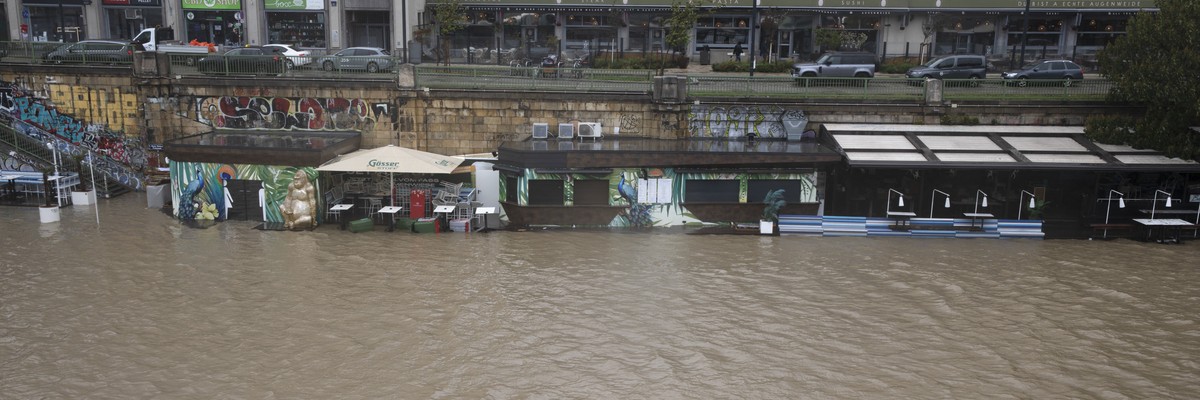
The Danube Canal overflows its banks in Vienna’s city center on September 15, 2024. (Photo: Alex Halada/AFP via Getty Images)
“What you see here is worse than in 1997, and I don’t know what will happen because my house is under water and I don’t know if I will even return to it,” one storm evacuee said.
Extreme flooding has claimed the lives of at least seven people in Central and Eastern Europe and forced thousands to flee their homes over the weekend.
Storm Boris—a low pressure system—has been lashing the area since Thursday, with major cities seeing a month’s worth of rain and some areas seeing their heaviest rainfall in 100 years between Saturday and Sunday.
“We are again facing the effects of climate change, which are increasingly present on the European continent, with dramatic consequences,” Romanian President Klaus Iohannis said, as The Guardian reported.
As feared, Storm Boris is wreaking havoc across parts of Central Europe with major flooding becoming widespread throughout the region. Here’s a 50-hour visible satellite and radar loop courtesy of @zoom_earthpic.twitter.com/F9KRA2SKeO
The storm has been deadliest in Romania, where four people were killed on Saturday and a fifth on Sunday, according toCNN. Hundreds of people also had to be rescued from rising waters.
The most impacted part of Romania was Galati, where the storm damaged around 5,400 homes—and around 700 in the village of Slobozia Conachi alone.
“This is a catastrophe of epic proportions,” Mayor Emil Dragomir said, as The Guardian reported.
“The idiotic media have failed to make it clear what’s coming—and this is still the beginning.”
The sixth death came in Austria, where a firefighter battling flooding perished on Sunday. Authorities have declared a disaster for Lower Austria, where Vienna is located, and staged nearly 5,000 rescues there Saturday night. The storm also shut down rail service in the eastern part of the country.
“We are experiencing difficult and dramatic hours in Lower Austria,” said the provincial governor Johanna Mikl-Leitner, as The Associated Press reported. “For many people in Lower Austria these will probably be the most difficult hours of their lives.”
In Poland, one person drowned in the hardest-hit region of Kłodzko, where around 1,600 people were forced to evacuate and 17,000 lost power.
In another town of Stonie Slaski, flood waters overwhelmed a dam and collapsed a bridge, while the river in Glucholazy overflowed its banks.
“The situation is still very dramatic in many place[s],” Polish Prime Minister Donald Tusk said on Sunday, according to CNN. “Unfortunately, these situations are repeating themselves in many places… but some residents sometimes underestimate the level of threat and refuse to evacuate.”
Flooding in parts of Central Europe is shaping up to be just as bad as many feared. This is footage from Głuchołazy in Poland near the border with the Czech Republic.
The storm also pummeled parts of Slovakia, Hungary, and the Czech Republic, where some of the highest rainfall totals in the region were reported and where four people are still missing.
The storm forced 10,000 people from the city of Opava to flee their homes, and Mayor Tomáš Navrátil said conditions were worse than in 1997’s so-called “flood of the century,” according to AP.
“What you see here is worse than in 1997, and I don’t know what will happen because my house is under water and I don’t know if I will even return to it,” Lipová-lázne resident Pavel Bily said, as The Guardian reported.
The rains are expected to continue at least through Monday.
In 2021, World Weather Attribution said that the climate emergency has made extreme flooding in Europe more likely. The storm also followed the hottest summer on record, as well as a warm beginning to September in the region, and warmer air can hold more moisture.
“People are in prison today for trying to warn the public how bad things are going to get,” author Matthew Todd wrote on social media in response to footage of a dam bursting in Poland. “Scientists have taken to the streets to warn us.”
People are in prison today for trying to warn the public how bad things are going to get. Scientists have taken to the streets to warn us. The idiotic media have failed to make it clear what’s coming – and this is still the beginning. Educate everyone you know:… https://t.co/5wleSmPNj3
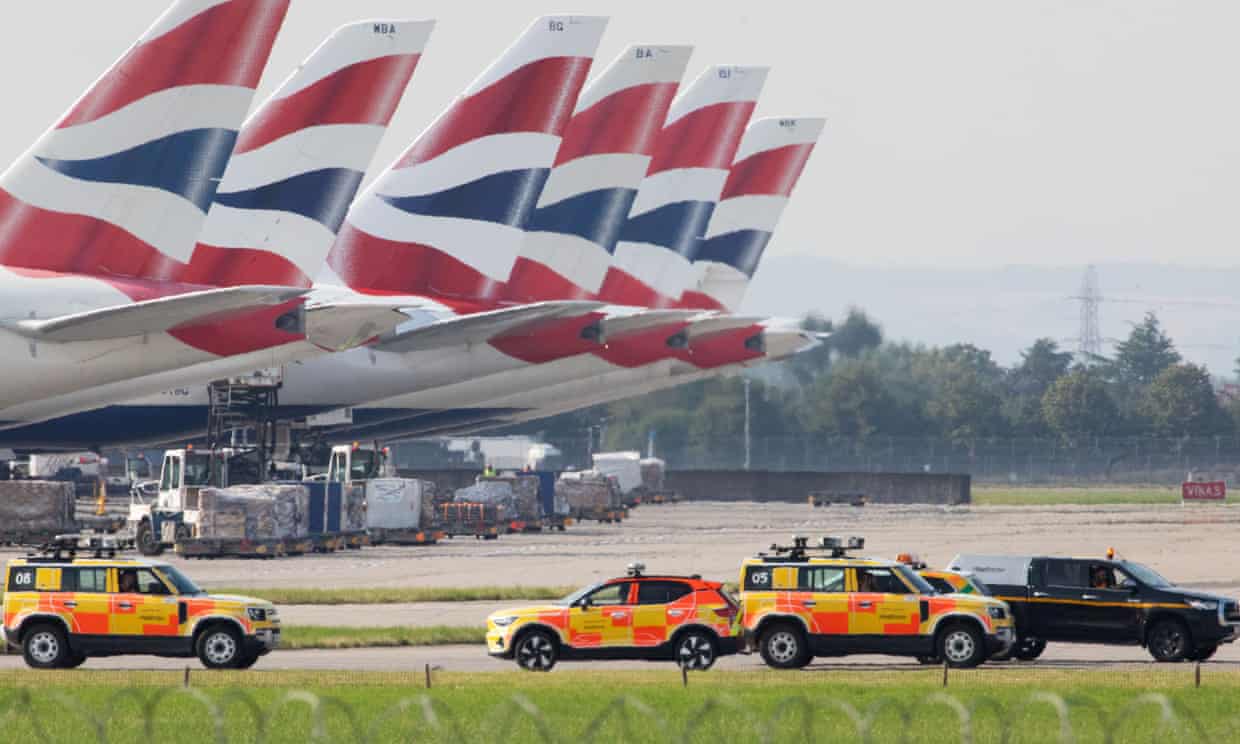
Police and Heathrow airport security were on high alert after Just Stop Oil protesters were arrested at the airport’s perimeter fence. Photograph: Kristian Buus/In Pictures/Getty Images
Ten activists arrested at Heathrow, over 30 flights cancelled at Cologne-Bonn, and planes delayed or diverted
Climate activists acting under the banner “oil kills” have glued themselves to the tarmac and grounded flights across Europe as holidaymakers attempt to make summer getaways.
In a wave of protests at airports from Oslo to Barcelona, activists disrupted flights and demanded that rich and polluting countries phase out fossil fuels by 2030. The protests, which the activists said had led to several arrests, came a day after climate scientists logged the world’s hottest day on record.
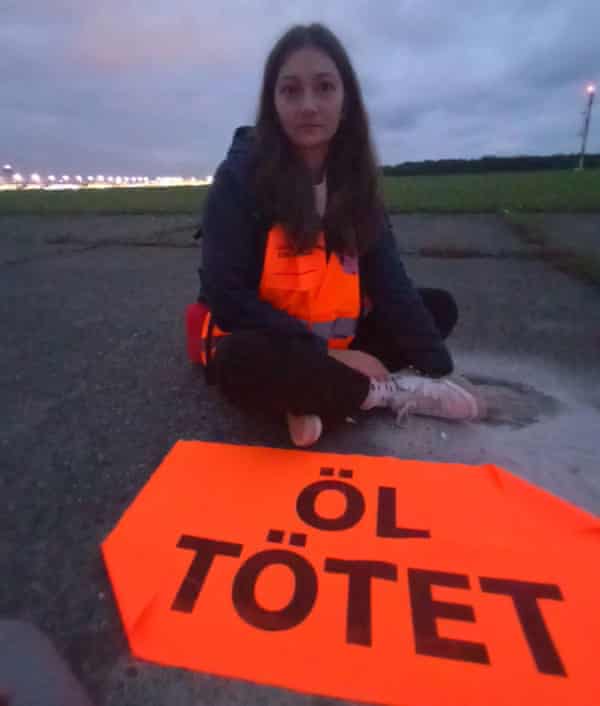
An activist taking part in the protest at Cologne-Bonn airport holds her hand glued to the runway. Photograph: Letzte Generation Handout/EPA
“Ordinary people are taking matters into their own hands today to do what our criminal governments have failed to do,” the campaign said in a statement. “We are putting our bodies on the wheels of the machine of the global fossil economy and saying ‘oil kills’.”
In Germany, protesters from the climate group Letzte Generation (Last Generation) briefly stopped flights on Wednesday morning after they cut a chain-linked fence and glued themselves to the tarmac at Cologne-Bonn airport. The airport said that 31 flights had been cancelled and six diverted.
In Austria, activists delayed a flight by refusing to sit down before takeoff while others spilled orange paint in the terminal at Vienna airport. In Switzerland, they blocked roads leading to Zürich and Geneva airports.
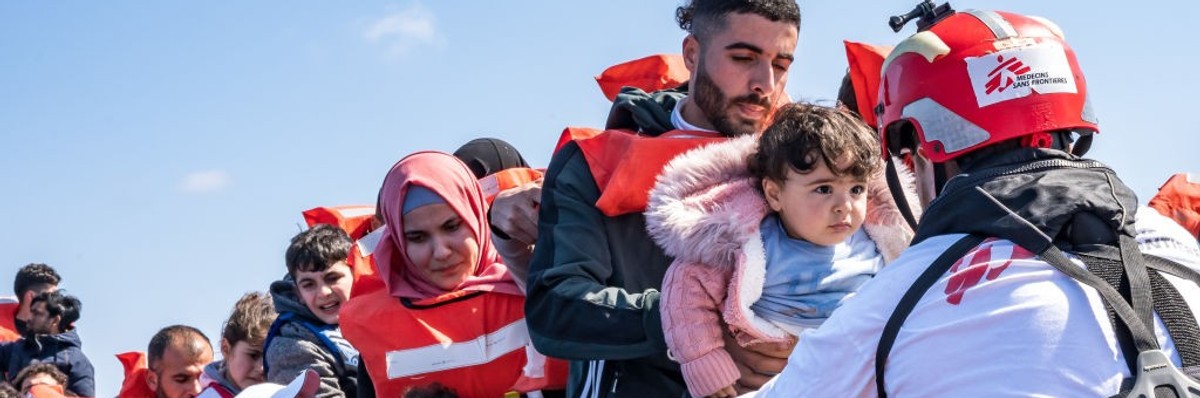
The Doctors Without Borders vessel Geo Barents intercepted two small boats full of migrants navigating toward Europe in the Central Mediterranean on March 16, 2024. (Photo by Simone Boccaccio/SOPA Images/LightRocket via Getty Images)
“As this legislative cycle starts, the E.U. can and must do better than abandon its commitment to the global refugee protection regime,” said an Amnesty campaigner.
Nearly 100 human rights organizations came together Tuesday to emphasize that members of the European Union “must guarantee the right to seek and enjoy asylum and uphold their commitments to the international refugee protection system.”
The joint statement from groups including Amnesty International, Human Rights Watch, and Oxfam came as members of the European Parliament prepare for the July 16 plenary sitting, the first meeting scheduled since the bloc’s June elections, which resulted in the far-right “Patriots for Europe” becoming the third-largest alliance in the legislative body.
The human rights coalition underscored obligations under Article 18 of the E.U. Charter of Fundamental Rights and expressed concern about “the recent and increasing attempts by the E.U. and its member states to evade their asylum responsibilities by outsourcing asylum processing and refugee protection risk undermining the international protection system.”
As the groups detailed:
Italy, for instance, is currently seeking to process asylum applications of certain groups of asylum-seekers outside of its territory, from detention in Albania—which risks leading to prolonged, automatic detention, a denial of access to fair asylum procedures with necessary procedural guarantees, and delayed disembarkation for people rescued or intercepted at sea. Others, such as Denmark and Germany, are assessing the feasibility of this type of arrangement. Fifteen E.U. member states and some political groups have endorsed similar shortsighted measures to shift asylum processing outside E.U. territory and encouraged the European Commission to explore ways to facilitate this through further legislative reform, including through a watered-down ‘safe third country’ concept.
These attempts must be seen in the context of parallel containment efforts that seek to stem departures and prevent the arrival of asylum-seekers to E.U. territory through partnership agreements with third countries, with little to no attention to the human rights records of those authorities.
The coalition stressed that “as the extensive track record of human rights violations in partner countries such as Libya demonstrates, the E.U. and Member States have no adequate tools and competencies to effectively monitor or enforce human rights standards outside of E.U. territory.”
A report published in November by Doctors Without Borders features stories of violence that migrants endured in nations including Libya and Tunisia while trying to get to the E.U. That publication also points out that 2023 was the deadliest year for migration in the Central Mediterranean since 2017, due in part to E.U. countries failing to assist those at risk of drowning.
On Friday, our aircrew witnessed 1 of 3 rescues by @soshumanity_de that day. While 111 people were evacuated to Lampedusa, the other ~180 survivors had to stay on board the Humanity 1, assigned the port of Bari, over 1100km & a 4-day crossing away—pure political harassment by 🇮🇹. pic.twitter.com/DXwVFzNq0X
— Sea-Watch International (@seawatch_intl) July 8, 2024
In addition to sounding the alarm about current E.U. policies and practices, the coalition on Tuesday cited examples including Australia’s offshore detention scheme, which “demonstrates how these models have created prolonged confinement and restricted freedom of movement, deeply harming both the mental and physical health of people seeking protection.”
The organizations also pointed to an asylum scheme attempted by the United Kingdom—which left the E.U. in 2020 following the 2016 Brexit vote—and Rwanda, which the statement notes “is not yet in effect following the U.K. Supreme Court declaring it unlawful and in any event is unlikely to be operationalized at any significant scale.”
The U.K.’s failed attempt to forcibly remove people to the African country was “projected to cost a staggering £1.8 million per asylum-seeker returned,” which is equal to €2.13 million or $2.3 million. The coalition called such schemes “not only an unjustifiable waste of public money, but also a lost opportunity to spend it in ways that would truly aid people seeking asylum by investing in fair and humane asylum systems and the communities that welcome them.”
Olivia Sundberg Diez, Amnesty’s E.U. advocate on migration and asylum, said in a statement Tuesday that “attempts by states to outsource their asylum responsibilities to other countries are not new—but have long been criticized, condemned, and rejected for good reason.”
“Just as the U.K.-Rwanda scheme is, rightly, collapsing, the E.U. and its member states should pay attention, stop making false promises, and wasting time and money on expensive, inhumane, and unworkable proposals,” she continued. “As this legislative cycle starts, the E.U. can and must do better than abandon its commitment to the global refugee protection regime.”
The EU and its member states have had some truly terrible policies toward asylum seekers in recent years.
The meeting scheduled for next week will follow the Pact on Migration and Asylum that the European Parliament passed in April and the Council of the E.U. adopted in May. The coalition highlighted that “civil society organizations have been clear about their serious concerns” regarding the reforms while also explaining that “the transfer of asylum-seekers outside of E.U. territory for asylum processing and refugee protection is not provided for in the pact, nor within current E.U. law.”
“After the E.U. and member states have spent close to a decade attempting to reform the E.U.’s asylum system, they should now focus on implementing it with a human rights-centered approach that prioritizes the right to asylum per E.U. law and fundamental principles of international refugee law to which they remain bound,” the coalition concluded. “They should not, mere weeks after the reform has passed, waste further time and resources on proposals that are incompatible with European and international law.”