Germany bans public grieving and solidarity with Palestine
Original article republished from peoples dispatch under a Creative Commons Attribution-ShareAlike 4.0 (CC BY-SA) license.

Germany is home to Europe’s largest Palestinian community, with roughly 80,000 Palestinians living in the country. For years, German authorities have tried to stifle Palestinian activism in the country, viewing it as a nuisance to its explicit policy of “unconditional support for Israel.” Demonstrations, such as one earlier this year to mark the 75th anniversary of the Nakba, have been sporadically banned in recent years and organizations, like the Palestinian prisoner solidarity network Samidoun, have also come under increasing scrutiny.
Yet the criminalization of solidarity with Palestine on a national level has taken on entirely new dimensions since October 7. After a small demonstration on Berlin’s busy Sonnenallee street on the evening of October 7, the German media and body politic have been up in arms about Palestinians supposedly celebrating terrorism and antisemitism on German streets.
Talking points that were two weeks ago only uttered by far-right AfD politicians are now being openly expressed by politicians from all parliamentary parties in Germany. Playing off the idea of “imported antisemitism,” the social democratic Chancellor Olaf Scholz is now arguing that “we must finally deport on a large scale” residents who do not hold German citizenship and openly protest against Israel. The Christian Democrats (CDU) are even demanding that the recognition of Israel’s right to exist must become a precondition for German citizenship.
Samidoun has been made into public enemy number one, as the media presents the group as a bastion for “sympathizers of terror” that poses “a particular danger, because as a secular organization, they are building bridges between Islamists and radical leftists.” In a speech before parliament on October 12, Chancellor Scholz personally announced a ban on Samidoun along with a ban on the activities of Hamas in Germany.
In Berlin specifically, which is home to one of the largest Palestinian diaspora communities outside the Arab world, the authorities have been particularly hostile towards any signs of solidarity with Palestine. Since October 7, every demonstration explicitly or implicitly referring to Palestine has been banned, leaving the roughly 30,000 Palestinians living in Berlin with no means of expressing their anguish at the siege and bombardment of Gaza.
Solidarity groups have been trying to bypass this censorship by avoiding political statements and focusing on humanitarian campaigning, yet even demonstrations and slogans such as “Children in Gaza need help” and “Solidarity with the civilian population in the Gaza Strip” were banned. On October 13, the police went so far as to ban a demonstration registered by the group “Jewish Voice for a Just Peace in the Middle East” entitled “Jewish Berliners against violence in the Middle East.”
Sonnenallee, a busy street in the district in which many Arab migrants live, has become a focal point of dissent against Israel’s attack on Gaza. The police patrol Sonnenallee every evening with tight controls on the public squares. Racial profiling and brutal arrests are commonplace and often recorded and posted to social media. One particular video shows police officers stomping out a candle-lit vigil with their boots.
In a letter to all Berlin schools, the city’s Department for Education, Youth and Family set out strict guidelines on how to discuss the situation in Palestine with students. “Any demonstrative action or expression of opinion that can be understood as advocating or approving of the attacks against Israel or support for the terrorist organizations carrying them out, such as Hamas or Hezbollah, constitutes a threat to school peace in the current situation and is prohibited.” According to the letter, these may include the following: “visibly wearing relevant clothing (for example, the kuffiyeh known as the Palestinian scarf), displaying stickers and patches with inscriptions such as ‘free Palestine’ or a map of Israel in the colors of Palestine (white, red, black, green), and shouting ‘free Palestine!’ and demonstrating verbal support for Hamas and its terrorism.”
At one high school on Sonnenallee, a 61-year-old teacher attempted to confiscate a Palestinian flag from a 14-year-old student and ended up in a physical altercation with a second 15-year-old student. The parents’ association of the school tried to organize a demonstration under the slogan “No place for racism, no place for violence” as a reaction to the incident, yet it was promptly banned by the police, ostensibly as a “a precautionary measure”. The Central Council of Palestinians in Germany has since sent a letter in response to Berlin’s Department for Education, expressing their “great concern about the psychological and educational development [of their children]” in Berlin schools.
As other European states are witnessing mass protests in solidarity with Palestine, the German state has been able to use force and violence to prevent such scenes on German streets. Yet it is unlikely that the government will be able to ban these sentiments of solidarity indefinitely, especially as the images of Israel’s brutal attack on Gaza continue to circulate around the world.
Original article republished from peoples dispatch under a Creative Commons Attribution-ShareAlike 4.0 (CC BY-SA) license.
Thousands gather in London for National Rejoin March

https://leftfootforward.org/2023/09/thousands-gather-in-london-for-national-rejoin-march/
The sun was shining on the capital as thousands of pro-EU supporters gathered in Central London on September 23, for the second National Rejoin March (NRM).
Protesters, waving, not just EU flags, but flags from across Europe, including Spain, Ireland, France, and Wales, congregated on Park Lane, where they made their way to Parliament Square.
Speakers from six countries took to the stage, in an event that was supported by 70 affiliated partner organisations. Orators included former Belgian prime minister Guy Verhofstadt, who said there is an absolute need for the UK to rejoin the EU and it is always welcome back. Terry Reintke, MEP, said the growing citizens movement for rejoin is being followed very closely in Brussels, where Britain is ‘missed a lot.’
…
https://leftfootforward.org/2023/09/thousands-gather-in-london-for-national-rejoin-march/
‘Ancient Heat Records Will Be Broken’: Southern Europe Braces for Unprecedented Temperatures
Original article by JAKE JOHNSON republished from Common Dreams under Creative Commons (CC BY-NC-ND 3.0).
“If the disasters we’re seeing this month aren’t enough to shake us out of that torpor, then the chances of our persevering for another hundred and twenty-five thousand years seem remote.”
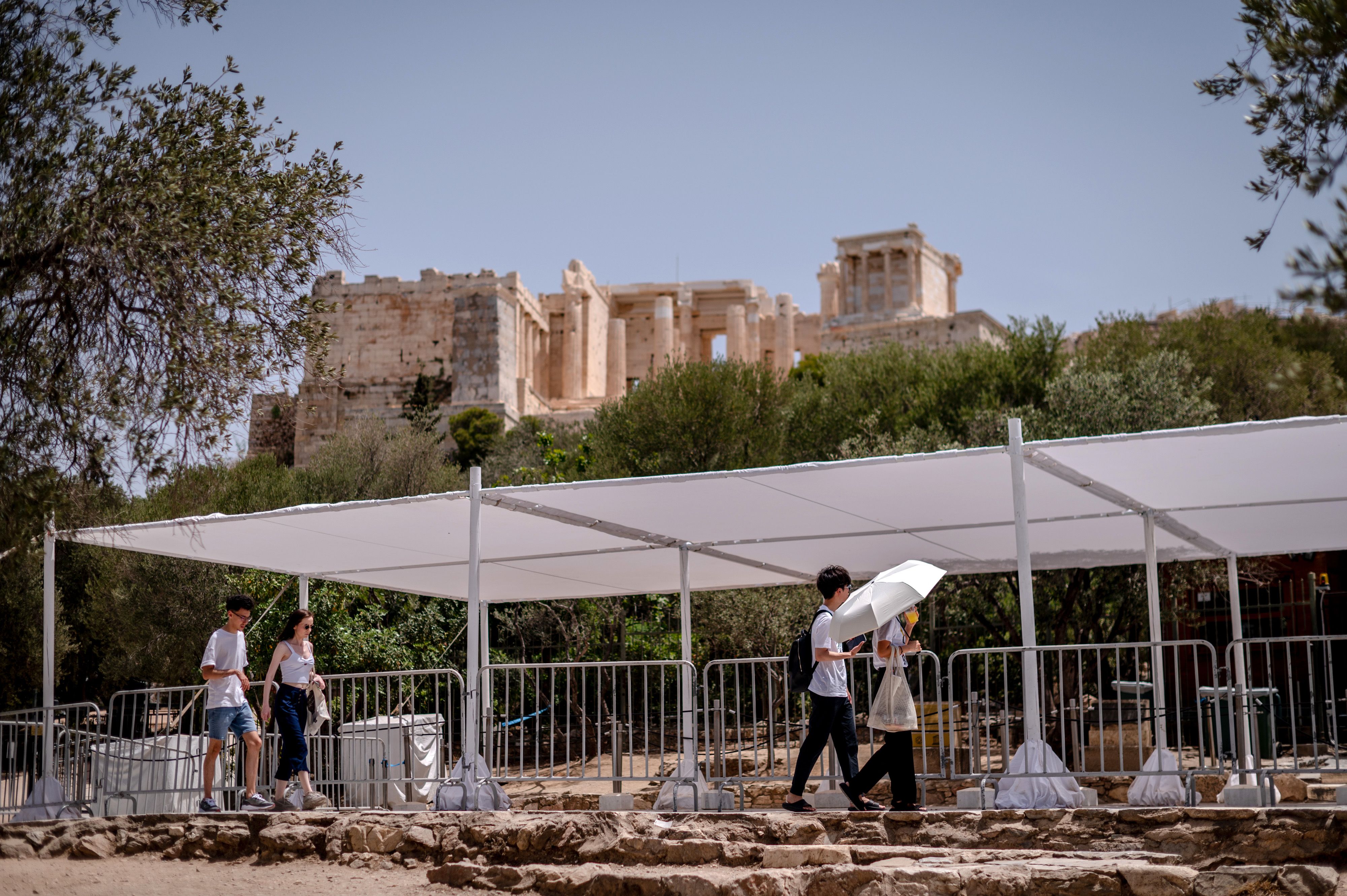
Southern Europe faced dangerously high temperatures on Sunday amid a continent-wide heatwave that’s expected to get worse in the coming days, potentially shattering longstanding records as the climate crisis rages.
Reuters reported that a “new anticyclone dubbed Charon, who in Greek mythology was the ferryman of the dead, pushed into the region from north Africa on Sunday and could lift temperatures above 45°C (113°F) in parts of Italy early this week,” prompting Italian officials to issue heat advisories for more than a dozen cities on Sunday.
Meteo.it, Italy’s weather news service, said Sunday that the country must “prepare for a severe heat storm that, day after day, will blanket the whole country.”
“In some places,” the service added, “ancient heat records will be broken.”
The fastest-warming continent on the planet, Europe has been facing scorching heat over the past several weeks as scientists warn that the fossil fuel-driven climate crisis is making such heatwaves more likely and increasingly intense. Last summer was Europe’s hottest season on record, and extreme heat killed more than 61,000 people on the continent between late May to early September of 2022.
But the current heatwave appears on track to be even more severe than last summer’s.
As CNN reported Sunday, “Climate scientists at the European Space Agency (ESA) say temperatures could reach 48°C (118.4°F) on the islands of Sicily and Sardinia, ‘potentially the hottest temperatures ever recorded in Europe.'”
“The ESA warned that Europe’s heat wave has only just begun with Spain, France, Germany, and Poland expected to see extreme weather, just as the continent welcomes what is expected to be a record-breaking number of tourists coming for the first time since the Covid-19 pandemic,” the outlet added.
Giulio Betti, an Italian meteorologist and climate expert, told the BBC that “temperatures will reach a peak between 19 and 23 July—not only in Italy but also in Greece, Turkey, and the Balkans.”
“Several local heat records within these areas may well be broken during those days,” Betti added.
Europe’s intensifying heatwave comes in the context of globally high temperatures fueled by El Niño conditions—which the climate crisis has likely made worse and more frequent.
Large swaths of the U.S., Asia, and Africa have experienced sweltering temperatures and other extreme weather—including deadly flooding—in recent weeks, heightening the urgency of coordinated climate action at the upcoming COP28 conference in the United Arab Emirates.
“It was probably the Earth’s hottest week in history earlier this month, following the warmest June on record, and top scientists agree that the planet will get even hotter unless we phase out fossil fuels,” The Guardian‘s Dharna Noor wrote Sunday. “Yet leading energy companies are intent on pushing the world in the opposite direction, expanding fossil fuel production and insisting that there is no alternative. It is evidence that they are motivated not by record warming, but by record profits, experts say.”
In February, after reporting a record-shattering $28 billion in 2022 profits, the London-based oil giant BP announced that it was walking back its emission-reduction goals and planning to produce more fossil fuels than expected.
Shell, which posted $40 billion in profits last year, followed suit last month, ditching its plans to reduce oil production by up to 2% per year.
In a New Yorkercolumn on Sunday, author and climate advocate Bill McKibben noted that the BBC aired an interview with Shell CEO Wael Sawan on July 6, the day scientists believe may have been the hottest on record.
During the interview, Sawan claimed that cutting oil and gas production would be “dangerous and irresponsible,” drawing swift backlash.
McKibben noted that Sawan “told the BBC that, while there are not currently any plans, Shell wouldn’t rule out moving its headquarters from the United Kingdom to the United States, where oil companies get higher market prices for their shares.”
“This suggested to him that the U.S. is more supportive of oil and gas companies, and, as he has told investors, he wants to ‘reward our shareholders today and far into the future,'” McKibben added. “That is pretty much the definition of ‘business as usual,’ and it’s precisely what has generated this completely unprecedented heat. If the disasters we’re seeing this month aren’t enough to shake us out of that torpor, then the chances of our persevering for another hundred and twenty-five thousand years seem remote.”
Original article by JAKE JOHNSON republished from Common Dreams under Creative Commons (CC BY-NC-ND 3.0).
Cerberus heatwave: Why is it so hot in Europe and how long will it last?
Why is it so hot in Europe?
Extreme temperatures have hit Europe this year as the world swelters through the El Niño weather pattern, and greenhouse gas emissions warm our climate.
But the latest highs have been made worse by an anticyclone dubbed ‘Cerberus’. This area of high pressure started in the Sahara before moving across northern Africa and into the Mediterranean.
The heatwave was named by the Italian Meteorological Society after the fiery-eyed, three-headed dog that guards the gates of the underworld in Greek mythology.
How hot will Europe get?
The Italian islands of Sardinia and Sicily could simmer in 48°C in the coming days, potentially reaching “the hottest temperatures ever recorded in Europe,” according to the European Space Agency (ESA).
In August 2021, Sicily hit 48.8°C – the current record.
Rome, Bologna and Florence are among the 10 Italian cities currently under red alert for extreme heat.
Spain’s weather service said thermometers could potentially hit 45°C southeastern areas of the Iberian Peninsula, which are also under an alert for extreme heat. The temperature of the ground in parts of the country has hit more than 60°C.
…