How is information made legitimate, and when is it appropriate for journalists to introduce skepticism? What happens when only one side of a conflict is given the legitimate voice, always repeated and rarely questioned, even when those sources have proven many times to have promulgated lies?
Military studies scholars and analysts understand that there is always a long genesis of historical, political and economic factors that can eventually erupt into conflict. In many ways, US establishment media seemed unwilling or unable (but likely both) to narrate a more complex, historically accurate account of the war on Gaza.
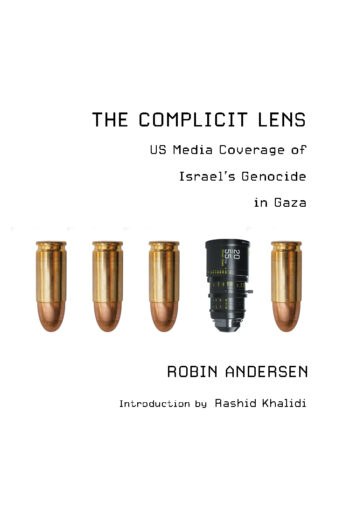
The Intercept (4/15/24) reported that editorial directives at the New York Times and CNN, two of the most important news sources in the US, advised reporters to avoid certain “taboo” words, such as “genocide” and “massacre.” Yet between October 7 and November 24, 2023, the Times used the word “massacre” 53 times—referring to Israelis killed by Palestinians, but only once to refer to a Palestinian killed by Israel (Intercept, 1/9/24).
From November onward, as deaths in Gaza piled up, the Times habitually avoided using emotionally fraught terms for Palestinians. Another term, “ethnic cleansing,” was also barred from use, along with “refugee camps” and “occupied territories.”
As the Times source who leaked the directives said, “You are basically taking the occupation out of the coverage, which is the actual core of the conflict.”
US news outlets were crippled by these verbal restrictions, incapable of offering an accurate explanation of what was happening in Gaza by imposing such constraints on humanitarian language, and international principles and laws.
Media frames are based on underlying assumptions, articulated through familiar tropes that appear unquestioned in language and representation. Some stories are recognizable as reflections of beliefs and myths, and others are accurate renderings when accompanied by on-the-ground documentation.
Seasoned journalists entrusted to cover such a monumental conflict seemed not to be schooled in the differences. They failed to identify the history and uses of atrocity stories as propaganda, and showed no awareness of the use of Islamophobic tropes such as the “brutish knife-wielding Arab terrorist,” or the West’s long history of Orientalism and the hypersexualized Arab male, as identified by Edward Said.
Establishment media applied a “lawlessness” trope, identified by Rebecca Solnit (A Paradise Built in Hell, 2009) as a dictate of convention to blame the victims of humanitarian disasters, when in fact in such crises, she argued, communities come together to help one another. The lawlessness frame was used to direct the causes of starvation away from Israel’s engineered famine, and point the finger of blame at starving Palestinians, who were being shot by IDF snipers as they looked for food.
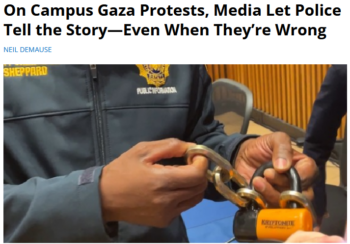
By April 2024, when police were called to break up student encampments, media relied on another powerful framing device, complete with its attendant language, to condone police violence against students at colleges and universities, first at Columbia, then at other campuses around the country. Campuses, they said, had been infiltrated by “outside agitators” (FAIR.org, 5/9/24).
Yet the critical debate articulated by student protests was part of American public discourse at the time. Though they were violently attacked by pro-Israel protesters and US law enforcement, students helped move American sentiment about the genocide to the center of cultural and political debate. By the fall of 2024, students would be hit by a wave of repression and attacks on their civil liberties and rights to freedom of expression.
Were these stereotypes taken into consideration when deciding which stories would be told, which talking points would be followed, and which perspectives would be ignored? Many of the narratives we are left with, used to explain this so-called “Israel/Palestine conflict,” are familiar media constructs and simply cannot explain a genocide.
In so many ways, big media failed to provide accurate information about Israel’s bombing attacks and their consequences on the people in Gaza. They improvised a language of confusion, denial and justification.
A combination of media tropes and frames, together with verbal inventions, downplayed Israel’s increasingly brutal genocidal violence, along with the hollow echoes that explained away every military act of violence, as the media served as “stenographers to power.” These strategies facilitated the continuation of a genocide. The failure to accurately cover the destruction of Gaza was inimical to the basic professional canons of journalism.
Genocide does not happen without a language to incite it. From collective punishment to ethnic cleansing, and the destruction of infrastructure to the withholding of food, water and medical care, Israel continually committed war crimes on a much greater scale than the initial Hamas attacks. Such acts depended on the demonization of an entire people, and the undervaluing of Palestinian life was a major feature of US reporting.
In Gaza, in addition to dismantling civilian infrastructure such as hospitals, Israel also carried out the destruction of cultural heritage sites, universities, schools and mosques, acts of destruction understood to deliberately eliminate an entire group of people defined by their ethnicity, religion, culture and identity. These are the crimes of genocide. Yet the words associated with these crimes were rarely if ever used in establishment media reporting on Israel’s attacks on Gaza.
FAIR’s work is sustained by our generous contributors, who allow us to remain independent. Donate today to be a part of this important mission.
Keir Starmer objects to criticism of the IDF. He asks how could anyone object to them starving people to death, forced marches like the Nazis did, bombing Gaza’s hospitals and universities, mass-murdering journalists, healthworkers and starving people queuing for food, killing and raping prisoners and murdering children. He calls for people to stop obstructing his genocide for Israel.Keir Starmer explains that UK is actively supporting Israel’s genocidal expansion and repeats his previous quotation that he supports Zionism “without qualification”. Keir Starmer said “I said it loud and clear – and meant it – that I support Zionism without qualification.” here: https://www.jewishnews.co.uk/keir-starmer-interview-i-will-work-to-eradicate-antisemitism-from-day-one/Donald Trump sings and dances, says that it’s fun to kill everyone …
There was a time, not terribly long ago, when the right claimed that the big social media companies weren’t just skewed to the left in terms of moderation, but that they were actually acting in the direct interests of the Democratic administration (House Judiciary Committee, 5/1/24).
When right-wing billionaire Elon Musk bought Twitter, eventually rebranding it as X, the right believed that he’d show the world that the popular site was a tool of the Democratic agenda (New Yorker, 1/11/23). The move increased Musk’s profile as a conservative crusader against social progress and economic populism before his brief stint as President Donald Trump’s federal jobs hatchet man in 2025 (Roosevelt Institute, 5/29/25).
Before a forced sale by its Beijing-based parent company, TikTok was attacked by both Democrats and Republicans because of its ownership, with both sides claiming that this not only gave the Chinese government the ability to spy on Americans, but also to skew political discourse away from Washington’s interests (FAIR.org, 11/13/23, 5/8/24, 1/3/25).
At Meta, founder Mark Zuckerberg quickly tried to distance his company from the notion that it acted in tandem with the Biden administration. Politico (8/26/24) reported:
Mark Zuckerberg says he regrets that Meta bowed to Biden administration pressure to censor content, saying in a letter that the interference was “wrong,” and he plans to push back if it happens again.
Zuckerberg told podcaster Joe Rogan (Joe Rogan Experience, 1/10/25) that the Biden administration had been “calling up the guys on our team and yelling at them and cursing and threatening repercussions if we don’t take down things that are true.” He asserted that Meta, and especially Facebook, “had gone too far in complying with such requests, and acknowledged that he and others at the company wrongly bought into the idea” (Axios, 1/10/25).
Meta ‘in bed with the regime’
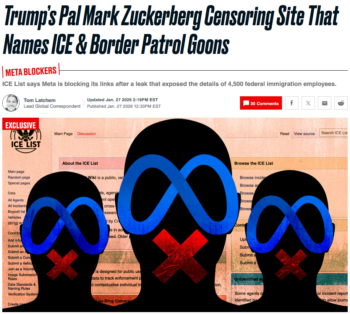
ICE List founder Dominick Skinner (Daily Beast, 1/27/26): “I don’t believe that it’s somehow an accident that a company so deeply ingrained in this regime is suddenly blocking a website that actively fights against it.”
If you took these claims at face value, you would expect that we would have a more neutral and less government-controlled social media in 2026. Instead, we have a social media oligarchy that is now working directly in the interests of the Trump administration’s national police state.
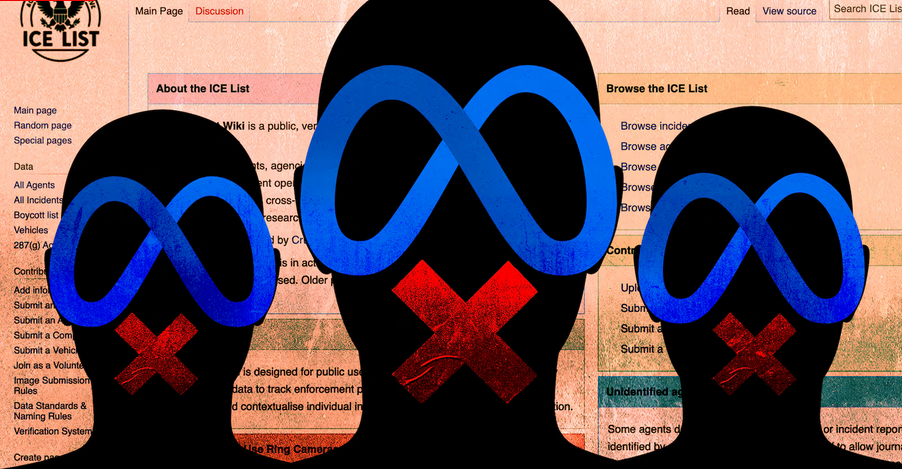
X converted from a free-wheeling social media site into a 24-hour online MAGA rally (Guardian, 1/4/25; NBC News, 2/16/25) a long time ago. But there are new developments involving other platforms. All of Meta’s social media sites—Facebook, Instagram and Threads—are blocking access to ICE List, a website that lists names of Homeland Security agents (Wired, 1/27/26).
Politico (1/27/26) reported that the website’s founder, Dominick Skinner, “questioned Meta’s policy against posting links to websites that contained people’s personal information.” Politico said he added “that Meta’s platforms had no issues with posting people-finder websites such as White Pages that shared individuals’ phone numbers and family members.”
I believe that Mark Zuckerberg is in bed with the regime. He was sitting behind Trump at the inauguration. His algorithms have worked to shape people into right-wing followers.
“Meta donated to the Trump Ballroom,” he pointed out—which is also true of other tech firms such as Amazon, Microsoft and Google (Fortune, 10/26/25).
TikTok now free to censor?
“We have to fight with the weapons that apply to the battlefield in which we engage, and the most important ones are social media,” Israeli Prime Minister Benjamin Netanyahu told pro-Israel influencers last September (Al Jazeera, 1/29/26). “The most important purchase that is going on right now is…TikTok.”
The TikTok deal is now final, with its Chinese former parent company, ByteDance, holding about a fifth of the network, with a major bulk controlled by tech giant Oracle, Silver Lake and the Abu Dhabi investment firm MGX (Reuters, 1/23/26). The sale was celebrated as a win against Chinese infiltration into the US media market, but the Washington Post editorial board (1/23/26) believed this wasn’t good enough:
ByteDance will maintain ownership of TikTok’s coveted algorithm and license it to the spinoff. The announcement emphasizes that the algorithm’s recommendations will be stored in Oracle’s US cloud system but also that the two companies will retain “global product interoperability,” with ByteDance maintaining control over e-commerce and marketing. That sounds like much less of a breakup than Congress intended.
FAIR (3/14/24, 9/27/24, 1/3/25) has long been skeptical of the US government move to force the sale of TikTok, as it was often based on dubious claims about data mining, and awash with McCarthyist fearmongering. Worse, Oracle’s co-founder is Larry Ellison, another right-wing tech billionaire (FAIR.org, 9/19/25; All Things Considered, 10/6/25), making the TikTok sale eerily reminiscent of the Musk takeover of Twitter.
Right after the deal was finalized, “users were raising concerns that the company is ‘censoring’ videos, including ones critical of President Donald Trump, ICE or mentions of Jeffrey Epstein,” AP (1/27/26) reported. “The complaints were enough for California Gov. Gavin Newsom to announce…that he is launching a review into whether TikTok is violating state law by censoring Trump-critical content.”
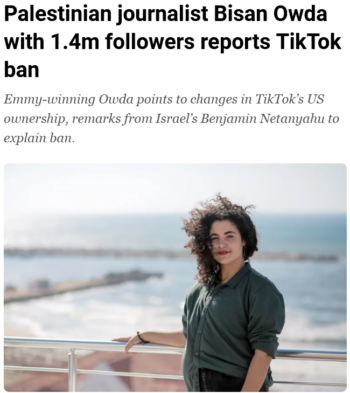
It reportedly wasn’t just censorship about ICE and Epstein. “Award-winning Palestinian journalist Bisan Owda has said she has been permanently banned from TikTok,” Al Jazeera (1/29/26) said, “days after the social media platform was acquired by new investors in the United States.”
Cripple social media to crush protests
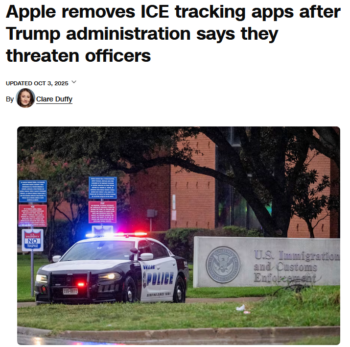
Apple pulled an ICE alert app from its online store as “defamatory, discriminatory or mean-spirited content.” CNN (10/3/25) noted: “Apple and its CEO Tim Cook have in recent months sought to strengthen the company’s relationship with the White House, amid policy changes from Trump that could threaten its business.”
Wealthy capitalists buy social media companies for the same reason they buy newspapers and radio stations: They want to use media to sway the political discussion toward policies that meet their economic and political interests. Musk taking over Twitter isn’t much different from Amazon titan Jeff Bezos taking over the Washington Post and turning its opinion section into a right-wing propaganda machine (Golden Hour, 9/15/25; New Republic, 11/3/25; Press Watch, 12/12/25; FAIR.org, 1/22/25, 1/28/25) and putting its news operation on life support (The Hill, 1/27/26).
But given growing street resistance to the state terror perpetrated by Immigration and Customs Enforcement and Border Patrol in cities around the US, these reports about social media blackouts are alarming, reminiscent of reports out of Turkey (Reuters, 9/8/25) and Iran (New York Times, 1/25/26).
With Zuckerberg, Musk and Ellison all showing their allegiance to the administration in various ways, this is all just more evidence that regime-adjacent social media are working in the interests of Trump’s authoritarian ambitions. And this has been brewing for some time. A few months ago, CNN (10/3/25) reported, Apple “removed ICEBlock and similar apps that allow people to alert others nearby about sightings of Immigration and Customs Enforcement agents in their area,” after receiving “a request from the US Department of Justice.” The Electronic Frontier Foundation (11/20/25) sued the DoJ and Department of Homeland Security over this and similar instances of platforms removing “apps that document immigration enforcement activities in communities throughout the country.”
‘A really troubling thing‘
The Council on American-Islamic Relations (1/27/26) commended the news social media platform UpScrolled “for pledging to protect the free flow of ideas on its platform, including both support for and opposition to the Israeli government’s human rights abuses.”
In an interview with FAIR, EFF senior counsel David Greene said there are several problems at play. One is that
there’s still a great deal of concentration in the direct-publishing social media space, so any decision that gets made by Meta or YouTube or TikTok is going to affect a ton of people who use their services to get their information.
But there is also tremendous pressure by the government to keep immigration enforcement, and all the expanded policing around mass deportations, in the shadows by keeping agents’ identities anonymous. “That’s a really, really troubling thing,” he said.
Greene also stressed that “if Meta or TikTok are doing this just to curry favor with the administration, or because they ideologically agree with it, that’s not illegal; they have a First Amendment right to curate their sites.”
Illegal, no, but still a critical problem. We aren’t looking at a totalitarian form of speech control, where the state and ruling party directly control various forms of media. Rather, we have a clan of oligarchs aligning themselves with authoritarian government goals because they benefit from being close to the regime.
While many activists have shown dismay at these developments, others have said the challenges inspire hope. The Council on American-Islamic Relations (1/27/26) said in a statement that “young people censored on TikTok have no intention of giving up their activism,” as they have “have repeatedly shown that they will not allow politicians, corporations or colleges to censor their speech.”
FAIR’s work is sustained by our generous contributors, who allow us to remain independent. Donate today to be a part of this important mission.
Elon Musk urges you to be a Fascist like him, says that you can ignore facts and reality then.Donald Fuhrump says that Amerikkka doesn’t bother with crimes or charges anymore, not being 100% Amerikkkan and opposing his real estate intentions is enough.Orcas discuss how Trump was re-elected and him being an obviously insane, xenophobic Fascist.
This month brought yet another record-breaking spate of flash floods and deadly heatwaves across the US. Yet, as a new study by Heated (6/27/24) reveals, despite ample reporting on these events, a majority of news outlets still did not link these events to their cause: climate change.
Emily Atkin and Arielle Samuelson, writers for the climate-focused, Substack-based outlet, analyzed 133 digital breaking news articles from national, international and regional outlets reporting on this month’s extreme weather. Just 44% mentioned the climate crisis or global warming. Broken down by weather event: 52% of stories that covered heatwaves, and only 25% of stories that covered extreme rainfall, mentioned climate change.
As Atkin and Samuelson write, by now we know that climate change is the main cause of both extreme heat and extreme flooding. And we know the biggest contributor of climate-disrupting greenhouse gasses: fossil fuels, which account for about 75% of global emissions annually.
Still, the study’s authors found, only 11% of the articles they studied mentioned fossil fuels. Only one piece (BBC, 6/24/24) mentioned deforestation, which scientists say contributes about 20% of annual greenhouse gas emissions. None mentioned animal agriculture, which the FAO estimates contributes about 12% of global emissions.
Stark omissions
The omissions were laughably stark: A New York Post piece (6/21/24) ended with a New Yorker and former Marine who said he’d been in “way hotter conditions”—in Kuwait and Iraq. An AP article (6/4/24) quoted the “explanation” offered by a spokesperson for the Arizona Department of Forestry and Fire Management: “It does seem like Mother Nature is turning up the heat on us a little sooner than usual.”
Heated recognized some outlets that consistently mentioned climate change in their breaking coverage of heat and floods this month. That list included NPR, Vox, Axios, BBC and Agence France-Presse (AFP).
Then there were the outlets whose breaking coverage never mentioned it: ABC News, USA Today, The Hill, the New York Post and Fox Weather. When questioned, many of these outlets pointed the study’s authors to other climate coverage they had done, but this study’s focus on breaking news stories was deliberate:
Our analysis focused only on breaking stories because climate change is not a follow-up story; it is the story of the lethal and economically devastating extreme weather playing out across the country. To not mention climate change in a breaking news story about record heat in June 2024 is like not mentioning Covid-19 in a breaking news article about record hospitalizations in March 2020. It’s an abdication of journalistic responsibility to inform.
Explaining isn’t hard
A crucial takeaway for journalists and editors in this piece is that explaining the cause of these weather events isn’t hard. It’s often a matter of adding a sentence at most, Atkin and Samuelson write. They provide examples of stories that successfully made this connection, as with BBC (6/24/24):
Scientists say extreme weather events are becoming more frequent and intense as a result of human-caused climate change, fueled by activities like burning fossil fuels and cutting down forests.
Heatwaves are becoming more severe and prolonged due to the global climate crisis, caused primarily by the burning of fossil fuels.
Notably, the Guardian piece was a reprint of an AParticle that did not originally include that sentence; Heated confirmed that it was added by a Guardian editor.
AP, however, was sometimes able to provide appropriate context, as in a June 21 piece:
This month’s sizzling daytime temperatures were 35 times more likely and 2.5 degrees F hotter (1.4 degrees C) because of the warming from the burning of coal, oil and natural gas—in other words, human-caused climate change.
More denial than acknowledgment
During last summer’s apocalyptic orange haze on the East Coast, caused by record Canadian wildfires, I conducted a similar study (FAIR.org, 7/18/23) on US TV news’s coverage. Out of 115 segments, only 38% mentioned climate change’s role. Of those 115, 10 mentioned it in passing, 10 engaged in climate denial and 12 gave a brief explanation without alluding to the reality that climate change is human-caused. Only five segments acknowledged that climate change was human caused, and just seven fully fleshed out the fact that the main cause of the climate crisis is fossil fuels.
When there are more segments denying climate change than acknowledging fossil fuels’ role in it, you know there’s a problem.
This year, I noticed coverage of worldwide coral bleaching that did make the appropriate connections (FAIR.org, 5/17/24). As Atkin and Samuelson emphasized, the difference between careless and responsible reporting on this issue is often just a few words.
As the world watched on social media and responded in outrage, US corporate media, once again, provided cover for the perpetrators of Israel’s genocide.
CounterPunch (5/31/24): “When the Israeli bombs strafed the safe zone, the plastic tents caught fire, sending flames leaping two meters high, before the melting, blazing structures collapsed on the people inside, many of them children who’d just been tucked in for the evening.”
Over the Memorial Day weekend, Israel bombed starving Gazan refugees crowded in tents in Rafah, where Israel had told them to go. As Jeffrey St. Clair (CounterPunch, 5/31/24) wrote, leaflets dropped in Rafah a few days before told them to go to “Tel al-Sultan through Beach Road,” an area set up by the UNRWA refugee agency and designated a UN humanitarian safe zone. The leaflet added, “Don’t blame us after we warned you.”
Nevertheless, without warning, Israel hit the camp with at least eight missiles spreading fire though the encampment of plastic tents (Quds News, 5/26/24). Some refugees burned to death, mostly women and children, leaving them dismembered and charred.
The world saw the terror of the massacre on international and social media. Images showed the area of the strike engulfed in flames as Palestinians screamed, cried, ran for safety and sought to help the injured. “They told people to move there then killed them,” Richard Medhurst (5/28/24) posted.
A boy cries in horror and fear as he watches his father’s tent burn with him inside. A man holds up the body of his charred, now-headless baby, wandering around, not knowing what to do or where to go. An injured, starving child convulses in pain as a medic struggles to find a vein for an IV in her emaciated arm (Al Jazeera, 5/27/24).
Al Jazeera (cited by Quds News, 5/26/24) quoted a Civil Defense source: “We believe that the occupation army used internationally prohibited weapons to target the displaced in Rafah, judging by the size of the fires that erupted at the targeted site.”
US news media reported the tent massacre, some more truthfully than others. But most establishment media repeated Israel’s false claims that it was an accident, weaving disinformation messaging into toned-down descriptions of the scene. With confused syntax, they omitted words like “genocide,” “massacre” and “starvation.” Most left out the language of international law that is best able to explain the unprecedented crimes against humanity that Israel is committing. Corporate reporting left the tent massacre devoid of context and empathy, ignored actions that need to be taken, and ultimately facilitated the ongoing Israeli genocide of Palestinians.
Embedded with an illegal invasion
By being embedded with Israeli forces, NBC (5/28/24) presented news literally from the IDF point of view.
When NBC News (5/28/24) reported from Gaza that “Israeli tanks reached the city center for the first time, according to NBC News‘ crew on the ground,” it failed to say that the NBC crew was embedded with Israel’s invading force.
The same sentence continued that Israel was “defying international pressure to halt an offensive that has sent nearly 1 million people fleeing Rafah.” But Israel was not just “defying…pressure”; it was in violation of a direct order from the International Court of Justice ICJ to halt its attack on Rafah. Yet NBC reporters rode into Rafah with an army that was ignoring international law to commit further genocide in Gaza.
Compare NBC’s words to those used by Ramy Abdu (5/26/24), chair of Euro-Med Human Rights Monitor, who posted: “In the deadliest response to the International Court of Justice’s decision, the Israeli army targeted a group of displaced persons’ tents in Rafah, killing approximately 60 innocent civilians so far.”
In a post, Francesca Albanese (5/26/24), UN special rapporteur for human rights in Palestine, included International actions that needed to be implemented:
The #GazaGenocide will not easily end without external pressure: Israel must face sanctions, justice, suspension of agreements, trade, partnership and investments, as well as participation in int’l forums.
Such sanctions are rarely discussed in establishment media, but are becoming more urgent, given the New York Times report (5/29/24) that Israel intends to extend the genocide through the remainder of 2024. Though the Times reported on the global outrage and demonstrations against the Rafah massacre, the words “genocide” and “massacre” were not used, nor was there any mention of the possibility of sanctions against Israel.
Instead of sourcing the International Criminal Court, the International Court of Justice or any humanitarian actors in the region, NBC (5/28/24) quoted a UN Security Council spokesperson:
Israel has a right to go after Hamas, and we understand this strike killed two senior Hamas terrorists who are responsible for attacks against Israeli civilians…. But as we’ve been clear, Israel must take every precaution possible to protect civilians.
Israel’s claim that it killed two Hamas leaders became the rationale for the strike, which was repeated extensively on corporate media. Over NBC‘s images of burning tents and killing scenes, the header read, “Dozens killed in Gaza tent camp in an airstrike targeting two Hamas commanders.”
The dead were connected to Hamas whenever possible. At the bottom of the video, the subtitles listed numbers of dead, followed with, “according to the emergency services in Hamas-run Gaza.”
Human rights attorney and Rutgers academic Noura Erakat (5/27/24) exposed the attempt to link murdered children to Hamas. Over the picture of a burned baby, she posted these harsh words:
Have you ever seen a burnt baby? Can you imagine her final, gaping screams? And all Israel had to tell you was “Hamas,” so you look at her and shrug. Your willful ignorance is genocidal.
CounterPunch (5/31/24) quoted Jeremy Konyndyk, former head of disaster relief for US Agency for International Development, saying, “Bombing a tent camp full of displaced people is a clear-cut, full-on war crime” who added, “Even if Hamas troops were present, that does not absolve the IDF of the obligation to protect civilians. It does not turn a tent camp into a free fire zone.”
‘A tragic incident’
Al Jazeera+ media critic Sana Saeed (X, 5/27/24) called the writers of such headlines “propagandists for genocide masquerading as journalists.”
On NBC (5/28/24), under the footage of the burning horrors of Rafah, the chyron read, “Netanyahu: Deadly Strike a Tragic Incident.”
In response to Israel’s “accident” claim, journalists, activists and social media users, including Rep. Rashida Tlaib, reacted with incredulity and withering criticism of those who asserted it. That was the reaction Axios reporter and CNN analyst Barak Ravid (5/27/24) received when he posted, “Breaking: Netanyahu says the airstrike in Rafah on Sunday was ‘a tragic mistake,’ and adds that it will be investigated.” Katie Halper (5/27/24) replied to Ravid with, “Nice to see you using your position as a journalist to do comms for the Israeli government.”
This was intentional. You don’t accidentally kill massive amounts of children and their families over and over again and get to say, “It was a mistake.” Genocidal maniac Netanyahu told us he wants to ethnically cleanse Palestinians.
She ended with the question, “When are you going to believe him?”
Sana Saeed (5/27/24), media critic for Al Jazeera+, posted the front pages of four print publications that repeated Netanyahu’s accident claim. The New York Times used “Tragic Accident,” while “Tragic Mistake” was preferred by Time magazine, Forbes and the AP. Over the headlines, she called them “propagandists for genocide masquerading as journalists.”
‘What Israel shared with us’
The second paragraph of CNN‘s report (5/28/24) featured Israeli Prime Minister Benjamin Netanyahu’s claim: “Despite our best effort not to harm those not involved, unfortunately a tragic error happened last night.”
But CNN (5/28/24) seemed to be vying for Most Valuable Propagandists by elaborating on the unlikely details offered by the IDF to describe the official Israeli version of what happened. It began with Netanyahu speaking to the Knesset: “Despite our best effort not to harm those not involved, unfortunately a tragic error happened last night. We are investigating the case.”
After four paragraphs of details of the massacre—“burned bodies, including those of children, could be seen being pulled by rescuers from the wreckage”—CNN returned to the justifications. The long, breathless chain of details began:
A US official told CNN Monday that Israel had told the Biden administration it used a precision munition to hit a target in Rafah, but that the explosion from the strike ignited a fuel tank nearby and started a fire that engulfed a camp for displaced Palestinians and led to dozens of deaths.
But the claims could not be confirmed; “It’s what Israel shared with us,” the official said.
But the attack on Rafah was in no way a single “precision” “hit,” as numerous sources reported that multiple bombs hit the camp. And Al Jazeera (5/27/24) reported that Israeli drone strikes also hit the Kuwaiti Hospital, the only functioning hospital in the area, killing two medics. It also pointed out that no notice to evacuate came before the strike.
Ever-changing disinformation
In an X post (5/27/24), Intercept co-founder Jeremy Scahill noted the shifting narrative coming from Israel:
Netanyahu now admits Israel carried out the horrifying bombings that incinerated human beings in Rafah last night and turned a refugee camp into hellfire. I assume all the people who claimed it was actually a failed Hamas rocket attack will now rush to correct themselves.
As we observed after the flour massacre (FAIR.org, 3/22/24), Israel’s string of differing false statements immediately following a massacre is an IDF propaganda strategy designed to confuse and delay. Focusing on changing falsities distracts from the massacre and turns the cameras away from the horrible images of US-supplied weapons slaughter. In this way, massacres become normalized.
Repeating and discussing the ever-changing Israeli disinformation of denial, discussing weapons and official statements, also allows US corporate media to avoid easily observed patterns of Israel’s ongoing massacres, in addition to drawing public attention away from the suffering. But on social media, the raw footage and cries of outrage by users indicate that the manufactured emotional distance collapses online.
Some users expressed extreme distress after prolonged viewing of such imagery. One Palestinian organizer (5/27/24) said:
I’m shaking uncontrollably since last night. I can’t get the beheaded baby that was burned alive. The woman’s screaming out of my head. The decomposed bodies of babies out of my head. The girl whose body was stuck to a wall. Hind’s final message to PRCS…. And now. How do you watch all this and not feel your soul dead?
The daughter of Palestinian refugees posted (5/27/24):
The flour massacre, the tents massacre, the hospital massacre, the refugee camp massacre, the “safe corridor” massacre, the endless massacres, in homes, on the streets, in tents, on foot— eight months of massacre after massacre after massacre.
Another user (5/27/24) asked, “Why do so many Israeli mistakes involve launching multiple missiles at people they’ve assured are in safe zones?”
‘Willful media blackout’
It was the Israeli newspaper Haaretz (2/29/24) that exposed US corporate media reporting as repeated propaganda in a piece titled, “In Netanyahu’s Israel, the Rafah Horror Was Neither ‘a Mishap’ nor Exceptional.” The editorial scoffed at the use of “tragic mishap” to describe the “horrific incident.” It observed that “it took Netanyahu 20 hours to produce the disgraceful statement, which, as usual, lacked any shred of regret over the death of ‘noncombatants.’”
Haaretz derided the “willful media blackout regarding the scope of death and destruction over the last eight months.” Skeptical about the assertion that “it was not expected to cause damage to noncombatant civilians,” the paper observed that, if true, “this involves an ongoing failure at the strategic level.”
LA Progressive (6/7/24): “In response to this massacre…the best US spokespeople could muster was to urge Israel to be ‘transparent’ about the assault.”
By May 29, US corporate media began to report extensively that the Israeli bombs dropped on Rafah that burned Palestinian refugees alive were made in the US. A munitions fragment was filmed by Palestinian journalist Alam Sadeq, and was posted on X (5/27/24) by former US Army explosive expert Trevor Ball two days earlier. Much was made of the fact that the ordinance was smaller than the usual 2,000-pound bombs used to destroy Gaza, and were the preferred bombs the Biden administration had sent to Israel.
As the New York Times (5/29/24) put it, “US officials have been pushing Israel to use more of this type of bomb, which they say can reduce civilian casualties.” The lengthy report included a drawing of the bomb, the details of its manufacture, and assertions that its use by Israel indicated they tried to kill fewer civilians. Gone were any mention of the “tragic mistake,” and the “exploded fuel tank,” forgotten as yesterday’s fake news.
But a lengthy back-and-forth about how the fire could have started failed to point out the obvious, which comes only at the very end when a retired US Air Force sergeant observes, “When you use a weapon that’s intended as precision and low–collateral damage in an area where civilians are saturated, it really negates that intended use.”
As Israel’s atrocities continue to mount in Gaza, the LA Progressive (6/7/24) wrote that though Biden claimed to care about the loss of civilian life in Gaza, and that an Israeli attacked on Rafah would be a “red line,” “events of the past weeks have demonstrated that none of these claims are in fact true.” It added that a month ago, Hamas agreed to an Egyptian-brokered ceasefire agreement “that looked a lot like the ceasefire agreement now being promoted by the Biden administration,” but Israel responded by rejecting that agreement as well.
In addition, Israel closed off the border area between Israel and Egypt, cutting off any aid or supplies from coming into famine-ravaged Gaza. The authors concluded, “What has transpired is a horrifying series of massacres against civilians, which the Biden administration continues to try to downplay, excuse and explain away.”
Over the last eight months, US establishment media have helped Biden “explain away” such atrocities. They have not stopped repeating Israel’s propaganda, and have acted as willing conduits for Israeli disinformation. It is past time they stopped doing so, and started reporting on what is actually happening on the ground in Gaza, not through the eyes of the IDF.
FAIR’s work is sustained by our generous contributors, who allow us to remain independent. Donate today to be a part of this important mission.
As peace activists occupied common spaces on campuses across the country, some in corporate media very clearly took sides, portraying student protesters as violent, hateful and/or stupid. CNN offered some of the most striking of these characterizations.
CNN‘s Dana Bash (Inside Politics, 5/1/24) blames the peace movement for “destruction, violence and hate on college campuses across the country.”
Dana Bash (Inside Politics, 5/1/24) stared gravely into the camera and launched into a segment on “destruction, violence and hate on college campuses across the country.” Her voice dripping with hostility toward the protests, she reported:
Many of these protests started peacefully with legitimate questions about the war, but in many cases, they lost the plot. They’re calling for a ceasefire. Well, there was a ceasefire on October 6, the day before Hamas terrorists brutally murdered more than a thousand people inside Israel and took hundreds more as hostages. This hour, I’ll speak to an American Israeli family whose son is still held captive by Hamas since that horrifying day, that brought us to this moment. You don’t hear the pro-Palestinian protesters talking about that. We will.
By Bash’s logic, once a ceasefire is broken, no one can ever call for it to be reinstated—even as the death toll in Gaza nears 35,000. But her claim that there was a ceasefire until Hamas broke it on October 7 is little more than Israeli propaganda: Hundreds of Palestinians were killed by Israeli forces and settlers in the year preceding October 7 (FAIR.org, 7/6/23).
‘Hearkening back to 1930s Europe’
“They didn’t let me get to class using the main entrance!” complains Eli Tsives in one of several videos he posted of confrontations with anti-war demonstrators. “Instead they forced me to walk around. Shame on these people!”
Bash continued:
Now protesting the way the Israeli government, the Israeli prime minister, is prosecuting the retaliatory war against Hamas is one thing. Making Jewish students feel unsafe at their own schools is unacceptable, and it is happening way too much right now.
As evidence of this lack of safety, Bash pointed to UCLA student Eli Tsives, who posted a video of himself confronting motionless antiwar protesters physically standing in his way on campus. “This is our school, and they’re not letting me walk in,” he claims in the clip. Bash ominously described this as “hearkening back to the 1930s in Europe.”
Bash was presumably referring to the rise of the Nazis and their increasing restrictions on Jews prior to World War II. But while Tsives’ clip suggests protesters are keeping him off UCLA campus, they’re in fact blocking him from their encampment—where many Jewish students were present. (Jewish Voice for Peace is one of its lead groups.)
So it’s clearly not Tsives’ Jewishness that the protesters object to. But Tsives was not just any Jewish student; a UCLA drama student and former intern at the pro-Israel group Stand With Us, he had been a visible face of the counter-protests, repeatedly posting videos of himself confronting peaceful antiwar protesters. He has shown up to the encampment wearing a holster of pepper spray.
One earlier video he made showing himself being denied entry to the encampment included text on screen claiming misleadingly that protestors objected to his Jewishness: “They prevented us, Jewish students, from entering public land!” (“You can kiss your jobs goodbye, this is going to go viral on social media,” he tells the protesters.) He also proudly posted his multiple interviews on Fox News, which was as eager as Bash to help him promote his false narrative of antisemitism.
‘Attacking each other’
“Security and [campus police] both retreated as pro-Israel counter-protesters and other groups attacked protesters in the encampment,” UCLA’s student paper (Daily Bruin, 5/1/24) reported.
UCLA protesters had good reason to keep counter-protesters out of their encampment, as those counter-protesters had become increasingly hostile (Forward, 5/1/24; New York Times, 4/30/24). This aggression culminated in a violent attack on the encampment on April 30 (Daily Bruin, 5/1/24).
Late that night, a pro-Israel mob of at least 200 tried to storm the student encampment, punching, kicking, throwing bricks and other objects, spraying pepper spray and mace, trying to tear down plywood barricades and launching fireworks into the crowd. As many as 25 injuries have been reported, including four student journalists for the university newspaper who were assaulted by goons as they attempted to leave the scene (Forward, 5/2/24; Democracy Now!, 5/2/24).
Campus security stood by as the attacks went on; when the university finally called in police support, the officers who arrived waited over an hour to intervene (LA Times, 5/1/24).
(The police were less reticent in clearing out the encampment a day later at UCLA’s request. Reporters on the scene described police in riot gear firing rubber bullets at close range and “several instances of protesters being injured”—LA Times, 5/3/24.)
The mob attacks at UCLA, along with police use of force at that campus and elsewhere, clearly represent the most “destruction, violence and hate” at the encampments, which have been overwhelmingly peaceful. But Bash’s description of the UCLA violence rewrote the narrative to fit her own agenda: “Pro-Israel and pro-Palestinian groups were attacking each other, hurling all kinds of objects, a wood pallet, fireworks, parking cones, even a scooter.”
When CNN correspondent Stephanie Elam reported, later in the same segment, that the UCLA violence came from counter-protesters, Bash’s response was not to correct her own earlier misrepresentation, but to disparage antiwar protesters: Bash commended the Jewish Federation of Los Angeles for saying the violence does not represent the Jewish community, and snidely commented: “Be nice to see that on all sides of this.”
“For me, never again is never again for anyone,” says a Jewish participant in the UCLA encampment (Instagram, 5/2/24).
‘Violence erupted’
Bash wasn’t the only one at CNN framing antiwar protesters as the violent ones, against all evidence. Correspondent Camila Bernal (5/2/24) reported on the UCLA encampment:
The mostly peaceful encampment was set up a week ago, but violence erupted during counter protest on Sunday, and even more tense moments overnight Tuesday, leaving at least 15 injured. Last night, protesters attempted to stand their ground, linking arms, using flashlights on officers’ faces, shouting and even throwing items at officers. But despite what CHP described as a dangerous operation, an almost one-to-one ratio officers to protesters gave authorities the upper hand.
Who was injured? Who was violent? Bernal left that to viewers’ imagination. She did mention that officers used “what appeared to be rubber bullets,” but the only participant given camera time was a police officer accusing antiwar students of throwing things at police.
Earlier CNN reporting (5/1/24) from UCLA referred to “dueling protests between pro-Palestinian demonstrators and those supporting Jewish students.” It’s a false dichotomy, as many of the antiwar protesters are themselves Jewish, and eyewitness reports suggested that many in the mob were not students and not representative of the Jewish community (Times of Israel, 5/2/24).
CNN likewise highlighted the law and order perspective after Columbia’s president called in the NYPD to respond to the student takeover of Hamilton Hall. CNNNewsroom (5/1/24) brought on a retired FBI agent to analyze the police operation. His praise was unsurprising:
It was impressive. It was surprisingly smooth…. The beauty of America is that we can say things, we can protest, we can do this publicly, even when it’s offensive language. But you can’t trespass and keep people from being able to go to class and going to their graduations. We draw a line between that and, you know, civil control.
CNN host Jake Tapper (4/29/24) criticized the Columbia president’s approach to the protests—for being too lenient: “I mean, a college president’s not a diplomat. A college president’s an authoritarian, really.” (More than a week earlier, president Minouche Shafik had had more than a hundred students arrested for camping overnight on a lawn—FAIR.org, 4/19/24.)
‘Taking room from my show’
**** MISSING IMAGE (difficult for WordPress to copy) **** captioned “The majority of news since the war began…has been skewed by a systemic and institutional bias within the network toward Israel,” a CNN staffer told the Guardian (2/4/24).
Tapper did little to hide his utter contempt for the protesters. He complained:
This is taking room from my show that I would normally be spending covering what is going on in Gaza, or what is going on with the International Criminal Court, talking about maybe bringing charges. We were talking about the ceasefire deal. I mean, this—so I don’t know that the protesters, just from a media perspective, are accomplishing what they want to accomplish, because I’m actually covering the issue and the pain of the Palestinians and the pain of the Israelis—not that they’re protesting for that—less because of this.
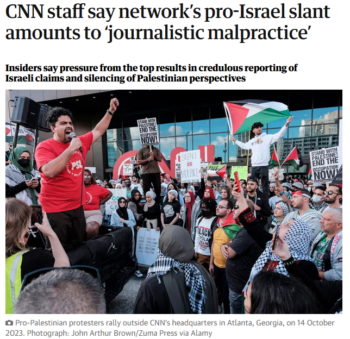
It’s Tapper and CNN, of course, who decide what stories are most important and deserve coverage—not campus protesters. Some might say that that a break from CNN‘s regular coverage the Israel’s assault on Gaza would not altogether be a bad thing, as CNN staffers have complained of “regurgitation of Israeli propaganda and the censoring of Palestinian perspectives in the network’s coverage of the war in Gaza” (Guardian, 2/4/24)
The next day, Tapper’s framing of the protests made clear whose grievances he thought were the most worthy (4/30/24): “CNN continues to following the breaking news on college campuses where anti-Israel protests have disrupted academic life and learning across the United States.”