Flour Massacre Called ‘Aid-Related Deaths’—Rather Than Part of Israel’s Engineered Famine

Spread the love

Original article by ROBIN ANDERSEN republished from FAIR under a Creative Commons Attribution-NonCommercial-NoDerivs 3.0 Unported License.

Over 100 Palestinians were killed and hundreds more wounded on February 29, when Israeli snipers opened fire on people approaching a convoy of trucks carrying desperately needed supplies of flour. The attack was quickly dubbed the flour massacre.

Corporate media reporting was contentious and confused, mired in accusations and conflicting details that filled the news hole, even as media downplayed the grave conditions in Gaza created by Israel’s engineered famine. With headlines layered in verbal opacity, the massacre prompted yet another egregious moment in media’s facilitation of Israel’s continuing genocide in Gaza.

Linguistic gymnastics

This New York Times headline (2/29/24) was described as “a haiku to avoid saying Israel massacres Palestinians that they’re deliberately starving in Gaza.”

On the day of the massacre, the New York Times (2/29/24) published this contrivance:

“As Hungry Gazans Crowd a Convoy, a Crush of Bodies, Israeli Gunshots and a Deadly Toll”

It was met with ridicule as it slid across online platforms. Assal Rad (Twitter3/1/24), author and research director at the Iranian American Council, called the piece of work “a haiku to avoid saying Israel massacres Palestinians that they’re deliberately starving in Gaza.”

Another Times headline (2/29/24) read, “Deaths of Gazans Hungry for Food Prompt Fresh Calls for Ceasefire.” Nima Shirazi, co-host of the podcast Citations Needed  (Twitter3/1/24), noted that “the New York Times just can’t bring itself to write clear headlines when Israeli war crimes are involved.” Shirazi offered this revision: “Israel Slaughters Starving People as It Continues Committing Genocide.”

Professor Jason Hickel (Twitter2/29/24), along with Mint Press‘s Alan MacLeod (2/29/24), flagged the use of the neologism “food aid–related deaths” when it turned up in a Guardian headline (2/29/24): “Biden Says Gaza Food Aid–Related Deaths Complicate Ceasefire Talks.” MacLeod noted, “Virtually the entire Western media pretend they don’t know who just carried out a massacre of 100+ starving civilians.”

Linguistic gymnastics—a longstanding plague pervading Western media coverage of Palestine (FAIR.org8/22/23)—were so popular in news headlines and reporting that Caitlin Johnstone (Consortium News3/1/24) compiled a list of them, adding  “chaotic incident” (CNN2/29/24) and “chaotic aid delivery turns deadly” (Washington Post2/29/24) to those already mentioned.

Sana Saeed, media critic for Al Jazeera, decoded the latter kind of construction for AJ+ (3/29/24), arguing that such passive language has been used “consistently to sanitize the violence that a powerful state is unleashing against civilian populations.”

As the genocide enters its sixth month, media analysts, investigative reporters and social media users have become adept at recognizing pro-Israeli contortions and patterns of language that justify Israel’s war on Gaza. This has become an essential aspect in exposing Israel’s genocide.

‘Anarchy rules in Gaza’

Economist (2/29/24): “As with many events in the war between Israel and Hamas, the facts are destined to remain fiercely contested.” 

The Economist (2/29/24), under the headline, “A New Tragedy Shows Anarchy Rules in Gaza: A Shooting and Stampede Kill 122 and Injure Hundreds,” went into the worst pro-Israel spin, with reporting that seemed to blame Palestinians for their own murders. Parroting Israeli press directives, the piece claimed Palestinians were killed by “trampling” each other in their own “stampede.”

The piece was written in literary prose: “Death descended on a coastal road in Gaza,” the reporter (not present at the scene) wrote. Then “catastrophe befell an aid convoy,” as if it merely happened upon bad luck.

Then the writer made a prediction: “As with many events in the war between Israel and Hamas, the facts are destined to remain fiercely contested.” That’s likely to come true, especially when major media outlets abdicate their responsibility for evaluating claims.

Timeline of changing denials 

Even in special “Verify” mode, the BBC (3/1/24) can’t bring itself to say in a headline who it was that killed Gazans.

Many other writers and journalists have documented the string of vacillating Israeli statements that help explain the contorted reporting. Al Jazeera reporter Willem Marx (Twitter3/1/24) traced a timeline of how the Israeli military changed its story over the course of the day.

The IDF began by claiming there had been trampling and pushing that led to injuries around the aid truck. Then, hungry Palestinians had “threatened their soldiers,” or “appeared in a threatening manner,” so the IDF shot at them. Later that day, Israeli officials claimed there were two separate incidents, one that involved trampling and the other that led to shooting. By the end of the day, they alleged only to have provided support to a humanitarian convoy, and that no shots were fired at all by the military.

When the BBC (3/1/24) verified that a video released by the Israeli military exhibited four unexplained breaks in the footage and was therefore invalid, the outlet still used the passive voice, referring in the headline to “Gazans Killed Around Aid Convoy.” One sentence of the detailed, confused article quoted Palestinian journalist Mahmoud Awadeyah: “Israelis purposefully fired at the men…. They were trying to get near the trucks that had the flour.” Earlier, however, Awadeyah was problematized when identified “as a journalist for Al Mayadeen, a Lebanon-based news station whose broadcasts are sympathetic to groups fighting Israel.”

Independent and international media 

“Israel’s use of food as a weapon of war reaches new heights,” Mondoweiss (3/4/24) reported.

If we compare corporate outlets to independent media, in which reporting was based on ground sources, humanitarian actors and aid workers, we find very different content.

Al Jazeera reporter Ismail al-Ghoul (2/29/24), who was at the scene of the massacre, said that “after opening fire, Israeli tanks advanced and ran over many of the dead and injured bodies. It is a massacre, on top of the starvation threatening citizens in Gaza.”

EuroMed staff (2/29/24) on the scene confirmed that the Israeli military had fired on starving Palestinians. EuroMed’s findings were summarized in a videotape by Palestinian news agency Quds News Network and posted by the Palestine Information Center (3/4/24).

Mondoweiss (3/4/24) reported details of the massacre from eyewitness accounts. One survivor recounted how an Israeli checkpoint “split the crowd in two,” preventing those who had entered the checkpoint from passing back to the northern side. Then Israeli soldiers opened fire on the crowd. International observers visited the injured survivors at al-Shifa’ Hospital, “confirming that the majority of wounds from the hundreds of injured people were due to live ammunition.”

In context of famine

Middle East Eye (2/29/24) put IDF claims in the context of a Gaza “on the brink of famine as a result of the Israeli blockade.”

Reporting in the alternative press also placed the massacre within the context of the rapidly increasing famine in Gaza.

The headline for the Electronic Intifada (2/29/24) read, “Palestinians Seeking Food Aid Killed as Israel Starves Gaza.” The outlet said an “engineered famine has taken hold in Gaza, with people resorting to eating wild plants with little nutritional value and animal feed to survive.”

Middle East Eye’s reporting (2/29/24) included the dire condition Palestinians are currently facing: “Much of Gaza’s population is on the brink of famine as a result of the Israeli blockade, according to the UN and other humanitarian organizations.”

The day of the massacre, Democracy Now! (2/29/24) opened its broadcast with a clear statement and the relevant context: “Israel Kills 104 Palestinians Waiting for Food Aid as UN Expert Accuses Israel of Starving Gaza.” Its first guest, UN special rapporteur on the right to food Michael Fakhri, said, “Every single person in Gaza is hungry.” He accused Israel of the war crime of intentional starvation. He emphasized that famine in the modern context is a human-made catastrophe:

At this point I’m running out of words to be able to describe the horror of what’s happening and how vile the actions have been by Israel against the Palestinian civilians.

Common Dreams (3/3/24) reported on Israel’s obstruction of aid convoys, and cited UNICEF on the deaths of children who

died of starvation and dehydration at a hospital in northern Gaza as Israeli forces continue to obstruct and attack aid convoys, fueling desperation across the territory…. People are hungry, exhausted and traumatized. Many are clinging to life.

It concluded, “These tragic and horrific deaths are man-made, predictable and entirely preventable.”

In the days before the massacre, numerous outlets had been documenting the growing famine looming over Gaza. This is the material independent media made use of for contextualizing the massacre.

The New York Times, on the other hand, put the massacre into an entirely different context. A piece (3/2/24) headlined “Disastrous Convey Was Part of New Israeli Effort for More Aid in Gaza,” cited as confirmation “Western diplomats, who spoke on condition of anonymity.” It said that international aid groups “suspended operations” because of “rising lawlessness,” as well as Israel’s refusal to “greenlight aid trucks.” It blamed starving Gazans by claiming that aid convoys had been looted either by “civilians fearing starvation” or by “organized gangs.”

‘How is this not a bigger story?’

“How is this not a bigger story?” one observer asked of this Al Jazeera report (3/6/24).

As Common Dreams and Mondoweiss reported, the flour massacre was not the first time the IDF killed starving Palestinians, and it would not be the last. As Mondoweiss (3/4/24) put it: “In less than a week, Israel has committed several massacres against the hungry. On Sunday, March 3, Israel bombed an aid convoy, killing seven people.”

Quds News Network (3/2/24) reported that Israel targeted hungry civilians again at Al Rasheed Street in northern Gaza while they were waiting for humanitarian aid. And  Quds (3/4/24) reposted Al Jazeera footage that captured the moments when Israel’s military opened fire at other hungry Gazans, this time at the Al Kuwait roundabout, as they looked for food aid.

Al Jazeera (3/6/24) continues to document the murders of Palestinians desperate for aid as they come under Israeli fire. On a longer videotape, a spokesperson for Human Rights Watch says these attacks violate ICJ orders:

The idea that these people are being killed as they scavenge for meager rations of food is just appalling, and is a reminder why there must be international immediate action to prevent further mass atrocities.

Following the Al Jazeera report, Assal Rad (Twitter3/6/24) expressed dismay:

Israeli attacks on Palestinians waiting for or attempting to get aid have repeatedly happened this week, yet there has been no media coverage since the massacre that killed over 100 people. Israel is attacking civilians it’s deliberately starving. How is this not a bigger story?

Normalizing starvation and massacres

The Floutist (11/16/23) addresses “the perversion of language that the defense of Israel’s violence requires.”

Sana Saeed (Twitter3/4/24) observed:

So just to be clear: Much like how Israel normalized attacking and destroying hospitals, and it was accepted by the international community, Israel is now normalizing shooting and killing the people it is starving as they seek food.

Media have failed to inform the US public on the horrific conditions experienced by starving civilians in Gaza. They blamed Palestinians for their own deaths, covering for the Israeli military as it carried out a massacre. They further dehumanized Palestinians by characterizing starving people as an unruly mob who trampled one another.

To paraphrase Patrick Lawrence (Floutist11/16/23) on the distortion of language in defense of Israel’s violence against Palestinians: It corrupts our public discourse, our public space, and altogether our ability to think clearly. This corruption is as vital as US bombs to the Israeli genocide against Palestine: Without these verbal distortions that justify, distract, deny and consume corporate information spaces, the genocide could not be carried out.

FAIR’s work is sustained by our generous contributors, who allow us to remain independent. Donate today to be a part of this important mission.

Original article by ROBIN ANDERSEN republished from FAIR under a Creative Commons Attribution-NonCommercial-NoDerivs 3.0 Unported License.

Continue ReadingFlour Massacre Called ‘Aid-Related Deaths’—Rather Than Part of Israel’s Engineered Famine

NYT’s Morning Newsletter Blames Everyone but Israel for Israeli Crimes

Spread the love

Original article by HARRY ZEHNER republished from FAIR under a Creative Commons Attribution-NonCommercial-NoDerivs 3.0 Unported License.

With over 17 million subscribers, the Morning, the New York Times’ flagship newsletter, is by far the most popular newsletter in the English-speaking world. (It has almost three times as many subscribers as the next most popular newsletter.)

Since October 7, as Israel has waged an unprecedented war on Palestinian children, journalists, hospitals and schools, the New York Times’ highly influential newsletter has bent over backwards to blame everyone but Israel for the carnage.

Waging a legitimate war

According to the Morning—led by head writer David Leonhardt—Israel’s war on Gaza is a targeted operation designed to eliminate Hamas. The Morning propagates this narrative despite well-documented declarations of collective punishment and even genocidal intent by high-ranking Israeli officials—a tendency that South Africa has forcefully documented in their case before the ICJ (UN, 12/29/23). Israeli President Isaac Herzog’s comments on October 12, 2023, are typical: “It’s an entire nation out there that is responsible. It’s not true, this rhetoric about civilians not aware, not involved.”

This sentiment has been echoed by Prime Minister Benjamin Netanyahu, multiple cabinet-level ministers and senior military officials. Speaking from a devastated northern Gaza, one top Israeli army official said (UN, 12/29/23): “Whoever returns here, if they return here after, will find scorched earth. No houses, no agriculture, no nothing. They have no future.”

The Morning (10/13/23) expresses what it sees as the main problem with mass death in Gaza: “The widespread killing of Palestinian civilians would damage Israel’s global reputation.”

Despite these statements and the body of supporting evidence, the Morning has consistently portrayed the war on Gaza as a focused campaign targeting the military infrastructure of Hamas.

For instance, in one October edition (10/13/23), Leonhardt and co-writer Lauren Jackson explained, “Israel’s goals are to prevent Hamas from being able to conduct more attacks and to reestablish the country’s military credibility.”

In similar fashion, in a late January edition (1/28/24), the Morning argued that Israel’s 17-year-long blockade of Gaza is primarily designed to debilitate Hamas—rather than to collectively punish Gazan civilians, as many analysts and human rights groups have argued:

For years, Israel has limited the flow of goods into Gaza, largely to prevent Hamas from gaining access to military supplies.

The Morning did, in the same edition (1/28/24), quote Israeli Defense Minister Yoav Gallant’s comments in the immediate aftermath of October 7:

After the Hamas-led October 7 terrorist attacks, Israel ordered what its defense minister called a “complete siege” of Gaza. The goal was both to weaken Hamas fighters and to ensure that no military supplies could enter.

This is, however, a downright fictional interpretation of Gallant’s quote (Al Jazeera10/9/23), given that the Morning failed to quote the next words out of his mouth:

There will be no electricity, no food, no water, no fuel, everything will be closed. We are fighting against human animals, and we are acting accordingly.

Blame the terrorists

The Morning (10/30/23) insists that “Hamas is responsible for many of the civilian deaths” caused by Israel—a division of responsibility it would never apply to civilians killed by Hamas on October 7.

The Morning consistently has argued that Hamas makes densely populated civilian areas legitimate targets for Israeli attacks by conducting military operations nearby. This deflects blame from Israel and frames civilian casualties as a necessary evil, as in the October 30 edition of the newsletter:

Hamas has hidden many weapons under hospitals, schools and mosques so that Israel risks killing civilians, and facing an international backlash, when it fights. Hamas fighters also slip above and below ground, blending with civilians.

These practices mean that Hamas is responsible for many of the civilian deaths, according to international law.

Similar rhetoric was deployed in this December edition (12/20/23):

Hamas has long hidden its fighters and weapons in and under populated civilian areas, such as hospitals and mosques. It does so partly to force Israel to make a gruesome calculation: To fight Hamas, Israel often must also harm civilians.

The Morning has not yet found it pertinent to report on, for instance, the Israeli soldiers who dressed as doctors to gain access to the Ibn Sina Hospital in the West Bank, and proceeded to assassinate three Palestinian militants in their hospital beds.

To the Morning (11/14/23), Israel’s mass slaughter of civilians is unavoidable:

The battle over Al-Shifa Hospital in Gaza highlights a tension that often goes unmentioned in the debate over the war between Israel and Hamas: There may be no way for Israel both to minimize civilian casualties and to eliminate Hamas.

It repeats this line again in a late January edition (1/22/24), once again framing the mass murder of civilians as a “difficult decision”:

The Israeli military faces a difficult decision about how to proceed in southern Gaza…. Israel will not easily be able to eliminate the fighters without killing innocent civilians.

And again in the October 17 edition:

Longer term, there will be more difficult choices. Many steps that Israel could take to reduce civilian casualties in Gaza, such as advance warnings of attacks, would also weaken its attempts to destroy Hamas’s control.

These themes are repeated across all editions of the Morning, and echo throughout the New York Times’ reporting on Israel. Israel’s motivations in the war (beyond eliminating Hamas) go unquestioned, while the openly genocidal statements made by high-ranking politicians and military leaders go unacknowledged.

And when Israeli mass murder of Palestinian civilians is mentioned, it is constantly qualified by the line that Hamas is fully or partially to blame.

‘Civilian death toll in Gaza’

David Leonhardt assures readers of the Morning (12/7/23) that “military experts say that there is probably no way for Israel to topple Hamas without a substantial civilian toll.” The possibility that this means that Israel should therefore not try to “topple Hamas” is not addressed.

Let’s break down one emblematic newsletter (12/7/23) written by Leonhardt in December, in which he “puts the [civilian death] toll in context and explains the reason for it.”

Leonhardt began by qualifying the Palestinian death toll—around 17,000 at time of writing in early December. First, he delegitimized the Gaza Health Ministry, which, he wrote, “seems to have spread false information during the war.” Though he acknowledged that “many international observers believe that the overall death toll is accurate…as do some top Israeli officials,” he wrote that “there is more debate about the breakdown between civilian and combatant deaths.” Leonhardt went on:

A senior Israeli military official told my colleague Isabel Kershner this week that about a third of the dead were likely Hamas-allied fighters, rather than civilians. Gazan officials have suggested that the combatant toll is lower, and the civilian toll higher, based on their breakdown of deaths among men, women and children.

Leonhardt only informs readers that Hamas has spread false information, while neglecting to mention Israel’s documented history of lying to the press (IMEU, 10/17/23Intercept2/27/24). He also declined to investigate the implausibility of his source’s figure: At this point in the war, about 30% of Palestinian fatalities were adult men, meaning the Israeli figure implies that essentially every adult man killed by Israel was a Hamas fighter—all civilian men being miraculously spared.

Next, Leonhardt attempted to explain “who is most responsible for the high civilian death toll”—concluding, even before describing them, that “different people obviously put different amounts of blame on each.”

First he named Israel, and contextualized and rationalized Israel’s war crimes:

After the October 7 attacks—in which Hamas fighters killed more than 1,200 people, while committing sexual assault and torture, sometimes on video—Israeli leaders promised to eliminate Hamas. Israel is seeking to kill Hamas fighters, destroy their weapons stockpiles and collapse their network of tunnels. To do so, Israel has dropped 2,000-pound bombs on Gaza’s densely populated neighborhoods.

Note that Leonhardt framed the war as a campaign only to “kill Hamas fighters, destroy their weapons stockpiles and collapse their network of tunnels,” despite the evidence that Israel has targeted civilian infrastructurejournalistshealthcare workers and aid workers—actions backed by the aforementioned statements of genocidal intent.

Though Leonhardt briefly mentioned that Israel’s war has drawn international criticism, he made no mention of international law and concluded with his refrain that Israel can hardly avoid causing the deaths of “substantial” numbers of civilians:

Nonetheless, military experts say that there is probably no way for Israel to topple Hamas without a substantial civilian toll. The question is whether the toll could be lower than it has been.

Next, Leonhardt turned to his condemnation of Hamas:

The second responsible party is Hamas. It hides weapons in schools, mosques and hospitals, and its fighters disguise themselves as civilians, all of which are violations of international law.

This approach both helps Hamas to survive against a more powerful enemy — the Israeli military—and contributes to Hamas’s efforts to delegitimize Israel. The group has vowed to repeat the October 7 attacks and ultimately destroy Israel. Hamas’s strategy involves forcing Israel to choose between allowing Hamas to exist and killing Palestinian civilians.

Hamas is simply not prioritizing Palestinian lives.

It is notable that—unlike with Israel—Leonhardt did not attempt to contextualize Hamas’ actions by noting the horrifying conditions that Israel has imposed on Gaza for years, or the over 900 Palestinian children killed by Israel in the decade preceding October 7. To Leonhardt, history is only relevant when it justifies Israeli aggression.

While Leonhardt states unequivocally that Hamas is violating international law, he does not find it worthwhile to investigate Israel’s flagrant and abundantly documented violations of international law. He also does not mention the Palestinian right to resist occupation, a right enshrined under international law.

This unequal treatment leads straight to the jarringly contrasting conclusions, in which he essentially excuses Israel’s genocidal war as unavoidable, while he condemns Hamas for “simply not prioritizing Palestinian lives.”

Leonhardt’s December 7 piece is not an aberration: It is emblematic of the language, selective contextualization and framing that the Times‘ Morning newsletter wields to provide ideological cover for Israel’s crimes.

Original article by HARRY ZEHNER republished from FAIR under a Creative Commons Attribution-NonCommercial-NoDerivs 3.0 Unported License.

Continue ReadingNYT’s Morning Newsletter Blames Everyone but Israel for Israeli Crimes

US Media and Factcheckers Fail to Note Israel’s Refutation of ‘Beheaded Babies’ Stories

Spread the love

Original article by DAVID KNOX republished from FAIR under a Creative Commons Attribution-NonCommercial-NoDerivs 3.0 Unported License.

The Washington Post (11/22/23) said it couldn’t make a definitive assessment of whether Biden’s atrocity claims were true. But Israel’s official casualty list (11/11/23) had already debunked them.

In late November, the Washington Post (11/22/23) factchecked President Joe Biden’s repeated claims that babies had been beheaded during Hamas’s October 7 attack in Israel.

Biden’s remarks during a November 15 news conference triggered the factcheck:

Hamas has already said publicly that they plan on attacking Israel again, like they did before, to where they were cutting babies’ heads off to burning women and children alive.

Despite acknowledging a lack of confirmation of such atrocities, the Post stopped short of branding Biden’s statements false, and declined to dole out any of its iconic Pinocchios.

“It’s too soon in the Israel/Gaza war to make a definitive assessment,” Post Factchecker Glenn Kessler wrote, noting that even the most basic facts weren’t yet known.

“The Israeli prime minister’s office has said about 1,200 people were killed on October 7, down from an initial estimate of 1,400,” he said, “but it’s unclear how many were civilians or soldiers.”

An authoritative count

That statement isn’t true. While the exact number killed amid the extreme violence and chaos of October 7 may never be finalized, an authoritative count of civilian deaths—as well as data that definitively refutes claims babies were beheaded—was available to anyone with access to the internet little more than a month after the attack.

That’s when Bituah Leumi, or National Insurance Institute, Israel’s social security agency, posted a Hebrew-language website (11/9/23) with the name, gender and age of every identified civilian victim and where each had been attacked.

Two days later Bituah Leumi (also transliterated as Bituach Leumi) posted an English-language news release (11/11/23) publicizing the website as a memorial to the civilian victims of the “Iron Swords” war—Israel’s name for Hamas’s attack and Israel Defense Forces’ response. (The news release refers to “695 identified war casualties,” but there are no wounded; all the victims are listed as “killed.”)

The journalistic importance of the memorial website was shown less than a month later, when Haaretz (12/4/23), Israel’s oldest newspaper, used the social security agency’s data to debunk some of the most sensational atrocities blamed on Hamas.

‘Proved untrue’

Haaretz (12/4/23) reported that Israeli Prime Minister Benjamin Netanyahu’s most sensational atrocity claims were “inaccurate.”

Haaretz’s 2,000-word, English-language article was cautious, with allowances for mistaken and exaggerated reports from traumatized observers describing horrific scenes of carnage. But unlike the Washington Post’s factcheck, the Israeli newspaper didn’t pull its punches, flatly concluding that some of the claims of atrocities “have been proved untrue.”

Chief among the claims disproved was that Hamas fighters deliberately slaughtered dozens of babies—beheading some, burning and hanging others.

“According to sources including Israel’s National Insurance Institute, kibbutz leaders and the police, on October 7 one baby was murdered, 10-month-old Mila Cohen,” the Haaretz article stated. “She was killed with her father, Ohad, on Kibbutz Be’eri.” The child’s mother survived.

In addition to a single infant, the social security agency’s list of victims includes only a few other young children. Haaretz’s reporters were able to determine the circumstances of each of their deaths:

According to the National Insurance Institute, five other children aged 6 or under were murdered, including Omer Kedem Siman Tov, 2, and his 6-year-old twin sisters Arbel and Shachar, who were killed on Kibbutz Nir Oz. There was also 5-year-old Yazan Zakaria Abu Jama from Arara in the southern Negev, who was killed in a Hamas rocket strike, and 5-year-old Eitan Kapshetar, who was murdered with his parents and his 8-year-old sister, Aline, near Sderot.

Haaretz also used the social security data to refute allegations made by Israeli Prime Minister Benjamin Netanyahu to Biden that Hamas targeted and tortured children:

There is no evidence that children from several families were murdered together, rendering inaccurate Netanyahu’s remark to US President Joe Biden that Hamas terrorists “took dozens of children, tied them up, burned them and executed them.”

‘Details still sparse’

The Washington Post (12/4/23) acknowledged the Haaretz story the same day it was published, with a one-paragraph “update” inserted into its November 22 factcheck. While crediting Haaretz with doing a “detailed examination of unverified accounts of alleged atrocities disseminated by Israeli first-responders and army officers,” the Post downgraded the Israeli newspaper’s conclusion, saying only that “no accounts of beheaded or burned babies could be verified.”

While the Post noted that Haaretz “could document only one case of a baby being killed in the Hamas attacks,” the update did not explain that the source of that critical fact was an agency of the Israeli government. Nor did the Post alter the factcheck’s inconclusive, mishmashed “Bottom Line”:

Almost two months after the Hamas attack, details are still sparse on claims of beheading of babies. One IDF official says he found a decapitated baby; a first responder says “little kids” were beheaded, though an exact number was not provided. Forensic records that would document the cause of death have not been released. There also are reports of at least two beheadings of adults—a soldier and a Thai worker. First responders say they viewed these bodies.

There is little dispute that many of the civilians killed by militants on October 7 died in especially brutal ways. But caution is still warranted, especially at the presidential level, about statements that babies were beheaded. The available evidence does not need exaggeration.

An unnecessary retraction

PolitiFact (11/21/23) retracted this story (10/20/23) because it didn’t include Israeli claims about mutilated babies that—according to Israel’s official records—didn’t exist.

The Post wasn’t the only factchecker that wavered when judging reports of slaughtered Israeli babies. The Poynter Institute’s PolitiFact retracted its story (10/20/23), headlined “How Politicians, Media Outlets Amplified Uncorroborated Report of Beheaded Babies.”

PolitiFact took the embarrassing action after being savaged by the Committee for Accuracy in Middle East Reporting and Analysis, better known as CAMERA.

CAMERA, which Haaretz (9/5/16) described as “a right-wing media watchdog that routinely attacks news outlets over their coverage of Israel,” blasted PolitiFact as “unethical,” “sloppy and misleading” (11/8/23) for failing to include in its story all reports of mutilated babies made by Israeli military spokespeople, government officials and emergency response workers.

PolitiFact (11/21/23) conceded “our initial story was incomplete,” and published a revised story (11/21/23) that included many of those comments. The new version also quoted an Israel Defense Forces spokesperson stating “that verified testimonies state some people were beheaded, but they could not confirm how many.”

Like the Post’s Factchecker, PolitiFact drew no conclusions about the truth or falsity of those claims, declining to issue a rating on its “Truth-O-Meter.”

‘Details still emerging’

Snopes (10/12/23) says it’s still too soon to say whether babies were beheaded on October 7, thought it promises, “We will update this story once more information comes to light.”

The factchecking website Snopes (10/12/23, last updated 12/18/23) also declined to provide a definite answer to the question posed in its headline: “Were Israeli Babies Beheaded by Hamas Militants During Attack on Kfar Aza?”

“At present, details are still emerging from communities affected in Israel, the death tolls are still being counted, and the manner of many deaths have not yet been confirmed,” Snopes stated.

In one of eight updates, Snopes cited Haaretz’s December 4 “analysis of child deaths during the October 7 attack.” But, as with the Washington Post’s update, Snopes did not mention that the newspaper had used Israeli social security data in its investigation.

FactCheck, a project of the Annenberg Public Policy Center at the University of Pennsylvania, (10/13/23) did find that a Facebook video was correct in saying “that ‘no evidence has been provided’ for the viral claim that ‘40 babies’ were ‘beheaded’ by Hamas.”

But a November 14 update, included in the story, quoted the head of Israel’s National Center of Forensic Medicine saying that “many bodies” of victims he had examined were “without heads.” But he couldn’t determine whether the decapitations were deliberate or the result of explosions.

FactCheck has not published any more on the issue.

The missing proof

FAIR.org (10/20/23): “The claim about beheading babies was…a shocking story that served to turn off logic and critical thinking.”

There’s a reason why the major factchecking organizations hesitate to pass judgment on the widespread claim of slaughtered babies: They rightly conclude that the lack of verifying evidence, such as photos or autopsy reports, does not conclusively prove the claims are false.

FAIR contributor Saurav Sarkar made that precise point in his report (10/20/23) lambasting “corporate media” for “their repetition of the shocking, unsubstantiated claim that Hamas had beheaded 40 babies in its violent attack on a kibbutz in southern Israel on October 7.”

“So we have a story, and that story was generated in a grossly irresponsible way, and then repeated over and over,” Sarkar stated. “But what proof do we have that the story is false? After all, even if it was reported badly, and repeated without additional substantiation, it might be true.”

Bituah Leumi, the Israeli social security agency, provided that missing proof when it posted the official list of victims that showed only one infant was killed in the attack.

The mainstream US news media ignored that authoritative evidence.

‘War on truth’

AFP (12/15/23) reported that data from Israel’s social security agency “invalidates some statements by Israeli authorities in the days following the attack.”

The first major news outlet outside of Israel to use data from the social security agency’s website was the French wire service Agence France-Presse.

The AFP’s 1,000-word, English-language dispatch, headlined “Israel Social Security Data Reveals True Picture of October 7 Deaths,” was picked up by France24 (12/15/23), the Times of India (12/15/23), the financial weekly Barron’s (12/15/23) and a scattering of small newspapers, including the Caledonian (Vermont) Record (12/15/23).

The AFP story covered much the same ground as Haaretz’s analysis, listing the same slain infant—Mila Cohen—and five other young victims under 7 years old in refuting claims of wholesale slaughter of babies.

While Google searches found no US mainstream media reporting on the Israeli social security agency’s data, several independent journalists did.

Gareth Porter, an American historian and journalist whose credentials go back to the Vietnam War, cited the social security data in an article in Consortium News (1/6/24) that argued that the Netanyahu government sought to build support for the invasion of Gaza by “inventing stories about nonexistent atrocities and planting them with credulous US news outlets.”

In February, Jeremy Scahill used that data to make the same case in a 8,000-word article, headlined “Netanyahu’s War on Truth,” in the Intercept (2/7/24), the investigative website he helped found.

Both journalists credit the December 15 AFP dispatch as the source of the Israeli social security data. (Porter’s story provides a link to the Times of India; Scahill links to France24.)

Earlier this week a third independent journalist, Glenn Greenwald (3/3/24), quoted the December 4 Haaretz report, which used the Israeli social security data, in a YouTube video, titled “October 7 Reports Implode: Beheaded Babies, NY Times Scandal & More.”

Emotion-inflaming stories

Media focus on the imaginary beheaded babies helped Israel get away with killing hundreds of actual babies (Al Jazeera1/25/24).

In the months since the Haaretz and AFP reports were published, Bituah Leumi has updated its civilian death count to 779, including 76 foreign workers, as more victims are identified (Jewish News Syndicate, 1/15/24.).

But a detailed examination this week of the 16-page list of victims on the memorial website found no additional infants or young children—only those already accounted for by Haaretz and AFP—and a total of 36 children under 18 years old.

Mila Cohen remains the only infant reported killed in the October 7 attack.

US corporate media’s failure to cite the social security agency’s data to forcefully refute claims of butchered babies and other outrages comes at a high cost. Such emotion-inflaming stories continue to foul the public debate over whether Israel’s invasion of Gaza, which has resulted in the deaths of more than 30,000 Palestinians (AP2/29/24)—two-thirds of those women and children (PBS2/19/24)—is a criminally disproportionate response to the Hamas attack.

Al Jazeera (2/29/24) broke down the Palestinian death count further, citing Gaza Health Ministry figures:

The ministry said of the 30,035 people killed so far in the conflict, more than 13,000 were children and 8,800 women. At least 70,457 people have been injured, of which more than 11,000 are in critical condition and need to be evacuated.

In January, when the Health Ministry had estimated the number of children killed at 10,000, Al Jazeera (1/25/24) published the names of more than 4,200 Palestinian dead under 18 years old. Of those children named, 502 were under 2 years old—that is, infants.

Unfounded horror stories about Hamas’s infant victims that should have been debunked were still being repeated by Biden (12/12/23) at a campaign fundraiser more than two months after Israel was attacked:

I saw some of the photographs when I was there—tying a mother and her daughter together on a rope and then pouring kerosene on them and then burning them, beheading infants, doing things that are just inhuman—totally, completely inhuman.

This time the Washington Post didn’t factcheck Biden—even though the White House stated months earlier that the president had never seen such photos (CNN, 10/12/23).

Still no Pinocchios.

Original article by DAVID KNOX republished from FAIR under a Creative Commons Attribution-NonCommercial-NoDerivs 3.0 Unported License.

Continue ReadingUS Media and Factcheckers Fail to Note Israel’s Refutation of ‘Beheaded Babies’ Stories

Shielding US Public From Israeli Reports of Friendly Fire on October 7

Spread the love

Original article by BRYCE GREENE republished from FAIR under a Creative Commons Attribution-NonCommercial-NoDerivs 3.0 Unported License.

Since October, the Israeli press has uncovered damning evidence showing that an untold number of the Israeli victims during the October 7 Hamas attack were in fact killed by the IDF response.

While it is indisputable that the Hamas-led attackers were responsible for many Israeli civilian deaths that day, reports from Israel indicate that the IDF in multiple cases fired on and killed Israeli civilians. It’s an important issue that demands greater transparency—both in terms of the questions it raises about IDF policy, and in terms of the black-and-white narrative Israel has advanced about what happened on October 7, used to justify its ongoing assault on the Gaza Strip.

Indeed, IDF responsibility for Israeli deaths has been a repeated topic of discussion in the Israeli press, accompanied by demands for investigations. But the most US readers have gotten from their own press about the issue is a dismissive piece from the Washington Post about October 7 “truthers.”

Implementing the Hannibal Directive?

Israel’s Haaretz (12/13/23) is willing to raise questions that seem to be taboo in the US press.

In the wake of October 7, after Israel began its genocidal campaign against Gaza, reports began to emerge from the Israeli press of incidents in which Israeli troops made decisions to fire on Hamas targets regardless of whether Israeli civilians were present.

That the IDF’s initial reaction was chaotic at best is well-documented. Much of the early military response came from the air, with little information for pilots and drone operators to distinguish targets but orders to shoot anyway (Grayzone10/27/23). Citing a police source, Haaretz (11/18/23) reported that at the Supernova music festival site, “an IDF combat helicopter that arrived to the scene and fired at terrorists there apparently also hit some festival participants.” But there are also mainstream Israeli media reports that credibly suggest the IDF may have implemented a policy to sacrifice Israeli hostages.

Supernova music festival attendee Yasmin Porat had escaped the festival on foot to the nearby village of Be’eri, only to be held hostage in a home with 13 others. One of the captors surrendered and released Porat to IDF troops outside. She described how, after a prolonged standoff, Israeli tank fire demolished that home and killed all but one of the remaining Israeli hostages. Her account was verified by the other surviving hostage (Electronic Intifada, 10/16/23Haaretz12/13/23). One of the Israeli victims was a child who had been held up as an example of Hamas’s brutality (Grayzone11/25/23).

Electronic Intifada (1/20/24) quoted the Israeli paper Yedioth Ahronoth (1/12/24) as saying that Israel “instructed all its fighting units to perform the Hannibal Directive in practice, although it did so without stating that name explicitly.”

Yedioth Ahronoth (1/12/24; translated into English by Electronic Intifada1/20/24)—one of Israel’s most widely read newspapers—published a bombshell piece that put these revelations in context. The paper reported that the IDF instructed its members

to stop “at any cost” any attempt by Hamas terrorists to return to Gaza, using language very similar to that of the original Hannibal Directive, despite repeated promises by the defense apparatus that the directive had been canceled.

The Hannibal Directive—named for the Carthaginian general who allegedly ingested poison rather than be captured by his enemies—is the once-secret doctrine meant to prevent at all costs the taking of IDF soldiers as hostages, even at the risk of harming the soldier (Haaretz11/1/11). It was supposedly revoked in 2016, and was ostensibly never meant to be applied to civilians (Haaretz1/17/24).

Yedioth Ahronoth reported:

It is not clear at this stage how many of the captives were killed due to the operation of this order on October 7. During the week after Black Sabbath [i.e., October 7] and at the initiative of Southern Command, soldiers from elite units examined some 70 vehicles that had remained in the area between the Gaza Envelope settlements and the Gaza Strip. These were vehicles that did not reach Gaza because on their way they had been hit by fire from a helicopter gunship, a UAV or a tank, and at least in some of the cases, everyone in the vehicle was killed.

Reports that the IDF gave orders to disregard the lives of Israeli captives have caused great consternation in Israel (Haaretz12/13/23). An author of the IDF ethics code called it “unlawful, unethical, horrifying” (Haaretz1/17/23). Yet any mention of the reports, or the debates they have inspired in Israel, seems to be virtually taboo in the mainstream US media.

The only mention of “Hannibal directive” FAIR could find in a major US newspaper the since October 7 came in a New York Post article (12/18/23) paraphrasing a released hostage who

claimed that Hamas told them the Israel Defense Forces would employ the infamous “Hannibal Directive” on civilians, a revoked protocol that once allegedly called on troops to prioritize taking out terrorists even if it meant killing a kidnapped soldier.

‘A general’s dilemma’

Readers had to read 150 paragraphs into this New York Times piece (12/22/23) before they came to the stunning revelation that an Israeli general ordered an assault on a house full of hostages “even at the cost of civilian casualties.”

A version of Supernova attendee Porat’s account was related a few days later in the New York Times (12/22/23), which published a lengthy investigative report piecing together what happened across the village of Be’eri. That report included a section about the standoff at the house where Porat was held, under the subhead “A General’s Dilemma.” It did not mention Porat’s prior revelations in Israeli media and the controversy they had caused.

The piece described how

the captors had forced roughly half of the hostages, including the Dagans, into Ms. Cohen’s backyard. They positioned the hostages between the troops and the house, according to Ms. Dagan and Ms. Porat.

After more than an hour of gunfire between the IDF and the gunmen, Ms. Dagan reported seeing at least two hostages in the backyard “killed in the gunfire. It wasn’t clear who killed them, she said.”

The article continued:

As the dusk approached, the SWAT commander and General [Barak] Hiram began to argue. The SWAT commander thought more kidnappers might surrender. The general wanted the situation resolved by nightfall.

Minutes later, the militants launched a rocket-propelled grenade, according to the general and other witnesses who spoke to the Times.

”The negotiations are over,” General Hiram recalled telling the tank commander. ”Break in, even at the cost of civilian casualties.”

The tank fired two light shells at the house.

Shrapnel from the second shell hit Mr. Dagan in the neck, severing an artery and killing him, his wife said.

During the melee, the kidnappers were also killed.

Only two of the 14 hostages—Ms. Dagan and Ms. Porat—survived.

It’s a shocking order; it’s also shocking that the Times offered no comment about the order. After the revelation caused a firestorm in Israel, including demands for an immediate investigation by family of those killed in the incident, the Times (12/27/23) published a followup about how General Hiram’s quote “stirred debate,” including multiple quotes from the general’s defenders.

Ignoring the context

There was another rare mention of Israeli friendly fire in New York Times (1/5/24), reporting on Palestinian Jerusalem resident Soheib Abu Amar, who was also held hostage and ultimately killed in the house Porat escaped from. Bizarrely, it did not mention the controversy over Hiram’s order.

Under the headline, “A Palestinian Man Vanished October 7. His Family Wants to Know Who Killed Him,” the Times traced Abu Amar’s disappearance that day, which began as a bus driver for partygoers at the music festival. Describing his final moments, the Times wrote that “Israeli security forces engaged in an intense battle with Hamas terrorists at the home” in which nearly “all of the hostages were killed.” It later mentioned that “families of the hostages…want an investigation to begin immediately,” but made no mention of Hiram’s order.

None of these Times articles put the Be’eri incident in the context of the Israeli press reports of other “friendly fire” incidents, and no other Times reporting has mentioned them, either, leaving the impression that the Hiram order was an isolated incident.

This is especially remarkable, given that one of the reporters on the Yedioth Ahronoth story, Ronen Bergenen, is also a New York Times contributor, and shared the byline on the Times‘ Be’eri investigation. His Yedioth Ahronoth revelations have yet to be mentioned in the Times, or elsewhere in US corporate media.

‘A small but growing group’

The Washington Post (1/21/24) conflates random cranks who claim that the October 7 attack was “staged by the Israeli military” with independent journalists who report on Israeli media exposés of friendly fire deaths—and associates both with Holocaust denial.

Meanwhile, the first time the Washington Post (1/21/24) made any mention of the controversies, it did so indirectly, and only to dismiss them by conflating them with conspiracy theories. Under the headline “Growing October 7 ‘Truther’ Groups Say Hamas Massacre Was a False Flag,” Post “Silicon Valley correspondent” Elizabeth Dwoskin attacked “truthers” who question the Israeli narrative of October 7, equating them with Holocaust deniers.

The Post’s first subject was a woman named Mirela Monte, who subscribed to a Telegram channel called Uncensored Truths. This convinced her that October 7 was a “’false flag’ staged by the Israelis—likely with help from the Americans—to justify genocide in Gaza.” The Post reported that the channel had nearly 3,000 subscribers, but despite this relatively miniscule reach, still used it as its lead example of dangerous misinformation.

Another target was an anonymous poster on the niche subreddit r/LateStageCapitalism, who claimed that “the Hamas attack was a false flag for Israel to occupy Gaza and kill Palestinians.” Though this is an internet forum largely consisting of memes, the Post described the subreddit as “a community of left-wing activists.”

These were held up as examples of a “small but growing group” that “denies the basic facts of the attacks,” pushes “falsehoods” and “misleading narratives” that “minimize the violence or dispute its origins.” The Post cited a seemingly random woman at a protest who claimed that “Israel murdered their own people on October 7”—linking her to “some in the crowd” who allegedly shouted “antisemitism isn’t real.”

But the Post avoided any attempt to address the empirical question of whether Israel killed any of its own on October 7. Dwoskin’s only reference to the reports from Israel come in a paragraph meant to downplay that question:

Israeli citizens have accused the country’s military of accidentally killing Israeli civilians while battling Hamas on October 7; the army has said it will investigate.

Dwoskin’s framing suggests these are minor concerns that are being appropriately dealt with. But those accusations are not of accidental killings, but of deliberate choices to treat Israeli civilians as expendable. And an internal army investigation is not the same as an independent investigation.

Moreover, the IDF only agreed to investigate the Be’eri incident, not the question of whether the Hannibal Directive was issued—and only after press scrutiny and public pressure, demonstrating the importance of having journalists willing to challenge those in power rather than covering up for them, as Dwoskin’s article did.

Attacking independent journalism

The Washington Post (1/21/24) falsely claimed that Grayzone “suggest[ed] that most Israeli deaths were caused by friendly fire, not Hamas,” because the outlet’s actual claim—that “the Israeli military killed its own citizens as they fought to neutralize Palestinian gunmen”—could not be refuted.

Dwoskin continued by attacking independent media outlets that have been covering the story: “But articles on Electronic Intifada and Grayzone exaggerated these claims to suggest that most Israeli deaths were caused by friendly fire, not Hamas.”

Electronic Intifada and the Grayzone are among the few outlets that have exposed English-language audiences to the reporting from Israel about the IDF’s attacks on Israeli civilians on October 7. To criticize Grayzone‘s reporting (10/27/23), the Post cited the director of “an Israeli watchdog organization dedicated to fighting disinformation,” who said that Grayzone “distorts” a helicopter pilot’s account of having trouble “distinguishing between civilians and Hamas.”

On the word “distorts,” Dwoskin hyperlinked to a Haaretz op-ed (11/27/23) attacking Grayzone editor Max Blumenthal’s reporting. That piece accused him misusing ellipses when he quoted the pilot from the Ynet piece who said there was “tremendous difficulty in distinguishing within the occupied outposts and settlements who was a terrorist and who was a soldier or civilian.”

Haaretz complained that Blumenthal’s ellipses left out a statement from the pilot: “A decision was made that the first mission of the combat helicopters and the armed drones was to stop the flow of terrorists and the murderous mob that poured into Israeli territory through the gaps in the fence.” Blumenthal, the paper complained, ignored that “the pilots were assigned a different task: stopping the terrorists flowing in from Gaza,” and that there was “no ambiguity in this task.”

However, this is entirely consistent with Blumenthal’s claim that “the pilots let loose a fury of cannon and missile fire onto Israeli areas below.” Given that hundreds of hostages were concurrently being taken from Israel into Gaza, there was a great deal of “ambiguity” in the task of “stop[ping] the flow of terrorists…through the gaps in the fence.” It’s highly relevant that the pilot said it was very difficult to distinguish “who was a terrorist and who was a soldier or civilian,” and that only later did the IDF “carefully select the targets.”

The Haaretz piece made several other dubious accusations, including charging Blumenthal with using “biased language” when he described Hamas as “militants” and “gunmen”—terms chosen by many establishment news outlets precisely to avoid bias (AP on Twitter1/7/21BBC10/11/23).

The op-ed also accused Blumenthal of omitting “everything related to the war crimes committed by Hamas terrorists,” ignoring his clear statement in his article that “video filmed by uniformed Hamas gunmen makes it clear they intentionally shot many Israelis with Kalashnikov rifles on October 7.”

The Post offered no example of the Grayzone claiming “most” Israeli deaths were caused by friendly fire, and FAIR could find no such claims in the outlet’s October 7 coverage. It has, however, reported extensively on the friendly fire reports in Israeli media that the Post has so studiously avoided.

Hiding the accusations

The Washington Post (1/21/24) misquoted this Electronic Intifada article (11/23/23) as saying that “‘most’ Israeli casualties on October 7″—military and civilian—were killed by friendly fire. What the article actually said was that “Israel killed many, if not most, of the civilians that died during the Palestinian offensive.”

The independent Palestinian-run outlet Electronic Intifada has also based its reporting on articles and interviews from the Israeli press (e.g., Ynet, 10/15/23Haaretz10/20/2311/9/2311/18/23Times of Israel11/9/23). The Washington Post, however, only wrote that EI senior editor Asa Winstanley was “basing the story, in part, on a YouTube clip (10/15/23) of a man who describes himself as a former Israeli general.”

As Winstanley noted in his response to Dwoskin, “‘Graeme Ipp’ described himself—and actually was—an Israeli major, as I explain in detail in the piece itself.” The Post did not link to the article, video or give any citation to help readers find the article in question, which served to conceal the blatant misquotation.

The Post also misquoted Winstanley to claim he wrote that “most” of the Israeli civilians were killed by the Israeli military that day. In reality, Winstanely (Electronic Intifada11/23/23) wrote that Ipp’s testimony was confirmation that “Israel killed many, if not most, of the civilians that died during the Palestinian offensive.”

Had the Post actually pointed its readers to the reporting from the Grayzone and Electronic Intifada, readers may have been able to more easily understand Dwoskin’s distortions. But discrediting those outlets serves an important political purpose: Along with Mondoweiss, they are some of the only English-language outlets that have covered the bombshell revelations that appear frequently within the Israeli press. Attacking their reporting hides from US public view the numerous accusations of deliberate mishandling of intelligence and mass killing by the IDF of its own civilians.

Mondoweiss (2/1/24): “Stories of atrocity, sometimes cobbled together from unreliable eyewitnesses, sometimes fabricated entirely, have made their way to heads of state and been used to justify Israel’s military violence.”

Holocaust denial?

A sizable chunk of the Washington Post‘s article centered on interviews with pro-Israel “experts” linking October 7 “truthers” to Holocaust denialism, or promoting “internet-driven conspiracy theories.” Dwoskin cited Emerson Brooking, a researcher from the NATO-affiliated Atlantic Council think tank, who warned that “the long tail of Holocaust denial is a lesson in what may happen to October 7.”

Dismissing any actual investigation into the facts, Brooking says, “It’s generally indisputable that Hamas did something—the pro-Hamas camp can’t erase that entirely.” He never specifies what that “something” was—the exact issue in question. Instead, he assumes that “something” is settled fact, and that anyone who investigates it is trying to “chip away at it” in an attempt at “rewriting…history.”

The Post equates people questioning the Holocaust—which has a factual record established over decades of international investigations, scholarship and research—with questioning the details of what Hamas called the Al Aqsa Flood, which has only ever been investigated by the Israeli government. That government, it should be recalled, has a documented record of blatantly lying and fabricating evidence.

Israel’s justification for its relentless assault upon Gaza has depended in large part upon its narrative. Since October 7, the Israeli government has blocked or rejected any serious international inquiry into the attacks or the IDF response. The US government has declined to call for or engage in any investigation.

On the other hand, in a recent statement, Hamas—which maintains that the Al Aqsa Flood was a military, not a terror, operation—has publicly agreed to cooperate with an international investigation into its own war crimes (Palestine Chronicle1/21/24).

Many of the most lurid claims that mobilized public opinion in support of Israel’s attack (e.g., 40 beheaded babies, babies cooked in ovens, etc.) have since been debunked and disproven (Mondoweiss2/1/24). In fact, Haaretz (11/18/23) revealed that Hamas had no prior knowledge of the festival they were accused of targeting.

Israeli and US officials repeatedly attribute all civilian deaths to Hamas, even though this is certainly false. Clearly, then, s0me Israeli civilian casualties have been “blame[d] on another party.”

How many Israeli civilians were actually killed by Hamas, and how many by Israel? Was the Al Aqsa Flood a terrorist attack designed to kill as many civilians as possible? These are important questions that have yet to be conclusively and independently answered, but the Washington Post seems to want to dissuade people from even asking them. In evoking the specter of Holocaust denial, Dwoskin and the Post are not defending the truth, but attempting to protect readers from it.

Original article by BRYCE GREENE republished from FAIR under a Creative Commons Attribution-NonCommercial-NoDerivs 3.0 Unported License.

Continue ReadingShielding US Public From Israeli Reports of Friendly Fire on October 7

‘Israel-Hamas War’ Label Obscures Israel’s War on Palestinians

Spread the love

Original article by GREGORY SHUPAK republished from FAIR. This work is licensed under a Creative Commons Attribution-NonCommercial-NoDerivs 3.0 Unported License.

Since October 7, the day the escalation in Israel/Palestine began (FAIR.org10/13/23), American media outlets have persistently described the fighting as an “Israel-Hamas war.” From October 7 through midday on December 1, the New York TimesWall Street Journal and Washington Post have combined to run 565 pieces that use the phrase “Israel-Hamas war.”

This paradigm has been a dominant way of covering the violence, even though Israel has been clear from the start that its assault has not been narrowly aimed at Hamas. At the outset of the Israeli onslaught, Israeli Defense Minister Yoav Gallant (Times of Israel10/9/23) said: “I have ordered a complete siege on the Gaza Strip. There will be no electricity, no food, no fuel, everything is closed.” Oxfam later said that such restrictions on Palestinians’ ability to eat—which left 2.2 million people “in urgent need of food”—mean that Israel is deploying a policy wherein “starvation is being used as a weapon of war against Gaza civilians.”

A day later, Israeli military spokesperson Adm. Daniel Hagari (Guardian10/10/23) said that “hundreds of tons of bombs” had already been dropped on the Gaza Strip, and admitted that “the emphasis is on damage and not on accuracy.”

The New York Times‘ label (12/2/23) encourages readers to view Israel’s attacks on a population as really being aimed at a distinct group.

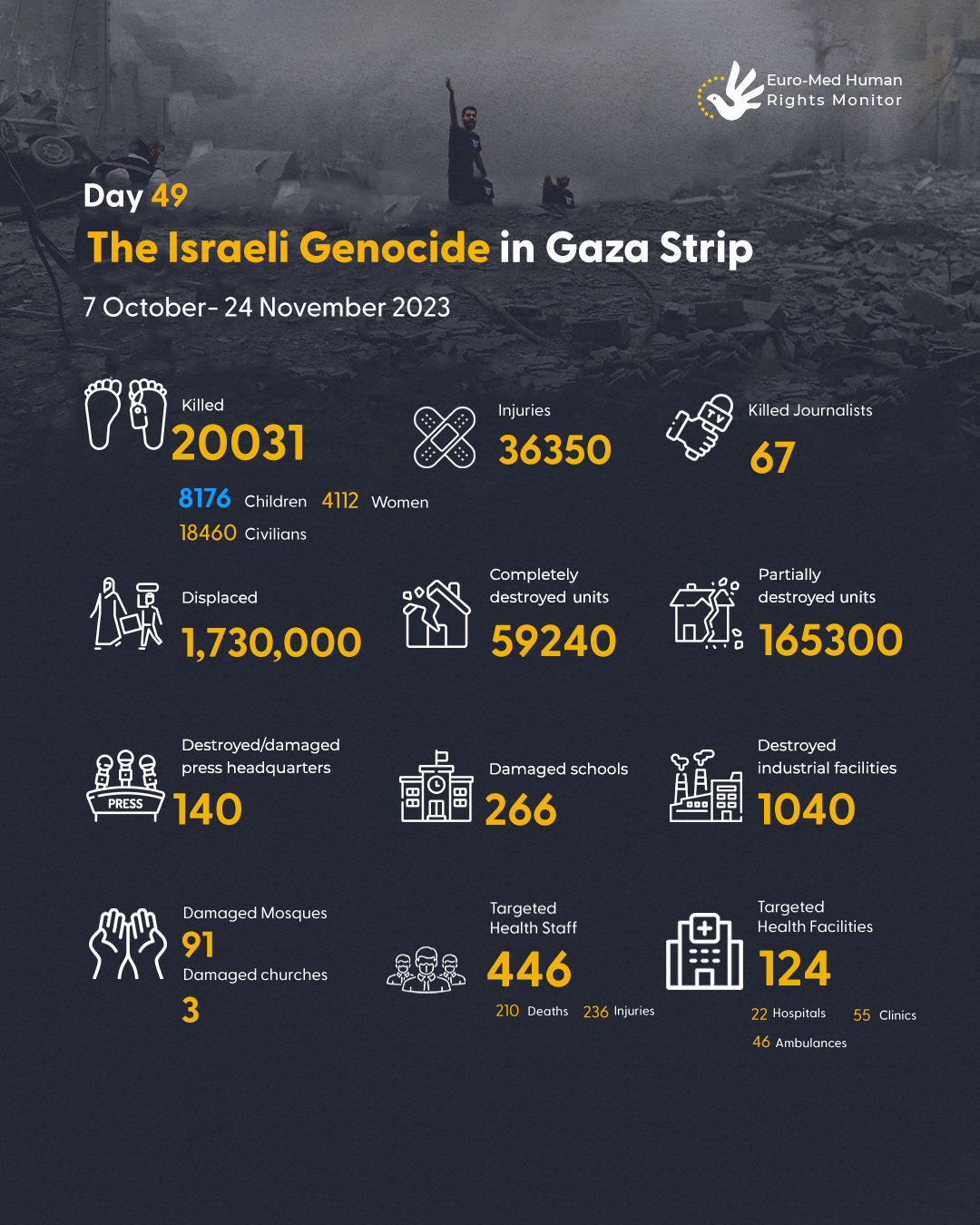
The indiscriminate nature of Israel’s assault is clear. The United Nations Office for the Coordination of Humanitarian Affairs reported on November 24 that “over 1.7 million people in Gaza, or nearly 80% of the population, are estimated to be internally displaced.” On November 25, the Swiss-based Euro-Mediterranean Human Rights Monitor reported that Israel had killed 20,031 Palestinians in Gaza, 18,460 of whom (or 92%) were civilians, since October 7.

Thus, while Israel has openly acknowledged that it is carrying out indiscriminate violence against Palestinians, US media outlets do Israel the favor of presenting its campaign as if it were only aimed at combatants. “Israel-Gaza war” comes closer to capturing the reality that Israel’s offensive is effectively against everyone living in Gaza. Yet “Israel-Gaza war” appears in 265 pieces in the three papers, exactly 300 fewer than the obfuscatory “Israel-Hamas war.”

Consider also the Euro-Mediterranean Human Rights Monitor finding that Israel has slaughtered 8,176 children. If 41% of all the Palestinians Israel has killed in the first seven weeks of its rampage have been children, and 8% have been combatants, then it is less an “Israel-Hamas war” than an Israeli war on Palestinian children.

Characterizing what has happened since October 7 as an “Israel-Hamas war” fails to adequately capture the scope and the character of Israel’s violence. Describing the bloodbath in Palestine this way obscures that grave violence is being visited upon virtually all Palestinians, whatever their political allegiances and whatever their relation to the fighting.

Cognitive dissonance

Contrary to the implication of NBC‘s headline (12/2/23), the divide in Hollywood is not between supporters of Israel and Hamas, but over the issue of Palestinian human rights.

Corporate media have often stuck to the “Israel-Hamas war” approach even when the information the outlets are reporting shows how inadequate it is to conceive of Israel’s attacks in that way. For instance, the New York Times (10/20/23) ran a story about Israel ordering 1.2 million Gaza residents to evacuate their homes, and still classified the evacuation as part of the “Israel-Hamas war.” The Izz ad-Din al-Qassam Brigades, Hamas’ armed wing, is estimated to have 30,000–40,000 fighters (Axios10/21/23).

The Wall Street Journal published a short piece (11/6/23) that noted:

The United Nations said that the Israel-Hamas war has killed the highest number of UN workers in any single conflict. The UN said that over 88 workers in its Relief and Works Agency [UNRWA], the largest humanitarian organization in the Gaza Strip, have been killed since October 7.

But UNRWA did not itself use the “Israel-Hamas war” narrative in the report to which the Journal referred, instead opting for “escalation in the Gaza Strip.” Indeed, Israel killing UN workers at a rate of almost three each day would seem to fall outside the bounds of an “Israel-Hamas war,” but that’s how the paper categorizes the violence. (“Israel’s war on the UN” falls well outside the bounds of the ideologically permissible in the corporate media.)

Washington Post article (11/7/23) titled “Israel’s War in Gaza and the Specter of ‘Genocide’” quoted several experts and political leaders making a credible case that, in the words of Craig Mokhiber, former director of the United Nations’ New York office on human rights, “the term ‘genocide’ needs to be applied” to what Israel is doing in Gaza.

Nevertheless, the article’s author, Ishaan Tharoor, attributed such statements to “critics of Israel’s offensive against the Islamist group Hamas,” and described the violence as “Israel’s overwhelming campaign against Hamas.” Genocide as defined by the UN requires “the intent to destroy a national, ethnic, racial or religious group, in whole or in part.” So saying that Israel’s attacks are directed “against Hamas” twice in an article pointing to authorities on genocide invoking the term with reference to Israel’s actions in Gaza ought to generate cognitive dissonance.

Violence on the West Bank

In the first two weeks of fighting, the BBC (10/22/23) reported, Israel killed 89 Palestinians on the West Bank.

Another problem with classifying the bloodshed of the last seven weeks as an “Israel-Hamas war” is that Israel has also enacted brutal violence and repression on the West Bank, which is governed by the Palestinian Authority, Hamas’ arch rivals; Hamas is mostly confined to Gaza (Electronic Intifada10/28/23).

Between October 7 and November 26, Israeli forces killed 222 Palestinians in the West Bank, and Israel’s government-backed settlers killed eight more. In that period, Israel has also repeatedly carried out airstrikes in the West Bank, hitting such targets as the Balata refugee camp (Reuters11/18/23) and a mosque in the Jenin refugee camp (BBC10/22/23).

Israel has also arrested hundreds of West Bank Palestinians since October 7 (AP11/26/23) and attacked a hospital in Jenin, shooting a paramedic while they were inside an ambulance and using military vehicles to block ambulances from entering hospitals.

It would therefore make more sense to speak of an “Israel-Palestine war” than an “Israel-Hamas war,” but the former has been used in just two articles in my dataset.

What the media presents as a war between Israel and an armed Palestinian resistance group is in reality an Israeli war on Palestinians’ physical survival, on their food and clean water supplies, on their homes, healthcareschoolschildren and places of worship—a war, in other words, on the Palestinians as a people.

Original article by GREGORY SHUPAK republished from FAIR. This work is licensed under a Creative Commons Attribution-NonCommercial-NoDerivs 3.0 Unported License.

Continue Reading‘Israel-Hamas War’ Label Obscures Israel’s War on Palestinians