Tag: flooding

  • With Planet Set to Overshoot 1.5°C Threshold, Emissions Must Still Be Cut Rapidly to Limit Damage: UN Report

    Spread the love

    Article by Julia Conley republished from Common Dreams under Creative Commons (CC BY-NC-ND 3.0).
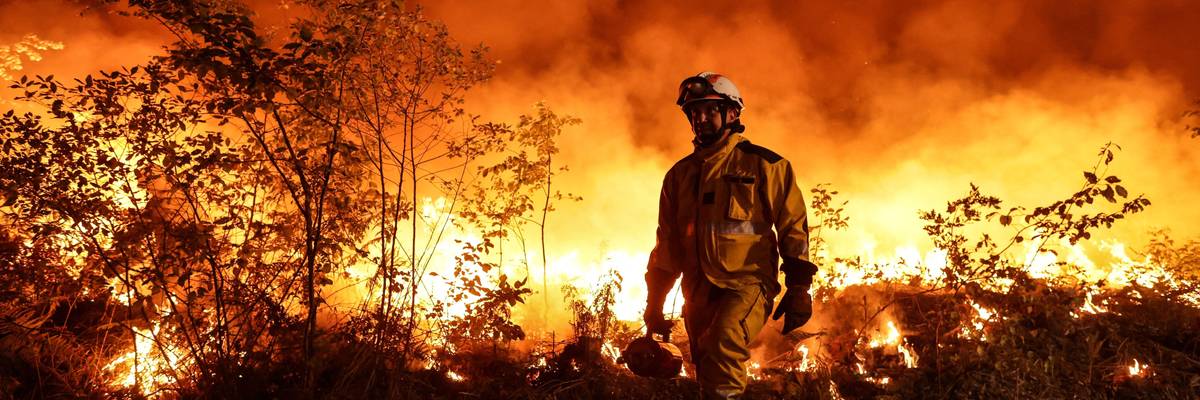
    Tactical firefighters set a backfire to a plot of land to prevent the wildfire from spreading as the winds change in Louchats, France, on July 17, 2022. (Photo by Thibaud Moritz/AFP via Getty Images)

    “Overshoot doesn’t have to mean surrender,” said one campaigner. “The size and length of that overshoot is still being written by the decisions governments make this year.”

    The world has officially moved past the point where preventing a temperature rise above 1.5°C will be possible, scientists said in a United Nations report released Wednesday, which made clear that communities can expect sea levels to continue rising, heatwaves to intensify, and hurricanes, wildfires, and flooding to become more frequent and dangerous—all climate impacts that experts have long warned about as policymakers have failed to rapidly draw down greenhouse gas emissions.

    But the authors of the report, published by the UN Environment Program (UNEP) and titled “Limiting Overshoot,” emphasized that the inevitable temperature rise must not be viewed as a point of no return, and that steps can and must be taken to ensure the overshoot of the 1.5°C goal is only temporary.

    RECOMMENDED…

    US-POLITICS-VOTE-TEXAS

    Talarico Protests as Texas Swing County Plans to Close 92 Polling Places

    US President Donald Trump

    ‘The President of the United States Is Mentally Unwell’: Deranged Trump Posts AI Slop of Iran Bombing

    The best-case scenario is now a peak global temperature of 1.8°C, said the report’s dozens of authors, with an “overshoot, peak, and decline” pathway still possible before the end of this century if policymakers ensure that planet-heating fossil fuel emissions are drastically reduced—starting immediately.

    The report is the first ever to establish the inevitability of overshooting the 1.5°C goal that countries were tasked with working toward when the Paris climate agreement was signed in 2015, and to chart a path toward ensuring the planet can ultimately make its way back down to 1.5°C—hopefully limiting the time above the threshold to a few decades.

    If the world remains above 1.5°C over preindustrial temperatures long-term, said UNEP Executive Director Inger Andersen, “there are no good outcomes.”

    Last year, global temperatures were already about 1.3°C to 1.4°C above the preindustrial average, The Washington Post reported, and the effects on the Earth have been made clear as wildfires have engulfed parts of Canada and South America; a glacial collapse led to flooding that killed more than 1,000 people in Nepal last week; and extreme heat killed more than 1,000 people across Europe this summer.

    “Across the globe, extreme heatwaves are already proving that climate impacts will strike faster, hit harder, and last longer—costing more lives and causing deeper disruption,” said Andersen. “Now is the time we must double down on climate action. We can—and must—get on the right path. By cutting greenhouse gas emissions, strengthening resilience and adaptation, and ensuring exceedance of 1.5°C is as small and short as possible.”

    The scientists said planet-heating fossil fuel emissions must be slashed by 55% by 2035 and almost entirely eliminated by the middle of the century to limit the global temperature rise to 1.8°C above preindustrial levels.

    Climate scientist Joeri Rogeli of Imperial College London, a lead author of the report, told the Post that swift action is crucial, as “for every five years that humanity delays reducing emissions… the peak temperature the world will ultimately face rises by at least a 10th of a degree.”

    The scientists emphasized that avoiding the 1.5°C limit would have been a less daunting goal than reversing the temperature rise. Policies that continue allowing oil, gas, and coal companies to extract fossil fuels will make both goals difficult to achieve.

    The report was released weeks after President Donald Trump terminated offshore wind energy projects in the US—the latest of several renewable energy projects he’s killed—and moved to take ownership of Venezuelan oil fields. Recent global climate summits have been attended by an outsized number of corporate lobbyists for fossil fuel industries, weakening the climate commitments that have come out of the meetings.

    Fenton Lutunatabua of 350.org Pacific noted that the report was also released as Pacific countries meet at the 55th Pacific Islands Forum Leaders Meeting.

    “All eyes are on one of the world’s largest fossil fuel exporters, Australia, and how they act on this urgent warning,” said Lutunatabua. “The climate crisis is here and any delay in mitigation, in phasing out coal, oil, and gas, will only make our adaptation pressures harder and more expensive to bear.”

    The report emphasizes that even if the world is able to reduce planetary heating once global temperatures shoot above 1.5°C, some impacts of continued fossil fuel extraction will be irreversible, including the melting of glaciers and the extinction of some species.

    But UN Secretary-General António Guterres was among those who said “an overshoot of ambition” is now required to mitigate the damage as much as possible.

    “This summer’s scorching heat, raging wildfires, and deadly floods are a warning of what lies ahead. We must make the overshoot above 1.5 degrees as small and short as possible,” said Guterres.

    Along with rapidly cutting emissions, the report calls “carefully governed carbon dioxide removal (CDR)—the process of removing carbon from the air and storing it through afforestation or other means—an essential part of the mix.”

    CDR methods—from planting forests to act as carbon sinks to technological fixes—come with limitations and are potentially reversible. Forests that are planted could be destroyed by wildfires, while CDR technology is largely unproven and can be energy-intensive—negating many of the benefits.

    “Overall, even optimistic CDR scaling is unlikely to deliver a temperature reversal beyond a few tenths of a degree this century,” reads the report. “This emphasizes the importance of focusing on reducing greenhouse gas emissions.”

    Richard Betts, a climate scientist at the University of Exeter and another report author, told the Post that CDR cannot be relied upon as a “get-out-of-jail-free card.”

    At 350.org, head of campaigns and networks Savio Carvalho said that “there is no version of ‘limiting overshoot’ that doesn’t start with ending new coal, oil, and gas expansion today.”

    “This report confirms what communities on the frontlines of the climate crisis have been telling us for years: that delay is not a neutral act, it is a decision,” said Carvalho. “We’ve just watched a glacier collapse bury Himalayan communities under mud and water, and we’re watching Pacific nations lose land to the sea in real time. UNEP is right that overshoot doesn’t have to mean surrender: The size and length of that overshoot is still being written by the decisions governments make this year, on fossil fuel phase-out, technology transfer, and on finance for the countries least responsible and most exposed.”

    Murat Kurum, Türkiye’s minister of environment, urbanization, and climate change and the president-designate of the 31st UN Climate Change Conference (COP31), said the upcoming summit scheduled for November “must turn this urgency into concrete action.”

    “Every fraction of a degree matters, and every year spent in overshoot increases climate risks and the potential for irreversible losses,” said Kurum. “The Overshoot Report makes clear that exceeding 1.5°C should not be seen as a new destination, but as a pathway we must urgently work to minimize and reverse. This requires rapid and sustained emissions reductions, alongside ambitious adaptation to protect people, communities, and ecosystems.”

    “We need to accelerate global electrification, reduce methane emissions from waste, strengthen the climate resilience of cities, and enhance the resilience of marine and coastal ecosystems,” he added. “The choices we make today will determine how high temperatures peak, how long they remain there, and how safely we can return to 1.5°C.”

    Article by Julia Conley republished from Common Dreams under Creative Commons (CC BY-NC-ND 3.0).

    Donald Trump urges you to be a Climate Science denier like him. He says that he makes millions and millions for destroying the planet, Burn, Baby, Burn and Flood, Baby, Flood.
    Donald Trump urges you to be a Climate Science denier like him. He says that he makes millions and millions for destroying the planet, Burn, Baby, Burn and Flood, Baby, Flood.
    Nigel Farage urges you to ignore facts and reality and be a climate science denier like him and his Deputy Richard Tice. He says that Reform UK has received £Millions and £Millions from the fossil fuel industry to promote climate denial and destroy the planet.
    Nigel Farage urges you to ignore facts and reality and be a climate science denier like him and his Deputy Richard Tice. He says that Reform UK has received £Millions and £Millions from the fossil fuel industry to promote climate denial and destroy the planet.
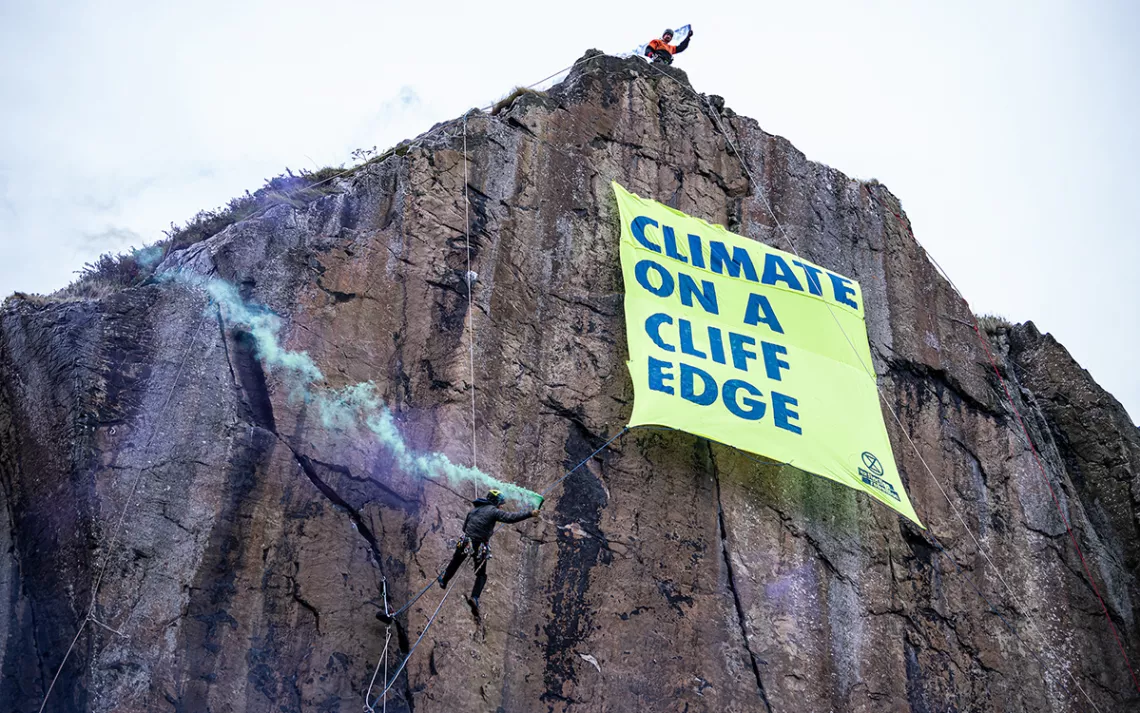
    Experienced climbers scale a rock face near the historic Dumbarton castle in Glasgow, releasing a banner that reads “Climate on a Cliff Edge.” One activist, dressed as a globe, symbolically looms near the edge, while another plays the bagpipes on the shores below. | Photo courtesy of Extinction Rebellion and Mark Richards
    Experienced climbers scale a rock face near the historic Dumbarton castle in Glasgow, releasing a banner that reads “Climate on a Cliff Edge.” One activist, dressed as a globe, symbolically looms near the edge, while another plays the bagpipes on the shores below. | Photo courtesy of Extinction Rebellion and Mark Richards

    Natural Disaster Expert: Elites Have NO PLAN for Climate Collapse. Aaron Bastani meets Bill McGuire

  • Climate change and La Niña made ‘devastating’ southern African floods more intense

    Spread the love

    Original article by Ayesha Tandon and Yanine Quiroz republished from Carbon Brief under a CC license.

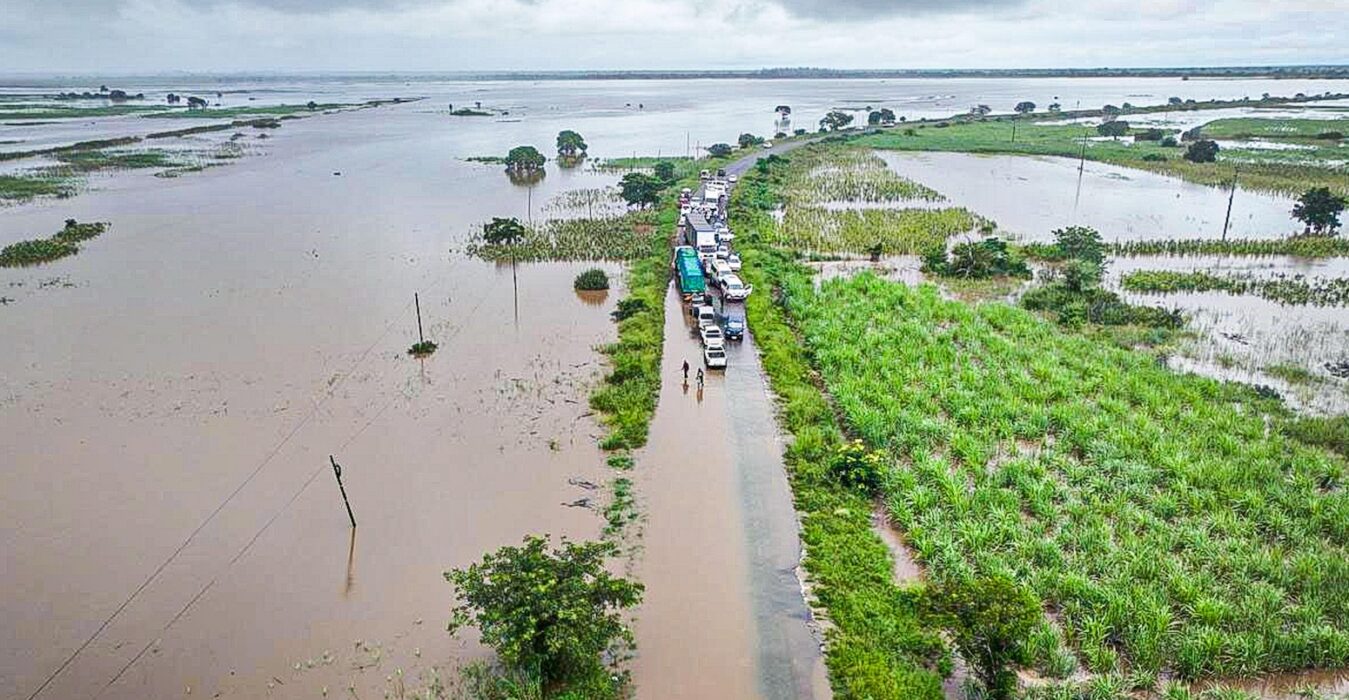
    Aerial view of a flooded road and surrounded landscape, Mozambique. Credit: Associated Press / Alamy Stock Photo

    “Exceptionally heavy” rainfall that led to deadly flooding across southern Africa in recent weeks was made more intense by a combination of climate change and La Niña.

    This is according to a rapid attribution study by the World Weather Attribution service.

    From late December 2025 to early January, south-eastern Africa was hit hard by intense downpours that resulted in more than a year’s worth of rain falling in some areas in just a few days, according to the study.

    This led to severe flooding that left at least 200 people dead, thousands sheltering in temporary accommodation and tens of thousands of hectares of farmland waterlogged.

    The analysis finds that periods of intense rainfall over southern Africa have become 40% more severe since pre-industrial times, according to observations.

    The authors say they were unable to calculate how much of this increase was driven specifically by climate change, due to limitations in how climate models simulate African rainfall.

    However, the study notes that the researchers “have confidence that climate change has increased both the likelihood and the intensity” of the rainfall.

    The authors also note that the El Niño-Southern Oscillation phenomenon played a role in the “devastating” flooding, estimating that a La Niña event made the rainfall around five times more likely.

    Major disruption

    The heavy rainfall started on 26 December last year and intensified from early January. The most-extreme rainfall took place between 10 and 19 January.

    The countries most affected by the floods, and analysed by the study, are Eswatini, Mozambique, South Africa and Zimbabwe, with some areas receiving up to 200mm of rain, according to the study authors.

    Study author Bernardino Nhantumbo – a researcher at Mozambique’s National Institute of Meteorology – told a press briefing that in just two or three days, some areas recorded the amount of rainfall that is “expected for the whole rainy season”.

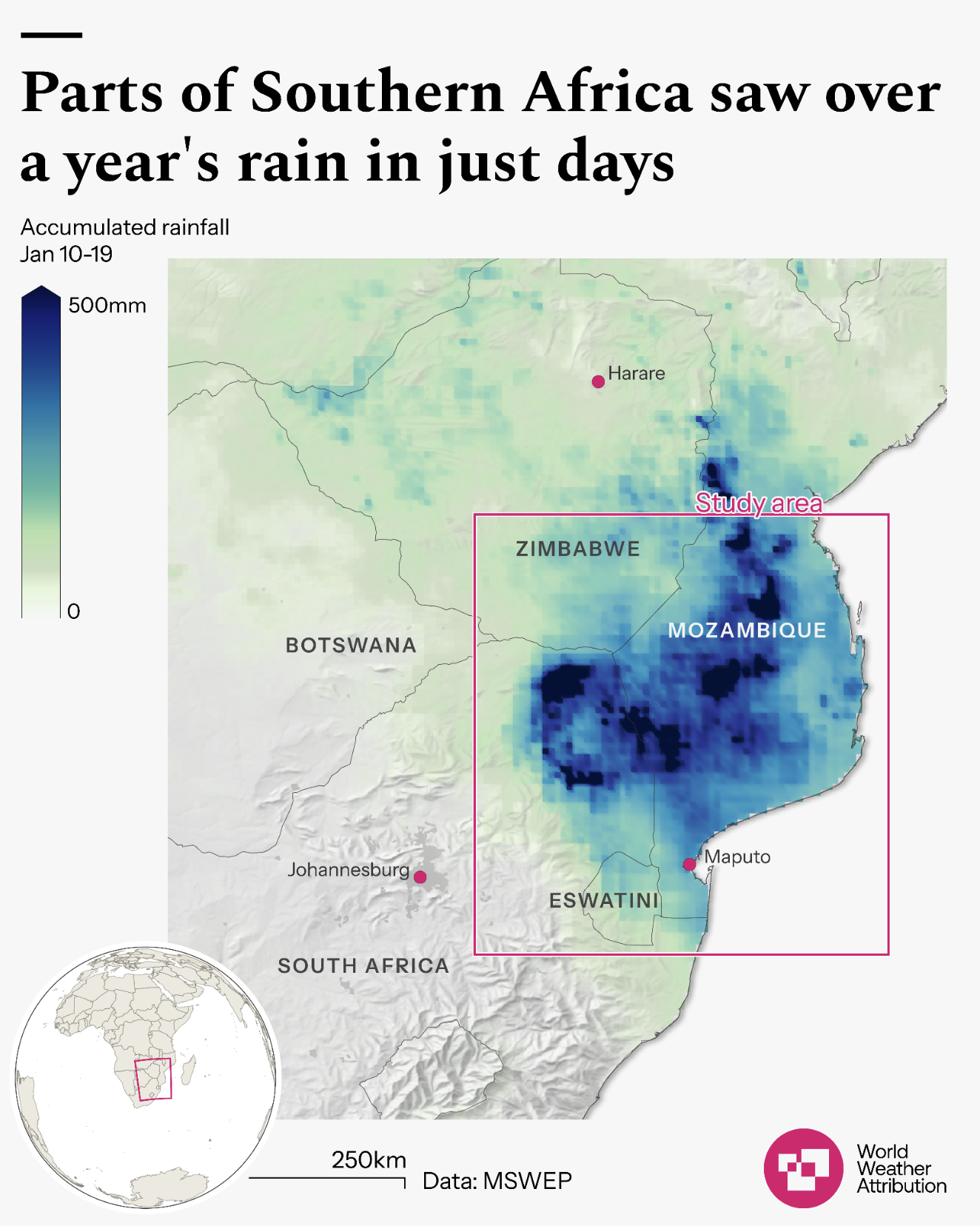
    The map below shows the areas most affected by intense rainfall over 10-19 January. Darker blue indicates a greater accumulation of rainfall, while light green indicates less rainfall. The pink box shows the study area.

    Satellite image of southern Africa showing that some areas saw over a year's rain in just days
    Most affected areas by large floods in southern Africa. Darker blue indicates a greater accumulation of rainfall, while light green indicates less rainfall. The pink box shows the study area. Source: WWA (2026).

    In Mozambique, the floods damaged nearly 5,000km of roads, which has hindered the transport of goods and affected pharmaceutical supply chains, the study says. In Zimbabwe, bridges, roads and infrastructure were “significantly damaged or destroyed”.

    More than 75,000 people have been affected by the floods in Mozambique, according to the study. BBC News reported the floods were the worst seen “in a generation” in the country.

    Dr Izidine Pinto, a climate scientist from Mozambique currently working at the Royal Netherlands Meteorological Institute, told a press briefing that the country was particularly affected because it “lies downstream of major river basins”. 

    The flooding prompted Mozambique’s education minister to consider rescheduling the start of the academic year, according to Channel Africa.

    In South Africa, the country’s weather service said that areas receiving more than 50mm of rain over 11-13 January were “widespread”, with some places seeing up to 200mm.

    South Africa’s Kruger National Park – the largest national park in South Africa – was severely damaged by floods and temporarily closed after several rivers burst their banks, reported TimesLIVE. 

    The South African news outlet quoted environment minister Willie Aucamp as saying: “The indication is that it will take as long as five years to repair all the bridges and roads and other infrastructure.” 

    Extreme rainfall

    The peak of the rainy season in southern Africa falls between December and February.

    To put the extreme rainfall into its historical context and determine how unlikely it was, the authors analysed a timeseries of 10-day maximum rainfall data for the December-February season.

    They find that in today’s climate, extreme rainfall events of the scale seen this year in southern Africa would be expected only once every 50 years. 

    They add that such events have become “significantly more intense”, with observational data showing a 40% increase in rainfall severity since pre-industrial times.

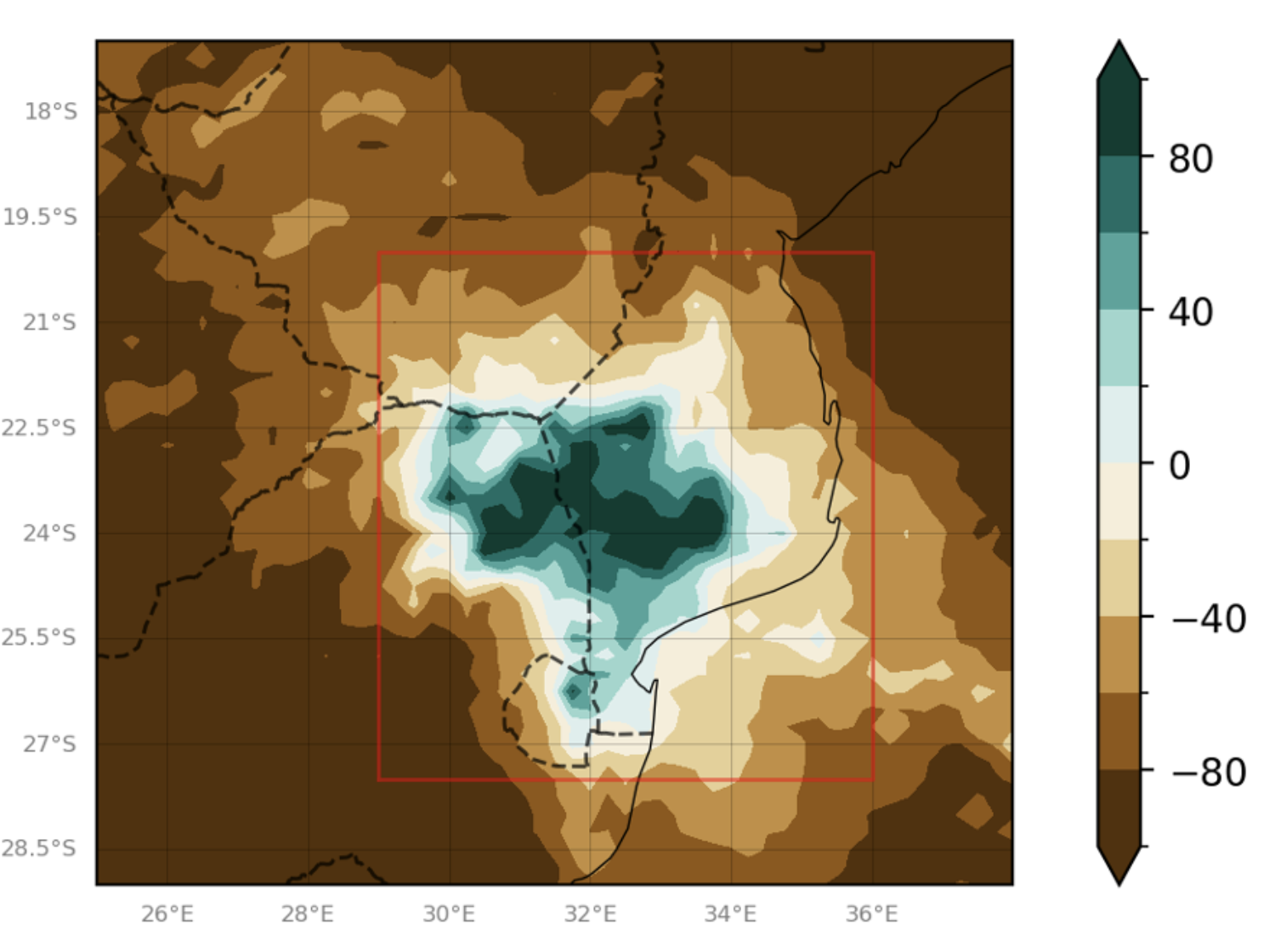
    The map below shows accumulated rainfall over Eswatini, Mozambique, South Africa and Zimbabwe over 10-19 January, as a percentage of the average December-February rainfall for the region over 1991-2020.

    Green shading indicates that the rainfall in 2026 was higher than in 1991-2020, while brown indicates that it was lower. The red box indicates the study region. 

    Accumulated rainfall over Eswatini, Mozambique, South Africa and Zimbabwe over 10-19 January 2026, shown as a percentage of the average December-February rainfall for the region over 1991-2020. The study region is outlined in dark red. Source: WWA (2026).
    Accumulated rainfall over Eswatini, Mozambique, South Africa and Zimbabwe over 10-19 January 2026, shown as a percentage of the average December-February rainfall for the region over 1991-2020. The study region is outlined in dark red. Source: WWA (2026).

    The study explains that in January and February, rainfall patterns in southern Africa are “strongly influenced” by the El Niño-Southern Oscillation (ENSO), a naturally occurring climate phenomenon that affects global temperatures and regional weather patterns. 

    La Niña is the “cool” phase of ENSO, which typically brings wetter weather to southern Africa.

    Pinto told the press briefing that “most past extreme rainfall events [in the region] have occurred during La Niña years”. 

    The authors estimate that the current weak La Niña event made the extreme rainfall five times more likely and increased the intensity of the event by around 22%.

    For attribution studies, which identify the “fingerprint” of human-caused climate change on extreme weather events, scientists typically use climate models to simulate and compare worlds with and without global warming.

    However, many models have limitations in their simulations of African rainfall. In this study, the authors found that the models available to them cannot “adequately capture” the influence of ENSO on rainfall in the region.  

    Study author Prof Fredi Otto, a professor in climate science at the Imperial College London, told a press briefing that these limitations are “well known”. They stem, in part, because the models were “developed outside of Africa” by modellers with different priorities, she explained. 

    This means that the authors were unable to calculate how much more intense or likely the rainfall event was specifically as a result of human-caused warming.

    However, Otto explained that the authors are “very, very confident that climate change did increase the likelihood and intensity of the rainfall” to some extent. This is because the observations all show an increase in rainfall over time and other existing literature supports this assumption, she added. 

    She told the press briefing that the results of this study were “definitely not 100% satisfactory”, adding that this study will “definitely not be the last of its kind in this region”. 

    (These findings are yet to be published in a peer-reviewed journal. However, the methods used in the analysis have been published in previous attribution studies.)

    Vulnerability

    The study warns that the flooding “exposed deep and persistent social vulnerability in the region”.

    The authors say that a large proportion of the population – especially in urban areas – live in poor housing with “inadequate planning and insufficient provision of basic services”.

    Paola Emerson, head of office at the UN Office for the Coordination of Humanitarian Affairs (OCHA) in Mozambique, told a UN press briefing about the flooding that nearly 90% of people in the country live in traditional adobe houses that “basically melt after a few days’ rains”.

    In a WWA press release, study author Nhantumbo explained:

    “When 90% of homes are made of sun-dried earth, they simply cannot withstand this much rain. The structural collapse of entire villages is a stark reminder that our communities and infrastructure are now being tested by weather they are just not designed to endure.”

    Study author Renate Meyer – an adviser with the conflict and climate team at the Red Cross Red Crescent Centre – said in a WWA press briefing that the “recurring frequency of hazards such as drought and extreme rainfall have had a significant impact on communities experiencing, amongst others, displacement, health challenges, socioeconomic loss and psychological distress”.

    For example, the World Health Organization (WHO) said in a press release that the event had disrupted access to health services and increased the risks of water- and mosquito-borne diseases, as well as respiratory infections across southern Africa.

    Meyer explained that the countries included in this study have “substantial populations living below or near the poverty line with limited savings, low insurance cover and a high dependence on climate sensitive livelihoods”. 

    Original article by Ayesha Tandon and Yanine Quiroz republished from Carbon Brief under a CC license.

    Donald Trump urges you to be a Climate Science denier like him. He says that he makes millions and millions for destroying the planet, Burn, Baby, Burn and Flood, Baby, Flood.
    Donald Trump urges you to be a Climate Science denier like him. He says that he makes millions and millions for destroying the planet, Burn, Baby, Burn and Flood, Baby, Flood.
    Nigel Farage urges you to ignore facts and reality and be a climate science denier like him and his Deputy Richard Tice. He says that Reform UK has received £Millions and £Millions from the fossil fuel industry to promote climate denial and destroy the planet.
    Nigel Farage urges you to ignore facts and reality and be a climate science denier like him and his Deputy Richard Tice. He says that Reform UK has received £Millions and £Millions from the fossil fuel industry to promote climate denial and destroy the planet.
    Elon Musk urges you to be a Fascist like him, says that you can ignore facts and reality then.
    Elon Musk urges you to be a Fascist like him, says that you can ignore facts and reality then.

  • BP raking in obscene profits at expense of people and planet

    Spread the love
    Climate protest
    Climate protest

    Fossil fuel giant BP is profiteering at the expense of people and planet, say the Scottish Greens. The comments from the party’s climate spokesperson, Patrick Harvie, come as BP has published its profits for Q3 2025.

    Earlier this year BP announced that it would cut its renewable energy investments and instead focus on increasing oil and gas production.

    Patrick said: 

    “It has been yet another year of climate chaos around the world, with wildfires and flooding taking a deadly toll. 

    “Yet times have rarely been better for the polluters and fossil fuel giants who are raking in eye-watering profits while our planet burns and households and families are hammered with escalating bills.

    “What makes BP’s profiteering particularly obscene is that they know the damage they are doing and are doubling down on it by rolling back on the few climate commitments that they had made.

    “Our energy market will never be fit for purpose as long as it is run by and for multibillion pound corporations like BP and those who are determined to exploit every last drop of oil at the expense of people and planet.”

    Patrick added: 

    “The UK government has a major decision on its hands when it comes to Rosebank. Will they keep the ban in place, or will they cave-in to pressure from the polluter lobby?

    “Scotland has a huge renewables potential, but we need our governments to step up, do the work and make the investment that is needed in workers and green jobs.”

    Nigel Farage urges you to ignore facts and reality and be a climate science denier like him and his Deputy Richard Tice. He says that Reform UK has received £Millions and £Millions from the fossil fuel industry to promote climate denial and destroy the planet.
    Nigel Farage urges you to ignore facts and reality and be a climate science denier like him and his Deputy Richard Tice. He says that Reform UK has received £Millions and £Millions from the fossil fuel industry to promote climate denial and destroy the planet.
    Neo-Fascist Climate Science Denier Donald Trump says Burn, Baby, Burn.
    Neo-Fascist Climate Science Denier Donald Trump says Burn, Baby, Burn.
    Orcas comment on killer apes destroying the planet by continuing to burn fossil fuels.
    Orcas comment on killer apes destroying the planet by continuing to burn fossil fuels.
  • Towns may have to be abandoned due to floods with millions more homes in Great Britain at risk

    Spread the love

    https://www.theguardian.com/environment/2025/oct/14/millions-more-homes-in-great-britain-at-risk-of-flooding-investigation-finds

    Flood waters surrounding houses in Wraysbury, Berkshire in January 2024. Greater London and Yorkshire and the Humber are two regions at particular risk in the coming years. Photograph: Daniel Leal/AFP/Getty Images

    Every constituency projected to be at greater risk, with many areas likely to be uninsurable, Guardian investigation finds

    Millions more homes in England, Scotland and Wales face devastating floods, and some towns may have to be abandoned as climate breakdown makes many areas uninsurable, a Guardian investigation has found.

    New analysis from the insurance industry, seen by the Guardian, reveals the extent of concern in the sector, with bosses warning that large swathes of housing and commercial property in densely populated areas will be at greater risk.

    Separately, experts have said that some towns may need to be abandoned as homes and businesses struggle to get insurance in areas repeatedly battered by storms and rising sea levels.

    Densely populated areas including London, Manchester and parts of north-east England, are likely to be worst hit. Experts also say London’s flood defences need to be updated urgently to protect the capital from devastating floods.

    …

    Orcas comment on killer apes destroying the planet by continuing to burn fossil fuels.
    Orcas comment on killer apes destroying the planet by continuing to burn fossil fuels.
    Neo-Fascist Climate Science Denier Donald Trump says Burn, Baby, Burn.
    Neo-Fascist Climate Science Denier Donald Trump says Burn, Baby, Burn.
    Nigel Farage urges you to ignore facts and reality and be a climate science denier like him and his Deputy Richard Tice. He says that Reform UK has received £Millions and £Millions from the fossil fuel industry to promote climate denial and destroy the planet.
    Nigel Farage urges you to ignore facts and reality and be a climate science denier like him and his Deputy Richard Tice. He says that Reform UK has received £Millions and £Millions from the fossil fuel industry to promote climate denial and destroy the planet.

  • ‘Profound concern’ as scientists say extreme heat ‘now the norm’ in UK

    Spread the love

    https://www.theguardian.com/environment/2025/jul/14/profound-concern-as-scientists-say-extreme-heat-now-the-norm-in-uk

    Weather records clearly show the UK’s climate is different now compared with just a few decades ago. Photograph: Geoffrey Swaine/Shutterstock

    Increasing frequency of heatwaves and flooding raises fears over health, infrastructure and how society functions

    Record-breaking extreme weather is the new norm in the UK, scientists have said, showing that the country is firmly in the grip of the climate crisis.

    The hottest days people endure have dramatically increased in frequency and severity, and periods of intense rain have also ramped up, data from hundreds of weather stations shows. Heatwaves and floods leading to deaths and costly damage are of “profound concern” for health, infrastructure and the functioning of society, the scientists said.

    The weather records clearly show the UK’s climate is different now compared with just a few decades ago, the scientists said, as a result of the carbon pollution emitted by burning fossil fuels.

    The analysis found that the number of days with temperatures 5C above the average for 1961-1990 had doubled in the last 10 years. For days 8C above average, the number has trebled and for 10C above average it has quadrupled. The UK has also become 8% sunnier in the last decade.

    …

    The assessment, called the State of the UK Climate 2024 and published in the International Journal of Climatology, found the last three years were in the UK’s top five hottest years on record. The warmest spring on record was seen in 2024 although this has already been surpassed in 2025.

    The UK has particularly long meteorological records and the Central England Temperature series is the longest instrumental record in the world. It shows that recent temperatures have far exceeded any in at least 300 years. However, today’s high temperatures are likely to be average by 2050, and cool by 2100, the scientists said.

    …

    Donald Trump urges you to be a Climate Science denier like him. He says that he makes millions and millions for destroying the planet, Burn, Baby, Burn and Flood, Baby, Flood.
    Donald Trump urges you to be a Climate Science denier like him. He says that he makes millions and millions for destroying the planet, Burn, Baby, Burn and Flood, Baby, Flood.
    Nigel Farage urges you to ignore facts and reality and be a climate science denier like him. He says that Reform UK has received millions and millions from the fossil fuel industry to promote climate denial and destroy the planet.
    Nigel Farage urges you to ignore facts and reality and be a climate science denier like him. He says that Reform UK has received millions and millions from the fossil fuel industry to promote climate denial and destroy the planet.