Search and rescue workers dig through debris looking for any survivors or remains of people swept up in the flash flooding on July 6, 2025 in Hunt, Texas.(Photo: Jim Vondruska/Getty Images)
“It’s not a question of whether climate change played a role—it’s only a question of how much,” said one expert.
As the death toll from catastrophic flooding in Texas continued to rise, climate scientists this weekend underscored the link between more frequent and severe extreme weather events and the worsening climate emergency caused primarily by humans burning fossil fuels.
Officials said Sunday that at least 69 people died in the floods, 59 of them in Kerr County. Of the 27 missing girls from Camp Mystic—some of whom were sleeping just 225 feet from the Guadalupe River when its waters surged during flash flooding Friday—11 are still missing.
While some local officials blamed what they said were faulty forecasts from the National Weather Service—which has been hit hard by staffing cuts ordered by the Trump administration’s Department of Government Efficiencyin line with Project 2025—meteorologists and climate scientists including Daniel Swain of the University of California, Los Angeles have refuted such allegations, citing multiple NWS warnings of potentially deadly flooding.
However, some experts asserted that vacancies at key NWS posts raise questions about forecasters’ ability to coordinate emergency response with local officials.
Climate scientists do concur that human-caused global heating is causing stronger and more frequent extreme weather events including flooding.
“This kind of record-shattering rain (caused by slow-moving torrential thunderstorms) event is *precisely* that which is increasing the fastest in a warming climate,” Swain wrote in a statement. “So it’s not a question of whether climate change played a role—it’s only a question of how much.”
As Jeff Masters and Bob Henson wrote Saturday for Yale Climate Connections:
Many studies have confirmed that human-caused climate change is making the heaviest short-term rainfall events more intense, largely by warming the world’s oceans and thus sending more water vapor into the atmosphere that can fuel heavy rain events. Sea surface temperatures this week have been as much as 1°F below the 1981-2010 average for early July in the western Gulf [of Mexico] and Caribbean, but up to 1°F above average in the central Gulf. Long-term human-caused warming made the latter up to 10 times more likely, according to the Climate Shift Index from Climate Central.
“The tragic events in Texas are exactly what we would expect in our hotter, climate-changed, world,” Bill McGuire, professor emeritus of geophysics and climate hazards at University College London, said Saturday. “There has been an explosion in extreme weather in recent years, including more devastating flash floods caused by slow-moving, wetter, storms, that dump exceptional amounts of rain over small areas across a short time.”
It’s hard to make the Texas flood tragedy worse, except to know that on the same day Trump signed a bill to stop our efforts to defeat the climate change that is causing increased frequency of disastrous floods. And giving us more expensive electricity. www.nytimes.com/2025/07/05/c…
Instead of taking action to combat the planetary emergency, the Trump administration is ramping up fossil fuel production while waging war on clean energy and climate initiatives. The so-called One Big Beautiful Bill Act signed into law by Trump on Friday slashes the tax credits for electric vehicles and other renewable technologies including wind and solar energy that were a cornerstone of the Biden-era Inflation Reduction Act.
Donald Trump urges you to be a Climate Science denier like him. He says that he makes millions and millions for destroying the planet, Burn, Baby, Burn and Flood, Baby, Flood.
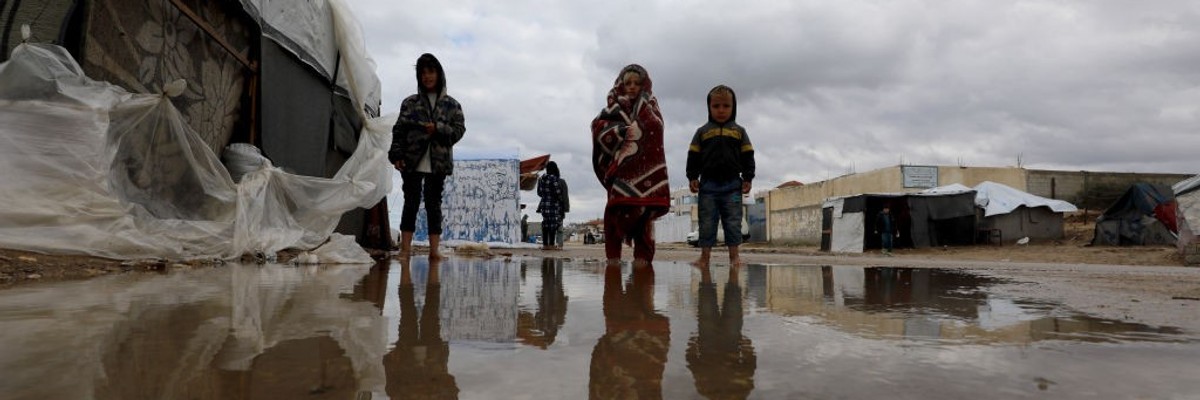
Displaced Palestinian children are pictured at a flooded makeshift camp in Nuseirat, Gaza on November 26, 2024. (Photo: Moiz Salhi/Anadolu via Getty Images)
“For many children, all they have is ruined bits of tent material swimming in swamp water in the camp they fled to for safety.”
Flooding induced by heavy rainstorms in recent days has compounded the humanitarian crisis facing Palestinians in the besieged Gaza Strip, intensifying the already-high threat of disease as nearly two million displaced people struggle to survive Israel’s U.S.-backed assault.
Save the Children, a humanitarian group working on the ground in Gaza, said Friday that torrential rainfall has transformed makeshift camps into swamps, impacting roughly 235,000 children who have been forced from their homes by Israeli attacks and displacement orders.
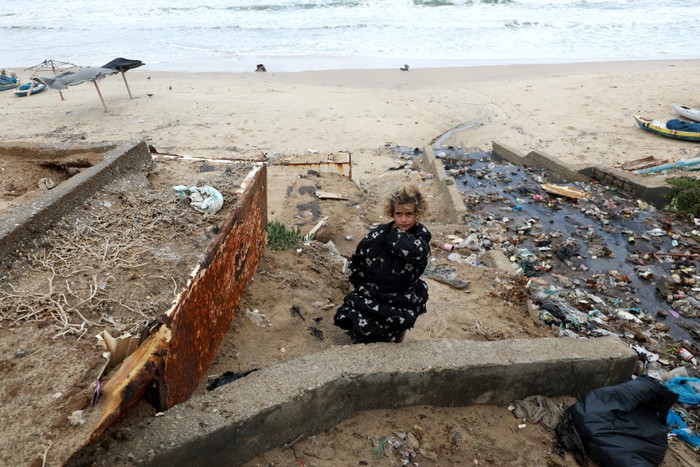
A Save the Children nutrition consultant who works in Gaza’s flood-affected camps said that most of the tents “are uninhabitable” and wholly inadequate to withstand harsh winter weather. Makeshift tents that now run for miles along Gaza’s coast have been badly damaged or completely destroyed in recent days by rising seawater.
“The tents are made of cloth and similar materials, and the ground is dust and mud, so tents get flooded within five minutes of rain,” said the Save the Children consultant, identified as Mariam. “People’s situation is miserable. A dire situation in terms of health, mental health, and immunity.”
“A mother came in today and apologized for being late. Why? Because it was raining through the night and their tent was flooded,” said Mariam. “The family had to go outside, and she had to carry the children until the rain stopped. Then they swept the water out and went back inside. Some people had to flee because big ponds were formed due to rain. It’s a tragic situation.”
(Photo: Moiz Salhi/Anadolu via Getty Images)
Reuters reported earlier this week that downpours “inundated tents and in some places washed away the plastic and cloth shelters used by displaced Gazans.” The United Nations estimates that around 1.6 million people live in makeshift shelters across Gaza.
“Some placed water buckets on the ground to protect mats from leaks and dug trenches to drain water away from their tents,” according to Reuters. “Many tents used early in the war have now worn out and no longer offer protection, but the price of new tents and plastic sheeting has shot up beyond the means of displaced families.”
Aid workers have warned for months of the threat stagnant water poses to public health in Gaza, whose sanitation infrastructure has been decimated by Israel’s large-scale bombing campaign. One Oxfam campaigner recently described the bomb-ravaged enclave as “a nightmarish landscape of insect and disease-ridden swamps and poisoned wells.”
In a report issued in September, the U.N. Children’s Fund and other organizations noted that “flooding creates stagnant water pools which can become breeding sites for mosquitoes, increasing the risk of diseases such as West Nile Fever.”
Jeremy Stoner, regional director for Save the Children, said Friday that “children in Gaza are not only losing their lives, their limbs, and their loved ones—they are also fleeing their bombed-out homes for camps with conditions less and less fit for human life, as we see more and more restrictions on aid.”
“As this deadly war has shattered the lives and futures of children for over a year now, we have seen access to critical things like food, healthcare, and sanitation stripped away,” Stoner added. “Now for many children, all they have is ruined bits of tent material swimming in swamp water in the camp they fled to for safety.”
Gaza’s health ministry said Friday that the official death toll in the enclave has risen to 44,363 following a series of Israeli attacks across the territory over the past 24 hours.
Since Thursday morning, as Al Jazeera reported Friday, Israeli attacks in central Gaza have killed dozens of people.
“Israeli fighter jets have carried out an intense bombing campaign in the Nuseirat area over the past day, targeting residential buildings and homes, as well as mosques and other public facilities,” the outlet observed. “One Israeli attack on Thursday struck a home sheltering displaced Palestinians, resulting in nine members from one family being killed. Israeli fighter jets also bombed a house in the camp belonging to the Dahdouh family on Friday, killing at least five people.”
Al Jazeera‘s Hani Mahmoud said Friday that as Israeli tanks and armored vehicles withdrew from areas of central Gaza that they attacked in the preceding 24 hours, “many displaced people made their way back to Nuseirat refugee camp to check on family members still inside.”
“Many were shocked to find out that their family members were not able to leave due to quadcopters constantly shooting at them,” Mahmoud said. “Many people have been killed either inside their homes or as they were making their way out of their residential buildings into the streets, they said. They are literally collecting bodies right now from the streets.”
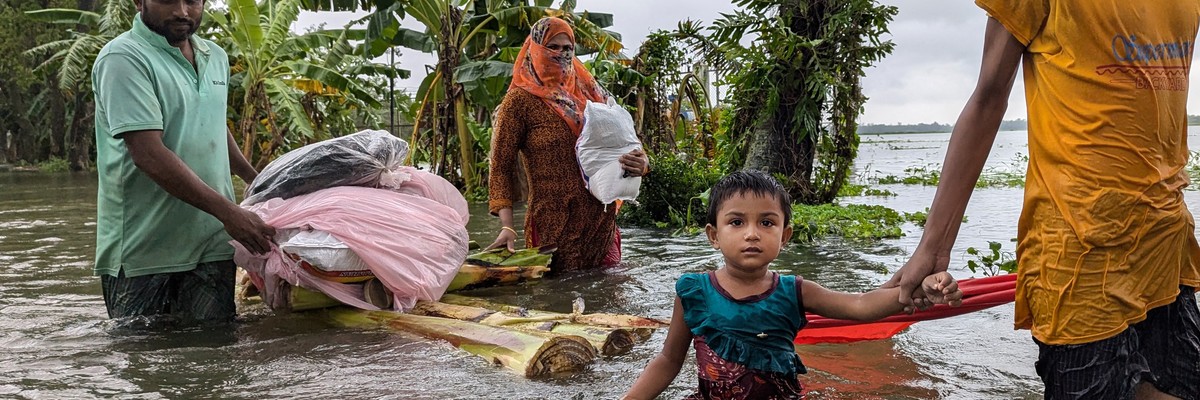
People wade through floodwaters in Feni, Bangladesh, on August 25, 2024. (Photo: Zakir Hossain Chowdhury/NurPhoto via Getty Images)
“No individual or economy on the planet is immune from the health threats of climate change,” said a lead researcher.
Over $1 trillion spent each year on subsidizing fossil fuel production must be redirected to public health efforts, said the experts behind a new annual report monitoring progress on the climate and global health.
“This year’s stocktake of the imminent health threats of climate inaction reveals the most concerning findings yet in our eight years of monitoring,” said Marina Romanello, executive director of the Lancet Countdown and a senior research fellow at UCL. “Once again, last year broke climate change records—with extreme heatwaves, deadly weather events, and devastating wildfires affecting people around the world.”
With 2023 named the hottest year on record earlier this year by the European Union’s Copernicus Climate Change Service, the researchers behind the new report found that the average person experienced an additional 50 days of dangerously hot weather that would not have happened without fossil fuel extraction heating the planet.
Heat-related deaths among people over age 65 reached the highest level ever recorded, 167% higher than in the 1990s and more than double the 65% increase that was expected if temperatures hadn’t changed since then.
An additional 151 million people across 124 countries experienced moderate or severe food insecurity last year, an increase that was associated with extreme drought that affected almost half of global land area.
“We must cure the sickness of climate inaction—by slashing emissions, protecting people from climate extremes, and ending our fossil fuel addiction.”
Changing climate conditions across the globe and the flooding that has come with more frequent hurricanes and tropical storms are also fueling a rise in the transmission of infectious diseases like dengue fever, according to the Lancet Countdown, and warmer coastal waters contributed a record-high number of cases of the bacterial infection vibriosis last year.
“The mosquitoes that spread infections like dengue fever epidemics are reaching new countries, and gradually moving north,” said Anthony Costello, a professor at UCL Institute for Global Health and co-chair of the countdown.
But despite those indicators and others, said Romanello, “we see financial resources continue to be invested in the very things that undermine our health.”
Researchers expressed optimism about rising investments in renewable energy, but warned that new fossil fuel investment accounted for more than a third of new energy spending in 2023, and 84% of world governments continue to subsidize fossil fuel production despite clear warnings from scientists that oil and gas extraction have no place on a pathway to limiting planetary heating to 1.5°C.
Governments are “in effect paying an estimated $1.4 trillion dollars per year to worsen the crisis,” reportedThe Hill.
Meanwhile, “only 68% of countries reported high-to-very-high implementation of the legally mandated capacities to manage health emergencies in 2023,” according to the Lancet Countdown. Just 35% of countries reported having early warning healthcare systems for heat-related illness.
“No individual or economy on the planet is immune from the health threats of climate change,” said Romanello. “The relentless expansion of fossil fuels and record-breaking greenhouse gas emissions compounds these dangerous health impacts and is threatening to reverse the limited progress made so far and put a healthy future further out of reach.”
Total carbon emissions from fossil fuel combustion reached nearly 40 gigatonnes last year, a 1.1% increase from 2022, contributing to high levels of air pollution as well as changing climate conditions.
“National-level net subsidies exceeded 10% of national health spending in 55% of the countries, and 100% in 27% of them,” reads a visual summary of the report. “These funds could be redirected towards supporting the transition to clean energy sources, protect vulnerable populations from soaring climate change risks, and enable a healthy future.”
Redirecting fossil fuel subsidies “would provide the opportunity to deliver a fair, equitable transition to clean energy and energy efficiency, and a healthier future, ultimately benefiting the global economy,” said Romanello.
Released less than two weeks before world governments are set to convene in Azerbaijan for the United Nations Climate Change Conference (COP29), where climate finance is expected to be a key issue, the report calls for “new strategies and finance for implementation” in order to protect global public health from climate disasters.
“These must acknowledge climate change’s effects on health and related systems, assess risks and vulnerabilities, and incorporate resilience to shocks,” reads a joint brief by the Lancet Countdown and Médecins Sans Frontières, also called Doctors Without Borders. “Adequate, predictable, and unified climate finance for adaptation and technical support is urgently needed to enable ministries of health and their implementing partners to adopt forward-thinking strategies, integrate anticipatory actions, and enhance flexibility and agility in their operating models.”
U.N. Secretary-General António Guterres said the report shows “we must cure the sickness of climate inaction—by slashing emissions, protecting people from climate extremes, and ending our fossil fuel addiction—to create a fairer, safer, and healthier future for all.”
To shift resources toward a “zero-emissions future,” said Costello, “people’s health must be put front and center of climate change policy to ensure the funding mechanisms protect well-being, reduce health inequities and maximize health gains, especially for the countries and communities that need it most.”
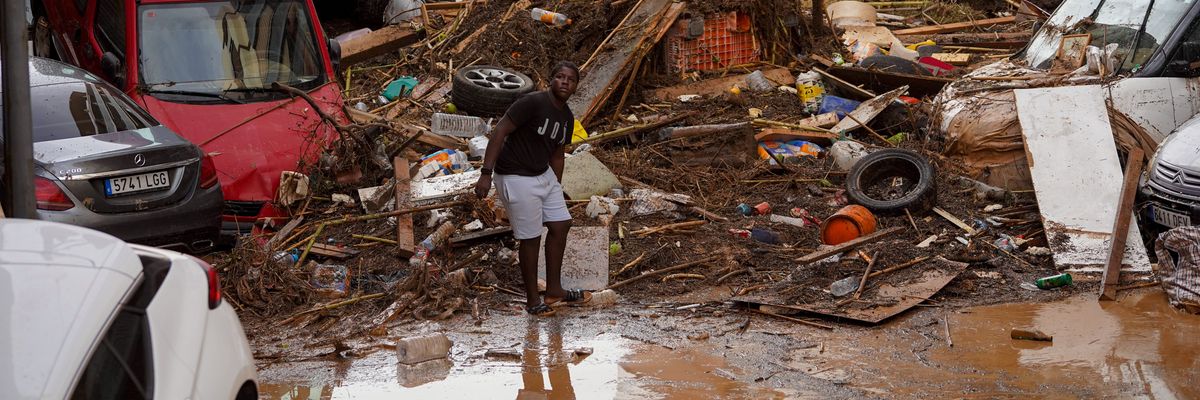
A view of the damaged area after a deluge brought up to 200 liters of rain per square meter (50 gallons per square yard) in hours in towns across the region of Valencia, Spain on October 30, 2024. (Photo: Alex Juarez/Anadolu via Getty Images)
“These disasters are only getting worse, and stopping the industries and systems driving climate collapse is the only rational response,” one climate group said.
Spain’s deadliest flooding in 30 years killed at least 72 people as torrential rain slammed the eastern region of Valencia on Tuesday, with some towns recording a year’s worth of rain in a single day.
The flooding sent churning muddy water down narrow streets, tossing cars, downing trees, bulldozing bridges and buildings, and trapping people in rising flood waters.
“The neighborhood is destroyed, all the cars are on top of each other, it’s literally smashed up,” Christian Viena, who owns a bar in Valencia’s Barrio de la Torre, told The Associated Press. “Everything is a total wreck, everything is ready to be thrown away. The mud is almost 30 centimeters (11 inches) deep.”
As of Wednesday morning, officials reported 70 deaths in Valencia and two in the bordering region of Castilla La Mancha. However, the death toll could rise as search and rescue operations continue amid difficult conditions, such as power outages and blocked roadways. Many people remain missing with their fates uncertain.
This includes residents of Utiel in Valencia, whose mayor, Ricardo Gabaldón, told Spanish broadcaster RTVE that Tuesday was the “worst day of my life.”
“We were trapped like rats,” Gabaldón said. “Cars and trash containers were flowing down the streets. The water was rising to 3 meters (9.8 feet).”
One person who was rescued was Denis Hlavaty, who spent the night perched on the edge of the roof of a gas station where he works.
“It’s a river that came through,” Hlavaty told Reuters, adding, “The doors were torn away and I spent the night there, surrounded by water that was 2 metres (6.5-feet) deep.”
“The fossil fuel industry increases the climate emergency, destroys the balance of critical ecosystems, and puts people’s lives in danger.”
The storm also canceled high-speed rail travel between Valencia and Madrid and Barcelona, and derailed one high-speed train near Malaga, though no one was injured.
While the rains had tapered off in Valencia by Wednesday morning, the rest of the country is not out of danger, as the storm is projected to move northeast.
“We mustn’t let our guard down because the weather front is still wreaking havoc and we can’t say that this devastating episode is over,” Spanish Prime Minister Pedro Sánchez told the nation on television Wednesday.
Even if the death toll does not rise, Tuesday’s floods are already the deadliest in Spain since 1996, when a flood near the Pyrenees killed 87. They are also the deadliest in Europe since floods in 2021 that killed at least 185.
In the immediate term, Tuesday’s deluge was caused by a phenomenon called a gota fría, or “cold drop,” a storm formed as cold air moves over the warm Mediterranean. In Spain, these kinds of storms are also commonly referred to with the acronym DANA—for Depresión Aislada en Niveles Altos, or isolated high-level depression.
However, scientists observe that the climate crisis is making rainstorms like this one more extreme, as warmer air can hold more moisture to dump when conditions are right. For Europe specifically, the warming of the Mediterranean causes more water to evaporate from its surface, super-charging rainstorms.
“Events of this type, which used to occur many decades apart, are now becoming more frequent and their destructive capacity is greater,” Ernesto Rodriguez Camino, senior state meteorologist and a member of the Spanish Meteorological Association, told Reuters.
The Spanish flooding comes a little more than a month after record rainfall swamped Central Europe and Eastern Europe, in an event that scientists concluded was made approximately twice as likely and 7% more severe by the climate crisis fueled primarily by the burning of fossil fuels.
“When we talk about climate change and climate emergency, it’s often perceived as an abstract concept far from our daily reality,” Eva Saldaña, the executive director of Greenpeace Spain, said in a statement. “Unfortunately, this is climate change: the intensification of extreme weather phenomenons like what happened tonight, with the level of destruction greater each time. Ignoring it causes deaths that we cannot allow.”
In a post on social media, Greenpeace Spain said that fossil fuel companies including the Spanish Repsol should pay for the damages.
“DANAS are more intense every time due to climate change,” the group wrote. “The fossil fuel industry increases the climate emergency, destroys the balance of critical ecosystems, and puts people’s lives in danger.”
Extinction Rebellion Global agreed. “These disasters are only getting worse, and stopping the industries and systems driving climate collapse is the only rational response,” the group wrote on social media.
The U.S.-based Climate Defiance, meanwhile, shared images of flood-ravaged streets with dismissals often leveled at climate activists.
Yellow Dot Studios, Don’t Look Up director Adam McKay’s climate-focused media studio, also shared an image of cars dropped in piles in the street by the flood waters to call out the double-standard in how direct-action climate protests and the corporate crimes of the fossil fuel industry are punished.
Friends of the Earth Spain focused on the human impacts, arguing that urgent climate action meant “putting people’s lives, and not economic models, at the center.”
“Don’t prioritize sending people to work in extreme and dangerous conditions,” the group wrote. “It is a priority to take effective, ambitious, and urgent measures in response to the climate crisis we are living through.”
Original article by Abdul Rahman republished from peoples dispatch under a Creative Commons Attribution-ShareAlike 4.0 (CC BY-SA) license.
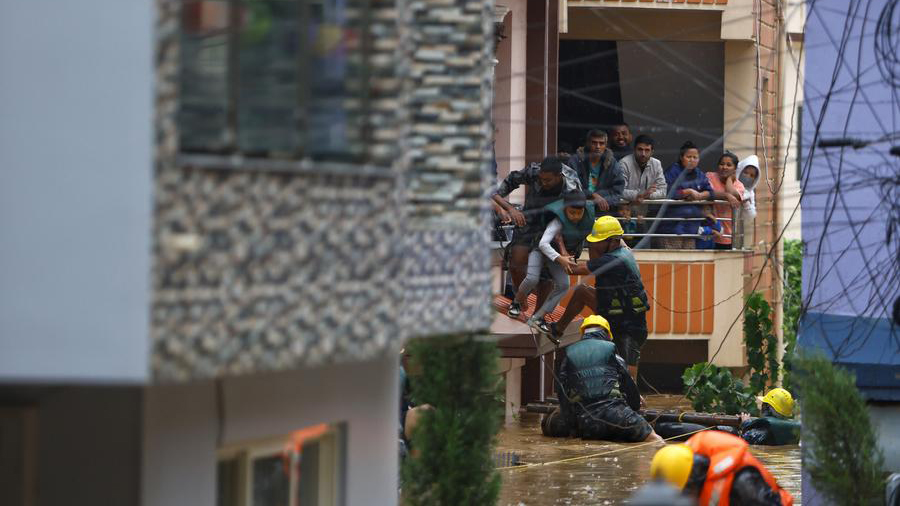
Rescuers evacuate flood victims in Lalitpur, Nepal ((Photo: Sulav Shrestha/Xinhua)
Meteorologists in the Himalayan nation have observed a pattern of change in the local climate in the last few years, with monsoon season lasting longer than usual and erratic rains affecting millions
Over 200 people have been killed or missing in the floods and landslides caused by unprecedented rains lashing Nepal for the last five days. Thousands have been displaced in different parts of the mountainous country.
On Monday, authorities announced the shutting down of all educational institutions. Several school and university buildings have also been damaged after facing the brunt of the torrential rains.
The capital Kathmandu has been one of the most affected regions in the country with a large number of neighborhoods flooded or covered with the mud due to rain water, which has also caused the water levels in the Bagmati river to rise. The flood and landslides have destroyed numerous homes, bridges, roads, and vehicles, leaving a large number of people stranded.
Many flooded areas are localities where poor and working class people live. Their houses have been inundated with water and mud, which may take longer to clear, raising the risk of the breakout of epidemics after the water recedes.
According to Nepal’s Ministry of Transport, 47 out of 80 highways in the country have been affected by the rains and landslides, greatly impacting transportation. Over one hundred flights were canceled due to heavy rains, and the Kathmandu airport stopped operating on Friday and Saturday for several-hour-long periods. It re-started operations again on Sunday morning.
Several power plants have also been damaged due to the flooding and landslides, disrupting the power supply to different parts of the country.
The Communist Party of Nepal (UML) issued a statement earlier asking the government to increase its efforts to relief and rescue work. The party also asked cadres to participate in flood relief efforts.
The heavy rains in Nepal could also have a significant impact in India. In Indian states like Bihar, the flooding was already worsening in the last couple of weeks. Thousands of people have been displaced in several bordering regions in Bihar in the last couple of days, with most of the rivers in the region flowing far above the danger mark.
According to official data, at least 1.6 million people on the Indian side of the border are already severely affected due to the floods. Several schools and other public services have been affected. Local power grids are also shutting down due to flooding, leaving thousands without electricity.
Effects of climate change
Heavy rains during the monsoon season in South Asia are normal. However, in the last few years, local meteorological officials have claimed the severity of rains has increased and the monsoon has been significantly prolonged. The monsoon has shifted its usual duration. Its withdrawal, stretching until the month of October, is quite unusual, resulting in larger repercussions on the region’s agriculture.
From Thursday to Saturday, Kathmandu received 322 mm rainfall against an annual average of around 2,700 mm, causing a sudden rise in the water levels in the region’s rivers. On Saturday alone, some parts of the city received 240 mm rainfall within 24 hours, a record in over two decades.
Several studies indicate that Nepal has emerged as one of the most vulnerable countries in the context of climate change. The rise in the country’s average temperature is much higher than that of the global average (0.056 degrees Celsius against the global average of 0.03 degree Celsius), for example. The rise in temperature has caused the melting of several glaciers in the country, again endangering the local climate as well as the livelihoods of millions of people.
Despite the seriousness of the climate situation in Nepal, most of the developed world has largely been indifferent to its concerns in the climate negotiations so far. Raising the issue, Prime Minister KP Sharma Oli, while speaking during the ongoing UN General Assembly’s 79th session on Thursday said that the world needs to pay attention to the possible effects of climate change in a country such as Nepal which is a “natural climate stabilizer” vital for maintaining balance in the global environment.
Given its significance for global climate concerns, “it is essential that the mountain agenda receive due attention in climate negotiations,” Oli said.
Original article by Abdul Rahman republished from peoples dispatch under a Creative Commons Attribution-ShareAlike 4.0 (CC BY-SA) license.