Tag: fossil fuel industry

  • Congressional Investigation Reveals New Evidence of Big Oil’s Decades-Long Campaign to Deny Climate Science

    Spread the love

    Original article by Adam M. Lowenstein republished from DeSmog.
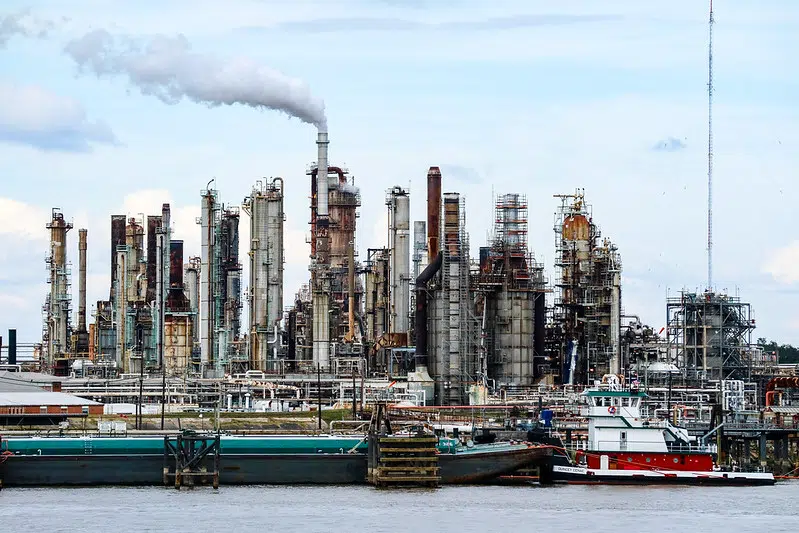
    An ExxonMobil refinery on the banks of the Mississippi River. Credit: Terekhova/Flickr (CC CREATIVE COMMONS INFO)

    Oil and gas companies and their top trade groups were aware for decades that carbon emissions contribute to climate change, according to a scathing new report from congressional investigators. Moreover, industry giants knew that many of the technologies they presented publicly as solutions to the climate crisis – such as algae-based biofuels and carbon capture and storage (CCS) – were neither as green nor as feasible as they promised, the study reveals.

    The Senate Budget Committee and Democrats on the House Committee on Oversight and Accountability published the report and related documents on April 30, three years after launching a joint investigation of Shell, Chevron, BP, ExxonMobil, and two leading industry trade groups..

    Fossil fuel obstructionism has evolved “from denial to duplicity,” said Senate Budget Committee Chairman Sheldon Whitehouse (D-RI), in a May 1 congressional hearing based on the report.

    Both the hearing and the report capture what Whitehouse described as “climate denial lite,” in which the industry pivots “to pretending it is taking climate change seriously, while secretly undermining its own publicly stated goals.”

    The investigation reveals that for ExxonMobil and other leading fossil fuel companies in the report, the perception of taking some sort of action on climate appears to have been as high a priority as actually taking action.

    For example, for years, Exxon sought to associate its brand with algae-based biofuels. In a 2019 video, the company claimed these biofuels “would one day power planes, propel ships, and fuel trucks – and cut their emissions in half.”

    Closeup of biofuel in a laboratory. Credit: Steve Jurvetson, CC BY 2.0 , via Wikimedia Commons

    Between 2009 and 2023, Exxon spent some $175 million on algae-related marketing like this video – almost half as much as the company spent working on the technology. (Exxon and other industry leaders largely stopped funding for algae biofuel research by 2023.)

    Even as the company publicly touted algae biofuels as a climate solution, the company knew the technology remained unproven – and, moreover, that Exxon was not investing nearly enough money if it were serious about developing algae as a viable technology.

    In an email made public by the committee, an Exxon employee noted that one of the company’s executives had “made comments about us getting too far out there on the original algae ads.”

    In an Exxon document released by House investigators with the header “Algae Biofuels Program Talking Points,” the company noted, “ExxonMobil’s analysis has concluded that final development and broad deployment of algae-based biofuels by the company would require future investments of billions of dollars” – orders of magnitude more than the $350 million that Exxon eventually spent.

    Repeating Patterns

    Congressional investigators identified a similar pattern in industry responses to a 2019 decision by Andrew Wheeler, then the head of the Environmental Protection Agency (EPA) under Donald Trump, to roll back a rule designed to reduce methane emissions.

    Internally, BP agreed with Wheeler’s decision. In a 2019 email published by the committee, one executive noted that Wheeler’s “legal theory … for rolling back direct regulation of methane” was “aligned with our thinking.” The American Petroleum Institute (API), the leading trade association for the oil and gas industry, which counts BP as a dues-paying member, lobbied for the rollback.

    In public, however, BP and other oil giants claimed to be disappointed by the Trump administration’s decision. David Lawler, then-chairman and president of BP America, said publicly that “direct federal regulation of methane emissions is essential.”

    “Time and again, the biggest oil and gas corporations say one thing for the purposes of public consumption, but do something completely different to protect their profits,” Jamie Raskin (D-MD), the top Democrat on the House Oversight Committee and one of the leaders of the investigation, said in his prepared testimony.

    “Company officials will admit the terrifying reality of their business model behind closed doors, but say something entirely different, false, and soothing to the public,” Raskin said.

    Yet, even as Raskin and Whitehouse were able to reveal damning new evidence of this corporate doublespeak, they pointed out that a complete public reckoning remained impossible, since the industry refused to fully engage with investigators.

    Denying Reality

    In a pattern that echoes the fossil fuel industry’s decades-long efforts to deny the reality of climate change and, more recently, to portray oil and gas companies as committed to solving the crisis, the four companies and two trade groups that received congressional subpoenas appear to have withheld meaningful information while simultaneously flooding the committees with “hundreds of thousands of generic and non-responsive documents,” Raskin said.

    Many documents submitted by the API were almost entirely redacted. The U.S. Chamber of Commerce produced only 24 documents that congressional investigators considered within the scope of the subpoena, including an invitation to a virtual meeting about “the future of natural gas infrastructure.”

    Fossil fuel interests “completely obstructed the committees’ investigation,” Raskin said in a video played at the hearing.

    During the hearing, this disinformation effort was assisted by congressional Republicans.

    Sen. Ron Johnson (R-WI) read into the record debunked right-wing claims that carbon dioxide is good for the climate because it is “plant food.”

    Source: Senate Budget Committee on X

    Sen. John Kennedy (R-LA) spent significant time alleging that Dr. Geoffrey Supran, a University of Miami climate disinformation expert who testified at the hearing, wrote tweets that Supran did not, in fact, write.

    “These are not my tweets, these are retweets,” Supran attempted to explain when he was finally shown the tweets, as Kennedy continued to speak over him.

    “I’d like to make very clear that this form of character assassination is characteristic of the propaganda techniques of fossil fuel interests,” Supran added.

    Supran’s point, however, was mostly obscured by Kennedy’s ongoing hectoring from the committee dais.

    In a more productive exchange, Sen. Tim Kaine (D-VA) asked Raskin about the argument Exxon put forth that the investigators’ subpoena was “designed to intrude on ExxonMobil’s First Amendment activities, including its constitutionally protected right to petition the government.”

    “That would obviously lead to the end of our civil and criminal discovery system, if the first amendment gave you the right not to turn over documents,” Raskin, a former constitutional law professor, replied.

    “When an objection is made – if it is an extremely unpersuasive, novel, imaginative, unsupported objection – you can always tell, there’s something they really don’t want you to see,” Kaine noted. “I can only imagine the extent of the iceberg under the water that you were not allowed to see.”

    The fossil fuel industry’s refusal to respond adequately to congressional subpoenas, while also flooding the committee with what Raskin’s testimony called a “paper blizzard” of some 125,000 “mass emails, newsletters, flyers, and otherwise meaningless fluff documents,” appeared designed to distract investigators and forestall potential legal action against companies and their executives.

    “There is certainly an adequate legal foundation for litigation against this industry,” Sharon Eubanks, the former head of the tobacco litigation team at the Department of Justice, and leader of the U.S. government’s racketeering case against Big Tobacco, told members of the committee.

    “Both industries lied to the public and regulators about what they knew about the harms of their products, and when they knew it.”

    Original article by Adam M. Lowenstein republished from DeSmog.

  • UK professor condemns own university over collaboration with oil giant

    Spread the love

    Original article by Ben Webster republished from Open Democracy under a Creative Commons Attribution-NonCommercial 4.0 International licence.

    Fawley oil refinery in Southampton

    Southampton University slammed after openDemocracy uncovered its involvement in Exxon’s ‘greenwashing’ project

    A senior professor has accused his own university of betraying its values by working with ExxonMobil on a project that has been condemned as greenwash.

    Ian Williams, professor in applied environmental science at the University of Southampton, made the allegations after openDemocracy revealed that Exxon had made misleading claims about capturing carbon at the UK’s biggest oil refinery at Fawley in Hampshire.

    We reported last month that Paul Greenwood, Exxon’s UK lead, had admitted that the oil giant would need a “magic wand” to deliver the project, which has no funding and no licence to store carbon.

    Exxon refers prominently to its collaboration with the University of Southampton in publications about the scheme.

    Williams suggested the university had been “fooled” into joining forces with the oil giant to launch the ‘Solent Cluster’, an industrial decarbonisation scheme focused on CCS.

    Lindsay-Marie Armstrong, the academic cluster lead at the University of Southampton, has joined senior Exxon executives at several events to promote the scheme, including a reception at the House of Commons in February.

    Williams hit out at the partnership during a lecture entitled “Working with the enemy: Why universities should not work with ‘Big Oil’” on 24 April, as part of the University of Southampton’s annual Green Week.

    He said Exxon had a long history of undermining climate science and funding groups that promoted climate scepticism, asking: “Why does the University of Southampton work with companies that operate against our values and deny our research data?”

    Williams pointed out the university’s collaboration with Exxon is at odds with two of its stated core values: its commitment to “embed environmental sustainability in everything we do” and its pledge to work with partners to “improve the environment”.

    He added that his decision to speak out means he is “not very popular in some quarters of the university” and might be branded a “rogue academic”.

    But Southampton University’s decision to partner with Exxon has also been criticised by many who study there. Heidi Wheatley, a second-year environmental science student, told openDemocracy that “the university’s relationship with the fossil fuel industry undermines my whole reasoning for studying this subject at this institution”.

    Wheatley added: “Students are already calling for the university to re-evaluate its relationship with the industry through its research activities and are petitioning the university to withdraw its multimillion-pound investments in fossil fuel companies. I implore the university to listen to its students and live up to its own strategic commitments to sustainability.”

    Williams quoted from openDemocracy’s investigation during his Green Week lecture, including our revelation that Exxon had so far refused to commit its own money to build the CCS plant and had instead focused investment on increasing diesel production at the refinery, spending £800m to produce an extra six million litres a day.

    He also quoted Doug Parr, chief scientist for Greenpeace UK, who told openDemocracy that Exxon’s CCS scheme “stands out as greenwashing”.

    openDemocracy revealed in November that fossil companies had ploughed more than £147m into British universities in seven years.

    Williams said: “Universities must be robust and healthy enough to resist commercial lobbying and greenwash. We must not be fooled again.”

    Urging Southampton University to extend its ban on working with tobacco companies to fossil fuel firms, he added: “Universities should say no to collaboration with fossil fuel companies, no to funding from or with fossil fuel companies, no to green washing, no to climate washing.”

    He also recommended the university commit to “not work[ing] on any form of greenwash project”, including “CCS” and “blue hydrogen” – a product made from natural gas, where most of the carbon dioxide from the gas is captured and stored. Blue hydrogen has come under fire from scientists, who have branded it a distraction from proven low-carbon alternatives to fossil fuels based on renewable energy.

    Williams also called on Southampton University to sign up to the People and Planet Fossil Free Campaign, which demands universities stop investing in and accepting funds from fossil fuel companies.

    A University of Southampton spokesperson did not respond to any of Williams’ recommendations when contacted by openDemocracy.

    Instead, they said: “Decarbonisation necessitates engagement with the sector that produces carbon and universities have a vital role to play in applying knowledge and expertise to address real areas of environmental concern.

    “This is what the Solent Cluster was set up and receives government funding for, with our role here to work alongside 120 organisations and businesses, including nine local governments and three other universities.

    “We uphold our value to embed environmental sustainability in everything that we do and require that all outputs from research undertaken with energy companies – and industry more widely – can be published, following our stated policies for responsible and open research.”

    An Exxon spokesperson said the company would give further detail on the CCS project “in due course”.

    Another recent openDemocracy investigation found that more than £281m of anonymous donations had poured into so-called Russell Group universities, including Southampton, since 2017. This prompted more than 120 academics, politicians and campaigners to sign an open letter calling for transparency over university funding in the UK.

    The universities’ secrecy over donations means any potential conflicts of interest and commercial influences, including those related to fossil fuel production, remain hidden.

    Some universities routinely invite fossil fuel companies to attend private meetings after donating millions of pounds.

    Original article by Ben Webster republished from Open Democracy under a Creative Commons Attribution-NonCommercial 4.0 International licence.

  • Taxing big fossil fuel firms ‘could raise $900bn in climate finance by 2030’

    Spread the love

    https://www.theguardian.com/environment/2024/apr/29/taxing-big-fossil-fuel-firms-raise-billions-climate-finance

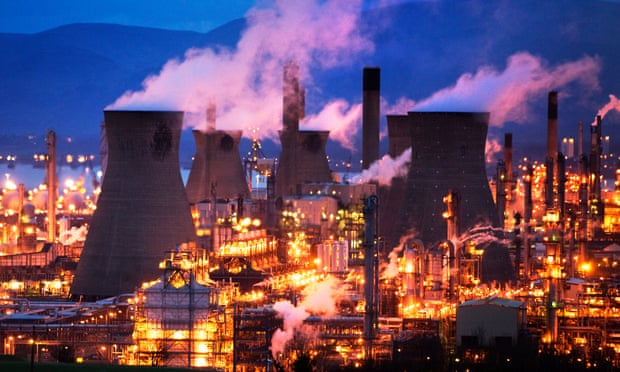
    Grangemouth oil refinery in Scotland. The report authors say the proposed levy could be easily administered within existing tax systems. Photograph: Murdo Macleod/The Guardian

    A new tax on fossil fuel companies based in the world’s richest countries could raise hundreds of billions of dollars to help the most vulnerable nations cope with the escalating climate crisis, according to a report.

    The Climate Damages Tax report, published on Monday, calculates that an additional tax on fossil fuel majors based in the wealthiest Organisation for Economic Co-operation and Development (OECD) countries could raise $720bn (£580bn) by the end of the decade.

    The authors say a new extraction levy could boost the loss and damage fund to help vulnerable countries cope with the worst effects of climate breakdown that was agreed at the Cop28 summit in Dubai – a hard-won victory by developing countries that they hope will signal a commitment by developed, polluting nations to provide financial support for some of the destruction already under way.

    David Hillman, the director of the Stamp Out Poverty campaign and co-author of the report, said it “demonstrates that the richest, most economically powerful countries, with the greatest historical responsibility for climate change, need look no further than their fossil fuel industries to collect tens of billions a year in extra income by taxing them far more rigorously. This is surely the fairest way to boost revenues for the loss and damage fund to ensure that it is sufficiently financed as to be fit for purpose.”

    …

    https://www.theguardian.com/environment/2024/apr/29/taxing-big-fossil-fuel-firms-raise-billions-climate-finance

  • Dozens of Climate Activists Arrested at Citibank Headquarters in New York City During Earth Week

    Spread the love

    https://insideclimatenews.org/news/25042024/citibank-headquarters-new-york-climate-activists-arrested/

    During a demonstration at Citibank’s headquarters in Manhattan on Wednesday, 33 protesters were taken into custody, including Rachel Rivera (center), a board member with New York Communities for Change. Credit: Keerti Gopal/Inside Climate News

    Campaigners pressuring Citibank say they see the bank as potentially movable on its funding of fossil fuels, citing the company’s commitments to sustainability.

    NEW YORK—Climate demonstrators blocked entrances to Citibank’s headquarters in Manhattan at the start of the workday on Wednesday and Thursday, part of a series of Earth Week actions pressuring the bank to end its financing of fossil fuels. On both mornings, it took the New York Police Department less than 10 minutes to start making arrests.

    Climate activists, citing Citibank as the second largest financier of fossil fuels in the world, are engaged in a multi-year campaign to pressure the bank to stop financing oil, gas and coal projects. The week’s protests follow a mock environmental justice hearing at a New York church on Monday, where advocates spoke about the health harms and human rights violations of Citibank-financed fossil fuel projects in Peru, Canada and domestically. The New York demonstration was timed alongside actions in Seoul, South Korea, Melbourne, Australia, Jakarta, Indonesia, Belfast, Northern Ireland, and Dallas that also targeted Citibank’s financing of coal, oil, natural gas and military projects.

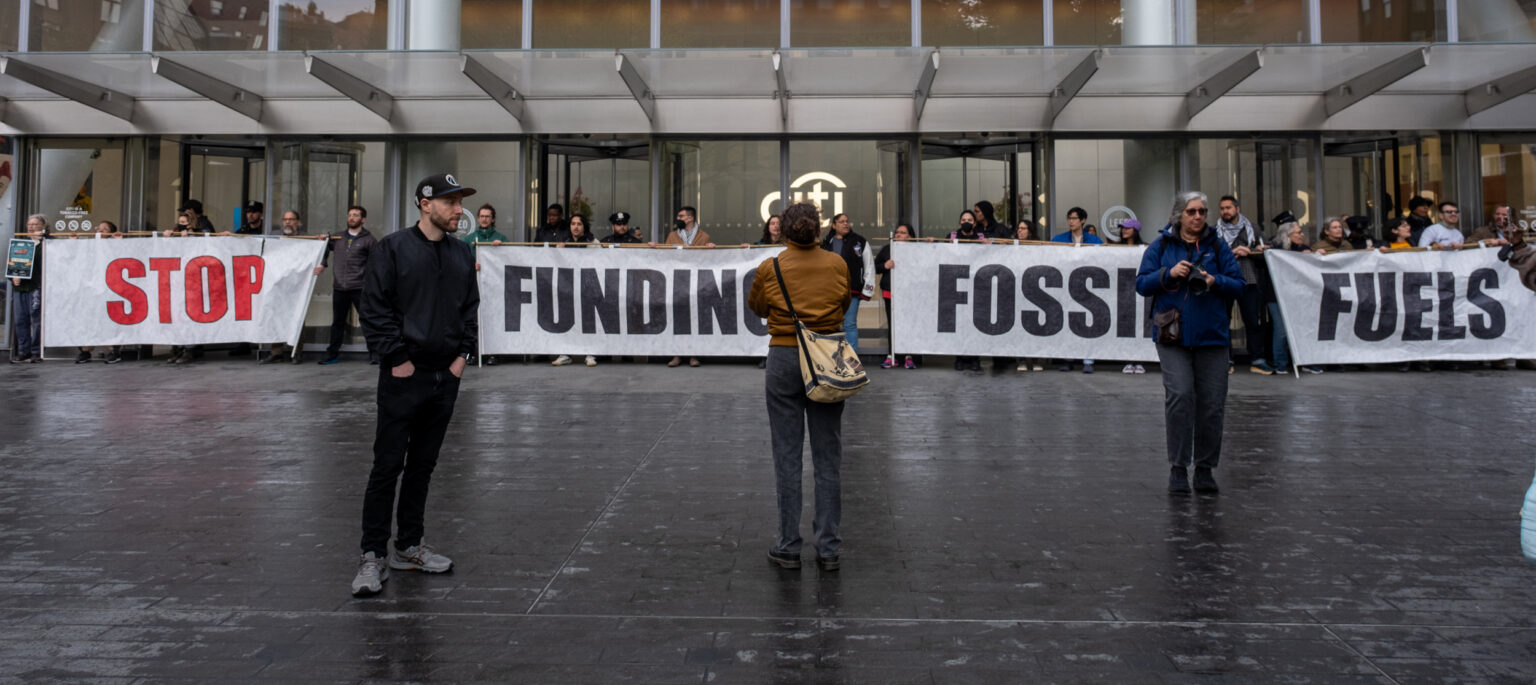
    At about 8:15 Wednesday morning, activists holding four large white banners that together read “Stop Funding Fossil Fuels” blocked the main entrance to Citibank’s headquarters while smaller groups of demonstrators stood outside other entrances to the building. Police began taking protesters into custody at 8:30 and arrested approximately 33 activists for disorderly conduct at Wednesday’s protest, according to activists and the office of NYPD’s deputy commissioner of public information. 

    Protesters barricaded the main entrance to Citibank’s headquarters in Manhattan on Wednesday morning. Credit: Keerti Gopal/Inside Climate News

    …

    Campaigners have said that, since 2016, Citibank has provided $332 billion in fossil fuel financing, and calculate that the bank has given $1.85 billion in financing to oil and gas operations in the Amazon since 2009 and $1.78 billion in financing to ConocoPhillips, the company behind the contentious Willow Project. 

    …

    https://insideclimatenews.org/news/25042024/citibank-headquarters-new-york-climate-activists-arrested/

  • It’s time to ban MPs from taking donations from fossil fuel firms

    Spread the love

    https://leftfootforward.org/2024/04/its-time-to-ban-mps-from-taking-donations-from-fossil-fuel-firms/ Many articles from LeftFootForward today.

    We need to build a firewall between politicians and the oil and gas firms driving the climate crisis.

    Richard Burgon is the Labour MP for Leeds East

    The same oil and gas giants behind the record energy bills that have forced so many into poverty have also brought us to the cliff edge of climate catastrophe.

    If we are to have a fighting chance of preventing the worst of the climate crisis, then we need to rapidly cut fossil fuel use. Key to that is breaking the vast power that oil and gas companies have over our politics.

    That’s why this week I will present a Bill in the House of Commons to ban MPs from receiving funding or any other benefit from oil and gas companies.

    My Private Members Bill would stop MPs from taking any second jobs with, or receiving any donations, gifts, hospitality or benefits-in-kind from, any company that makes more than 50% of its annual revenue from oil or gas.

    It would also force the Government to end investments by the Parliamentary Contributory Pension Fund in any oil and gas companies.

    The aim of my Bill is simple: to build a firewall between our political decision-makers and the oil and gas corporations that have knowingly caused the climate crisis.

    For decades, oil and gas giants used their vast financial power to confuse and undermine the science about the role of fossil fuels in driving climate change. More recently, their focus has moved on throwing huge sums at delaying, blocking and weakening global climate action.

    Fossil fuel money also pollutes British politics. The Tory Party received £3.5m from donors with fossil fuel, polluter and climate denial links in 2022 according to an analysis of Electoral Commission records by DeSmog, an investigative website focused on global warming misinformation campaigns.

    …

    https://leftfootforward.org/2024/04/its-time-to-ban-mps-from-taking-donations-from-fossil-fuel-firms/

    dizzy: Despite this article having been written by a Labour MP it should not be assumed that the UK Labour Party will be any different from the Conservatives on the climate crisis or fossil fuel industry.